


32,99 €
Mehr erfahren.
- Herausgeber: John Wiley & Sons
- Kategorie: Bildung
- Sprache: Englisch
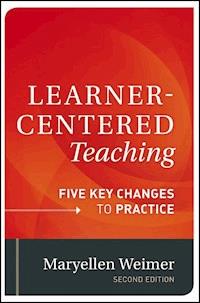
In this second edition of the classic work Learner-Centered Teaching, Maryellen Weimer--one of the nation's most highly regarded authorities on effective college teaching--offers a comprehensive introduction to the topic of learner-centered teaching in the college and university classroom. This thoroughly revised and updated edition includes the most current examples of practice in action from a variety of disciplines and contains new information on the research support for learner-centered approaches. Weimer also includes a more in-depth discussion of how students' developmental issues influence the effectiveness of learner-centered teaching. Learner-centered teaching focuses attention on what the student is learning, how the student is learning, the conditions under which the student is learning, whether the student is retaining and applying the learning, and how current learning positions the student for future learning. To help educators accomplish the goals of learner-centered teaching, this important book presents the meaning, practice, and ramifications of the learner-centered approach and how this approach transforms the college classroom environment. Learner-Centered Teaching shows how to tie teaching and curriculum to the process and objectives of learning rather than to the content delivery alone. The book also offers well-researched advice for educators who want to transition to a learner-centered approach in their classrooms and identifies the steps to take to put into place learner-centered policies and practices. Learner-Centered Teaching provides a theoretical foundation for the learner-centered approach and outlines a positive way to improve teaching.
Sie lesen das E-Book in den Legimi-Apps auf:
Seitenzahl: 490
Veröffentlichungsjahr: 2013
Ähnliche

















Table of Contents
TITLE PAGE
COPYRIGHT PAGE
DEDICATION
PREFACE TO THE SECOND EDITION
WHAT MAKES THE SECOND EDITION BETTER
CONTENT OVERVIEW
AUDIENCE
ACKNOWLEDGMENTS
THE AUTHOR
PART ONE: FOUNDATIONS OF THE LEARNER-CENTERED APPROACH
CHAPTER ONE: LEARNER-CENTERED TEACHING: ROOTS AND ORIGINS
A PERSONAL HISTORY
THE THEORIES BEHIND LEARNER-CENTERED TEACHING
CHAPTER TWO: RESEARCH: EVIDENCE THAT LEARNER-CENTERED APPROACHES WORK
RESEARCH UPDATES
NOTEWORTHY REVIEWS OF RESEARCH
DISCIPLINE-BASED RESEARCH IN SUPPORT OF LEARNER-CENTERED APPROACHES
STUDIES OF INDIVIDUAL LEARNER-CENTERED COURSES
WHAT DO STUDENTS SAY ABOUT LEARNER-CENTERED APPROACHES?
CONCLUSION
PART TWO: THE FIVE KEY CHANGES TO PRACTICE
CHAPTER THREE: THE ROLE OF THE TEACHER
WHAT NEEDS TO CHANGE?
WHAT HASN’T CHANGED?
WHY HASN’T TEACHING BECOME MORE LEARNER-CENTERED?
FACILITATIVE TEACHING: PRINCIPLES THAT GUIDE ITS IMPLEMENTATION
INTERESTING IMPLEMENTATION ISSUES
CHAPTER FOUR: THE BALANCE OF POWER
WHAT NEEDS TO CHANGE AND HASN’T: TEACHER CONTROL
CHANGING THE BALANCE OF POWER
REDISTRIBUTING POWER: EXAMPLES
INTERESTING IMPLEMENTATION ISSUES
CHAPTER FIVE: THE FUNCTION OF CONTENT
WHAT NEEDS TO CHANGE?
WHY IT NEEDS TO CHANGE
WHY IT ISN’T CHANGING
HOW DOES CONTENT FUNCTION IN A LEARNER-CENTERED COURSE?
DEVELOPING LEARNING SKILLS: GUIDELINES
STRATEGIES THAT DEVELOP LEARNING SKILLS
IMPLEMENTATION ISSUES
CHAPTER SIX: THE RESPONSIBILITY FOR LEARNING
WHAT NEEDS TO CHANGE AND STILL HASN’T
CLASSROOM CLIMATES THAT PROMOTE STUDENT RESPONSIBILITY FOR LEARNING
STUDENT INVOLVEMENT IN CLASSROOM CLIMATE
IMPLEMENTATION ISSUES
CHAPTER SEVEN: THE PURPOSE AND PROCESSES OF EVALUATION
WHAT NEEDS TO CHANGE AND HASN’T
HOW THE PURPOSE AND PROCESSES OF EVALUATION CHANGE
USING EXAMS, ASSIGNMENTS, AND ACTIVITIES TO PROMOTE LEARNING
DEVELOPING SELF- AND PEER-ASSESSMENT SKILLS
IMPLEMENTATION ISSUES
PART THREE: IMPLEMENTING THE LEARNER-CENTERED APPROACH
CHAPTER EIGHT: RESPONDING TO RESISTANCE
WHY DO STUDENTS RESIST?
RECOGNIZING RESISTANCE
OVERCOMING RESISTANCE
FACULTY RESISTANCE
CHAPTER NINE: TAKING A DEVELOPMENTAL APPROACH
THE DEVELOPMENTAL PROCESS: WHAT WE KNOW
DEVELOPMENTAL DESIGN FOR ASSIGNMENTS AND ACTIVITIES
DEVELOPMENTAL CURRICULAR DESIGN
GOOD PLACES TO BEGIN
THE DEVELOPMENTAL ISSUES FOR FACULTY
APPENDIX ONE: SYLLABUS AND LEARNING LOG ENTRIES FOR SPEECH COMMUNICATIONS 100A
TEXT
COURSE ASSIGNMENTS
EXAMS
PRESENTATIONS
SMALL-GROUP EXPERIENCES
LEARNING LOG
SPEECH CRITIQUES
PARTICIPATION
BONUS POINTS
GRADES
LEARNING LOG ENTRIES
APPENDIX TWO: RESOURCES THAT DEVELOP LEARNING SKILLS
SUCCESSFUL STUDENTS: GUIDELINES AND THOUGHTS FOR ACADEMIC SUCCESS
TEN COMMANDMENTS FOR EFFECTIVE STUDY SKILLS
DISCUSSION GUIDELINES FOR STUDENTS
CONSIDER A STUDY GROUP
REFERENCES
NAME INDEX
SUBJECT INDEX
Cover illustration: Viktoriya Sukhanova/iStockphoto
Jacket design: Michael Cook
Copyright © 2013 by John Wiley & Sons, Inc. All rights reserved.
Published by Jossey-Bass
A Wiley Imprint
One Montgomery Street, Suite 1200, San Francisco, CA 94104-4594—www.josseybass.com
No part of this publication may be reproduced, stored in a retrieval system, or transmitted in any form or by any means, electronic, mechanical, photocopying, recording, scanning, or otherwise, except as permitted under Section 107 or 108 of the 1976 United States Copyright Act, without either the prior written permission of the publisher, or authorization through payment of the appropriate per-copy fee to the Copyright Clearance Center, Inc., 222 Rosewood Drive, Danvers, MA 01923, 978-750-8400, fax 978-646-8600, or on the Web at www.copyright.com. Requests to the publisher for permission should be addressed to the Permissions Department, John Wiley & Sons, Inc., 111 River Street, Hoboken, NJ 07030, 201-748-6011, fax 201-748-6008, or online at www.wiley.com/go/permissions.
Limit of Liability/Disclaimer of Warranty: While the publisher and author have used their best efforts in preparing this book, they make no representations or warranties with respect to the accuracy or completeness of the contents of this book and specifically disclaim any implied warranties of merchantability or fitness for a particular purpose. No warranty may be created or extended by sales representatives or written sales materials. The advice and strategies contained herein may not be suitable for your situation. You should consult with a professional where appropriate. Neither the publisher nor author shall be liable for any loss of profit or any other commercial damages, including but not limited to special, incidental, consequential, or other damages. Readers should be aware that Internet Web sites offered as citations and/or sources for further information may have changed or disappeared between the time this was written and when it is read.
Jossey-Bass books and products are available through most bookstores. To contact Jossey-Bass directly call our Customer Care Department within the U.S. at 800-956-7739, outside the U.S. at 317-572-3986, or fax 317-572-4002.
Wiley publishes in a variety of print and electronic formats and by print-on-demand. Some material included with standard print versions of this book may not be included in e-books or in print-on-demand. If this book refers to media such as a CD or DVD that is not included in the version you purchased, you may download this material at http://booksupport.wiley.com. For more information about Wiley products, visit www.wiley.com.
Library of Congress Cataloging-in-Publication Data
Weimer, Maryellen, 1947–
Learner-centered teaching : five key changes to practice / Maryellen Weimer.—Second edition.
pages cm
Includes bibliographical references and index.
ISBN 978-1-118-11928-0 (hardback); ISBN 978-1-118-41903-8 (ebk.); ISBN 978-1-118-41616-7 (ebk.); ISBN 978-1-118-43369-0 (ebk.)
1. College teaching. 2. Learning, Psychology of. I. Title.
LB2331.W39 2013
378.1'2—dc23
2012041888
Honoring the memory of
Barbara Robertson Friz
October 10, 1909–October 20, 2009
PREFACE TO THE SECOND EDITION
Welcome to the second edition of Learner-Centered Teaching: Five Key Changes to Practice. If you haven’t read the first edition or haven’t read it for a while, let me start by explaining why I’ve opted for the learner-centered name. A variety of terms are being used to describe these approaches to teaching: learning-centered, student-centered learning, student-centered teaching, or just plain student-centered, usually as contrasted with teacher-centered.
I think it’s important to keep the focus on the learners, our students. However, when student gets incorporated in the description there’s a tendency to end up in heated discussions about students as customers, and should educators be trying to satisfy them, and are student-customers always right, and is education a product, and if not, what do those tuition dollars buy? Those discussions have merit and should be occurring, but they are not what learner-centered teaching is about. The focus needs to stay on learners and the kind of instructional strategies that support their efforts to learn.
Why not use the learning-centered label, then? Learning is an abstraction. It’s not a word that points us directly toward its meaning. Faculty belong to a culture that thrives on theoretical, abstract ideas. With the focus on learning, we are likely to find ourselves discussing more and better learning at some abstract level. We don’t need learning connected to teaching via some intellectually captivating conceptual framework; we need instructional policies and practices that directly affect how much and how well students learn. What we call something will guide how we think about it—so what something is called matters. Calling this learner-centered teaching keeps us focused on what this way of teaching is about.
WHAT MAKES THE SECOND EDITION BETTER
What makes this edition better? A variety of things do, starting with arguments that are tighter and clearer. Some of these changes arise from the fact that extensive lecture-based teaching is becoming increasingly difficult to defend. There is more research documenting that this method encourages superficial learning, along with an inability to retain and apply what has been learned. And there is growing evidence that learner-centered approaches produce a different kind of learning, develop learning skills, and move students in the direction of autonomy and independence as learners.
This edition is stronger because it incorporates more of the experiential knowledge base. That addition is the result of my ongoing conversations with faculty about learner-centered approaches—how they are using them, what happens when they do, what unresolved issues have emerged, and what recommendations they would offer others. Their views and experiences have deepened my understanding of learner-centered teaching. Improvements in the experiential knowledge base are also the result of the prolific number of pedagogical articles that report on the design, use, and assessment of learner-centered approaches. These ways of teaching are being used across the disciplinary landscape by faculty at all kinds of institutions teaching all kinds of students.
I believe this edition is stronger because it tackles with more vigor what hasn’t changed since the 2002 edition, and, regrettably, that includes almost everything targeted for change in the first edition. Evidence in Chapter Two, on research, and in the five chapters on key changes verifies that despite more widespread use of learner-centered approaches, instruction overall continues to be mostly teacher centered, faculty are still making most of the learning decisions for students, content still centers the instructional universe, teachers are still doing too many of the learning tasks that students should be doing for themselves, and students are still not regularly encouraged to assess their own work or that of their peers (which is different from grading it).
That’s the stand-back, view-from-across-the-room picture of instruction in higher education. Up close, there are signs of change. “Learner-centered” has become something institutions aspire to be—it’s trendy now and along with that come the proverbial blessings and curses. As the conversation about being learner-centered continues, more people hear about it, and after consideration they try out some of its approaches. That’s on the blessing side. One of the curses of this increased “popularity” involves a definitional looseness resulting from widespread use of the term. At this point, the learning-centered label is close to synonymous with active learning and is applied to almost any strategy that engages students and mentions learning. I think this edition is stronger because it seeks to reclaim and advance definitional clarity. Learner-centered teaching has characteristics that make it unique and that differentiate it from active learning and other forms of student engagement.
I have enjoyed revising, rewriting, and rethinking the content of this book more than I expected I would. It is exciting to see an orientation to teaching evolve in ways that make it more substantive and intellectually viable. It is also satisfying to see how much we have learned and challenging to realize how much we still don’t know and need to learn.
CONTENT OVERVIEW
The details of what’s new in this edition are best described in an overview of the chapters ahead. Content in Chapters One and Two was drawn from Chapter One in the first edition. Chapter One now contains the story of how I became a learner-centered teacher and a description of where these ideas originated and on what they are based.
Chapter Two is essentially a new chapter. It introduces a sample of the research on and research related to learner-centered approaches. A significant amount of research has been completed since 2002. The chapter samples what’s been done; it does not comprehensively review the literature. As discussed in the chapter, comprehensive reviews of this literature base present sizable logistical challenges. Work on learner-centered approaches is being done across a wide range of disciplines. Tracking everything down is a daunting task even with search technologies. Equally challenging is integrating and comparing results. Researchers define learner-centered differently; some don’t use any of the terms to describe treatments that most would call learner-centered. They test hypotheses using many methodological approaches. The work includes qualitative and quantitative analyses. Research on learner-centered teaching is not a systematic progression with one set of findings leading to the next set of research questions. Chapter Two looks more like a crazy quilt than a patterned design. Nonetheless, I think most will find the research sampled there constitutes an impressive array of evidence. It was the prevalence of new research and its intriguing array of findings that finally persuaded me to prepare a second edition.
If I could pick the chapter I would most like those interested in learner-centered teaching to read, it would be Chapter Two. Faculty have a long history of avoiding educational research, and they continue that research avoidance by not reading the wave of discipline-based pedagogical scholarship spawned by the scholarship of teaching movement. This is to their disadvantage and the detriment of instructional practice. What we do in the classroom can be verified (maybe even vindicated) by quantitative and qualitative analyses. Research adds validity to what have been asserted to be “best practices.” Knowing what we know, in this case about learner-centered teaching, confirms what we propose and values what we do.
The heart of the book remains, as it was in the first edition, the Five Key Changes to Practice chapters in Part Two. These are the areas of my practice that changed when I moved from a teacher-oriented approach to a learner-centered one. This way of organizing learner-centered changes has been used by others, and I use it regularly when I speak about learner-centered teaching—the structure seems to work, so I have retained it.
Each of those chapters has been significantly revised. Early in each I explore what has and hasn’t changed since 2002. Unfortunately, most of the attitudes that prevent learner-centered changes still prevail. What has changed is the number of new strategies, assignments, activities, and approaches that teachers are using to realize the changes explored in these chapters. Each chapter ends with an Implementation Issues section. These sections incorporate some of the content from Chapter Nine in the first edition along with new ideas and information.
The book ends with a chapter on resistance (both that displayed by students and that expressed by colleagues) and a more detailed chapter on the developmental issues involving the design and sequence of activities and assignments that advance learner development in a planned and systematic way. It suggests good places to begin the transformation of students from passive, dependent learners to autonomous, self-directed ones. The chapter also addresses developmental issues experienced by faculty.
This edition does not contain a chapter on Making Learner-Centered Teaching Work. Some of that content is now incorporated in the Implementation Issues section of each of the Five Key Changes to Practice chapters. Since 2002 I have written a book (Weimer, 2010) devoted to the ongoing growth and development of college teachers, and much of its content explores the process of implementing instructional changes. Treatment of these topics in the new book is much more thorough and well documented than it was in the previous edition.
Most of the appendixes remain in the new edition. Fifty percent of the references listed at the end of the book have been published since the first edition came out. I hope the highlights of them that I have incorporated in this book will motivate readers to consult these excellent sources.
One final note: I revised this edition after retirement. I’m still teaching—at least that’s how I think of my ongoing work with faculty—but I’m not teaching undergraduates. When I wrote the first edition, I was teaching undergraduates, so descriptions of what I did in the classroom were in present tense. I’ve kept them that way in this edition.
AUDIENCE
Like the first edition, this book is for faculty. However, it’s not a book exclusively for learner-centered teaching converts. It’s also a book for faculty who think learner-centered ideas might be of interest, but they have questions and concerns. Are these ways of teaching that retain high standards and intellectual rigor? Are they ways of teaching that pander to students and encourage the sense of entitlement that so compromises the educational enterprise? Does this way of teaching diminish the role and importance of teachers? The book offers answers to these questions. It is a book for those interested in learning about these instructional approaches. It’s even a book for those who may not think they’re interested in learner-centered teaching but who are concerned about students—their passivity, lack of motivation, disinterest in learning. It’s for teachers who wonder if there might be better ways to connect students with the power and joy of learning.
I suspect, though, that most readers will have an interest in the topic. A lot will have tried some of these approaches and are reading in order to move their practice forward. I’ve tried to respond to that audience by including many new assignments, activities, and approaches in this edition. If you’ve read the first edition and wonder if it’s worth your time to read the second, the author is probably not the best person to ask. I will say, though, that my goal was to write a significantly revised second edition—one that merited a reread.
Readers interested in the topic will also include some beginners—something all of us once were. This is a book for beginners, as well. It presents lots of experiences of other beginners—you can learn from us, including from our mistakes—and it offers advice on getting started, including identification of specific strategies, assignments, and activities that are good places to launch learner-centered teaching.
ACKNOWLEDGMENTS
First off, a heartfelt thanks to the many faculty and administrators who purchased copies of the first edition. It gives this author great pleasure to meet readers and see copies of the book that have obviously been read. I hope this book continues and furthers interest in the topic.
This edition took much longer to prepare than I anticipated. I kept finding new material and wanting to significantly rewrite the old. Higher Education Editor David Brightman at Jossey-Bass was patient and constructively persistent. As the years of our collaboration lengthen, my respect for and appreciation of him only grow. Aneesa Davenport, also at Jossey-Bass, is an organizational and detail wizard whose commitment to book projects expedites their preparation. In addition to these and other impressive professional skills, she is a person of grace and charm.
Husband Michael and brother Mark are my fine family support. Mark provided careful help with the references. I dedicated the 2002 edition to my much-loved and greatly admired Aunt Barbara. She died ten days past her one-hundredth birthday, and this edition honors her memory. Her mind left before her body, which was a tragedy I had not anticipated. But my book was beside her bed when she died. Her caregivers told me she carried it with her even when she could no longer say why.
January 2013Maryellen WeimerMarsh Creek, Pennsylvania
THE AUTHOR
In 2007 Maryellen Weimer retired from Penn State as Professor Emeritus of Teaching and Learning. For the last thirteen years of her career at Penn State, she taught communication courses, first-year seminars, and other courses for business students at one of Penn State’s regional campus colleges. In 2005 she won Penn State’s Milton S. Eisenhower award for distinguished teaching.
Before returning to full-time teaching, Weimer was the associate director of the National Center on Postsecondary Teaching, Learning and Assessment, a five-year, $5.9 million, U.S. Department of Education research and development center. Prior to that, she spent ten years as director of Penn State’s Instructional Development Program.
Weimer has numerous publications—including articles in refereed journals, book chapters, and books reviews—and service on the editorial boards of journals. She has consulted with over five hundred colleges and universities on instructional issues. She regularly keynotes national meetings and regional conferences.
Since 1987, she has edited The Teaching Professor, a monthly newsletter on college teaching with 15,000 subscribers. She has edited or authored ten books, including a 1990 book on faculty development, a 1993 book on teaching for new faculty, and a 1995 anthology edited with Robert Menges, Teaching on Solid Ground. She was primary author of a Kendall-Hunt publication, Teaching Tools, a collection of collaborative, active, and inquiry-based approaches to be used in conjunction with Biological Perspectives, an NSF-funded introductory biology text created by Biological Sciences Curriculum Studies (BSCS). Jossey-Bass published her book Learner-Centered Teaching: Five Key Changes to Practice in 2002, her next book, Enhancing Scholarly Work on Teaching and Learning, in 2006, and a 2010 book, Inspired College Teaching: A Career-Long Resource for Professional Growth. Her blog, Teaching Professor (found at www.facultyfocus.com), has more than 75,000 subscribers.
PART ONEFOUNDATIONS OF THE LEARNER-CENTERED APPROACH
CHAPTER ONE
LEARNER-CENTERED TEACHING: ROOTS AND ORIGINS
This chapter tells two stories. It recounts how I became a learner-centered teacher and it shares a bit of the origin and history of learner-centered ideas. The story of learner-centered teaching begins long before my efforts to focus on student learning. The approaches I started using rest on a collection of educational theories—some comparatively new; others established and venerable. These theories help explain why and how this way of teaching promotes learning. Knowing a bit about them makes it easier to decide whether this philosophy of teaching fits currently held beliefs or whether teaching using these approaches would represent a change in educational philosophy. The theoretical framework also offers criteria that can be used to assess the effectiveness of what has been implemented. Finally, knowing about the theories makes it easier to trace the origin of the various lines of research written about in Chapter Two.
The interplay between my story and these theories is interesting. I didn’t start out aspiring to become a learner-centered teacher. I didn’t even realize the changes I was implementing could be called that. Like many midcareer faculty, I was looking for new ideas—partly out of my need for growth and change, and partly because a lot of what I saw in classrooms seemed so ineffective. I opted for ideas I liked and ones that I thought I could make work. It took some time before I saw that the approaches I was using shared common elements, and it took even longer before I discovered that what I was doing rested on strong theoretical foundations. Once I discovered these things, I felt vindicated. What was happening in my classroom wasn’t some sort of fluke. Students were responding as they did for good reasons—but that’s not where my story begins.
The next section contains my story. It includes examples that illustrate learner-centered approaches, and they give an early sense of how learner-centered teaching might be defined. I also highlight each of the five areas in which I implemented changes. These areas are the subject of the five chapters in Part Two and are really the heart of my exploration of learner-centered teaching. Discussion of the theories follows my story, and examples are included in that discussion as well. They build some context around the theories and make it a bit easier to assemble a learner-centered framework out of the various theories.
A PERSONAL HISTORY
Like most important life lessons, what I have come to believe about learner-centered teaching grew out of a serendipitous confluence of events and experiences. The ones I consider most important are so overlapping and intertwined that a stream-of-consciousness recounting would more accurately describe how they occurred. However, in the interest of coherence, I will recount each of them separately.
EVENTS AND EXPERIENCES: WHAT MOTIVATED THE CHANGE
My transformation began in 1994, when, after a number of years working in faculty development, on educational research projects, and occasionally teaching upper-division and graduate courses, I returned to the classroom to teach entry-level, required courses. It was one of those midlife career moves motivated by the realization that the time for doing things no longer appeared limitless. As I took stock and tried to decide what I wanted to do with the rest of my career, it became clear that the most important and personally satisfying work I had done was in the classroom. I decided to return, finishing out my career as it had started, teaching undergraduates.
I went back wanting to teach differently, even though I wasn’t terribly clear in my thinking about what was wrong with how I taught or how I wanted change. I thought more about students and the fact that their lack of confidence prevented them from doing well in the basic communication courses I taught. They needed to find their way past self-doubt, awkwardness, and the fear of failure to a place where they could ask a question in class, make a contribution in a group, and speak coherently in front of peers. It came to me that I might address the problem by giving the students a greater sense of control. What if I presented them with some choices and let them make some of the decisions about their learning?
My first semester back in the classroom I decided to try this approach in my 8 a.m. section. I designed a beginning public speaking course that had only one required assignment: the dreaded speech. They had to give at least one. The rest of the syllabus presented them with a cafeteria of assignment options: a learning log; group projects of various sorts; credit for participation and the analysis of it; critiques of peers; conducting an interview, being interviewed, or both; and conventional multiple-choice exams. A version of this syllabus appears in Appendix One. As can be seen there, each assignment had a designated point value, and it was not a case of do-it-and-get-full-credit. Students could opt to complete as many or as few assignments as they wished, depending on the course grade they desired. Each assignment had a due date, and once the date passed, that assignment could not be turned in.
The first couple of days, students were totally confused. I remember a conversation with one about whether the exams were required. “They must be required. If the tests are optional, no one will take them.” “Sure they will. Students need points to pass the class.” “But what if I don’t take them?” “Fine—do other assignments and get your points that way.” “But what do I do on exam days?” “You sleep in!” Several students said they couldn’t decide which assignments they should do and asked me to make the choices for them. Even more wanted me to approve the collection of assignments they had selected.
Once the confusion passed, what happened the rest of the semester took me by surprise. I had no attendance policy, but I got better attendance than in any other class I could remember. More students (not all, but most) started to work hard early in the course, and some students determinedly announced that they would do every assignment if that was what it took to get enough points for an A. I was stunned by this change of attitude—students willing to work and without complaints? The high energy level and sense of optimism I usually saw in students those first few class days continued well into the course, and even as the stress of the semester started showing, this class was different. These students were more engaged. They routinely asked questions, sustained discussion longer and in the end disagreed with me and other students far more than I remembered other beginning students doing. No, it wasn’t instructional nirvana—there were still missed deadlines, shoddy work, and poor choices made about learning, but these things happened less often. I was definitely onto something and decided I would continue to experiment with the course.
About this time, I was asked to review a Brookfield (1995) manuscript under contract with Jossey-Bass and subsequently published as Becoming a Critically Reflective Teacher. I reference it in almost everything else I write. Few things I have read before or since have so dramatically influenced my pedagogical thinking. First off, I discovered how much about one’s own teaching could be learned through critical reflective practice. Brookfield describes methods that allow teachers to dissect instructional practices so that the assumptions on which they rest can be clearly seen. Since then I’ve learned much more from other adult educators who study, describe, and promote both this kind of critical reflection and the transformative learning it often produces (Mezirow and Associates, 2000; Cranton, 2006). Transformative learning is one of the theories I’ll be discussing subsequently in this book. But it was Brookfield who first enabled me to hold a mirror up to my teaching. The instructional image I saw was not what I expected. It was far less flattering.
I saw an authoritarian, controlling teacher who directed virtually everything that happened in the classroom. I made all the decisions and did so with little regard as to their impact on student learning and motivation. Almost totally focused on teaching, I had created a classroom environment that showcased my pedagogical prowess. Student learning just happened automatically, an outcome of my devotion to excellent teaching. It didn’t matter where I turned the mirror, I never saw anyone other than the teacher.
Before Brookfield, I fussed around with some interesting new strategies; after Brookfield, I tried to transform the teacher. Shaping up the course turned out to be a whole lot easier than “fixing” my very teacher-centered methods. Flachmann (1994) captures exactly how I felt then:
I’m a little embarrassed to tell you that I used to want credit for having all the intelligent insights in my classroom. I worked hard to learn these facts … I secretly wanted my students to look at me with reverence. I now believe that the opposite effect should occur—that the oracle, the locus and ownership of knowledge, should reside in each student and our principal goal as teachers must be to help our students discover the most important and enduring answers to life’s problems within themselves. Only then can they truly possess the knowledge that we are paid to teach them [p. 2].
Another wise teacher makes the point this way: “I’ve come to realize that it is not so much what students know but what they can do. Likewise, teaching is not about what I know but what I enable others to do” (Phelps, 2008, p. 2).
Another event during this period also strongly influenced my thinking. For years my husband, Michael, had wanted to build a wooden boat. He collected books, bought plans, subscribed to Wooden Boat magazine and faithfully watched Classic Boat on TV when it was on Speedvision. Then we bought a piece of property on an island. We planned to build a house there and needed a boat big enough to haul supplies to the site. Armed with a set of blueprints (selected after having reviewed hundreds), Michael started building the hull of a wooden boat. New words crept into his vocabulary. Over supper, he chatted on about battens, chines, sheer clamps, the kellson, and garboard. Next, the hull was covered with marine plywood, not something easily obtained in landlocked central Pennsylvania. The whole neighborhood showed up to help turn the hull. Then it was time to construct the floor, design the cabin, and rebuild the motor. Every step was accompanied with a whole new set of tasks to learn. During the evenings he watched videotapes demonstrating fiberglassing techniques. Every day some new marine supply catalog showed up in the mailbox.
After hours of work that extended across months, Noah’s Lark emerged, a twenty-four-foot, lobster-style wooden boat. She had a sleek white hull and dashing yellow stripe, a beautifully finished ash cabin, and she was powered by a fully rebuilt but not terribly fuel-efficient MerCruiser. She rode the water gracefully, rose to plane with style, and made her way through white caps and choppy water with steady certainty. She reliably towed barge loads of building supplies, always turning heads at the public launch. The bold asked, “Where did you get that boat?” “Built her,” my husband replied, unable to hide the pride in his voice.
It takes far more time and money to build a wooden boat than I imagined. Beyond those surprises, I marveled at the confidence my husband brought to the task. Where did it come from? On what was it based? He had never built a boat—houses, yes; furniture, yes; but not a boat. As the project progressed and charges on the credit card mounted, I felt it financially prudent to ask, pretty much on a monthly basis, “Do you know what you’re doing?” “Is this really going to be a boat we can use?” His answer was always the same, “No, I don’t know what I’m doing, but I’m learning. Of course it will turn out. We need a boat, don’t we?”
There was an irony I didn’t miss—actually, it stuck in my craw. Michael is a college graduate. He acquired a degree in industrial engineering in his early thirties, and college was not the experience that had developed his confidence as a learner. In fact, quite the opposite had occurred. He graduated from college feeling that he just made it, keenly disappointed with what he had learned and stressed by the conditions under which he was expected to learn. He credits experiences with his father for developing his confidence. It irritated me that his college experience had undermined his beliefs about what he could do. College should be the time and the place for students to develop the learning skills on which that confidence rests.
While ruminating, I tried to imagine which of my students might tackle a complicated learning project about which they knew little. No one came to mind. I saw nothing in my students or myself, for that matter, that resembled the confidence and perseverance with which my husband confronted his need to learn how to build a wooden boat. That led me to think about what kind of classroom experiences would develop this self-confidence and these sophisticated learning skills. I couldn’t answer that question right off, but I did become persuaded that one of my tasks as a teacher was developing learning skills and the confidence to use them.
Setting that goal changed my thinking about many aspects of instruction. I began to see course content in a different light. It moved from being the end to being the means. It went from being something I covered to something I used to develop learning skills and an awareness of learning processes. I stopped assuming students were learning how to generate examples, ask questions, think critically, and perform a host of other skills by seeing me do them. If they were going to develop those skills, they needed to be the ones practicing them, not me. I saw evaluation as something more than the mechanism that generated grades. It became a potent venue for promoting learning and developing self- and peer-assessment skills.
As my teaching transformation continued moving in the learner-centered direction, I realized how little I actually knew about learning. Brookfield’s well-referenced book introduced me to all sorts of new sources. At the same time, interest in learning swept across higher education. For a while there, it almost felt as if learning had just been discovered—or maybe rediscovered. There were all sorts of things to read, and I read them in an unsystematic way, just allowing one source to lead to another. As I learned more about learning, I discovered that the new approaches I was adopting rested on a variety of educational theories, many supported by research.
ORGANIZING WHAT I LEARNED
I didn’t try to organize the hodgepodge of learner-centered strategies and approaches I was implementing until I started working on the first edition of this book. It was then I saw that those changes could be grouped around five key aspects of instructional practice. Those five areas have continued to structure my thinking about learner-centered teaching. In both the first edition and this one, there is one chapter about each area. I consider those five chapters the heart of my work on learner-centered teaching.
Since they are so central, these aspects of instruction merit an introduction now. I start with how learner-centered teaching changes the role of the teacher. I didn’t start with this chapter in the first edition, but I do in this edition for two reasons. It’s a good place to start because it makes sense to faculty. Teaching that promotes learning is not teaching that endlessly tells students what they should do and what they should know. Rather, it promotes learning by facilitating the acquisition of knowledge. The hard and messy work of learning can be done only by students. And I start here because changing the role of the teacher is central and significant. I’m not sure that it’s the first thing that needs to change. But the other changes cannot be executed if the role of the teacher stays the same. It’s significant because although this change may be easy to accept intellectually, most of us have discovered practicing facilitation in the classroom is anything but simple. It presents teachers with an ongoing set of challenges.
Changing the balance of power in the classroom requires a bigger conceptual stretch. Teacher authority is assumed—taken for granted so often that most teachers have lost their awareness of it. Whether they realize it or not, teachers exert enormous control over the learning processes of students. They decide what students will learn and how they will learn it. They set the pace and establish the conditions under which the learning will take place. They regulate the flow of communication in the classroom, and finally they certify whether and how well students have learned. What does that leave for students to decide? Ironically, what’s left is the most important decision of all: students decide whether or not they will learn. But even though teachers can’t guarantee learning outcomes, they can positively influence students’ motivation to learn when they give students some control over the learning process. The challenge for learner-centered teachers is finding those strategies that give students control and responsibility commensurate with their ability to handle it. The goal of learner-centered teaching is the development of students as autonomous, self-directed, and self-regulating learners.
The function of content stands as the strongest barrier to changes that make teaching more learner-centered. Teachers have lots of content to cover, and when students are working with new and unfamiliar content, they don’t cover it as efficiently as faculty. Learner-centered courses still contain plenty of content, but teachers use the content instead of covering it. They use it as they always have—to develop a knowledge base—but they also use content to develop the learning skills students will need across a lifetime of learning. Equipping students with learning skills makes it possible for them to learn content themselves—sometimes within the course itself and regularly after it.
Learner-centered teachers institute changes that make students more responsible for learning. They work to create and maintain climates that are conducive to learning, whether students meet in classrooms or online. Teachers and students have become too dependent on extrinsic motivation to power learning. Students do things for points, grades, because they’ll be quizzed, or there’s some other kind of requirement. Without those sticks and carrots, learning activities grind to a halt. Students need to orient to learning differently. Learner-centered teachers let students start experiencing the consequences of decisions they make about learning, like not coming to class prepared, not studying for the exam, not contributing in groups. And learner-centered teachers work to do a better job of conveying the love and joy of learning. Teachers spend lifetimes learning and never even think about points.
Finally, learner-centered teachers revisit the purposes and processes of evaluation. Starting with the purpose, teachers evaluate what students know and can do for two reasons. They have a professional obligation to certify mastery of material, but teachers also use assessment activities like exams because preparing for them, taking them, and finding out the results can all promote learning. The goal of the learner-centered teacher is to maximize the learning potential inherently a part of any experience where students produce a product, perform a skill, or demonstrate their knowledge. As for the processes of evaluation, at issue here is the lack of opportunities students have to develop self- and peer-assessment skills while in college. Because grades retain such importance, teachers must grade student work. But mature learners have self-assessment skills and can constructively deliver feedback to others. Learner-centered teachers design learning experiences that give students opportunities to explore and develop these important skills, and they seek out strategies and approaches that do not compromise the integrity of the grading process.
Since publication of the first edition, this organizational scheme for considering learner-centered approaches has been used by others in presentations and publications. This typology continues to make sense, so it provides the structure for this second edition as well.
AND THE LEARNING CONTINUES
I taught another five years after publication of the first edition of Learner-Centered Teaching. I continued to refine the techniques I was using and implement new ones. I couldn’t say exactly when, but at some point the collection of techniques I assembled stopped being interesting things to do and became a teaching philosophy. As such, it ended up influencing how I thought about every aspect of my instructional practice. So many things changed that I hardly recognized the teacher I had become.
Before retiring, I made several other realizations about this approach to teaching. First, it is not an easier way to teach. It requires sophisticated instructional design skills. When students are doing more learning on their own, what and how they learn is directly linked to the activities used to engage them. They will learn more and learn it better if those activities are well designed, whether they are done in class or at home. So many of the instructional activities I used were things students did in many other classes—multiple-choice exams, research papers, group presentations. I used them without thinking that their features could be manipulated and changed in ways that affected what and how students learned. When I reconsidered those assignments and activities, it wasn’t always apparent what changes would result in better learning experiences. I discovered by trial and error and by soliciting lots of feedback on the changes from students. I stopped asking them whether they “liked” a particular activity and inquired about its impact on their efforts to learn.
In addition to requiring more upfront planning time, learner-centered teaching is more difficult because it is much less scripted. You don’t go to a classroom or online with a carefully prepared lecture—one with all the examples, transitions, questions (maybe even answers), links to previous material, sample problems ready to go on visually impressive PowerPoint slides. You go well prepared with a repertoire of material at your disposal—you have a carefully packed tool box, and, like any expert working on location, you know what you’ll need most of the time. Even so, chances are that some days you won’t have everything you need. In this case, you trust your experience with the content, with learning, and with students. Something else from the tool box may work or you’ll be able to make do until you can get what you need.
I also came to realize that in learner-centered classrooms teachers don’t work alone. Students become learning partners. They explore with teachers what will help them better understand an issue, a theory, or a problem. Never before did I feel this sense of partnership with students. Focused on more and better learning, we all made suggestions and offered feedback. And we all celebrated those breakthroughs to understanding and insight. It brought a kind of invigorating energy and spontaneity to the classroom, and it was exactly what I needed to sustain my interest, enthusiasm, and love of teaching during those last years I was in the classroom.
As my experience with learner-centered approaches grew, I found myself attracted to classroom activities that pushed and challenged me. I kept wanting to try new things. The positive experiences I had implementing them—even those that didn’t work well—are the reason why I now routinely recommend the infusion of learner-centered approaches as the antidote to teaching that has become more ho-hum than imaginative. I felt better about myself as a teacher during those last few years than at any other time of my career.
Before I retired, I also came to understand that this way of teaching offers a deeper kind of personal satisfaction. This isn’t teaching that features pedagogical showmanship. It’s not about the teacher performing. It’s about students learning and teachers making contributions that help learning happen. You can do things as a teacher that directly affect how much and how well students learn content. Sometimes students even fall in love with what has captured your intellectual imagination. You can also help students develop learning skills that change how they approach every learning task. You can help them learn to read critically, challenge assumptions, ask good questions, and evaluate answers. You can help students grow and develop as human beings—you can change their lives, and that’s what makes teaching such a worthwhile endeavor. It is work that makes a difference.
Since retiring, I am continuing to work in this area, motivated in part by the interest it has sparked in others. I’ve written other books, but when I’m asked to speak, it is almost always about learner-centered teaching. These ongoing discussions with various faculty groups have continued to change my thinking about learner-centered teaching and were another motivation for doing a new edition of this book.
My thinking on the topic has also been enriched by much new literature published since the first edition. There are books and articles, some accounts of how learner-centered approaches succeeded, and some describing how they failed. There are descriptions of new techniques, some innovative and some modest alterations of common practices. There is much more research, some of it in education, but a lot based in the disciplines. Some studies report the effects of a particular technique on learning outcomes; others report on the impact of a variety of learner-centered changes implemented in a single course. Because this research exists in so many different disciplines, many of the questions and findings are not known by those in other fields, even though they share the same interests and could learn much from each other’s work. The research employs so many different methodologies that it can’t be integrated empirically, but its many findings can be reported and implications for practice explored. I saw this as another reason to revisit a now dated book and prepare a new one.
As I begin working on this new edition, our house on the island is almost finished. Michael built a huge fireplace in the front room. It rests on and circles around the giant boulder that is the back wall of our house. We think we have something of an Extreme Home. Perhaps you will see us on that television show some day. It was another of those projects that involved much learning, experimenting, heavy lifting, and spectacular results, once the smoke started reliably ascending the chimney. And downstairs in the workshop a second incarnation of Noah’s Lark is taking shape. With the first boat, as Michael explains, “I didn’t learn everything I needed to know the first time.” When a wooden boat sits in the water and out in weather for the four summer months, rot becomes an issue. This Noah began with the same hull plan, but she looks different and has significant design changes. “I’m building this one to last fifteen years.” We shall see. And after the new Noah, there’s a 1961 Chris Craft awaiting restoration in the other garage bay. “How do you restore a very old wooden boat? I don’t know. There’s lots I have to learn.”
THE THEORIES BEHIND LEARNER-CENTERED TEACHING
To make the transition from this personal history to a discussion of relevant theories, let me distill what I have come to believe are the key ingredients of learner-centered teaching. It is teaching focused on learning—what the students are doing is the central concern of the teacher. Being “focused on learning” is easily understood at a superficial level, but its delineation reveals more details and intricacies:
There’s much more about all of these intricacies in the chapters ahead.
At this point the consideration is how these key characteristics of learner-centered teaching grow out of and uniquely integrate a number of different educational theories. Although any number of us who use learner-centered approaches would claim that for us they function as the philosophy that drives our instructional decision making and grounds our practice, learner-centered teaching is not described in the literature as an educational theory or philosophy. Rather, it is regularly tied to existing theories like those briefly highlighted next.
ATTRIBUTION THEORY AND SELF-EFFICACY
When applied to education, Attribution Theory identifies what students attribute their success or failure to. Heider (1958) is credited with originating the theory. It was developed further by Wiener (1986) and researchers like Covington (1992). When students try to explain an academic outcome (like how well they did or didn’t do on an exam), they generally attribute it to either ability or effort—how competent they are or how hard they tried. We’ve all seen how strongly attributions influence student behavior. Students regularly show up in our classes convinced they can’t do something—write, solve problems, dance, or give a speech. A fine teacher of developmental writing once told me that the toughest challenge teaching deficient writers was persuading them that they could indeed write. How can you write if you don’t have the ability? Some of these beliefs we see in ourselves. I am no good with computers. I can’t make most technology tools work. When my husband is gone, I don’t watch TV because I can’t figure out how the silly remote control works. Are all thirty-five of those buttons really necessary?
Attribution Theory also explores how the cause (or source of the attribution) is tempered by what Weiner (1986) identified as control, stability, and locus. Is the cause under the student’s control? Students tend to see ability as something they are born with, not something they can control. Is the cause stable or does it fluctuate? If a lack of ability is what causes you to do poorly in math, that cause is stable and unlikely to change, which makes it tricky to explain success unless you attribute it to blind luck. Is the locus associated with internal factors or external ones? For example, believing that the teacher put “tricky” questions on the exam or included problems not like those assigned as homework allows the student to blame external forces for poor performance. It also illustrates how locus mediates cause attribution.
Self-efficacy, not unrelated to Attribution Theory, has to do with students’ beliefs about their capabilities—whether they can learn something. Bandura (1997), whose work in the area is most influential, has shown that what students believe about what they can and can’t do influences all sorts of academic decisions from choice of major, to participation in activities, to their pursuit of job interviews. The power of these beliefs is illustrated by things like test anxiety, where a student may know the material very well but because the testing situation raises all sorts of doubts about capability she performs poorly.
Because beliefs about self-efficacy are formed from a variety of different sources of information, teachers and classmates can be instrumental. To build a sense of self-efficacy, students need to be in learning situations that “(1) construe ability as an acquirable skill, (2) deemphasize competitive social comparisons and highlight self-comparison of progress and personal accomplishment, and (3) reinforce the individual student’s ability to exercise some control over the learning environment” (Stage, Muller, Kinzie, and Simmons, 1998, p. 26).
The bottom line is that many students do not have much faith in themselves as learners. Learner-centered approaches respond by challenging those beliefs with things like carefully sequenced assignment sets, which increase the likelihood of success, with clear demonstrations of how effort makes a difference, and with teaching that lets students own the responsibility for learning and for the decisions they make about learning.
RADICAL AND CRITICAL PEDAGOGY
This educational theory was first and now most famously articulated by the Brazilian educator Freire in a 1970 book, Pedagogy of the Oppressed (rereleased in 1993 by a U.S. publisher). The central tenet of radical or critical pedagogy (I will use the terms interchangeably, although those who work in this area make distinctions between the terms) rests on the idea that education is a vehicle for social change. Stage, Muller, Kinzie, and Simmons (1998, p. 57) elaborate: “Education’s role is to challenge inequality and dominant myths rather than socialize students into the status quo. Learning is directed toward social change and transforming the world, and ‘true’ learning empowers students to challenge oppression in their lives.”
Freire’s equation of education with social change grew out of his experiences teaching illiterate peasants to read, a skill they then used to challenge corrupt political regimes that had long repressed them. Those who view the growth of knowledge as an objective, rational process oppose attaching this “political” agenda to education. The critical pedagogues counter that all “forms of education are contextual and political whether or not teachers and students are consciously aware of these processes” (Stage, Muller, Kinzie, and Simmons, 1998, p. 57). Tompkins (1991, p. 26) offers a clear description of how this political agenda manifests itself in every classroom. “I have come to think more and more that what really matters … is not so much what we talk about in class as what we do … The classroom is a microcosm of the world; it is the chance we have to practice whatever ideals we cherish. The kind of classroom situation one creates is the acid test of what it is one really stands for.”
As you might suspect, this theory does not endorse teaching as the transmission of knowledge from authorities. Aronowitz (1993, p. 89) explains Freire’s intentions for the classroom: “He means to offer a system in which the locus of the learning process is shifted from the teacher to the students. And this shift overtly signifies an altered power relationship, not only in the classroom but in the broader social canvas as well.”
The idea of education as a vehicle for social change is not a dominant feature of current learner-centered practices. Those of us who use these approaches, especially in more egalitarian countries and cultures, are not trying to educate the masses so that they can redress social injustices. That may be an implicit goal of all education, but it’s not the reason usually given for adopting these approaches. The interest is more in overcoming students’ predilection to passivity. We are trying to teach in ways that encourage students to accept responsibility for learning. We want them to leave our classes believing that what and how they have learned enables them to figure out more things on their own and for themselves.
My experiences talking about learner-centered teaching have convinced me that the power issues raised by this theory are a central concern to faculty. Time and again in workshops, teachers tell me that students are not ready to handle learning decisions. They are unprepared and not motivated. They need and want teachers who tell them exactly what to do and how they must do it.
This transfer of power to students realized initially by giving them some control over learning decisions is further addressed in a masterfully edited conversation between Freire and Horton (Horton and Freire, 1990). Horton’s theories of education emerged out of his work preparing disenfranchised African Americans to pass voting tests. Both Freire and Horton shared power with the poorest of poorly prepared students, those who could not read. And did they find that even these students could be trusted with decisions about their learning? They did indeed, and when students were so trusted, their motivation to learn increased dramatically.
Radical pedagogy challenges many common assumptions about who is responsible for what in the teaching learning process. It is a theory that questions the role of teacher authority in student learning experiences and one that challenges teachers to explore ethically responsible ways of sharing power with students. Making all the learning decisions for students may be what they want, but it is not an approach that develops confident, motivated learners. Radical pedagogy is about changing the power dynamic in classrooms for the benefit of students and learning.
FEMINIST PEDAGOGY
Feminist pedagogy is also about changing the power dynamic in the classroom, but for reasons that have more to do with teachers than with students. Like radical pedagogy, this theory finds that most teaching is too authoritarian. Power in the classroom is not equitably distributed, and the imbalance negatively affects learning outcomes, especially for women. Higher education has a history of male domination, and the forms patriarchy entrenched in society have found root in the academy and its classrooms. As a result, students (usually females, especially in male-dominated fields) are treated differentially. Their learning is inhibited by power structures that protect the powerful.
Feminist pedagogy sees patriarchy as of a perversion of power. Those in power love and protect their power to the disadvantage of those they control. They resist giving up power, not admitting their love of power, but instead offer up reasons why those in their classrooms are not capable of making decisions for themselves. Said more bluntly, the power issue is more about faculty and less about students.
Being in control in the classroom does come with a seductive set of advantages that include being able to set the agenda, direct the action, squelch most forms of dissent, and showcase one’s intellectual and pedagogical prowess. The benefits of being in control may be the reason some teachers object to learner-centered approaches that require them to share power. This theory prompts individual teachers to explore the real reasons why learner-centered approaches seem untenable.
In feminist classrooms, teachers are facilitators of learning. More metaphorically, the teacher is like the maestro who directs others to make music or the gardener who prepares and plants, feeds, and waters, trims and prunes, making it possible for flowers to bloom with beauty and fragrance, or the midwife who brings experience and expertise to the birth of learning.
Feminist theory also critiques the competitive aspects of education. It posits that education does a much better job of teaching students to compete than to cooperate. Although not a feminist scholar, Kohn (1986) amasses a persuasive collection of evidence against the competitive aspects of educational practices such as grading on a curve. Learner-centered approaches encourage cooperation. They value the learning that occurs when students collaborate and work best in classrooms where learning can happen anywhere and should happen everywhere. Feminist hooks (1994, p. 12) describes these classrooms as “radical spaces of possibility.”
Because the messages of both radical and feminist pedagogy are confrontational and the agenda political, discussion of them mostly occurs in venues far removed from the classroom. As a consequence, most faculty are unfamiliar with work done in these areas, even though many learner-centered ideas can be traced back to these theories. These more democratic and equalitarian views of education call into question traditional power structures and the role of teacher authority. They propose that students be empowered to accept responsibility for learning and that teachers are successful when they are no longer needed.
CONSTRUCTIVISM
At the core of this currently prominent educational theory is the relationship between learners and content. “Constructivist approaches emphasize learners’ actively constructing their own knowledge rather than passively receiving information transmitted to them from teachers and textbooks. From a constructivist perspective, knowledge cannot simply be given to students: Students must construct their own meanings” (Stage, Muller, Kinzie, and Simmons 1998, p. 35). Fosnot (1996, p. 29) expands this description by explaining that learning “requires invention and self-organization on the part of the learner. Thus teachers need to allow learners to raise their own questions, generate their own hypotheses and models as possibilities and test them for validity.” This theory of education and learning rests on the work of a variety of psychologists and philosophers, most notably Piaget, Bruner, von Glaserfeld, and Vygotsky.
Unlike critical pedagogy and feminist pedagogy, which are almost never mentioned in the work of practitioners, constructivism is regularly offered as a justification for using learner-centered approaches. The approaches associated with constructivism often involve group work, although those writing about the theory more regularly refer to the act of individual learners connecting new information to what they currently know in ways meaningful to them. The distinction is something of a moot point, because when students work together in groups, each group member still deals with content individually, relying on his or her own experiences and understandings.




