


1,99 €
Mehr erfahren.
- Herausgeber: Quickie Classics
- Kategorie: Geisteswissenschaft
- Sprache: Englisch
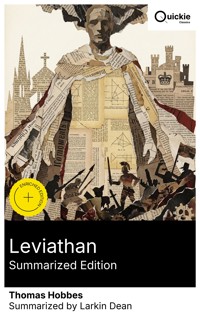
A dense, architectonic treatise, Leviathan offers an anatomy of the commonwealth, opening with an account of human psychology—endeavors and aversions, power, passions—within a mechanistic philosophy; from this Hobbes derives the state of nature as 'war of every man against every man' and the rational laws of nature culminating in the social contract and submission to an undivided sovereign, by institution or acquisition. Combining geometrical definitions with polemical eloquence and scriptural exegesis, Leviathan (1651) emerges from the intellectual ferment of the Scientific Revolution and the confessional strife of the English Civil War. Hobbes (1588–1679), educated at Oxford and long associated with the Cavendish household, absorbed the new mechanics via Galileo and corresponded amid the Parisian philosophical milieu. Witness to civil tumult and exile, he feared the corrosions of sectarian zeal and scholastic obscurity; these experiences, alongside his materialist psychology, drove his bid to secure peace through absolute sovereignty. This work rewards readers in political theory, law, history, and theology. Whether one seeks foundations for state authority, a sharp account of liberty as non-impediment, or a cautionary meditation on disorder, Leviathan remains indispensable—provocative, lucid, and unsettling in its insistence that security precedes all other goods. Quickie Classics summarizes timeless works with precision, preserving the author's voice and keeping the prose clear, fast, and readable—distilled, never diluted. Enriched Edition extras: Introduction · Synopsis · Historical Context · Author Biography · Brief Analysis · 4 Reflection Q&As · Editorial Footnotes.
Das E-Book können Sie in Legimi-Apps oder einer beliebigen App lesen, die das folgende Format unterstützen:
Veröffentlichungsjahr: 2026
Ähnliche

















Leviathan (Summarized Edition)
Table of Contents
Introduction
At the core of Thomas Hobbes's Leviathan lies a stark wager: that only by uniting our vulnerable, contentious selves under an awe-inspiring common power can we exchange the perpetual risk of conflict for the manufactured peace of order, a bargain that tests how much liberty we can relinquish without losing the very reasons we sought protection, how far fear can be transformed into law, and how a multitude of isolated judgments can be made to speak with one voice without erasing the persons whose consent must animate the sovereign they authorize.
Leviathan is a major work of political philosophy, published in 1651 amid the upheavals surrounding civil war in England and the remaking of its institutions. Written as a systematic treatise rather than a historical narrative, it constructs its argument from definitions and consequences, moving from psychology to ethics, law, and the structure of commonwealths. The book belongs to early modern philosophy, when debates about sovereignty, authority, and religious division pressed urgently on political life. Hobbes addresses these crises not by recounting events but by explaining the principles that, he contends, must underwrite stable government and the conditions of civil peace.
Readers encounter an argument that begins with sense perception and human passions before turning to the political question: what arrangement can reliably avert mutual destruction. To illuminate the stakes, Hobbes posits a pre-political condition in which no common judge exists, then derives the rationale for a covenant instituting a common power. The prose is rigorous, occasionally severe, with long, carefully linked sentences and sudden, memorable images. The tone is analytic and unsentimental, yet it carries the urgency of a thinker writing in a time of fracture. Expect a stepwise demonstration rather than anecdotes, and an architect’s blueprint more than a sermon.
At its heart are themes that continue to frame political argument: the equality that springs from shared vulnerability; the primacy of security as the condition for any other good; the trade-offs between freedom of action and the protections of law. Hobbes explores how promises bind, how authority represents the many, and why clarity of language is essential to avoid faction and confusion. He insists that laws must be knowable and backed by sufficient power to be effective. The book treats liberty not as license but as room to act within rules that make coordinated life possible, reframing freedom through the lens of peace.
Because conflict in his time often turned on competing religious claims, Hobbes devotes sustained attention to the place of religion in civil order. He examines how scriptural interpretation, ecclesiastical organization, and private belief intersect with public authority, seeking arrangements that minimize occasions for strife. This inquiry sits alongside a naturalistic account of human action and a methodological confidence that politics can be understood without appeals to mystery. The aim is not to extinguish conscience but to prevent divided allegiances from unraveling peace. The result is a comprehensive vision in which theological and civil questions are carefully related to institutional stability.
Hobbes remains vital because the dilemmas he frames recur whenever trust falters and institutions are strained. Debates about emergency powers, security and privacy, the authority of expertise, and the risks of factional rhetoric echo concerns he set in stark relief. His analysis clarifies what follows when there is no accepted referee, whether in fragile states or in polarized publics that cannot agree on facts. By tracing legitimacy to recognizable interests and consent, he offers tools for assessing claims to rule without romanticism. Leviathan still prompts readers to ask how much power is necessary, to whom it is answerable, and why.
Approaching the book today rewards patience with its careful definitions and steadiness across its long arc. Read it as a design manual for political order, attentive to how small premises accumulate into large conclusions, and as a meditation on the costs of peace. The argument’s coherence does not require agreement on every point; its value lies in sharpening how we reason about conflict, cooperation, and authority. Without relying on historical detail, Hobbes furnishes a durable framework for thinking through crisis. To engage Leviathan is to rehearse the foundational question of political life: how can strangers live together without fear.
Synopsis
Thomas Hobbes’s Leviathan, published in 1651, sets out a systematic account of human behavior and political order amid the turbulence of the English Civil War. Hobbes proposes to build civil science from clear definitions and a method modeled on reasoning from first principles. He treats society as an artificial construct designed to secure peace and protection. Across four parts, he examines human psychology, the creation and structure of commonwealths, the relation between religious authority and civil power, and the errors that, in his view, darken understanding. The work frames a central problem: how can a durable peace be achieved among free and equal individuals?
In the first part, Hobbes analyzes the workings of the mind. He begins with sensation as mechanical motion, explains imagination as decaying sense, and traces trains of thought from association and design. Language enables naming and reasoning, but also introduces error through ambiguity and misuse. Science advances when terms are defined and consequences deduced. He describes passions as appetites and aversions that direct action, with power understood as means to secure future desires. Prudence arises from experience, while reason orders means to ends. The will culminates in the last appetite before action, grounding a natural striving for self-preservation and felicity.
From this psychology, Hobbes derives a picture of natural equality that breeds competition, mistrust, and desire for reputation. In the absence of a common authority, the condition he calls the state of nature is marked by insecurity, where each person has a right to all things necessary for survival. Reason, however, discovers laws of nature—precepts of peace—such as seeking concord where possible, laying down rights by mutual consent, and keeping covenants once made. Justice arises from valid agreements, not from a separate moral order. These insights motivate the move from precarious independence to an organized framework for collective defense.
The second part sets out how a commonwealth is instituted. Individuals, guided by reason, authorize one person or an assembly to represent them, enabling a unity of action otherwise impossible in a multitude. This covenant is made among subjects to institute a sovereign, not between subjects and sovereign, so the bearer of authority is not party to the contract. The sovereign becomes an artificial person whose will counts as the will of all for public acts. The end is peace and protection, achieved when coercive power deters breach of covenant and settles disputes through law rather than private force.
Hobbes then enumerates the rights and prerogatives that make sovereignty effective. The sovereign judges doctrines, makes laws, defines property, appoints magistrates, conducts war and peace, and determines the rules of civil and criminal justice. These powers are indivisible and cannot be forfeited without dissolving the commonwealth. Subjects owe obedience because they have authorized the sovereign’s acts, yet retain a basic liberty to resist when immediate self-preservation is endangered. Hobbes differentiates counsel from command, advocates consistent interpretation of law, and treats taxation and censorship as instruments for security. Paternal and despotical dominion appear as modes of acquisition analogous to civil institution.
He contrasts forms of commonwealth—monarchy, aristocracy, and democracy—by considering who bears the person of the state. Each form has characteristic strengths and vulnerabilities, and Hobbes argues that unified interest and secrecy can favor monarchy, while public deliberation may complicate assemblies. Stability depends on avoiding divided sovereignty, curbing private factions, and educating subjects in civil duty. The commonwealth may be endangered by unchecked private judgment, claims of independent authority, or misinterpretation of law. Succession rules, publicity of laws, and institutional design are all treated as practical means to preserve peace, so that disputes are resolved within the framework of authorized power.
The third part addresses religion within a civil order. Hobbes examines prophecy, miracles, and the nature of spirit, contending that scriptural interpretation must be settled by the commonwealth’s sovereign to prevent conflict. He distinguishes God’s natural dominion from a kingdom founded by covenant, and discusses the church as a congregation whose public acts require civil authorization. Sacraments, worship, and clerical offices are treated as external matters subject to law, while faith concerns inward belief. By allocating the right to define doctrine and authorize teaching, Hobbes seeks to align religious practice with public peace, limiting occasions for jurisdictional rivalry and sedition.
In the fourth part, Hobbes catalogues sources of ignorance he calls the kingdom of darkness. He criticizes obscurity in language, reliance on disputed authorities, and scholastic doctrines that, in his view, confuse substance and form or multiply entities without necessity. He is wary of claims about demonic activity and incorporeal substances that escape clear definition. Hobbes also warns against institutional power centers—such as independent clerical hierarchies or universities—that cultivate doctrines undermining allegiance to civil law. By tracing how conceptual errors translate into political danger, he argues for disciplined reasoning as a safeguard against faction, fear, and superstition in public life.
Across its arguments, Leviathan develops a social contract theory that links security to authoritative rule, while situating religion inside a unified civil framework. Its analysis raises enduring questions about consent, obligation, liberty, and the scope of state power. Readers encounter a stark diagnosis of conflict without common authority and a comprehensive design for avoiding it through institutional construction. Without relying on historical narratives or appeals to tradition, Hobbes offers a model intended to be demonstrative and practical. The book’s lasting significance lies in how it sets terms for debates about order and freedom that continue to shape modern political thought.
Historical Context
Thomas Hobbes wrote Leviathan in the midst of seventeenth-century English turmoil. Published in 1651, it addressed a realm where monarchy, Parliament, and the Church of England had been convulsed by war. Oxford and Cambridge still anchored learning in Aristotelian scholasticism, while new mechanical philosophies pressed for reform. London's print trade, overseen by the Stationers' Company and shifting licensing rules, spread political and religious controversy quickly. Local parish structures, county justices, and royal courts had recently been disrupted, exposing gaps in authority. In this unsettled setting, Hobbes offered a systematic account of civil order grounded in a material view of human behavior and institutional power.
The immediate political context was the breakdown of Stuart governance. Charles I's Personal Rule from 1629 to 1640 strained finances and authority, provoking resistance to new levies such as ship money. Attempts to impose episcopal liturgy in Scotland led to the Bishops' Wars and summoned the Long Parliament in 1640. Conflict escalated into the English Civil Wars (1642-1651), featuring the New Model Army, Parliament's victory at Naseby in 1645, and the king's trial and execution in 1649. A Commonwealth replaced the monarchy, and England entered the Interregnum. Hobbes's reflections were shaped by these years of faction, military mobilization, and contested sovereignty.
Hobbes was born in 1588 at Westport, near Malmesbury, educated at Magdalen Hall, Oxford, and long served the Cavendish family as tutor and secretary. Travels on the Continent brought him into contact with humanist scholarship and new science. In 1641 his objections to Descartes' Meditations appeared through Marin Mersenne's Paris circle. Anticipating danger after circulating The Elements of Law, he departed for Paris in 1640 and joined the royalist exile community. There he wrote De Cive (1642) and later taught mathematics to the future Charles II. He composed much of Leviathan in Paris before returning to London in 1651.
Religious conflict saturated public life. Disputes over episcopal governance and doctrine led to the Westminster Assembly in 1643 and the Solemn League and Covenant with the Scottish Covenanters. Presbyterians pressed for a national church settlement, while Independents in the New Model Army favored broader liberty of conscience. Radical sects multiplied in the 1640s, intensifying arguments about preaching, authority, and scriptural interpretation. Bishops were abolished, church courts dismantled, and tithes debated. These convulsions made questions of ecclesiastical power inseparable from politics. Leviathan's extensive treatment of scriptural authority and church organization responded to this environment, asserting the need to settle religious jurisdiction decisively.
The intellectual milieu combined lingering scholastic frameworks with the new sciences. English universities still centered on Aristotle's natural philosophy, logic, and Latin disputation. Yet works by Galileo and Kepler, Francis Bacon's methodological program, and William Harvey's demonstration of blood circulation (1628) reoriented inquiry toward mechanism and experiment. Hobbes admired Euclid's geometry as a model of certainty and developed a materialist psychology and politics continuous with contemporary natural philosophy. Through the Paris network of Mersenne, he debated optics and motion and exchanged critiques with Descartes. Leviathan's methodical definitions and deductive structure reflect this aspiration to build civil science on clear principles.
Leviathan was printed in London in 1651 by Andrew Crooke, its striking frontispiece engraved by Abraham Bosse after Hobbes's design. The book immediately drew controversy for its account of sovereignty, its Erastian subordination of church to state, and its materialist language. Royalists criticized its de facto defense of present power; divines attacked its scriptural interpretations. Hobbes soon returned from Paris to live quietly under the Commonwealth. After the Restoration, Leviathan continued to attract scrutiny; in 1666 the House of Commons investigated atheistical books, and Hobbes feared prosecution, discouraging further publications on religion. Nonetheless the work circulated widely in England and abroad.
Beyond England, Europe had emerged from the Thirty Years' War (1618-1648), whose devastation sharpened concerns about disorder and confessional strife. The Peace of Westphalia recognized territorial sovereignty and complex religious settlements, reinforcing state claims to jurisdiction. Fiscal-military development, standing armies, and intensified taxation expanded central authority across many polities, including France and the Dutch Republic. International commerce and colonial ventures broadened horizons while complicating governance. Hobbes observed these dynamics during his continental travels and Paris residence. Leviathan's insistence on undivided sovereignty and the primacy of security resonates with post-Westphalian efforts to stabilize authority after prolonged war and to subordinate private violence to public power.
Leviathan thus crystallizes an era's anxieties and aspirations. It translates the experience of civil war, regicide, and competing churches into a general theory of political obligation designed to prevent renewed collapse. Its rigorous definitions, reliance on a mechanistic psychology, and critique of university scholasticism align with the emerging scientific temper. At the same time, its defense of indivisible, coercive sovereignty and civil control of religion answers the specific English dilemmas of the 1640s and 1650s. By proposing a secular foundation for authority grounded in human consent and fear, the book both reflects and critiques the institutions that had failed.
Author Biography
Thomas Hobbes (1588–1679) was an English philosopher whose work helped define modern political thought during the upheavals of the seventeenth century. Writing in the wake of the Scientific Revolution and the English Civil War, he sought a comprehensive, materialist account of human nature, knowledge, and the state. His landmark treatise, Leviathan, articulated a theory of political authority grounded in consent and the need to avoid civil conflict. Hobbes also wrote on logic, physics, psychology, and language, attempting to build a unified system modeled on geometric method. His arguments have remained central to debates about sovereignty, obligation, and the scope of state power.
Hobbes received an education at Oxford, studying at Magdalen Hall, where instruction emphasized classical languages and Aristotelian philosophy. He later criticized scholastic methods and turned to mathematics as a model of certainty. After leaving the university, he entered the service of the Cavendish family, a role that shaped his intellectual life for decades. As a tutor and companion, he gained access to libraries, patrons, and scholarly networks. The environment encouraged him to read widely in history, ethics, and natural philosophy. Early on he formed the conviction that political order depends on a rigorous understanding of human passions and reasoning.
Continental travel further broadened Hobbes’s horizons. In Paris he associated with the circle of Marin Mersenne, where current work in mathematics and natural philosophy was discussed. He absorbed the mechanistic outlook associated with Galilean science and held Euclid’s geometry as a model for systematic knowledge. In the early 1640s he contributed objections to Descartes’s Meditations, pressing skeptical and materialist challenges. Classical historians also mattered: Hobbes esteemed Thucydides for his analysis of power and civil strife. These influences converged in his ambition to explain sensation, language, and politics by tracing effects to their causes, using clear definitions and methodical argument.
Hobbes’s first major publication was his English translation of Thucydides, issued in 1629, intended as a warning against factionalism. He composed The Elements of Law in 1640, circulating it in manuscript. Soon after he wrote De Cive, published in Latin in the early 1640s and later in English, setting out a civil philosophy that anticipated Leviathan. As tensions in England escalated, he relocated to Paris, where he continued his studies and eventually served as mathematics tutor to the future Charles II during the royalist exile. The political crisis sharpened his resolve to provide a durable foundation for civil peace.
Leviathan appeared in 1651, offering a sweeping account of human psychology, language, religion, and political authority. Hobbes argued that in the state of nature individuals face insecurity and rationally authorize a sovereign to secure peace. The work’s insistence that ecclesiastical power be subject to civil authority, and its austere view of revelation, provoked controversy among royalists and clergy. After publication, Hobbes left Paris and returned to England, submitting to the Commonwealth to live and write in relative safety. The book’s distinctive style and bold synthesis made it immediately influential and widely attacked, a touchstone for defenders and critics of sovereignty.
In later decades Hobbes elaborated his system and engaged in public disputes. De Corpore addressed logic and body; De Homine treated optics and human nature. He defended a compatibilist account of freedom in exchanges with John Bramhall and sparred with mathematicians, notably John Wallis, over geometry and the quadrature of the circle. He also wrote on English law in a Dialogue and composed Behemoth, an analysis of the civil wars; both were published after his death. Late in life he produced translations of Homer. Even when opponents faulted his science or theology, they acknowledged the force of his political reasoning.
After the Restoration, Hobbes benefitted from limited royal protection but faced intermittent threats of censure, including accusations of atheism and heresy. He continued to write into advanced age, revising earlier works and composing a Latin verse autobiography. Hobbes died in 1679. His legacy endures across political theory, legal philosophy, and international relations. Advocates and critics alike engage his claims about consent, sovereignty, and the priority of peace. Later traditions—social contract thought, legal positivism, and realist approaches to power—developed in dialogue with his ideas. Hobbes remains a central figure for debates about authority, rights, and the limits of government.




