


Erhalten Sie Zugang zu diesem und mehr als 300000 Büchern ab EUR 5,99 monatlich.
- Herausgeber: Nick Hern Books
- Kategorie: Poesie und Drama
- Serie: NHB Drama Classi
- Sprache: Englisch
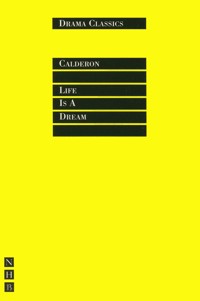
Drama Classics: The World's Great Plays at a Great Little Price A masterpiece of the Spanish Golden Age. It is foretold that Prince Sigismund will become a tyrant. Alarmed, his father, the king, imprisons him. When he is released for a day as an experiment he proves the omens only too right, and, as a result, is incarcerated once more. Sigismund persuades himself that all that has passed is a dream and emerges to rule wisely and justly. Pedro Calderon's play Life is a Dream was first published in 1635. This English translation by John Clifford was first performed at the Lyceum Theatre, Edinburgh, in 1998. It is published in the Nick Hern Books Drama Classics series.
Sie lesen das E-Book in den Legimi-Apps auf:
Seitenzahl: 126
Veröffentlichungsjahr: 2015
Das E-Book (TTS) können Sie hören im Abo „Legimi Premium” in Legimi-Apps auf:
Ähnliche








DRAMA CLASSICS
LIFEIS A DREAM
by
Pedro Calderón de la Barca
translated and with an introduction by
John Clifford
NICK HERN BOOKS
London
www.nickhernbooks.co.uk
Contents
Title Page
Introduction
Calderón: Key Dates
Characters
Life is a Dream
Copyright and Performing Rights Information
Introduction
Pedro Calderón de la Barca (1600-81)
Calderón was born in Madrid on 17 January 1600. His father was a senior official in the government. The family had pretensions to nobility; but in Spain’s racially obsessed society the profession of administrator, secretary or official was a somewhat dubious one. Those who exercised such professions were tainted with the suspicion that they might be of Jewish or Muslim origin; so Calderón’s family’s social standing can never have been a secure one.
Pedro Calderón was the third of six brothers; their love and support for each other seems to have been vital in a troubled life. Their mother died in childbirth when Calderón was ten; in 1614, four years later, his father married again. The stepmother hated the brothers so intensely that when their father died in 1615 she initiated a successful lawsuit that left them disinherited and dispossessed.
The father, to judge both from the terms of his will and the portrayal of fathers in his son’s plays, was authoritarian and unloving. He stipulated that on pain of disinheritance his eldest son must abandon his relationship with the woman he loved and wished to marry. As for Pedro, he ordered him on no account to abandon his studies and commanded him to become a priest.
Calderón’s response to this was to leave university, abandon the calling to priesthood and embrace the dissolute and disreputable profession of poet and playwright. Once his first successful play, Love, Honour and Power, was performed in 1625, he rapidly built up for himself a reputation as a poet, a dramatist and a wit.
He and his brothers were also building up a dubious reputation as brawlers and duellists, implicated in the deaths of several men and the violation of a convent. They narrowly escaped prison on more than one occasion; and for a couple of years Calderón had to live in exile.
It was probably in the late 1620s, in the midst of this troubled and turbulent period, that he wrote Life is a Dream. Scattered references to it in other plays indicate that the play took a hold of the imagination both of fellow play wrights and of audiences; when he and his brother came to publish the first volume of his Plays (in 1636) he placed it at the head of the volume.
At that time, theatre in Spain was still dominated by the extraordinary skills of Lope de Vega and, to a lesser degree, his rival Tirso de Molina. Tirso, who was a member of a religious order, was silenced in 1625 (he was exiled to a remote monastery and deprived of pen and paper) and Lope’s death in 1635 left the way clear for Calderón to establish himself as the leading playwright of his day.
From then until his death in 1681, he kept on writing an astonishing stream of beautiful plays in all three dramatic arenas open to him – in the public theatre, the court theatre, and in the street, where his auto sacramentales were performed during the feast of Corpus Christi. These allegorical dramas were played on carts equipped with extraordinary and ingenious stage machinery, and they generally dramatised points of Catholic doctrine.
Though the auto sacramental sounds like a distinctly unpromising type of drama, Calderón wrote for it plays of miraculous intellect, wit, dramatic imagination and human tenderness.
He also mastered the art of writing spectacle for the royal court. Philip IV loved theatre, and built several in his palaces. He commissioned elaborately staged spectacles from Calderón, often based on mythological subjects.
Philip IV was king only in name; the real power was wielded by his chief minister, Olivares, who encouraged Philip’s love of pleasure and theatrical spectacle, because the appeal of these distractions made it easier for Olivares to exercise control over the important affairs of state.
Knowingly or not, Calderón participated in this process. The fall of Olivares in 1643 left him in some difficulty; and his direct experiences of war, fighting in the army involved in the suppression of the revolt of Catalonia in 1640, all deepened his disillusionment with Spain’s militaristic policies as it attempted to hold on to its rapidly dissolving empire.
But neither these setbacks, nor the deaths of his brothers, nor an affair with an unnamed woman prevented Calderón from writing plays. In 1647 his only son was born; in 1651 he became a priest; in 1657 the son died. And Calderón kept on writing plays. He was writing till the day of his death, on 25 May 1681, and in his will he wrote the script for his own funeral. He was very specific about the costumes of his pallbearers and his own corpse, and insisted the coffin be kept open so that his corpse could be seen as it was dragged through the streets of Madrid. He hoped the public would learn from the spectacle – and think about how best to lead their lives.
His Plays
His work remains largely unknown to this day.
In the past twenty years in Britain very little of it has been seen: Life is a Dream (by the RSC in a very free adaptation by Adrian Mitchell), The Mayor of Zalamea (by the National Theatre), Schism in England (my translation; again by the National), The Doctor of Honour (by Cheek by Jowl), a brave and wonderful attempt at one of his autos, The Great Theatre of the World by the Medieval Players and recently The Painter of His Dishonour by the RSC in a fine translation by David Johnstone.
So much still remains to be discovered:
Devotion to the Cross, a passionate flirtation with incest and parricide;
The Constant Prince, a deeply moving meditation on the virtue (or stupidity) of martyrdom;
The Statue of Prometheus, an extraordinary retelling of the myth;
The Amazing Magician, his version of the Faust legend;
. . . and even this list (which is very selective) leaves out his comedies.
I translated his brilliantly funny House with Two Doors in 1980 (the experience helped me discover myself as a playwright) and continue to be astonished that plays like The Veiled Lady and the Hidden Man, The Female Ghost, True Love Burns like Fire, Nothing Is More Powerful Than Silence remain completely unknown. They rival Goldoni in their ingenuity, and surpass him in wit, theatrical flair and sheer humanity.
There can be few writers who gave so much to their chosen form: and yet who still remain so unknown for it.
What Happens In the Play
Act One
Rosaura enters dressed as a man. Her horse has bolted and left her and her servant Clarín utterly lost in a mountainous region when night is falling. They see a tower and go up to it, hoping to find shelter. Instead they find a naked chained man imprisoned in a dark tower. He does not understand why he has been imprisoned: he and Rosaura feel a profound attraction for each other.
The prisoner’s jailer, Clotaldo, arrests Rosaura and Clarín for trespassing on forbidden ground. Rosaura hands him her sword; and he recognises it. It was once his: he gave it to his lover and made her promise that she should give it to their child.
Clotaldo is now caught in a dilemma: he has been ordered to kill all those who approach the tower, and he cannot bear the thought of killing his own child.
We move to the court of Poland, where Astolfo and Estrella are beginning to woo each other. We learn that Basilio, the king, is childless; Astolfo and Estrella are his nephew and niece, and he is encouraging them to marry in order to settle their competing claims for the throne.
Estrella remarks that Astolfo’s declarations of love are not particularly convincing; not least since he is wearing the portrait of another woman hanging around his neck. Astolfo’s explanations are cut short by the arrival of the king.
Basilio complacently reminds his nephew, his niece and his whole court of his skill as an astrologer and his capacity to foretell future events. He then recalls his dismay at the appalling horoscope that he read at his son’s birth. It foretold civil war between father and son and his own eventual defeat. His wife died in childbirth; unwilling to kill his own child, Basilio nonetheless felt unable to ignore his horoscope. At the time, it was announced the son had been born dead; Basilio tells his court that in fact Segismundo is alive.
He is the prisoner in the tower, and has been kept in isolation since the day he was born. Tomorrow, Basilio intends to make a test of Segismundo’s capacity for kingship: he will be brought from the tower to take Basilio’s place in the palace. Everything he orders will be carried out as if he were king. If Segismundo responds to this situation with wisdom and self-restraint, then he will be crowned king. If not, he will be deposed, sent back to the tower, and the succession will pass to Astolfo and Estrella.
Leaving his courtiers to digest this sensational piece of news, Basilio is met by Clotaldo. Clotaldo is about to beg for his child’s life when Basilio instructs him to free the prisoners. There is no more need to keep Segismundo’s existence a secret.
Rosaura and Clotaldo, meanwhile, are intensely curious about each other’s identity. Rosaura is looking for her father; Clotaldo wants to know more about his child. He manages to draw out of Rosaura the fact that she is his daughter; that she has been seduced and abandoned by Astolfo, and has followed him to Poland to seek revenge.
Act Two
The act begins with Clotaldo telling Basilio that Segismundo has been drugged and brought to the palace. Basilio explains that if Segismundo fails this test of character, he can be drugged again and taken back to his prison, and then told that everything he saw in the palace was nothing but a dream.
Clotaldo has huge misgivings about the whole project; but it’s all too late, because Segismundo has already woken up. Basilio instructs Clotaldo to tell him he is the son of the king.
Segismundo, who has spent all his life a prisoner, bound in chains, is utterly bewildered by the change in his fortunes. He becomes very angry when he discovers he’s actually the son of a king, and tries to kill Clotaldo, the man who’s been keeping him in prison. When a servant tries to reason with him, Segismundo kills him; when he sees Rosaura – who is now wearing women’s clothes – he tries to rape her; when Clotaldo intervenes Segismundo tries to kill first Clotaldo and then Astolfo. He is furious with his own father, whom he insults; and it is obvious he is going to have to be drugged again and returned to prison.
Clarín meets Clotaldo and blackmails him into giving him money and a position in return for agreeing not to disclose Rosaura’s identity.
Rosaura, who has been advised by Clotaldo to dress as a woman to avoid scandal, has become a lady-in-waiting to Estrella until her situation improves. Estrella sends her to Astolfo to pick up the portrait he has been wearing and that so offended her the last time they met. It is obviously Rosaura’s portrait; and she is placed in an impossible position. Astolfo recognises her at once; Rosaura manages to trick him out of her portrait and place him in the wrong before Estrella.
Segismundo is returned to the tower; Clarín is imprisoned alongside him to thwart his blackmail. Just before leaving him alone with his chains, Clotaldo advises Segismundo to try to control his rage; life may be a dream, but the good you do is never lost. Not even in dreams.
Segismundo is left alone. He tries to understand what has happened to him; and concludes that the whole of life is nothing but a dream.
Act Three
Clarín is still in the tower. He’s hungry, and he keeps having bad dreams. He is astonished when a group of soldiers burst in, call him Prince Segismundo, and ask him to rule them. It’s obviously what they do in Poland – some kind of weird custom – and he’s about to do as they say when Segismundo appears. The soldiers explain they are in rebellion against Basilio. They’ve learnt he has a son whom they want to be their king. They don’t want Astolfo.
Segismundo is reluctant to go with them. He’s convinced it’s all going to turn out to be just another dream, and he’ll end up back in the tower feeling even worse than before. But the soldiers persuade him; and he promises himself he’ll try to remember that it is only a dream and not get carried away with it. They all set off to march against the palace of the king.
When the rebellion breaks out, Clotaldo expects Segismundo to kill him; but Segismundo has taken his words to heart, and is trying to do good. So he lets Clotaldo go free. When he reaches the palace, Clotaldo discovers the rebellion has spread throughout the kingdom. Basilio is in despair: he understands that he has brought about the very thing he set out to try to prevent.
There is nothing to be done but try to crush the rebellion: he, Astolfo, and Estrella set out to fight. Rosaura prevents Clotaldo following them; she still wants revenge on Astolfo, and she wants to discover if Clotaldo is her father. Clotaldo tries to evade the whole issue by suggesting Rosaura enter a convent; Rosaura refuses. She sets off to fight for Segismundo. Clotaldo goes off to fight for the king.
Segismundo, meanwhile, is marching with his army, exhilarated by their success. Rosaura reaches him, and tells him her story. The first time she met him dressed as a man; the second, dressed as a woman; now she meets him dressed as an androgyne, wearing both a gorgeous dress and the weapons of war. She has come both to help him fight his battle and obtain his help in her quest for revenge.
Seeing her again, Segismundo is able to connect all the different parts of his experience. He finally understands that what he saw in the palace was not a dream; that life has reality and substance. He really desires Rosaura and is tempted to rape her. But he remembers Clotaldo’s words about doing good. They seem to be the only thread that can help him make sense of life’s confusion.
The only way he can overcome his desire for Rosaura is turn his back on her; he marches off to war, leaving her uncertain and confused. Clarín rejoins her and is just about to tell her that Clotaldo is her father when the battle begins. Rosaura goes off to fight; Clarín isn’t going to be so silly as to fight. He’ll escape death by hiding.




