


1,49 €
Mehr erfahren.
- Herausgeber: Atlantic Books
- Kategorie: Gesellschafts- und Liebesromane
- Sprache: Englisch
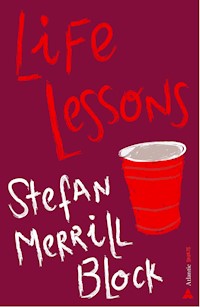
From the critically acclaimed author of Oliver Loving and The Story of Forgetting is a short story about friendship, loss and growing up. ______________________ Life lesson: the most soothing salve available to the man who has recently torched his own face is a regular application of wickedness with a pretty girl. The choices we make can follow us, and when half of your face is torched you can't escape the past. As a freshman in college he meets friends and attends parties, red cup in tow. His face is a Rorschach test to his friends, though he'll never tell them what really happened. In his group of friends there is Ava- sardonic, infatuating and alarmingly beautiful Ava. But he's too burnt up to be considered as anything more than a 'bestie' to a girl like her...
Das E-Book können Sie in Legimi-Apps oder einer beliebigen App lesen, die das folgende Format unterstützen:
Veröffentlichungsjahr: 2019
Ähnliche


















Stefan Merrill Block grew up in Plano, Texas. His first book, The Story of Forgetting, was an international bestseller and the winner of Best First Fiction at the Rome International Festival of Literature. Stefan's stories and essays have appeared in The New York Times, The Guardian, NPR's Radiolab, GRANTA, The Los Angeles Times, and many other publications. Stefan lives in Brooklyn. His latest novel is Oliver Loving.
Find out more at www.stefanmerrillblock.com
Atlantic Short Stories
A Lesson in Englishness
Unnatural
The Hall Chimp
Published in Great Britain in 2019 by Atlantic Books, an imprint of Atlantic Books Ltd.
Copyright © Stefan Merrill Block, 2019
The moral right of Stefan Merrill Block to be identified as the author of this work has been asserted by him in accordance with the Copyright, Designs and Patents Act of 1988.
All rights reserved. No part of this publication may be reproduced, stored in a retrieval system, or transmitted in any form or by any means, electronic, mechanical, photocopying, recording, or otherwise, without the prior permission of both the copyright owner and the above publisher of this book.
This novel is entirely a work of fiction. The names, characters and incidents portrayed in it are the work of the author’s imagination. Any resemblance to actual persons, living or dead, events or localities, is entirely coincidental.
Every effort has been made to trace or contact all copyright holders. The publishers will be pleased to make good any omissions or rectify any mistakes brought to their attention at the earliest opportunity.
10 9 8 7 6 5 4 3 2 1
A CIP catalogue record for this book is available from the British Library.
E-book ISBN: 978 1 8389 50392
Atlantic Books
An imprint of Atlantic Books Ltd
Ormond House
26–27 Boswell Street
London
WC1N 3JZ
www.atlantic-books.co.uk
LIFE
LESSONS
Contents
Life Lessons
One night, about a month into my first semester, my new floormate Kenneth spent a long while probing the throat of his empty bottle of Natty Light, in and out, in and out, as his eyes went narrow and fixed on me. Kenneth was a lapsed Rugby flanker, the sort of beer-paunchy, overconfident white guy who liked to wear doo-rags ironically (it was Kenneth who threw the annual Pimps n’ Hoes Party, the pictures of which he’d much later use to mock-blackmail us all), and even still it had taken Kenneth a half-case of beer to work up the nerve to ask me the question that everyone had been wanting to ask about my face. “I’m sorry,” he said at last, gesturing toward the purplish mass that I could still occasionally feel throbbing over my head’s eastern hemisphere, “but this can no longer go unmentioned.” His friend Victoria swatted him.
“No, no, it’s okay,” I said. “These scars? Life lesson: after eating hallucinogenic mushrooms, you should never step into a campfire, no matter what seductive nonsense it tries to tell you.” We were sitting in a dorm hallway at 3 a.m. then, the cinder-block walls spinning with a night of heavy drinking, and through my woozy double-vision I watched the warped faces of my floormates buck and sway in a sudden frenzy of laughter. At that point, their sum-total knowledge of me was that I had been in the army and that I had arrived at campus with half my face torched; they had every reason to believe I was just bullshitting. But the sardonic, fair-skinned and alarmingly beautiful young woman seated across from me — a kind of punk, tattooed Swiss Miss — nodded gravely. “It’s true,” this girl, Ava, told the group. “One of the RAs told me all about it.” Our gaze met, and I tucked my monster’s face between my knees.
“Seriously? Fucking shrooms?” Kenneth crowed. “I’m really sorry, bro.”
“That’s okay.” I shrugged, hoisting the ache of my grinning cheeks. “Actually, I like to think of it like the origin story for a superhero. I walked into that fire as a normal boy and emerged as Inferno Man!” For some reason, I kissed my biceps.
All this was, of course, bullshit indeed. It was 2003, and I should have been off tearing up the oil-sodden deserts with the 4th Squadron, 3rd Armored Calvary Regiment, but after just three months of basic training at Fort Hood, Texas, an incident with a stun grenade had snatched me away from that future at the cost of my Black Irish good looks, which had been the only true thing I’d once known about myself. In the burn ward at Walter Reed, I’d been neighbor to a number of men whose explosions had come at hands other than their own. They’d come back from that nightmare without appendages, portions of their torsos, the ability to string their words together on a coherent thread. “That some shit, but happy you never see real shit over there,” my roommate Tony Beans had slurred after I related my story, and he offered a knowing grin, as if I might have wanted that training grenade to explode in my fist — in that, the hospital therapist and my parents were all in agreement. I was put on psychological watch, and my mental health care had mostly consisted of sitting in over-bright group therapy sessions with the rest of my mutilated ilk while a pert, impatient woman named Dr. Weitzer held court. “The real devil,” Dr. Weitzer told our group one afternoon, “is that feeling of purposelessness. It is up to each of us to find meaning in what we’ve suffered. So here is my assignment to you all. I want each of you to keep a list of lessons you have learned, which you would like to tell your children, if you have them. To your future children, if you don’t.”
The other guys shrugged off Dr. Weitzer’s advice, but if I was ever going to leave those linoleum-drab hallways I knew I had to adhere to whatever sentimental nostrum she prescribed. Life lesson, I wrote with my aching, mutilated claw of a hand, never sign up for military service to gratify your parents.
Life lesson, I added. When you blow yourself up with a hand grenade, you will learn certain surprising truths about your family - for one, that they will never forgive you.
These lessons became a routine that deepened into a habit, and I found that I quite liked to imagine the immaculate pink shell of a child’s ear, listening.
Life lesson: If you fail to secure financial aid when you apply to college, self-immolation is a good Plan B. Before I’d gone in for the army, I’d been accepted to a nice little university in St. Louis that I could never have afforded. And yet, after my long stint in the burn ward at Walter Reed — granted Dr. Weitzer’s stamp of certified sanity and an honorable discharge — I was offered admission to the second semester, a nearly full scholarship, a room of my own, and the unbearable pity of the fresh-faced, slightly booze-bloated freshmen who shared my hall.




