


Erhalten Sie Zugang zu diesem und mehr als 300000 Büchern ab EUR 5,99 monatlich.
- Herausgeber: PUCPRess
- Kategorie: Religion und Spiritualität
- Sprache: Englisch
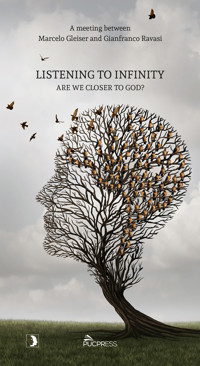
(...) People have a very distorted view of science, religion, and the relationship between them. They immediately put science and faith as antipodes in constant confrontation. My vision is a little more historical and cultural. I see science as a manifestation of human effort to engage in the mystery of existence. And religion is also a manifestation of human effort to engage in the mystery of existence. In a certain way, both come from the same source. Refusing to talk is refusing to look at one side of our life, human existence, which is part of who we are. It's a perfectly natural conversation. Marcelo Gleiser Dossier Courtyard of the Gentiles
Sie lesen das E-Book in den Legimi-Apps auf:
Seitenzahl: 57
Veröffentlichungsjahr: 2019
Das E-Book (TTS) können Sie hören im Abo „Legimi Premium” in Legimi-Apps auf:
Ähnliche
















Original title in Portuguese: À escuta do infinito. Estamos mais perto de Deus?
2018, PUCPRESS. Translation authorized.
Copyright for the English edition
©2019, Fabiano Incerti
2019, PUCPRESS
This book, in whole or in part, may not be reproduced by any means without the express written permission of the Publisher. Opinions, assumptions, conclusions, or recommendations made in this material are the responsibility of the respondents.
PONTIFICAL CATHOLIC UNIVERSITY OF PARANÁ
Rector
Waldemiro Gremski
Vice-Rector
Vidal Martins
Pro-Rector for Mission, Identity, and Extension
Brother Rogério Renato Mateucci
Director of the Science and Faith Institute
Fabiano Incerti
Institutional Identity Manager
José André de Azevedo
Collection Curator
Fabiano Incerti
Technical review
Douglas Borges Candido Mariana Vidotti
Translation
Juliana Vermelho Martins David Martin Palmer II
PUCPRESS
Coordination
Michele Marcos de Oliveira
Edition
Susan Cristine Trevisani dos Reis
Art Edition
Rafael Matta Carnasciali
Text Preparation
Juliana Almeida Colpani Ferezin
Proofreading
Elisama Nunes dos Santos Paula Lorena Silva Melo
Cover and graphic design
Rafael Matta Carnasciali
Layout
Eduardo Ramos
Produção de ebook
S2 Books
PUCPRESS
1155 Imaculada Conceição Street - Administration Building - 6th floor
Campus Curitiba - Zip Code 80215901 - Curitiba / Paraná / Brazil
Phone: +55 41 32711701
Publication Cataloging Data
Pontifical Catholic University of Paraná
Integrated Library System - SIBI / PUCPR
Central Library
Incerti, Fabiano
I36e 2019
Listening to the infinite: are we closer to God? / Fabiano Incerti, coordinator; Translation: Juliana Vermelho Martins and David Martin Palmer II - Curitiba: PUCPRESS, 2019.
60 p. ; 21 cm
ISBN 978-85-54945-71-8
ISBN 978-85-54945-72-5 (e-book)
1. God. 2. Religion and science. 3. Dialogues I. Gleiser, Marcelo II. Ravasi, Gianfranco. III. Title
CDD 20. ed. – 231
SUMMARY
PRESENTATION
The evening of April 11, 2016 will be remembered at the Pontifical Catholic University of Paraná. On the University Theater (TUCA) stage, one of the greatest intellectual and influential Catholic thinkers, Cardinal Gianfranco Ravasi, sits for a frank and transparent conversation with one of today’s most respected agnostic astrophysicists, Brazilian professor Marcelo Gleiser. The theme that provokes and approaches them is the question for God. From different and equally profound perspectives, as the conversation progresses, they give an example of what seems to be the urgency for our times: we need to dialogue. And both teach us that, before being a concession, dialogue is an exercise that requires openness, learning and the recognition that the other, while picking me apart, is the one that completes me.
This is the spirit of the Courtyard of the Gentiles, project from the Vatican’s Pontifical Council for Culture: believers and non-believers dialoguing on fundamental issues for human existence, regarding culture, science and faith. Held in symbolic spaces in different cities around the world, it brings together personalities from the universe of arts, economics, science, politics, and academia. Those are Benedict XVI’s words to the Roman Curia in December 2009 that inspire this creative and thought-provoking initiative, which has since generated real encounters and active listening: “Today, in addition to interreligious dialogue, there should be a dialogue with those to whom religion is something foreign, to whom God is unknown and who nevertheless do not want to be left merely Godless, but rather to draw near to him, albeit as the Unknown”.
It was the partnership with the National Conference of Bishops of Brazil (CNBB), the Archdiocese of Curitiba and FTD Education that made it possible for the PUCPR Science and Faith Institute to hold the first edition of Courtyard of the Gentiles in Brazilian lands and released, with the publication of this work, its first collection of books.
May the following pages be inspiring to new times, where the simple gesture of sitting at the table for good conversation is the sign of the most powerful human and spiritual convergence.
Good reading!
Fabiano Incerti and Rogério Renato Mateucci Curitiba, summer of 2018.
PREFACE
Then you will know the truth, and the truth will set you free.
John 8:32
It is perfectly true, as the philosophers say, that life must be understood backwards. But they forget the other proposition, that it must be lived forwards.
S. Kierkegaard
The conviction that knowledge leads us to the best of worlds is reckless; most of the time, it is based on critical judgment and ideological choices that tend to eliminate differences. The best of all worlds assumes a kind of eugenic and biased purity, the condition of a desired emancipation of man at all costs. From this perspective, the well-informed reason decides about right and wrong, creates and destroys, emancipates and condemns. History has given us enough grounds to prudently distrust progress reduced to products of objective rationality.
Our time, based on hegemony of a triumphant reason, dominated by a technoscientific vision, has specialized in the descriptive understanding of the world and loses, day by day, the primordial intimacy with enchantment. Today, the world shares a conviction resulting from the triumph of the lights of Reason, definitely pushing back myths, superstitions and religions. The “free” man experiences prophetical certainties like that of Spinoza showing that he, taken by his fears and hopes, no longer behaves “as if he made nature delirious”, he undertakes the task proposed by Bacon to turn his Knowledge into Power and commits himself to the project suggested by Descartes to be a “master and possessor of nature.” This same man was convinced by Hobbes that “thinking is calculating” and by Planck in the certainty that “real is only what can be measured”, and everyone sees the pledge of a supposed human emancipation believing in a sovereign unquestionable power of science in this programmatic framework.
Knowledge, however, must lead us rather to unsurpassable sense of man and this is, in essence, mystery. Before relegating us to the limits of impotence, the mystery is the first condition of our search. Our thirst for knowledge is never satisfied with possession, but with the discomfort provided by what we are not yet and do not yet have. The cultivation of the spirit is by its nature opposed to the logic of selective profits, and therefore the knowledge that praises itself for alleged possession of the truth is the same that carries its funeral.
Certainly, the starry sky appears to both poet and scientist; definitely not more to the latter than to the former. A physical-chemical-mechanical description of a starry night does not take away its enigma of ecstasy. There is no supremacy of the scientist over the poet, but exceptional greatness in the meeting of both. Knowledge, speaking to the mysterious essence of man, resists the reductionist and arbitrary compartmentalization so claimed by this disenchanted and secular time, dominated by what is instrumental and functional.
In a 1904 essay entitled The Value of Science




