


Erhalten Sie Zugang zu diesem und mehr als 300000 Büchern ab EUR 5,99 monatlich.
- Herausgeber: Nine Arches Press
- Kategorie: Poesie und Drama
- Sprache: Englisch
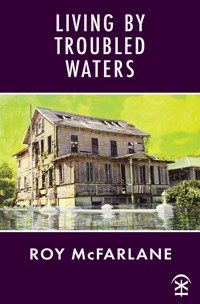
Living by Troubled Waters is the third poetry collection by Roy McFarlane – an extraordinary, uncompromising book exploring slavery, colonialism, and the continued tragedies visited upon Black bodies whilst these legacies remain unresolved. In his close examination of the horror of racialised violence, McFarlane examines how the strong currents of the past and present flow side by side. His poems ask us to think about the Black Mediterranean of today as much as we do about the Windrush scandal and the aftershocks of trans-Atlantic slavery, where Black people are still imprisoned, enslaved and drowned as they flee persecution and poverty. Living by Troubled Waters is innovative, formally experimental and far ranging in scope; erasure & inclusion (to make known) poems interweave and speak to the wider body of the collection. In his use of archival documents as a space for activism and linguistic intervention, McFarlane writes back into history, reclaiming voices and reshaping narratives. His poems also draw strength from themes of place and displacement, social justice, Black motherhood, family, art - and from the power of poetry itself as a witness to troubled times.
Sie lesen das E-Book in den Legimi-Apps auf:
Seitenzahl: 72
Veröffentlichungsjahr: 2022
Das E-Book (TTS) können Sie hören im Abo „Legimi Premium” in Legimi-Apps auf:
Ähnliche












Living by Troubled Waters
Living by Troubled Waters
Roy McFarlane
ISBN: 978-1-913437-54-1
eISBN: 978-1-913437-55-8
Copyright © Roy McFarlane, 2022
Cover artwork: © Hew Locke, ‘Almond St, 2014’. Reproduced by kind permission of the artist. http://hewlocke.net
All rights reserved. No part of this work may be reproduced, stored or transmitted in any form or by any means, graphic, electronic, recorded or mechanical, without the prior written permission of the publisher.
Roy McFarlane has asserted his right under Section 77 of the Copyright, Designs and Patents Act 1988 to be identified as the author of this work.
First published October 2022 by:
Nine Arches Press
Unit 14, Sir Frank Whittle Business Centre,
Great Central Way, Rugby.
CV21 3XH
United Kingdom
www.ninearchespress.com
Nine Arches Press is supported using public funding by Arts Council England.
Contents
Author's Note: A Short History of the Violence Visited upon Black Bodies of the Enslaved
An aubade in response to how do you feel in the wake of George Floyd’s death, realising I’m holding a scream, decibels high enough to crack the fragility of white people
{ }
Black Mother
You are Impossible to Love (Part 1)
We are a Love Supreme
Mother From Her Child
Living by Troubled Waters #1
Visitation of the Spirits
NEWCROSS HOSPITAL, 2013: A SCAN REPORT ON THE LUNGS
KINGSTON, 1907: IN TIMES OF EARTHQUAKES
PORT ROYAL, 1692: RICHEST AND WICKEDEST CITY IN THE WORLD
NEW YEARS EVE, 1920: BEDWARD TO ASCEND TO THE SKIES
ST THOMAS, 1951: HURRICANE CHARLIE PASSOVER
THE SMOG OF 1962: LOVE IN THE TIMES OF FOG
PARKFIELD ROAD, WOLVERHAMPTON, 2014: THE LAST VISITATION
The Passion of the Enslaved / On the Body of a Negro
Nanny of the Black Country wearing Converse All Stars
Mothers of Love
Black women don’t feel pain
Living by Troubled Waters #2
I must call her The Mother with the Pearl Earring
On the night Malcom X was assassinated Yuri Kochiyama cradles the head of a dying man
In this Clearing, on this Verandah
A place where we can all breathe
Icarus’s mouth
Taking Flight (I)
The Ghazal of the Displaced
Praise for those who run in the midnight hour
Lampedusa
Rio Grande
Younous Chekkouri
Pantoum of the 27
After a reading from Dear Refugee by Amir Darwish
Taking flight (II)
the dismembered past
You are Impossible to Love (Part 2)
After Hew Locke, Wreck, 2021
Black Square
Cain rose against Abel
Abel’s blood cries from the ground
Abel, Hebel, breath be they name
Living by Troubled Waters #3
Black Pietas
We Were Already Divine
After reading ‘To Toussaint L’Overture’ by Wordsworth, Ira Aldridge is often visited by his Spirit
Threatened with DAMNATION
If Only We Could Walk On Air
I’m holding a scream
Toussaint
You are Impossible to Love (Part 3)
the Clearing
Laying of Hands
MAN-TO-MAN
AFTER A BASKETBALL GAME
AFTER AN EVENING OF LOVING
The Act of Remembering
The Suit
Finding my father in the field of words
after duckanoos…
Amulet
Space in the Front Room
Taken possession of the kingdom
The Fields of Bilston College
Living by Troubled Waters #4
We, the Brothers of the Salute
You left in between the snowdrops that fell lightly
Praise for My Father
To be free
{ }
To the Heron who stood with me in the ruins of another Black man’s life
Notes
Acknowledgements & Thanks
Further Reading
About the author and this book
How we could have lived or died this way, how the descendants of slaves
Still fled and the descendants of slave-catchers still shot them, how we awoke
Every morning without the blood of the dead sweating from every pore.
– Martín Espada, ‘How We Could Have Lived or Died This Way’
When we revolt it’s not for a particular culture. We revolt simply because, for many reasons, we can no longer breathe.
– Frantz Fanon
Author’s Note:
A Short History of the Violence Visited upon the Black Bodies of the Enslaved
Erasure & Inclusion (to make known) poems – a term that I’ve devised when looking for the opposite of erasure – have been created in response to researching reports and articles from the 1800 to 1850s from British and Caribbean newspapers. I chose this particular time period because of The Haitian Revolution and The Abolition of the Slave Trade Act 1807, catalysts to the idea of freedom and identity across the African Diaspora which inspired enslaved runaways to be free.
The following selection of Erasure & Inclusion (to make known) poems are interwoven and speak to the general body of poems in this collection and are the threads that hold the collection together. As the poems of the present bear witness to the social issues and tragedies visited upon Black bodies of the present, these incidents are rooted in a past that still hasn’t been dealt with, and in current times when their being brought to the surface draws indignation and backlash from white society. These poems cannot be read without the stories of the past being found side-by-side.
First, let me take you back to my childhood; during times of boredom, difficult questions and affirmation of my faith, my mother would say Go and read your Bible, a big old cream Bible that held the sixty-six books of the canon but also the apocrypha – the hidden stories between the Old and New Testament. Also, in this hefty tome there were illustration panels interwoven, Rembrandt’s works of art inspired by biblical stories, the humanity and passion of the stories (made known) in paintings and drawings. These were images I’d come back to time and time again, lost in the toe-curling Blinding of Samson or the body of Christ lovingly and carefully taken down in Descent from the Cross.
That framework has followed me into this collection. These Erasure & Inclusion poems bring life to the collection. And as Tom Phillip, one of the early exponents of erasure poems, said in his classical A Humument, “I mined and undermined its text to make it yield alternative stories”. I wanted the alternative stories of the enslaved runaways, I wanted to draw out their experience and when I couldn’t find an erasure poem, I went for the opposite to include an alternative story within the text by shredding, cutting and repeating the text to make known something anew. Erasure & Inclusion (to make known) poems are ways of speaking to, radically intervening in, and responding to the original text in order to draw something out, and find a new voice in the process.
Roy McFarlane,
June 2022.
An aubade in response to how do you feel in the wake of George Floyd’s death, realising I’m holding a scream, decibels high enough to crack the fragility of white people
I would not write
if it wasn’t for a new morning
where canals cut deep enough
to make new waters; where
coots with chicks fill a nest
in a curtain of grass; where
dandelions’ breath fills the air;
where herons walk like deities
heads held high and Gregory Porter
takes me to another place:
take me to the alley,
take me to the afflicted ones.
This new morning
barely casts a shadow,
sun gentle, cajoling me
where the River Tame stays true
to the old ways; where the question
rings will things ever change;
where an old Black sage who has seen
the knee, the choke, the rope
around the neck – heard the refrain
I can’t breathe again and again
tells you I’m tired.
I wish for a sun
to rise with the same warmth
as the sun that rises on you, a sun
that shakes hands with the night
and bids us well until the next day.
You are Impossible to Love (Part 1)
Windrush Generation # Paulette Wilson (died) # Kenneth Williams # Junior Green # Judy Griffith # Windrush Generation # Jeffery Miller # Winston Jones # Dexter Bristol (died) # Windrush Generation # Valerie Baker # Richard Stewart
You are the child of Windrush, sweet and bitters. You are the unwanted truth written in the pleats of your mother’s summer dress. You are love and lust in the time of the Big Freeze. You are the seasons changing. You are the tears cried through the inquisition of tell me the name of his father. You are the growing burden, the choice to be made. You are the unwanted, the invisible.
You are the visible, the wanted. You are another mother’s love, the love of her mother and the love of many mothers. You are herstory, the visitations of the spirits, discernment and the psalms of pilgrims with grips




