


95,99 €
Mehr erfahren.
- Herausgeber: John Wiley & Sons
- Kategorie: Wissenschaft und neue Technologien
- Sprache: Englisch
"Where this book is exceptional is that the reader will not just learn how LTE works but why it works"
Adrian Scrase, ETSI Vice-President, International Partnership Projects
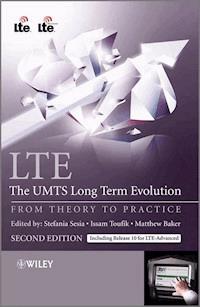
Following on the success of the first edition, this book is fully updated, covering the latest additions to LTE and the key features of LTE-Advanced.
This book builds on the success of its predecessor, offering the same comprehensive system-level understanding built on explanations of the underlying theory, now expanded to include complete coverage of Release 9 and the developing specifications for LTE-Advanced. The book is a collaborative effort of more than 40 key experts representing over 20 companies actively participating in the development of LTE, as well as academia. The book highlights practical implications, illustrates the expected performance, and draws comparisons with the well-known WCDMA/HSPA standards. The authors not only pay special attention to the physical layer, giving an insight into the fundamental concepts of OFDMA-FDMA and MIMO, but also cover the higher protocol layers and system architecture to enable the reader to gain an overall understanding of the system.
Key New Features:
- Comprehensively updated with the latest changes of the LTE Release 8 specifications, including improved coverage of Radio Resource Management RF aspects and performance requirements
- Provides detailed coverage of the new LTE Release 9 features, including: eMBMS, dual-layer beamforming, user equipment positioning, home eNodeBs / femtocells and pico cells and self-optimizing networks
- Evaluates the LTE system performance
- Introduces LTE-Advanced, explaining its context and motivation, as well as the key new features including: carrier aggregation, relaying, high-order MIMO, and Cooperative Multi-Point transmission (CoMP).
- Includes an accompanying website containing a complete list of acronyms related to LTE and LTE-Advanced, with a brief description of each (http://www.wiley.com/go/sesia_theumts)
This book is an invaluable reference for all research and development engineers involved in implementation of LTE or LTE-Advanced, as well as graduate and PhD students in wireless communications. Network operators, service providers and R&D managers will also find this book insightful.
Sie lesen das E-Book in den Legimi-Apps auf:
Seitenzahl: 1339
Veröffentlichungsjahr: 2011
Ähnliche



















Contents
Cover
Half Title page
Title page
Copyright page
Dedication
Editors’ Biographies
List of Contributors
Foreword
Preface to the Second Edition
Acknowledgements
List of Acronyms
Chapter 1: Introduction and Background
1.1 The Context for the Long Term Evolution of UMTS
1.2 Requirements and Targets for the Long Term Evolution
1.3 Technologies for the Long Term Evolution
1.4 From Theory to Practice
References
Part I: Network Architecture and Protocols
Chapter 2: Network Architecture
2.1 Introduction
2.2 Overall Architectural Overview
2.3 Protocol Architecture
2.4 Quality of Service and EPS Bearers
2.5 The E-UTRAN Network Interfaces: S1 Interface
2.6 The E-UTRAN Network Interfaces: X2 Interface
2.7 Summary
References
Chapter 3: Control Plane Protocols
3.1 Introduction
3.2 Radio Resource Control (RRC)
3.3 PLMN and Cell Selection
3.4 Paging
3.5 Summary
References
Chapter 4: User Plane Protocols
4.1 Introduction to the User Plane Protocol Stack
4.2 Packet Data Convergence Protocol (PDCP)
4.3 Radio Link Control (RLC)
4.4 Medium Access Control (MAC)
4.5 Summary of the User Plane Protocols
References
Part II: Physical Layer for Downlink
Chapter 5: Orthogonal Frequency Division Multiple Access (OFDMA)
5.1 Introduction
5.2 OFDM
5.3 OFDMA
5.4 Parameter Dimensioning
5.5 Summary
References
Chapter 6: Introduction to Downlink Physical Layer Design
6.1 Introduction
6.2 Transmission Resource Structure
6.3 Signal Structure
6.4 Introduction to Downlink Operation
References
Chapter 7: Synchronization and Cell Search
7.1 Introduction
7.2 Synchronization Sequences and Cell Search in LTE
7.3 Coherent Versus Non-Coherent Detection
References
Chapter 8: Reference Signals and Channel Estimation
8.1 Introduction
8.2 Design of Reference Signals in the LTE Downlink
8.3 RS-Aided Channel Modelling and Estimation
8.4 Frequency-Domain Channel Estimation
8.5 Time-Domain Channel Estimation
8.6 Spatial-Domain Channel Estimation
8.7 Advanced Techniques
References
Chapter 9: Downlink Physical Data and Control Channels
9.1 Introduction
9.2 Downlink Data-Transporting Channels
9.3 Downlink Control Channels
References
Chapter 10: Link Adaptation and Channel Coding
10.1 Introduction
10.2 Link Adaptation and CQI Feedback
10.3 Channel Coding
10.4 Conclusions
References
Chapter 11: Multiple Antenna Techniques
11.1 Fundamentals of Multiple Antenna Theory
11.2 MIMO Schemes in LTE
11.3 Summary
References
Chapter 12: Multi-User Scheduling and Interference Coordination
12.1 Introduction
12.2 General Considerations for Resource Allocation Strategies
12.3 Scheduling Algorithms
12.4 Considerations for Resource Scheduling in LTE
12.5 Interference Coordination and Frequency Reuse
12.6 Summary
References
Chapter 13: Broadcast Operation
13.1 Introduction
13.2 Broadcast Modes
13.3 Overall MBMS Architecture
13.4 MBMS Single Frequency Network Transmission
13.5 MBMS Characteristics
13.6 Radio Access Protocol Architecture and Signalling
13.7 Public Warning Systems
13.8 Comparison of Mobile Broadcast Modes
References
Part III: Physical Layer for Uplink
Chapter 14: Uplink Physical Layer Design
14.1 Introduction
14.2 SC-FDMA Principles
14.3 SC-FDMA Design in LTE
14.4 Summary
References
Chapter 15: Uplink Reference Signals
15.1 Introduction
15.2 RS Signal Sequence Generation
15.3 Sequence-Group Hopping and Planning
15.4 Cyclic Shift Hopping
15.5 Demodulation Reference Signals (DM-RS)
15.6 Uplink Sounding Reference Signals (SRS)
15.7 Summary
References
Chapter 16: Uplink Physical Channel Structure
16.1 Introduction
16.2 Physical Uplink Shared Data Channel Structure
16.3 Uplink Control Channel Design
16.4 Multiplexing of Control Signalling and UL-SCH Data on PUSCH
16.5 ACK/NACK Repetition
16.6 Multiple-Antenna Techniques
16.7 Summary
References
Chapter 17: Random Access
17.1 Introduction
17.2 Random Access Usage and Requirements in LTE
17.3 Random Access Procedure
17.4 Physical Random Access Channel Design
17.5 PRACH Implementation
17.6 Time Division Duplex (TDD) PRACH
17.7 Concluding Remarks
References
Chapter 18: Uplink Transmission Procedures
18.1 Introduction
18.2 Uplink Timing Control
18.3 Power Control
References
Part IV: Practical Deployment Aspects
Chapter 19: User Equipment Positioning
19.1 Introduction
19.2 Assisted Global Navigation Satellite System (A-GNSS) Positioning
19.3 Observed Time Difference Of Arrival (OTDOA) Positioning
19.4 Cell-ID-based Positioning
19.5 LTE Positioning Protocols
19.6 Summary and Future Techniques
References
Chapter 20: The Radio Propagation Environment
20.1 Introduction
20.2 SISO and SIMO Channel Models
20.3 MIMO Channel Models
20.4 Radio Channel Implementation for Conformance Testing
20.5 Concluding Remarks
References
Chapter 21: Radio Frequency Aspects
21.1 Introduction
21.2 Frequency Bands and Arrangements
21.3 Transmitter RF Requirements
21.4 Receiver RF Requirements
21.5 RF Impairments
21.6 Summary
References
Chapter 22: Radio Resource Management
22.1 Introduction
22.2 Cell Search Performance
22.3 Mobility Measurements
22.4 UE Measurement Reporting Mechanisms and Requirements
22.5 Mobility Performance
22.6 RRC Connection Mobility Control Performance
22.7 Radio Link Monitoring Performance
22.8 Concluding Remarks
References
Chapter 23: Paired and Unpaired Spectrum
23.1 Introduction
23.2 Duplex Modes
23.3 Interference Issues in Unpaired Spectrum
23.4 Half-Duplex System Design Aspects
23.5 Reciprocity
References
Chapter 24: Picocells, Femtocells and Home eNodeBs
24.1 Introduction
24.2 Home eNodeB Architecture
24.3 Interference Management for Femtocell Deployment
24.4 RF Requirements for Small Cells
24.5 Summary
References
Chapter 25: Self-Optimizing Networks
25.1 Introduction
25.2 Automatic Neighbour Relation Function (ANRF)
25.3 Self-Configuration of eNodeB and MME
25.4 Automatic Configuration of Physical Cell Identity
25.5 Mobility Load Balancing Optimization
25.6 Mobility Robustness Optimization
25.7 Random Access CHannel (RACH) Self-Optimization
25.8 Energy Saving
25.9 Emerging New SON Use Cases
References
Chapter 26: LTE System Performance
26.1 Introduction
26.2 Factors Contributing to LTE System Capacity
26.3 LTE Capacity Evaluation
26.4 LTE Coverage and Link Budget
26.5 Summary
References
Part V: LTE-Advanced
Chapter 27: Introduction to LTE-Advanced
27.1 Introduction and Requirements
27.2 Overview of the Main Features of LTE-Advanced
27.3 Backward Compatibility
27.4 Deployment Aspects
27.5 UE Categories for LTE-Advanced
References
Chapter 28: Carrier Aggregation
28.1 Introduction
28.2 Protocols for Carrier Aggregation
28.3 Physical Layer Aspects
28.4 UE Transmitter and Receiver Aspects
28.5 Summary
References
Chapter 29: Multiple Antenna Techniques for LTE-Advanced
29.1 Downlink Reference Signals
29.2 Uplink Reference Signals
29.3 Downlink MIMO Enhancements
29.4 Uplink Multiple Antenna Transmission
29.5 Coordinated MultiPoint (CoMP) Transmission and Reception
29.6 Summary
References
Chapter 30: Relaying
30.1 Introduction
30.2 Theoretical Analysis of Relaying
30.3 Relay Nodes in LTE-Advanced
30.4 Summary
References
Chapter 31: Additional Features of LTE Release 10
31.1 Introduction
31.2 Enhanced Inter-Cell Interference Coordination
31.3 Minimization of Drive Tests
31.4 Machine-Type Communications
References
Chapter 32: LTE-Advanced Performance and Future Developments
32.1 LTE-Advanced System Performance
32.2 Future Developments
References
Index
LTE — The UMTS Long Term Evolution
This edition first published 2011© 2011 John Wiley & Sons Ltd.
Registered officeJohn Wiley & Sons Ltd, The Atrium, Southern Gate, Chichester, West Sussex, PO19 8SQ, United Kingdom
For details of our global editorial offices, for customer services and for information about how to apply for permission to reuse the copyright material in this book please see our website at www.wiley.com.
The rights of the authors to be identified as the authors of this work have been asserted in accordance with the Copyright, Designs and Patents Act 1988.
All rights reserved. No part of this publication may be reproduced, stored in a retrieval system, or transmitted, in any form or by any means, electronic, mechanical, photocopying, recording or otherwise, except as permitted by the UK Copyright, Designs and Patents Act 1988, without the prior permission of the publisher.
Photograph on cover courtesy of Alcatel-Lucent, from the ngConnect LTE-equipped car. 3GPP website reproduced by permission of © 3GPP™.
Wiley also publishes its books in a variety of electronic formats. Some content that appears in print may not be available in electronic books.
Designations used by companies to distinguish their products are often claimed as trademarks. All brand names and product names used in this book are trade names, service marks, trademarks or registered trademarks of their respective owners. The publisher is not associated with any product or vendor mentioned in this book. This publication is designed to provide accurate and authoritative information in regard to the subject matter covered. It is sold on the understanding that the publisher is not engaged in rendering professional services. If professional advice or other expert assistance is required, the services of a competent professional should be sought.
Library of Congress Cataloging-in-Publication Data
Sesia, Stefania.LTE–the UMTS long term evolution : from theory to practice/ Stefania Sesia, Issam Toufik, Matthew Baker.– 2nd ed.p. cm.Includes bibliographical references and index.ISBN 978-0-470-66025-6 (hardback)1. Universal Mobile Telecommunications System. 2. Long-Term Evolution (Telecommunications) I. Toufik, Issam. II. Baker, Matthew (Matthew P.J.) III. Title.TK5103.4883.S47 2011621.3845′6–dc222010039466
A catalogue record for this book is available from the British Library.
Print ISBN: 9780470660256 (H/B)ePDF ISBN: 9780470978511oBook ISBN: 9780470978504epub ISBN: 9780470978641
Dedication
To my family.Stefania Sesia
To my parents for their sacrifices and unconditional love. To my brother and sisters for their love and continual support. To my friends for being what they are.Issam Toufik
To the glory of God, who ‘so loved the world that He gave His only Son, that whoever believes in Him shall not perish but have eternal life’. — The Bible.Matthew Baker
Editors’ Biographies
Matthew Baker holds degrees in Engineering and Electrical and Information Sciences from the University of Cambridge. From 1996 to 2009 he worked at Philips Research where he conducted leading-edge research into a variety of wireless communication systems and techniques, including propagation modelling, DECT, Hiperlan and UMTS, as well as leading the Philips RAN standardization team. He has been actively participating in the standardization of both UMTS WCDMA and LTE in 3GPP since 1999, where he has been active in 3GPP TSG RAN Working Groups 1, 2, 4 and 5, contributing several hundred proposals. He now works for Alcatel-Lucent, which he joined in 2009, and he has been Chairman of 3GPP TSG RAN Working Group 1 since being elected to the post in August of that year. He is the author of several international conference papers and inventor of numerous patents. He is a Chartered Engineer, a Member of the Institution of Engineering and Technology and a Visiting Lecturer at the University of Reading, UK.
Stefania Sesia received her Ph.D. degree in Communication Systems and Coding Theory from both Eurecom (Sophia Antipolis, France) and ENST-Paris (Paris, France) in 2005. From 2002 to 2005 she worked at Motorola Research Labs, Paris, towards her Ph.D. thesis. In June 2005 she joined Philips/NXP Semiconductors (now ST-Ericsson) Research and Development Centre in Sophia Antipolis, France where she was technical leader and responsible for the High Speed Downlink Packet Access algorithm development. She has been participating in 3GPP TSG RAN Working Groups 1 and 4 standardization meetings. From 2007 to 2009 she was on secondment from NXP Semiconductors to the European Telecommunications Standard Institute (ETSI) acting as 3GPP TSG RAN and 3GPP TSG RAN Working Group 4 Technical Officer. She is currently back in ST-Ericsson as senior research and development engineer, actively participating in 3GPP TSG RAN Working Group 4 as a delegate. She is the author of several international IEEE conference and journal papers and many contributions to 3GPP, and inventor of numerous US and European patents.
Issam Toufik graduated in Telecommunications Engineering (majoring in Mobile Communication Systems) in 2002 from both ENST-Bretagne (Brest, France) and Eurecom (Sophia Antipolis, France). In 2006, he received his Ph.D. degree in Communication Systems from Eurecom/ENST-Paris, France. From June to August 2005 he worked for Samsung Advanced Institute of Technology (SAIT), South Korea, as a Research Engineer on LTE. In January 2007, he joined NXP Semiconductors/ST-Ericsson, Sophia Antipolis, France, as a Research and Development Engineer for UMTS and LTE algorithm development. In November 2009, he joined the European Telecommunications Standard Institute (ETSI) acting as 3GPP TSG RAN and 3GPP TSG RAN Working Group 4 Technical Officer. He is the author of several international IEEE conference and journal papers and contributions to 3GPP, and inventor of numerous patents.
List of Contributors
Abe, Tetsushi, NTT DOCOMO
e-mail: abetet@nttdocomo.com
Ancora, Andrea, ST-Ericsson
e-mail: andrea.ancora@stericsson.com
Anderson, Nicholas, Research In Motion
e-mail: nianderson@rim.com
Baker, Matthew, Alcatel-Lucent
e-mail: matthew.baker@alcatel-lucent.com, m.p.j.baker.92@cantab.net
Bertrand, Pierre, Texas Instruments
e-mail: p-bertrand@ti.com
Bhattad, Kapil, Qualcomm
e-mail: kbhattad@qualcomm.com
Bury, Andreas, Blue Wonder Communications
e-mail: andreas.bury@bluwo.com
Chun, SungDuck, LG Electronics
e-mail: duckychun@lge.com
Classon, Brian, Huawei
e-mail: brian.classon@huawei.com
Damnjanovic, Jelena, Qualcomm
e-mail: jelenad@qualcomm.com
Farajidana, Amir, Qualcomm
e-mail: amirf@qualcomm.com
Fischer, Patrick, Bouygues Telecom
e-mail: pfischer@bouyguestelecom.fr
Geirhofer, Stefan, Qualcomm
e-mail: sgeirhofer@qualcomm.com
Gerstenberger, Dirk, Ericsson
e-mail: dirk.gerstenberger@ericsson.com
Gesbert, David, Eurecom
e-mail: david.gesbert@eurecom.fr
Godin, Philippe, Alcatel-Lucent
e-mail: philippe.godin@alcatel-lucent.com
Golitschek, Alexander, Panasonic
e-mail: alexander.golitschek@eu.panasonic.com
Gonsa, Osvaldo, Panasonic
e-mail: osvaldo.gonsa@eu.panasonic.com
Gorokhov, Alex, Qualcomm
e-mail: gorokhov@qualcomm.com
Hardouin, Eric, Orange Labs
e-mail: eric.hardouin@orange-ftgroup.com
Hu, Teck, Alcatel-Lucent
e-mail: teck.hu@alcatel-lucent.com
Hus, Olivier,
e-mail: olivierjhus@gmail.com
Jämsä, Tommi, Elektrobit
e-mail: tommi.jamsa@elektrobit.com
Jiang, Jing, Texas Instruments
e-mail: jing.jiang@ti.com
Kaltenberger, Florian, Eurecom
e-mail: florian.kaltenberger@eurecom.fr
Kazmi, Muhammad, Ericsson
e-mail: muhammad.kazmi@ericsson.com
Knopp, Raymond, Eurecom
e-mail: raymond.knopp@eurecom.fr
Laneman, J. Nicholas, University of Notre Dame
e-mail: jnl@nd.edu
Lee, YoungDae, LG Electronics
e-mail: leego@lge.com
Love, Robert, Motorola Mobility
e-mail: robert.love@motorola.com
Luo, Xiliang, Qualcomm
e-mail: xluo@qualcomm.com
Montojo, Juan, Qualcomm
e-mail: juanm@qualcomm.com
Moulsley, Tim, Fujitsu
e-mail: t.moulsley@btopenworld.com
Nakamura, Takaharu, Fujitsu
e-mail: n.takaharu@jp.fujitsu.com
Nakamura, Takehiro, NTT DOCOMO
e-mail: nakamurata@nttdocomo.co.jp
Nangia, Vijay, Motorola Mobility
e-mail: vijay.nangia@motorola.com
Nimbalker, Ajit, Motorola Mobility
e-mail: aijt.nimbalker@motorola.com
Palat, K. Sudeep, Alcatel-Lucent
e-mail: spalat@alcatel-lucent.com
Payne, Adrian, ERA Technology
e-mail: adrian.w.payne@gmail.com
Ranta-aho, Karri, Nokia Siemens Networks
e-mail: karri.ranta-aho@nsn.com
Rumney, Moray, Agilent
e-mail: moray_rumney@agilent.com
Sälzer, Thomas, Huawei
e-mail: thomas.salzer@huawei.com, thomas.salzer@gmx.de
Sayers, Tony, Ultra Electronics
e-mail: tony.sayers@talktalk.net
Sesia, Stefania, ST-Ericsson
e-mail: stefania.sesia@stericsson.com
Shen, Zukang, CATT
e-mail: shenzukang@catt.cn
Slock, Dirk, Eurecom
e-mail: dirk.slock@eurecom.fr
Suzuki, Hidetoshi, Panasonic
e-mail: Suzuki.Hidetoshi@jp.panasonic.com
Tomatis, Fabrizio, ST-Ericsson
e-mail: fabrizio.tomatis@stericsson.com
Tosato, Filippo, Toshiba
e-mail: filippo.tosato@toshiba-trel.com
Toufik, Issam, ETSI
e-mail: issam.toufik@etsi.org, issam.toufik@eurecom.fr
van der Velde, Himke, Samsung
e-mail: himke.vandervelde@samsung.com
van Rensburg, Cornelius, Huawei
e-mail: cdvanren@ieee.org
Whinnett, Nick, Picochip
e-mail: nickw@picochip.com
Yi, SeungJune, LG Electronics
e-mail: seungjune@lge.com
Ylitalo, Juha, Elektrobit
e-mail: juha.ylitalo@elektrobit.com
Foreword
GSM, and its evolution through GPRS, EDGE, WCDMA and HSPA, is the technology stream of choice for the vast majority of the world’s mobile operators. Users have experienced increasing data rates, together with a dramatic reduction in telecommunications charges; they now expect to pay less but receive more. Therefore, in deciding the next steps, there must be a dual approach: seeking considerable performance improvement but at reduced cost. Improved performance must be delivered through systems which are cheaper to install and maintain. LTE and LTE-Advanced represent these next steps and will be the basis on which future mobile telecommunications systems will be built.
Many articles have already been published on the subject of LTE, varying from doctoral theses to network operator analyses and manufacturers’ product literature. By their very nature, those publications have viewed the subject from one particular perspective, be it academic, operational or promotional. A very different approach is taken with this book. The authors come from a number of different spheres within the mobile telecommunications ecosystem and collectively bring a refreshing variety of perspectives. What binds the authors together is a thorough knowledge of the subject material which they have derived from their long experience within the standards-setting environment, the 31rd Generation Partnership Project (3GPP). LTE discussions started within 3GPP in 2004, so it is not a particularly new subject. In order to fully appreciate the thinking that conceived this technology, however, it is necessary to have followed the subject from the very beginning and to have witnessed the discussions that took place from the outset. Moreover, it is important to understand the thread that links academia, through research to standardization since it is widely acknowledged that by this route impossible dreams become market realities. Considerable research work has taken place to prove the viability of the technical basis on which LTE is founded and it is essential to draw on that research if any attempt is made to explain LTE to a wider audience. The authors of this book have not only followed the LTE story from the beginning but many have also been active players in WCDMA and its predecessors, in which LTE has its roots.
This book provides a thorough, authoritative and complete tutorial of the LTE system, now fully updated and extended to include LTE-Advanced. It gives a detailed explanation of the advances made in our theoretical understanding and the practical techniques that will ensure the success of this ground-breaking new radio access technology. Where this book is exceptional is that the reader will learn not just how LTE works but why it works.
I am confident that this book will earn its rightful place on the desk of anyone who needs a thorough understanding of the LTE and LTE-Advanced technology, the basis of the world’s mobile telecommunications systems for the next decade.
Adrian Scrase, ETSI Vice-President,International Partnership Projects
Preface to the Second Edition
Research workers and engineers toil unceasingly on the development of wireless telegraphy. Where this development can lead, we know not. However, with the results already achieved, telegraphy over wires has been extended by this invention in the most fortunate way. Independent of fixed conductor routes and independent of space, we can produce connections between far-distant places, over far-reaching waters and deserts. This is the magnificent practical invention which has flowered upon one of the most brilliant scientific discoveries of our time!
These words accompanied the presentation of the Nobel Prize for Physics to Guglielmo Marconi in December 1909.
Marconi’s success was the practical and commercial realization of wireless telegraphy – the art of sending messages without wires – thus exploiting for the first time the amazing capability for wireless communication built into our universe. While others worked on wireless telephony – the transmission of audio signals for voice communication – Marconi interestingly saw no need for this. He believed that the transmission of short text messages was entirely sufficient for keeping in touch.
One could be forgiven for thinking that the explosion of wireless voice communication in the intervening years has proved Marconi wrong; but the resurgence of wireless data transmission at the close of the twentieth century, beginning with the mobile text messaging phenomenon, or ‘SMS’, reveals in part the depth of insight Marconi possessed.
Nearly 100 years after Marconi received his Nobel prize, the involvement of thousands of engineers around the world in major standardization initiatives such as the 3rd Generation Partnership Project (3GPP) is evidence that the same unceasing toil of research workers and engineers continues apace.
While the first mobile communications standards focused primarily on voice communication, the emphasis now has returned to the provision of systems optimized for data. This trend began with the 3rd Generation Wideband Code Division Multiple Access (WCDMA) system designed in the 3GPP, and is now reaching fulfilment in its successor, the Long-Term Evolution (LTE). LTE was the first cellular communication system optimized from the outset to support packet-switched data services, within which packetized voice communications are just one part. Thus LTE can truly be said to be the heir to Marconi’s heritage – the system, unknown indeed to the luminaries of his day, to which his developments have led.
LTE is an enabler. It is not technology for technology’s sake, but technology with a purpose, connecting people and information to enable greater things to be achieved. It is already providing higher data rates than ever previously achieved in mobile communications, combined with wide-area coverage and seamless support for mobility without regard for the type of data being transmitted. To provide this level of functionality and flexibility, it is inevitable that the complexities of the LTE system have far surpassed anything Marconi could have imagined.
One aim of this book, therefore, is to chart an explanatory course through the LTE specifications, to support those who design LTE equipment.
The LTE specification documents themselves do not tell the whole story. Essentially they are a record of decisions taken – decisions which are often compromises between performance and cost, theoretical possibility and practical constraints. We aim therefore to give the reader a detailed insight into the evaluations and trade-offs which lie behind the technology choices inherent in LTE. The specifications also continue to develop, as new releases are produced, and this Second Edition is therefore fully updated to cover Release 9 and the first release of LTE-Advanced, Release 10.
Since the first version of LTE was developed, the theoretical understanding which gave rise to LTE has continued to advance, as the ‘unceasing toil’ of thousands of engineers continues with the aim of keeping pace with the explosive growth of mobile data traffic. Where the first version of LTE exploited Multiple-Input Multiple-Output (MIMO) antenna techniques to deliver high data rates, the evolution of LTE towards LTE-Advanced extends such techniques further for both downlink and uplink communication, together with support for yet wider bandwidths; meanwhile, heterogeneous (or hierarchical) networks, relaying and Coordinated MultiPoint (CoMP) transmission and reception start to become relevant in LTE-Advanced.
It is particularly these advances in underlying scientific understanding which this book seeks to highlight.
In selecting the technologies to include in LTE and LTE-Advanced, an important consideration is the trade-off between practical benefit and cost of implementation. Fundamental to this assessment is ongoing enhancement in understanding of the radio propagation environment and scenarios of relevance to deployments of LTE and LTE-Advanced. This has been built on significant advances in radio-channel modelling.
The advances in techniques and theoretical understanding continue to be supported by developments in integrated circuit technology and signal processing power which render them feasible where they would have been unthinkable only a few years ago.
Changes in spectrum availability and regulation also influence the development path of LTE towards LTE-Advanced, reinforcing the need for the new technology to be adaptable, capable of being scaled and enhanced to meet new global requirements and deployed in a wide range of different configurations.
With this breadth and depth in mind, the authorship of the chapters of the second edition of this book is even wider than that of the first edition, and again is drawn from all fields of the ecosystem of research and development that has underpinned the design of LTE. They work in the 3GPP standardization itself, in the R&D departments of companies active in LTE, for network operators as well as equipment manufacturers, in universities and in other collaborative research projects. They are uniquely placed to share their insights from the full range of perspectives.
To borrow Marconi’s words, where LTE and LTE-Advanced will lead, we know not; but we can be sure that these will not be the last developments in wireless telegraphy.
Matthew Baker, Stefania Sesia and Issam Toufik
Acknowledgements
Like the first edition, the fully updated and expanded second edition of this book is first and foremost the fruit of a significant team effort, which would not have been successful without the expertise and professionalism displayed by all the contributors, as well as the support of their companies. The dedication of all the co-authors to their task, their patience and flexibility in allowing us to modify and move certain parts of their material for harmonization purposes, are hereby gratefully acknowledged. Particular thanks are due to ST-Ericsson, Alcatel-Lucent and ETSI for giving us the encouragement and working environment to facilitate such a time-consuming project. The help provided by ETSI, 3GPP and others in authorizing us to reproduce certain copyrighted material is also gratefully acknowledged. We would like to express our gratitude to the many experts who kindly provided advice, feedback, reviews and other valuable assistance. We believe their input in all its forms has made this book a more accurate, valuable and even enjoyable resource. These experts include Jacques Achard, Kevin Baum, Martin Beale, Keith Blankenship, Yufei Blankenship, Federico Boccardi, Kevin Boyle, Sarah Boumendil, Alec Brusilovsky, Paul Bucknell, Richard Burbidge, Aaron Byman, Emilio Calvanese Strinati, Choo Chiap Chiau, Anand Dabak, Peter Darwood, Merouane Debbah, Vip Desai, Marko Falck, Antonella Faniuolo, Jeremy Gosteau, Lajos Hanzo, Lassi Hentilä, Shin Horng Wong, Paul Howard, Howard Huang, Alan Jones, Yoshihisa Kishiyama, Achilles Kogiantis, Pekka Kyösti, Daniel Larsson, Jung-Ah Lee, Thierry Lestable, Gert-Jan van Lieshout, Andrew Lillie, Matti Limingoja, Huiheng Mai, Caroline Mathieson, Darren McNamara, Juha Meinilä, Tarik Muharemovic, Gunnar Nitsche, Jukka-Pekka Nuutinen, SungJun Park, Roope Parviainen, Paul Piggin, Claudio Rey, Safouane Sfar, Ken Stewart, Miloš Tesanovic, Paolo Toccacelli, Ludo Tolhuizen, Li Wang, Tim Wilkinson and Steve Zhang.
We would also like to acknowledge the efforts of all participants in 3GPP who, through innumerable contributions and intense discussions often late into the night, facilitated the completion of the LTE specifications for Releases 8, 9 and 10 in such a short space of time.
We would especially like to thank the publishing team at John Wiley & Sons, especially Tiina Ruonamaa, Susan Barclay, Jasmine Chang, Mariam Cheok, Sheena Deuchars, Caitlin Flint, Sarah Hinton, Anna Smart and Sarah Tilley for their professionalism and extensive support and encouragement throughout the preparation of both the first and second editions of this book.
Finally, it should be noted that this book is intended only as a guide to LTE and LTE-Advanced, and the reader should refer to the specifications published by 3GPP for definitive information. Any views expressed in this book are those of the authors and do not necessarily reflect the views of their companies. The editors welcome any suggestions to improve future editions of this book.
The Editors
List of Acronyms
* An asterisk indicates that the acronym can have different meanings depending on the context. The meaning is clearly indicated in the text when used.
3GPP 3rd Generation Partnership Project
3GPP2 3rd Generation Partnership Project 2
ABS Almost Blank Subframe
AC Access Class
ACI Adjacent Channel Interference
ACIR Adjacent Channel Interference Ratio
ACK Acknowledgement
ACLR Adjacent Channel Leakage Ratio
ACS Adjacent Channel Selectivity
ADC Analogue to Digital Converter
ADSL Asymmetric Digital Subscriber Line
AGI Antenna Gain Imbalance
A-GNSS Assisted Global Navigation Satellite System
AM Acknowledged Mode
AMC Adaptive Modulation and Coding
AMPS Analogue Mobile Phone System
AMR Adaptive MultiRate
ANR Automatic Neighbour Relation
ANRF Automatic Neighbour Relation Function
AoA Angle-of-Arrival
AoD Angle-of-Departure
APN Access Point Name
APP A-Posteriori Probability
ARFCN Absolute Radio Frequency Channel Number
ARIB Association of Radio Industries and Businesses
ARP Almost Regular Permutation*
ARP Allocation and Retention Priority*
ARQ Automatic Repeat reQuest
AS Access Stratum*
AS Angular Spread*
A-SEM Additional SEM
ATDMA Advanced TDMA
ATIS Alliance for Telecommunications Industry Solutions
AuC Authentication Centre
AWGN Additive White Gaussian Noise
BCC Base station Colour Code
BCH Broadcast CHannel
BCCH Broadcast Control CHannel
BCJR Algorithm named after its inventors, Bahl, Cocke, Jelinek and Raviv
BER Bit Error Rate
BLER BLock Error Rate
BM-SC Broadcast-Multicast Service Centre
BP Belief Propagation
BPRE Bits Per Resource Element
bps bits per second
BPSK Binary Phase Shift Keying
BSIC Base Station Identification Code
BSR Buffer Status Reports
CAPEX CAPital EXpenditure
CAZAC Constant Amplitude Zero AutoCorrelation
CB Circular Buffer
CBF Coordinated Beamforming
CC Component Carrier
CCCH Common Control CHannel
CCE Control Channel Element
CCI Co-Channel Interference
CCO Cell Change Order
Lesen Sie weiter in der vollständigen Ausgabe!
Lesen Sie weiter in der vollständigen Ausgabe!
Lesen Sie weiter in der vollständigen Ausgabe!
Lesen Sie weiter in der vollständigen Ausgabe!
Lesen Sie weiter in der vollständigen Ausgabe!
Lesen Sie weiter in der vollständigen Ausgabe!
Lesen Sie weiter in der vollständigen Ausgabe!
Lesen Sie weiter in der vollständigen Ausgabe!
Lesen Sie weiter in der vollständigen Ausgabe!
Lesen Sie weiter in der vollständigen Ausgabe!
Lesen Sie weiter in der vollständigen Ausgabe!
Lesen Sie weiter in der vollständigen Ausgabe!
Lesen Sie weiter in der vollständigen Ausgabe!
Lesen Sie weiter in der vollständigen Ausgabe!
Lesen Sie weiter in der vollständigen Ausgabe!
Lesen Sie weiter in der vollständigen Ausgabe!
Lesen Sie weiter in der vollständigen Ausgabe!
Lesen Sie weiter in der vollständigen Ausgabe!
Lesen Sie weiter in der vollständigen Ausgabe!
Lesen Sie weiter in der vollständigen Ausgabe!
Lesen Sie weiter in der vollständigen Ausgabe!
Lesen Sie weiter in der vollständigen Ausgabe!
Lesen Sie weiter in der vollständigen Ausgabe!
Lesen Sie weiter in der vollständigen Ausgabe!
Lesen Sie weiter in der vollständigen Ausgabe!
Lesen Sie weiter in der vollständigen Ausgabe!
Lesen Sie weiter in der vollständigen Ausgabe!
Lesen Sie weiter in der vollständigen Ausgabe!
Lesen Sie weiter in der vollständigen Ausgabe!
Lesen Sie weiter in der vollständigen Ausgabe!
Lesen Sie weiter in der vollständigen Ausgabe!
Lesen Sie weiter in der vollständigen Ausgabe!
Lesen Sie weiter in der vollständigen Ausgabe!
Lesen Sie weiter in der vollständigen Ausgabe!
Lesen Sie weiter in der vollständigen Ausgabe!
Lesen Sie weiter in der vollständigen Ausgabe!
Lesen Sie weiter in der vollständigen Ausgabe!
Lesen Sie weiter in der vollständigen Ausgabe!




