


18,49 €
Mehr erfahren.
- Herausgeber: Nick Hern Books
- Kategorie: Poesie und Drama
- Serie: NHB Modern Plays
- Sprache: Englisch
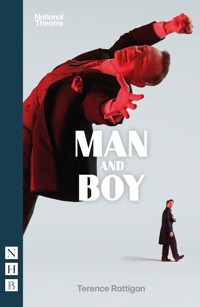
'In finance, man makes his own miracles.' Jazz, Broadway and the Great Depression. In 1930s New York City, international financier Gregor Antonescu's luck has finally run out. As news of a catastrophic business deal ripples across the world, he flees to the apartment of his estranged son Basil. There, Gregor will need all of his ruthlessness and ingenuity to save his reputation and keep his empire from collapse. But will he risk using his only son as a pawn in one last power play? A sharp and gripping tale of paternity and corruption, Terence Rattigan's play Man and Boy was first performed in London in 1963. This edition was published alongside a revival at the National Theatre, London, in 2026. It features Rattigan's final version of the play, with an authoritative introduction by Rattigan scholar Dan Rebellato and an afterword by Anthony Lau, director of the revival.
Das E-Book können Sie in Legimi-Apps oder einer beliebigen App lesen, die das folgende Format unterstützen:
Seitenzahl: 263
Veröffentlichungsjahr: 2026













Terence Rattigan
MAN AND BOY
Introduced by Dan Rebellato
NICK HERN BOOKS
London
www.nickhernbooks.co.uk
Contents
Introduction
Terence Rattigan
Man and Boy
Production History
Man and Boy
Afterword
About the Author
Copyright and Performing Rights Information
Terence Rattigan (1911–1977)
Terence Rattigan stood on the steps of the Royal Court Theatre, on 8 May 1956, after the opening night of John Osborne’s LookBack in Anger. Asked by a reporter what he thought of the play, he replied, with an uncharacteristic lack of discretion, that it should have been retitled ‘Look how unlike Terence Rattigan I’m being.’1 And he was right. The great shifts in British theatre, marked by Osborne’s famous premiere, ushered in kinds of playwriting which were specifically unlike Rattigan’s work. The pre-eminence of playwriting as a formal craft, the subtle tracing of the emotional lives of the middle classes – those techniques which Rattigan so perfected – fell dramatically out of favour, creating a veil of prejudice through which his work even now struggles to be seen.
Terence Mervyn Rattigan was born on 10 June 1911, a wet Saturday a few days before George V’s coronation. His father, Frank, was in the diplomatic corps and Terry’s parents were often posted abroad, leaving him to be raised by his paternal grandmother. Frank Rattigan was a geographically and emotionally distant man, who pursued a string of little disguised affairs throughout his marriage. Rattigan would later draw on these memories when he created Mark St Neots, the bourgeois Casanova of Who is Sylvia? Rattigan was much closer to his mother, Vera Rattigan, and they remained close friends until her death in 1971.
Rattigan’s parents were not great theatregoers, but Frank Rattigan’s brother had married a Gaiety Girl, causing a minor family uproar, and an apocryphal story suggests that the ‘indulgent aunt’ reported as taking the young Rattigan to the theatre may have been this scandalous relation.2 And when, in the summer of 1922, his family went to stay in the country cottage of the drama critic Hubert Griffiths, Rattigan avidly worked through his extensive library of playscripts. Terry went to Harrow in 1925, and there maintained both his somewhat illicit theatregoing habit and his insatiable reading, reputedly devouring every play in the school library. Apart from contemporary authors like Galsworthy, Shaw and Barrie, he also read the plays of Chekhov, a writer whose crucial influence he often acknowledged.3
His early attempts at writing, while giving little sign of his later sophistication, do indicate his ability to absorb and reproduce his own theatrical experiences. There was a ten-minute melodrama about the Borgias entitled The Parchment, on the cover of which the author recommends with admirable conviction that a suitable cast for this work might comprise ‘Godfrey Tearle, Gladys Cooper, Marie Tempest, Matheson Lang, Isobel Elsom, Henry Ainley… [and] Noël Coward’.4 At Harrow, when one of his teachers demanded a French playlet for a composition exercise, Rattigan, undaunted by his linguistic shortcomings, produced a full-throated tragedy of deception, passion and revenge which included the immortal curtain line: ‘COMTESSE. (Souffrant terriblement.) Non! non! non! Ah non! Mon Dieu, non!’5 His teacher’s now famous response was ‘French execrable: theatre sense first class’.6 A year later, aged fifteen, he wrote The Pure in Heart, a rather more substantial play showing a family being pulled apart by a son’s crime and the father’s desire to maintain his reputation. Rattigan’s ambitions were plainly indicated on the title pages, each of which announced the author to be ‘the famous playwrite and author T. M. Rattigan.’7
Frank Rattigan was less than keen on having a ‘playwrite’ for a son and was greatly relieved when in 1930, paving the way for a life as a diplomat, Rattigan gained a scholarship to read History at Trinity, Oxford. But Rattigan’s interests were entirely elsewhere. A burgeoning political conscience that had led him to oppose the compulsory Officer Training Corps parades at Harrow saw him voice pacifist and socialist arguments at college, even supporting the controversial Oxford Union motion ‘This House will in no circumstances fight for its King and Country’ in February 1933. The rise of Hitler (which he briefly saw close at hand when he spent some weeks in the Black Forest in July 1933) and the outbreak of the Spanish Civil War saw his radical leanings deepen and intensify. Rattigan never lost his political compassion. After the war he drifted towards the Liberal Party, but he always insisted that he had never voted Conservative, despite the later conception of him as a Tory playwright of the establishment.8
Away from the troubled atmosphere of his family, Rattigan began to gain in confidence as the contours of his ambitions and his identity moved more sharply into focus. He soon took advantage of the university’s theatrical facilities and traditions. He joined the Oxford Union Dramatic Society (OUDS), where contemporaries included Giles Playfair, George Devine, Peter Glenville, Angus Wilson and Frith Banbury. Each year, OUDS ran a one-act play competition and in Autumn 1931 Rattigan submitted one. Unusually, it seems that this was a highly experimental effort, somewhat like Konstantin’s piece in TheSeagull. George Devine, the OUDS president, apparently told the young author, ‘Some of it is absolutely smashing, but it goes too far.’9 Rattigan was instead to make his first mark as a somewhat scornful reviewer for the student newspaper, Cherwell, and as a performer in the Smokers (OUDS’s private revue club), where he adopted the persona and dress of ‘Lady Diana Coutigan’, a drag performance which allowed him to discuss leading members of the Society with a barbed camp wit.10
That the name of his Smokers persona echoed the contemporary phrase, ‘queer as a coot’, indicates Rattigan’s new-found confidence in his homosexuality. In February 1932, Rattigan played a tiny part in the OUDS production of Romeo and Juliet, which was directed by John Gielgud and starred Peggy Ashcroft and Edith Evans (women undergraduates were not admitted to OUDS, and professional actresses were often recruited). Rattigan’s failure to deliver his one line correctly raised an increasingly embarrassing laugh every night (an episode which he reuses to great effect in Harlequinade). However, out of this production came a friendship with Gielgud and his partner, John Perry. Through them, Rattigan was introduced to theatrical and homosexual circles, where his youthful ‘school captain’ looks were much admired.
A growing confidence in his sexuality and in his writing led to his first major play. In 1931, he shared rooms with a contemporary of his, Philip Heimann, who was having an affair with Irina Basilevich, a mature student. Rattigan’s own feelings for Heimann completed an eternal triangle that formed the basis of the play he co-wrote with Heimann, First Episode. This play was accepted for production in Surrey’s ‘Q’ theatre; it was respectfully received and subsequently transferred to the Comedy Theatre in London’s West End, though carefully shorn of its homosexual subplot. Despite receiving only £50 from this production (and having put £200 into it), Rattigan immediately dropped out of college to become a full-time writer.
Frank Rattigan was displeased by this move, but made a deal with his son. He would give him an allowance of £200 a year for two years and let him live at home to write; if at the end of that period, he had had no discernible success, he would enter a more secure and respectable profession. With this looming deadline, Rattigan wrote quickly. Black Forest, an O’Neill inspired play based on his experiences in Germany in 1933, is one of the three that have survived. Rather unwillingly, he collaborated with Hector Bolitho on an adaptation of the latter’s novel, Grey Farm, which received a disastrous New York production in 1940. Another project was an adaptation of ATale of Two Cities, written with Gielgud; this fell through at the last minute when Donald Albery, the play’s potential producer, received a complaint from actor-manager John Martin-Harvey who was beginning a farewell tour of his own adaptation, TheOnly Way, which he had been performing for forty-five years. As minor compensation, Albery invited Rattigan to send him any other new scripts. Rattigan sent him a play provisionally titled Gone Away, based on his experiences in a French language summer school in 1931. Albery took out a nine-month option on it, but no production appeared.
By mid-1936, Rattigan was despairing. His father had secured him a job with Warner Brothers as an in-house screenwriter, which was reasonably paid; but Rattigan wanted success in the theatre, and his desk-bound life at Teddington Studios seemed unlikely to advance this ambition. By chance, one of Albery’s productions was unexpectedly losing money, and the wisest course of action seemed to be to pull the show and replace it with something cheap. Since Gone Away required a relatively small cast and only one set, Albery quickly arranged for a production. Harold French, the play’s director, had only one qualm: the title. Rattigan suggested French Without Tears, which was immediately adopted.
After an appalling dress rehearsal, no one anticipated the rapturous response of the first-night audience, led by Cicely Courtneidge’s infectious laugh. The following morning Kay Hammond, the show’s female lead, discovered Rattigan surrounded by the next day’s reviews. ‘But I don’t believe it,’ he said. ‘Even The Times likes it.’11
French Without Tears played over 1000 performances in its three year run and Rattigan was soon earning £100 a week. He moved out of his father’s home, wriggled out of his Warner Brothers contract, and dedicated himself to spending the money as soon as it came in. Partly this was an attempt to defer the moment when he had to follow up this enormous success. In the event, both of his next plays were undermined by the outbreak of war.
After the Dance, an altogether more bleak indictment of the Bright Young Things’ failure to engage with the iniquities and miseries of contemporary life, opened, in June 1939, to euphoric reviews; but only a month later the European crisis was darkening the national mood and audiences began to dwindle. The play was pulled in August after only sixty performances. Follow My Leader was a satirical farce closely based on the rise of Hitler, co-written with an Oxford contemporary, Tony Goldschmidt (writing as Anthony Maurice in case anyone thought he was German). It suffered an alternative fate. Banned from production in 1938, owing to the Foreign Office’s belief that ‘the production of this play at this time would not be in the best interests of the country’,12 it finally received its premiere in 1940, by which time Rattigan and Goldschmidt’s mild satire failed to capture the real fears that the war was unleashing in the country.
Rattigan’s insecurity about writing now deepened. An interest in Freud, dating back to his Harrow days, encouraged him to visit a psychiatrist that he had known while at Oxford, Dr Keith Newman. Newman exerted a Svengali-like influence on Rattigan and persuaded the pacifist playwright to join the RAF as a means of curing his writer’s block. Oddly, this unorthodox treatment seemed to have some effect; by 1941, Rattigan was writing again. On one dramatic sea crossing, an engine failed, and with everyone forced to jettison all excess baggage and possessions, Rattigan threw the hard covers and blank pages from the notebook containing his new play, stuffing the precious manuscript into his jacket.
Rattigan drew on his RAF experiences to write a new play, Flare Path. Bronson Albery and Bill Linnit who had supported French Without Tears both turned the play down, believing that the last thing that the public wanted was a play about the war.13 H. M. Tennent Ltd., led by the elegant Hugh ‘Binkie’ Beaumont, was the third management offered the script; and in 1942, Flare Path opened in London, eventually playing almost 700 performances. Meticulously interweaving the stories of three couples against the backdrop of wartime uncertainty, Rattigan found himself a box-office success. Beaumont, already on the way to becoming the most powerful and successful West End producer of the era, was an influential ally for Rattigan. There is a curious side-story to this production; Dr Keith Newman decided to watch 250 performances of this play and write up the insights that his ‘serial attendance’ had afforded him. George Bernard Shaw remarked that such playgoing behaviour ‘would have driven me mad; and I am not sure that [Newman] came out of it without a slight derangement’. Shaw’s caution was wise.14 In late 1945, Newman went insane and eventually died in a psychiatric hospital.
Meanwhile, Rattigan had achieved two more successes; the witty farce, While the Sun Shines, and the more serious, though politically clumsy, Love in Idleness (retitled O Mistress Mine in America). He had also co-written a number of successful films, including The Day Will Dawn, Uncensored, The Way tothe Stars and an adaptation of French Without Tears. By the end of 1944, Rattigan had three plays running in the West End, a record only beaten by Somerset Maugham’s four in 1908.
Love in Idleness was dedicated to Henry ‘Chips’ Channon, the Tory MP who had become Rattigan’s lover. Channon’s otherwise gossipy diaries record their meeting very discreetly: ‘I dined with Juliet Duff in her little flat… also there, Sibyl Colefax and Master Terence Rattigan, and we sparkled over the Burgundy. I like Rattigan enormously, and feel a new friendship has begun. He has a flat in Albany.’15 Tom Driberg’s rather less discreet account fleshes out the story: Channon’s ‘seduction of the playwright was almost like the wooing of Danaë by Zeus – every day the playwright found, delivered to his door, a splendid present – a case of champagne, a huge pot of caviar, a Cartier cigarette box in two kinds of gold… In the end, of course, he gave in, saying apologetically to his friends, “How can one not?”.’16 It was a very different set in which Rattigan now moved, one that was wealthy and conservative, the very people he had criticised in After the Dance. Rattigan did not share the complacency of many of his friends, and his next play revealed a deepening complexity and ambition.
For a long time, Rattigan had nurtured a desire to become respected as a serious writer; the commercial success of FrenchWithout Tears had, however, sustained the public image of Rattigan as a wealthy, young, light-comedy writer-about-town.17 With The Winslow Boy, which premiered in 1946, Rattigan began to turn this image around. In doing so he entered a new phase as a playwright. As one contemporary critic observed, this play ‘put him at once into the class of the serious and distinguished writer’.18 The play, based on the Archer-Shee case in which a family attempted to sue the Admiralty for a false accusation of theft against their son, featured some of Rattigan’s most elegantly crafted and subtle characterisation yet. The famous second curtain, when the barrister Robert Morton subjects Ronnie Winslow to a vicious interrogation before announcing that ‘The boy is plainly innocent. I accept the brief’, brought a joyous standing ovation on the first night. No less impressive is the subtle handling of the concept of ‘justice’ and ‘rights’ through the play of ironies which pits Morton’s liberal complacency against Catherine Winslow’s feminist convictions.
Two years later, Rattigan’s Playbill, comprising the one-act plays The Browning Version and Harlequinade, showed an ever deepening talent. The latter is a witty satire of the kind of touring theatre encouraged by the new Committee for the Encouragement of Music and Arts (CEMA, the immediate forerunner of the Arts Council). But the former’s depiction of a failed, repressed Classics teacher evinced an ability to choreograph emotional subtleties on stage that outstripped anything Rattigan had yet demonstrated.
Adventure Story, which in 1949 followed hard on the heels of Playbill, was less successful. An attempt to dramatise the emotional dilemmas of Alexander the Great, Rattigan seemed unable to escape the vernacular of his own circle, and the epic scheme of the play sat oddly with Alexander’s more prosaic concerns.
Rattigan’s response to both the critical bludgeoning of this play and the distinctly lukewarm reception of Playbill on Broadway was to write a somewhat extravagant article for the New Statesman. ‘Concerning the Play of Ideas’ was a desire to defend the place of ‘character’ against those who would insist on the pre-eminence in drama of ideas.19 The essay is not clear and is couched in such teasing terms that it is at first difficult to see why it should have secured such a fervent response. James Bridie, Benn Levy, Peter Ustinov, Sean O’Casey, Ted Willis, Christopher Fry and finally George Bernard Shaw all weighed in to support or condemn the article. Finally Rattigan replied in slightly more moderate terms to these criticisms insisting (and the first essay reasonably supports this) that he was not calling for the end of ideas in the theatre, but rather for their inflection through character and situation.20 However, the damage was done (as, two years later, with his ‘Aunt Edna’, it would again be done). Rattigan was increasingly being seen as the arch proponent of commercial vacuity.21
The play Rattigan had running at the time added weight to his opponents’ charge. Originally planned as a dark comedy, Who isSylvia? became a rather more frivolous thing both in the writing and the playing. Rattled by the failure of Adventure Story, and superstitiously aware that the new play was opening at the Criterion, where fourteen years before French Without Tears had been so successful, Rattigan and everyone involved in the production had steered it towards light farce and obliterated the residual seriousness of the original conceit.
Rattigan had ended his affair with Henry Channon and taken up with Kenneth Morgan, a young actor who had appeared in Follow My Leader and the film of French Without Tears.
However, the relationship had not lasted and Morgan had for a while been seeing someone else. Rattigan’s distress was compounded one day in February 1949, when he received a message that Morgan had killed himself. Although horrified, Rattigan soon began to conceive an idea for a play. Initially it was to have concerned a homosexual relationship, but Beaumont, his producer, persuaded him to change the relationship to a heterosexual one.22 At a time when the Lord Chamberlain refused to allow any plays to be staged that featured homosexuality, such a proposition would have been a commercial impossibility. The result is one of the finest examples of Rattigan’s craft. The story of Hester Collyer, trapped in a relationship with a man incapable of returning her love, and her transition from attempted suicide to groping, uncertain self-determination is handled with extraordinary economy, precision and power. The depths of despair and desire that Rattigan plumbs have made The Deep Blue Sea one of his most popular and moving pieces.
1953 saw Rattigan’s romantic comedy The Sleeping Prince, planned as a modest, if belated, contribution to the Coronation festivities. However, the project was hypertrophied by the insistent presence of Laurence Olivier and Vivien Leigh in the cast and the critics were disturbed to see such whimsy from the author of The Deep Blue Sea.
Two weeks after its opening, the first two volumes of Rattigan’s Collected Plays were published. The preface to the second volume introduced one of Rattigan’s best-known, and most notorious creations: Aunt Edna. ‘Let us invent,’ he writes, ‘a character, a nice respectable, middle-class, middle-aged, maiden lady, with time on her hands and the money to help her pass it.’23 Rattigan paints a picture of this eternal theatregoer, whose bewildered disdain for modernism (‘Picasso – “those dreadful reds, my dear, and why three noses?”’)24 make up part of the particular challenge of dramatic writing. The intertwined commercial and cultural pressures that the audience brings with it exert considerable force on the playwright’s work.
Rattigan’s creation brought considerable scorn upon his head. But Rattigan is neither patronising nor genuflecting towards Aunt Edna. The whole essay is aimed at demonstrating the crucial role of the audience in the theatrical experience. Rattigan’s own sense of theatre was learned as a member of the audience, and he refuses to distance himself from this woman: ‘despite my already self-acknowledged creative ambitions I did not in the least feel myself a being apart. If my neighbours gasped with fear for the heroine when she was confronted with a fate worse than death, I gasped with them’.25 But equally, he sees his job as a writer to engage in a gentle tug-of-war with the audience’s expectations: ‘although Aunt Edna must never be made mock of, or bored, or befuddled, she must equally not be wooed, or pandered to or cosseted’.26 The complicated relation between satisfying and surprising this figure may seem contradictory, but as Rattigan notes, ‘Aunt Edna herself is indeed a highly contradictory character.’27
But Rattigan’s argument, as in the ‘Play of Ideas’ debate before it, was taken to imply an insipid pandering to the unchallenging expectations of his audience. Aunt Edna dogged his career from that moment on and she became such a byword for what theatre should not be that in 1960, the Questors Theatre, Ealing, could title a triple-bill of Absurdist plays, ‘Not For Aunt Edna’.28
Rattigan’s next play did help to restore his reputation as a serious dramatist. Separate Tables was another double bill, set in a small Bournemouth hotel. The first play develops Rattigan’s familiar themes of sexual longing and humiliation while the second pits a man found guilty of interfering with women in a local cinema against the self-appointed moral jurors in the hotel. The evening was highly acclaimed and the subsequent Broadway production a rare American success.
However, Rattigan’s reign as the leading British playwright was about to be brought to an abrupt end. In a car from Stratford to London, early in 1956, Rattigan spent two and a half hours informing his Oxford contemporary George Devine why the new play he had discovered would not work in the theatre. When Devine persisted, Rattigan answered ‘Then I know nothing about plays.’ To which Devine replied, ‘You know everything about plays, but you don’t know a fucking thing about Look Back in Anger.’29 Rattigan only barely attended the first night. He and Hugh Beaumont wanted to leave at the interval until the critic T. C. Worsley persuaded them to stay.30
The support for the English Stage Company’s initiative was soon overwhelming. Osborne’s play was acclaimed by the influential critics Kenneth Tynan and Harold Hobson, and the production was revived frequently at the Court, soon standing as the banner under which that disparate band of men (and women), the Angry Young Men, would assemble. Like many of his contemporaries, Rattigan decried the new movements, Beckett and Ionesco’s turn from Naturalism, the wild invective of Osborne, the passionate socialism of Wesker, the increasing influence of Brecht. His opposition to them was perhaps intemperate, but he knew what was at stake: ‘I may be prejudiced, but I’m pretty sure it won’t survive,’ he said in 1960, ‘I’m prejudiced because if it does survive, I know I won’t.’31
Such was the power and influence of the new movement that Rattigan almost immediately seemed old-fashioned. And from now on, his plays began to receive an almost automatic panning. His first play since Separate Tables (1954) was Variation on a Theme (1958). But between those dates the critical mood had changed. To make matters worse, there was the widely publicised story that nineteen-year-old Shelagh Delaney had written the successful A Taste of Honey in two weeks after having seen Variation on a Theme and deciding that she could do better. A more sinister aspect of the response was the increasingly open accusation that Rattigan was dishonestly concealing a covert homosexual play within an apparently heterosexual one. The two champions of Osborne’s play, Tynan and Hobson, were joined by Gerard Fay in the ManchesterGuardian and Alan Brien in the Spectator to ask ‘Are Things What They Seem?’32
When he is not being attacked for smuggling furtively homosexual themes into apparently straight plays, Rattigan is also criticised for lacking the courage to ‘come clean’ about his sexuality, both in his life and in his writing.33 But neither of these criticisms really hit the mark. On the one hand, it is rather disingenuous to suggest that Rattigan should have ‘come out’. The 1950s were a difficult time for homosexual men. The flight to the Soviet Union of Burgess and Maclean in 1951 sparked off a major witch-hunt against homosexuals, especially those in prominent positions. Cecil Beaton and Benjamin Britten were rumoured to be targets.34 The police greatly stepped up the investigation and entrapment of homosexuals and prosecutions rose dramatically at the end of the forties, reaching a peak in 1953–4. One of their most infamous arrests for importuning, in October 1953, was that of John Gielgud.35
But neither is it quite correct to imply that somehow Rattigan’s plays are really homosexual. This would be to misunderstand the way that homosexuality figured in the forties and early fifties. Wartime London saw a considerable expansion in the number of pubs and bars where homosexual men (and women) could meet. This network sustained a highly sophisticated system of gestural and dress codes, words and phrases that could be used to indicate one’s sexual desires, many of them drawn from theatrical slang. But the illegality of any homosexual activity ensured that these codes could never become too explicit, too clear. Homosexuality, then, was explored and experienced through a series of semi-hidden, semi-open codes of behaviour; the image of the iceberg, with the greater part of its bulk submerged beneath the surface, was frequently employed.36 And this image is, of course, one of the metaphors often used to describe Rattigan’s own playwriting.
Reaction came in the form of a widespread paranoia about the apparent increase in homosexuality. The fifties saw a major drive to seek out, understand, and often ‘cure’ homosexuality. The impetus of these investigations was to bring the unspeakable and underground activities of, famously, ‘Evil Men’ into the open, to make it fully visible. The Wolfenden Report of 1957 was, without doubt, a certain kind of liberalising document in its recommendation that consensual sex between adult men in private be legalised. However the other side of its effect is to reinstate the integrity of those boundaries – private/public, hidden/exposed, homosexual/heterosexual – which homosexuality was broaching. The criticisms of Rattigan are precisely part of this same desire to divide, clarify and expose.
Many of Rattigan’s plays were originally written with explicit homosexual characters (French Without Tears, TheDeep Blue Sea and Separate Tables, for example), which he then changed.37 But many more of them hint at homosexual experiences and activities: the relationship between Tony and David in First Episode, the Major in Follow My Leader who is blackmailed over an incident in Baghdad (‘After all,’ he explains, ‘a chap’s only human, and it was a deuced hot night – ’),38 the suspiciously polymorphous servicemen of While the Sun Shines, Alexander the Great and T. E. Lawrence from Adventure Story and Ross, Mr Miller in The Deep BlueSea and several others. Furthermore, rumours of Rattigan’s own bachelor life circulated fairly widely. As indicated above, Rattigan always placed great trust in the audiences of his plays, and it was the audience that had to decode and reinterpret these plays. His plays cannot be judged by the criterion of ‘honesty’ and ‘explicitness’ that obsessed a generation after Osborne. They are plays which negotiate sexual desire through structures of hint, implications and metaphor. As David Rudkin has suggested, ‘the craftsmanship of which we hear so much loose talk seems to me to arise from deep psychological necessity, a drive to organise the energy that arises out of his own pain. Not to batten it down but to invest it with some expressive clarity that speaks immediately to people, yet keeps itself hidden.’39
The shifts in the dominant view of both homosexuality and the theatre that took place in the fifties account for the brutal decline of Rattigan’s career. He continued writing, and while Ross (1960) was reasonably well received, his ill-judged musical adaptation of French Without Tears, Joie de Vivre (1960), was a complete disaster, not assisted by a liberal bout of laryngitis among the cast, and the unexpected insanity of the pianist.40 It ran for four performances.
During the sixties, Rattigan was himself dogged with ill-health: pneumonia and hepatitis were followed by leukaemia. When his death conspicuously failed to transpire, this last diagnosis was admitted to be incorrect. Despite this, he continued to write, producing the successful television play Heart to Heart in 1962, and the stage play Man and Boy the following year, which received the same sniping that greeted Variation on a Theme. In 1964, he wrote Nelson – a Portrait in Miniature for Associated Television, as part of a short season of his plays.
It was at this point that Rattigan decided to leave Britain and live abroad. Partly this decision was taken for reasons of health; but partly Rattigan just seemed no longer to be welcome. Ironically, it was the same charge being levelled at Rattigan that he had faced in the thirties, when the newspapers thundered against the those who had supported the Oxford Union’s pacifist motion as ‘woolly-minded Communists, practical jokers and sexual indeterminates’.41 As he confessed in an interview late in his life, ‘Overnight almost, we were told we were old-fashioned and effete and corrupt and finished, and… I somehow accepted Tynan’s verdict and went off to Hollywood to write film scripts.’42 In 1967 he moved to Bermuda as a tax exile. A stage adaptation of his Nelson play, as Bequest to the Nation, had a lukewarm reception.
Rattigan had a bad sixties, but his seventies seemed to indicate a turnaround in his fortunes and reputation. At the end of 1970, a successful production of The Winslow Boy was the first of ten years of acclaimed revivals. In 1972, Hampstead Theatre revived While the Sun Shines, and a year later the Young Vic was praised for its French Without Tears. In 1976 and 1977 The BrowningVersion was revived at the King’s Head and Separate Tables at the Apollo. Rattigan briefly returned to Britain in 1971, pulled partly by his renewed fortune and partly by the fact that he was given a knighthood in the New Year’s honours list. Another double bill followed in 1973: In Praise of Love comprised the weak Before Dawn and the moving tale of emotional concealment and creativity, After Lydia. Critical reception was more respectful than usual, although the throwaway farce of the first play detracted from the quality of the second.
Cause Célèbre, commissioned by BBC Radio and others, concerned the Rattenbury case, in which Alma Rattenbury’s aged husband was beaten to death by her eighteen-year-old lover. Shortly after its radio premiere, Rattigan was diagnosed with bone cancer. Rattigan’s response, having been through the false leukaemia scare in the early sixties, was to greet the news with unruffled elegance, welcoming the opportunity to ‘work harder and indulge myself more’.43 The hard work included a play about the Asquith family and a stage adaptation of CauseCélèbre, but, as production difficulties began to arise over the latter, the Asquith play slipped out of Rattigan’s grasp. Although very ill, he returned to Britain, and on 4 July 1977, he was taken by limousine from his hospital bed to Her Majesty’s Theatre, where he watched his last ever premiere. A fortnight later he had a car drive him around the West End where two of his plays were then running before boarding the plane for the last time. On 30 November 1977, in Bermuda, he died.
As Michael Billington’s perceptive obituary noted, ‘his whole work is a sustained assault on English middle-class values: fear of emotional commitment, terror in the face of passion, apprehension about sex’.44 In death, Rattigan began once again to be seen as someone critically opposed to the values with which he had so long been associated, a writer dramatising dark moments of bleak compassion and aching desire.
Notes
1. Quoted in Rattigan’s Daily Telegraph obituary (1 December 1977).
2. Michael Darlow and Gillian Hodson. Terence Rattigan: The Man andHis Work. London and New York: Quartet Books, 1979, p. 26.
3. See, for example, Sheridan Morley. ‘Terence Rattigan at 65.’ The Times. (9 May 1977).
4. Terence Rattigan. Preface. The Collected Plays of Terence Rattigan:Volume Tw




