


19,99 €
Mehr erfahren.
- Herausgeber: Nick Hern Books
- Kategorie: Poesie und Drama
- Sprache: Englisch
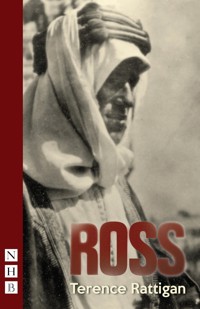
Terence Rattigan's epic and probing drama about the man immortalised as Lawrence of Arabia. Arrogant, flippant, withdrawn and with a talent for self-concealment, the mysterious Aircraftman Ross seems an odd recruit for the Royal Air Force. In fact the truth is even stranger than the man himself. Behind the false name is an enigma, a man named Lawrence who started as a civilian in the Map Office in 1914 and went on to mastermind some of the most audacious military victories in the history of the British Army. These victories earned him an enduring and romantic nom de guerre: Lawrence of Arabia. Rattigan's 1960 play reveals the unusual and deeply conflicted Englishman behind the heroic legend. This edition, with an Introduction by Dan Rebellato, was published alongside the revival at the Chichester Festival Theatre in 2016, directed by Adrian Noble and starring Joseph Fiennes as Ross.
Das E-Book können Sie in Legimi-Apps oder einer beliebigen App lesen, die das folgende Format unterstützen:
Veröffentlichungsjahr: 2016
Ähnliche












Terence Rattigan
ROSS
Introduced byDan Rebellato
NICK HERN BOOKS
London
www.nickhernbooks.co.uk
Contents
Title Page
Introduction to Terence Rattigan
Introduction to Ross
List of Rattigan’s Produced Plays
Original Production
Acknowledgements
Dedication
Characters
Ross
About the Author
Copyright and Performing Rights Information
Terence Rattigan (1911–1977)
Terence Rattigan stood on the steps of the Royal Court Theatre, on 8 May 1956, after the opening night of John Osborne’s Look Back in Anger. Asked by a reporter what he thought of the play, he replied, with an uncharacteristic lack of discretion, that it should have been retitled ‘Look how unlike Terence Rattigan I’m being.’1 And he was right. The great shifts in British theatre, marked by Osborne’s famous premiere, ushered in kinds of playwriting which were specifically unlike Rattigan’s work. The pre-eminence of playwriting as a formal craft, the subtle tracing of the emotional lives of the middle classes – those techniques which Rattigan so perfected – fell dramatically out of favour, creating a veil of prejudice through which his work even now struggles to be seen.
Terence Mervyn Rattigan was born on 10 June 1911, a wet Saturday a few days before George V’s coronation. His father, Frank, was in the diplomatic corps and Terry’s parents were often posted abroad, leaving him to be raised by his paternal grandmother. Frank Rattigan was a geographically and emotionally distant man, who pursued a string of little-disguised affairs throughout his marriage. Rattigan would later draw on these memories when he created Mark St Neots, the bourgeois Casanova of Who is Sylvia? Rattigan was much closer to his mother, Vera Rattigan, and they remained close friends until her death in 1971.
Rattigan’s parents were not great theatregoers, but Frank Rattigan’s brother had married a Gaiety Girl, causing a minor family uproar, and an apocryphal story suggests that the ‘indulgent aunt’ reported as taking the young Rattigan to the theatre may have been this scandalous relation.2 And when, in the summer of 1922, his family went to stay in the country cottage of the drama critic Hubert Griffiths, Rattigan avidly worked through his extensive library of playscripts. Terry went to Harrow in 1925, and there maintained both his somewhat illicit theatregoing habit and his insatiable reading, reputedly devouring every play in the school library. Apart from contemporary authors like Galsworthy, Shaw and Barrie, he also read the plays of Chekhov, a writer whose crucial influence he often acknowledged.3
His early attempts at writing, while giving little sign of his later sophistication, do indicate his ability to absorb and reproduce his own theatrical experiences. There was a ten-minute melodrama about the Borgias entitled , on the cover of which the author recommends with admirable conviction that a suitable cast for this work might comprise ‘Godfrey Tearle, Gladys Cooper, Marie Tempest, Matheson Lang, Isobel Elsom, Henry Ainley… [and] Noël Coward’. At Harrow, when one of his teachers demanded a French playlet for a composition exercise, Rattigan, undaunted by his linguistic shortcomings, produced a full-throated tragedy of deception, passion and revenge which included the immortal curtain line: ‘. (.) Non! non! non! Ah non! Mon Dieu, non!’ His teacher’s now famous response was ‘French execrable: theatre sense first class’. A year later, aged fifteen, he wrote , a rather more substantial play showing a family being pulled apart by a son’s crime and the father’s desire to maintain his reputation. Rattigan’s ambitions were plainly indicated on the title pages, each of which announced the author to be ‘the famous playwrite and author T. M. Rattigan.’
Lesen Sie weiter in der vollständigen Ausgabe!
Lesen Sie weiter in der vollständigen Ausgabe!
Lesen Sie weiter in der vollständigen Ausgabe!
Lesen Sie weiter in der vollständigen Ausgabe!
Lesen Sie weiter in der vollständigen Ausgabe!
Lesen Sie weiter in der vollständigen Ausgabe!
Lesen Sie weiter in der vollständigen Ausgabe!
Lesen Sie weiter in der vollständigen Ausgabe!
Lesen Sie weiter in der vollständigen Ausgabe!
Lesen Sie weiter in der vollständigen Ausgabe!
Lesen Sie weiter in der vollständigen Ausgabe!




