


9,14 €
Mehr erfahren.
- Herausgeber: Gita Publishing House
- Kategorie: Religion und Spiritualität
- Sprache: Englisch
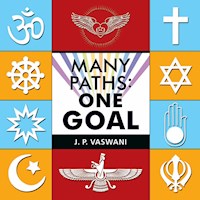
Most of us are not found to be wanting in loyalty to our faiths; the problem is to cultivate a healthy respect for what others believe! This is a worthy aim which Dada J.P. Vaswani can surely help you achieve with this balanced, thoughtful work, written in the true Indian spirit of reverence and appreciation for all approaches to Truth and Divinity.
The author presents each religion as a precious jewel embellished in the crown of world civilization. Whether it is Christianity, Islam, Hinduism, Jainism, Judaism, Buddhism, Sikhism, Baha’ism, Sufism or Zoroastrianism, the individual artefact is distinct, precious and unique. But the sub-stratum of belief that is at the core of their structure is eternal and unchanging: faith in the One God and the unity and fellowship of all Creation. And running as a golden thread through them all is the ultimate law which every faith never ever fails to emphasise: Do nothing that may cause pain to others.
Here is a book which will reinforce your faith in humanity and help you become aware of what Vedanta emphasises: the One behind the Many, the Single Divinity behind the multiplicity of thought and creation.
Das E-Book können Sie in Legimi-Apps oder einer beliebigen App lesen, die das folgende Format unterstützen:
Seitenzahl: 416
Veröffentlichungsjahr: 2017
Ähnliche



















MANY PATHS:
ONE
Published by Gita Publishing House Sadhu Vaswani Mission, 10, Sadhu Vaswani Path, Pune – 411 001, (India). [email protected]
© J.P. Vaswani First Published - 3000 copies - October, 2010 2nd Reprint - 16000 copies - May, 2011 3rd Reprint - 3000 copies – May, 2017 e-book – December, 2017
MANY PATHS: ONE GOAL
ISBN 978-93-80743-11-0
No part of this book may be reproduced or utilized in any form or by any means, electronic or mechanical including photocopying, recording or by any information storage and retrieval system, without permission in writing from the Author.
Printed by Mehta Offset Pvt. Ltd. A-16, Naraina Industrial Area, Phase II,
GITA PUBLISHING HOUSE PUNE, (INDIA).
www.dadavaswanisbooks.org
INVOCATION
In all Religions, the Light is Thine! In all the Scriptures, the Inspiration is Thine! In all the Saints, the Picture is Thine! In all the Races, the Song-flute is Thine! In all the Countries, the Rose-dust is Thine! Master! Sing the Song of Union anew
Dedication
To
Gurudev Sadhu Vaswani
The Teacher (Guru) who urged: Religion? Let us talk of it less, practise more!
– J. P. Vaswani
There are so many who can believe only one thing at a time. I am so made as to rejoice in the many and behold the beauty of the One in the many. Hence my natural affinity to many religions; in them all I see revelations of the One Spirit. And deep in my heart is the conviction that I am a servant of all prophets.
– Sadhu Vaswani
CONTENTS
Foreword
What Is Religion?
Why Do We Need Religion?
The Baha’i Faith
Buddhism
Christianity
The Hindu Faith
Islam
Jainism
Judaism
Sikhism
Sufism
Zoroastrianism
The Paths Are Many
Conversion
Fellowship Song
Glossary
About the Author
FOREWORD
In the fourth chapter of the Bhagavad Gita, we find a beautiful sloka:
However men approach Me, even so do I greet them as Mine own;
For all the paths men take from any side are Mine, verily Mine!
(IV – 11)
Speaking to his dear, devoted disciple Arjuna, the Lord says: “At the end of each path do I stand. All ways are My ways. All men everywhere walk to Me!”
Gurudev Sadhu Vaswani’s comments on this sloka are truly memorable:
His Path, indeed, is the One Path: there is no other. He is the One Bridge that spans the sea of sorrow, the Bridge of Light. The Bridge has diverse colours, and each is called by a different name. The Bridge has different sections or stages. Gnana, bhakti, karma are some of the names used by men to indicate what helps them to cross: but the path for all is still His path.
All paths lead us to God. Therefore, fights, feuds, arguments, discussions, debates and differences in the name of the religion are futile. You can follow the path that draws you; let another follow the path that draws him; yet another can take the path that he chooses – ultimately, all of you will arrive at the same destination.
In a world torn by strife and violence, religion is exploited by unscrupulous elements that fan the flames of hatred in the name of their faith and belief. At the same time, it has become habitual for vested interests to blame religion for all the evils of society. Thus, religion today has been made a convenient scapegoat for all the atrocities perpetrated by man. Fundamentalism, intolerance, bigotry and fanaticism have crept into religious faith. Terrorism, bloodshed and killing of innocent men and women are all labelled as “religious” strife.
A man came to Sadhu Vaswani and said to him, “You say: God is Love; God is Mercy. Why is it that your God stands by and watches while there is so much violence and suffering in the world?”
Sadhu Vaswani pointed to a tablecloth. At the back of the cloth was a mishmash of crisscrossed stitches, with knots and ties and tangles. It all looked so untidy. But when the cloth was turned right side up, the man saw on it beautifully embroidered, the words, God is Love. “It is we who turn religion inside out,” the Master explained. “In truth, God is Love; God is Mercy.”
Today, in the name of religion, we have fights and feuds, sectarian strife, hatred and violence. But let us not forget that religion came to unite, to reconcile, to create harmony among men. It is not religion which has failed us, it is we who have failed religion!
Sadhu Vaswani, constantly urged us, “Let us talk of religion less, practise more!” We need to follow his wise counsel now, more than ever before. We need to put into practice the great truths and ideals of religion in our daily life. And if we really take the trouble to study the great religions of the world, we will come to know that they emphasise the ideals of Love, Peace, Service, Piety, Prayer and Brotherhood.
I humbly submit to you, that rivalry in religion is meaningless. There can be no rivalry among true religions. If such rivalry has become rampant today, it is due to want of knowledge and lack of reverence.
There are some who believe that they have the one full and final revelation of the truth; so that those who stand outside the circle of their own faith must necessarily be in error. Again, there are others who approach religious issues without the spirit of sympathy; they fix their attention on what they regard as aberrations and extravagancies of a particular religion and say, “This religion is a monstrosity!” Saddest of all, we have people who hurt and kill in the name of religion. They are ignorant of the fact that they are killing their own brothers and sisters!
This is why discord and hatred have entered the sphere of religion; and religion, which was meant to be a bond of union, has become a source of sectarian strife. Little wonder then, that young men and women today, are turning away from true religion.
India is the land of many religions and has always respected every religion. For India has profoundly believed, through the centuries, that God is One, though the ways to reach Him are many. The Hindus do not merely tolerate, but accept every religion, knowing that so many religions are but so many ways of the human soul to grasp and realise the Infinite!
We can indeed be proud of India’s inspiring history in this regard. India has always stood for religious harmony and understanding. Today, India is passing through a difficult period. But this is only a temporary, transitional phase. The history of India bears ample testimony to the fact that through the centuries, the truth and message of religious harmony has influenced the Hindu people, Hindu society, Hindu political thought and Hindu state policy – both of large empires and small kingdoms – all over India. Not only is India home to the world’s oldest extant religion, Hinduism; she has also been the cradle of other great faiths of the world like Jainism, Buddhism and Sikhism. Unroll the pages of the past, and you will find that among all the nations of the earth, India alone has greeted and welcomed with love and respect every foreign religion that entered the country. Judaism, Christianity, Islam, Zoroastrianism, Baha’ism, have all become naturalised in India, have become religions of India and have been influenced by the Indian environment. When they first entered India, they were all received with respect and love. This is an outstanding example of tolerance and liberalism in world history. And it is this spirit that this book is meant to reflect.
WHAT IS RELIGION?
Even as I attempt to answer that question, the unforgettable words of Gurudev Sadhu Vaswani echo in my heart:
Religion! Let us talk of it less, practise more!
Sadhu Vaswani was right! Religion is not merely a matter of words; it is practice of the art of living; it permeates every aspect of our lives.
When human beings first became capable of thought, surely they must have wondered about themselves, the natural environment that was their habitat and the vast sky above them, and then again, they perhaps asked themselves how such phenomena as day, night, lightning, thunder, rain and the various seasons occurred, and by what laws they operated; and who was in charge of it all . . .
When questions arise in the mind, answers follow after reflection and contemplation.
If we turn to etymology, we are in a way, taking refuge in sophisticated linguistic abstractions: for let us admit, faith and belief preceded speech and language. The words we are familiar with today arose much later than the ancient religions of this world.
To return then to the question: What is religion? The Latin word religio translates roughly as “careful” “scrupulous” or “things done with great attention to detail”.
The Latin root liga means to bind; religare thus means to bind something to something else. Thus religion could mean binding man to God; binding people together in a common faith; binding us to a tradition of belief and worship.
Interestingly both culture and cult are derived from the Latin root cultus, which means worship of a Higher Power. Thus we may infer that belief in and worship of a Higher Power formed the very basis of culture; or, to put it differently, religious worship was the foundation of the great cultural systems of the world.
Consider for example, Stonehenge in Britain; the Acropolis in Rome; the Parthenon in Greece; the Pyramids of Egypt; the Archeological Excavations of the Indus valley; the Sun Temple at Konark; the Ka’bah in Mecca; and to move to modern examples, St. Peter’s Basilica; Juma Masjid; the Pearl Mosque; the Pallava Cave Temples . . . the list is endless. All these architectural marvels are nothing but the expression of man’s faith and belief in the Supreme Being whom, for want of a better word, we call God.
Religions also came to regulate man’s lives through their moral and ethical laws – rules and prescriptions that were meant to be respected and observed scrupulously. Thus we find many of the world faiths telling their adherents what to eat and what not to eat; whom one can and cannot marry; what people could do and must not do. Not only did this regulate and govern human conduct, but also brought peace and harmony into human lives. It would be no exaggeration to say that religions came to protect, order and preserve the survival of humanity. They also contributed to tradition and continuity, for faith and belief were nurtured and carefully passed down from one generation to another. In this sense, we could also say that religions constituted the earliest information systems of the world.
Somewhere along the way, religions also acquired a specific organisational structure. Special people were chosen to lead worship and rituals, and perhaps, to intercede with the Gods on behalf of humans. Thus hierarchical systems gradually arose and religions became institutionalised.
One of the earliest definitions of religion in English, comes from Dr. Johnson’s Dictionary, which simply calls it, “a system of faith and worship”. The German philosopher Hegel defined religion with more feeling as, “the Divine Spirit becoming conscious of Himself through the finite spirit”. The sociologist Lindbeck defines religion as, “a kind of cultural and/or linguistic framework or medium that shapes the entirety of life and thought... it is similar to an idiom that makes possible the description of realities, the formulation of beliefs, and the experiencing of inner attitudes, feelings and sentiments.”
What all religious scholars agree on is that there can be no unitary definition of religion that is acceptable to all.
Thus we can see, from being “a strong belief in a supernatural power or powers that control human destiny”, religion gradually evolved into “an institution to express belief in a Divine Power”. Today, we even have a branch of metaphysics called the philosophy of religion which asks and tries to find answers to questions on the world of nature, the presence of God, the problem of evil, and the complex inter-relationship between religion and morality. The philosophy of religion must be distinguished from religious philosophy, which is specific to individual religions. Of all these issues we may say that God is primary and central to religious belief.
In what is regarded as the first and fundamental work on the subject, Aristotle’s ‘Metaphysics’ refers to God as “the unmoved mover”, “the most divine of things observed by us”, as “the thinking of thinking”. Today God is variously referred to as Brahman, Ishwar, Allah, YHWH, and so on. God is sometimes given a personal name, a proper noun to emphasise His personal nature, as in Krishna-Vasudeva in Bhagavad or later Vishnu and Hari. While the Abrahamaic religions are monotheistc, Hinduism is polytheistic within the framework of belief in a Supreme Being; religions like Buddhism and Jainism are virtually non-theistic.
Once again, I must recall Sadhu Vaswani’s words: God defined is God denied!
The word “pantheism” derives from the Greek words pan meaning all and theos meaning God; pantheism literally means “all is God”. Essentially, pantheists believe that the Universe as a whole is divine, and that there is no divinity other than the Universe and Nature.
Closely allied to pantheism is animism, the belief that every object in the universe is, in a sense, alive, and that every object has a spirit or a soul, and that every object is divine in its own right.
There are many people too, who view religion primarily as a collection of myths, stories and legends. Myth is a much debased word today, but twentieth century developments in anthropology and psychology have brought out the centrality of myth in human culture and civilisation. Myths are, in fact, stories that embody profound truths that are too complex to grasp in abstract terms. Myths are deeply significant stories that are shared by the people of a particular culture. Myths hence form an integral aspect of their cultural identity. Thus every religion has its own ‘myth of creation’. Let me caution you, I use myth, not in its debased sense as a false notion or a lie, but in the sense of a deeply held belief. The myth of creation is allied to the religion’s world view as a whole. Other myths may include stories of critical stages, such as the story of Noah’s Ark in the Bible or the churning of the ocean in the Vishnu Purana.
Closely allied to myth are rituals. Ritual is yet another word that is now used in a debased sense, to denote empty, meaningless religious practices. But in early religions, rituals were deeply symbolic actions, performed in compliance with sacred beliefs and ideals. When performed with such dedication and pure motives, they fulfilled the spiritual and emotional needs of the people, and brought them great satisfaction. Today, rituals of various kinds are a feature of almost all known religions, and in fact, have also been incorporated into secular activities: e.g. flag hoisting ceremonies, lighting of the Olympic torch, singing the national anthem, etc. They are certainly not empty actions, but have become very meaningful and valuable traditions and customs.
I have until now, given you some theoretical aspects of all world religions; but close to my heart is a view of religion which is derived from the rishis of ancient India: Ekam, Satyam, Shivam, Sundaram.
Sarva-roopa-dharam Shaantham Sarva-naama-dharam Shivam Sat-chit-aananda rupam Advaitam Satyam Shivam Sundaram
(The One Absolute, who is Being, Awareness and Bliss, is the embodiment of peace in all His forms. All His Names are auspicious and He manifests the threefold attributes of Truth, Auspiciousness and Beauty).
Ekam – for there is but One Light pervading all. There is but One Light that thrills the universe from end to end – the One Eternal Light.
Satyam – for the central note of religion is Truth: not your version of truth or my version of truth, but the truth of the One, the truth of the soul and the Oversoul, the Supreme Being and the rest of creation, the paramatma and jivatma, as Hinduism puts it so beautifully.
Shivam – or goodness, unalloyed and pure goodness, for the third note of that beautiful melody of faith is purity of thought, word and deed.
Sundaram – or beauty. The realisation that God is One, that He is the Truth and the Only Goodness we all need, leads to the ultimate beauty of God-realisation, which is the goal of all religions.
In India, we use the word dharma to denote religion. Dharma is derived from the Sanskrit root dhri, meaning ‘to hold’. Dharma is a power that holds – it upholds, it sustains, it maintains the universe from end to end. It does this by means of certain laws, the Laws of the Spirit, which are closer than you think, to the laws of science. Schilling, the well known physicist asserted that both science and religion have “a threefold structure of experience, theoretical interpretation and practical application.” Therefore, our ancient rishis described religion as atma vidya, or the science of the Spirit.
Religion then is a study and application of the laws of life. These are laws to which we must conform, if we wish to be happy. Do you live according to the laws of the Kingdom of God? Do you bear witness to these laws in deeds of daily life?
“What is your religion?” This was a question that people repeatedly asked Gurudev Sadhu Vaswani. And he would answer, “I know of no religion higher than the religion of unity and love, of service and sacrifice.”
On one occasion, he said, “Religions are worth no more than a straw if they do not teach man to love God and serve the God-in-man. For God dwelleth in every man.”
The Kingdom of God is within you. Your religion, your faith must help you reach this world within!
WHY DO WE NEED RELIGION?
Do we really need God or indeed a religion in this day and age?
This is a question that has been repeatedly asked by people at various fora, at discourses by spiritual leaders and at gatherings of thinkers and scholars.
I am not going to take the standpoint of the atheists on this issue: they are people who are certain of their unfaith: they do not need religion or God, and do not need an answer to this question.
The distinguished humorist Mark Twain answered the question in his own way: “Man is a religious animal. He is the only religious animal. He is the only animal that has the True religion – several of them.
For the sake of those who are genuinely troubled and disturbed by what they see as the condition of the world today, for those who seek reassurance, this question must be tackled.
Here are a few answers that emerged when I invited some of my friends to answer the question:
1. We need religion for the sake of our own salvation. After all, death cannot be the end of the life of the soul.
2. We need religion because we all need to stay connected with a Higher Reality.
3. We need religion to live life in the right way.
4. We need religion because if there is one relationship we cannot do without, it is our relationship with God.
5. We need religion because it is only the sense of a Higher Authority, a Superior Power that can guide us through the vicissitudes of life.
6. We need religion because we need to have a sense of order, a sense of belonging, and also a sense of protection and security that a Higher Power affords us. Without this belief we would be lost in nihilism.
7. To quote St. Augustine, “We are restless until we find our rest in God.”
8. God and Religion give meaning to our life. Why would anyone want to lead a life that is meaningless?
Religion is response to the God-within and the God-around you!
As we may see from the above, lots of people have very clear thoughts about why they need God and Religion in their lives. (You may have noticed too, it is impossible to speak of one without the other; so closely are God and Religion intertwined in our lives.)
And yet, when we see the decline of values and morals in society, when we see people ready to kill innocents in the name of faith, when we see the threat of a Third World War looming, we begin to wonder: how can such things happen in a world ordered by religion? What is the significance, the role of religion in such times? Is religion being hijacked by a few people to serve their vested interests in the name of God and faith?
Let us not stop with professing faith: let us practice the great ideals of religion in our daily life.
All that is best, all that is wise, all that is beautiful and worthwhile, all that is true and radiant, comes to us from God.
As I have studied the religions of the world at the feet of my beloved master – Sadhu Vaswani – a great seer, sage and prophet; of the New Age; as I have imbibed the teachings of the great founders of the different faiths under his benign wisdom, it seems to me that there is a beautiful similarity in their message. To study different religions in the light of sympathy and understanding is to know that they emphasise the same fundamental truth. This often makes me wonder why some people claim that their own religions are true and others are not!
To abolish religion would be to tear the very heart of humanity.
As religions advance in time, they tend to become more and more rigid and create differences. What we really need today is that people belonging to different faiths should join together in the creative and constructive task of building a new world order, based on unity and love and universal brotherhood.
We live in an age of science and we are proud of our achievements and the ‘progress’ we have made; and indeed, science has given us many comforts, conveniences and gadgets. So many of us today are apt to take the sanctuary that science offers, almost as an article of faith! But the problem is that science has also inflated our ego and skewed our vision. We are beginning to think: “What is there that man cannot do on his own? We have no need of God or religion!”
True it is that man is exploring the moon for the purpose of a settlement; true it is that our rockets are trying to reach the distant planets; our satellites are stationed in space and bring us minute-to-minute details of what is happening in the firmament and in the nooks and corners of this vast world. But does this make us feel safe and secure? Are we truly happy? Are we at peace with ourselves? Are we at peace with our own neighbours and the rest of the world?
Let me remind you, that one of the greatest scientists of our time, Albert Einstein, observes: “True religion is real living, living with all one’s soul, with all one’s goodness and righteousness.” Whoever the God we choose to believe in, whatever the faith we follow, there can be no compromise on this: we must be good; we must lead a good life and as far as possible; we must do good to others.
The eminent psychiatrist, Karl Jung observed that civilisation today has become sick because man has alienated himself from God. I believe that God is the source and the sustainer of all life and we cannot live a happy and healthy life – physically, spiritually, emotionally and morally – so long as this alienation persists.
The cure to the many maladies that affect us today, is certainly not to reject religion, but to practise religion in its truest sense, true to the spirit, rather than the letter. How is this to be done? Take a U-turn to God!
The eternal Sanatana Dharma, the way of life I practise, teaches me to believe not in the survival of the fittest, but in the glorious ideal: Sarve bhavantu sukhinaha – may all beings be happy!
If there is one thing I wish this book to convey to you, it is this. All religions are pathways to the One Eternal God. All we need to do is see to it that every Hindu is a true Hindu, every Christian is a true Christian, and every Muslim is a true Muslim. All religions are true, and everyone must be true to the religion they are born into.
Historians and scholars of religion agree that the Baha’i Faith is the world’s youngest independent religion. Its Founder Baha’u’llah (1817-1892), lived and preached his faith in times that are still in people’s living memory. Today over five hundred million people all over the world owe allegiance to this faith. The word Baha’i is both a noun and an adjective, used respectively to describe the faith, and also a follower of the faith. The term Baha’ism is not generally encouraged, and Baha’i Faith is the preferred choice.
Awe-inspiring Lotus Temple, Delhi
THE BAHA’I FAITH
Throughout history, God has revealed Himself to humanity through a series of divine messengers. Baha’u’llah, regarded as the latest of these messengers, brought new spiritual and social teachings for our time. His essential message is of unity. He taught the oneness of God, the oneness of the human family, and the oneness of religion. He said, “The earth is but one country and mankind its citizens,” and that now is the time for humanity to live in unity. Baha’is believe that the crucial need facing humanity is to find a unifying vision of the nature and purpose of life and of the future of society. Such a vision unfolds in the writings of Baha’u’llah.
Never become angry with one another...Love the creatures for the sake of God and not for themselves. You will never become angry or impatient if you love them for the sake of God.
A new or independent religion does not arise in a vacuum. Thus Buddhism and Jainism grew out of Hinduism. They were in one sense, reactions to Hinduism in their own historical and social context. Similarly, Jesus Christ was born a Jew, and followed the Jewish faith, before his teachings evolved into the new religion of Christianity. We can also say that Buddhism and Christianity acquired their independence and distinct identity, only when they moved out of the land of their origin, into the wider world arena, and became the accepted faith of ‘outsiders’ other than Indians or Jews. This is true of the Baha’i Faith too. It may be said to have originated in the matrix of Islam, although it subsequently became quite independent of the originating religion.
The new Faith first began in Persia or Iran. From there it spread to many neighbouring countries like Turkey, Russia and Northern India. Some Jews, Christians and Zoroastrians embraced the new Faith, although its early followers were predominantly Muslim. Many of its ideas were drawn from the Holy Qur’an, although they differed in matters of interpretation.
The Baha’i Faith is unique in this respect – that it unreservedly accepts the validity of other faiths and world religions. Baha’is believe that Abraham, Moses, Zoroaster, Buddha, Krishna, Jesus and Muhammad are all equally authentic messengers of one God. The teachings of these divine messengers are seen as paths to salvation which contribute to the “carrying forward of an ever-advancing civilisation.” But they also believe that this series of interventions by God through his messengers, has been progressive with relation to human history, each revelation from God evolving from the previous one, each more complex than those which preceded it, and each preparing the way for the next.
ORIGINS
Any discussion of the origins of the Baha’i Faith must begin with the mention of two great visionaries of Nineteenth Century Persia, as Iran was then called. The first of these was Mirza Ali Muhammed (1820-1850) who called himself as “The Bab”, meaning “Gate”, from a Shia Muslim concept. In 1844, The Bab announced to his few faithful followers that he was but the latest in a long line of spiritual leaders whose task it was to proclaim the advent of God’s messenger upon this earth. He also spoke repeatedly of “He whom God shall make manifest”, a Messiah whose coming had been proclaimed by all the world’s scriptures. In his book, the Bayán, The Bab described the messianic figure as “the origin of all divine attributes”, and stated that his command would be equivalent to God’s command. The Bab stated further that once the messianic figure arrived, the perusal of just one of his verses would be greater than a thousand perusals of his own book, the Bayan. This prediction was widely recognised as being fulfilled by Baha’u’lla, the founder of the Baha’i Faith.
The Bab’s open proclamations were perceived as a threat to state and clergy. His followers were persecuted and the Bab himself was arrested, tortured and eventually executed by the Persian authorities for heresay against Islam.
Baha’u’llah was born Mirza Husain Ali, in one of the most wealthy and influential families of Persia. (The Arabic word Baha’ means ‘glory’ or ‘splendour’) His father was a wealthy government minister, Mirza Buzurg-i-Nuri. The family could trace its ancestry back to the great dynasties of Iran’s imperial past. Baha’u’llah led a princely life as a young man, receiving an education that focused largely on calligraphy, horsemanship, classic poetry, and swordsmanship. His son and official biographer says of him:
From his earliest childhood he was distinguished among his relatives and friends.... in wisdom, intelligence and as a source of new knowledge, he was advanced beyond his age and superior to his surroundings. All who knew him were astonished at his precocity. It was usual for them to say, ‘Such a child will not live,’ for it is commonly believed that precocious children do not reach maturity.
In a letter Baha’u’llah recalled a childhood incident– that is, seeing an elaborate puppet show about war and intrigues in the court of a king and the riches of those in authority. After the performance, Baha’u’llah saw a man come out from behind the tent with a box under his arm. “What is this box?” Baha’u’llah asked him. “All this lavish display and these elaborate devices,” the puppet master replied, “the king, the princes, and the ministers, their pomp and glory, their might and power, everything you saw, are now contained within this box.” This taught the young boy that all the pomp and power of this world are transient; and that the Truth must be sought beyond these external trappings.
By the time he was fourteen, he was regarded as wise beyond his years. He could converse on any subject and solve any problem presented to Him. In large gatherings he would explain intricate religious questions to the ulema (clergy), and they were amazed by his perspicacity and his thorough knowledge of the scriptures.
The source of all evil is for man to turn away from his Lord and to set his heart on things ungodly. In all matters, moderation is desirable. If a thing is carried to excess, it will prove a source of evil.
Upon his father’s death, a position in the ministry was offered to him, but he declined the offer politely. Instead, he chose a life of service and philanthropy, earning from the people the title, ‘Father of the Poor’. He spent much of his time in communion with nature, saying, “The country is the world of the soul, the city is the world of bodies.”
When a thought of war comes, oppose it by a stronger thought of peace. A thought of war must be destroyed by a more powerful thought of love. Thoughts of war bring destruction to all harmony, well-being, restfulness and contentment.
First a follower of the Bab, he hosted a gathering of the most eminent followers of the Bab, known as Babis. This gathering was significant as it served to establish an independent identity and character of the Babi religion. He too was imprisoned in one of the notorious dungeons of Persia known as “the dark pit”. He refused to evade arrest with the help of his powerful friends, choosing instead to walk to the deadly prison where he was to be incarcerated. It is said that he was stoned and vilified by angry mobs as he was led away by the authorities.
He himself relates that in 1853, while incarcerated in the dungeon of the Síyáh-Chál in Tehran, he received the first intimations that he was the Messiah anticipated by the Bab. But it was only ten years later that he revealed to his followers that he had been sent by God to redeem the world, and to interpret God’s Will for a new age.
Fortunately for the faithful, he escaped execution. But now began a saga of banishment from the land of his birth – the beginning of 40 years of exile, further imprisonment and persecution. He was forced to depart from his country even before recuperating from the ill health caused by being in the dungeon and from the wounds resulting from the weighty chains around his neck. He was sent first to Baghdad, where too, he attracted growing numbers of followers.
While he was in Baghdad, he withdrew to the mountainous wilderness of Kurdistan, where he lived alone for two years. He spent his time reflecting on the implications of the divine purpose to which he had been called. The Baha’is regard this period as the parallel of Moses’ withdrawal to Mount Sinai, Jesu’s forty days and nights in the desert, and Muhammad’s retreat to the cave on Mount Hira. Baha’u’llah wrote some of his most renowned works in Baghdad, including the Hidden words, Seven valleys, Book of Certitude (Kitab-i-Iqan).
The Persian authorities used their influence to banish Baha’u’llah from Baghdad. In April 1863, before leaving for Constantinople (Istanbul), Baha’u’llah and his companions camped in a garden on the banks of the Tigris River for twelve days. It was here that Baha’u’llah revealed to his close friends and followers that he was the Promised One foretold by the Bab, and indeed, in all the world’s scriptures. Baha’is celebrate their most joyous festival, the holy Ridvan Festival, in commemoration of those twelve eventful days. Thus it was nearly ten years after the Revelation that Baha’u’llah proclaimed the truth to his people.
Persecution for him and his followers continued in Constantinople, from where he was banished to go to Adrianapole. He made no attempt to escape from his persecutors. Instead, he proclaimed to contemporary rulers and heads of state that he was God’s redeemer, sent to heal the wounds of civilisation. This only ignited the wrath of the orthodox clergy. He and his family were subjected to inhuman treatment while at Adrianapole; this place was the farthest he would be forced to go from his native land. But even here, despite the extreme conditions under which he and the rest of the exiles lived, his teachings continued to spread. A greater flow of writings than ever before came from his pen and they were distributed by his followers to places as far away as Egypt and India.
Here in Adrianapole occurred one of the tragic incidents of the Messiah’s life. Jealous of his ever growing popularity and the reverence which he attracted from people even in exile, Mírzá Yahyá, his half brother, hired people to poison him. Baha’u’llah became extremely ill, and it took him months to recuperate. The episode left him with a tremor that showed in his handwriting to the end of his life.
From 1867 onwards, Baha’u’llah wrote a series of letters to the kings and rulers of the world, including Emperor Napoleon III, Queen Victoria, Kaiser Wilhelm I, Tsar Alexander II and others. In these letters, he openly proclaimed His station as a Messenger of God. He urged the leaders to pursue justice and disarmament and exhorted them to band together into a commonwealth of nations, warning them of dire consequences should they fail to establish peace.
The gate leading to the Shrine of Baha’u’llah, the resting place of the founder of the Baha’i Faith
Lay not on any soul a load which ye would not wish to be laid upon you, and desire not for anyone the things ye would not desire for yourselves. This is my best counsel unto you, did ye but observe it.
He and his family were under orders to go to the prison city of Akka, but others accompanied him voluntarily. Baha’u’llah warned his companions that even greater trials awaited them and that if they wished to protect themselves, they should leave for other destinations immediately. It was a warning that the exiles chose to disregard. At that time, ‘Akká (Acre) was regarded as ‘the end of the world’, a final destination for the most notorious murderers, highway robbers, and political enemies of the Ottoman regime. A walled city of filthy streets and damp, desolate houses, ‘Akká had no source of fresh water, and the air was popularly described as being so foul that birds flying overhead would fall dead out of the sky. By banishing the Messiah with his family and followers to this wretched place, the authorities expected that they would soon perish.
But that was not to be. Here in this city at first, and later in its suburbs and environs, the Messiah was to live for over 24 years, till his death in 1892. Here he composed his most important work, the Most Holy Book (Kitáb-i-Aqdas). In it he outlined the vital precepts of the faith for his followers, and also laid the groundwork for Baha’i institutions, and articulates His vision for the development of human civilisation.
It was here, in April 1890 that Professor Edward Granville Browne of Cambridge University met Baha’u’llah in four successive interviews. Professor Browne wrote of his first meeting: “The face of him on whom I gazed I can never forget, though I cannot describe it. Those piercing eyes seemed to read one’s very soul; power and authority sat on that ample brow.... no need to ask in whose presence I stood, as I bowed myself before one who is the object of a devotion and love which kings might envy and emperors sigh for in vain.”
The Shrine of the Bab, Haifa
In the early hours of May 29, 1892, Baha’u’llah passed away at the Mansion of Bahjí. Nine days later his will was unsealed. It designated ‘Abdu’l-Bahá, his second son, as His successor and head of the Baha’i Faith. (His eldest son had died under tragic circumstances when the family had been imprisoned earlier at Akka.) It was for the first time in history that the founder of a world religion had made explicitly clear whom people should follow after his death. This declaration of a successor is the pivotal provision of what is known to Baha’is as the “Covenant of Baha’u’llah”. It has enabled the Baha’i Faith to remain united around one central authority for over a century.
His followers grew in great numbers after his death. They established over 70,000 Baha’i centres worldwide.
THE TEACHINGS OF BAHA’U’LLAH
The Baha’is believe in one God as a single supernatural Being who created the universe and all creatures and forces within it. This Being, Whom we call God, has absolute control over His creation (omnipotence) as well as perfect and complete knowledge of it (omnipotence). They also believe that though people may pray to Him in different languages and call Him by different Names (such as Allah or Yehovah, God or Brahma), they are referring to the same unique Being.
Baha’u’llah taught that God is so far beyond His creation that human beings will never be able to grasp any clear image of Him; nor can they ever appreciate His majesty and power except in the most remote manner. The very terms we use to decribe God are indequate, as they relate to our limited human experiences and knowledge.
It is for this reason that the discipline of daily prayer, meditation, and study of the Baha’is. They feel that this disipline is one of the most important ways of growing closer to their Creator.
Baha’i notions of progressive religious revelation result in their accepting the validity of most of the world’s religions, whose founders and central figures are seen as manifestations of God. Though their faith is sometimes described as syncretic combinations of earlier religions’ beliefs, they describe their faith as an independent world religion, differing from the other traditions in its relative age and in the appropriateness of Baha’u’llah’s teachings to the modern context.
Humanity is seen as essentially one, though highly varied; its diversity of race and culture are seen as worthy of appreciation and acceptance. Doctrines of racism, nationalism, caste, social class and gender-based hierarchy are seen as artificial impediments to unity. The Baha’i teachings state that the unification of humankind is the paramount issue of the present world.
Shoghi Effendi, the appointed head of the religion from 1921 to 1957, wrote the following summary of what he considered to be the distinguishing principles of Baha’u’llah’s teachings, which, he said, together with the laws and ordinances of the Kitáb-i-Aqdas, constitute the bedrock of the Baha’i Faith:
My home is the home of peace. My home is the home of joy and delight. My home is the home of laughter and exultation. Whosoever enters through the portals of this home must go out with gladsome heart. This the home of light; whosoever enters here must become illumined.
The independent search after truth, unfettered by superstition or tradition; the oneness of the entire human race, the pivotal principle and fundamental doctrine of the Faith; the basic unity of all religions; the condemnation of all forms of prejudice, whether religious, racial, class or national; the harmony which must exist between religion and science; the equality of men and women, the two wings on which the bird of humankind is able to soar; the introduction of compulsory education; the adoption of a universal auxiliary language; the abolition of the extremes of wealth and poverty; the institution of a world tribunal for the adjudication of disputes between nations; the exaltation of work, performed in the spirit of service, to the rank of worship; the glorification of justice as the ruling principle in human society, and of religion as a bulwark for the protection of all peoples and nations; and the establishment of a permanent and universal peace as the supreme goal of all mankind—these stand out as the essential elements which Baha’u’llah proclaimed.
The following principles are frequently listed as a quick summary of the Baha’i teachings. They are derived from transcripts of speeches given by ‘Abdu’l-Bahá during his tour of Europe and North America in 1912.
• Unity of God
• Unity of religion
• Unity of humankind
• Equality between men and women
• Elimination of all forms of prejudice
• World peace
• Harmony of religion and science
• Independent investigation of truth
• Universal compulsory education
• Universal auxiliary language
• Obedience to government and non-involvement in partisan politics
• Elimination of extremes of wealth and poverty
With specific regard to the pursuit of world peace, Baha’u’llah prescribed a world-embracing collective security arrangement as necessary for the establishment of a lasting peace.
THE SACRED SCRIPTURES OF THE BAHA’I FAITH
The most holy text is the Kitab-i-Aqbas, written by Baha’u’llah. This text forms the book of laws in the Baha’i Faith. Other important texts include:
• Gleanings from the Writings of Baha’u’llah
• Prayers and Meditations
• Epistle to the Son of Wolf
• The Seven Valleys and the Four Valleys
Other sacred writings Include those of the Bab and Abdul Baha’.
BAHA’I FESTIVALS
A Baha’i Festival
Ridvan: The twelve day period commemorating Baha’u’llah’s announcement of his claim to prophethood and his departure from Baghdad in 1863, observed from sunset April 20 to sunset, May 2. The first, ninth and twelfth days of Ridvan are major Baha’i holy days on which work is suspended.
Most of the sacred festivals of this faith are associated with the Bab and the Messiah. These include:
Declaration of the Bab: celebrated in May
Ascension of Baha’u’llah: May 29
Martyrdom of the Bab: July 9
Birth of the Bab: October 20
Birth of Baha’u’llah: November 12
Day of the Covenant: November 26
Ascension of ‘Abdu’l-Bahá: November 28
Ayyam-i-Ha: (i.e. Essence of God Festival) February 25 – March 1: This is celebrated through acts of love, fellowship, unity, charity and goodwill.
Naw-Ruz, the Baha’i new year, begins on March 21, the first day of spring. This is preceded by a period of fasting between March 2-March 20.
MARRIAGES IN THE BAHA’I FAITH
Baha’is understand that the family is the basic unit of society. Unless this all-important basic unit is healthy and stable, society itself cannot be healthy and unified. Monogamous marriage stands at the foundation of family life.
Baha’u’llah said of marriage that it is “a fortress for well-being and salvation.” The Baha’i writings further state that married couples should strive to become “loving companions and comrades and at one with each other for time and eternity...”
Parental approval is considered essential for marriages. Baha’is believe that this requirement helps to preserve unity within the marriage – and within the extended family. This entails respect for parents from the children. It also ensures that parental support is always available to young couples during the crucial early years of their marriage.
Once parental permission is obtained, the marriage takes place, requiring only the simplest of ceremonies. In the presence of two witnesses designated by the local Baha’i governing council, the couple recites the following verse: “We will all, verily, abide by the will of God.” For Baha’is, that simple commitment to live by God’s will implies all of the commitments associated with marriage, including the promises to love, honour and cherish; to care for each other regardless of material health or wealth; and to share with and serve each other. As in most religions, the marriage vow is considered sacred in the Baha’i Faith. The partners are expected to be absolutely faithful to each other.
Beyond these simple requirements, Baha’is are free to celebrate their marriage according to their personal tastes, family resources, and cultural traditions, Baha’i ceremonies run the gamut from small to large, including all manner of music, dance, dress, food and festivity.
UNIQUE FEATURES OF THE BAHA’I FAITH
The central theme of Baha’u’llah’s message is that humanity is one single race and that the day has come for its unification in one global society. One of the purposes of the Baha’i Faith is to help make this possible. A worldwide community of some five million Baha’is, representative of most of the nations, races and cultures on earth, is working to give Baha’u’llah’s teachings a practical effect. Their experience will be a source of encouragement to all who share their vision of humanity as one global family and the earth as one homeland. In keeping with this philosophy Baha’is come from a wide range of ethnic and cultural backgrounds.
There is no clergy in the Baha’i Faith. Because the human race has entered upon the age of its maturity, each individual is able to explore the revelation of God and to decide on the issues of life through prayer, reflection, and consultation with others. To make this possible, the Baha’i scriptures have so far been translated into some 800 different languages.
The work of the Faith is entirely supported by voluntary contributions from the members. Giving to the Baha’i fund is regarded as one of the privileges of membership; the Faith does not accept outside contributions.
Life in this world, as Baha’u’llah presents it, is like the life of a child in the womb of its mother: the moral, intellectual, and spiritual powers which a human being develops here, with the help of God, will be the “limbs” and “organs” needed for the soul’s progress in the worlds beyond this earthly one. The way of life which Baha’is seek to cultivate, therefore, is one that encourages personal development. Daily prayer and meditation free the soul from conditioned patterns and open it to new possibilities.
Meditation is the key for opening the doors of mysteries. In that state man abstracts himself; in that state man withdraws himself from all outside objects; in that subjective mood he is immersed in the ocean of spiritual life and can unfold the secrets of things in themselves.
Under the unique Consultative System of this Faith, development projects have proliferated all over the world. They include tutorial schools, local clinics, classes in health care, agricultural projects, reforestation, alcoholism counselling, and children’s hostels.
Throughout the critical first century of the Faith’s existence the provisions laid down by Baha’u’llah have protected the Baha’i community from sectarianism, and have enabled it to adapt itself to the requirements of a rapidly evolving civilisation.
The Universal House of Justice, ordained by Baha’u’llah as the legislative authority in the Baha’i Faith, came into existence in 1963. It is a nine-member body elected at five-year intervals by the entire membership of the national governing institutions of the Baha’i world. The House of Justice directs the spiritual and administrative affairs of the Baha’i International Community. It serves, also, as a custodian and trustee of the Baha’i Holy Places and other properties in the Holy Land. Endowed by Baha’u’llah with the authority to legislate on all matters not specifically laid down in the Baha’i scriptures, the House of Justice is the institution that keeps the Baha’i community abreast of an ever-changing world.




