


266,99 €
Mehr erfahren.
- Herausgeber: John Wiley & Sons
- Kategorie: Wissenschaft und neue Technologien
- Sprache: Englisch
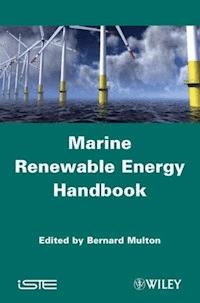
Marine renewable energy is a significant resource for generating electricity, and if some conversion technologies have already reached a certain level of maturity, others are emerging. The originality of this multidisciplinary book is to offer a broad spectrum of knowledge from academic and industry experts of various origins. It deals with general aspects such as the specificities and constraints of the marine environment, the concepts of hydrodynamics and ocean engineering, as well as the industrial and economic sides necessary for the assembly of projects. It also discusses conversion technologies such as offshore wind, tidal power plants, tidal stream turbines, wave energy converters and ocean thermal energy plants. Finally, two chapters are devoted to power electronic conversion and power transmission cables.
Sie lesen das E-Book in den Legimi-Apps auf:
Seitenzahl: 870
Veröffentlichungsjahr: 2013
Ähnliche



















Table of Contents
Foreword
Preface
Chapter 1: Marine Environment and Energy Resources
1.1. Introduction
1.2. Physical and potential resources
1.3. Physical aspects of the marine environment
1.4. Environmental data
1.5. Bibliography
Chapter 2: Constraints of the Marine Environment
2.1. Extreme conditions at sea
2.2. Materials in the marine environment
2.3. Bibliography
Chapter 3: Some Concepts of Hydrodynamics and Ocean Engineering
3.1. The marine environment
3.2. Loads on marine structures
3.3. Numerical and experimental tools for analysis
3.4. Conclusion
3.5. Bibliography
Chapter 4: Marine Energy and Industrial Actors
4.1. Why does marine energy concern large industrial players?
4.2. An energy source of immense potential
4.3. Marine energy: a sector reserved for industrial players and large-scale international investors
4.4. Example of offshore wind energy: the main players and industry in France
4.5. Industrial assembly
4.6. Industrial risks and how to manage them
4.7. Hazard management for interventions at sea
4.8. Design and maintenance of electricity-producing installations at sea
4.9. Policies and organization of maintenance
4.10. Operational and maintenance activities
4.11. Estimating maintenance costs
4.12. Decision-making by the investors
4.13. Conclusion
4.14. Bibliography
Chapter 5: Installation of Wind Turbines at Sea
5.1. Peculiarities of the marine environment
5.2. Design of the support structures of offshore wind turbines
5.3. Assembly of offshore wind turbines
5.4. Electrical cables
5.5. Access to offshore wind turbines
5.6. Floating wind turbines
Chapter 6: Conversion Systems for Offshore Wind Turbines
6.1. Evolution of wind energy technology
6.2. Estimating the wind energy resource
6.3. Wind turbines
6.4 Bibliography
Chapter 7: Production of Tidal Range Energy
7.1. Tidal range energy — theory and potential
7.2. Potential of tidal range energy development
7.3. Tidal range energy in France: the Rance Tidal Power Plant
7.4. Tidal range energy in Canada — Annapolis
7.5. Tidal range energy in the United Kingdom — the Severn
7.6. Tidal range energy in South Korea — Sihwa
7.7. The challenges of tidal range energy
7.8. Bibliography
Chapter 8: Concepts, Modeling and Control of Tidal Turbines
8.1. Introduction
8.2. State of the art technology in tidal turbines
8.3. Modeling and control of tidal turbines
8.4. Bibliography
Chapter 9: Paimpol-Bréhat: Development of the First Tidal Array in France
9.1. Introduction and context
9.2. Selection of technologies
9.3. Technical specifications of the project and the producible power
9.4. Administrative procedures
9.5. Conclusion and perspectives
9.6. Bibliography
Chapter 10: Feedback from the Sabella Tidal Current Turbine Project
10.1. Introduction
10.2. Design of the Sabella turbines
10.3. The demonstration project Sabella D03
10.4. Conclusions
10.5. Bibliography
Chapter 11: Wave Energy Converters
11.1. Presentation of the wave energy resource
11.2. Classification of wave energy converters
11.3. Direct wave energy converters with direct electromechanical conversion (type C5)
11.4. Fluctuations of power produced by wave energy converters
11.5. Bibliography
Chapter 12: Ocean Thermal Energy Conversion: A Historical Perspective
12.1. The thermal resource of the oceans
12.2. Main principles of ocean thermal energy conversion
12.3. Georges Claude, the pioneer
12.4. A renaissance at the end of the 20th Century?
12.5. Reflections
12.6. Bibliography
Chapter 13: Ocean Thermal Energy Conversion: Solutions Studied
13.1 The industrial approach to ocean thermal energy conversion
13.2. The energy conversion system at the heart of OTEC
13.3. Integration of OTEC plants
13.4. An OTEC plant in the marine environment
13.5. Conclusion
13.6. Bibliography
Chapter 14: Electrical Conversion Systems
14.1. Historical introduction
14.2. General facts
14.3. Voltage inverters in pulse width modulation
14.4. Storage
14.5. Control of the voltage Ed
14.6. Filtering the output voltages
14.7. Transmission
14.8. Technology
14.9. Maintenance
14.10. Conclusion
14.11. Bibliography
Chapter 15: Cables for Collecting and Transmitting Energy Produced by Offshore Technologies
15.1. Introduction
15.2. General facts
15.3. Functions of high-voltage cable systems
15.4. Manufacture of submarine cables
15.5. Principles and tools for the design of submarine cables
15.6. Tests of submarine cables
15.7. Specificities of DC cables
15.8. Specificities of dynamic cables
15.9. Electrical characteristics of submarine cables
15.10. New advances presented during JICABLE 2011
15.11. Bibliography
List of Authors
Index
First published 2012 in Great Britain and the United States by ISTE Ltd and John Wiley & Sons, Inc.
Apart from any fair dealing for the purposes of research or private study, or criticism or review, as permitted under the Copyright, Designs and Patents Act 1988, this publication may only be reproduced, stored or transmitted, in any form or by any means, with the prior permission in writing of the publishers, or in the case of reprographic reproduction in accordance with the terms and licenses issued by the CLA. Enquiries concerning reproduction outside these terms should be sent to the publishers at the undermentioned address:
ISTE Ltd27-37 St George’s RoadLondon SW19 4EUUKJohn Wiley & Sons, Inc.111 River StreetHoboken, NJ 07030USAwww.iste.co.ukwww.wiley.com© ISTE Ltd 2012
The rights of Bernard Multon to be identified as the author of this work have been asserted by him in accordance with the Copyright, Designs and Patents Act 1988.
Library of Congress Cataloging-in-Publication Data
Marine renewable energy handbook / edited by Bernard Multon.
p. cm.
Includes bibliographical references and index.
ISBN 978-1-84821-332-6
1. Ocean energy resources--France. 2. Renewable energy sources--France. I. Multon, Bernard. TJ163.25.F8M345 2012
333.91′4--dc23
2011043743
British Library Cataloguing-in-Publication Data
A CIP record for this book is available from the British Library
ISBN: 978-1-84821-332-6
Foreword
When I first met Bernard Multon, in the early 2000s when a “marine energy club” was set up in ECRIN1, all anyone talked about was offshore wind energy, and even then, not really in terms of France in particular. There were only a few of us, representing research organizations and industrial players, who dared mention the enormous potential of marine energy as a whole, and the danger of France once again missing the renewable energy boat. As Bernard Multon points out in the preface of this book, there are significant risks and rewards at stake with marine renewable energy (MRE), which are linked to the energetic potential it represents and its economic impact in terms of markets and jobs — particularly in France and the overseas territories but also in the export market. This rings true, given that a number of European states began to take innovative and forward-looking approaches in this area, with incentive policies which allowed a number of industrial enterprises to take their places, even at that early stage, in this potentially huge market.
After that, the outlook in France changed. While even now, a certain degree of skepticism exists, the necessity and urgency of developing renewable energies (REs) are widely acknowledged. The measures put in place following both the Grenelle on the Environment2 and the Grenelle on the Ocean, widespread consultation of the actors concerned, and initiatives taken by research organizations, industrial enterprises and local collectivities, have shown the strategic need to further develop existing technologies for exploiting MREs, to identify research priorities and to forge connections between the potential actors in the field of marine energy in France. Many of these actors are among the authors of this book.
Five MRE prototypes are being co-financed as part of a program of “Investing for the Future”. They will be tested at sea between now and 2013. The call for tender on offshore wind in July 2011 should allow us to attain 3,000 MW in terms of installed capacities within the next few years, which is a step on the road towards achieving the goal of 6,000 MW by 2020. The first pre-industrial tidal stream farm should see the light of day in 2012, off the coast of Paimpol in the Côtes d’Armor. However, new funding on a national and European scale, assistance in terms of research, development of prototypes, pilot “farms” and testing at sea, are all necessary in order for these new technologies to reach a stage of technical and economic viability.
It is in this context that the French President, in July 2009, announced a huge technological platform dedicated to marine energy in France. This was confirmed a few months later by the Prime Minister, who added that it would be based in Brest. The Institut d’Excellence dans le domaine des Energies Décarbonées (IEED — Institute of Excellence in the field of Carbon-Free Energy), set up by “France Energies Marines” (French Marine Energy), is a national-scale initiative structured around enterprises, research organizations and higher education institutions and local collectivities. It brings together approximately 50 actors, creating a pluridisciplinary potential for R&D and the possibility for testing methods and testing sites. The creation of this IEED, expected in 2011, should enable us to speed up the development of a new energy sector, offering innovation and new jobs.
This book, Marine Renewable Energy Handbook, edited by Bernard Multon, comes at exactly the right time and makes a genuine contribution to disseminating the knowledge which is essential for research on MRE. Stepping away from the strictly prospective and strategic conventional register, it looks at disciplines where there is room for improvement in terms of reliability and performance. It will be important to develop the non-technological, environmental and socio-economic aspects, especially when we gain experience from the earliest models and use the lessons learnt from it to identify new directions for research.
It will serve as a reference for a number of actors in the field of marine energy: researchers, SMEs, industrialists, etc., as well as for students interested in this field, who can pursue the general or specific courses which are being set up in France — notably in Brest with the Masters in Marine Renewable Energy — but also in Europe and the world over!
Michel PAILLARD
Project Manager, “Energies Marines Renouvelables”
IFREMER
November 2011
1 ECRIN: “Échange et coordination recherche-industrie” was an association for the promotion of industry-researcher relations founded by CNRS and CEA.
2 The “Grenelle Environnement” is a conference bringing together the government, local authorities, trade unions, business and voluntary sectors to draw up a plan of action involving concrete measures to tackle the environmental issue.
Preface1
In the context of rapidly emerging technologies for exploiting marine renewable energy, we have gathered input from France’s top specialists in order to establish an overview of the technological aspects without neglecting the environmental and societal aspects of this relatively new domain.
The ensemble of renewable energy (RE) resources offers immense potential which, through mistrust or denigration, was long considered insufficient, but which today is at last widely recognized and accepted. Across the whole of the terrestrial biosphere, it represents around 8,000 times the current global primary energy consumption [MUL 11]. Given that oceans cover roughly two thirds of the surface of the planet, we can say that they alone constitute a resource equivalent to 5,000 times our consumption. Thus, it is a question of considerable potential in less confined spaces but in places which are far more hostile.
In 1999, when he received the Alternative Nobel Prize, Hermann Scheer [SCH 06] (a member of the German parliament and major proponent of Germany’s laws on the development of REs) made the following comments, which perfectly sum up what renewable energy resources (terrestrial and marine) represent for the future: “Renewable energies are inexhaustible. They do not destroy the environment. They are available everywhere. […] Their use facilitates solidarity with future generations. […] They secure the future of mankind.”
With regard to electricity, even though it represents only 17% of the final energy consumption worldwide, it is beyond a doubt one of the most potent symbols of human progress. Indeed, more than any other, it helps to serve Man’s basic needs, such as sustenance, care and cultivation. Of all the forms of final (commercialized) energy, this is the one which is growing the fastest, and it is likely that it will continue to take pride of place in the global energy market during the 21st Century. However, while the use of electricity as a form of energy may be very benign (producing little or no local emissions), it has a profound impact on the environment because at present, over 80% of it is produced using non-renewable and extremely polluting resources (67% from fossil fuels and 13% from nuclear technology). Concerns over the depletion of non-renewable resources and their environmental impact have led to massive-scale development of technologies to convert renewable resources into electricity. It is highly likely that by 2030, electricity production from renewable resources will account for between one third and half of global production. Also, some extremely serious scenarios envisage 100% renewable electricity production at a “local” level (on the scale of large regions) by 2050.
In this context, one of the major problems is the intermittence of electricity production from the most widely available resources — the sun and the wind. The storage of energy, the exploitation of weather forecasts and intelligent management (particularly of consumption) are the main channels to circumvent this problem. However, there is another factor, which is particularly important for reducing costs — complementarity of production. Studies have already shown, on a European scale [PEL 10], for example, that wind/solar complementarity was high and that it helped to significantly reduce storage requirements. It has also been proven, on a smaller scale, that wave power increased the smoothing effect and helped reduce the energy storage capacities needed [BAB 06]. Besides the fact that exploiting this complementarity would enable us to reduce global costs, the fact that a large portion of the world population lives in coastal areas constitutes one of the principal motivations for looking to the sea to exploit resources, in conditions which are, however, rather more difficult than on land.
Marine energy resources encompass a great diversity of forms. Besides geothermic resources and marine (particularly algal) biomass, the majority of resources come from sunlight and its “decomposition residues”, which are wind, waves and thermohaline circulation currents. Only the effects of the tides have a different origin, since they result from the gravitational interaction between the earth, moon and sun.
The following table, taken from [MUL 09], gives a global overview of the oceans’ resources. The figures given are merely representative. The orders of magnitude of exploitable and recoverable portions, as well as the yields considered in order to calculate the exploitable electrical energy may be subject to criticism. The precise source of this data, and the associated explanations, can be found in [MUL 09]. For reference purposes, world production of electricity in 2008 was around 20,000 TWh.
Table 1.Orders of magnitude of renewable energy resources and of the portion of them that is recoverable in primary and electrical energy, with means of production, for which the efficiency (ç) is specified
While the economic and societal factors are also included, this book mainly covers the technological and, in particular, electrical, aspects of marine energy converters. The environmental dimension could have been developed further, in particular the lifecycle assessment, which is absolutely fundamental, on such subjects. We encourage all the actors in the field of renewable energy production to begin taking account, where information is available, of the environmental impact across the entire lifecycle of the concepts in question.
Finally, we wish to mention that Brittany, which has great potential for marine energy (apart from ocean thermal energy conversion!), in 2009 produced a reference document [JOU 09], which is less technologically specific than this book, but which complements it very well, and which we recommend to the reader.
In conclusion, we hope that this volume will contribute to accelerating the emergence of renewable marine energy, with new technologies and new concepts which will play a part in creating the sustainable development of which mankind is currently very much in need.
Bibliography
[BAB 06] BABARIT A., BEN AHMED H., CLÉMENT A.H., DEBUSSCHERE V., DUCLOS G., MULTON B., ROBIN G., “Simulation of electricity supply of an Atlantic island by offshore wind turbines and wave energy converters associated with a medium scale local energy storage”, Elsevier Renewable Energy, vol 31, pp. 153-160, 2006.
[JOU 09] JOURDEN G., MARCHAND P., Des énergies marines en Bretagne: à nous de jouer!, Report of the Conseil économique et social de Bretagne, Région Bretagne, March 2009.
[MUL 09] MULTON B., CLÉMENT A.H., RUELLAN M., SEIGNEURBIEUX J., BEN AHMED H., “Marine energy resources conversion systems”, Chapter 7 in SABONNADIÈRE J.C. (ed.), Renewable Energy Technologies, ISTE Ltd., London, John Wiley & Sons, New York, 2009.
[MUL 11] MULTON B., THIAUX Y., BEN AHMED H., “Consommation d'énergie, ressources énergétiques et place de l’électricité”, Techniques de l'Ingénieur, Traités de Génie Electrique, D3900v2, February 2011.
[PEL 10] HEIDE D., VON BREMEN L., GREINER M., HOFFMANN C., SPECKMANN M., BOFINGER S., “Seasonal optimal mix of wind and solar power in a future, highly renewable Europe”, Elsevier Renewable Energy, vol. 35, pp. 2483-2489, 2010.
[SCH 06] SCHEER H., Energy Autonomy: The Economic, Social and Technological Case for Renewable Energy, EarthScan, 2006.
1 Written by Bernard MULTON.
Chapter 2
Constraints of the Marine Environment1
2.1. Extreme conditions at sea
In order to perform as designed, an offshore installation is expected to survive repeated loads (fatigue) and the most severe conditions it is likely to encounter during its lifetime (extremes) — and often there is a further expectation: that it should fulfill its functions uninterrupted up to a certain level of severity of (sub-extreme) conditions.
Lesen Sie weiter in der vollständigen Ausgabe!
Lesen Sie weiter in der vollständigen Ausgabe!
Lesen Sie weiter in der vollständigen Ausgabe!
Lesen Sie weiter in der vollständigen Ausgabe!
Lesen Sie weiter in der vollständigen Ausgabe!
Lesen Sie weiter in der vollständigen Ausgabe!
Lesen Sie weiter in der vollständigen Ausgabe!
Lesen Sie weiter in der vollständigen Ausgabe!
Lesen Sie weiter in der vollständigen Ausgabe!
Lesen Sie weiter in der vollständigen Ausgabe!
Lesen Sie weiter in der vollständigen Ausgabe!
Lesen Sie weiter in der vollständigen Ausgabe!
Lesen Sie weiter in der vollständigen Ausgabe!
Lesen Sie weiter in der vollständigen Ausgabe!
Lesen Sie weiter in der vollständigen Ausgabe!




