


0,00 €
Mehr erfahren.
- Herausgeber: Mel Dunay
- Kategorie: Gesellschafts- und Liebesromane
- Sprache: Englisch
It is a world not quite like ours, where the insect-like Gnosha live alongside humans, cars, and cell phones; and stranger things lurk in the shadows. Rina is a city girl now, but she can’t bring herself to say no when asked to come back home for an old local custom: a symbolic marriage between her town’s young women and the Mountain King, a legendary guardian spirit. As Rina travels home with a handsome but mysterious folklorist, she learns that the Mountain King is real, and a monstrous menace….
Das E-Book können Sie in Legimi-Apps oder einer beliebigen App lesen, die das folgende Format unterstützen:
Veröffentlichungsjahr: 2016
Ähnliche




















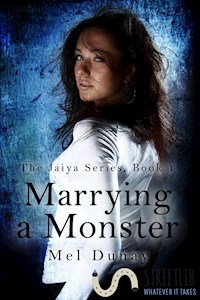
Marrying a Monster
––––––––
Mel Dunay
Copyright © 2016 Mel Dunay
All rights reserved.
ISBN,
ISBN-13,
––––––––
DEDICATION
––––––––
To my family, always.
Acknowledgments
––––––––
Many thanks to Adrijus Guscia (Rocking Book Covers) for an excellent book cover, and to Carol Davis (A Better Look Editing Services) for her help in finding and fixing my mistakes.
Also by Mel Dunay
The Jaiya Series
Marrying A Monster
Waking The Dreamlost
Table of Contents
Copyright Page
Also By Mel Dunay
CONTENTS
Prologue
CHAPTER ONE
CHAPTER TWO
CHAPTER THREE
CHAPTER FOUR
Chapter Five
CHAPTER SIX
CHAPTER SEVEN
CHAPTER EIGHT
Thank you
Sign up for Mel Dunay's Mailing List
CONTENTS
Prologue
1
Chapter One
3
Chapter Two
26
Chapter Three
40
Chapter Four
56
Chapter Five
79
Chapter Six
96
Chapter Seven
113
Chapter Eight
126
Thank You
141
Prologue
It was ten years before Independence, the end of Imperial rule over the country of Jaiya, although Raki did not know it at the time.
She did know that she was six and small for her age, that she could more or less read, and that she could not write well enough to ever be expected to learn more about it.
She was eating a simple dinner of flat breads and barley soup with her parents. When she’d asked for cheese and honey, they’d told her that only the big girls, the Mountain King’s Brides, got to eat those at this time of year.
When she sulked about that, her father said, “Don’t worry. It will be your turn soon enough. And in one of the safer years.”
And her mother had looked like she was going to cry. Raki had never seen her do that before.
Her mother could slaughter a chicken without blinking an eye, and bullied the lazy young men of the town back to plowing their terraced fields if they stopped to sneak a nip of moonshine.
A sound Raki had never heard before shattered the still night air. It sounded like a cat’s snarl, only far deeper. It sounded like her father shouting, only far bigger.
It sounded like thunder, only it came from...a something that wasn’t a cat or her father, but was more like them than whatever made the thunder. The downy hairs on her arms stood on end at the sound.
“What was that?” she asked her father. For a moment, he looked like he was going to cry too. Then his face smoothed out into a grim calm, and he picked her up and carried her to her little bed.
“It won’t come for you, little one,” he said, hugging her tightly. “Every nine years is the masting, and every eleventh masting is the greater one, like this one. A night like this will not happen again in your lifetime.”
CHAPTER ONE
The firecrackers were rattling outside loud enough to wake the dead when Rina opened the back door for her parents. The noise sounded like a machine gun shootout in a bad gangster movie.
Rina was as patriotic as anyone, but she sometimes wondered whether this was really the most appropriate way to celebrate the eighty-nine years that had passed since the country of Jaiya had gained its independence from the Empire.
“Maa, Paa, please come in,” she shouted above the noise.
She got them inside the back office of the little clothing shop she co-owned with her friend Kajjal and slammed the door on the humid, sticky heat of late summer.
Only then did she go through the full, formal greeting ritual she never used for anyone else, waving a little oil lamp over her parents’ heads with prayers to the Creator and the city’s guardian spirits to protect her guests during their time here.
These rituals were more to please her parents than to please herself. Rina was pretty sure that the Creator would look after good-hearted folk like her parents no matter where they were, and the best guardians you could have in a city like Rivertown weren’t spirits at all but a can of pepper spray and a good eye for spotting troublemakers.
When she was done with the rituals, she set the lamp down and hugged her parents tightly in turn.
“It’s good to see you two again,” she said, taking a long, hard look at them.
Maa seemed to have more gray hairs than she had when the family had come down to the city to shop for the winter solstice, but looked strong and happy aside from that.
Rina had the TV tuned to a news program but with the sound off, and Maa watched with interest as a human politician on the screen mouthed insults at his Gnosha counterpart, who looked something like a giant insect with a frog’s head.
Gnosha were not a common sight up on Mount Snarl, where Rina and Kajjal had been born and where their parents still lived and worked.
Paa had some more crinkles at the outer corners of his eyes, but his eyes themselves were as shrewd and expressive as ever. Right now, they looked like they were going to pop out of his head at the promotional poster in the back of the store.
This was a shot from behind of Rina’s business partner Kajjal, looking over her shoulder and wearing clothes the two women had created together: a black lace sari paired with a scarlet petticoat and a sleeveless blouse of the same color, with ties in the back instead of hooks or buttons.
The combination showed off a fair amount of Kajjal’s shoulder blades and spine, and the colors worked well for her; because her mother’s father had been an Imperial, not a Jaiyan, her skin was the color of milk with a little tea in it, while Rina’s was the color of tea with a little milk in it.
So Kajjal modeled clothes in the stark jewel tones that worked well with paler complexions, and Rina modeled clothes in the bright colors that would wash out those paler complexions.
Paa’s mouth set in a line of disapproval, and then opened. Rina was braced to say something like, “It’s the latest fashion...” but then Paa shut his mouth again. They’d argued about this seven months ago, at winter solstice, and apparently he didn’t feel like covering the same ground again, which was fine by Rina.
“Let’s go upstairs, where it’s cooler,” Rina said.
The shop itself only had overhead fans. The working class and lower middle-class women didn’t seem to mind when they came to buy blouses, saris, sarongs, and Imperial-style gowns.
As for the young, tough-guy types who seemed to have nothing better to do than smoke foul-smelling cigarettes and crowd into any store with real air conditioning, they didn’t come in here much.
“It would be cheaper to keep your apartment cool in summer if you built it in the basement,” Paa argued as they climbed the stairs.
Rina tried not to roll her eyes. He was probably thinking of the shallow cave up on Mount Snarl that opened onto the meadow he owned.
Until their hometown of Thundermouth got electricity, Paa had used that cave as a refrigerator, and he still stored his goat’s-milk cheese there while it ripened.
“We’re too close to the river,” she told Paa. “The basements here flood very easily.”
Rina opened the door at the top of stairs and sighed with relief at the blast of air conditioning. Kajjal, who shared the apartment with Rina, had just finished setting out their copper tea set, complete with sugar bowl, spice bowls, the creamer, and four little ceramic-lined copper teacups.
The two friends kept a packet of tea leaves and an electric pot for heating hot water on a counter in the back office, along with a glass bottle of milk in the mini-fridge, but a visit from either woman’s parents rated the good stuff.
Kajjal uncle’d and aunty’d Rina’s parents respectfully—about three winter solstices ago, they had told her to stop calling them sir and ma’am—and offered everyone tea. Maa and Paa only got down to business after tea had been poured and milk and flavoring had been added to everyone’s taste.
“Last time we talked on the phone, you had said business wasn’t doing well,” Maa said.
Rina blushed with embarrassment. Telling her parents that the business would not show a profit this year never got easier, and the fact that she and Kajjal had managed to keep the shop out of the red last year for the first time ever made it feel worse this time.
“We’ve done pretty well this year in terms of expanding our off-the-rack sales...” she began hesitantly.
“But it wasn’t enough to offset the losses on the custom-made side,” Kajjal cut in. Rina shot her a grateful look.
Paa looked quizzical, his bulging eyes darting from side to side as he thought. “This is about that seamstress who had dengue fever, isn’t it?” he asked.
“She’s one of our best workers, and without her, we just could not keep up with the demand,” Rina admitted. “But she’s doing better now, and she helped us find some more women to work for us.”
Maa flipped through the account books while Paa peered over her shoulder.
“You did pretty well, all things considered,” she said. “What really put you into the red was paying the hospital bills.”
Maa’s tone said that of course Rina and Kajjal had to do that, and no one could blame them for the results, but Paa’s eyes widened. “A government hospital shouldn’t cost that much,” he said indignantly. “They’re open to everyone.”
Rina exploded.
“Paa, pray to the Creator that you never have to spend time in one of those places. People jammed into the front halls, waiting to be treated. If they don’t pay the receptionist, they don’t get seen by a nurse. If they don’t pay the nurse...”
Paa retreated almost immediately, raising his hands in a way that was part shrug, part show of surrender. “I should know better than to argue with you about this,” he said.
“We understand why you are doing this,” said Maa. “But since we are two of your four chief investors, we need to talk about the consequences.”
She said this with a smile, referring to all the money she and Paa and Kajjal’s parents had lent them in the four years since they had started this business together.
Rina felt a tight spot in her chest. Her parents weren’t going to be able to lend them money this time.
She had hoped that her work would help support her parents instead of taking money out of their pockets, but that wasn’t happening just yet.
“We don’t need to borrow money. We’ll manage just fine,” Rina began before her mother cut her off.
“Hush, child. Don’t try to lie when the account ledgers are sitting right in front of me with a different story to tell.” She paused. “Although I guess I shouldn’t complain, since we haven’t been very open with you about some things ourselves.”
“Your mother and I didn’t make you go through the marriage to the Mountain King when you first came of age,” Paa said.
Rina was puzzled. “You said it would be all right, that the village elders let me have a dispensation from going through the ritual because I was away at school.” Even as she said it, a light began to dawn. “Then, when we started the business, you said, ‘Don’t worry, we’ll handle it.’”
“It’s some kind of fine or tithe, isn’t it, Uncle?” Kajjal asked. “That’s what the elders in my village threatened my parents with, when I didn’t want to do it.”
She came from the town of Barleyfields, only halfway up Mount Snarl. Rina’s hometown was at the top.
It was Maa who answered. “Yes, we paid the fine. We didn’t want you to worry. But with your sister getting ready to go off to college, we need to keep money on hand to help her too.”
Paa cut in gruffly. “We can’t do that, and help you out with the business, and pay the tithes for withholding a bride from the ritual. We can do two out of the three.”
Rina cringed a little on the inside. As a child, she’d been scared to death by the stories other kids told of the Mountain King carrying kids off when he didn’t get a bride.
As a teenager, she’d hated the idea of being sort-of married in a pointless ritual before she could get really married to her dream husband.
As a college student, she’d thought it old-fashioned and reactionary of her village to have a ritual where they basically offered their young women to the local guardian spirit, one who wasn’t all that benign in the old legends, and whom nobody really believed in anymore.
But Rina was twenty-eight now, with one relationship that had gotten to the marriage negotiations stage before falling apart, and a few casual ones that hadn’t gotten even that far.
At this stage in her life, being forward-thinking meant looking after her employees and her business, not rebelling against her village’s customs.
She looked at Kajjal.
“It’s not that bad, really,” Kajjal said. Her parents had refused to pay the tithe when it was demanded, so Kajjal had gone back to her village one summer and gotten the ritual over with.
“You party for a couple of days, you dress up nice, and you get a twenty-minute quickie wedding with a proxy groom standing in for the Mountain King. Then you spend the night in a bunch of tents with the other brides, with the proxy grooms standing guard outside.” Kajjal smirked. “Anybody who, um, really likes their proxy groom gets to have some fun. Then you get up in the morning, and all the old people who are mad at you for not being barefoot, pregnant and illiterate, pretend you were taken by the Mountain King and never speak to you again.”
Rina caught herself giggling, while Maa grinned openly and Paa rubbed his nose to hide a sly smile. He was the one who had to do business in their village, and Rina knew he couldn’t let himself get too caught up in disrespecting the elected council of elders who controlled everything.
“How soon is the ritual?” Rina asked.
Maa looked relieved. “The smokeflowers are only just budding,” she said. “They’ll start blooming in a week, and continue for a week and a half. The priests will want to hold the ritual as soon the blooming starts, but they will just have to wait.”
Paa snorted. “Amita’s going through the ritual this year too, and her father won’t let the priests start without her.”
“She’s interning with the minister of agriculture, you know.” There was a slight touch of envy in Maa’s voice, maybe a little reproof of her daughter for going into a line of work as frivolous as fashion.
“Yes, Mother, I know,” said Rina patiently. Amita was having an affair with the minister of agriculture, but Rina didn’t want to shock Maa by getting into that.
Paa looked uncomfortable and examined his teacup intently. He probably knew what Amita had gotten up to and why she’d done it. The whole Mount Snarl district got tax breaks just because the minister of agriculture had a young, pretty mistress from a village near the top of the mountain.
Neither Kajjal nor Rina had ever done anything of the kind, and Rina sometimes wondered if it wasn’t the contrast with Amita that kept Paa from getting more wound up than he already was about Rina’s and Kajjal’s fashion designs and their willingness to model the clothes themselves.
“Anyway.” Maa didn’t even seem to notice their reactions. “The priests will wait until nearly the end of the blooming if they have to. If you need to wrap things up down here, you should have a little time.”
“Your mother and I will need to start back soon, though, so we can prepare. You might be on your own for the trip up,” Paa warned her.
“That will be fine,” Rina said. Fond as she was of her parents, she didn’t feel like traveling with them all the way up Mount Snarl.
Rina managed to get things sorted out in less than a week, but then the river that cut through Rivertown overflowed and took out the bridge closest to her home.
She had to take a motor rickshaw halfway across town to the south to find a bridge that wasn’t bottlenecked with politicians heading up to their vacation homes in Summertown, or tourists trying to get to one of the bigger, more commercial smokeflower festivals in the foothills of the Blue Smoke Mountains.
She had planned to travel on the cheap, narrow-gauge train as far as Summertown, but there had been an accident on that line, and the only train going to Summertown was the luxury express.
It was evening by the time she and her suitcase reached the bus stop on the edge of town, and she sat down on her suitcase to wait for a bus that would take her up to Summertown.
Do I have everything? Rina worried. What did I forget?
She’d brought a nice chiffon sari with her for more formal dinners, and some chic skirts and shirts in the latest Imperial styles just to make everybody’s eyes pop out at home.
Her mother had told her not to worry about her clothes for the ritual; the family would take care of that, which meant that she was probably going to look gaudy and tacky in the end, but with any luck, there would only be a couple of photos of her dressed like that.
Sometimes, Rina envied curvy little Kajjal for her ability to make saris look good—Rina was taller and leaner, and although knee-skimming Imperial style skirts looked great on her, she had to choose her saris carefully so that she didn’t look rangy and gangly in them.
Rina had her phone, and the plugin charger for it, even though electricity was a dicey proposition where she was going, and the solar charger for when the electricity was out—were her subscriptions to the mobile novel site up to date?
She dug the phone out and tapped the screen a couple of times. Yes, the phone had chapters from all the serialized novels she had planned to subscribe to.
She had her purse, which meant she had makeup, money, a pencil and a small design sketchbook, and a couple of pairs of nice earrings to wear if she wanted to or could sell if something went wrong and she needed more money.
Right now, she was wearing tan and white tennis shoes, denim shorts and a cream-colored polo shirt that hopefully wouldn’t show the grime too much.
The bus pulled up, and she got on. Men brushed past her repeatedly as they squeezed their way to the rear. She didn’t like the way some of them looked at her, but she tried not to let it bother her. She needed to wear these clothes to stay cool and move around more easily, and she wasn’t going to be intimidated by anyone leering at her.
She did not manage to get a seat, but she grabbed one of the overhead grip straps toward the front with one hand, planted her suitcase between her legs, and then held on tight to her purse.
Her balance was good enough that she didn’t fall down or bump anyone when the bus lurched into motion.
A couple of hours outside of Capital, the bus passed through a stretch of mango orchards. The season for their fruit had passed, and there were no workers moving among the trees, but what always struck Rina about this place was how overgrown the space under the trees looked, with paths that looked like they had been made by deer rather than people.
A toll gate with its barrier lowered blocked the road ahead. There was no booth for collecting money from the drivers who passed through. Instead, there stood a creature like a six-foot-tall praying mantis, its shell gleaming maroon and yellow in the sun.
“Is that a Gnosha?” a pale-skinned tourist with an Imperial accent asked. “I always thought they were some sort of hoax your government put on to fool you lot.”
“I don’t know why the government gave them this stretch of land when there was already a major road on it,” said one of the other passengers with disgust.
“I do,” Rina said. “The minister of agriculture realized that the hills on the other side of the Gnosha reservation would make a great addition to his tea plantation. So, he confiscated that land by eminent domain for a road that’s no use to anyone but the truckers hauling his tea to market.”
The tourist’s eyes were starting to glaze over, but Rina plowed ahead.
“Then the minister had the government sell him the leftover land it didn’t need for the new road. At a discount price, of course.”
“You make the Gnosha sound like a bunch of innocent victims,” the man next to Rina said.
He was college-age, with a grubby plaid shirt and jeans torn at the knees, and a weak attempt at a beard.
Rina knew the type: going to college on the money raised by a working class or lower middle class family, but determined not to learn anything or work at anything, just smoke, drink and hit on women.
“Well, they were,” Rina said. “It wasn’t their idea, and there’s not much they or anyone else can do when the government invokes eminent domain.”
“At least they got this toll road in compensation,” said one of the other passengers. “That’s surely a gold mine for them.”
Rina shook her head. “You must not have traveled this road since they took it over. The Gnosha aren’t interested in money. You’ll see.”
The bus stopped in front of the barrier, and the driver opened the door on the passenger side. The Gnosha stooped forward and leaned into the opening, gripping the frame of the doorway with three-fingered hands no bigger than Rina’s.
Most of the passengers flinched, and Rina thought she heard a startled yelp from one of the small children on the bus.
For her own part, she tried to squash her gut-level dislike of insects by focusing on the Gnosha’s face, which looked like that of a cartoon frog, with large, shining green-gold eyes and a wide, thin-lipped mouth that turned up slightly at the corners.
That expression of friendly curiosity reminded Rina of the two or three other Gnosha that she had met. Maybe they weren’t all like that, but the ones who were interested in dealing with humans usually were.
“Greetings,” said the Gnosha in a voice that sounded like it was made by a complicated flute rather than a human throat. “Welcome to the territory of the Stetemo Hive. We collect tolls in a different way than you do.”
He paused. At least, Rina thought this one was a he; she had been told that these relatively small Gnosha, who had no cutting edges on their forearms and shins to defend themselves with, were builder drones, chosen for toll duty because humans found them less intimidating than the other castes.
“Everyone must leave the bus and come with me,” the Gnosha said. “To the sandpit over there.” He gestured to a square, sand-filled area within sight of the road, framed with weathered wooden beams.
“What are you going to do to us?” The question came from an austere-looking woman with the shaved head and orange-yellow robes of an ascetic in religious orders.
“Whatever it is, you’re not going to do it to me!” the driver snapped. “I’ve got to stay with the bus.”
“Don’t be silly,” Rina said. “I’ve been this way before, and all the Gnosha want us to do is draw a picture in the sand. Each of us, in turn. That includes you,” she said to the driver, “because they won’t let you leave until you draw your picture, and without you to drive us, none of us are leaving, and I for one have to reach Thundermouth by the end of the week.”
The driver scowled at her, but Rina could tell from looking around that most of the passengers were scowling back at him. Nobody wanted to be stuck here for any length of time.
One of the few people who weren’t scowling was a man standing up a couple of rows back from Rina. He was taller than the people in front of him, but not enough to show Rina more of him than a hawk-like face set on a strong-looking neck and a pair of shoulders that seemed to match the neck.
The man was wearing a white dress shirt open at the throat. His face had a look of polite curiosity that reminded Rina of the expression on the Gnosha toll collector’s face.
“Fine, you win,” the bus driver said. He turned off the bus and started to step out of the vehicle. Over his shoulder, he added, “But you’re coming with me.”
“I should hope so,” Rina said. “Someone’s got to show you how it’s done.”
She followed him out of the bus. The rest of the group came after them. Rina walked confidently up to the sandbox and started to draw an embroidery pattern she had sketched the other day in her idea book, a pattern full of loops and spirals. She looked up at the Gnosha to see what he thought.
“The Hive approves,” he said. “Thank you for contributing to our understanding of how humans think.”
The bus driver went next, drawing a stick man next to a box with a money symbol inside. Then came a woman with the saffron robes and shaved head of an ascetic, who drew an ancient religious glyph.
Then came the tall man Rina had noticed earlier. He might have been anywhere between thirty-five and forty. Seen close up, his longish hair was limp and sticky from the humidity, as was his shirt and the somewhat battered khaki pants he was wearing.
The clinging clothes hinted at a lean, well-formed figure as the man dropped into a graceful crouch and drew a four-legged stick figure with a smiley face.
Rina only recognized it as a horse when the man added a mane and tail. Then he drew a series of jagged, angular things that might have been writing in a language Rina did not know.
The Gnosha was silent for a moment, then said, “I have told the Queens that after paying the toll, you expressed a wish to speak with them. They are willing, if you will meet them at the main Hive dwelling right now.”
“I would be honored,” the man said. He had a heavy, rather nasal voice, not unattractive, but with a bit of a growl buried in it. “Can you tell me where to go, please?”
The Gnosha pointed toward a narrow trail that started at the toll gate and wound away into the underbrush.
“Thank you.” The man bowed at the waist, in as close to the Gnosha style as a human being could manage, and set off down the deer trail at a jog.
“What’s that idiot trying to do, break his neck?” the young man with the beard sneered.
Rina shrugged and offered an answer. “He seems to know how to handle a Gnosha trail, so maybe he’s done business with one of the other Hives. Some of them hire humans to act as go-betweens in their dealings with other groups of Gnosha.”
The young man’s eyes narrowed. “I wonder how you got to know so much about those freaks. You some kind of bug lover?”
Rina felt her face go hot with anger. “Maybe if you had a real job, you’d have done business with the Gnosha yourself, and then you’d know just as much about them as I do.”
The young man’s scowl deepened. “I don’t [...]




