


38,39 €
Mehr erfahren.
- Herausgeber: Packt Publishing
- Kategorie: Wissenschaft und neue Technologien
- Sprache: Englisch
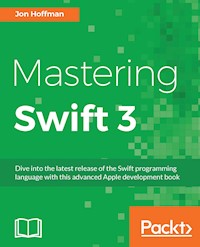
Dive into the latest release of the Swift programming language with this advanced Apple development book
About This Book
- Discover the new features and improvements to Swift 3
- Get to grips with advanced design patterns and techniques to write smarter, cleaner Swift code
- Become a more fluent Swift developer and build powerful, impressive iOS and OS X applications.
Who This Book Is For
This book is for developers who want to dive into the newest version of Swift.
If you are a developer that learns best by looking at, and working with code, then this book is for you. A basic understanding of Apple's tools is beneficial but not mandatory.
What You Will Learn
- Dive into the core components of Swift 3.0, including operators, collections, control flow, and functions
- Create and use classes, structures, and enums
- Understand object-oriented Swift and see how to tackle inheritance, protocols, and extensions
- Develop a practical understanding of subscripts, optionals, and closures
- See how to use the new protocol extension and error handling features of Swift 3.0
- Add concurrency to your applications using Grand Central Dispatch
In Detail
Swift is the definitive language of Apple development today. It's a vital part of any iOS and OS X developer's skillset, helping them to build the most impressive and popular apps on the App Store—the sort of apps that are essential to iPhone and iPad users every day. With version 3.0, the Swift team have added new features to improve the development experience—making it easier to get the results you want and customers expect.
Inside, you'll find the key features of Swift 3.0 and quickly learn how to use the newest updates to your development advantage. From Objective-C interoperability to ARC, to closures and concurrency, this advanced Swift guide will develop your expertise and make you more fluent in this vital programming language.
We give you in-depth knowledge of some of the most sophisticated elements of Swift development including protocol extensions, error-handling, design patterns, and concurrency, and guide you on how to use and apply them in your own projects. You'll see how even the most challenging design patterns and programming techniques can be used to write cleaner code and to build more performant iOS and OS X applications.
By the end of this book, you'll have a handle on effective design patterns and techniques, which means you'll soon be writing better iOS and OS X applications with a new level of sophistication and control.
Style and approach
Packed with practical examples that show you how to put the concepts you learn into practice quickly, we'll takes you through some of the most advanced and sophisticated elements of the language in a practical and actionable way. You can also download the code to use yourself
Sie lesen das E-Book in den Legimi-Apps auf:
Seitenzahl: 513
Veröffentlichungsjahr: 2016
Ähnliche












Table of Contents
Mastering Swift 3
Mastering Swift 3
Copyright © 2016 Packt Publishing
All rights reserved. No part of this book may be reproduced, stored in a retrieval system, or transmitted in any form or by any means, without the prior written permission of the publisher, except in the case of brief quotations embedded in critical articles or reviews.
Every effort has been made in the preparation of this book to ensure the accuracy of the information presented. However, the information contained in this book is sold without warranty, either express or implied. Neither the author, nor Packt Publishing, and its dealers and distributors will be held liable for any damages caused or alleged to be caused directly or indirectly by this book.
Packt Publishing has endeavored to provide trademark information about all of the companies and products mentioned in this book by the appropriate use of capitals. However, Packt Publishing cannot guarantee the accuracy of this information.
First published: October 2016
Production reference: 1191016
Published by Packt Publishing Ltd.
Livery Place
35 Livery Street
Birmingham
B3 2PB, UK.
ISBN 978-1-78646-612-9
www.packtpub.com
Credits
Author
Jon Hoffman
Copy Editor
Vikrant Phadke
Reviewer
Jannis Muething
Project Coordinator
Shweta H Birwatkar
Commissioning Editor
Ashwin Nair
Proofreader
Safis Editing
Acquisition Editor
Tushar Gupta
Indexer
Aishwarya Gangawane
Content Development Editor
Sumeet Sawant
Graphics
Disha Haria
Technical Editor
Egan Lobo
Production Coordinator
Nilesh Mohite
About the Author
Jon Hoffman has over 20 years of experience in the field of Information Technology. Over those 20 years, Jon has worked in the areas of system administration, network administration, network security, application development, and architecture. Currently, Jon works as a senior software engineer for Syn-Tech Systems.
Jon has developed extensively for the iOS platform since 2008. This includes several apps that he has published in the App Store, apps that he has written for third parties, and numerous enterprise applications. What really drives Jon is the challenges the Information Technology field provides and there is nothing more exhilarating to him than overcoming a challenge.
You can follow Jon on his two blogs: http://masteringswift.blogspot.com and http://myroboticadventure.blogspot.com.
Some of Jon’s other interests are watching Baseball (Go Sox) and Basketball (Go Celtics). Jon also really enjoys Tae Kwon Do where he and his oldest daughter Kailey earned their black belts together early in 2014, Kim (his wife) earned her black belt in December 2014, and his youngest daughter is currently working towards her black belt.
I would like to thank my wonderful wife Kim, without whose support, encouragement, patience, and understanding this book would have never been written. I would also like to thank my two wonderful daughters Kailey and Kara who have both been my inspiration and driving force since the days they were born.
About the Reviewer
Jannis Muething works as a freelance developer and designer for mobile applications. He is currently based in Dortmund, Germany and has been developing for mobile devices with a focus on iOS since 2009. Since 2014, he has been working for smartcircles mHealth AG, where he is involved in many projects. Recently he has also been doing security research focused on the protection of private data on mobile devices. Prior to mobile/iOS design and development, he worked at Materna GmbH, where he mainly did Java development. He can be found on the web at http://jannis.co and on Twitter at @j4nnis.
www.PacktPub.com
For support files and downloads related to your book, please visit www.PacktPub.com.
Did you know that Packt offers eBook versions of every book published, with PDF and ePub files available? You can upgrade to the eBook version at www.PacktPub.com and as a print book customer, you are entitled to a discount on the eBook copy. Get in touch with us at [email protected] for more details.
At www.PacktPub.com, you can also read a collection of free technical articles, sign up for a range of free newsletters and receive exclusive discounts and offers on Packt books and eBooks.
https://www.packtpub.com/mapt
Get the most in-demand software skills with Mapt. Mapt gives you full access to all Packt books and video courses, as well as industry-leading tools to help you plan your personal development and advance your career.
Why subscribe?
Preface
Swift is the definitive language of Apple development today. It’s a vital part of any iOS and OS X developer’s skillset, helping them to build the most impressive and popular apps on the App Store—the sorts of app that are essential to iPhone and iPad users every day.
What this book covers
Chapter 1, Taking the First Steps with Swift, shows you how to start and use Playgrounds to experiment with Swift programming. We will also cover the basic Swift language syntax and discuss proper language styles.
Chapter 2, Learning About Variables, Constants, Strings, and Operators, will show how to use variables and constants in Swift. We will also look at the various data types and how to use operators in Swift.
Chapter 3, Using Swift Collections and the Tuple Type, will look at how we can use the Swift collection types to store related data. These collection types are the dictionary and array types. We will also look at how we can use the Cocoa and Foundation data types in Swift.
Chapter 4, Control Flow and Functions, will cover control flow and functions in Swift. It is essential to understand the concepts in this chapter before going on. Every application that we write, beyond the simple Hello World applications, will rely very heavily on the control flow statements and functions.
Chapter 5, Classes and Structures, is dedicated to Swift's classes and structures. We'll look at what makes them similar and what makes them different. We'll also look at access controls and object-oriented design. We'll close this chapter out by looking at memory management in Swift.
Chapter 6, Using Protocols and Protocol Extensions, will cover both protocols and protocol extensions in detail since protocols are very important to the Swift language, and having a solid understanding of them will help us write flexible and reusable code.
Chapter 7, Protocol-Oriented Design, will cover the best practices of Protocol-Oriented Design with Swift. It will be a brief overview of what is covered in my Protocol-Oriented Programming (POP) book.
Chapter 8, Writing Safer Code with Availability and Error Handling, will look at Swift’s error-handling features. This feature is really important for writing safe code. While we are not required to use this feature in our custom types, it does give us a uniform manner to handle and respond to the error. Apple has also started to use this error handling in their frameworks. It is recommended that we use error handling in our code.
Chapter 9, Custom Subscripting, will discuss how we can use custom subscripts in our classes, structures, and enumerations. Subscripts in Swift can be used to access elements in a collection. We can also define custom subscripts for our classes, structures, and enumerations.
Chapter 10, Using Optional Types, will explain what optional types really are, what the various ways to unwrap them are, and optional chaining. For a developer who is just learning Swift, optional types can be one of the most confusing items to learn.
Chapter 11, Working with Generics, will explain how Swift implements generics. Generics allow us to write very flexible and reusable code that avoids duplication.
Chapter 12, Working with Closures, will teach us how to define and use closures in our code. Closures in Swift are similar to blocks in Objective-C except that they have a much cleaner and easier way of using syntax. We will conclude this chapter with a section on how to avoid strong reference cycles with closures.
Chapter 13, Using Mix and Match, will explain mix and match and demonstrate how we can include Swift code in our Objective-C projects and Objective-C code in our Swift projects. With all of the apps and frameworks written in Objective-C, it is important to allow Swift and Objective-C code to work together.
Chapter 14, Concurrency and Parallelism in Swift, will show how to use both Grand Central Dispatch and Operation Queues to add concurrency and parallelism to our applications. Understanding and knowing how to add concurrency and parallelism to our apps can significantly enhance the user experience.
Chapter 15, Swift Formatting and Style Guide, will define a style guide for the Swift language that can be used as a template for enterprise developers who need to create a style guide, since most enterprises have style guides for the various languages that they develop in.
Chapter 16, Swift's Core Libraries, will be a chapter on using the Swift core libraries, including reading/writing files, network primitives, and JSON parsing.
Chapter 17, Adopting Design Patterns in Swift, will show you how to implement some of the more common design patterns in Swift. A design pattern identifies a common software development problem and provides a strategy for dealing with it.
What you need for this book
To follow along with the examples in this book, you'll need an Apple computer with OS X 10.11 or higher installed. You'll also need to install Xcode version 8.0 or higher with Swift version 3 or higher.
Who this book is for
This book is for developers who want to dive into the newest version of Swift. If you are a developer that learns best by looking at and working with code, then this book is for you. A basic understanding of Apple's tools is beneficial but not mandatory.
Reader feedback
Feedback from our readers is always welcome. Let us know what you think about this book-what you liked or disliked. Reader feedback is important for us as it helps us develop titles that you will really get the most out of. To send us general feedback, simply e-mail [email protected], and mention the book's title in the subject of your message. If there is a topic that you have expertise in and you are interested in either writing or contributing to a book, see our author guide at www.packtpub.com/authors.
Customer support
Now that you are the proud owner of a Packt book, we have a number of things to help you to get the most from your purchase.
Downloading the example code
You can download the example code files for this book from your account at http://www.packtpub.com. If you purchased this book elsewhere, you can visit http://www.packtpub.com/support and register to have the files e-mailed directly to you.
You can download the code files by following these steps:
Once the file is downloaded, please make sure that you unzip or extract the folder using the latest version of:
The code bundle for the book is also hosted on GitHub at https://github.com/PacktPublishing/Mastering-Swift-3. We also have other code bundles from our rich catalog of books and videos available at https://github.com/PacktPublishing/. Check them out!
Downloading the color images of this book
We also provide you with a PDF file that has color images of the screenshots/diagrams used in this book. The color images will help you better understand the changes in the output. You can download this file from https://www.packtpub.com/sites/default/files/downloads/MasteringSwift3_ColorImages.pdf.
Errata
Although we have taken every care to ensure the accuracy of our content, mistakes do happen. If you find a mistake in one of our books-maybe a mistake in the text or the code-we would be grateful if you could report this to us. By doing so, you can save other readers from frustration and help us improve subsequent versions of this book. If you find any errata, please report them by visiting http://www.packtpub.com/submit-errata, selecting your book, clicking on the Errata Submission Form link, and entering the details of your errata. Once your errata are verified, your submission will be accepted and the errata will be uploaded to our website or added to any list of existing errata under the Errata section of that title.
To view the previously submitted errata, go to https://www.packtpub.com/books/content/support and enter the name of the book in the search field. The required information will appear under the Errata section.
Piracy
Piracy of copyrighted material on the Internet is an ongoing problem across all media. At Packt, we take the protection of our copyright and licenses very seriously. If you come across any illegal copies of our works in any form on the Internet, please provide us with the location address or website name immediately so that we can pursue a remedy.
Please contact us at [email protected] with a link to the suspected pirated material.
We appreciate your help in protecting our authors and our ability to bring you valuable content.
Questions
If you have a problem with any aspect of this book, you can contact us at [email protected], and we will do our best to address the problem.
Chapter 1. Taking the First Steps with Swift
Ever since I was 12 years old and wrote my first program in the BASIC programming language, programming has been a passion for me. Even as programming became my career, it always remained more of a passion than a job, but over the past few years, that passion waned. I was unsure why I was losing that passion. I attempted to recapture it with some of my side projects, but nothing really brought back the excitement that I used to have. Then, something wonderful happened! Apple announced Swift. Swift is such an exciting and progressive language that it has brought a lot of that passion back and made programming fun for me again.
In this chapter, you will learn:
What is Swift?
Swift is Apple's new programming language, introduced at the Worldwide Developers Conference (WWDC) in 2014 alongside the integrated development environment Xcode 6 and iOS 8. Swift was arguably the most significant announcement at WWDC 2014, and very few people, including Apple insiders, were aware of the project's existence prior to it being announced.
It was amazing, even by Apple's standards, that they were able to keep Swift a secret for as long as they did and that no one suspected they were going to announce a new development language. At WWDC 2015, Apple made another big splash when they announced Xcode 7 and Swift 2. Swift 2 was a major enhancement to the Swift language. During that conference, Chris Lattner said that a lot of the enhancements were based on the direct feedback that Apple received from the developer community.
On December of 2015, Apple officially released Swift as an open source project, with the swift.org site dedicated to the open source Swift community. The Swift repository is located on Apple's GitHub page (http://github.com/apple). The Swift evolution repository (https://github.com/apple/swift-evolution) tracks the evolution of Swift by documenting the proposed changes for Swift. You can also find a list of which proposals were accepted and which were rejected in the evolution repository. If you are interested in understanding where Swift is heading, you should check out this repository. It is interesting to note that Swift 3 contains several enhancements that were proposed by the community.
Swift 3 is a major enhancement to the Swift language that is NOT source compatible with previous releases of the Swift language. It contains fundamental changes to the language itself and to the Swift standard library. One of the main goals of Swift 3 is to be source compatible across all platforms, so the code that we write for the one platform will be compatible with all other platforms. This means that the code we develop for Mac OS will work on Linux, although certain frameworks, such as UIKit, may not be compatible across platforms.
The development of Swift was started in 2010 by Chris Lattner. He implemented much of the basic language structure, with only a few people being aware of its existence. It wasn't until late 2011 that other developers began to really contribute to Swift and in July of 2013, it became a major focus of the Apple Developer Tools group.
Chris Lattner started working at Apple in the summer of 2005. He has held several positions in the Developer Tools group and is currently the director and architect of that group. On his home page (http://www.nondot.org/sabre/), he notes that Xcode's Playgrounds (you can read more on Playgrounds a little later in this chapter) became a personal passion of his because it makes programming more interactive and approachable. We will be using Playgrounds a lot in this book as a test and experimentation platform. Starting with iOS 10, we will be able to use Swift Playgrounds on the iPad.
Note
To me, being able to use Swift Playgrounds on the iPad is very exciting because it will make it easier for people getting started with programming to learn the Swift language. I am really looking forward to showing my daughters how to use Playgrounds on their iPads.
There are a lot of similarities between Swift and Objective-C. Swift adopts the readability of Objective-C's named parameters and dynamic object model. When we refer to Swift as having a dynamic object model, we are referring to the ability of types to change at runtime. This includes adding new (custom) types and changing/extending the existing types.
While there are a lot of similarities between Swift and Objective-C, there are significant differences between them as well. Swift's syntax and formatting are a lot closer to Python than Objective-C, but Apple did keep the curly braces. I know Python people would disagree with me, and that is all right because we all have different opinions, but I like the curly braces. Swift actually makes the curly braces required for control statements, such as if and while, which eliminates bugs, such as goto fail in Apple's SSL library.
Swift was also built to be fast. At WWDC 2014, Apple showed a number of benchmarks, which proved that Swift significantly outperformed Objective-C. Swift uses the LLVM compiler, which is included with Xcode 7 to transform Swift code into highly optimized native code that is tuned to get the most out of Apple's modern hardware.
Swift features
When Apple said that Swift is Objective-C without the C, they were really only telling us half of the story. Objective-C is a superset of C and provides object-oriented capabilities and a dynamic runtime to the C language. This meant that with Objective-C, Apple needed to maintain compatibility with C, which limited the enhancements it could make to the Objective-C language. As an example, Apple could not change how the switch statement functioned and still maintain the C compatibility.
Since Swift does not need to maintain the same C compatibility as Objective-C, Apple was free to add any features/enhancements to the language. This allowed Apple to include the best features from many of today's most popular and modern languages, such as Objective-C, Python, Java, Ruby, C#, Haskell, and many others.
The following chart shows a list of some of the most exciting enhancements that Swift includes:
Swift feature
Description
Type inference
Swift can automatically deduce the type of the variable or constant based on the initial value.
Generics
Generics allow us to write code once to perform identical tasks for different types of objects while still maintaining type safety.
Collection mutability
Swift does not have separate objects for mutable or non-mutable containers. Instead, you define mutability by defining the container as a constant or variable.
Closure syntax
Closures are self-contained blocks of functionality that can be passed around and used in our code.
Optionals
Optionals define a variable that might not have a value.
Switch statement
The switch statement has been drastically improved with features such as pattern matching, guard conditions, and no automatic fall-through. This is one of my favorite improvements.
Multiple return types
Functions can have multiple return types using tuples.
Operator overloading
Classes can provide their own implementation of the existing operators.
Enumerations with Associated values
In Swift, we can do a lot more than just defining a group of related values with enumerations.
There is one feature that I did not mention in the preceding chart because it is technically not a feature of Swift; it is a feature of Xcode and the compiler. This feature is Mix and match. Mix and match allow us to create applications that contain both Objective-C and Swift files. This allows us to systematically update our current Objective-C applications with Swift classes and also use Objective-C libraries/frameworks in our Swift applications.
Before we begin our journey into the wonderful world of Swift development, let's take a detour and visit a place that I have loved ever since I was a kid—the playground.
Summary
In this chapter, we showed you how to start and use Playgrounds to experiment with Swift programming. We also covered the basic Swift language syntax and discussed proper language styles. The chapter concluded with two Hello World examples.
In the next chapter, we will see how to use variables and constants in Swift. We will also look at the various data types and how to use operators in Swift.




