


25,99 €
Mehr erfahren.
- Herausgeber: John Wiley & Sons
- Kategorie: Wissenschaft und neue Technologien
- Serie: RGS-IBG Book Series
- Sprache: Englisch
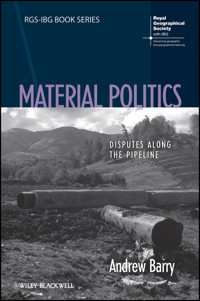
In Material Politics, author Andrew Barry reveals that as we are beginning to attend to the importance of materials in political life, materials has become increasingly bound up with the production of information about their performance, origins, and impact.
- Presents an original theoretical approach to political geography by revealing the paradoxical relationship between materials and politics
- Explores how political disputes have come to revolve not around objects in isolation, but objects that are entangled in ever growing quantities of information about their performance, origins, and impact
- Studies the example of the Baku-Tbilisi-Ceyhan oil pipeline – a fascinating experiment in transparency and corporate social responsibility – and its wide-spread negative political impact
- Capitalizes on the growing interdisciplinary interest, especially within geography and social theory, about the critical role of material artefacts in political life
Sie lesen das E-Book in den Legimi-Apps auf:
Seitenzahl: 548
Veröffentlichungsjahr: 2013
Ähnliche



















Contents
Series Editors’ Preface
Figures and Tables
Acknowledgements
Abbreviations
Chapter One Introduction
Making Things Political
Governing Materials
An Experiment in Transparency and Responsibility
The Georgian Route
The Archive
Overview of the Chapters
Chapter Two The Georgian Route: Between Political and Physical Geography
Political Fieldwork
Geopolitics, Oil, the Caucasus
Physical Geography
The Pipeline Regime
Conclusion: Political Knowledge
Chapter Three Transparency’s Witness
Resource Curse
Disclosure
Assembling Civil Society
A Public Experiment
Chapter Four Ethical Performances
Ethics and Business
Ethics, Politics and the Logic of Abduction
Art, Research and Politics
Conclusions: Ethics and Knowledge Controversies
Chapter Five The Affected Public
Disclosure
Affected Communities
Points and Corridors
A Disputed Public
Conclusions: From Affected Communities to Material Impacts
Chapter Six Visible Impacts
Landslides
Vibration
Impact and Action
Circulations of Impact
Chapter Seven Material Politics
Metals
Politics
Itinerant Practices
Chapter Eight Economy and the Archive
Interference
Compensation System
Accounting for Labour
Multiple Histories
Chapter Nine Conclusions
Geopolitical Fieldwork
The Limits of Transparency
Material Politics
Coda
Notes
1 Introduction
2 The Georgian Route: Between Political and Physical Geography
3 Transparency’s Witness
4 Ethical Performances
5 The Affected Public
6 Visible Impacts
7 Material Politics
8 Economy and the Archive
9 Conclusions
References
Film, Television, Video and Photography
Documents, Reports and Publicity Material
Index
RGS-IBG Book Series
Published
Material Politics: Disputes Along the PipelineAndrew BarryEveryday Moral Economies: Food, Politics and Scale in CubaMarisa WilsonWorking Lives – Gender, Migration and Employment in Britain, 1945–2007Linda McDowellFashioning Globalisation: New Zealand Design, Working Women and the Cultural EconomyMaureen Molloy and Wendy LarnerDunes: Dynamics, Morphology and Geological HistoryAndrew WarrenSpatial Politics: Essays for Doreen MasseyEdited by David Featherstone and Joe PainterThe Improvised State: Sovereignty, Performance and Agency in Dayton BosniaAlex JeffreyLearning the City: Knowledge and Translocal AssemblageColin McFarlaneGlobalizing Responsibility: The Political Rationalities of Ethical ConsumptionClive Barnett, Paul Cloke, Nick Clarke and Alice MalpassDomesticating Neo-Liberalism: Spaces of Economic Practice and Social Reproduction in Post-Socialist CitiesAlison Stenning, Adrian Smith, Alena Rochovská and Dariusz ŚwiątekSwept Up Lives? Re-envisioning the Homeless CityPaul Cloke, Jon May and Sarah JohnsenAerial Life: Spaces, Mobilities, AffectsPeter AdeyMillionaire Migrants: Trans-Pacific Life LinesDavid LeyState, Science and the Skies: Governmentalities of the British AtmosphereMark WhiteheadComplex Locations: Women’s Geographical Work in the UK 1850–1970Avril MaddrellValue Chain Struggles: Institutions and Governance in the Plantation Districts of South IndiaJeff Neilson and Bill PritchardQueer Visibilities: Space, Identity and Interaction in Cape TownAndrew TuckerArsenic Pollution: A Global SynthesisPeter Ravenscroft, Hugh Brammer and Keith RichardsResistance, Space and Political Identities: The Making of Counter-Global NetworksDavid FeatherstoneMental Health and Social Space: Towards Inclusionary Geographies?Hester ParrClimate and Society in Colonial Mexico: A Study in VulnerabilityGeorgina H. EndfieldGeochemical Sediments and LandscapesEdited by David J. Nash and Sue J. McLarenDriving Spaces: A Cultural-Historical Geography of England’s M1 MotorwayPeter MerrimanBadlands of the Republic: Space, Politics and Urban PolicyMustafa DikeçGeomorphology of Upland Peat: Erosion, Form and Landscape ChangeMartin Evans and Jeff WarburtonSpaces of Colonialism: Delhi’s Urban GovernmentalitiesStephen LeggPeople/States/TerritoriesRhys JonesPublics and the CityKurt IvesonAfter the Three Italies: Wealth, Inequality and Industrial ChangeMick Dunford and Lidia GrecoPutting Workfare in PlacePeter Sunley, Ron Martin and Corinne NativelDomicile and DiasporaAlison BluntGeographies and MoralitiesEdited by Roger Lee and David M. SmithMilitary GeographiesRachel WoodwardA New Deal for Transport?Edited by Iain Docherty and Jon ShawGeographies of British ModernityEdited by David Gilbert, David Matless and Brian ShortLost Geographies of PowerJohn AllenGlobalizing South ChinaCarolyn L. CartierGeomorphological Processes and Landscape Change: Britain in the Last 1000 YearsEdited by David L. Higgitt and E. Mark Lee
Forthcoming
Smoking Geographies: Space, Place and TobaccoRoss Barnett, Graham Moon, Jamie Pearce, Lee Thompson and Liz TwiggPeopling Immigration Control: Geographies of Governing and Activism in the British Asylum SystemNick GillGeopolitics and Expertise: Knowledge and Authority in European DiplomacyMerje KuusThe Geopolitics of Expertise In the Nature of Landscape: Cultural Geography on the Norfolk BroadsDavid MatlessRehearsing the State: The Political Practices of the Tibetan Government-in-ExileFiona McConnellFrontier Regions of Marketization: Agribusiness, Farmers, and the Precarious Making of Global Connections in West AfricaStefan OumaArticulations of Capital: Global Production Networks and Regional TransformationsJohn Pickles, Adrian Smith & Robert Begg, with Milan Buček, Rudolf Pástor and Poli RoukovaOrigination: The Geographies of Brands and BrandingAndy PikeMaking Other Worlds: Agency and Interaction in Environmental ChangeJohn Wainwright
This edition first published 2013© 2013 John Wiley & Sons, Ltd
Registered OfficeJohn Wiley & Sons, Ltd, The Atrium, Southern Gate, Chichester, West Sussex,PO19 8SQ, UK
Editorial Offices350 Main Street, Malden, MA 02148-5020, USA9600 Garsington Road, Oxford, OX4 2DQ, UKThe Atrium, Southern Gate, Chichester, West Sussex, PO19 8SQ, UK
For details of our global editorial offices, for customer services, and for information about how to apply for permission to reuse the copyright material in this book please see our website at www.wiley.com/wiley-blackwell.
The right of Andrew Barry to be identified as the author of this work has been asserted in accordance with the UK Copyright, Designs and Patents Act 1988.
All rights reserved. No part of this publication may be reproduced, stored in a retrieval system, or transmitted, in any form or by any means, electronic, mechanical, photocopying, recording or otherwise, except as permitted by the UK Copyright, Designs and Patents Act 1988, without the prior permission of the publisher.
Wiley also publishes its books in a variety of electronic formats. Some content that appears in print may not be available in electronic books.
Designations used by companies to distinguish their products are often claimed as trademarks. All brand names and product names used in this book are trade names, service marks, trademarks or registered trademarks of their respective owners. The publisher is not associated with any product or vendor mentioned in this book.
Limit of Liability/Disclaimer of Warranty: While the publisher and author(s) have used their best efforts in preparing this book, they make no representations or warranties with respect to the accuracy or completeness of the contents of this book and specifically disclaim any implied warranties of merchantability or fitness for a particular purpose. It is sold on the understanding that the publisher is not engaged in rendering professional services and neither the publisher nor the author shall be liable for damages arising herefrom. If professional advice or other expert assistance is required, the services of a competent professional should be sought.
Library of Congress Cataloging-in-Publication Data
Barry, Andrew, 1960–Material politics : disputes along the pipeline / Andrew Barry.pages cmIncludes index.
ISBN 978-1-118-52911-9 (hardback) – ISBN 978-1-118-52912-6 (paper)1. Geopolitics. 2. Materials–Political aspects. 3. Material culture–Politicalaspects. 4. Petroleum pipelines–Political aspects. 5. International economic relations–Political aspects. I. Title.JC319.B39 2013320.1′2–dc23
2013018241
A catalogue record for this book is available from the British Library.
Cover image: © Andrew BarryCover design by Workhaus
For Georgie
Series Editors’ Preface
The RGS-IBG Book Series only publishes work of the highest international standing. Its emphasis is on distinctive new developments in human and physical geography, although it is also open to contributions from cognate disciplines whose interests overlap with those of geographers. The Series places strong emphasis on theoretically-informed and empirically-strong texts. Reflecting the vibrant and diverse theoretical and empirical agendas that characterize the contemporary discipline, contributions are expected to inform, challenge and stimulate the reader. Overall, the RGS-IBG Book Series seeks to promote scholarly publications that leave an intellectual mark and change the way readers think about particular issues, methods or theories.For details on how to submit a proposal please visit:
www.rgsbookseries.com
Neil CoeNational University of SingaporeJoanna BullardLoughborough University, UKRGS-IBG Book Series Editors
Figures and Tables
Figures
1.1
Route of the BTC pipeline
2.1
Alternative pipeline routes through Georgia
3.1
Making Politics Transparent, Tbilisi
5.1
Witness Statements, London
6.1
Visible signs
6.2
Map of Dgvari and surrounding villages
6.3
The impact of landslides, Dgvari
7.1
The Materiality of Construction
8.1
Between geopolitics and corporate social responsibility
9.1
Energy Infrastructure
Tables
1.1
Institutions and organisations involved in the development and politics of the BTC pipeline
1.2
Timeline of the BTC pipeline project
Acknowledgements
This book reports on a huge body of social research carried out along the route of a 1760 km pipeline. Much of the book is based on my own reading of the reports that this enterprise generated, whether they derived from the work of consultants, officials or NGOs. When weighed up against this research, my own fieldwork along the route of the pipeline through Georgia was modest in scale, but it also proved highly productive. For this I am grateful to my colleagues, assistants and informants. I am particularly indebted to my researcher Joanna Ewart-James, whose organisational ability and good sense made an enormous contribution to the success of six months of fieldwork in the UK and Georgia in early 2004. While in Tbilisi, we were initially assisted by the staff of the British Council. My thanks go, in particular, to Jo Bakowski, then Director of the British Council in Georgia, and to Louis Plowden-Wardlaw for introducing us. Tamta Khalvashi and Alex Scrivener provided invaluable assistance and translation skills as well as their knowledge of, and insights into, Georgian political history. Alex’s good humour and tolerance of my determination to track down seemingly obscure details made fieldwork with him a real pleasure. I also owe a debt of gratitude to Farideh Heyat, who carried out a short period of fieldwork on the development of BTC in Azerbaijan on my behalf, which was the starting point for my account of transparency. While much of this book is based is based on evidence found in public documents, the BTC pipeline was also the subject of two important documentary films. I am especially grateful to Marin Skalsky for a series of conversations about his film Zdroj and to Nino Kirtadze for sending me a copy of her Un Dragon dans les eaux pures du Caucase at a timely moment.
This project had multiple origins. Meltem Ahiska’s research on the history of Turkish radio broadcasting prompted me to think about the importance of archives and the formation of publics. James Marriott from Platform provided invaluable suggestions and contacts during the early stages of the project. Barry Halton and Elizabeth Wild from BP gave me their support, and helped me arrange initial meetings with BP staff working in offices in Tbilisi, Baku, Ankara and London. I am very grateful to the employees of BP in Tbilisi, who were open about some of the challenges that they faced, always professional in their conduct, and generous with their time. During the course of my research in Georgia I benefited enormously from a series of interviews with Manana Kochladze from Green Alternative. Through the help of both Manana and BP staff in Tbilisi I was able to accompany Georgian NGOs and BP Community Liaison Officers to a number of the villages along the pipeline. My thanks also to the many informants I interviewed in London, Washington, Ankara, Tbilisi and Baku who are not named in the text as well as others who assisted me. None of my informants sought to impose conditions on the conduct of my research or its publication. Fieldwork in the region was funded by a grant from the UK Economic and Social Research Council Science in Society programme (‘Social and Human Rights Impact Assessment and the Governance of Technology’, 2003–4, RES-151-25-0011).
The idea for this book was first conceived in 2005, when I was working at Goldsmiths College in London. My thanks go to Celia Lury and Mariam Motamedi-Fraser, who co-founded the Centre for the Study of Invention and Social Process at Goldsmiths with me, for their friendship and inspiration. My thanks also to Tim Mitchell and the members of International Center for Advanced Studies and NYU in 2004–5 for their interest and support, and to Soumhya Venkatesen for lending me her room. More recently, I was lucky enough to work closely with Derek McCormack, Richard Powell and Ali Rogers, whose example helped me to understand what it means to think geographically. My thanks also to Ailsa Allen for the care that she took in preparing illustrations for the book, to my students at St Catherine’s College for forcing me to think about the relevance of my concerns to theirs, and to Theo Barry-Born for his editorial assistance. Earlier drafts of many of the chapters were read by a number of colleagues and friends. I am enormously grateful to Lionel Bently, Bruce Braun, Mick Halewood, Caroline Humphrey, Jamie Lorimer, Andy Stirling, Gisa Weszkalnys and Sarah Whatmore and, above all, to Tom Osborne and Corin Throsby. In the latter stages of the development of the manuscript, I was also fortunate to receive insightful comments from the editorial board of the RGS-IBG book series, as well as an astute report from an anonymous reviewer. I remain grateful to Steve Hinchliffe for his encouragement, Neil Coe for his timely and clear editorial recommendations, and to Jacqueline Scott for being such an effective editor. Anne Piper provided an ideal refuge in Wytham over several years.
The book would not have been possible without the support of Theo and Clara and, above all, Georgie Born. Georgie’s own research powerfully informed my sense of the value and the practice of ethnography. She has been a constant interlocutor throughout the development of this book and a critical and careful reader. It is therefore dedicated to her, with my gratitude and love.
Oxford, March 2013
Earlier versions of the following chapters have been published previously. Permission to publish this material is gratefully acknowledged.Chapter 3 – Akrich, M., Barthe, Y., Muniesa, F. and Mustar, F. (eds) (2010) Débordements: Mélanges Offert à Michel Callon, Paris: Presses des Mines, 21–40.Chapter 7 – Braun, B. and Whatmore, S. (eds) (2010) Political Matter: Technoscience, Democracy, and Public Life, Minneapolis, MN: Minnesota University Press, 89–118.
Abbreviations
ACG
Azeri-Chirag-Guneshli oil field
AGI
Above ground installation
APG
Artist Placement Group
APLR
Georgian Association for Protection of Landowners Rights
BPEO
Best Practicable Environmental Option
BTC
Baku-Tbilisi-Ceyhan Pipeline
CAO
Compliance Advisor Ombudsman
CDAP
Caspian Development Advisory Panel
CDI
Community Development Initiative
CEE
Central and East European Bankwatch Network
CIP
Community Investment Programme
DFID
UK government Department for International Development
DEAO
District Executive Authorities Office
DSA
Designated State Authority
ECGD
UK government Export Credits Guarantee Department
EBRD
European Bank for Reconstruction and Development
EIA
Environmental Impact Assessment
EITI
Extractive Industries Transparency Initiative
ERM
Environmental Resources Management
ESAP
Environmental and Social Action Plan
ESIA
Environmental and Social Impact Assessment
ESM
Environment and Social Management Plan
ESR
Environmental and Social Report to Lenders
FFM
Fact-Finding Mission
GIOC
Georgian International Oil Corporation
GSSOP
Georgia Sustainment and Stability Operations Program
GTEP
Georgia Train and Equip Program
GYLA
Georgian Young Lawyers Association
HDD
Horizontal Directional Drilling
HGA
Host Government Agreement
IAT
Indicator Assessment Tool
IDP
Internally displaced person
IEC
Independent Environmental Consultants Report to Lenders
IFC
International Finance Corporation
IFI
International Financial Institutions
IRM
Independent Recourse Mechanism
KHRP
Kurdish Human Rights Project
MSG
Multi-stakeholder group
NCEIA
Netherlands Commission for Environmental Impact Assessment
OECD
Organisation for Economic Co-operation and Development
OPEC
Organization of the Petroleum Exporting Countries
OSCE
Organisation for Security and Co-operation in Europe
OSR
Oil Spill Response Plan
PCIP
Project Community Investment Plan
PCDP
Public Consultation and Disclosure Plan
PKK
Kurdistan Workers’ Party
PMDI
Pipeline Monitoring and Dialogue Initiative
RAP
Resettlement Action Plan
RR
Regional Review
SCP
South Caucasus Pipeline
SLRF
state land replacement fee
SOCAR
State Oil Company of Azerbaijan Republic
SPJV
Spie Capag/Petrofac International Joint Venture
SR
Sustainability Report
SRAP
Social and Resettlement Action Plan Review
STP
São Tomé e Príncipe
STS
Science and technology studies
UNDP
United Nations Development Programme
UNECE
United Nations Economic Commission for Europe
UKNCP
United Kingdom National Contact Point for the OECD guidelines
WWF
World Wildlife Fund
Chapter One
Introduction
In July 2004 officials from the International Finance Corporation (IFC) visited the small village of Dgvari, in the mountains of the Lesser Caucasus, in the region of the spa town of Borjomi in Western Georgia. The village, which was built on a slope that was prone to landslides, was gradually collapsing, and the villagers wanted to be moved elsewhere. The visit from the IFC was not prompted directly by the occurrence of landslides, however, but by the construction of an oil pipeline in the valley in which Dgvari was situated. The villagers feared that pipeline construction would intensify the frequency of landslides, and they looked to the pipeline company, which was led by BP, to address the problem. Geoscientific consultants, paid for by BP, had previously visited the village, taken measurements and produced a report, reaching the conclusion that although the villagers did need to move, the construction of the pipeline would not make the situation worse. A controversy therefore arose between the villagers and BP over whether or not the construction of the pipeline carried significant risks for the village, and whether the company had the responsibility for addressing the problem. It was this dispute that brought the IFC officials to the village of Dgvari.
In recent years geographers and social theorists have increasingly drawn attention to the critical part that materials play in political life. No longer can we think of material artefacts and physical systems such as pipes, houses, water and earth as the passive and stable foundation on which politics takes place; rather, it is argued, the unpredictable and lively behaviour of such objects and environments should be understood as integral to the conduct of politics. Physical and biological processes and events, ranging from climate change and flooding to genetic modification and biodiversity loss, have come to animate political debate and foster passionate disputes. Yet if geographers have become interested in what has variously been described as the force, agency and liveliness of materials, thus probing the limits of social and political thought, then at the heart of this book lies an intriguing paradox: for just as we are beginning to attend to the activity of materials in political life, the existence of materials has become increasingly bound up with the production of information. Disputes such as those that occurred in Dgvari have come to revolve not around physical processes such as landslides – which have activity in themselves – in isolation, but around material objects and processes that are entangled in ever-growing quantities of information. The problem of the landslides of Dgvari was assessed by BP’s consultants and Georgian geoscientists, as well as by the officials from the IFC, and the deteriorating condition of the villagers’ houses was observed by numerous environmentalists and journalists over many years, as well as by myself. To understand the puzzling political significance of the landslides of Dgvari, I will suggest in what follows, we need to understand how their existence became bound up with a vast quantity of documents and reports that circulated between the village and the offices of ministries, scientists and environmentalists in Tbilisi, Washington, DC, London and elsewhere.
Lesen Sie weiter in der vollständigen Ausgabe!
Lesen Sie weiter in der vollständigen Ausgabe!
Lesen Sie weiter in der vollständigen Ausgabe!
Lesen Sie weiter in der vollständigen Ausgabe!
Lesen Sie weiter in der vollständigen Ausgabe!
Lesen Sie weiter in der vollständigen Ausgabe!
Lesen Sie weiter in der vollständigen Ausgabe!
Lesen Sie weiter in der vollständigen Ausgabe!
Lesen Sie weiter in der vollständigen Ausgabe!
Lesen Sie weiter in der vollständigen Ausgabe!
Lesen Sie weiter in der vollständigen Ausgabe!




