


0,99 €
Niedrigster Preis in 30 Tagen: 1,99 €
Niedrigster Preis in 30 Tagen: 1,99 €
Mehr erfahren.
- Herausgeber: Booksell-Verlag
- Kategorie: Gesellschafts- und Liebesromane
- Sprache: Englisch
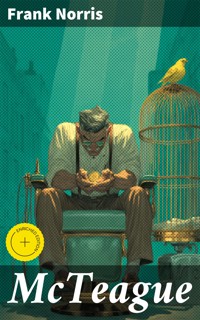
Frank Norris's "McTeague" is a pivotal work in American literature that delves into the themes of fate, desire, and the primal aspects of human nature. Set in late 19th-century San Francisco, the novel follows the life of McTeague, a simple and brutish dentist, whose life spirals into tragedy as his desires clash with societal expectations and moral decay. Norris employs a naturalistic literary style, rich in vivid imagery and psychological depth, effectively presenting a deterministic view of human behavior shaped by environment, instincts, and social inequalities within the burgeoning American society. The novel's stark realism paints a grim portrait of life, offering profound insights into the struggle between ambition and despair. Frank Norris, an influential figure in the literary movement known as Naturalism, was deeply inspired by the philosophical underpinnings of determinism and the socio-economic conditions of his time. His experiences as a journalist and his fascination with the burgeoning Chicago and San Francisco landscapes informed his narrative choices in "McTeague." Living through a transformative period in America, Norris harnessed his observations of class struggles and moral conflicts to create an unflinching portrait of humanity at its most vulnerable. For readers seeking a profound exploration of human instincts and the darker facets of ambition, "McTeague" is an essential read. Norris's incisive commentary on life and society not only captivates with its intricate character portrayals but also invites readers to reflect on the universal struggles that define the human experience. This novel stands as a testament to the lasting impact of Naturalism and remains relevant in its examination of personal ambition and societal constraints. In this enriched edition, we have carefully created added value for your reading experience: - A succinct Introduction situates the work's timeless appeal and themes. - The Synopsis outlines the central plot, highlighting key developments without spoiling critical twists. - A detailed Historical Context immerses you in the era's events and influences that shaped the writing. - A thorough Analysis dissects symbols, motifs, and character arcs to unearth underlying meanings. - Reflection questions prompt you to engage personally with the work's messages, connecting them to modern life. - Hand‐picked Memorable Quotes shine a spotlight on moments of literary brilliance. - Interactive footnotes clarify unusual references, historical allusions, and archaic phrases for an effortless, more informed read.
Das E-Book können Sie in Legimi-Apps oder einer beliebigen App lesen, die das folgende Format unterstützen:
Veröffentlichungsjahr: 2019
Ähnliche












McTeague
Table of Contents
Introduction
McTeague is a relentless study of how modest, everyday desires—comfort, security, admiration—can, under the abrasive pressure of chance and the city’s routines, swell into obsessions that trap people in patterns they neither intended nor fully understand, revealing a world where habit hardens into fate, the accidental windfall magnifies appetite, and the very texture of ordinary life—rooms, streets, shops, and schedules—guides choices as surely as will or conscience, until what began as common hopes for prosperity and affection become conflicts over possession, status, and identity that unsettle friendships, deform love, and expose the fragile boundary between need and greed.
Published in 1899, Frank Norris’s McTeague is an American naturalist novel set primarily in San Francisco at the close of the nineteenth century. Its world is the city’s working and lower-middle-class neighborhoods, especially a commercial street where small trades, cheap entertainments, and crowded boardinghouses shape daily rhythms. Within this setting, the book observes the routines of shopkeepers, clerks, craftsmen, and medical practitioners at a moment when professions were tightening into licensed, regulated fields. The backdrop is both concrete and emblematic: a bustling urban landscape whose noise, bargains, and narrow rooms stand in for larger social pressures emerging in modern American life.
At the center is McTeague, a large, taciturn dentist with little formal training who has built a modest practice on a busy San Francisco street, where reliable routines promise stability and a sense of status. Through his friendship with Marcus Schouler, he meets Trina, whose visit to the dental chair becomes the first step in a courtship that alters the balance among them. An unexpected lottery windfall enters this intimate triangle early, intensifying hopes and anxieties in equal measure. The premise is simple and potent: ordinary people, touched by sudden money and bruised by pride, must navigate affection, loyalty, and the costs of desire.
Norris’s style is spare, unsentimental, and attentive to material detail, hallmarks of literary naturalism. He builds scenes from the concrete—streetcars rattling, window displays, parlor furnishings—so that character emerges from environment and habit rather than from grand declarations. The third-person narrative holds a steady, observational distance, letting small causes accumulate into large effects without melodrama. Pacing alternates between patient, documentary-like description and bursts of sharp intensity. The language is plain yet tactile, the mood often grimly ironic, and moments of tenderness appear without sentimentality. The result is a reading experience that feels both immediate and inexorable, grounded in a closely watched urban reality.
Central themes include the magnetism of money, the psychology of possession, and the frictions between desire and restraint. The novel examines how status anxieties and professional legitimacy intersect with personal pride, and how social mobility can both beckon and corrode. It portrays masculinity as a volatile mix of strength, performance, and vulnerability, often strained by competition and economic stress. Consistent with its era, the book also contains depictions and stereotypes reflective of late nineteenth-century prejudices; approaching these elements with critical awareness is essential. Across these concerns, McTeague insists that environment, habit, and chance exert profound influence over choice, testing the limits of individual will.
For contemporary readers, McTeague resonates as a study of the pressures money exerts on private life—how windfalls can unsettle relationships, how scarcity shapes self-image, and how social rules around work and credentialing define belonging. The story invites reflection on urban inequality, consumer appetites, and the ways luck magnifies both possibility and fear. It also prompts ethical questions: What do we owe others when our fortunes change? What compromises do we make to secure respectability? By staging these dilemmas in ordinary rooms and on ordinary streets, Norris connects structural forces to intimate decisions, keeping the narrative’s relevance clear without forcing modern analogies.
Readers can expect an immersive, unsettling portrait of turn-of-the-century city life, rendered with granular attention and a mounting sense of pressure. The book rewards patience: its slow accretion of detail sharpens the emotional stakes while preserving the dignity and opacity of its characters. It is a stark, absorbing entry point into American naturalism for those drawn to social fiction, psychological scrutiny, and city novels that probe how environment shapes fate. Read with an eye to historical context and a willingness to confront discomfort, McTeague offers both hard clarity and lingering unease, fulfilling its promise to show ordinary hopes edging toward peril.
Synopsis
Frank Norris’s McTeague unfolds on San Francisco’s Polk Street in the late nineteenth century, centering on McTeague, a large, taciturn dentist of modest background. Informally trained by a traveling charlatan, he practices without a license, sustaining a quiet routine amid small shopkeepers and boarders. His office, with its prominent chair and caged canary, represents the limited ambitions and habits that define his days. The neighborhood forms a compact ecosystem of saloons, parlors, and sidewalks where reputations matter. The novel opens by observing this milieu in measured detail, establishing the forces of environment, routine, and social pressure that will shape the characters’ choices and fortunes.
Into this setting comes Trina Sieppe, connected to McTeague through his friend Marcus Schouler, an energetic local with ambitions and pride. Trina, from a hardworking Swiss-German family, visits McTeague for a troublesome tooth and undergoes an extraction under anesthetic. The dentist, shy yet impressionable, becomes fascinated by her decorous manner and precision. Around them, Polk Street’s rhythms continue: evening gatherings, Sunday outings, and the boisterous presence of the Sieppes at community events. The narrative lingers on ordinary exchanges and social rituals, showing how courtship is filtered through public scrutiny, acquaintances’ advice, and the narrow horizons of a neighborhood built on modest trades.
Courting proceeds awkwardly but steadily. Encouraged at first by Marcus, who imagines he is being generous and strategic, McTeague proposes, and Trina accepts. Her talent for carving small toys and her instinct for thrift promise a careful, secure household. A lottery ticket she had purchased earlier unexpectedly wins a substantial sum, transforming expectations around the couple. McTeague envisions comfort and professional stability, while Marcus, who believed he sacrificed his own chances, feels deprived of a reward he thinks partly his. This windfall begins to recalibrate friendships and loyalties, quietly introducing the tension between desire, entitlement, and the sober discipline of saving.
Money’s presence alters behavior more than circumstances. Trina’s prize becomes a symbol of control; she invests and hoards, preferring the feel of coins to visible improvements. McTeague anticipates better equipment, household comforts, and recognition, but finds plans deferred. Marcus’s resentment sharpens into rivalry, feeding gossip and public posturing. Scenes at picnics and local celebrations reveal shifting alliances, as jesting turns to insult and pride seeks an audience. The narrative maintains focus on small gestures—who pays, who boasts, who yields a seat—because these reveal deeper currents. The couple’s engagement advances, yet every step gathers friction from greed, jealousy, and brittle honor.
Professional insecurity soon becomes concrete. Attention turns to the legality of McTeague’s practice, and campaigns against unlicensed dentistry gain force. Through complaint and insinuation—some of it traceable to Marcus—authorities intervene, and McTeague is compelled to close his office. The removal of his sign marks a public loss of status, income, and identity. This shift tightens domestic pressures, as promises made during prosperity become untenable. Attempts at temporary work prove meager and uncertain. Polk Street reacts with a mix of curiosity, sympathy, and moralizing, and the household’s reduced means, once a private inconvenience, becomes an outward fact shaping every social encounter.
Within the marriage, frugality hardens into compulsion. Trina’s insistence on saving every coin intensifies as resources shrink, while McTeague’s frustration grows into sullenness and drink. The apartment reflects their stasis and strain: worn furnishings, deferred repairs, the persistent presence of the caged canary. Parallel to their story, the junk dealer Zerkow and the servant Maria Macapa fixate on a tale of vanished gold dishes, a rumor that exerts a corrosive pull. Their subplot echoes the main narrative’s obsession with wealth and memory, suggesting how imagined treasure can erode trust. Neighbors retreat or pry, and the couple’s isolation becomes increasingly visible.
Conflicts escalate publicly and at home. Marcus confronts McTeague in displays of bravado that test pride and threaten violence, while the couple’s quarrels become sharper and more physical. With employment scarce and respectability compromised, choices narrow. A sudden, severe crisis ruptures the domestic stalemate, and the attention of the law turns toward the household. The novel presents these developments as the outgrowth of accumulated pressures rather than single impulsive acts, keeping its naturalistic emphasis on cause and effect. As reputations collapse, Polk Street’s lively routines recede, and the narrative tightens around flight, pursuit, and the consequences of anger and greed.
After this turning point, movement replaces routine. McTeague departs familiar streets for itinerant labor, rail camps, and mining outposts, encountering companions and adversaries shaped by the same economic urgencies. Geographic distance mirrors moral and social dislocation. Pursuers, rumors, and chance meetings heighten risk, compressing options to a stark contest of endurance. The western landscape grows increasingly severe, culminating in stretches of blazing, arid country that test strength and resourcefulness. Material needs—water, food, money—dominate attention as alliances fray. The story advances toward a final reckoning in an empty, sun-struck expanse, while withholding its particulars to preserve the immediacy of discovery.
Overall, McTeague offers a rigorous study of how environment, habit, and economic pressure channel human behavior. Small desires become fixed obsessions, and a windfall meant to secure comfort amplifies mistrust, envy, and fear. By tracing the couple and their circle from modest routines to perilous outcomes, the novel depicts the fragility of social standing and the costs of pride. Its parallel stories and richly drawn Polk Street underscore a central message: character and circumstance interact relentlessly, and money, rather than liberating, often binds. Without moralizing, the narrative shows how ordinary lives, pressed by scarcity and passion, drift toward irreversible consequences.
Historical Context
Frank Norris situates McTeague in San Francisco in the 1890s, a Pacific metropolis that had grown from a Gold Rush port into a dense, heterogeneous city of nearly 300,000 people by 1890. The novel’s Polk Street—lined with boardinghouses, small shops, saloons, and storefront services—mirrors the lower-middle-class districts that flourished along cable car corridors and between downtown and the western neighborhoods. The story’s geography stretches from cramped urban interiors to the stark reaches of Death Valley, tracking a path from the city’s cash economy to the frontier’s stark extractive logic. This juxtaposition underscores California’s dual identity: urban boomtown modernity abutting a still-active mining frontier.
The novel’s preoccupation with money, sudden windfalls, and ruin is rooted in California’s boom-and-bust economy. The Gold Rush began with the 1848 discovery at Sutter’s Mill; by 1852 annual gold production in California exceeded $80 million (contemporary dollars), and San Francisco became the financial clearinghouse of the Pacific. The Comstock Lode (1859) in neighboring Nevada poured more than $300 million in silver and gold by the mid-1870s, further enriching San Francisco banking, wholesale, and shipping houses. Rail capital consolidated this wealth: the Southern Pacific, controlled by the “Big Four” (Leland Stanford, Collis P. Huntington, Charles Crocker, Mark Hopkins), dominated transportation and politics into the 1890s, prompting regulatory provisions in California’s 1879 constitution aimed at curbing railroad power. The national Panic of 1893 then crashed commodity prices and credit, with more than 500 bank failures and some 15,000 business bankruptcies; unemployment rose toward 18–19 percent in 1894. San Francisco’s small proprietors and tradespeople suffered volatile demand and debt squeezes. At the same time, a culture of gambling and lotteries persisted. The Louisiana State Lottery Company (1868–1895) operated nationally until Congress’s Anti-Lottery Acts of 1890 and 1895 restricted the mails and interstate transport; California’s 1879 constitution barred lotteries, pushing them underground. McTeague’s plot—Trina’s lottery windfall, obsessive hoarding, and the protagonist’s loss of livelihood—duplicates these economic rhythms: speculative gain, legal clampdowns, and desperation in downturns. Norris’s own reporting from the Witwatersrand goldfields in South Africa in 1895–1896 exposed him to mining capitalism’s hazards and windfalls, reinforcing themes of extraction, luck, and violence that culminate in the novel’s desert finale. The book thus channels a half-century of California’s extractive capitalism into the intimate scale of a single street and a doomed household.
San Francisco’s working-class politics in the late nineteenth century were marked by nativist agitation and restrictive immigration laws. The Workingmen’s Party of California, led by Denis Kearney, held mass “sand-lot” rallies in 1877 that fueled anti-Chinese violence in the city. Nationally, Congress passed the Chinese Exclusion Act in 1882, barring Chinese labor immigration; the Geary Act of 1892 extended the ban and required Chinese residents to carry certificates of residence, a provision upheld in Fong Yue Ting v. United States (1893). The novel’s Polk Street milieu—with German-speaking artisans, a Polish Jewish junk dealer, and ubiquitous ethnic small trades—reflects the era’s mixed neighborhoods amid hardening racial and ethnic boundaries.
McTeague’s unlicensed practice reflects the late nineteenth-century shift from informal healers to regulated professions. The American Dental Association formed in 1859, and the National Association of Dental Examiners in 1883 promoted state licensing. California created its Board of Dental Examiners in 1878, requiring practitioners to register; amendments in the 1880s tightened standards, mandating diplomas or examination and criminalizing unlicensed work. Enforcement remained inconsistent, especially in cities with many storefront “painless” dentists. In the novel, the official letter ordering McTeague to cease practice echoes these statutes’ expanding reach, exposing how regulatory modernization could abruptly sever the livelihoods of marginal practitioners who had thrived in earlier, looser markets.
Urban infrastructure and leisure framed daily life on Polk Street. San Francisco pioneered cable cars in 1873 on Clay Street; by the late 1880s lines knit together downtown, the Western Addition, and new residential tracts, enabling commuting and weekend excursions. German beer gardens and picnic grounds south of the city, along with music halls and neighborhood saloons, offered affordable entertainment to clerks, tradesmen, and artisans. Municipal Boards of Health, active since the mid-nineteenth century, targeted overcrowded lodging houses and unsanitary yards in the 1880s–1890s. McTeague’s courting scenes in public parks and his neighborhood’s tavern culture are grounded in this urban fabric, where modest amusements, cramped quarters, and alcohol intersected with financial strain.
Labor conflict and insecurity shaped the 1890s. The national depression after 1893 fueled mass unemployment, Coxey’s Army’s march to Washington in 1894, and the Pullman Strike of 1894, which disrupted rail traffic across the West and elicited federal injunctions and troop deployments. In San Francisco, seafaring and waterfront unions organized in the 1880s, and the city’s trades expanded union density through the decade. Even so, small proprietors and casual laborers faced irregular incomes and debt. The novel’s shopkeepers, clerks, and day labor underscore this precarious stratum, caught between organized capital and organized labor, where a missed wage, lost clientele, or medical bill could tip households toward beggary or violence.
The novel’s finale in Death Valley invokes the American mining frontier’s harsh realities. Harmony Borax Works operated in Death Valley from 1883 to 1888, using famed twenty-mule teams to haul borax over 160 miles to the railhead at Mojave. Initially financed by William T. Coleman, the operation later passed to F. M. “Borax” Smith’s Pacific Coast Borax Company, which popularized the “20 Mule Team” brand after 1891. Sparse water, extreme heat, and itinerant camps made the desert a proving ground for extractive risk. McTeague’s flight across alkali flats and dry ranges, clutching ill-gotten cash, mirrors a frontier economy where law thinned, survival was scarce, and fortunes were literally dragged across the sand.
As social and political critique, the book exposes the moral hazards of an extractive, laissez-faire order that fused speculative gain with institutional frailty. It indicts a city where unregulated storefront medicine coexisted with sudden regulatory purges, where gambling and underground lotteries thrived amid legal bans, and where ethnic stereotypes and exclusion hardened neighborhood life. By tracing a lower-middle-class couple’s slide during the 1893 downturn—through hoarding, job loss, and domestic brutality—the narrative highlights class insecurity and the absence of social safety nets. The desert climax renders, in stark relief, a polity that left individuals to the mercies of capital, chance, and the climate itself.
McTeague
CHAPTER 1
It was Sunday, and, according to his custom on that day, McTeague took his dinner at two in the afternoon at the car conductors' coffee-joint on Polk Street. He had a thick gray soup; heavy, underdone meat, very hot, on a cold plate; two kinds of vegetables; and a sort of suet pudding, full of strong butter and sugar. On his way back to his office, one block above, he stopped at Joe Frenna's saloon and bought a pitcher of steam beer[1]. It was his habit to leave the pitcher there on his way to dinner.
Once in his office, or, as he called it on his signboard, “Dental Parlors,” he took off his coat and shoes, unbuttoned his vest, and, having crammed his little stove full of coke, lay back in his operating chair at the bay window, reading the paper, drinking his beer, and smoking his huge porcelain pipe while his food digested; crop-full, stupid, and warm. By and by, gorged with steam beer, and overcome by the heat of the room, the cheap tobacco, and the effects of his heavy meal, he dropped off to sleep. Late in the afternoon his canary bird, in its gilt cage just over his head, began to sing. He woke slowly, finished the rest of his beer—very flat and stale by this time—and taking down his concertina from the bookcase, where in week days it kept the company of seven volumes of “Allen's Practical Dentist,” played upon it some half-dozen very mournful airs.
McTeague looked forward to these Sunday afternoons as a period of relaxation and enjoyment. He invariably spent them in the same fashion. These were his only pleasures—to eat, to smoke, to sleep, and to play upon his concertina.
The six lugubrious airs that he knew, always carried him back to the time when he was a car-boy at the Big Dipper Mine in Placer County, ten years before. He remembered the years he had spent there trundling the heavy cars of ore in and out of the tunnel under the direction of his father. For thirteen days of each fortnight his father was a steady, hard-working shift-boss of the mine. Every other Sunday he became an irresponsible animal, a beast, a brute, crazy with alcohol.
McTeague remembered his mother, too, who, with the help of the Chinaman, cooked for forty miners. She was an overworked drudge, fiery and energetic for all that, filled with the one idea of having her son rise in life and enter a profession. The chance had come at last when the father died, corroded with alcohol, collapsing in a few hours. Two or three years later a travelling dentist visited the mine and put up his tent near the bunk-house. He was more or less of a charlatan, but he fired Mrs. McTeague's ambition, and young McTeague went away with him to learn his profession. He had learnt it after a fashion, mostly by watching the charlatan operate. He had read many of the necessary books, but he was too hopelessly stupid to get much benefit from them.
Then one day at San Francisco had come the news of his mother's death; she had left him some money—not much, but enough to set him up in business; so he had cut loose from the charlatan and had opened his “Dental Parlors” on Polk Street, an “accommodation street” of small shops in the residence quarter of the town. Here he had slowly collected a clientele of butcher boys, shop girls, drug clerks, and car conductors. He made but few acquaintances. Polk Street called him the “Doctor” and spoke of his enormous strength. For McTeague was a young giant, carrying his huge shock of blond hair six feet three inches from the ground; moving his immense limbs, heavy with ropes of muscle, slowly, ponderously. His hands were enormous, red, and covered with a fell of stiff yellow hair; they were hard as wooden mallets, strong as vises, the hands of the old-time car-boy. Often he dispensed with forceps and extracted a refractory tooth with his thumb and finger. His head was square-cut, angular; the jaw salient, like that of the carnivora.
McTeague's mind was as his body, heavy, slow to act, sluggish[1q]. Yet there was nothing vicious about the man. Altogether he suggested the draught horse, immensely strong, stupid, docile, obedient.
When he opened his “Dental Parlors,” he felt that his life was a success, that he could hope for nothing better. In spite of the name, there was but one room. It was a corner room on the second floor over the branch post-office, and faced the street. McTeague made it do for a bedroom as well, sleeping on the big bed-lounge against the wall opposite the window. There was a washstand behind the screen in the corner where he manufactured his moulds. In the round bay window were his operating chair, his dental engine, and the movable rack on which he laid out his instruments. Three chairs, a bargain at the second-hand store, ranged themselves against the wall with military precision underneath a steel engraving of the court of Lorenzo de' Medici, which he had bought because there were a great many figures in it for the money. Over the bed-lounge hung a rifle manufacturer's advertisement calendar which he never used. The other ornaments were a small marble-topped centre table covered with back numbers of “The American System of Dentistry,” a stone pug dog sitting before the little stove, and a thermometer. A stand of shelves occupied one corner, filled with the seven volumes of “Allen's Practical Dentist.” On the top shelf McTeague kept his concertina and a bag of bird seed for the canary. The whole place exhaled a mingled odor of bedding, creosote, and ether.
But for one thing, McTeague would have been perfectly contented. Just outside his window was his signboard—a modest affair—that read: “Doctor McTeague. Dental Parlors. Gas Given[2]”; but that was all. It was his ambition, his dream, to have projecting from that corner window a huge gilded tooth, a molar with enormous prongs, something gorgeous and attractive. He would have it some day, on that he was resolved; but as yet such a thing was far beyond his means.
When he had finished the last of his beer, McTeague slowly wiped his lips and huge yellow mustache with the side of his hand. Bull-like, he heaved himself laboriously up, and, going to the window, stood looking down into the street.
The street never failed to interest him. It was one of those cross streets peculiar to Western cities, situated in the heart of the residence quarter, but occupied by small tradespeople who lived in the rooms above their shops. There were corner drug stores with huge jars of red, yellow, and green liquids in their windows, very brave and gay; stationers' stores, where illustrated weeklies were tacked upon bulletin boards; barber shops with cigar stands in their vestibules; sad-looking plumbers' offices; cheap restaurants, in whose windows one saw piles of unopened oysters weighted down by cubes of ice, and china pigs and cows knee deep in layers of white beans. At one end of the street McTeague could see the huge power-house of the cable line. Immediately opposite him was a great market; while farther on, over the chimney stacks of the intervening houses, the glass roof of some huge public baths glittered like crystal in the afternoon sun. Underneath him the branch post-office was opening its doors, as was its custom between two and three o'clock on Sunday afternoons. An acrid odor of ink rose upward to him. Occasionally a cable car passed, trundling heavily, with a strident whirring of jostled glass windows.
On week days the street was very lively. It woke to its work about seven o'clock, at the time when the newsboys made their appearance together with the day laborers. The laborers went trudging past in a straggling file—plumbers' apprentices, their pockets stuffed with sections of lead pipe, tweezers, and pliers; carpenters, carrying nothing but their little pasteboard lunch baskets painted to imitate leather; gangs of street workers, their overalls soiled with yellow clay, their picks and long-handled shovels over their shoulders; plasterers, spotted with lime from head to foot. This little army of workers, tramping steadily in one direction, met and mingled with other toilers of a different description—conductors and “swing men” of the cable company going on duty; heavy-eyed night clerks from the drug stores on their way home to sleep; roundsmen returning to the precinct police station to make their night report, and Chinese market gardeners teetering past under their heavy baskets. The cable cars began to fill up; all along the street could be seen the shopkeepers taking down their shutters.
Between seven and eight the street breakfasted. Now and then a waiter from one of the cheap restaurants crossed from one sidewalk to the other, balancing on one palm a tray covered with a napkin. Everywhere was the smell of coffee and of frying steaks. A little later, following in the path of the day laborers, came the clerks and shop girls, dressed with a certain cheap smartness, always in a hurry, glancing apprehensively at the power-house clock. Their employers followed an hour or so later—on the cable cars for the most part whiskered gentlemen with huge stomachs, reading the morning papers with great gravity; bank cashiers and insurance clerks with flowers in their buttonholes.
At the same time the school children invaded the street, filling the air with a clamor of shrill voices, stopping at the stationers' shops, or idling a moment in the doorways of the candy stores. For over half an hour they held possession of the sidewalks, then suddenly disappeared, leaving behind one or two stragglers who hurried along with great strides of their little thin legs, very anxious and preoccupied.
Towards eleven o'clock the ladies from the great avenue a block above Polk Street made their appearance, promenading the sidewalks leisurely, deliberately. They were at their morning's marketing. They were handsome women, beautifully dressed. They knew by name their butchers and grocers and vegetable men. From his window McTeague saw them in front of the stalls, gloved and veiled and daintily shod, the subservient provision men at their elbows, scribbling hastily in the order books. They all seemed to know one another, these grand ladies from the fashionable avenue. Meetings took place here and there; a conversation was begun; others arrived; groups were formed; little impromptu receptions were held before the chopping blocks of butchers' stalls, or on the sidewalk, around boxes of berries and fruit.
From noon to evening the population of the street was of a mixed character. The street was busiest at that time; a vast and prolonged murmur arose—the mingled shuffling of feet, the rattle of wheels, the heavy trundling of cable cars. At four o'clock the school children once more swarmed the sidewalks, again disappearing with surprising suddenness. At six the great homeward march commenced; the cars were crowded, the laborers thronged the sidewalks, the newsboys chanted the evening papers. Then all at once the street fell quiet; hardly a soul was in sight; the sidewalks were deserted. It was supper hour. Evening began; and one by one a multitude of lights, from the demoniac glare of the druggists' windows to the dazzling blue whiteness of the electric globes, grew thick from street corner to street corner. Once more the street was crowded. Now there was no thought but for amusement. The cable cars were loaded with theatre-goers—men in high hats and young girls in furred opera cloaks. On the sidewalks were groups and couples—the plumbers' apprentices, the girls of the ribbon counters, the little families that lived on the second stories over their shops, the dressmakers, the small doctors, the harness-makers—all the various inhabitants of the street were abroad, strolling idly from shop window to shop window, taking the air after the day's work. Groups of girls collected on the corners, talking and laughing very loud, making remarks upon the young men that passed them. The tamale men appeared. A band of Salvationists began to sing before a saloon.
Then, little by little, Polk Street dropped back to solitude. Eleven o'clock struck from the power-house clock. Lights were extinguished. At one o'clock the cable stopped, leaving an abrupt silence in the air. All at once it seemed very still. The ugly noises were the occasional footfalls of a policeman and the persistent calling of ducks and geese in the closed market. The street was asleep.
Day after day, McTeague saw the same panorama unroll itself. The bay window of his “Dental Parlors” was for him a point of vantage from which he watched the world go past.
On Sundays, however, all was changed. As he stood in the bay window, after finishing his beer, wiping his lips, and looking out into the street, McTeague was conscious of the difference. Nearly all the stores were closed. No wagons passed. A few people hurried up and down the sidewalks, dressed in cheap Sunday finery. A cable car went by; on the outside seats were a party of returning picnickers. The mother, the father, a young man, and a young girl, and three children. The two older people held empty lunch baskets in their laps, while the bands of the children's hats were stuck full of oak leaves. The girl carried a huge bunch of wilting poppies and wild flowers.
As the car approached McTeague's window the young man got up and swung himself off the platform, waving goodby to the party. Suddenly McTeague recognized him.
“There's Marcus Schouler,” he muttered behind his mustache.
Marcus Schouler was the dentist's one intimate friend. The acquaintance had begun at the car conductors' coffee-joint, where the two occupied the same table and met at every meal. Then they made the discovery that they both lived in the same flat, Marcus occupying a room on the floor above McTeague. On different occasions McTeague had treated Marcus for an ulcerated tooth and had refused to accept payment. Soon it came to be an understood thing between them. They were “pals.”
McTeague, listening, heard Marcus go up-stairs to his room above. In a few minutes his door opened again. McTeague knew that he had come out into the hall and was leaning over the banisters.
“Oh, Mac!” he called. McTeague came to his door.
“Hullo! 'sthat you, Mark?”
“Sure,” answered Marcus. “Come on up.”
“You come on down.”
“No, come on up.”
“Oh, you come on down.”
“Oh, you lazy duck!” retorted Marcus, coming down the stairs.
“Been out to the Cliff House[4] on a picnic,” he explained as he sat down on the bed-lounge, “with my uncle and his people—the Sieppes, you know. By damn! it was hot,” he suddenly vociferated. “Just look at that! Just look at that!” he cried, dragging at his limp collar. “That's the third one since morning; it is—it is, for a fact—and you got your stove going.” He began to tell about the picnic, talking very loud and fast, gesturing furiously, very excited over trivial details. Marcus could not talk without getting excited.
“You ought t'have seen, y'ought t'have seen. I tell you, it was outa sight. It was; it was, for a fact.”
“Yes, yes,” answered McTeague, bewildered, trying to follow. “Yes, that's so.”
In recounting a certain dispute with an awkward bicyclist, in which it appeared he had become involved, Marcus quivered with rage. “'Say that again,' says I to um. 'Just say that once more, and'”—here a rolling explosion of oaths—“'you'll go back to the city in the Morgue wagon. Ain't I got a right to cross a street even, I'd like to know, without being run down—what?' I say it's outrageous. I'd a knifed him in another minute. It was an outrage. I say it was an OUTRAGE.”
“Sure it was,” McTeague hastened to reply. “Sure, sure.”
“Oh, and we had an accident,” shouted the other, suddenly off on another tack. “It was awful. Trina was in the swing there—that's my cousin Trina, you know who I mean—and she fell out. By damn! I thought she'd killed herself; struck her face on a rock and knocked out a front tooth. It's a wonder she didn't kill herself. It IS a wonder; it is, for a fact. Ain't it, now? Huh? Ain't it? Y'ought t'have seen.”
McTeague had a vague idea that Marcus Schouler was stuck on his cousin Trina. They “kept company” a good deal; Marcus took dinner with the Sieppes every Saturday evening at their home at B Street station, across the bay, and Sunday afternoons he and the family usually made little excursions into the suburbs. McTeague began to wonder dimly how it was that on this occasion Marcus had not gone home with his cousin. As sometimes happens, Marcus furnished the explanation upon the instant.
“I promised a duck up here on the avenue I'd call for his dog at four this afternoon.”
Marcus was Old Grannis's assistant in a little dog hospital that the latter had opened in a sort of alley just off Polk Street, some four blocks above Old Grannis lived in one of the back rooms of McTeague's flat. He was an Englishman and an expert dog surgeon, but Marcus Schouler was a bungler in the profession. His father had been a veterinary surgeon who had kept a livery stable near by, on California Street, and Marcus's knowledge of the diseases of domestic animals had been picked up in a haphazard way, much after the manner of McTeague's education. Somehow he managed to impress Old Grannis, a gentle, simple-minded old man, with a sense of his fitness, bewildering him with a torrent of empty phrases that he delivered with fierce gestures and with a manner of the greatest conviction.
“You'd better come along with me, Mac,” observed Marcus. “We'll get the duck's dog, and then we'll take a little walk, huh? You got nothun to do. Come along.”
McTeague went out with him, and the two friends proceeded up to the avenue to the house where the dog was to be found. It was a huge mansion-like place, set in an enormous garden that occupied a whole third of the block; and while Marcus tramped up the front steps and rang the doorbell boldly, to show his independence, McTeague remained below on the sidewalk, gazing stupidly at the curtained windows, the marble steps, and the bronze griffins, troubled and a little confused by all this massive luxury.
After they had taken the dog to the hospital and had left him to whimper behind the wire netting, they returned to Polk Street and had a glass of beer in the back room of Joe Frenna's corner grocery.
Ever since they had left the huge mansion on the avenue, Marcus had been attacking the capitalists, a class which he pretended to execrate. It was a pose which he often assumed, certain of impressing the dentist. Marcus had picked up a few half-truths of political economy—it was impossible to say where—and as soon as the two had settled themselves to their beer in Frenna's back room he took up the theme of the labor question. He discussed it at the top of his voice, vociferating, shaking his fists, exciting himself with his own noise. He was continually making use of the stock phrases of the professional politician—phrases he had caught at some of the ward “rallies” and “ratification meetings.” These rolled off his tongue with incredible emphasis, appearing at every turn of his conversation—“Outraged constituencies,” “cause of labor,” “wage earners,” “opinions biased by personal interests,” “eyes blinded by party prejudice.” McTeague listened to him, awestruck.
“There's where the evil lies,” Marcus would cry. “The masses must learn self-control; it stands to reason. Look at the figures, look at the figures. Decrease the number of wage earners and you increase wages, don't you? don't you?”
Absolutely stupid, and understanding never a word, McTeague would answer:
“Yes, yes, that's it—self-control—that's the word.”
“It's the capitalists that's ruining the cause of labor,” shouted Marcus, banging the table with his fist till the beer glasses danced; “white-livered drones, traitors, with their livers white as snow, eatun the bread of widows and orphuns; there's where the evil lies.”
Stupefied with his clamor, McTeague answered, wagging his head:
“Yes, that's it; I think it's their livers.”
Suddenly Marcus fell calm again, forgetting his pose all in an instant.
“Say, Mac, I told my cousin Trina to come round and see you about that tooth of her's. She'll be in to-morrow, I guess.”
CHAPTER 2
After his breakfast the following Monday morning, McTeague looked over the appointments he had written down in the book-slate that hung against the screen. His writing was immense, very clumsy, and very round, with huge, full-bellied l's and h's. He saw that he had made an appointment at one o'clock for Miss Baker, the retired dressmaker, a little old maid who had a tiny room a few doors down the hall. It adjoined that of Old Grannis.
Quite an affair had arisen from this circumstance. Miss Baker and Old Grannis were both over sixty, and yet it was current talk amongst the lodgers of the flat that the two were in love with each other. Singularly enough, they were not even acquaintances; never a word had passed between them. At intervals they met on the stairway; he on his way to his little dog hospital, she returning from a bit of marketing in the street. At such times they passed each other with averted eyes, pretending a certain preoccupation, suddenly seized with a great embarrassment, the timidity of a second childhood. He went on about his business, disturbed and thoughtful. She hurried up to her tiny room, her curious little false curls shaking with her agitation, the faintest suggestion of a flush coming and going in her withered cheeks. The emotion of one of these chance meetings remained with them during all the rest of the day.
Was it the first romance in the lives of each? Did Old Grannis ever remember a certain face amongst those that he had known when he was young Grannis—the face of some pale-haired girl, such as one sees in the old cathedral towns of England? Did Miss Baker still treasure up in a seldom opened drawer or box some faded daguerreotype, some strange old-fashioned likeness, with its curling hair and high stock? It was impossible to say.
Maria Macapa, the Mexican woman who took care of the lodgers' rooms, had been the first to call the flat's attention to the affair, spreading the news of it from room to room, from floor to floor. Of late she had made a great discovery; all the women folk of the flat were yet vibrant with it. Old Grannis came home from his work at four o'clock, and between that time and six Miss Baker would sit in her room, her hands idle in her lap, doing nothing, listening, waiting. Old Grannis did the same, drawing his arm-chair near to the wall, knowing that Miss Baker was upon the other side, conscious, perhaps, that she was thinking of him; and there the two would sit through the hours of the afternoon, listening and waiting, they did not know exactly for what, but near to each other, separated only by the thin partition of their rooms. They had come to know each other's habits. Old Grannis knew that at quarter of five precisely Miss Baker made a cup of tea over the oil stove on the stand between the bureau and the window. Miss Baker felt instinctively the exact moment when Old Grannis took down his little binding apparatus from the second shelf of his clothes closet and began his favorite occupation of binding pamphlets—pamphlets that he never read, for all that.
In his “Parlors” McTeague began his week's work. He glanced in the glass saucer in which he kept his sponge-gold, and noticing that he had used up all his pellets, set about making some more. In examining Miss Baker's teeth at the preliminary sitting he had found a cavity in one of the incisors. Miss Baker had decided to have it filled with gold. McTeague remembered now that it was what is called a “proximate case,” where there is not sufficient room to fill with large pieces of gold. He told himself that he should have to use “mats” in the filling. He made some dozen of these “mats” from his tape of non-cohesive gold, cutting it transversely into small pieces that could be inserted edgewise between the teeth and consolidated by packing. After he had made his “mats” he continued with the other kind of gold fillings, such as he would have occasion to use during the week; “blocks” to be used in large proximal cavities, made by folding the tape on itself a number of times and then shaping it with the soldering pliers; “cylinders” for commencing fillings, which he formed by rolling the tape around a needle called a “broach,” cutting it afterwards into different lengths. He worked slowly, mechanically, turning the foil between his fingers with the manual dexterity that one sometimes sees in stupid persons. His head was quite empty of all thought, and he did not whistle over his work as another man might have done. The canary made up for his silence, trilling and chittering continually, splashing about in its morning bath, keeping up an incessant noise and movement that would have been maddening to any one but McTeague, who seemed to have no nerves at all.
After he had finished his fillings, he made a hook broach from a bit of piano wire to replace an old one that he had lost. It was time for his dinner then, and when he returned from the car conductors' coffee-joint, he found Miss Baker waiting for him.
The ancient little dressmaker was at all times willing to talk of Old Grannis to anybody that would listen, quite unconscious of the gossip of the flat. McTeague found her all a-flutter with excitement. Something extraordinary had happened. She had found out that the wall-paper in Old Grannis's room was the same as that in hers.
“It has led me to thinking, Doctor McTeague,” she exclaimed, shaking her little false curls at him. “You know my room is so small, anyhow, and the wall-paper being the same—the pattern from my room continues right into his—I declare, I believe at one time that was all one room. Think of it, do you suppose it was? It almost amounts to our occupying the same room. I don't know—why, really—do you think I should speak to the landlady about it? He bound pamphlets last night until half-past nine. They say that he's the younger son of a baronet; that there are reasons for his not coming to the title; his stepfather wronged him cruelly.”
No one had ever said such a thing. It was preposterous to imagine any mystery connected with Old Grannis. Miss Baker had chosen to invent the little fiction, had created the title and the unjust stepfather from some dim memories of the novels of her girlhood.
She took her place in the operating chair. McTeague began the filling. There was a long silence. It was impossible for McTeague to work and talk at the same time.
He was just burnishing the last “mat” in Miss Baker's tooth, when the door of the “Parlors” opened, jangling the bell which he had hung over it, and which was absolutely unnecessary. McTeague turned, one foot on the pedal of his dental engine, the corundum disk whirling between his fingers.
It was Marcus Schouler who came in, ushering a young girl of about twenty.
“Hello, Mac,” exclaimed Marcus; “busy? Brought my cousin round about that broken tooth.”
McTeague nodded his head gravely.
“In a minute,” he answered.
Marcus and his cousin Trina sat down in the rigid chairs underneath the steel engraving of the Court of Lorenzo de' Medici. They began talking in low tones. The girl looked about the room, noticing the stone pug dog, the rifle manufacturer's calendar, the canary in its little gilt prison, and the tumbled blankets on the unmade bed-lounge against the wall. Marcus began telling her about McTeague. “We're pals,” he explained, just above a whisper. “Ah, Mac's all right, you bet. Say, Trina, he's the strongest duck you ever saw. What do you suppose? He can pull out your teeth with his fingers; yes, he can. What do you think of that? With his fingers, mind you; he can, for a fact. Get on to the size of him, anyhow. Ah, Mac's all right!”
Maria Macapa had come into the room while he had been speaking. She was making up McTeague's bed. Suddenly Marcus exclaimed under his breath: “Now we'll have some fun. It's the girl that takes care of the rooms. She's a greaser[5], and she's queer in the head. She ain't regularly crazy, but I don't know, she's queer. Y'ought to hear her go on about a gold dinner service she says her folks used to own. Ask her what her name is and see what she'll say.” Trina shrank back, a little frightened.
“No, you ask,” she whispered.
“Ah, go on; what you 'fraid of?” urged Marcus. Trina shook her head energetically, shutting her lips together.
“Well, listen here,” answered Marcus, nudging her; then raising his voice, he said:
“How do, Maria?” Maria nodded to him over her shoulder as she bent over the lounge.
“Workun hard nowadays, Maria?”
“Pretty hard.”
“Didunt always have to work for your living, though, did you, when you ate offa gold dishes?” Maria didn't answer, except by putting her chin in the air and shutting her eyes, as though to say she knew a long story about that if she had a mind to talk. All Marcus's efforts to draw her out on the subject were unavailing. She only responded by movements of her head.
“Can't always start her going,” Marcus told his cousin.
“What does she do, though, when you ask her about her name?”
“Oh, sure,” said Marcus, who had forgotten. “Say, Maria, what's your name?”
“Huh?” asked Maria, straightening up, her hands on he hips.
“Tell us your name,” repeated Marcus.
“Name is Maria—Miranda—Macapa.” Then, after a pause, she added, as though she had but that moment thought of it, “Had a flying squirrel an' let him go.”
Invariably Maria Macapa made this answer. It was not always she would talk about the famous service of gold plate, but a question as to her name never failed to elicit the same strange answer, delivered in a rapid undertone: “Name is Maria—Miranda—Macapa.” Then, as if struck with an after thought, “Had a flying squirrel an' let him go.”
Why Maria should associate the release of the mythical squirrel with her name could not be said. About Maria the flat knew absolutely nothing further than that she was Spanish-American. Miss Baker was the oldest lodger in the flat, and Maria was a fixture there as maid of all work when she had come. There was a legend to the effect that Maria's people had been at one time immensely wealthy in Central America.
Maria turned again to her work. Trina and Marcus watched her curiously. There was a silence. The corundum burr in McTeague's engine hummed in a prolonged monotone. The canary bird chittered occasionally. The room was warm, and the breathing of the five people in the narrow space made the air close and thick. At long intervals an acrid odor of ink floated up from the branch post-office immediately below.
Maria Macapa finished her work and started to leave. As she passed near Marcus and his cousin she stopped, and drew a bunch of blue tickets furtively from her pocket. “Buy a ticket in the lottery?” she inquired, looking at the girl. “Just a dollar.”
“Go along with you, Maria,” said Marcus, who had but thirty cents in his pocket. “Go along; it's against the law.”
“Buy a ticket,” urged Maria, thrusting the bundle toward Trina. “Try your luck. The butcher on the next block won twenty dollars the last drawing.”
Very uneasy, Trina bought a ticket for the sake of being rid of her. Maria disappeared.
“Ain't she a queer bird?” muttered Marcus. He was much embarrassed and disturbed because he had not bought the ticket for Trina.
But there was a sudden movement. McTeague had just finished with Miss Baker.
“You should notice,” the dressmaker said to the dentist, in a low voice, “he always leaves the door a little ajar in the afternoon.” When she had gone out, Marcus Schouler brought Trina forward.
“Say, Mac, this is my cousin, Trina Sieppe.” The two shook hands dumbly, McTeague slowly nodding his huge head with its great shock of yellow hair. Trina was very small and prettily made. Her face was round and rather pale; her eyes long and narrow and blue, like the half-open eyes of a little baby; her lips and the lobes of her tiny ears were pale, a little suggestive of anaemia; while across the bridge of her nose ran an adorable little line of freckles. But it was to her hair that one's attention was most attracted. Heaps and heaps of blue-black coils and braids, a royal crown of swarthy bands, a veritable sable tiara, heavy, abundant, odorous. All the vitality that should have given color to her face seemed to have been absorbed by this marvellous hair. It was the coiffure of a queen that shadowed the pale temples of this little bourgeoise. So heavy was it that it tipped her head backward, and the position thrust her chin out a little. It was a charming poise, innocent, confiding, almost infantile.
She was dressed all in black, very modest and plain. The effect of her pale face in all this contrasting black was almost monastic.
“Well,” exclaimed Marcus suddenly, “I got to go. Must get back to work. Don't hurt her too much, Mac. S'long, Trina.”
McTeague and Trina were left alone. He was embarrassed, troubled. These young girls disturbed and perplexed him. He did not like them, obstinately cherishing that intuitive suspicion of all things feminine—the perverse dislike of an overgrown boy. On the other hand, she was perfectly at her ease; doubtless the woman in her was not yet awakened; she was yet, as one might say, without sex. She was almost like a boy, frank, candid, unreserved.
She took her place in the operating chair and told him what was the matter, looking squarely into his face. She had fallen out of a swing the afternoon of the preceding day; one of her teeth had been knocked loose and the other altogether broken out.
McTeague listened to her with apparent stolidity, nodding his head from time to time as she spoke. The keenness of his dislike of her as a woman began to be blunted. He thought she was rather pretty, that he even liked her because she was so small, so prettily made, so good natured and straightforward.
“Let's have a look at your teeth,” he said, picking up his mirror. “You better take your hat off.” She leaned back in her chair and opened her mouth, showing the rows of little round teeth, as white and even as the kernels on an ear of green corn, except where an ugly gap came at the side.
McTeague put the mirror into her mouth, touching one and another of her teeth with the handle of an excavator. By and by he straightened up, wiping the moisture from the mirror on his coat-sleeve.
“Well, Doctor,” said the girl, anxiously, “it's a dreadful disfigurement, isn't it?” adding, “What can you do about it?”
“Well,” answered McTeague, slowly, looking vaguely about on the floor of the room, “the roots of the broken tooth are still in the gum; they'll have to come out, and I guess I'll have to pull that other bicuspid. Let me look again. Yes,” he went on in a moment, peering into her mouth with the mirror, “I guess that'll have to come out, too.” The tooth was loose, discolored, and evidently dead. “It's a curious case,” McTeague went on. “I don't know as I ever had a tooth like that before. It's what's called necrosis. It don't often happen. It'll have to come out sure.”
Then a discussion was opened on the subject, Trina sitting up in the chair, holding her hat in her lap; McTeague leaning against the window frame his hands in his pockets, his eyes wandering about on the floor. Trina did not want the other tooth removed; one hole like that was bad enough; but two—ah, no, it was not to be thought of.
But McTeague reasoned with her, tried in vain to make her understand that there was no vascular connection between the root and the gum. Trina was blindly persistent, with the persistency of a girl who has made up her mind.
McTeague began to like her better and better, and after a while commenced himself to feel that it would be a pity to disfigure such a pretty mouth. He became interested; perhaps he could do something, something in the way of a crown or bridge. “Let's look at that again,” he said, picking up his mirror. He began to study the situation very carefully, really desiring to remedy the blemish.
It was the first bicuspid that was missing, and though part of the root of the second (the loose one) would remain after its extraction, he was sure it would not be strong enough to sustain a crown. All at once he grew obstinate, resolving, with all the strength of a crude and primitive man, to conquer the difficulty in spite of everything. He turned over in his mind the technicalities of the case. No, evidently the root was not strong enough to sustain a crown; besides that, it was placed a little irregularly in the arch. But, fortunately, there were cavities in the two teeth on either side of the gap—one in the first molar and one in the palatine surface of the cuspid; might he not drill a socket in the remaining root and sockets in the molar and cuspid, and, partly by bridging, partly by crowning, fill in the gap? He made up his mind to do it.
Why he should pledge himself to this hazardous case McTeague was puzzled to know. With most of his clients he would have contented himself with the extraction of the loose tooth and the roots of the broken one. Why should he risk his reputation in this case? He could not say why.
It was the most difficult operation he had ever performed. He bungled it considerably, but in the end he succeeded passably well. He extracted the loose tooth with his bayonet forceps and prepared the roots of the broken one as if for filling, fitting into them a flattened piece of platinum wire to serve as a dowel. But this was only the beginning; altogether it was a fortnight's work. Trina came nearly every other day, and passed two, and even three, hours in the chair.
By degrees McTeague's first awkwardness and suspicion vanished entirely. The two became good friends. McTeague even arrived at that point where he could work and talk to her at the same time—a thing that had never before been possible for him.
Never until then had McTeague become so well acquainted with a girl of Trina's age. The younger women of Polk Street—the shop girls, the young women of the soda fountains, the waitresses in the cheap restaurants—preferred another dentist, a young fellow just graduated from the college, a poser, a rider of bicycles, a man about town, who wore astonishing waistcoats and bet money on greyhound coursing. Trina was McTeague's first experience. With her the feminine element suddenly entered his little world. It was not only her that he saw and felt, it was the woman, the whole sex, an entire new humanity, strange and alluring, that he seemed to have discovered. How had he ignored it so long? It was dazzling, delicious, charming beyond all words. His narrow point of view was at once enlarged and confused, and all at once he saw that there was something else in life besides concertinas and steam beer. Everything had to be made over again[2q]. His whole rude idea of life had to be changed. The male virile desire in him tardily awakened, aroused itself, strong and brutal. It was resistless, untrained, a thing not to be held in leash an instant.
Little by little, by gradual, almost imperceptible degrees, the thought of Trina Sieppe occupied his mind from day to day, from hour to hour. He found himself thinking of her constantly; at every instant he saw her round, pale face; her narrow, milk-blue eyes; her little out-thrust chin; her heavy, huge tiara of black hair. At night he lay awake for hours under the thick blankets of the bed-lounge, staring upward into the darkness, tormented with the idea of her, exasperated at the delicate, subtle mesh in which he found himself entangled. During the forenoons, while he went about his work, he thought of her. As he made his plaster-of-paris moulds at the washstand in the corner behind the screen he turned over in his mind all that had happened, all that had been said at the previous sitting. Her little tooth that he had extracted he kept wrapped in a bit of newspaper in his vest pocket. Often he took it out and held it in the palm of his immense, horny hand, seized with some strange elephantine sentiment, wagging his head at it, heaving tremendous sighs. What a folly!
At two o'clock on Tuesdays, Thursdays, and Saturdays Trina arrived and took her place in the operating chair. While at his work McTeague was every minute obliged to bend closely over her; his hands touched her face, her cheeks, her adorable little chin; her lips pressed against his fingers. She breathed warmly on his forehead and on his eyelids, while the odor of her hair, a charming feminine perfume, sweet, heavy, enervating, came to his nostrils, so penetrating, so delicious, that his flesh pricked and tingled with it; a veritable sensation of faintness passed over this huge, callous fellow, with his enormous bones and corded muscles. He drew a short breath through his nose; his jaws suddenly gripped together vise-like.
But this was only at times—a strange, vexing spasm, that subsided almost immediately. For the most part, McTeague enjoyed the pleasure of these sittings with Trina with a certain strong calmness, blindly happy that she was there. This poor crude dentist of Polk Street, stupid, ignorant, vulgar, with his sham education and plebeian tastes, whose only relaxations were to eat, to drink steam beer, and to play upon his concertina, was living through his first romance, his first idyl. It was delightful. The long hours he passed alone with Trina in the “Dental Parlors,” silent, only for the scraping of the instruments and the pouring of bud-burrs in the engine, in the foul atmosphere, overheated by the little stove and heavy with the smell of ether, creosote, and stale bedding, had all the charm of secret appointments and stolen meetings under the moon.
By degrees the operation progressed. One day, just after McTeague had put in the temporary gutta-percha[3] fillings and nothing more could be done at that sitting, Trina asked him to examine the rest of her teeth. They were perfect, with one exception—a spot of white caries on the lateral surface of an incisor. McTeague filled it with gold, enlarging the cavity with hard-bits and hoe-excavators, and burring in afterward with half-cone burrs. The cavity was deep, and Trina began to wince and moan. To hurt Trina was a positive anguish for McTeague, yet an anguish which he was obliged to endure at every hour of the sitting. It was harrowing—he sweated under it—to be forced to torture her, of all women in the world; could anything be worse than that?
“Hurt?” he inquired, anxiously.




