


Erhalten Sie Zugang zu diesem und mehr als 300000 Büchern ab EUR 5,99 monatlich.
- Herausgeber: Dog Horn Publishing
- Kategorie: Fantasy und Science-Fiction
- Sprache: Englisch
Scott Malthrop is a murderer with a difference: his entire house is filled with an enormous device gradually assembled by him and his father over four decades. Known only as "The Machine" the device seems to transport Malthrop to different locations in space and time by feeding off his memories and a vast array of sentimental objects and trophies taken by Malthrop from his own past and that of his victims. As Malthrop's experiments become ever more violent and life-threatening, they cause distortions in the surrounding quantum fabric, and spark off pursuit from two very different directions: a local Police Inspector and two "Angels" sent back from the end of time.
Sie lesen das E-Book in den Legimi-Apps auf:
Seitenzahl: 214
Veröffentlichungsjahr: 2015
Das E-Book (TTS) können Sie hören im Abo „Legimi Premium” in Legimi-Apps auf:
Ähnliche



















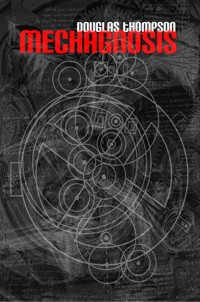
MECHAGNOSIS
BY
DOUGLAS THOMPSON
Mechagnosis
Published by Dog Horn Publishing at Smashwords
Copyright 2011 Douglas Thompson
Acknowledgements
Thanks to: Nina Allan, Andrew Hook, Victoria Hooper, Adam Lowe,
Rona MacDonald, David Rix, Stephen Theaker, and Steve Upham.
The translations from Rilke’s Duino Elegies are based on those by
David Young, published by W. W. Norton & Company, 1978.
Contents
Chapter One: The Machine Starts
Chapter Two: Angels, It Seems
Chapter Three: Mapping A Face
Chapter Four: Remember Babel
Chapter Five: Eternal Saturdays
Chapter Six: The Testament Of Wilbir
Chapter Seven: Suburban Séance
Chapter Eight: Concrete Coffin
Chapter Nine: The Enigma Of Return
Chapter Ten: Forgiving Everything
~The Machine Starts~
“If I cried out who would hear me up there among the angelic orders? And suppose one suddenly took me to his heart I would shrivel, I couldn’t survive next to his greater existence. Beauty is only the first touch of terror we can still bear, and it awes us so much because it so coolly disdains to destroy us... ”
—Rainer Maria Rilke, from theDuino Elegies, #1.
Scott Malthrop climbs aloft through the dusty skylight, out to the big roof and ruffling birds. It is time. How like waves their wings lift his breaths and cloud the eyes. Fresh fluttersong of washing-lines: glimpsed mysteries of neighbours in solitariness. The sweet grain of urban monotony, secrets unshared. The sun goes down like eyelids closing, bracing grimace, dignity of pain.
Malthrop has access to several apartment roofs as well as his own, and these he has gradually colonised with foliage and bait for birds, and cages to catch them. In the early days of his father’s first experiments, perhaps some of the birds were run to death. This was foolish and short-sighted as well as immoral. Now every bird is only temporarily captured and put to work then re-released a week later into the beckoning sky, well-rewarded for its labour. Malthrop has come to love the birds, their calm eyes and fluttering hearts. Although he rarely tags them, he believes some return on purpose, wanting to be captured again, for the exercise and the food, maybe even for his company.
Today he enlists only a dozen and releases the others, taking them below in wooden cages, down through the roof hatch into his apartment, or what used to be an apartment. Now it is only residual, marginal, left over space around The Machine. The Machine occupies all three storeys of his narrow urban townhouse, from front to back, cogs and levers up against windows and walls, floor joists long cut away and braced to make room for wheels and pistons.
He times his start-up phase to coincide with the busiest periods of traffic outside, so the neighbours will not be overly alarmed by the considerable vibrations. Sometimes he likes to use a few seagulls for extra power, but today the team are all pigeons, city doves, his trusty stalwarts. The Intake Platforms consist of wheels and wing harnesses within ventilated glass tanks and seed dispensers. Malthrop kisses and caresses each bird one after the other, calming and soothing its palpitations before depositing it gently down a one-way tube onto its running wheel. When all twelve avian pilots are assembled, he salutes them with a tired smile then descends below to rope himself into the control room.
We say “control”, and yet the whole essence of this room is a lack of control. A statistical degree of hazard has been built in, essential to guarantee a sense of danger on the part of the operator. A one in one hundred chance always exists that the Dead Man’s Lever will fall and Malthrop suffocate in sand or water. In such a scenario, his skeleton will eventually become part of The Machine, as his father and mother are already: just one of a thousand sentimental objects incorporated for esoteric functions which somehow contribute to its overall spiritual charge.
One thing is for certain: when The Machine is working, every component, at some point, must move. The toy yacht with white sails that his father built him when he was aged three, will rotate and rock on salty waves in an old bathtub. His mother’s swimsuit will be stretched and flexed like a washing machine’s drive-band. The crackling gramophone record of the sound of seagulls will repeat while the sand from the first beach he ever played on pours like an hourglass from vessel to vessel: colourful bright plastic pales from beaches; grim janitorial buckets that caught waterdrops from the roof leaks in his first school.
Malthrop sits and writes his diary entry, aware as ever that it may be his last:
The word “Nostalgia” was only invented in 1688, by the Swiss physician Johannes Hofer, to describe a medical condition of near-fatal homesickness. If, as Wittgenstein said, “the limits of my language mean the limits of my world”, then did nostalgia simply not exist before this date, if it could only be so clumsily denoted as wistfulness for days passed?
Father made me memorise the dates. 1674: The English agricultural pioneer Jethro Tull is born. 1701: he invents the seed drill, setting off the Agricultural Revolution and in turn the Industrial Revolution. Mechanisation gets underway and the traditional way of life of the rural peasant is doomed to history. This is how history works: from the tiniest insignificance a chain of events grows too slowly for anyone to ponder or stop. A seed drill is invented and men land on the moon. The Machine starts. Tonight I might die.
—Scott Malthrop, son of Scott Malthrop Senior (deceased), 30 th April 2020.
Malthrop binds and gags himself until completely helpless, throws his head back onto The Starter Pad. The chamber he is locked within begins to fall and rotate on an infinitesimally slow orbit through The Presses. Although, like life on Earth, at any given moment he can feel entirely static, in truth he is perpetually in motion and danger. Gradually over hours, water and soil come and go: plants from his parents’ garden, grass from the park where he kissed his first girlfriend, water from the bath in which he drowned her. His wrist bindings are coils of her black hair, and when The Machine stretches him over its cruellest segments, deprived of air, he will struggle and her tresses will dig deep into his flesh as he screams, washed in his own blood and tears.
Above him or below somewhere, as the great calibrated wheels rotate, the birds will flap and pedal on with industrial ferocity, rest-times kicking in and alternating, the tag team dutifully working through the night. Their calm eyes remain relentless in their purpose, profoundly understood. Animals have no concept of futility.
What was the first machine in the world I wonder? The slingshot? The Shadoof? Archimedes’ Screw? The Buddhist prayer wheel... now there’s an interesting one: a machine played by the wind, by the Gods themselves, with only a spiritual purpose. Sometime after the dawn of the machine age, the backlash quietly began: the absurd machines of eccentric inventors have sprung up simultaneously all over the planet, like spring flowers magically blossoming in the shade of a broad oak. Heath Robinson, Rube Goldberg , every culture today has its own name and equivalent: in France The Gas Factory , Denmark Storm P Machines , in Bengal Abol Tool , in Japan Chindōgu and Pythagoras Switch , Turkey Zihni Sinir Proceleri . The beauty and universal appeal of these devices, particularly to children (the most devout little anarchists amongst us), resides in their very inefficiency, their transparent futility. But Man and Machine have unfinished business since 1701. Has irrational beauty really no term within our mathematical equations? If these machines are pointless then Life is pointless. But if we can bring ourselves to say that such machines are sublimely beautiful, what then? Then the metaphor, the microcosm is grasped, and we may be healed. The most perfectly futile, the most sublime and absurd machines of all are of course: ourselves. We must embrace futility and absurdity. We must seize the machines that so wound us and make them part of us again, make love to them, make them as magnificently ludicrous as ourselves. Then we, and they, will be whole again, and God will smile.
Malthrop’s mother had been obsessed with cleanliness. The droning of the vacuum cleaner not once but twice a week, was the oppressive music of his childhood. Not satisfied with this, she had purchased a separate vacuum for each storey of the house and inducted Malthrop and his father into operating each of these simultaneously while she worked her fastidious routine. The resultant wall of noise must have tried the neighbours’ patience sorely, but since Malthrop seldom saw them he soon presumed them stone deaf, mad, or dead from the attrition. Perhaps they were good solid walls, and just as well.
What drove his father most to despair, was how the Hoovering regime had to go on regardless of other commitments and weather. Although Malthrop’s parents were fond of a weekend walk together in the country, often this would have to be undertaken at sunset, twilight, or black of night, the day’s preceding sunlight having been cruelly squandered on the manic removal of dust.
Then there were the washing machines. Three of them. One each. Malthrop believed that other families allowed their worn linen to accumulate for a day or two, in charming wicker baskets. But in his mother’s regime anything handed in dirty would have to be washed within the hour, even if it meant it had to be the only item in the drum. It was inconceivable to him how he might go about explaining to his school teachers that he was exhausted and inattentive in class due to sleep loss from washing machine noise. He almost envied his classmates their simpler traditional pleasures of fighting parents and teenage brothers with loud music.
When The Machine is in perfect motion: whirring, exquisitely organised, and Malthrop bound, robbed of control of his own destiny; he can at last begin to dream and drift. Time dissolves for hours and days on end. He has no moon or sunlight, partial sensory deprivation takes hold. Space, the materiality of the walls, dissolves. He sees a beach, perhaps it is the sand pouring down tubes near his neck, but no: he is really there now on that beach. He stands up and looks around. He looks down and sees his arms are bound with seaweed, breaking off easily, dissolving. He feels a rumbling beneath his feet, and kneels down and brushes some sand away: he realises the entire Machine is still working, but buried under the sand. He laughs to himself and walks across the top of it and on towards a strange apparition: a hedge maze, here on the edge of the sea. Where is this? Does he remember this place at all?
He first met Melanie in the summer pavilion in the Botanic Gardens. Summer rain had forced them both indoors, total strangers, running from different directions towards each other, closing the flimsy wooden doors behind them like a conspiracy. Her long hair soaked with rain was like a static waterfall, a gleaming black fountain of life. Her eyes, breaking into laughter as sunlight re-emergent: struck the dewdrops like bells, sparkling diadems on spiders webs at the trellised eaves.
She had asked him the time of day and he had shrugged and pointed calmly to her watch. Oh, this? It’s stopped, I’m afraid. Her long slender arm bore something gold and Swiss.
May I? She shivered sweetly as he took her wrist. I am a jeweller, I might... Her eyes widened as he took it apart in front of her, too stunned to stop him until the peril was over before it had begun, the piece returned to her in good order . I think you’ll find it will work now... he smiled modestly.
You make jewellery, watches?—she marvelled.
Repair other people’s mostly, he sighed, gazing out again at the bleak rain, -but occasionally I get to work on something new.
How did you learn?
From my father.
A family business?
Well, it is mine now, the work ruined his hands and eyes, as it may do mine, in time...
But you have such lovely hands, she gasped, surprised at herself for being so forward, the fingers...
Long and sensitive, like a girls?—he blushed, old playground taunts echoing through his inner ear.
Like an artist... she said smiling, and closed his hand around itself like a flower.
The importance of words again. Even the word “Luddite” has been carefully sabotaged and barbed by modern historians and sociologists, to police the minds of the present generation. The Luddites did not oppose machines or destroy machines out of wanton hatred. They left intact the mills and weaving machines of anyone who had not used the increased productivity to lower their prices and wages. They were opposed in other words, not to machines, but to an economic system that used machines to make ordinary people’s lives worse, not better. Their simple question was one that should still be asked today about every new invention before we embrace it, but never is: will it improve our experience of life? -Enhance or diminish our sense of our selves? Do we actually need it?
This was no trivial matter. It was the British Empire’s equivalent of Rome’s Spartacus and the Slave Revolt. At times in 1813, more soldiers were fighting Luddite armies than were fighting Napolean’s forces in Spain. Thousands of Luddites were tried and deported and imprisoned for life. “Machine Breaking” was made a capital crime. Ring leaders were hung and beheaded in public. Right from the start, machines have been a serious business.
Malthrop’s mother. Dust to dust. Dust was, and is, everywhere. Not like stains and spills with someone to blame and the hope of avoidance. Dust happens. The fear of dust is like the rejection of time and life itself. To clean it away is to say you wish to die, to cancel out your own sordid stain upon eternity. To Malthrop, his mother always seemed to live life as a dress rehearsal, a dance alone on a blank stage she had to keep clean until something better happened. But nothing happens if the stage is kept blank. Please Mrs Malthrop, can Scott Junior come out to play?—his friend Vince’s disappointed face at the door. Bringing friends back would, of course, increase the likelihood of mess and stains, so better not to have them. Life, in short, is horribly likely to incur death. So don’t live. Clean. Constantly.
There was an accident in the end. Stairs are fiercely hard to keep clean, the most wear-and-tear combined with the most awkward angles. Something fell or twisted, a Hoover dropped through space into a stairwell like a plunging pendulum and his mother was strangulated, her limbs pinned through a balustrade. Whatever cries she may have emitted were of course, entirely inaudible to her dutifully employed spouse and issue, engaged in their own sonic blitzkriegs on separate floors. For years afterwards, Malthrop found his frozen memory of the scene of her demise he chanced upon, impossible to consider as anything other than a grotesque art installation.
A good deal of The Machine having been built by his father, Malthrop can never be entirely certain of its next move. Is it the third day now, or the fourth? He has totally lost track of time. The adapted railway track has gradually taken him towards the basement and the Chamber of Slicing Mirrors, lined with his grandmother’s fur coats, the intoxicating aroma of mink and fox and mothballs and old mould. The mirrors flood slowly with boiling hot water this time, and various childhood trinkets: rubber ducks and toys come bobbing down to meet him, the inane grin on a clown face mocking him in frozen caricature of sadistic mirth as the vicious steam accumulates.
Suddenly a further door opens and an autumnal bonfire scaulds him, piles of leaves blow over him, black embers sting his eyes. Damp grass and earth are everywhere: he is helping his father chop wood as a child. He can smell his dad’s tweed jacket, the rubber of his boots. He is back in time. His parents have just had a fight, and Malthrop’s mother has stormed off threatening never to return, but they know she will, like all the other times. There is a quiet camaraderie brewing between father and son, like a teapot on the hob, like a bonfire gone past its peak and safe to leave unattended. Smiling, late, coldish sunlight is in his father’s eyes, the glint of wisdom in his spectacles, the sweat on his brow: the fruit of honest toil rather than nervous tension, for a change. Things will be alright. Malthrop wants to stay there forever: with the smell of sacks of fresh-fallen apples laid out on the kitchen floor.
If only the world had made it easier to report Mother’s death. The forms, the certificates, the weeks and months of insensitive bureaucracy, the disbelief from every faceless organisation, forcing my father to photocopy her death certificate over and over again and take it like a naughty schoolboy with a punishment exercise to show his bank manager, just to get access to their joint account. A hundred phonecalls from a hundred companies demanding that the flagrant charade of fraudulent death be admitted to. After the many indignities that this society heaps on every individual throughout their life, it saves its best one until last: that even to die is some kind of transgression, a non-sequitur in the capitalist system, something our relatives are made to feel to blame for, if we are let away with it at all. No, my father and I would sit down together at the end of yet another day of “formalities” and laugh through our tears and grief: how much easier and simpler it would be not to die at all. Indeed, it seems to be what “they” expect of us.
People wonder why great civilisations like the Maya collapsed without apparent reason in the past: and I suspect that one day they will find out the answer is that they invented the application form, then lost the taste for life. Drowned under the weight of their own bureaucracy. Life is too complex to map and categorise. It just happens. But when you try to categorise and file it, it does not.
That was the seed of some of our genius, you see. We resolved there and then that my father would not be buried when the time came, and that our shared names were a great opportunity. So I am officially a hundred and sixty years old now and have the longest running state pension in recorded history. Except history isn’t recording me.
Melanie was always trying to keep fit. Malthrop went with her a few times to the local gymnasium and was always horrified by the machines they had there. There was something vile and intermittent in their motion. They had no fluidity of purpose, no holistic integration. Running machines, walking machines: then why had Melanie driven them both to the gym? She was never able to answer this, as if it was a ludicrous question that only a simpleton would ask. Why simulate a three mile walk when you could just take one? And those weights and devices for stretching pectoral and biceps, the forces they exerted seemed horribly oblique, unfamiliar, the aches and pains they left you with like the aftermath of some grossly unnatural act that you might want to confess to a doctor or priest.
The scene in the gym amazed Malthrop: of rank after rank of running youths confined like battery hens, counteracting their mental boredom with video and audio through wires and screens. It seemed like distilled futility, stripped of its customary clothes, as if your employer were to ask you to lick every stamp you would ever need in your life in just one afternoon, or make every cup of coffee you’d need for a year in advance.
Melanie was young, her figure was perfect, but God had made it that way, not gymnasiums, and not Melanie herself. It had always struck Malthrop as ludicrous how a woman might thank you if you praised her good looks, as if she could have been in any way eligible for credit for her own physical creation. Praising her parents might make more sense, but even then it would only be for not having damaged her. Insane though it sounds, and Malthrop was by no means religious, praising a woman for her looks had always struck him as something close to blasphemy.
Malthrop is sitting in a bar in the Canal District, telling his old school friend Vince about the early days of The Machine, after his mother died. His father had gone quite strange for a while, and thought about starting his own religion. He had set out to find some followers. Vince laughs as Malthrop tells him how when he was just thirteen he had been made to take a collection box around the dusty old wooden pews of a derelict church, looking with doe-eyes for donations from gatherings of various social outcasts, semi down-and-outs, and mental cases. The Machine was much smaller then, a less advanced prototype only the size of one room, and a few privileged believers who came visiting were allowed access to the Mechanised Revelation of Sublime Absurdity, a private view.
Malthrop can still remember fragments of his father’s sermons:
The Industrial Age has robbed much of the Human race of its dignity, remade us all in its own image. It seems as if to be a good citizen we must do our very best to resemble robots. Mankind has redefined itself in terms of the machine, even in our very language to describe ourselves: upgrades, products, consumers, dysfunctional, social services, integration, productivity. But the opposite process is still possible and necessary. Humanise the machines, make them artistic and restless and pointless, vain and unreasonable, contrary and vicious, capricious and scandalously beautiful, just as we are. Fuck the machines before they fuck you!
But he can’t have said that in a church! Vince objects loudly, standing up and slamming his glass on the table, -and why would you risk telling me this? Malthrop looks up to see that the left side of Vince’s face is melting as if it is a billposter soaked in rain, and one of his hands is turning gleaming silver. Malthrop steps away from the table and Vince’s hand has become an egg-whisker now, a whirring liquidiser that he is lifting threateningly towards his face, as his voice turns into Malthrop’s mother’s, harping on about cleanliness and godliness.
Something’s wrong, the electric bulb overhead blinks and Malthrop knocks Vince aside and staggers over to the far wall, holding his temples, a throbbing headache taking hold. He draws the tall black curtains to the function room aside and instead of the expected amplifiers and beer kegs he finds The Machine humming and whirring and turning, its dials flashing, shaking the floor. He turns back and sees the room is fading, Vince has curled up under the table and is whimpering as he turns into a pet dog.
Malthrop is back in The Machine. Can it be day five? He has soiled himself and the pain and fatigue are growing unbearable, his leg bindings cutting through the skin. Multi-coloured electric wires are visible around him now: the Zone Of Memories Of Lightning perhaps, or of Every Computer You Have Ever Worked On. The meditations crush him. Every drawing and document he has ever done seen from the perspective of each hard drive and processor. The slow passage of dull days encoded in binary, the flashing of electrons. Like looking at yourself as a fourteen mile high statue from the perspective of a flea on your shoe. Time, molecular time. Only during sensory deprivation can you grasp the horror of each infinite instant.
A switch clicks and the first of a series of agonising electric shocks convulses Malthrop in the comfortless darkness. A surprise: something nice his father left him.
Of course he had tried to delay for as long as possible Melanie gaining entry to the house. Stories of his father being a dangerous drunkard, a madman, incontinent, the house unsanitary, apt to run around naked. These had held her at bay for a whole three months, no small achievement, until that day...
Melanie had opened the double doors from the cramped kitchenette, expecting as any normal human being would, to clap eyes upon a living room, a fireplace, perhaps an elderly father sitting beside it with a rug on his knees. The shock and the scream were horribly immediate. The problem was one of distance, focal depth denied to the expectant eye. There in front of her and stretching high above as she staggered back in disbelief: was a wall of blackened machinery, hideously complex, engraved, crenellated, cogged, annotated, and calibrated with numerals and symbols mathematical and alchemical. She turned to the other doors, to other cupboards, unmasking the demon, uncovering the precarious status of her own existence: a lie of a room, a mere charade, a paper-thin stage set over the gates of Hell, a Sunday hat upon a putrefying corpse. This small room was all that was left of the house, and the scene within it doomed.
She wept as he tried to embrace her, he gripped her as she turned away. Do you even have a father?!
He’s in there... he muttered weakly and she knew with a killing certainty that he didn’t mean alive. Her struggling wounded then angered him. If she had calmly reflected and discussed, then she might have walked away. Then things would have been different. But her screams and his despair at her failure to understand, her kicks and his lunges became the same motion, a composite machine, an opposite of sex, a fight. An immortality of sorts for her, no more need to breathe for him, the ultimate mortician. The bones, the sinews, the hair, the teeth all retain the deeper beauty. All else is betrayed by time, better burned away.




