


18,70 €
Mehr erfahren.
- Herausgeber: Schwabe Verlag Berlin GmbH
- Kategorie: Poesie und Drama
- Sprache: Englisch
This anthology of twenty medieval tales contains a representative selection of the various kinds of short narrative in verse that were transmitted together in German manuscript collections from the later thirteenth century onwards. They include religious miracle-tales, comic tales, moral-didactic tales, and courtly tales. Considered together, they offer an insight into how medieval poets tried to entertain as well as instruct their audiences in matters of faith and everyday conduct, and just what it was that made medieval listeners (and readers) laugh. The translations have been taken from DVN vol. 5 (Deutsche Versnovellistik des 13. bis 15. Jahrhunderts, ed. by Klaus Ridder and Hans-Joachim Ziegeler) and revised for the general reader; they are presented here for the first time with a commentary and notes.
Das E-Book können Sie in Legimi-Apps oder einer beliebigen App lesen, die das folgende Format unterstützen:
Seitenzahl: 286
Veröffentlichungsjahr: 2023
Ähnliche







Inhalt
Cover
Titelei
Acknowledgements
List of Figures
Introduction
RELIGIOUS TALES
1: ‘The doubter’
2: ‘Our Lady’s knight’
3: ‘The poor woman’s penny’
COMIC TALES
4: ‘The snow-child’
5: ‘The students’ adventure’
6: ‘The monk’s ordeal’
7: ‘The little wheel’ by Johannes von Freiberg
8: ‘The alms’
9: ‘Half a pear’ by Konrad von Würzburg (?)
10: ‘The old mother’
11: ‘The blind house-guest’
12: ‘Konni’ by Heinz ‘the Cellarer’
13: ‘The priest with the cord’
MORAL TALES
14: ‘Fair hair, grey hair’
15: ‘Half a blanket’
16: ‘The pennyworth of wit’ by Hermann Fressant
COURTLY TALES
17: ‘The eye’
18: ‘The buzzard’ by Flagelin
OTHER
19: ‘The hound’s ordeal’
20: ‘Quail-tales’
Commentary
1: ‘The doubter’
2: ‘Our Lady’s knight’
3: ‘The poor woman’s penny’
4: ‘The snow-child’
5: ‘The students’ adventure’
6: ‘The monk’s ordeal’
7: ‘The little wheel’ by Johannes von Freiberg
8: ‘The alms’
9: ‘Half a pear’ by Konrad von Würzburg (?)
10: ‘The old mother’
11: ‘The blind house-guest’
12: ‘Konni’ by Heinz ‘the Cellarer’
13: ‘The priest with the cord’
14: ‘Fair hair, grey hair’
15: ‘Half a blanket’
16: ‘The pennyworth of wit’ by Hermann Fressant
17: ‘The eye’
18: ‘The buzzard’ by Flagelin
19: ‘The hound’s ordeal’
20: ‘Quail-tales’
Further reading
Primary literature
Secondary literature
Über das Buch
Sebastian Coxon
Medieval German Tales
An Anthology
Schwabe Verlag
Bibliographic information published by the Deutsche Nationalbibliothek
The Deutsche Nationalbibliothek lists this publication in the Deutsche Nationalbibliografie; detailed bibliographic data are available on the Internet at http://dnb.dnb.de.
© 2023 Schwabe Verlag Berlin GmbH
This work is protected by copyright. No part of it may be reproduced, stored in a retrieval system or transmitted in any form or by any means, electronic, mechanical, photocopying, recording, or otherwise, or translated, without the prior written permission of the publisher.
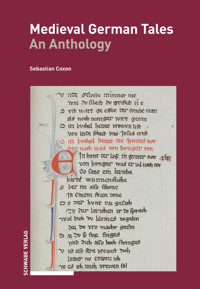
Cover illustration: Cologny-Genf, Bibl. Bodmeriana, Cod. Bodmer 72: Sammlung kleinerer mittelhochdeutscher Reimpaardichtungen (Kalocsa-Kodex) (https://www.e-codices.unifr.ch/de/list/one/fmb/cb-0072), fol. 98r: opening lines of ‘The hound’s ordeal’ / Des Hundes Not
Cover: icona basel gmbh, Basel
Typesetting: 3w+p, Rimpar
Print: CPI books GmbH, Leck
Printed in Germany
ISBN Print 978-3-7574-0112-2
ISBN eBook (PDF) 978-3-7574-0116-0
ISBN eBook (EPUB) 978-3-7574-0117-7
DOI 10.31267/978-3-7574-0116-0
The ebook has identical page numbers to the print edition (first printing) and supports full-text search. Furthermore, the table of contents is linked to the headings.
www.schwabeverlag.de
Acknowledgements
I continue to owe a debt of gratitude to everyone involved in the ‘Deutsche Versnovellistik’ (DVN) project, without whom these translations simply would not have been possible. This includes Susanne Franzkeit and the Schwabe Verlag. It would be remiss of me not to extend my thanks to several other individuals too: Anne Cobby (Cambridge) for guidance in matters Old French; and PWC and KS for their services as readers. I also gratefully acknowledge the generosity of the following institutions for permitting the reproduction of manuscript-images: Fondation Martin Bodmer (Cologny-Genf); Heidelberg University Library; Bremen State and University Library; Austrian National Library (Vienna); and the Tiroler Landesmuseum Ferdinandeum (Innsbruck).
List of Figures
Fig. 1:
Heidelberg, University Library, Cpg 341, c. 1300–25, fol. 70v: rubric and opening lines of ‘The poor woman’s penny’ / Der Heller der armen Frau.
22
Fig. 2:
Innsbruck, Tiroler Landesmuseum Ferdinandeum, Cod. FB 32001, dated 1456, fol. 8r: rubric and opening of ‘The snow-child’ / Das Schneekind (version A).
30
Fig. 3:
Vienna, Austrian National Library, Cod. 2705, c. 1250–75, fol. 140v: opening of ‘Fair hair, grey hair’ / Blonde und graue Haare.
72
Fig. 4:
Bremen, State and University Library, msb 0042–02, c. 1425–50, fol. 96v: rubric and opening of ‘The buzzard’ / Der Bussard.
86
Fig. 5:
Cologny-Genf, Bibl. Bodmeriana, Cod. Bodm. 72, c. 1300–25, fol. 252v: rubric and opening lines of ‘Quail-tales’ / Wachtelmäre (courtesy of Fondation Martin Bodmer).
102
Introduction
Short texts, both narrative and non-narrative, played an important role in the development of literature in German during the Middle Ages. In this respect medieval German literature is no different to other more familiar vernacular literary traditions in Europe such as Old French, in which fabliaux (comic tales), for example, are as well known today as certain chansons de geste (heroic epics) and the Arthurian romances of Chrétien de Troyes. As we shall see, German too has its own tradition of comic tales (‘Schwankmären’) as well as other types of short narratives, all of which have parallels in other languages and literary cultures. In Middle English, for instance, Geoffrey Chaucer assembles a comparable range of tale-types (religious, comic, moral, courtly) within the narrative superstructure of his Canterbury Tales (c. 1387–1400), doubtless inspired by the ten days of ten tales of Giovanni Boccaccio’s Decameron (completed by 1353). No single superwork of this kind exists in German in this period. Nevertheless, large numbers of short texts and short narratives were transmitted together in manuscript collections from the second half of the thirteenth century onwards.1 For the most part the contents of these collections were not compiled in any particular order, although there are certain exceptions. The overriding concern appears to have been to gather all available material including tales suited for different purposes and for different occasions. The tone, literary effects and thematic interests of these texts vary tremendously; they may even be seen to contradict each other at times in terms of their moral-didactic messaging. These compilations are, as a result, as colourful and mixed as they are provocative and challenging to understand.
The aim of this anthology is to give the non-specialist or general reader a taste of this range of shorter narrative literature in the German tradition, including but by no means restricted to fabliaux-like tales. It should be noted that for all their differences almost all the twenty texts featured here share certain fundamentals, not least their verse-couplet form (which is lost in translation). As far as literary structure is concerned, each narrative is typically followed by an epilogue in which the author-narrator signs off, addressing recipients one last time; the tendency to begin with some sort of introduction, preface or prologue is slightly less pronounced. From start to finish author-narrators speak directly to the recipients of these tales as if they were standing in front of them; and scholars generally think that throughout the Middle Ages the main mode of reception was one of public recital and ‘performance’, with reading, either alone or in small groups, only becoming a factor from the fourteenth century onwards. As is often the case with medieval literature, the poets of a significant proportion of these tales (especially the earlier ones) drew on source-texts, inspired and influenced either by Latin clerical literary tradition or Old French tales (or both). Poets of later tales, who were working within a settled tradition in German, were able to draw on established motifs, narrative structures, and plot-types to compose tales without obvious parallels elsewhere. Recipients’ knowledge and experience of the broader tradition too is likely to have a played an important role in their appreciation of any one text.
Types of tales
For orientation it still makes sense to group medieval German verse-couplet tales according to ‘type’ – in accordance with their primary thematic interests and predominant modes of narration – although this is far from an exact science. As explained later in this Introduction, any categorization that is too strict and neat runs the risk of being at odds with the historical reality of such a dynamic literary tradition.
In principle, if not always in practice, religious tales represent one of the more clear-cut types of short narrative in question. Their inclusion in this anthology, alongside comic tales for example, is intended to reflect the juxtaposition of the pious and the profane in the most significant manuscripts. Against the background of an enormous amount of analogous material in Latin, the later thirteenth and early fourteenth century witnessed an explosion of miracle-tales and the like in the vernacular, accompanied by a growing fascination with the Virgin Mary. Miracles and the miraculous are the acid-test of belief, offering audiences the opportunity to observe or perhaps even to experience vicariously the incursion into this world of a divine force for good, whether in the form of an otherworldly songbird (nr 1 ‘The doubter’), a sapling whose leaves bear the angelical salutation Ave Maria / ‘Hail Mary’ (nr 2 ‘Our Lady’s knight’), or an inscription that rewrites itself in a newly built cathedral (nr 3 ‘The poor woman’s penny’). That the transcendental should make its presence known by virtue of the written word, and the Latin written word at that, is symptomatic of the control over education exerted by the Church for much of the Middle Ages.
When it comes to more obviously worldly or secular tales, referred to as ‘Mären’, by scholars in the field, the majority fall into the category of comic tales (‘Schwankmären’), i. e. short narratives which, we think, were meant to entertain and elicit audience-laughter. The emergence of this form of literary comedy was not necessarily entirely dependent on precedents set by other literary cultures, whether witty anecdotes in Latin (ridicula) or the Old French fabliaux (also known today as contes à rire), but it was doubtless shaped by them. German comic tales (in verse) were destined for lasting success, and, unlike the fabliaux, they continued to be composed until the early sixteenth century. Evidently, certain key features of this narrative type (wit and wordplay; hilarious predicaments; outrageous transgression of all-too familiar boundaries) never lost their appeal. Later ‘Schwankmären’ evince a notable tendency towards more extreme plots, more drastic and explicit representations of bodily matters (sexuality; urination and defecation), and more violence and unbridled aggression.
Two further aspects of these comic tales are worth noting. First, the tradition is carried by variations on the same basic storylines (e. g. adulterers escape detection; adulterers are caught and punished; foolish mistakes and misunderstandings) involving a recognizable and more or less fixed cast of mostly nameless figure types: the crafty or foolish wife; the lecherous priest; the foolish (or crafty) husband; the clever student; the filthy peasant etc. Audience familiarity with these types enabled poets to use a kind of narrative shorthand to get to the key moments quickly, whilst anticipating and exploiting their listeners’ approval of and, even more importantly, antipathy towards certain figures. Second, the plots of many of these texts are structured around acts of provocation and retaliation, a narrative scheme which effectively offers superior figures of one kind or another the licence to hit back hard at those who offend them, although once again this structural template readily lent itself to variation. Medieval comic tales are nothing if not antagonistic, and the conflicts that underpin them pit women against men, clerics against the laity, and even more fundamentally perhaps clever against stupid.
Transgression exercises a different function in moral tales, where attention is drawn to wrong behaviour, defined above all in terms of vice and sin, for the explicit purpose of moral improvement on the part of recipients. Such narratives tend to focus either on the bad outcomes for those who choose to conduct themselves badly (i. e. as negative examples), or, more positively, on the benefits and rewards for those who are able to learn and change for the better. Either way, narrative detail here is subordinate to the moral lesson(s) drawn and explained to the audience by the respective author-narrator, and as such, the adhortative quality of these tales is similar to that found in other kinds of didactic poetry. Once again, the poets behind such texts can hardly have been unaware of the extensive collections of this kind of material in Latin from the late twelfth century onwards. However, just as influential, especially in the earliest phase of this tradition, is the vernacular poet known as Der Stricker (fl. 1220–50), amongst whose many didactic poems – or the poems commonly attributed to him – texts such as nr 14 ‘Fair hair, grey hair’ are preserved (Vienna, Cod. 2705, c. 1250–75). Certain issues, not least the relationship between parents and their children, seem to be as relevant to audiences in the fifteenth century as they were in the thirteenth. Tales like nr 15 ‘Half a blanket’ were recycled and reworked by one generation after another, resulting in multiple versions (with varying narrative detail) of one and the same story. In several notable instances, such as nr 16 ‘The pennyworth of wit’ by one Hermann Fressant (att. 1348–53), an unusually expansive mode of storytelling is adopted, featuring an author-narrator whose intrusiveness threatens to distract from the moral lesson in hand.
Some of the longest (short) tales or ‘Mären’ are unmistakably courtly in content and tone, nr 18 ‘The buzzard’ being a prime example. This is hardly surprising, if we consider how closely related such texts are to the courtly romance both in terms of the appetite they satisfy for certain themes – love and knighthood – and the motifs and narrative schemes they contain, such as young love, the ‘tragic’ death of lovers, and lovers separated by some misfortune and then happily reunited several years later. It is not inconceivable that knowledge of courtly tales in Old French (so-called ‘lais’) played a role here too. Tales like nr 17 ‘The eye’, moreover, pick up on problematic scenarios or extreme test cases of courtly love (what happens if a knight should suffer disfigurement in the pursuit of chivalry: does that make him any less loveable?). There is very little scope for comedy in such narratives, the tone set by the author-narrators tends to be earnest and sentimental. Such whole-hearted endorsement of courtly culture says a lot about the aspirations of the target audience, and the resonance of these stories, even in the later Middle Ages, cannot be underestimated. The enduring value attached to a tale like ‘The buzzard’ can also be measured by the production of at least four tapestries of this story, all of which were produced in Strasbourg in the last decades of the fifteenth century.2
The final two tales in the anthology represent text types characterized by their overt, flagrant even, fictionality. However fictitious the other narratives may be, poets often assert their veracity in some way, although it is hard to tell how serious some of these claims are. There is quite patently no grey area when it comes to fables, i. e. stories involving talking animals, the vast majority of which, from the earliest collective manuscript (Vienna, Cod. 2705) onwards, were used as an entertaining means of delivering a serious moral lesson. In a few instances the fable’s latent potential for comedy, especially comedy of incongruity, is realized more fully. Comic fables (‘Tierschwänke’) like nr 19 ‘The hound’s ordeal’ share the antagonistic ethos, figure types and even certain scenes with the European tradition of beast epic surrounding the archtrickster Reynard the fox, with roots in Old French but subsequently reworked in German too. Elsewhere, in so-called nonsense-texts such as nr 20 ‘Quail-tales’, the term fictionality does not really do justice to the quite deliberate refusal to make sense whilst adhering very loosely to certain traditional narrative schemes (such as the bridal expedition). The impossible world presented here for the audience’s festive entertainment combines elements of the topsy-turvy (the world upside down), travesty and the absurd, as well as the carnivalesque. Somewhat paradoxically, the radical content of the ‘tale’ is neatly packaged within a regular formal structure of 12 stanzas of 12 lines whose refrain would seem to invite audience participation.
Caveats
However helpful it may be to divide these verse-couplet tales into several subgroups, it is important to realize that in practice the differences between them were not absolute or invariable but relative. This literary tradition was a dynamic one, and the narrative short form highly malleable, both in terms of the way the poets chose to tell their stories and present themselves (as author-narrators), and the balance they struck between strengthening faith, providing moral instruction and amusing their listeners.
Many of the difficulties we, as modern readers, have when weighing up the significance of this material relate to these same core functions. Two points are worth stressing. In the first instance, it is only too easy to exaggerate unnecessarily the differences between religious tales and non-religious or secular tales, anticipating polarities (thematic; ideological) which simply did not exist to quite the same degree. Apart from their fundamentally Christian worldview and frame of understanding, medieval (German) poets and their audiences may well have been alive to theological subtexts in stories which strike us as being worldly or even extremely profane (nr 8 ‘The alms’, for example). Similarly, many vernacular tales of humility and piety were intended for consumption by audiences with an interest in material courtly culture as well. As a result, religious tales were not always as profoundly anti-worldly as we might expect. Thus, in one tale devotion to the Virgin Mary is evidently not incompatible with participation in a chivalric tournament (nr 2 ‘Our Lady’s knight’); while in another, the reward for humility can also encompass worldly riches (nr 3 ‘The poor woman’s penny’).
Second, another tempting and equally problematic distinction to draw is that between didacticism and comedy, between learning and laughter. There is plenty of evidence to suggest that amusement was considered an entirely valid means of holding an audience’s attention and of making moral teaching stick. But navigating this area, so many centuries after these texts were first composed, is tricky. Moral-didactic messaging was probably not confined to the author-narrator’s commentary but could be conveyed implicitly by the narrative itself, which immediately puts the modern reader at a disadvantage. Furthermore, given that so much comedy is culturally and historically specific we cannot always be sure – and that is putting it mildly – just what made medieval audiences laugh. So, in principle at least, we must allow for the possibility that comic effects may be found in moral (and religious) tales too, just as comic tales, even in their most drastic form, may have had a hint of moral-didactic purpose about them. Transgressive behaviour (as portrayed in such tales) can only be found amusing by those who are familiar with the codes of conduct that are being breached. Does that mean that in the end such texts still exercised powerful normalizing effects? The fact that we can no longer say for sure just how conservative or disruptive medieval German ‘Schwankmären’ were, is one of the reasons they remain so fascinating.
Manuscript transmission
Medieval German tales were transmitted first and foremost in collective manuscripts dating from the second half of the thirteenth century to around the middle of the fifteenth century, and containing, in some cases, upwards of two hundred short texts of various kinds. These large collections likely drew on much smaller bundles of texts, very few of which have survived. Intriguingly, the earliest known of these booklets (Berlin, mgo 1430, c. 1325–50) consists of two comic tales (nr 5 ‘The students’ adventure’; ‘The two confessions, version A’) separated by a religious tale (nr 2 ‘Our Lady’s knight’). In terms of our anthology, tale nr 1 ‘The doubter’ is an outlier in that it is only known to have existed in a Latin devotional manuscript, where it appears to have served as a layman’s guide to reading the Psalms.3
Most of the tales translated here are preserved in at least two manuscripts, the exceptions being nr 11 (‘The blind house-guest’) and 12 (‘Konni’ by Heinz ‘the Cellarer’), which are found only in one. The most widely transmitted text is nr 8 (‘The alms’; eight manuscripts), followed by nr 9 (‘Half a pear’; seven). Notably, the same texts rarely occur in the same order; consequently, their meaning in context – as determined by the texts that precede and follow them – would seem to vary quite considerably. As far as this anthology is concerned, each text has been translated on the basis of the earliest known manuscript copy, as listed here in chronological order:4
Vienna, Austrian National Library, Cod. 2705, c. 1250–75: [tale nr 4], [14];
Heidelberg, University Library, Cpg 341, c. 1300–25: [2], [3], [6], [7], [8], [10], [15], [19];
Cologny-Genf, Bibl. Bodmeriana, Cod. Bodm. 72, c. 1300–25: [20];
Berlin, Staatsbibliothek Preußischer Kulturbesitz, Ms. germ. oct. 1430, c. 1325–50: [5];
Strasbourg, St John’s Manuscript A 94, c. 1330–50 [destroyed by fire in 1870]: [9], [17];
Vienna, Austrian National Library, Cod. 2885, dated 1393: [16];
Moscow, Russian State Archive of Ancient Documents, Fonds 181, c. 1400: [18];
Karlsruhe, Baden State Library, Donaueschingen 104, c. 1425: [12];
Karlsruhe, Baden State Library, Karlsruhe 408, c. 1430–35: [13];
Dresden, Saxon State and University Library, Mscr. M 67, c. 1450: [11].
Many of these manuscripts have been digitalized and can be directly accessed online.5 Even just a quick look at the earliest codices (Vienna, Cod. 2705; Heidelberg, Cpg 341; Cologny-Genf, Cod. Bodm. 72) is enough to confirm that they were material objects of some prestige and representative value. Moreover, not only do these parchment books get bigger, but it is possible to observe how the compilers and scribes take even greater care over the presentation and arrangement of the literary text on the manuscript page, enabling recipients to read selectively or have a specific tale read to them. In the neat and tidy Vienna codex (see Figure 3), which also includes a comprehensive table of contents,6 each text starts with a red initial and is numbered in red ink (‘Fair hair, grey hair’, in the second column, is nr clxxvi, or 176). This layout is developed in the Heidelberg manuscript (see Figure 1; ‘The poor woman’s penny’ starts towards the bottom of the second column), where each text is given a full-blown title in red ink. Almost all these rubrics take the form of a rhyming-couplet. The title for ‘The poor woman’s penny’ is more elaborate, as it also demarcates the conclusion to an extended sequence of miracle-tales concerning the Virgin Mary (including ‘Our Lady’s knight’).7 Cod. Bodm. 72 (see book cover and Figure 5), written out in its entirety by one of the team of scribes behind Heidelberg, Cpg. 341, represents an improvement on the latter: the order of the texts is altered in some places; several titles are refined; the parchment is of better quality; the alternating red and blue initials are more elaborate; and, like Vienna, Cod. 2705, it numbers the texts and lists them all in a table of contents. Thus, whether to the eye, to the ear or to the touch, Cod. Bodm. 72 was meant to offer an enhanced experience to its users.
Not all manuscripts were produced with such care and at such expense. One of the two complete (fifteenth-century) manuscripts containing ‘The buzzard’ (see Figure 4) is a typical example of more modest late-medieval book production. By contrast, the last known large collection of ‘Mären’ (Innsbruck, Tiroler Landesmuseum Ferdinandeum, Cod. FB 32001), which can be dated to 1456, features over 50 coloured pen-and-ink drawings squeezed into the margins between and around the characteristic two columns of text. Later copies of six of the texts included in this anthology are illustrated in this way, with pictures of principal figures, meaningful objects or significant scenes placed near the beginning of the respective tales.8 The drawings most likely helped users to find the texts they were looking for; but in some cases, they also steer recipients towards a particular interpretation. In respect of nr 4 ‘The snow-child’ (see Figure 2), for instance, antipathy towards the merchant’s wife is conveyed visually (unchaste young woman lifting robes) before a word has been read. At least one user seems to have found the image titillating, if the later addition to the picture (the faint outlines of a phallus are still just about visible) is anything to go by.
Note on translations
The translations assembled here are taken from vol. 5 of the DVN (Deutsche Versnovellistik, ed. by Ridder and Ziegeler), an extensive scholarly edition of over 170 medieval German verse-couplet tales. The twenty texts chosen for this anthology offer an introduction to this much larger body of material and are reasonably representative of it, although it was very hard to do justice to the sheer number and range of verse-couplet tales that exist. The selected translations have been revised with a non-specialist readership in mind. I took the decision to unclutter the page by removing line numbering (in alignment with the edited medieval texts), and I have taken advantage of the lifting of this requirement to make the translations more readable. To help with comprehension and literary interpretation each text now comes with a short commentary and explanatory notes (marked by asterisks throughout). Interested readers will find some suggestions for further English-language reading at the end of the book. For obvious reasons most of the relevant secondary literature in this field is written in German. The Bibliography below lists a selection of some of the most important scholarship to date.
Bibliography
Beine, Birgit, Der Wolf in der Kutte. Geistliche in den Mären des deutschen Mittelalters, Bielefeld 1999
Berron, Reinhard and Christian Seebald, ‘Die neue Berliner Handschrift mgo 1430. Ein bedeutendes Zeugnis zur Märenüberlieferung des 14. Jahrhunderts’, Zeitschrift für deutsches Altertum und deutsche Literatur [ZfdA] 145 (2016), 319–42
Dahm-Kruse, Margit, Versnovellen im Kontext. Formen der Retextualisierung in kleinepischen Sammelhandschriften, Tübingen 2018
Eichenberger, Nicole, Geistliches Erzählen. Zur deutschsprachigen religiösen Kleinepik des Mittelalters, Berlin 2015
Fischer, Hanns, Studien zur deutschen Märendichtung, 2nd revised edn by Johannes Janota, Tübingen 1983
Grubmüller, Klaus, ‘Deutsche Tierschwänke im 13. Jahrhundert: Ansätze zur Typenbildung in der Tradition des Reinhart Fuchs?’, in: Werk – Typ – Situation: Studien zu poetologischen Bedingungen in der älteren deutschen Literatur. Hugo Kuhn zum 60. Geburtstag, ed. by Ingeborg Glier et al., Stuttgart 1969, pp. 99–117
—, Die Ordnung, der Witz und das Chaos. Eine Geschichte der europäischen Novellistik im Mittelalter: Fabliau – Märe – Novelle, Tübingen 2006
Haug, Walter, ‘Entwurf zu einer Theorie der mittelalterlichen Kurzerzählung’, in: Kleinere Erzählformen des 15. und 16. Jahrhunderts, ed. by Walter Haug and Burghart Wachinger, Tübingen 1993, pp. 1–36
Kerth, Sonja, ‘ich quam geriten in ein lant ûf einer blawen gense. Weltbetrachtung und Welterfahrung im Zerrspiegel mittelalterlicher Unsinnsdichtung’, Wolfram-Studien 20 (2008), 415–34
Knapp, Fritz Peter (ed.), Kleinepik, Tierepik, Allegorie und Wissensliteratur, Berlin 2013
Koch, Elke, ‘Fideales Erzählen’, Poetica 51 (2020), 85–118
Mihm, Arend, Überlieferung und Verbreitung der Märendichtung im Spätmittelalter, Heidelberg 1967
Schallenberg, Andrea, Spiel mit Grenzen. Zur Geschlechterdifferenz in mittelhochdeutschen Verserzählungen, Berlin 2012
Schnell, Rüdiger, ‘Erzählstrategie, Intertextualität und “Erfahrungswissen”. Zu Sinn und Sinnlosigkeit spätmittelalterlicher Mären’, Wolfram-Studien 18 (2004), 367–404
Slenczka, Alwine, Mittelhochdeutsche Verserzählungen mit Gästen aus Himmel und Hölle, Münster 2004
Suchomski, Joachim, ‘delectatio’ und ‘utilitas’: Ein Beitrag zum Verständnis mittelalterlicher komischer Literatur, Berne 1975
Wagner, Silvan, Gottesbilder in höfischen Mären des Hochmittelalters. Höfische Paradoxie und religiöse Kontingenzbewältigung durch die Grammatik des christlichen Glaubens, Frankfurt a. M. 2009
Wagner, Silvan (ed.), Mären als Grenzphänomen, Berlin 2018
Ziegeler, Hans-Joachim, Erzählen im Spätmittelalter. Mären im Kontext von Minnereden, Bispeln und Romanen, Munich 1985
Zotz, Nicola, ‘Sammeln als interpretieren. Paratextuelle und bildliche Kommentare von Kurzerzählungen in zwei Sammelhandschriften des späten Mittelalters’, ZfdA 143 (2014), 349–72
Endnoten
1Several of these manuscripts are listed towards the end of this Introduction.
2Fragments of these tapestries can be found in major museums around the world, including London’s Victoria & Albert Museum: Textiles and Fashion Collection, nr 4509–1858: https://collections.vam.ac.uk/item/O129349/the-story-of-the-buzzard-tapestry-unknown/ [3/6/23].
3The manuscript in question is Metz, Bibliothèque municipale, Ms. 1200 (Salis no. 53), dated 1276 [lost].
4Full details of the manuscript transmission of all the texts, and many more besides, can be found in DVN, ed. by Ridder and Ziegeler, vols 5 (English) and 6 (German).
5Cf. the online database ‘Handschriftencensus. An inventory of the manuscript tradition of medieval German-language texts’: https://handschriftencensus.de [3/6/23].
6The table of contents consists of a numbered list of all the texts’ first lines.
7‘Here end the tales of Our Lady’s miracles. Now God performs another one as shown by the tale of how a king’s cathedral was completed by a poor woman with her half-penny, which saved her from her poverty.’
8Nr 5 ‘The students’ adventure’ (two young men in conversation); nr 8 ‘The alms’ (housewife giving bread to beggar); nr 9 ‘Half a pear’ (youthful courtier holding half a pear); nr 10 ‘The old mother’ (old woman); nr 20 ‘Quail-tales’ (a quail). A different version of ‘Half a blanket’ (nr 15) is also illustrated here (young boy with bow and arrow; decrepit old man).
RELIGIOUS TALES
Fig. 1: Heidelberg, University Library, Cpg 341, c. 1300–25, fol. 70v: rubric and opening lines of ‘The poor woman’s penny’ / Der Heller der armen Frau.
1: ‘The doubter’
God will not allow anyone into his kingdom unless they possess two particular virtues. In the Latin, as I have read, these are called spes et longanimitas. That is: hope and perseverance*, so that they can serve God in this life with cheerful patience in order to gain eternal and never-ending joy. No one should be angered by the trials and tribulations they suffer in this life. We must be purified just like Almerían silk*, if – with God’s grace – we on this earth are to gain the prize of entering the kingdom of heaven the moment we die. For that reason, you should not be too desperate for worldly success. What has never waned and must endure forever is a bountiful reward worth wishing for. Every person should strive to earn this without complaint, that is my advice, because God’s reward is unending.
I ask every sensible woman and man to think on this and not care about the summer and beautiful flowers, gold, silver, and splendid clothes. All these things are as nothing when life is slipping away or when the dying heart sets them aside. What use to those proud warriors, the Nibelungs*, was their treasure when they were slaughtered in a foreign land? The Roman emperors too could not live forever. However rich they had been, death still took them all; and they had to go to the place God ordained for them. So set aside wealth and worldly honours and strive, brave souls, for honour that is everlasting! The ways of this world are deaf and blind and like a dream. Nobody is saved by their wealth or their high birth or any splendour to be gained here. None of this compares to that everlasting joy which the sweet, merciful Christ has prepared for his own; nothing compares to that delightful place where our troubles are at an end, where we may live forever in an ecstasy never before felt by human heart, nor seen by human eye, nor at any time heard by human ear.* They are fools indeed who sacrifice this for the sake of material wealth that is a source of great joy today but is quite the opposite tomorrow and consigns people to gruesome and terrible torments, the likes of which have never been heard of by anyone alive.
God knows his own people full well. They should allow my words to enter their hearts, and they should strive with all their might to gain the ecstasy I have described. Anyone who achieves this is blessed at birth, because in heaven a thousand years seem to last no longer than one day.* I am telling the truth, providing I have not been deceived by writing that wise men consider to be free of falsehood.
I read this in the Vitas patrum*. There was a monk in a monastery who got up one night for Matins*, as good monks usually do. And when (in the choir) that verse* was sung which says that a thousand years in God’s sight are barely as long as the memory of the day before yesterday, this same monk began to doubt in earnest whether the Scripture was telling the truth. And now that it was dawn and Matins had finished, the doubter immediately went to lock up, since he was the sacristan there and he looked after the monastery church. The monastery in question, moreover, was situated at the edge of a beautiful forest. And as the day was now breaking (so that everything was visible in the daylight) – what I’m telling you in this story actually happened! – he noticed a very pretty bird standing in front of the door. He swiftly made towards it, intending to pick it up in his hand. At that very moment the bird fluttered further and further away from him. The monk forgot all about the church and followed it into the forest. The pretty bird flew up into a tree and sang so beautifully, the sweet melodies filled his heart with ecstasy, and he did not care what happened to the church and to all the treasure that was held there for safekeeping. He had ears only for the birdsong. So sweet, indeed, were the notes pouring out of the bird’s golden throat that the monk had never heard anything so melodious in all his life. The tree too, where the bird was perched, seemed to him to be so perfect, he thought: ‘How can it be that as often as I have walked through this forest, no tree in it has ever appeared so lovely?’




