


0,99 €
Mehr erfahren.
- Herausgeber: Metaphorosis Publishing
- Kategorie: Fantasy und Science-Fiction
- Sprache: Englisch
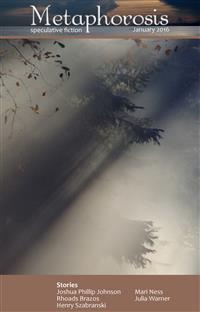
Beautifully written speculative fiction from Metaphorosis. All the stories from the month, plus author biographies, interviews, and story origins Table of Contents The Demon in the Page – Joshua Phillip Johnson Cat Play – Mari Ness … and now He erases – Rhoads Brazos The Machinery – Julia Warner In the Belly of the Angel – Henry Szabranski
Das E-Book können Sie in Legimi-Apps oder einer beliebigen App lesen, die das folgende Format unterstützen:
Veröffentlichungsjahr: 2018
Ähnliche
















Metaphorosis
January 2016
edited by B. Morris Allen
ISSN: 2573-136X (online)ISBN: 978-1-64076-060-8 (e-book)
Metaphorosis
Neskowin
Table of Contents
Metaphorosis
January 2016
The Demon in the Page
It came from Joshua Phillip Johnson
A question for Joshua Phillip Johnson
About Joshua Phillip Johnson
Cat Play
It came from Mari Ness
About Mari Ness
A question for Mari Ness
… and now He erases
It came from Rhoads Brazos
A question for Rhoads Brazos
About Rhoads Brazos
The Machinery
A question for Julia Warner
About Julia Warner
In the Belly of the Angel
It came from Henry Szabranski
A question for Henry Szabranski
About Henry Szabranski
Metaphorosis Publishing
Copyright
Landmarks
Title Page
Table of Contents
Body Matter
January 2016
The Demon in the Page — Joshua Phillip Johnson Cat Play — Mari Ness ... and now He erases — Rhoads Brazos The Machinery — Julia Warner In the Belly of the Angel — Henry Szabranski
The Demon in the Page
Joshua Phillip Johnson
“Ochre!” Mahj’s tired shout was the crunch of autumn leaves underfoot, and the densely packed tomes of the library devoured the sound.
“Ochre!” She tried again, her voice straining, tempting another coughing fit. Running from place to place was a student’s game.
“Coming!” came the faint reply, wafting through the archives like a shallow breath.
While Ochre’s footsteps grew from light pats to insistent thumps, Mahj looked again at the open journal in front of her, at her frustrated attempts at translation, each word and letter splitting apart into seemingly infinite variations and meanings, infinite attempts at connection and understanding.
Mahj ran the soft pad of one finger over the page, over the crisscrossed chaos of her pen strokes, trying to trace the force she saw there, the opaque, shifting demon, at times frustrating and clarifying her work, lurking just behind the inky nettles of text.
“I see you,” Mahj whispered to her demon.
As a younger scholar, Mahj had been mocked for her tendency to talk to herself or the books she studied. That had all changed, though, when she had been the first of her peers to successfully translate an Old World Göthelian text during her 3rd year working at the Languages Institute. Since then, the same evidence used to malign her in social and professional circles was used to support titles like “athrylith” or “genius” or “عبقري”or Olive Drab#7.
Ochre raced into the room. Ochre raced everywhere. He had the candle-at-the-end-of-its-wick look worn by graduate students everywhere: tired eyes surrounded by great pillowy masses of discolored skin, hair that had seen neither pillow nor comb, and days-old clothing. He looked a mess.
“Yes, Mahj?” Ochre’s deep voice still shaped words with the thick tongue of Grißla, a dulcet chromatic language that played on the soft palate.
“How is your High Caste Illysial coming?”
Ochre held himself a little straighter, his sixth student sense detecting an exam. Ochre had been a student for a long time, and he could sense an exam, formal or not, from a great distance. And he did not fail exams.
“Very well, Mahj. I have memorized the primary, secondary, and tertiary indents along with successfully mastering 43 of the 55 writing implements.”
Mahj raised an ancient eyebrow.
“Edmund took the rest and hid them,” Ochre said, his confidence slipping away in the face of his annoyance.
Mahj frowned, making a mental note to speak with Edmund, who was the Institute’s (admittedly) brilliant but (just as admittedly) immature head curator. Ever since Ochre’s arrival three years past, torturing the new graduate student had seemed to become a regular part of Edmund’s job. Mahj suspected it had more than a little to do with Edmund’s crush on Ochre.
“Very well. What do you know of the language itself?” Mahj rarely gave these kinds of impromptu quizzes for her mentee, who had arrived from a Very Serious school where Very Important tests were given frequently in order to separate the Great Students from the Good Students, and the Brilliant Students from the Greats. Ochre was not used to gaining validation from his superiors from simply doing good work, and he often wished Mahj would quiz him more, if only for the sake of his own sense of self worth.
Ochre spoke with robotic accuracy, as though he were citing from a book, which, in a way, he was. His photographic memory pulled up the correct page and he simply read it from his mind.
“High Caste Illysial, a purely written language, is comprised of indents pressed into soft, medium thickness paper. The indents, based on their width, depth, and shape, communicate a series of increasingly complex subjects. A series of 55 intricate, specialized tools are used to create these indents. Ink is then applied to the area surrounding an indent or, in rare cases, inside the indents, to articulate the predicate.”
“Good—” Mahj began, but Ochre was on a roll and would not be stopped from putting forward his argument.
“Because of the intrinsically exclusionary nature of the language, and based on its historical usage, it is my contention that High Caste Illysial is the precursor of several modern languages, most notably Lark’s and the Silent Tongue. Although certain scholars disagree with High Caste Illsyial’s impact and historical importance, one only has to look at—”
“I yield!” Mahj cried, wheezing out a laugh and holding up her hands in mock surrender. “Very nicely done,” she said, smiling at Ochre, who fairly glowed with the praise.
Mahj handed him a book of High Caste Illysial.
“What do you make of that? Just general impressions.”
Ochre felt a thrill of anxiety. Mahj was asking about his overall thoughts, but he could sense an urgency pulsing behind her words. She was after something else, something she wanted to see if he could or would find on his own, something secret. This was the real exam, and Ochre did not fail exams.
“Paper is standard synthetic vellum. Cover is surprisingly soft reinforced Estin leaf.”
Mahj waved a hand to move Ochre on.
“The text. What about the text itself,” said Mahj, her voice easy, the light in her eyes belying her casual tone.
Ochre blew a spout of air up from the corner of his mouth, causing a frazzled thatch of hair to puff up and settle again. He opened the book and scanned through a bundle of pages at random before quickly and systematically working through and commenting on each chapter. His eyes moved often to Mahj’s face, and his happiness of only a moment earlier dimmed a little each time he saw no spark of recognition or praise there.
“Standard index with class-specific gerunds integrated into an otherwise typical syntax,” he finished, knowing that he had failed. He passed back the book, defeat plain on his face and in the slump of his shoulders.
“That’s just fine, Ochre,” Mahj said, taking the book. Her words were a blow to the graduate student, who was not used to being fine, not used to having his work be fine.
Mahj opened her mouth to say more, perhaps to reassure her pupil that he’d done a wonderful job, perhaps to lie and say that he’d found exactly what she was looking for. Perhaps to tell him the truth and to ask him to look again for the demon lurking there.
But she erupted into a coughing fit, and Ochre, his motions practiced and routine these days, passed her a handkerchief before placing firm hands on her shoulders, holding her upright. If her coughing fits were a storm, Ochre was the sturdy foundation Mahj huddled under.
It ended slowly, the coughs crumbling away into nothing, leaving Mahj red faced and short of breath and Ochre concerned and uncertain how to help. It was an uncertainty he’d come to know well.
“Are you alright?”
Mahj nodded and gestured for Ochre to sit. While he did, Mahj ran a finger over the closed cover of her journal, thinking again of the demon.
“What,” Mahj began, her voice thin atop her shallow breathing, “is the purpose of translation?”
This was a cherished and well-worn conversation between them, a debate relished by both the teacher and the student.
Ochre leaned forward and sent another spout of air to unsettle the hair falling into his face.
“Translation is the process of shifting content from one medium to another. The goal of translation is to preserve content as perfectly as possible, to maintain meaning and syntax in the face of linguistic barriers.”
He grinned, knowing his next statement would be met with rolled eyes.
“Translation is mathematics. The translator balances the equation. The good translator balances the equation elegantly.”
Mahj disagreed, as she always did during these discussions, though she struggled to articulate why. Ochre presented a theory of translation held and taught by every expert in the field, a theory so widespread as to be thought a certainty.
“How robotic and rigid your translations must be,” she said, smiling at her student. “What of the moments when perfect translation is impossible? What of the moments in translation when a text proliferates in meaning, one grapheme splitting into three or five or ten possible and viable meanings?” She held up a book Ochre had become increasingly familiar and annoyed with in his time with Mahj.
Translators the world over called it The Blank Book: a private joke celebrating their failure, lessening the blow to their collective ego. A text as old as the written word and filled with a monolithic language, but it was still devoid of meaning for all their attempts at translation. And so it remained The Blank Book. The author, as best they could guess, was someone with initials that translated to EY. Or perhaps VC. Mahj had published several papers arguing for a female author named EY, and this many years later, she had almost no idea if she had been right.
Ochre, the dogged optimist and rule-abiding absolutist, glared at the book in Mahj’s hands and said, “No more than obstacles to be overcome by the talented and clever translator.”
Mahj reached for her journal.
“Take Grißla for example,” she said, pursuing her point despite Ochre’s defense. She pointed to one of her entries on an ink-filled page. “ ‘Hooker’s Green’. A color whose meaning, when translated, splits into several related but distinct possibilities. One does not arrive at the meaning through context; one arrives at several meanings through context. Even if that one were, as you say,” Mahj arched an eyebrow and leaned forward, “a talented and clever translator.”
Ochre laughed and offered his rebuttal. And the student and teacher talked late into the night, interrupted only once more by another coughing fit.
#
Journal Entry 38




