


0,99 €
Mehr erfahren.
- Herausgeber: Metaphorosis Publishing
- Kategorie: Fantasy und Science-Fiction
- Sprache: Englisch
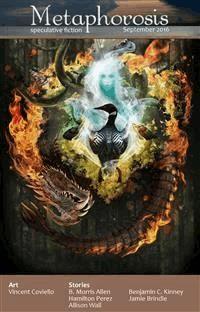
Beautifully written speculative fiction from Metaphorosis magazine. All the stories from the month, plus author biographies, interviews, and story origins Table of Contents Dragons I Have Slain – B. Morris Allen Shiplight – Benjamin C. Kinney Strix Antiqua – Hamilton Perez Showtime – Jamie Brindle Flann Brónach and the King’s Champion – Allison Wall Cover art by Vincent Coviello.
Das E-Book können Sie in Legimi-Apps oder einer beliebigen App lesen, die das folgende Format unterstützen:
Veröffentlichungsjahr: 2018
Ähnliche
















Metaphorosis
September 2016
edited by B. Morris Allen
ISSN: 2573-136XISBN: 978-1-64076-068-4 (e-book)
Metaphorosis
Neskowin
Table of Contents
Metaphorosis
September 2016
Dragons I Have Slain
It came from B. Morris Allen
Shiplight
It came from Benjamin C. Kinney
A question for Benjamin C. Kinney
About Benjamin C. Kinney
Strix Antiqua
It came from Hamilton Perez
A question for Hamilton Perez
About Hamilton Perez
Showtime
A question for Jamie Brindle
About Jamie Brindle
Flann Brónach and the King’s Champion
A question for Allison Wall
About Allison Wall
Metaphorosis Publishing
Copyright
Landmarks
Title Page
Table of Contents
Body Matter
September 2016
Dragons I Have Slain — B. Morris Allen Shiplight — Benjamin C. Kinney Strix Antiqua — Hamilton Perez Showtime — Jamie Brindle Flann Brónach and the King’s Champion — Allison Wall
Dragons I Have Slain
B. Morris Allen
I collect dragon tears. It isn’t difficult; they’re insidious and subtle, and they seep through my armor and into my skin like ink, leaving me stained, soiled, sorrowful — a human map of misery. The Dragon Atlas, I call it — marked with the precise locations of honor and shame.
Dragons cry for the same reasons we do — pain, heartache, joy. We think of them as wise and cold, but wisdom is no antidote to empathy. Dragons are kings of empathy. That’s what makes killing them so hard.
There was Vyurfang, short for something unpronounceable in dragon-tongue. I stood on his chest, his broken limbs splayed out across the rocks, the point of my longsword slipped between two diamond scales. I kept my back to him, and he turned his sky-dark eyes on my mirrored shield, and said “I am sorry, Solna,” even as he tried to use my name against me. He cried as I slipped the blade home once, and again, and again, and again, through every chamber of his heart. He cried as his long body writhed in agony, as I came down to hold his head against my bosom and snap his tired neck. The tears soaked through the metal plate and the cotton gambeson and steeped my chest in sagacity and shrewdness, experience and acumen. I wash and wash, but I cannot get it out.
In the town, they hailed me as a savior, offered me fine wines, rich foods, soft beds. Handsome men, pretty women — I refused them all, and in the parlor of the inn they whispered to each other about dedication and purity as I shed my futile armor.
“Send up hot water,” I told the landlord, “and keep it coming.” I’ve done this before, and though no water can cleanse me, it’s better to try than to despair. A dragon taught me that.
#
When we were girls, I was the dragon.
“Breathe fire, Solna,” Elyndra commanded, and I would roar and cough on all fours, and she would hack off my head.
“Why must you play with that girl?” my mother asked, as if she could not see Elyndra’s in-born grace, her golden beauty.
“Because her mother is scullery maid at the castle,” my father replied. “And if she did not help us to sell our crop, who would buy it?”
#
After Vyurfang there was Cold-Heart, whose only weakness was in her mouth, into which I fired an iron quarrel when she spoke of duty and of passion. Her tears are etched into my forearms where I tore the quarrel out so that she would not lie with her mouth open and speechless as her body turned to stone.
And after Cold-Heart, there were Klarsharp, and Windclaw, and Sharpstone, and Zmeyra, and more others than I care to count. Each one marked me with their tears, wrote their passing on my skin. I feel the burden of it like a cloak of chain, slowing my steps, clouding my thoughts. Even when I sleep, it drags me down into nightmare, and when I wake, I force myself to stand only so that I can be doing, not thinking, even if that doing is only a slow march to one more death.
Dragons are a violent breed, with an instinct for survival so deep that even after death, they strive for life. Even while they hope to die, they try to fight. It is an instinct in them, I think, that they cannot suppress. I kill them this way and that way, and every time I think them dead, they twitch and claw and tear. And weep.
#
“I can’t look you in the eye,” Elyndra told me when we were older, almost blooded women. “A dragon can enthrall a man with a single glance.”
“As you’ve enthralled Osal,” I agreed, making a joke of heartbreak. “Though what you’ll do with a thrall so small and weak, I can’t say.”
“I have you to protect me,” she smiled, and kissed me on the cheek. “And Osal is clever, and his father is the glass-smith.” But she wouldn’t look me in the eye, and her kisses grew fewer as our bodies grew curves.
#
My armor, once of mirror-shined plate and tight-knit mail is rent now to tatters, discarded across fields and hillsides, caves and plains. Only my weapons remain: a sharp sword, a strong bow, and a promise, burdens now so heavy I can barely walk.
Today, it will end. Today, I will kill my last dragon, or she will kill me. There is always that hope. Today, I go without even my mirror shield to save me from enthralling dragon eyes. I will kill her with my eyes closed, or she will enslave me, or I will die. Today is the end.
They watch me as I go from the village. I have saved a pretty dress for today, a soft cotton gown they gave to me in Hatherton. The canvas baldric pulls against it, pricks the fine weave with coarse fiber until I give up and carry the sword in one hand, arbalest in the other, and the promise on my conscience. I hear the children snicker at a savior in a sun dress, hear parents chide them in quiet, tolerant voices.
I have kept my boots, for the way is muddy, and there are streams I must cross. At the first, I slip the sword under one arm, and pull the dress up to my thighs. It is easier than plate, and more comfortable. The children laugh and point, and make jokes about dragons’ legs, but they come no further. We are too close now for childish dares.
It was daring that brought me to this day, and desperation. Desperation to catch the eye of Elyndra, a spare, fine willow to my tall and sturdy walnut. Daring to think she might value strength and commitment over craft or intellect.
#
When we were women grown, Elyndra went in to the castle, as a lady’s under-maid, and I followed her. No lace and fripperies for me, no delicate embroideries on satin underthings, but canvas straps and heavy pikes.
“I’m sorry,” Elyndra said when we met in the evenings. “But we must use what we have. I’m pretty. You’re strong. Best not to argue with fate.” Fate decreed that her mistress invite Olas to show the Countess and court his tricks of glass and wire, and that I enlist as guard trainee.
“You’re no nearer Elyndra in the guard than here at home,” said my mother when I packed to leave home. “And with your father gone, I need your help.”
“I will send my wages,” I mumbled.
“Elyndra is a tramp, and a shameless one,” said my mother, and she gazed past father’s empty chair to the widow Remble’s shack. “She’ll no more be with you than you’ll be a hero, with all your belts and spears and bruises.”
The dragon came not long after, a long dark shape like a storm cloud spread thin by wind. It settled on the mountain behind the castle, on the steep slopes that fell off in cliffs to the river below.
“They’ve written to the Queen,” Elyndra said, eyes wide. “They say she’ll send a hero! Osal told me so. He said it will be a hero, with landboats so full of armor it’ll take ten men to row each one. The Countess herself has ordered him to make a special far-sight device so that she can see the dragon from her tower. And with the pay from it,” she looked away, a slight flush across her perfect skin. “Well, you know.”
I found a sword easily enough, a rusty piece of steel from the practice racks. Armor I did without, going forth as near-naked then as I do now, though more sensibly dressed in cotton trousers and tunic. I crossed the shallow valley below the castle, went quiet into the dark of the mountains, and climbed through the mist, glad it muffled my scrabbling steps from the dragon whose shadow filled the tap-rooms.
I found him just above the treeline, in a cave less tunnel than scrape, a shallow overhang of rock exposed to cold winds that fell down from the ice above to the cliff below. I had no mirror, for I was brave, not shrewd, and when he opened his eyes to me, I was lost.
I spent untold centuries in delirious contentment, washed in cerulean tides that hinted love and warmth and certainty until he closed his eyes again and I was free. I wept for loss and fell to my knees to beg him to take me back, my sword discarded dull and evil at my side.




