


5,49 €
Mehr erfahren.
- Herausgeber: 이즈그리민(izgrimean)
- Kategorie: Gesellschafts- und Liebesromane
- Sprache: Englisch
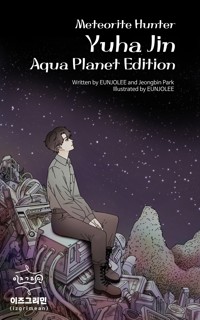
In the year 20XX in Korea, Yuha Jin is a ‘meteorite hunter’ who collects and sells meteorites. One day, after hearing a signal that a meteorite had fallen, Yuha and his AI assistant, Frimal, headed to the Uyut Desert. Despite their search, they find nothing—not even a trace of the meteorite. What could have possibly happened there? This is a science fiction novel that incorporates a hypothesis to solve Earth's environmental issues.
Das E-Book können Sie in Legimi-Apps oder einer beliebigen App lesen, die das folgende Format unterstützen:
Seitenzahl: 279
Veröffentlichungsjahr: 2024
Ähnliche




















Creative Commons
Meteorite Hunter Yuha Jin
Aqua Planet Edition
Author | EUNJOLEE, Jeongbin Park
Editor | EUNJOLEE, Jeongbin Park
Cover Design | EUNJOLEE
Illustrations | EUNJOLEE
Published by | 이즈그리민(izgrimean)
Publisher | EUNJOLEE
Date of Publication | May 27, 2024
Publisher Registration | May 24, 2023, No. 2023-000052
EMAIL | [email protected]
First Edition eBook Published | May 27, 2024
Price |
ISBN | 979-11-987080-1-4(05810)
© 2024, 이즈그리민(izgrimean). All rights reserved. Reproduction or distribution of this work, in whole or in part, without explicit permission from 이즈그리민(izgrimean) is prohibited by law.
For reuse of any part of this book, permission must be obtained from both the copyright holder and 이즈그리민(izgrimean).
This content uses the fonts ‘나눔바른고딕(NanumBarunGothic)’, and ‘나눔스퀘어(NanumSquare ExtraBold)’ distributed by Naver, ‘속초바다 돋움(Sokcho-Bada Dotum)’ distributed by Sokcho city hall, and ‘학교안심 마법사 R(School Safety Wizard R)’ distributed by the Korea Education and Research Information Service (KERIS) for the cover design and illustrations.
Getting Started
This novel includes proposals on educational materials and hypotheses for solving environmental pollution issues. However, all other content, including characters, institutions, events, and places, is fictitious and has no relation to reality.
Comments from Jeongbin Park
What do you think about the Earth? I often think about the future of our planet, which is the foundation of our lives and our origins. The Earth has given everything to humanity, but in our quest for a comfortable life, we have excessively processed and used its resources. This has led to the problems of environmental pollution and destruction, challenges we have brought upon ourselves. While it's impossible to completely stop using resources as humans, I believe we still need to continuously consider better directions for the future.
One of the major environmental issues I wanted to address in this book is the ‘Great Pacific Garbage Patch.’ This mass of plastic waste has accumulated in the ocean currents, forming what resembles an island. It's evidence of the vast amount of garbage discarded on our planet and a tragedy for our future.
How can we solve the problem of the Great Pacific Garbage Patch? I believe using microbes could potentially transform this tragedy into a happy ending. Although it's just a theoretical solution within the confines of this novel right now, I hope this theory could ultimately provide a clue to solving the issue in the future.
Comments from EUNJOLEE
I wanted to create various meanings through words and pictures, which led me to establish a publishing company called ’이즈그리민(izgrimean).’ This book marks the beginning of 이즈그리민(izgrimean).
In this story, I not only participated in the illustration but also in the writing, crafting a message, and developing a worldview of public interest. I wanted to lead the characters within this world and the readers to conclude together.
I write stories to believe in myself and move forward. Everyone may have different perspectives on the world, but through this book, I wish to share my view of the world with you. Why not start this journey through this unexpected world?
Ch. 1: Meteorite Hunter
A colossal sound that I had never encountered before was heard. The sound implied a falling meteorite from the sky. I barely woke up and half-raised myself from a beanbag chair.
The alarm has sounded with the greatest intensity ever since I started this work. I abruptly came to myself and told my AI secretary, Frimal, to investigate the location of the meteorite. I was wrapped in a hopeful expectation of a fortunate discovery.
My name is Yuha Jin. However, people call me ‘a meteorite hunter’ instead of my name. Some of those who criticize me even describe me as ‘dumb as a rock’... Specifically, I am in the business of locating where meteorites have fallen, collecting the meteorites from these locations, and selling them to governments or research institutions. To some, I may simply appear as one peddling ‘rocks.’ However, meteorites have always been of paramount importance as fundamental research material, and their value has skyrocketed manifold in just a few years since the discovery of a new energy source, ‘dark energy1,’ within them.
▲ 1If the universe contained only ordinary matter and dark matter, it would only contract. However, the universe is currently undergoing accelerated expansion, and dark energy is being pointed to as the energy driving this expansion. The quantum vacuum is proposed as a candidate for dark energy, but much of it remains an unknown territory.
I live and work as a meteorite hunter from my base, which is also my home and office, located in a secluded area about two hours away by car from Seoul. This place is truly hidden, with not even a single signpost nearby. Except for the unavoidable interactions with people at work, I mostly stay concealed within my base. In the yard of this base, there are several airplanes that I bought cheaply and refurbished stylishly. So, I pride myself on the fact that, when viewed from about 100 meters away, my base looks quite well-equipped.
South Korea, starting in the year 20XX, began experiencing an infrastructure collapse outside of Seoul, the capital city. I remember my grandfather explaining to me when I was young that, except for major cities, it became difficult to even see people if you drove a bit out of Seoul. He also mentioned that it was becoming rare to find young people who spoke in dialects. Since this is also not a metropolitan city, I rarely meet people here unless they are long for nature and give up city life or customers who come to meet me. Ever since I was young, I've heard the media and officials from government agencies or futurists say that we need to devise strategies for the phenomenon where the population resides only in certain areas. However, even after I became an adult, not much seems to have changed. This place too, I've heard, once had what they called a ‘commercial district.’ But now, the trees have grown so straight and tall, forming forests everywhere, showing that nature has been well-preserved. At night, the sounds of insects are gently heard, and I like to fall asleep to this natural lullaby. This place has value to me as a foundation to cherish and settle in. And here, using cutting-edge technologies, I've been doing things that others can't even imagine.
The meteorite that had surprised me ensnared my thoughts. The recent fall seemed to be of considerable size, leading me to speculate about the high likelihood of finding dark energy within it once again. Confident in my meteorite detection technology as being among the world's elite, I doubted anyone else on Earth had noticed its descent. Yet the worry that it might have landed near human habitation and someone might discover it before I crept into my mind. With a sense of urgency, I summoned Frimal. My capable AI assistant, with the charming appearance of a puppy, approached me.
Yuha“Frimal, where might that meteorite have landed, if indeed it was a true meteorite?”Frimal“Yes, Master. Judging by the trends of the signal, it appears to be more akin to a spherical meteorite than a fallen aircraft or satellite. I am currently calculating the precise location.”Frimal calmed me with a serene voice. I've been monitoring the majority of meteorites that fall to Earth, utilizing tens of thousands of satellites orbiting our planet and hundreds of thousands of celestial telescopes, all for the job of a meteorite hunter. Although I haven't been in this line of work for very long, the fluctuation in signals today was unprecedented. The size of the meteorite must surely be beyond imagination.
About three years ago, I suddenly remembered a moment from when I was hunting for meteorites. It was when I caught the biggest signal ever, although it's nothing compared to what we catch now. The expected site of the meteorite was in Greenland, a place where hardly anyone lives. The average temperature there is around -30 °C (-22 ℉), and it was winter at the time, making it extremely cold. To avoid the risk of freezing to death, I spent a lot of money on a winter coat. Thanks to this coat, I was prepared to withstand the extreme cold.
When meteorites first enter the Earth's atmosphere, they are often of considerable size. However, as they journey through the thermosphere, mesosphere, stratosphere, and troposphere, the frictional heat significantly reduces their size. For this reason, although a considerable amount of signals are detected when monitoring meteorites, most of them disintegrate before reaching the Earth's surface. In the early days of my meteorite hunting, there were numerous instances of rushing out at the slightest signal. Over time, with accumulated experience, it became possible to discern the threshold of signals indicating a meteorite's arrival on the ground. After several attempts, I was even able to distinguish the signals in such detail that I could decide whether to dispatch based on the economic costs involved. Due to the significant costs involved in activating expensive equipment, the process of deciding whether to deploy became increasingly cautious. However, the Greenland meteorite presented a signal so significant that it warranted immediate action, bypassing the usual review process.
Back then, as it is now, my main mode of transport was my airplane. In particular, as a meteorite hunter, my job often involves unusual tasks that require me to carry specially designed equipment and devices. These items were mostly inventions of my own. Also, airplanes that could carry all this gear were expensive, which meant I felt the need to make every meteorite hunt a success to justify the cost. On top of that, since meteorites can be considered hazardous by many countries and have strict rules for their transport and handling, using my airplane has been a way to make everything much safer and less of a hassle.
However, a strong storm often surrounded the Greenland destination, so I might expect a possible airplane accident if anything went slightly wrong. By providing a whole air pressure chart and satellite photos of clouds to Frimal with a built-in weather forecast function, I tried to determine times when there was little wind in that area. However, the weather prediction was still unpredictable even if modern technologies were used, so I would determine the period quite carefully.
After several simulations, I finally decided on the aviation date. As international aviation can be a sensitive problem for many countries, I needed to get permission for flights by contacting the relevant flight governments of the countries. Thus, I got permission from the Ministry of Air and Space Defense for the North Atlantic Ocean, which is related to the flight to Greenland. Fortunately, I have several important licenses, so I was able to get the flight permit request approved in about a week. In the process, abruptly, I could think of the role of licenses as a barrier to entry into a meteorite hunter’s work. This work is not one anyone can easily start. This license was acquired, luckily, through the previous company where I traded various inventions.
After the permit, I tested the required equipment and reviewed various scenarios. When it was the flight date after a week’s preparation, Frimal and I took an automatic flight. I had to fly for 24 hours. Because the network was not working on this old-fashioned airplane I took, I just decided to get some sleep without a reservation. I fell asleep so quickly, presumably because I got tired while preparing many processes for this flight.
When I slowly opened my eyes, I immediately found that Frimal’s expected point and his weather prediction were greatly accurate. Indeed, the meteorite on white snow was within 500 meters of his prediction. Frimal and I got off the airplane after landing. However, it was so challenging to proceed step-by-step due to the heavy winter clothes. Frimal seemed to be sluggish and often fell into the snow, unlike normal smart robots. Even if so, we managed to arrive at the meteorite location by depending on each other.
Upon facing the meteorite in the Greenland area, it turned out to be quite large, as expected. The snow around the area where the meteorite was found did not seem to have accumulated for long, and there were signs of thermal erosion in the ground where the meteorite had been placed. After reaching the meteorite, Frimal carefully brushed off the snow adhered to it with a brush-like tool, as discussed before departure, much like dusting off soil when excavating fossils. Essentially, meteorites can provide important information about the birth of the universe and extraterrestrial materials, so it is crucial to collect them as intact as possible. Moreover, since the meteorite may contain radioactive isotopes, it was necessary to proceed with caution for the excavator's safety. For this reason, during the excavation process, it was imperative to continuously use a dosimeter to avoid radiation exposure, wear protective clothing made of special material, and use a small lead safe for transporting the meteorite. Performing such meticulous work while carrying the heavy lead safe was quite challenging in winter clothing. However, tasks that would not be easy for a team composed only of humans could proceed relatively smoothly since Frimal, a robot, took on those tasks instead.
When I ran the radiation dosimeter in my chest, I found radiation far exceeding the natural levels. We carefully lifted the meteorite, stored it in the safe, and loaded it on the plane. As the meteorite can be eroded by inappropriate temperature and humidity, I connected the load with the proper apparatus, followed by a quality control process. And I watched a clock. Soon I realized it was less than two hours for the whole process after taking off the plane.
After the lift-off of the plane, I threw away the winter clothes. Even though the air was too cold, my sweat fell like rain.
Yuha‘It's so arduous just because I worked wearing winter clothes...’I was so exhausted that I fell asleep quickly, and when I opened my eyes, I had arrived at the base. After taking some rest at the base, we searched for potential customers to sell the meteorite to. A significant part of a meteorite hunter's job involved such administrative tasks. Eventually, I decided to contact a laboratory located at CERN2, Switzerland. The reason behind choosing CERN's researchers was due to a recent report from CERN about discovering dark energy from a radioactive meteorite. According to the confidential information I had obtained, they were searching for a future energy source that could replace electricity or oil, based on some undisclosed research, and that was precisely dark energy. Therefore, they seemed like the most ideal potential buyers for the meteorite I had discovered.
▲ 2CERN, or the European Organization for Nuclear Research, is the world's biggest particle physics research center. This institute is located at the border between Switzerland and France and has revolutionized the areas of high-energy physics, quantum mechanics, and particle physics.
I sent them a message expressing my desire to meet with some of the meteorite data I have. Their response came surprisingly quickly. They showed a lot of interest in my data. After three online meetings with scientists at CERN, it seemed that the scientists became more interested in the meteorite I had discovered. They sent an email saying they wanted to see the meteorite directly. Consequently, together with Frimal, we headed to Switzerland on a flight we had prepared in advance to meet those scientists in person.
The day after I arrived at a research complex situated in a quiet region of Switzerland, I had a long conversation with CERN researchers. The task they were responsible for was the exact analysis of the meteorite. They proceeded with diverse examinations after taking the meteorite out of the vault.
The scientists asked about the initial circumstances, the environment, and all the detailed specifics of how the meteorite was discovered. I answered their questions diligently and handed them an analysis report about the meteorite I had collected myself. They began to derive results through experiments and analyses designed concerning my answers and reports. We engaged in discussions based on these outcomes, and as time passed, interesting conclusions began to emerge.
After much debate and discussion, it seemed the moment the researchers at CERN had secretly hoped for had finally arrived. They announced that the dark energy they had long sought was discovered within this very meteorite. Moreover, they shared the astonishing revelation that the high levels of radiation emitted from the meteorite were due to dark energy transforming the original elements into radioactive isotopes.
I submitted a contract and an estimate outlining rewards for meteorite-related work to the scientists. They responded promptly, making an advance payment. Subsequently, I transferred the meteorite to them and informed them of the date for the final payment, receiving a guarantee to successfully conclude the transaction. Thus, the transfer of the meteorite was completed.
While preparing to return to base, buoyed by the reward far greater than anticipated, the director of the research lab abruptly halted me. His expression bore an unprecedented gravity, presaging the weight of the words that were about to spill from his lips.
HeadResearcher“Excuse me, Jin. My boss wants to have a conversation with you.”His words, hesitantly uttered, were enough to transform my excitement into a feeling of anxiety. The director of the research institute, the lead researcher, and Frimal boarded the train with unspoken anxiety. Our destination was a formidable building in France. I couldn't help but wonder whether it housed an intelligence agency or something even more significant.
Upon arriving there, the Director of CERN, dressed in a striking suit, welcomed us. Beside him sat key figures from the European Union. In addition, a prominent political figure, familiar with the newspapers, was also seated there. Their expressions were serious, and it seemed as though everyone gathered there was imbued with a sense of gravity, as if a significant decision had to be made. I speculated in my mind about the significance of all this and why they had summoned me, but I remained silent, waiting for their response.
Directorof CERN“Mr. Jin, the reason why we called you...”Upon hearing the director's words, my bewildered heart, once clouded with confusion, swiftly transformed into astonishment. Alongside the director, several figures spoke to me of an exclusive contract to sell meteorites. Their ambition to harness dark energy far exceeded anything I had imagined.
Listening to them, my feelings transcended mere astonishment. It was a mix of fear and disbelief. That my work and research could captivate such esteemed individuals... Was this reality, or was I dreaming? Amidst these doubts and confusion, I knew I had to grasp their plan. As their story unfolded, it gradually dawned on me. For them, dark energy was not just a subject of research but a tool to fulfill their ambitions.
In South Korea, the technology to handle energy sources is not as developed, and the energy market itself is relatively small compared to other countries. Therefore, making contracts with these nations was not a bad choice for advancing my business. However, I was cautious about hastily making contracts with countries other than my country regarding energy sources, which could be directly linked to national security. Additionally, I was well aware that, as a businessman, it was crucial not to rush into agreements to gain negotiating power. I began to assess the situation from a strategic perspective to avoid being swayed by immediate benefits.
After much deliberation, where thoughts chased each other like a tail following its head, I found myself having signed a Memorandum of Agreement (MOA) with them, followed by a few promotional sales contracts. This was a pact meant to clarify mutual interests and to utilize our resources efficiently. It was not an exclusive sales agreement, though. Later, I began to ponder. The continuous talk of an exclusive sales contract made me wonder: could there be another party, unknown to me, desiring the very meteorite they sought?
Another question then surfaced in my mind. What potential value could the dark energy contained within the meteorite hold? And to what extent must its value have reached for them to be willing to pay such a considerable sum? My understanding of dark energy was quite limited, compelling me to recognize the necessity of delving deeper into this field of study.
After meeting with the Director of CERN and others in France, I began to contemplate the skills necessary to effectively fulfill my role as a meteorite hunter. Effective negotiation skills, exceptional judgment, and a comprehensive understanding of dark energy were essential, of course. Additionally, I felt the need to enhance my technical abilities in discovering and collecting meteorites. Proficiency in external negotiations, internal operations, and understanding market trends was also required across various fields. These processes were indispensable for becoming the first-rated meteorite hunter.
The three years that followed were dedicated to pouring newly accumulated wealth into technological innovation alongside my duties as a meteorite hunter. I learned survival skills to endure any situation and prepared the necessary equipment. I purchased a new airplane, adopted cutting-edge technology, and introduced a drone system that I hadn't equipped before. To detect meteorites more precisely and thoroughly, I increased the number of observation telescopes. Additionally, I introduced animaloid assistants to the base to support administrative tasks, aside from Frimal. Not only did I interact with CERN officials, but I also conducted further investigations to understand who else was interested in the meteorites and to explore the characteristics of the dark energy slumbering within them.
And now, three years hence, the strong signal long sought has at last been observed.
Frimal“The calculation results are out now. The meteorite fell near the Uyut Desert.”While momentarily lost in a flashback, I was snapped back to reality by Frimal's announcement that he had already found the location. I was automatically filled with awe and admiration for Frimal's ability to pinpoint the location of the meteorite in such a short moment. Frimal was originally an outdated animaloid robot that even junk shops considered worthless. Despite its rough exterior, it unmistakably resembled a dog. Nowadays, humanoid robots are popular, but I somehow found animaloids more endearing than their human-shaped counterparts. To an engineer's eye, it was equipped with more features than necessary, and its discontinued production added an appealing rarity. Thus, Frimal became my first assistant and a fantastic colleague who always completed tasks flawlessly.
▲ Frimal. Although it's an outdated animaloid robot model, it's a fantastic colleague who always handles tasks neatly.
While Frimal calculated the location and trajectory of the fallen meteorite, I instructed the other robots to prepare the airplane and other equipment. Then, I changed into active walker boots and breathable work clothes. I loaded some necessary equipment onto the plane and removed some unnecessary items to reduce weight. I also wore a long-range communication watch and tested various systems to maintain continuous communication with the base. After about an hour of such preparations, a light aircraft was ready for takeoff.
Yuha“Then... it's about time we set off, isn't it?”The airplane was a retired aircraft that had previously been used for pilot training in a training squadron, and I recently purchased it under favorable conditions. I boarded the plane with Frimal. I activated the autopilot function, commanding it to take off and fly automatically. As the lodge where I had been staying began to shrink to the size of a thumbnail through the window, I comfortably leaned back in my chair. Indeed, there's no other way but to sleep during such long flights. I leaned back and closed my eyes.
Beep. Beep.
I woke up to the alarm sound becoming increasingly clearer. It seemed that I had fallen asleep again after letting my guard down for a moment. Just as I was about to get irritated by the loud noise, my gaze was stolen by the new landscapes that entered my view. Looking at the clock, it had already been about 10 hours since we departed. The continuous ‘beep’ sound from the receiver was already indicating that I was nearing my destination.
▲ The landscape of the Uyut Desert unfolded below the airplane. Previously, this aircraft was used as a military plane for pilot training.
A vast desert stretched out before me. Having done this for a long time, I naturally learned that the high albedo3 of the desert poses a considerable risk of skin burns or blindness. I hurriedly put on a hat and sunglasses and began applying sunscreen.
▲ 3Albedo refers to the reflectance of the Earth. It signifies the portion of solar radiation energy that is reflected or scattered back into space by the Earth's surface, dust, water vapor, and air.
Without the luxury of time to marvel at my arrival in a new territory, I found myself squinting against the intense sunlight of the desert, hastily checking my compass. The needle was visibly shaking, indicating a potent magnetic field in the area. Although the compass no longer accurately pointed to the north, I was relieved to receive accurate GPS data from my previously acquired satellite communication device, ensuring I knew exactly where I was. This device, once discarded by the military like an obsolete aircraft, was large and not much to look at, yet it functioned flawlessly. Despite its reliable performance, it was phased out in favor of newer models with advanced features, as the person who sold me the device had explained. Consequently, I managed to acquire this and other pieces of equipment at a significantly reduced cost.
I landed at the estimated meteorite location calculated by Frimal. As soon as I landed, I had a feeling it might take a long time to find the meteorite because there were no signs of it anywhere. It was odd because Frimal must have calculated it precisely... The thought that it might be a struggle made me feel dizzy. For that time, I might have to stay here until I find the meteorite. As soon as that decision was made, I started thinking. To survive here, securing the most important things—energy, water, and food—was crucial. Yes, energy... Among the eco-friendly energy sources, solar energy was known to be the most efficient. Therefore, I took out 20 solar panels from the cargo bay of the plane to harness energy from the sun. These solar panels were the first things I packed after Frimal mentioned that our destination was the Uyut Desert, recalling the intense sunlight beating down on the desert. And these solar panels were a gift from a mentor I had been indebted to when I first started this business.
Yuha‘I wonder if he’s doing well. As always, I feel like this solar cell is truly useful.’In every trial that came our way, this solar cell, like a talisman, smoothed the path before us. But the recollection of the past was fleeting; the relentless beat of the sun hastened my pulse, urging me to hastily erect the solar arrays and commence recharging the aircraft. The impetus to prioritize the aircraft lay in the merciless what-ifs of nature—be it the element of surprise borne by sandstorms or the lurking venom of scorpions, unpredictable reasons for retreat are paramount. I took out a highly compressed tent and then connected it to a solar panel and a switch to control the power. I used electrical force to release the tent's compression. This made the tent expand naturally and take its shape, all thanks to the electric field. It was once a great invention I made with my colleagues.
Yuha‘This will take care of the worries about sleeping.’Now that I had set up the solar panels and tent, it was time to search for water. From the plane, I deployed three drones and instructed Frimal to scan the nearby area. About half an hour later, Frimal reported that he found no rivers, lakes, or oases in the vicinity. Anxiety crept in, but there was no time to dwell in worry. I had to secure water by any means necessary. I considered drawing groundwater, much like drilling for oil, but the underground rock was far tougher than anticipated, and we hadn't packed equipment for such an endeavor, making drilling impractical. Briefly, I contemplated relocating our base camp to a water-rich location by plane. However, the uncertainty of how far we'd have to move and the reluctance to stray too far from our intended position near the meteorite site made that option hard to pursue.
While I was staring blankly at the desert, unable to come up with any viable and innovative ideas, I noticed that the white termites inhabiting the area were carrying droplets of water. It seemed as though they were indicating that edible drinking water was nearby. Following the direction from which the termites were coming, I stumbled upon a large cactus. Numerous white termites were swarming around it. Since they were not clinging to any other plants in the vicinity, it appeared that they preferred this species of cactus over any other desert vegetation. This led me to believe that the cactus contained a significant amount of water. I took out my MacGyver knife from my pocket and slightly cut into the stem of the cactus. Unlike other cacti, a much larger amount of sap was flowing out from the cut stem.
Yuha‘With this, I can make water.’For about an hour, I wandered around the base camp, gathering dozens of stems from that peculiar cactus species, before returning to plane. Once aboard, I connected the electronic components in the aircraft to a solar circuit, creating an induction range4. This induction, a simple circuit that generates heat, proved incredibly useful, especially in survival situations, and I was adept at crafting it. I placed the cactus stems inside the induction device and wrapped the apparatus in kitchen cling film. As the stems began to emit steam, they started to bend, and the termites clinging to them fell to the ground en masse. The water's cohesion had kept the termites attached to the stems, but as it evaporated, they could finally fall away. Not just the cactus, but the termites too were drying and shriveling due to the induction.
▲ 4An induction range operates by sending alternating current of more than 20,000 Hz through an internal coil, making the cooking utensil or iron vessel act as a secondary coil, thereby generating an induced current. The heat generated in the cooking utensil or the like is proportional to the square of the induced current.
I frowned as I looked at the termites on the ground. Before the steam could fly into the air, I quickly brought over some glass tubes to collect the cactus steam. To cool the steam, I split the cactus stem and wrapped it around the branch part attached to the glass tube. The steam coming from the cactus would travel up the tube, meet the cold part where the cactus stem was wrapped, and turn into droplets, which were then collected in one place. By creating a makeshift fractional distillation apparatus, I was able to obtain a significant amount of water from the cactus. I sighed in relief at the thought of securing the most essential element for survival. Night had fallen, and although I hadn't eaten anything all day, this level of hunger was still bearable. It seemed necessary to have time to recover from fatigue before starting work again tomorrow. I went into the tent, pulled out a thick blanket5, and covered myself.
▲ 5Deserts are made of sand with low heat capacity, making them considerably hot during the day and quite cold at night. Conversely, oceans have a high heat capacity, resulting in minimal temperature fluctuations between day and night.
It seemed like I had only closed my eyes for a moment, but already the hot sunlight was seeping into the tent through its seams. Woken by the dazzling light, I found myself drenched in sweat. The discomfort of my body soaked in sweat was overwhelming. I began to unpack some gear, including sensors, heating pads, and an air conditioner, to create a special mat. This invention was peculiar as it stayed warm at night and cool during the day. It was truly the epitome of ‘essential survival gear,’ necessary to protect the body temperature from the exterior. Thanks to years of accumulated know-how and training to assemble it anytime, making this was a piece of cake. With this, I felt I could comfortably withstand the heat going forward.
I wonder how focused I had been. Before I knew it, the sun was high in the sky. After preparing everything needed to stay here for a while, I finally felt the hunger twisting my stomach. Looking for any wild animals that could serve as food, I stepped out of the plane and looked around, but found nothing suitable. In truth, finding food in the wild didn't appeal to my taste, and there was the risk of consuming some unique poison from wild animals, so I hadn't been hopeful from scratch. The hunger was clouding my mind, making me consider abandoning the base camp and promising myself to return later. After much thought and finding no solution, I decided to search the plane for anything edible. I searched every nook and cranny of the plane for a long time. After a while, I was fortunate to discover for the first time that there was a space under the seats in the cargo hold, and searching that space, I found several dusty boxes. I had purchased them, but since I hadn't inspected the interior of the plane in detail at the time of purchase, I didn't know what was inside. Opening one of the boxes, I found it was filled with cans of nutritional powder. I picked up one of the cans.
Yuha‘If it's…’The cans contained in this box had a military unit mark on their surface, and the cans themselves were in a defense color, which made it seem like they were originally distributed for training purposes by the Air Force. These supplies will be responsible for my diet in the desert for the time being. Thanks to having obtained a fair amount of water until I found the cans, I was able to mix these powders with water to make something somewhat edible on the spot. At first glance, it looked like some kind of protein shake, but it tasted even worse. Nonetheless, I am now in a position to survive at this base camp for at least a month.




