


116,99 €
Mehr erfahren.
- Herausgeber: John Wiley & Sons
- Kategorie: Wissenschaft und neue Technologien
- Sprache: Englisch
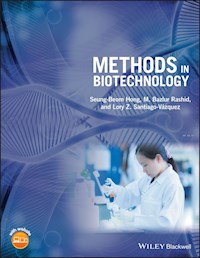
As rapid advances in biotechnology occur, there is a need for a pedagogical tool to aid current students and laboratory professionals in biotechnological methods; Methods in Biotechnology is an invaluable resource for those students and professionals.
Methods in Biotechnology engages the reader by implementing an active learning approach, provided advanced study questions, as well as pre- and post-lab questions for each lab protocol. These self-directed study sections encourage the reader to not just perform experiments but to engage with the material on a higher level, utilizing critical thinking and troubleshooting skills.
This text is broken into three sections based on level – Methods in Biotechnology, Advanced Methods in Biotechnology I, and Advanced Methods in Biotechnology II. Each section contains 14-22 lab exercises, with instructor notes in appendices as well as an answer guide as a part of the book companion site. This text will be an excellent resource for both students and laboratory professionals in the biotechnology field.Sie lesen das E-Book in den Legimi-Apps auf:
Seitenzahl: 1044
Veröffentlichungsjahr: 2016
Ähnliche



















Table of Contents
Cover
Title Page
Copyright
Preface
Acknowledgements
Introduction to biotechnology lab
Lab safety
Good work habits
Lab etiquette
Lab record
Lab report and assignment
Further reading
Laboratory Schedule (Methods in Biotechnology (MB))
Laboratory Schedule (Advanced Methods in Biotechnology (AMB) 1)
Laboratory Schedule (AMB 2)
About the companion website
Part I: Methods in Biotechnology (MB) Laboratory Exercises
Chapter 1: MB experiment 1: Lab measurements
Introduction
Pre-lab assignment
Materials and equipment
Procedure
Part I. Pipetting skill
Part II. Density and specific gravity
Procedure
Discussion
Post-lab assignment
Further reading
Chapter 2: MB experiment 2: Use of the spectrophotometer and Beer's law
Introduction
Pre-lab assignment
Materials and equipment
Procedure
Result
Discussion
Post-lab assignment
Further reading
Chapter 3: MB experiment 3: Making solutions and buffer efficacy
Introduction
Pre-lab assignment
Materials and equipment
Procedure
Part I. pH meter calibration
Part II. Making solutions (to share four groups)
Part III. Buffering capacity (addition of strong acid and strong base to buffered and unbuffered solutions)
Part IV. Dilution effect on buffer pH and buffer capacity
Discussion
Post-lab assignment
Further reading
Chapter 4: MB experiment 4: Acid–base titration
Introduction
Pre-lab assignment
Materials and equipment
Procedure
Part I. Two-point calibration of pH Meter
Part II. Titration of acetic acid with NaOH
Part III. Titration of HCl with NaOH
Part IV. Data integration
Discussion
Post-lab assignment
Further reading
Chapter 5: MB experiment 5: Protein denaturation and precipitation
Introduction
Pre-lab assignment
Materials and equipment
Procedure
Discussion
Post-lab assignment
Further reading
Chapter 6: MB experiment 6: Bacterial transformation
Introduction
Pre-lab assignment
Materials and equipment
Procedure (day 1)
Procedure (day 2)
Procedure (day 3)
Discussion
Post-lab assignment
Further reading
Chapter 7: MB experiment 7: GFP purification
Introduction
Pre-lab assignment
Materials and equipment
Procedure
Discussion
Further reading
Chapter 8: MB experiment 8: SDS-PAGE analysis
Introduction
Pre-lab assignment
Materials and equipment
Procedure
Discussion
Post-lab assignment
Further reading
Chapter 9: MB experiment 9: DNA isolation
Part I. Plasmid DNA isolation
Introduction
Pre-lab assignment
Materials and equipment
Procedure
Part I. Plasmid DNA isolation
Part II. Genomic DNA isolation
Introduction
Materials and equipment
Procedure
Result
Discussion
Post-lab assignment
Further reading
Chapter 10: MB experiment 10: PCR-based Alu-human DNA typing
Introduction
Pre-lab assignment
Materials and equipment
Procedure
Part E. Viewing and photography
Result
Discussion
Post-lab assignment
Further reading
Chapter 11: MB experiment 11: Restriction enzyme digestion
Introduction
Pre-lab assignment
Materials and equipment
Procedure
Chapter 12: MB experiment 12: Agarose gel electrophoresis
Introduction
Procedure
Result
Discussion
Post-lab assignment
Further reading
Chapter 13: MB experiment 13: Ouchterlony and ELISA immunoassays
Introduction
Pre-lab assignment
Materials and equipment
Procedure
Part I. Ouchterlony (double diffusion) assay
Part II. ELISA assay
Result
Discussion
Post-lab assignment
Further reading
Chapter 14: MB experiment 14: Testing plant substances for antimicrobial activity
Introduction
Pre-lab assignment
Materials and equipment
Procedure
Result
Discussion
Post-lab assignment
Further reading
Chapter 15: MB experiment 15: Peroxidase enzyme activity assay
Introduction
Pre-lab assignment
Materials and equipment
Procedure
Results
Discussion
Post-lab assignment
References
Part II: Advanced Methods in Biotechnology (AMB) 1 Laboratory Exercises
chapter 16: AMB 1 experiment 16: Aseptic technique and culture handling
Introduction
Pre-lab assignment
Materials and equipment
Procedure
Post-lab assignment
Further reading
chapter 17: AMB 1 experiment 17: Yeast culture media preparation
Introduction
Pre-lab assignment
Materials and equipment
Procedure
Post-lab assignment
Further reading
chapter 18: AMB 1 experiment 18: Growth curve
Introduction
Pre-lab assignment
Materials and equipment
Procedure
Post-lab assignment
Further reading
Chapter 19: AMB 1 experiment 19: Mini plasmid prep
Introduction
Pre-lab assignment
Materials and equipment
Procedure (adapted from QIAprep miniprep kit)
Post-lab assignment
Additional information
References
Further reading
Chapter 20: AMB 1 experiment 20: Restriction digestion, purification, concentration, and quantification of DNA
Introduction
Pre-lab assignment
Materials and equipment
Procedure
Post-lab assignment
Further reading
Chapter 21: AMB 1 experiment 21: Polymerase chain reaction (PCR)
Introduction
Pre-lab assignment
Materials and equipment
Procedure
Post-lab assignment
Additional background information
Further reading
Chapter 22: AMB 1 experiment 22: TA, blunt end, SLIC, and CPEC cloning of PCR product
Introduction
Pre-lab assignment
Materials and equipment
Procedure (day 1)
Procedure (day 2)
Post-lab assignment
Further reading
Chapter 23: AMB 1 experiment 23: One-step multifragment assembly cloning
Introduction
Pre-lab assignment
Materials and equipment
Procedure (day 1)
Procedure (day 2)
Procedure (day 3)
J. Screening of transformants
Post-lab assignment
References
Further reading
Chapter 24: AMB 1 experiment 24: Restriction enzyme digestion and fast agarose gel electrophoresis
Introduction
Pre-lab assignment
Materials and equipment
Procedure
Post-lab assignment
Additional background information
References
Further reading
chapter 25: AMB 1 experiment 25: Southern blot transfer
Introduction
Pre-lab assignment
Materials and equipment
Procedure (day 1)
Procedure (day 2)
Post-lab assignment
Reference
Further reading
Chapter 26: AMB 1 experiment 26: Probe labeling and purification
Introduction
Pre-lab assignment
Materials and equipment
Procedure
Post-lab assignment
Further reading
Chapter 27: AMB 1 experiment 27: Dot blot assay
Introduction
Pre-lab assignment
Materials and equipment
Procedure
Post-lab assignment
Further reading
Chapter 28: AMB 1 experiment 28: Pre-hybridization, hybridization, and detection
Introduction
Pre-lab assignment
Materials and equipment
Procedure
Post-lab assignment
Further reading
Chapter 29: AMB 1 experiment 29: Total yeast RNA isolation and RT-PCR
Introduction
Pre-lab assignment
Materials and equipment
Procedure (adapted from SV total isolation kit, Promega and verso one-step RT PCR Kit, Life technologies)
Post-lab assignment
References
Further reading
Chapter 30: AMB 1 experiment 30: Yeast-based in vivo recombination cloning
Introduction
Pre-lab assignment
Materials and equipment
Procedure
Part I. Isolation of overlapping DNA fragments (day 1)
Part II. Yeast transformation (day 2)
Further reading
Chapter 31: AMB 1 experiment 31: Plasmid DNA isolation from yeast
Introduction
Materials and equipment
Procedure
References
Chapter 32: AMB 1 experiment 32: E. coli transformation with yeast plasmid DNA
Introduction
Materials and equipment
Procedure
Post-lab assignment
Further reading
Chapter 33: AMB 1 experiment 33: X-gal filter lift assay
Introduction
Materials and equipment
Procedure
Post-lab assignment
Further reading
Chapter 34: AMB 1 experiment 34: Protein quantitation assay
Introduction
Part I. Bradford assay
Materials and equipment
Procedure
Part II. Lowry assay
Materials and equipment
Procedure
Part III. BCA assay
Material and equipment
Procedure
Post-lab assignment
Further reading
Chapter 35: AMB 1 experiment 35: Quantitative β-Galactosidase assay in yeast
Introduction
Pre-lab assignment
Materials and equipment
Procedure
Part I. Permeabilized cell assay
Part II. Cell-free protein extract assay
Post-lab assignment
Reference
Further reading
Chapter 36: AMB 1 experiment 36: Gel filtration chromatography (GFC)
Introduction
Pre-lab assignment
Materials and equipment
Procedure
Post-lab assignment
Further reading
Chapter 37: AMB 1 experiment 37: Ion exchange chromatography (IEC)
Background
Pre-lab assignment
Materials and equipment
Procedure
Post-lab assignment
Further reading
Part III: Advanced Methods in Biotechnology (AMB) 2 Laboratory Exercises
Chapter 38: AMB 2 experiment 38: E. coli culture media preparation
Introduction
Pre-lab assignment
Materials and equipment
Procedure
Post-lab assignment
Further reading
Chapter 39: AMB 2 experiment 39: Site-directed mutagenesis
Introduction
Pre-lab assignment
Materials and equipment
Procedure
Post-lab assignment
Further reading
Chapter 40: AMB 2 experiment 40: Protein expression in E. coli
Introduction
Pre-lab assignment
Materials and equipment
Procedure
Part I. Restriction sequence/ligation-dependent cloning
Part II. Restriction sequence/ligation-independent cloning)
Procedure
Post-lab assignment
Further reading
Chapter 41: AMB 2 experiment 41: Protein purification by affinity column chromatography
Introduction
Pre-lab assignment
Materials and equipment
Procedure
Part I. Protein expression and cell harvest (TA will do this part)
Part II. Cell lysate preparation and affinity column chromatography
Part III. Small-scale quick batch method (optional)
Post-lab assignment
Further reading
Chapter 42: AMB 2 experiment 42: SDS-PAGE analysis of affinity column fractions
Introduction
Pre-lab assignment
Materials and equipment
Procedure
Part I. Protein concentration and buffer exchange
Part II. Sodium dodecyl sulfate/poly acrylamide gel electrophoresis
Part III. Protein blotting on to protran® nitrocellulose membrane
Post-lab assignment
Reference
Further reading
Chapter 43: AMB 2 experiment 43: Western blot analysis of affinity column fractions
Introduction
Pre-lab assignment
Materials and equipment
Procedure
Part I. Blot transfer (day 1)
Part II. Antibody detection (day 2)
Post-lab assignment
Further reading
Chapter 44: AMB 2 experiment 44: Yeast media preparation and phenotypic analysis of yeast strains
Introduction
Pre-lab assignment
Materials and equipment
Procedure
Part I. Media preparation
Part II. Single colony isolation (quadrant streaking)
Part III. Phenotype Verification
Discussion
Post-lab assignment
Further reading
Chapter 45: AMB 2 experiment 45: Yeast transformation for yeast two-hybrid (Y2H) assay and genome editing by CRISPR-Cas system
Introduction
Pre-lab assignment
Materials and equipment
Procedure
Part I. LiAc-mediated transformation for Y2H assay
Part II. LiAc-mediated transformation for genome editing
Post-lab assignment
References
Further reading
Chapter 46: AMB 2 experiment 46: Yeast mating-mediated Y2H assay and genomic PCR
Introduction
Pre-lab assignment
Materials and equipment
Procedure
Part I. Y2H assay
Part II. Yeast genomic PCR
Post-lab assignment
Further reading
Chapter 47: AMB 2 experiment 47: Yeast colony PCR screening and cycle DNA sequencing
Introduction
Pre-lab assignment
Materials and equipment
Procedure
Part I. Yeast colony PCR
Part II. Cycle sequencing
Post-lab assignment
Further reading
Chapter 48: AMB 2 experiment 48: DNA sequencing electrophoresis
Introduction
Pre-lab assignment
Materials and equipment
Procedure
Part I. Clean-up of DNA sequencing samples
Part II. Capillary electrophoresis using ABI 3500xL DNA analyzer
Part III. Review sequencing results
Part IV. Editing chromatogram sequence and exporting sequence data
Part V. Data analysis using multiple sequence alignment program clustal omega
Post-lab assignment
Further reading
Chapter 49: AMB 2 experiment 49: RNA interference
Introduction
Pre-lab assignment
Materials and equipment
Procedure (day 1)
Part I. LiAc-mediated transformation
Procedure (day 2)
Part II. Growth test
Post-lab assignment
Reference
Further reading
Chapter 50: AMB 2 experiment 50: Protein preparation for 2D gel electrophoresis
Introduction
Pre-lab assignment
Materials and equipment
Procedure
Post-lab assignment
Further reading
Chapter 51: AMB 2 experiment 51: Two-dimensional gel electrophoresis
Introduction
Pre-lab assignment
Materials and equipment
Procedure (Day 1)
Part I. Rehydration of IPG DryStrip (instructor will do this part)
Procedure (day 2)
Part II. Rehydration of proteins
Part III. First dimension (IEF)
Procedure (Day 3)
Part IV. Preparation of buffers and chemicals
Part V. Equilibration of IPG strips
Part VI. Second dimension (SDS-PAGE)
Post-lab assignment
Further reading
Part IV: Appendices
Methods in Biotechnology Appendix 1
Instructor notes of MB experiment 1
Instructor notes of MB experiment 2
Instructor notes of MB experiment 3
Instructor notes of MB experiment 4
Instructor notes of MB experiment 5
Instructor notes of MB experiment 6
Instructor notes of MB experiment 7
Instructor notes of MB experiment 8
Instructor notes of MB experiment 9
Instructor notes of MB experiments 10, 11, and 12
Instructor notes of MB experiment 13
Instructor notes of MB experiments 14 and 15
MB Appendix 2
MB lab math practice problem set
MB Appendix 3
Answers to MB lab math practice problem set
MB Appendix 4
Commonly used buffer tables (MB)
0.1 M tris buffer
1 M tris buffer
0.1 M acetate buffer
0.1 M phosphate buffer
AMB 1 Appendix 1
Instructor notes of AMB 1 experiments 16 and 17
Instructor notes of AMB 1 experiments 18 and 19
Instructor notes of AMB 1 experiments 20 and 21
Instructor notes of AMB 1 experiment 22
Instructor notes of AMB 1 experiment 23
Instructor's notes of AMB 1 experiments 23.I, 24, 25, and 26
Instructor notes of AMB 1 experiments 27 and 28.A and B
Instructor notes of AMB 1 experiments 28.C and 30.A and B
Instructor notes of AMB 1 experiment 29
Instructor notes of AMB 1 experiments 30. C and D, 31, and 32
Instructor notes of AMB 1 experiments 33 and 34
Instructor notes of AMB 1 experiment 35
Instructor notes of AMB 1 experiments 36 and 37
AMB 1 Appendix 2
AMB 1 Lab math practice problem set
AMB 1 Appendix 3
Answers to AMB 1 Lab math practice problem set
Part I. Metric unit conversion
Part II. Dilution
Part III. Percent solution
Part IV. Ratio and proportions
Part V. Mole and molarity
Part VI. Applications
AMB 1 Appendix 4
Band Quantification by ImageJ Program
AMB 1 Appendix 5
Distributor addresses
AMB 2 Appendix 1
Instructor notes of AMB 2 experiment 38
Common materials and equipment
Instructor notes of AMB 2 experiment 39
Instructor notes of AMB 2 experiment 40
Instructor notes of AMB 2 experiment 41
Instructor notes of AMB 2 experiments 42 and 43A
Instructor notes of AMB 2 experiment 43.B and 44
Instructor notes of AMB 2 experiment 45
Instructor notes of AMB 2 experiment 46
Instructor notes of AMB 2 experiment 47
Instructor notes of AMB 2 experiments 48 and 49
Instructor notes of AMB 2 experiment 50
Instructor notes of AMB 2 experiment 51
AMB 2 Appendix 2
AMB 2 Lab math practice problem set
AMB 2 Appendix 3
Answers to AMB 2 Lab math practice problem set
AMB 2 Appendix 4
Colony counting with ImageJ program
AMB 2 Appendix 5
Bacteria and yeast genetic nomenclature
Further reading
AMB 2 Appendix 6
Plasmid maps
AMB 2 Appendix 7
Distributor addresses
Glossary
Abbreviations
Index
End User License Agreement
Pages
vii
ix
xi
xii
xiii
xiv
xv
xvi
xvii
xviii
xix
1
3
4
5
6
7
9
10
11
12
15
16
17
18
19
20
21
22
23
25
26
27
28
29
30
31
32
33
34
35
37
38
39
41
42
43
44
45
46
47
48
49
50
51
52
53
54
55
57
58
59
60
63
64
65
67
68
69
70
70
73
74
75
77
78
79
80
81
83
84
85
86
87
88
89
90
91
92
93
94
95
96
97
98
99
100
101
102
103
104
105
106
107
108
109
111
112
113
114
117
118
119
121
122
123
125
126
127
128
129
131
132
133
134
135
136
137
139
140
141
142
143
144
145
146
147
148
149
150
151
152
153
155
156
157
158
159
161
162
163
164
165
166
167
169
171
172
173
175
176
177
178
179
180
181
182
183
184
185
186
187
188
189
190
191
192
193
194
195
196
197
199
200
201
202
203
203
204
205
206
207
209
210
211
212
213
215
216
217
218
219
221
222
223
224
225
227
228
229
230
231
232
233
234
235
237
238
239
240
241
242
243
244
245
246
247
248
249
250
251
252
252
255
256
257
258
259
260
261
262
263
265
266
267
268
269
271
272
273
274
275
276
277
278
279
280
281
282
283
284
285
286
287
288
289
290
291
292
293
294
295
297
299
300
301
302
303
304
305
306
307
308
309
310
311
313
314
315
316
317
319
320
321
322
323
325
330
335
336
337
338
Guide
Cover
Table of Contents
Preface
Part I: Methods in Biotechnology (MB) Laboratory Exercises
Begin Reading
Methods in Biotechnology
Seung-Beom Hong
M. Bazlur Rashid
Lory Z. Santiago-Vázquez
Copyright © 2017 by John Wiley & Sons, Inc. All rights reserved
Published by John Wiley & Sons, Inc., Hoboken, New Jersey
Published simultaneously in Canada
No part of this publication may be reproduced, stored in a retrieval system, or transmitted in any form or by any means, electronic, mechanical, photocopying, recording, scanning, or otherwise, except as permitted under Section 107 or 108 of the 1976 United States Copyright Act, without either the prior written permission of the Publisher, or authorization through payment of the appropriate per-copy fee to the Copyright Clearance Center, Inc., 222 Rosewood Drive, Danvers, MA 01923, (978) 750-8400, fax (978) 750-4470, or on the web at www.copyright.com. Requests to the Publisher for permission should be addressed to the Permissions Department, John Wiley & Sons, Inc., 111 River Street, Hoboken, NJ 07030, (201) 748-6011, fax (201) 748-6008, or online at http://www.wiley.com/go/permission.
Limit of Liability/Disclaimer of Warranty: While the publisher and author have used their best efforts in preparing this book, they make no representations or warranties with respect to the accuracy or completeness of the contents of this book and specifically disclaim any implied warranties of merchantability or fitness for a particular purpose. No warranty may be created or extended by sales representatives or written sales materials. The advice and strategies contained herein may not be suitable for your situation. You should consult with a professional where appropriate. Neither the publisher nor author shall be liable for any loss of profit or any other commercial damages, including but not limited to special, incidental, consequential, or other damages.
For general information on our other products and services or for technical support, please contact our Customer Care Department within the United States at (800) 762-2974, outside the United States at (317) 572-3993 or fax (317) 572-4002.
Wiley also publishes its books in a variety of electronic formats. Some content that appears in print may not be available in electronic formats. For more information about Wiley products, visit our web site at www.wiley.com.
Library of Congress Cataloging-in-Publication Data applied for.
Cover image: Courtesy of freedigitalphotos.net
Preface
Biotechnology is one of the fastest growing fields of science and industry and is proving to be very promising in the twenty-first century, going along with new advances in automated instrumentation and the emerging synergy among genomics, transcriptomics, proteomics, metabolomics, and bioinformatics. New products based on discoveries through research and development continue to transform the way we live. Because biotechnology makes use of living organisms or their products for the benefit of humans and the environment, it has several subdisciplines depending on the type of research organism or system being studied. Whatever the source organism or system, it remains an experimental science where most basic and applied researches are performed in the laboratory until they are translated into commercial or publishable products approved by regulatory agencies. It is therefore vital that students of future biotech scientists become familiar with the up-to-date experimental methods, experimental designs, and data analyses. Employers, both in industry and academia, have a preference for a qualified workforce with good hands-on laboratory experience and who can work together as part of a team with good critical thinking complemented by good communication skills. This course is designed to address such transferable knowledge, skills, and ability by adopting an inquiry-based self-directed active learning approach to the laboratory-intensive course.
This manual is based on a 15-week semester schedule with a four-hour laboratory session per week. However, it also can be used for a 10-week quarter schedule by selecting appropriate lab exercises at the discretion of instructors. The lab exercises were developed for the core graduate curriculum of the Biotechnology Program at the University of Houston Clear Lake. Students take three biotechnology core laboratory courses, named Methods in Biotechnology (MB) and Advanced Methods in Biotechnology (AMB) 1 and 2. The MB course is a prerequisite to two other AMB 1 and 2 courses. Each lab or more than one lab exercise can be finished within four hours. We offered this laboratory course in the afternoon or evening so that the instructor can begin incubation in the morning to prepare cultures and other laboratory materials. The course content can be tailored to suit the need of the individual instructor. Throughout the experiments, time-saving procedures were implemented in order to complete them within the time period, though students often need to observe results and collect data after overnight or several days of incubation to check their plates. Although we have successfully used protocols in laboratory exercises, we do not claim that they are flawless. They may need modifications in response to new technological innovations and some other changing needs.
Study assignments (pre-lab and post-lab questions) are listed in each lab protocol to help students prepare for each laboratory session and apply knowledge to solve its related problems. This self-directed study will encourage students to extend their knowledge from simply performing experiments to a higher level of critical thinking and troubleshooting. The purpose of each experiment is also intentionally not given to promote the student thinking. It is important that students prepare in advance so that they can clearly understand the protocols and concepts while they are doing the experiments. Lack of preparation will increase the time spent performing experiments as well as the chances of making careless mistakes. We have experienced the difference between prepared and unprepared student groups in terms of the time they spend completing the exercises successfully. Data tables are provided to aid in data collection and step-by-step procedures for data analysis are described in detail.
Throughout the lab exercises we have used the two most widely used model organisms, Escherichia coli and Saccharomyces cerevisiae, because not only are they much easier and safer to handle compared to other organisms but they are also applicable to diverse cellular and molecular biology experiments. The concept and principle underlying each experiment are explained in the introduction part, and sometimes additional background information on specific details is provided at the end of a protocol. In order to understand how an experiment works, it is important to know what materials and equipment are used. The reagents and microbiological strains required for each experiment are listed at the beginning of each experiment. We often mentioned specific brand names of reagents because we have had satisfactory experiences with those products; however, comparable products from competitor companies can also be used, allowing the users to work within their budget or personal preferences.
To facilitate preparedness and instruction of this course, we have provided detailed notes for instructors in Appendix 1 sections. We also have included laboratory schedules outlining the individual experiments we have performed in each lab session. This requires very labor-intensive teaching and supervision. It is a great advantage to both the prospective employers and students if the students learn as much as possible before entering the workforce. The schedules will be helpful, especially when instructors want to choose certain experiments tailored to their own needs at their discretion. In Appendix 2 sections, we have included a lab math practice problem set for the students to master laboratory mathematics skills because these skills are crucial for success in experiments conducted by technicians and bench scientists.
Acknowledgements
The authors express their gratitude to the reviewers: Dr. Om V. Singh at the University of Pittsburgh, Dr. Stephen C. Kempf at Auburn University, and Dr. Kathleen M. Susman at Vassar College. We also express our gratitude to the editors of John Wiley & Sons, Dr. Gregor Chicchetti, Senior Commissioning Editor; Mindy Okura-Marszycki, Senior Acquisitions Editor; and Stephanie Dollan, Senior Editorial Assistant for reviewing process. We greatly appreciate Dorathy Steve who managed to coordinate all the schedules in time throughout the publishing process and Patricia Bateson, who read every word of the text, for editing process.
Although we do not endorse the particular products of any company over others, we are grateful to the Agilent Technologies, Thermo Fisher Scientific, GE Healthcare Bio-Sciences, Takara-Clontech Laboratories, and New England BioLabs companies that allowed us to use their photo images and illustrations related to the materials used for laboratory exercises.
The development of this course would not have been possible without the undivided support from Dr. Larry H. Rode, Division Chair for Natural Sciences at the University of Houston Clear Lake. We especially thank Dr. Stephens Brian for editing equipment operation protocols and teaching assistants and staffs at UHCL Department of Biotechnology who helped make this course work run smoothly in a timely manner.
Introduction to biotechnology lab
To work in biotechnology requires you to perform experiments using a variety of biochemicals, tools, and instruments and record your result data. The quality of work is more important than the quantity of work to generate a reliable and acceptable product of new findings as a result of scientific research experiments. Regardless of the work environment, attention to detail is particularly important to work in a professional manner for carrying out procedures using necessary equipment and instruments correctly. During this process, you must also keep to safety rules that deal with potential risks and hazards associated with output and input materials of each experiment. Lab safety influences lab productivity because quality work is highly dependent on both safe performance and health status of workers. Unsafe performance or operational activity is a leading cause of the loss of or damage to laboratory resources. Perhaps one of the most important elements of Good Laboratory Practice (GLP) is the accurate documentation of written records. However, injuries or illness caused by neglecting precautionary safety measures will in turn have a negative impact on the investigator's mental and physical activities for written records. Safety should be a priority always regardless of the experiment. Because science is a very human activity, workers should maintain the integrity in conducting experiments and reporting scientific findings. Accordingly, you should familiarize yourself with safety issues and take necessary measures to prevent work-related injuries and incidents. In addition, you should also practice good work habits along with lab etiquette to promote a cheerful and productive working atmosphere. The compiled lists of lab safety, good work habits, lab etiquette, and record keeping guidelines, which are routinely practiced by skilled workers, are described in the following pages.
Lesen Sie weiter in der vollständigen Ausgabe!
Lesen Sie weiter in der vollständigen Ausgabe!
Lesen Sie weiter in der vollständigen Ausgabe!
Lesen Sie weiter in der vollständigen Ausgabe!
Lesen Sie weiter in der vollständigen Ausgabe!
Lesen Sie weiter in der vollständigen Ausgabe!
Lesen Sie weiter in der vollständigen Ausgabe!
Lesen Sie weiter in der vollständigen Ausgabe!
Lesen Sie weiter in der vollständigen Ausgabe!
Lesen Sie weiter in der vollständigen Ausgabe!
Lesen Sie weiter in der vollständigen Ausgabe!
Lesen Sie weiter in der vollständigen Ausgabe!
Lesen Sie weiter in der vollständigen Ausgabe!
Lesen Sie weiter in der vollständigen Ausgabe!
Lesen Sie weiter in der vollständigen Ausgabe!
Lesen Sie weiter in der vollständigen Ausgabe!
Lesen Sie weiter in der vollständigen Ausgabe!
Lesen Sie weiter in der vollständigen Ausgabe!
Lesen Sie weiter in der vollständigen Ausgabe!
Lesen Sie weiter in der vollständigen Ausgabe!
Lesen Sie weiter in der vollständigen Ausgabe!
Lesen Sie weiter in der vollständigen Ausgabe!
Lesen Sie weiter in der vollständigen Ausgabe!
Lesen Sie weiter in der vollständigen Ausgabe!
Lesen Sie weiter in der vollständigen Ausgabe!
Lesen Sie weiter in der vollständigen Ausgabe!
Lesen Sie weiter in der vollständigen Ausgabe!
Lesen Sie weiter in der vollständigen Ausgabe!
Lesen Sie weiter in der vollständigen Ausgabe!
Lesen Sie weiter in der vollständigen Ausgabe!
Lesen Sie weiter in der vollständigen Ausgabe!
Lesen Sie weiter in der vollständigen Ausgabe!
Lesen Sie weiter in der vollständigen Ausgabe!
Lesen Sie weiter in der vollständigen Ausgabe!
Lesen Sie weiter in der vollständigen Ausgabe!
Lesen Sie weiter in der vollständigen Ausgabe!
Lesen Sie weiter in der vollständigen Ausgabe!
Lesen Sie weiter in der vollständigen Ausgabe!
Lesen Sie weiter in der vollständigen Ausgabe!
Lesen Sie weiter in der vollständigen Ausgabe!
Lesen Sie weiter in der vollständigen Ausgabe!
Lesen Sie weiter in der vollständigen Ausgabe!
Lesen Sie weiter in der vollständigen Ausgabe!
Lesen Sie weiter in der vollständigen Ausgabe!
Lesen Sie weiter in der vollständigen Ausgabe!
Lesen Sie weiter in der vollständigen Ausgabe!
Lesen Sie weiter in der vollständigen Ausgabe!
Lesen Sie weiter in der vollständigen Ausgabe!
Lesen Sie weiter in der vollständigen Ausgabe!
Lesen Sie weiter in der vollständigen Ausgabe!
Lesen Sie weiter in der vollständigen Ausgabe!
Lesen Sie weiter in der vollständigen Ausgabe!
Lesen Sie weiter in der vollständigen Ausgabe!
Lesen Sie weiter in der vollständigen Ausgabe!
Lesen Sie weiter in der vollständigen Ausgabe!
Lesen Sie weiter in der vollständigen Ausgabe!
Lesen Sie weiter in der vollständigen Ausgabe!
Lesen Sie weiter in der vollständigen Ausgabe!
Lesen Sie weiter in der vollständigen Ausgabe!
Lesen Sie weiter in der vollständigen Ausgabe!
Lesen Sie weiter in der vollständigen Ausgabe!
Lesen Sie weiter in der vollständigen Ausgabe!
Lesen Sie weiter in der vollständigen Ausgabe!
Lesen Sie weiter in der vollständigen Ausgabe!
Lesen Sie weiter in der vollständigen Ausgabe!
Lesen Sie weiter in der vollständigen Ausgabe!
Lesen Sie weiter in der vollständigen Ausgabe!
Lesen Sie weiter in der vollständigen Ausgabe!
Lesen Sie weiter in der vollständigen Ausgabe!
Lesen Sie weiter in der vollständigen Ausgabe!
Lesen Sie weiter in der vollständigen Ausgabe!
Lesen Sie weiter in der vollständigen Ausgabe!
Lesen Sie weiter in der vollständigen Ausgabe!
Lesen Sie weiter in der vollständigen Ausgabe!
Lesen Sie weiter in der vollständigen Ausgabe!
Lesen Sie weiter in der vollständigen Ausgabe!




