


Erhalten Sie Zugang zu diesem und mehr als 300000 Büchern ab EUR 5,99 monatlich.
- Herausgeber: The Lilliput Press
- Kategorie: Gesellschafts- und Liebesromane
- Sprache: Englisch
From award-winning author Adrian Duncan comes his first collection of astonishing short stories. These modern stories have been written over the past decade, half having been previously published in The Moth, The Stinging Fly, Dublin Review and elsewhere, half completely new. Patterning and happenstance make up the rich quotidian lives of the characters portrayed in these strange, energetic tales. The loose figures of young artists, footballers and artisan engineers act out against diverse backgrounds from Dublin's northside to Hamburg, Abu Dhabi and Accra, lives tethered yet adrift in a random universe of hard scrabble and occasional illumination. The prose is spare, precise and imagistic, the humour dark and absurdist, shot through with an underlying humanity that has become the trademark of this remarkable writer. Taking inspiration from his childhood fascination with football team formations, Duncan arranges this collection with an eye to how each piece interacts with the others: 'While looking at a starting eleven and imagining the team's possible patterns of movement on the field of play, one question always prevails: What is behind all of this?' With two novels and one short story collection published in the same number of years, the Lilliput Press is proud to present this new collection as Adrian Duncan quickly gains international attention. Recently winning the inaugural John McGahern Annual Book Prize and being shortlisted for the inaugural Dalkey Literary Award for Emerging Writer, Duncan's prowess grows with each work. Edge Hill Short Story Prize 2021 Longlist.
Sie lesen das E-Book in den Legimi-Apps auf:
Seitenzahl: 165
Veröffentlichungsjahr: 2021
Das E-Book (TTS) können Sie hören im Abo „Legimi Premium” in Legimi-Apps auf:
Ähnliche

















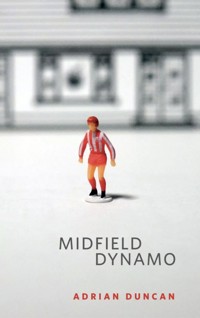
midfield dynamo
ADRIAN DUNCAN
the lilliput press
dublin
To Niamh
Praise forA SABBATICAL IN LEIPZIG
‘A book such as W.G. Sebald might have written, had he been an Irish engineer. In precise and penetrating prose, this novel probes memory and absence … A quietly compelling work from a writer of real daring and poise.’
VONA GROARKE
‘By turns poetic and forensic, exuberant and melancholy. At all times it is an entirely riveting, deeply felt musing on intimacy, loneliness and the nature of perception itself.’
SUE RAINSFORD
‘There’s a painstaking precision to the word and design of this book. Yet from such precision comes art. … Slow, affecting and beautiful.’
NIAMH DONNELLY,Irish Times
‘What I enjoyed so much about this beautiful, pensive book is how it made me look at the world differently.’
JUSTINE CARBERY,The Sunday Independent
‘An entrancing read, one laced with despair, regret and tranquility … It will be hard to forget this examination of time.’
ADAM MATTHEWS,RTÉ Culture
Praise forLOVE NOTES FROM A GERMAN BUILDING SITE
‘The best book I have read in years … a perfect depiction of love, and of desire and struggle.’
GREG BAXTER
‘With elegance and precision, this beautiful book shows the forces that act on the structures of buildings and those that impact on relationships. Duncan’s Berlin building site is, perhaps surprisingly, a brilliantly compelling place: the complications of construction converging with the complex experiences of those who work there.’
WENDY ERSKINE
‘A strange, oblique, haunted work of quiet meditative intelligence. Adrian Duncan evokes the building of cities and the dislocated, phantasmal lives that unfold amid their looming geometries. His debut novel contains some of the finest writing on love I’ve read in recent memory.’
ROB DOYLE
‘... a reflective, beautifully paced novel’
SARAH GILMARTIN,Irish Times
‘If more men thought and wrote as tenderly and honestly, we’d have stronger, sturdier novels and fewer garish monuments to consumerism.’
DAVID O’CONNOR,The Sunday Independent
Note to reader
The stories in this book are arranged into a starting eleven and a coach. I chose a field position for each story based on the personality I perceived from it. This layout helped me to visualize the book’s elements, structure and possible patterns.
My team formation is the somewhat old-fashioned: 1-4-4-2. I’ve decided, also, to stay true to its numbering system, which is not altogether straightforward. For example, the left winger is given the number 11, one of the central midfielders is given the number 4 and one of the centre-halves has been numbered 6 …
This layout, however, is not to suggest there is a preferred order for reading these stories. All I am hoping to say in describing my method is that this particular arrangement of stories is the one I most trust.
Kalugin fell asleep and had a dream: He’s sitting in some bushes and a policeman is walking by.
Kalugin woke up, scratched around his mouth and fell asleep again, and again he had a dream: He’s walking by the bushes, and in the bushes sits a policeman, hiding.
– ‘A Dream’, Daniil Kharms, from Today I Wrote Nothing
DEFENCE
1. Design No. 108
When we were very young my brother and I used to stand in front of the window of our sitting room and peer out at the world. Our house, I should say, is pure Bungalow Bliss, straight from the book, design number 108, ‘The Hazels’. Except for one tiny difference: the builders got the front living-room window all wrong. It is massive.
One night when my parents went out drinking all over town, a storm blew in. The wind grew to a thunderous roar. My brother and I looked out through the wobbling single-glazed window and we held each other tight. With one particular gust, the pane of glass bulged and burst in upon us. A whole world of dust, leaf, branch and tree surged in and gathered us up in a confounding swirl, wherein I could see my brother being hurled towards a mirror. He hit it head first then he fell to the floor, as did I. I clambered over to him and shouted through the gale:
‘Are you serious, sir?’
He looked blankly back at me. A large shard of glass protruded from his cheek. I removed the glass, dragged him to the kitchen, closed all of the doors, pulled him onto the table, grabbed my father’s chloroform cloth, knocked my brother out and operated on him. I cleaned the blood from his face, stitched his cheek together, rubbed saltwater into the wounds and left him there to rest.
Days later, with the wind still bellowing around our sitting room, I roused my brother and we left through the back door of our house into a calm and sunny autumnal day. We ran to the museum where we usually found our parents after their binges, my father passed out on the steps and my mother sitting bolt upright. My mother gathered my brother and I up into her bosom and held us close.
Many years from now, I will sit at my lamp-lit study desk and notice a large red blot of ink in my ledger – a blot absent-mindedly made with an old bingo marker unearthed from a box, after I had moved house, at the end of a lifetime of many painful divorces – and I will think of my dear brother’s face.
•
When we were very young my brother and I used to stand in front of the window of our sitting room and peer out at the world. Our house, I should say, is pure Bungalow Bliss, straight from the book, design number 108, ‘The Hazels’. Except for one tiny difference: the builders got the split-level floor joists all wrong.
My father, a builder and salt merchant, once came close to complete ruin. After many visits from a young bank manager whose manner was kind, my father was forced to sell his warehouses by the sea, his residential properties, all of his trucks, vans and lorries and most of his salt stock. What was left of the stock was deposited, one morning, outside of our house and covered over with a sheet of white plastic. My father spent four months in bed. The autumn day he chose to re-enter the world was so clear that I was sure he would cry when he saw it. But he simply sat at the kitchen table and drank a cup of steaming coffee, in a strange, deliberate manner. Eventually he called the family to the table and said:
‘That, out there, under that tarpaulin, is all I have left.’
We turned and looked at the white quaking mound.
‘Underneath that sheet of plastic is three tonnes of salt brick,’ he said, ‘and,’ he said, ‘we must get it indoors before the winter comes.’
The three tonnes of salt were stacked on the upper part of our split-level home where the builders had built the joists incorrectly. And, some creaking weeks later, the whole ziggurat of salt and timber and nail and dust came clattering down, crushing my dear brother, my mother and me. As for my father? I have no way of telling what he did next or where he went.
•
When we were very young my brother and I used to stand in front of the window of our sitting room and peer out at the world. Our house, I should say, is pure BungalowBliss, straight from the book, design number 108, ‘The Hazels’. Except for one tiny difference: the builders, unpaid for weeks, decided to construct it with substandard blocks.
When my father noticed cracks all over the house he invited an engineer to carry out a survey. The engineer found the walls had been built with cavity blocks cast with a large percentage of salt in them, and were ‘criminally substandard’.
Armed with this report my father and his solicitor tracked down the builders, and threatened to sue them ‘into the ground’. They agreed to reconstruct the walls of the house inside the existing walls of salt block. I remember the hammering and churning and cursing and smoking around our abode, the strange men, their smells, their breath, their rough hands, the close quarters. The foreman on this job was handsome, and over the course of this rebuild my mother’s appearance and manner changed. You don’t need me to describe her lingering around the site, the flirting, the predictable exposure, the schism, the confusion, the unfinished walls of our house and my father’s flight to the sea, his moon-glimmered thrashing, flailing, roaring, gulping, etc.
•
When we were very young my brother and I used to stand in front of the window of our sitting room and peer out at the world. He would lean forward, touch the window with his fingers and then count from one to one hundred – over and over again, as if by doing so he could make the window disappear.
I would ask him to stop. He would ignore me; then we would fight like small beasts until one of us bled.
‘How is this sore for you?’ the victor would cry. ‘Tell me now: how is this sore for you?’
•
When we were very young my brother and I used to stand in front of the window of our sitting room and peer out at the world. Our house, I should say, is pure Bungalow Bliss, straight from the book, design number 108, ‘The Hazels’. Each Saturday morning my brother, barefoot, would take to the roof, and I to the attic. He would lasso around the chimney pot a harness he had fashioned of rope and tyre tubing. Meanwhile, just below in the attic, I would sit and listen, and my mother beneath in the sitting room would kneel at the hearth and begin building the house fire. My brother would begin abseiling around the chimney, it by now issuing skyward spirals of smoke from the fire in the hearth of the sitting room below. Round and round my brother would go thud thud thudding upon the clay tiles. He, this great centrifugal god of the skies, while I, in the attic, listened. I watched the tiny haphazard dumps of dust falling down from the battens, felt and trusses each time his feet struck the roof – until these puffs of dust settled, all of them, in little piles upon the boards of the attic floor, among the toys and tat and rubbish. Then I would hear my brother sitting on the ridge tiles breathing heavily, and my mother would call up at me through the oblong of light in the floor of the attic, telling me I should come down for breakfast. I’d hear her go outside and call my brother down, but he would just tell her to ‘do one’.
One winter’s morning, the whole place crusted with frost, my brother’s harness gave way and he slipped from the roof. For a moment he was exorbitant, untethered from the sky and the earth, until he landed in the yard on his head. He slept for ten months. On the afternoon he woke, he leaned over to one side of his bed and threw up into a gleaming metal bucket endless – thunderous – strings of blood-yellow bile. Then he lay back, closed his eyes and smiled, and the autumn sun, shafting across the galaxies of boiling dust, through the hospital blinds and onto his red glistening lips, bounced and finally came to rest upon the backs of my gaping eyes.
My brother then sat up and announced to us all that he could no longer smell anything, and that whatever invisible filament of connection to the world we all enjoyed, he no longer had it, or wanted it, and, he said, that he felt sorry for us all still so bound to the very things we wished to flee.
2. Houses by the Sea
My brother owns a second home by the sea. When I go there, I run most mornings along the beach; it curves for a mile or so until it comes to a small peninsula of black sea-slick crags.
One morning it was grey, misty and still. The waves broke and ran listlessly. It had not been raining, but the whole place was wet, as if a low-flying cloud had grazed along the coast and forgotten a piece of itself before it was pushed up over the mountains. On my way back I saw a piebald cow stuck knee-deep in the surf. It was struggling and looked as if it might topple at any moment. I chased over and tried to lead it out of the water, but it didn’t want to go. I stood looking at it for a while, it looking calmly back at me. When its breathing eased I tried once more. I urged it back up the strand to the dunes, then onto some grass where the other cows were grazing.
As I walked back to the house, I looked over my shoulder and saw the cow again, shitting and lumbering back down towards the sea. I continued on a few steps, then turned and ran back. I stood in front of the cow, cajoling it back up the strand. We slowly zigzagged our way across the beach, back down once more towards the surf – me shooing, the cow changing direction – until I found myself stomach-deep in water and leaning against this animal’s dark heaving chest. Then it pushed me over; I was submerged and sea-deafened. By the time I scrambled back to my feet, it was past me and almost up to its neck in water. I stood there shivering, with the waves breaking across me, and watched it disappear.
My brother’s place, that he almost never uses, is on a hill outside a small coastal town. I come here to get away from my bedsit in the city. I left my wife a few years back for another woman. She and I then split soon after and she went back to her husband and two sons. I now find this part of the country hospitable. On the ragged strip of road that leads up to the house there are a number of other decrepit black-windowed bungalows, plopped hodge-podge down the hill.
In the town, which is probably more a village, there are two big hotels, a harbour, a shop and no pubs, so when I come here I call around to a guy called Leonard for a drink. He was once a priest, well educated, theology, history, that sort of thing – a PhD and a Master’s degree from the Sorbonne and Leiden, he told me. He’s a decent guy, but he has completely given up. His wife passed away three years ago in their holiday home after she had been sick for a while. And he can’t leave. First time I met him was by his front hedge; I was out for a walk and we began talking. He asked me in for a cup of coffee, six times. We ended up drinking whiskey and conversing all day.
It has been a few months since I’ve been here; so after I get back to the house and take a shower, I call up to him with a paper-bagged bottle of Jameson under my arm.
When he comes to the door, he looks at me for a moment and says, ‘Finn.’ It’s almost a question.
‘Leonard.’
He looks awful. His white hair has thinned, and his narrow face looks longer and somehow more drawn – as if, since I’ve last seen him, he has been hanging tiny weights from his skin.
‘Come in,’ he says.
The house is on the cusp of being left to waste. It certainly hasn’t been cleaned, maybe since I last saw him. The corridor is poorly lit. The rooms off it are dark too. The pale carpet is worn and there is a smell of animal about the place.
We sit in his fluorescently lit kitchen and he makes us coffee.
‘Good to see you,’ he says, ‘I was hoping you’d call up.’
I sit back into my chair and look around the kitchen listening to the thrum of the electrics, and the whoop of the sea wind outside.
‘I wonder could you look at the house?’ he says.
‘Sure,’ I say. ‘Why?’
‘Structurally,’ he says, ‘my solicitor tells me, to sell this place I need a certificate of compliance; I thought you wouldn’t mind.’
‘I can do that.’
He stirs his coffee gently, before taking another mouthful. Then he pushes the cup to one side and we open the whiskey and start to drink.
I tell him about the cow.
Many hours later, I wake up on the sofa in Leonard’s sitting room. He has passed out and is breathing clumsily on the chair across from me. That glowing blue darkness you get just before dawn is everywhere, suggesting the shape of everything. We, glasses in hands, look like a couple of narcoleptics who dropped off mid-sentence. I lie back and close my eyes.
When I was much younger, twenty-two or so, I lived in the north of England for a number of years. I met a woman one night – she would have been over forty. We got drunk and went back to her place. She was rich, in that her parents were. In her bedroom she had a JD Fergusson portrait, depicting a dark-haired woman in a Parisian café. I loved that pink painting. This woman and I fucked each other all night. Next afternoon I hobbled home, empty. Every Friday night after that I’d get a call from her. She’d be drunk and ask me over. I’d always say I had no money – which was mostly true – and couldn’t get across town. She’d say that she would take care of it. So when I’d roll up at her house in a taxi, she’d come out and pay, like she was my mother, then I’d go inside and fuck her in a cold way. She is the only woman I can say with certainty that I have ever satisfied.
Around this time I was drinking every weekend, to the point where I would black out on large chunks of the night. It was as if, when I was drinking, I would not ground myself. I would allow nothing to adhere.
I am awake again. It is morning and Leonard is standing over me.
‘Finn,’ he says, ‘Finn.’
I rise and follow Leonard to the kitchen where we have a cup of tea and some toast. He reminds me of the survey. We finish our breakfast and, as we walk around the bungalow documenting cracks, I assure him there is no subsidence serious enough to compromise the sale. We enter the room where his wife spent her last few months. A neatly made single bed sits along the gable wall and the curtains are pulled. Around the room images of Catholic icons and rosary beads dangle from timber ledges holding various discoloured bottles of holy water. I scan the room for defects, make some notes and we leave.
In the hallway he pulls a folding stairs down from the attic and we clamber up to look at the trusses. The space is cold but dry, and the fibrewool between the trusses shines under the glow of a single bulb. From somewhere behind Leonard I can hear the gurgle of a water tank. As we hunker in among the criss-crossing roof struts, I feel like we are part of an intimate guild of joiners. I ask him why he is selling the place so suddenly.
‘There’s nothing sudden,’ he says, ‘I need the money is all. I’m six years from retirement, and I’ve nothing to get me there.’
‘Where will you live?’ I ask.
‘I have a sister.’
‘Where does she live?’ I ask.
‘Inland from here,’ he replies.




