


Erhalten Sie Zugang zu diesem und mehr als 300000 Büchern ab EUR 5,99 monatlich.
- Herausgeber: Iron Press
- Kategorie: Gesellschafts- und Liebesromane
- Sprache: Englisch
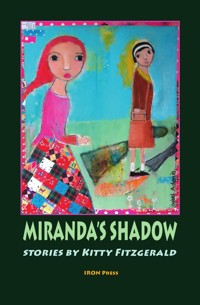
Shortlisted for the 2013 William Trevor / Elizabeth Bowen International Short Story Award. Best known for her novels, Kitty Fitzgerald is also an accomplished short-story writer. Miranda's Shadow, her debut full collection, brings together a series of provocative, richly conceived stories that share the same dark, fabulous drama that saw her novel Pigtopia (Faber, 2006) garner such grand acclaim. Just what is Alice Noonan's secret? And who is the strange wino with the voice of an angel? And why does nobody go in or out of the Faulkners' house? These are tales of temptation, suspicion and murder – from savage fairies to the photographer who saw too much. "A writer of stylistic daring who cuts her own furrow." The Scotsman Kitty Fitzgerald was born in Ireland. Her short story 'The Bones of St Ignatius' won the Notes from the Underground / Latitude Festival Short Story Competition in 2009. Her fourth novel, Pigtopia, was published by Faber in 2006, and has been translated into more than twenty languages. She is the editor of the Iron Press anthology Root: New Stories by North-East Writers, published in February 2013. Four of her plays have been broadcast on BBC Radio 4. She lives in Northumberland. This book is also available as a eBook. Buy it from Amazon here.
Sie lesen das E-Book in den Legimi-Apps auf:
Seitenzahl: 218
Veröffentlichungsjahr: 2013
Das E-Book (TTS) können Sie hören im Abo „Legimi Premium” in Legimi-Apps auf:
Ähnliche


















Kitty Fitzgerald, Irish writer, lives on the North East Coast of England. Her other work includes four novels: Marge (Sheba 1985), Snapdragons (Brandon 1999), Small Acts of Treachery (Brandon 2002), Pigtopia (Faber 2005), which took second place in the Barnes & Noble Discover New Writers Awards (fiction) 2006.
She has had eight theatre plays produced, most recently, Making Plans for Jessica (2011, Anne Orwin’s Youth Theatre) and Bingo! (2010, Cloud Nine Theatre).
Four of her radio dramas have been produced by BBC Radio 4. Kitty has edited three anthologies of short fiction for IRON Press, most recently, ROOT, stories by North East Writers, 2013.
First published 2013 by IRON Press
5 Marden Terrace, Cullercoats, North Shields, NE30 4PD
T: +44 (0)191 2531901
www.ironpress.co.uk
ISBN (pbk) 978-0-9565725-9-2
ISBN (ebook) 978-0-9575032-6-7
© Kitty Fitzgerald
© This collection IRON Press 2013
IRON Press Books are distributed by Central Books
and represented by Inpress Books Ltd, Churchill House, 12 Moseley St, Newcastle upon Tyne, NE1 1DE
T: +44 (0) 191 2308104
www.inpressbooks.co.uk
Acknowledgements are made to the Hosking Houses Trust for their residency (Sept-Dec 2012) and financial support.
www.hoskinghouses.co.uk
Thanks also to, The Authors’ Foundation and The Society of Authors. Kitty was the recipient of: a Hawthornden Fellowship in 2005, a Time to Write Award, Arts Council England 2003 and The C P Taylor Playwriting Bursary 2002.
Her story, The Bones of Saint Ignatious won the 2009 Latitude Festival / Notes from The Underground Short Story Competition. The story, Miranda’s Shadow was first published, 2012, in Platform, New Fiction by North East Writers, commissioned by New Writing North 2012. Once Were Angels Here was first published online by Shortfire Press, 2011.
www.shortfirepress.com
Miranda’s ShadowThe KnowledgeThe Instrument BarCity of DreamsOnce Were Angels HereAn Immodest ProposalThe Bones of Saint IgnatiousHuntedNoirishArmageddonCaged
In memory of Joseph & Mary Fitzgerald and Khodor Dannan
Miranda’s Shadow
There’s something about shadows. Have you noticed? They have substance but it’s different from ours. It comes from another place, someplace concurrent but shifty, shifting. I found that out when I was at junior school. There was a girl in my class, an unusual girl, called Miranda. She was the most beautiful thing I’d ever seen with her bright burgundy hair and lilac eyes. She had some syndrome or other, can’t remember what it was called, but she rarely made eye contact and seldom spoke.
One day, in the playground, a group of us were having a game of chase and I ended up quite close to Miranda, in the corner of the yard where she always retreated from the rest of us. It was a brilliant day, robin’s egg sky, not a sliver of a breeze. I don’t know why but I looked down at her shadow, facing away from me, just like her. And as I continued to stare, it turned, trembled and started moving away from her body towards mine. I was terrified. Miranda saw my fear, I’m certain of that because she looked at me. For the first time in the eight years she’d been at the school, she actually looked directly at me for more than one second.
That was the starting point for my fascination with shadows. I wanted to know everything about them, like where they came from. I mean, were they there at birth? Mam was pregnant with my sister Charlie at the time and I told her I wanted to be present at the birth. She refused, said I was too young and did a lot of tut-tutting. I couldn’t let it go though. I needed to know if a new born baby had a shadow. So I wore her down by doing loads of internet research and found dozens of reasons why I should be present at the birth.
One, I could help with her breathing exercises; dad was useless at stuff like that. Two, we were doing a project on childbirth at school (lie). Three, I might not bond with my sister if I wasn’t present at the birth…
‘I said no,’ Mam cut in. But with a bit of persuasion from Dad – after I promised to wash the car every week until the end of the month – she agreed to let me wait in the corridor and slip inside the delivery room the moment Charlie was in her arms. I have to admit to having second and third thoughts when I heard the mewling and squawking leaking out of the room. Once I got inside I was ambushed for several minutes by the gurgling, beetroot-faced bundle lying on Mam’s chest. Then I checked from every angle in the room, made sure the sun was coming in the window, even put on some lights. Guess what? There wasn’t one. No shadow, not even a hint.
After that I haunted baby Charlie. First thing in the morning I went on the shadow hunt. After school, every day, I was straight on her case. Mam and Dad just thought I was crazy about my new sister. I could hardly tell them the truth. Want to know what I discovered? Six months old, that’s when the shadow truly emerged.
It wasn’t scientific, obviously; you’d have to set up a huge project and monitor thousands of babies to be able to come to any worthwhile conclusion. However, it confirmed for me what I already suspected: shadows are not integral to the body, they’re separate. That’s when I began obsessing. I started with my own shadow. It wasn’t impressive; it was too pale, ill defined and sort of ragged at the edges. Still, it didn’t wander or try to run away like others I saw. Later I discovered that often, the shadow a person casts is quite different from the face they put out to the world. They can appear average, conventional, pay-your-bills-on-time, never-rock-any-boat types, but catch their shadow on a real bright day and it can be jagged, sharp, conflicted. And vice versa, the ones that seem laid back, extrovert and radical, their shadows are sometimes curiously bland.
Then there are the shadows that aren’t fully connected, like Miranda’s. If they catch you staring, they often move independently of their bodies. It’s awesome. I once saw this guy in Exhibition Park. He had two small kids with him. It was an ultramarine sky and I could clearly see all of their shadows. At first they seemed fine but when for some reason the guy lost it and started bellowing and ranting, the kids’ shadows began to shrink and started looking about, as if they wanted to escape. At the same time, the man’s began to grow until it was massive and surrounded the children’s. I was frightened and at the same time, intrigued by what was happening; I couldn’t turn away, it was invaluable research. But when the man saw me watching, he shouted,
‘What’re ye looking at?’ And his shadow began to leak towards mine, smoothly, like demented lubricant. I ran away, fast.
My whole life has been a research project. I’m twenty-seven and I run a science fiction book and film shop in Newcastle called Shadowlands where I keep a record of all things shady. Hey, remember that fantastic, surprising scene in the film, The Third Man? When the light comes on in the window and shows the Harry Lime character hiding in the shadow of a doorway opposite with a cat sitting on his shoes? That’s class. I think Carol Reed knew about shadows. What about the strange small boy with the rubber ball who suddenly cast a huge shadow as he led the mob after Holly Martins? Was it distortion or was it real? And later, when Martins was being questioned about seeing Harry Lime, who was supposed to be dead, he actually said,
‘I was chasing his shadow.’ Did he mean that Lime’s shadow was separate from his body? Was Carol Reed actually trying to warn us about shadows?
Coppola definitely knows. He showed it in his version of Dracula, the way a shadow can move independently of its owner. If it gave you the shivers watching the film, imagine what it’s like to witness it happening in real time. And it’s not the sort of thing you can drop into a conversation is it? Hey, do you know the truth about shadows? That’s probably why I’m a loner. I’m not happy about getting close to other people’s shadows. You just never know.
Anyway, after I saw Coppola’s Dracula for the tenth time, I got to thinking about Miranda, about the way her shadow had moved towards me that day in the school playground and started this whole obsession off. And I knew I had to find her and see her shadow one more time.
The internet’s a wonderful thing, if you know how to use it, and I do. It took me less than half an hour to trace her. I was surprised to discover that she was lecturing in art at Northumbria University. Because of the way she’d behaved at school I’d expected her to be in some sort of care facility or still living with her parents. Her phone number was right there in the regular directory.
When I rang she repeated my name with a question mark, ‘Callum Delaney?’
‘I’m sorry, you probably don’t remember me—’ I began.
‘Yes, I do,’ she said. ‘Callum, the maths genius with the licorice hair. I’m just surprised because I was thinking about you last week, wondering what had happened to you.’
‘Synchronicity,’ I said.
‘Strange,’ she replied. ‘Are you still a bit spooky?’
‘Me? I thought it was you that was weird.’
‘No, I was withdrawn, with a touch of Asperger’s. You were nutty. The way you could do all that mental arithmetic, didn’t you realize it freaked everybody out?’
‘You hardly ever spoke,’ I retaliated.
‘Nobody else could get a word in when you were around.’
She laughed and I suddenly remembered hearing that sound in class one day when I got ten out ten, yet again, for the maths test; it was like wooden chimes rippling in the wind.
‘What are you up to Callum, still solving complex geometrical problems?’
‘Running a science fiction film and bookshop called Shadowlands.’
‘Mmm, that figures.’
When I suggested meeting up she seemed positively eager. We agreed to have a coffee the following day.
‘Promise you won’t talk algebra all the time?’
‘I promise.’
I stayed late at work, checking in the new stock, and clearing out the old to take to charity shops. My future meeting with Miranda lingered in my mind the whole time. The strangest thing about it was how relaxed I felt. In bed later, I read an article I’d been saving from Nature magazine. It was about a young woman with no history of psychiatric problems who was being checked out for epilepsy. When a certain part of her brain – the left temporoparietal junction – was electrically stimulated, she talked about how she had encounters with a ‘shadow person’. I’d heard of shadow people before but I thought they were just poorly connected shadows. Perhaps I was wrong. It was a sharp, cloudless day with a high sun. We met at the outdoor café in front of the Theatre Royal in Newcastle and I couldn’t resist glancing at her shadow. It was strong, beautifully formed, no jagged edges and completely stable. She caught me looking and smiled.
‘You saw it, that day in the playground, didn’t you?’ she said as we sat down. I was so startled that she remembered, I just gave her one of my puzzled looks. ‘My shadow,’ she went on. ‘You saw the way my shadow moved, the way it wasn’t really mine. I know you saw it. I’m so glad you got in touch.’
I came clean with her then; told her about my obsession, why I’d tracked her down, my research on my baby sister, everything. And she told me what I must have known all along,
‘Sometimes people get the wrong shadows,’ she said. ‘The system fails, there’s a glitch and a mismatch occurs. That’s what happened to me.’
‘How did you find out?’
‘Out of the corner of my eye, I kept seeing it move and twitch as if it didn’t want to be with me.’ She paused as the coffee arrived.
‘Who do you get in touch with about something like that?’ I asked.
‘I became that quiet, watchful child that you remember, until when I was thirteen, my mother got pregnant with my brother. And once when we were picking her up from an appointment at the hospital, I suddenly thought: what if someone born around the same time as me got my shadow by mistake?’
‘What a brilliant idea; it could explain such a lot of the weird shadow activity I’ve seen.’ She touched my hand and smiled.
‘I went to see my doctor and told him I was doing a special study at school and needed to know how many children were born in the same hospital as me on the same day and what their names were. He was very helpful.’ She dunked her croissant in her coffee and manoeuvered it into her mouth without dribbling a single drop. I was very impressed.
‘And?’ I asked as she finished eating.
She grinned, cat-like, before checking her watch. ‘I have to get back to work, so I’ll give you the quick version. My shadow was trying to live on a lad who’d been born in the same hospital as me but the day before. Unfortunately, the shadow I had didn’t belong to the boy and he wouldn’t listen when I tried to explain the situation to him. He was too unsettled, too angry. So, I just went very close to him. My shadow recognized me and left his body. My errant shadow had no choice but to go to the lad because my real shadow dislodged it. I’m afraid I never saw him again and often wondered what happened to him.’
I asked her to repeat it more slowly and she did. I shook my head. ‘Difficult to believe, but from what I know I’m sure it’s true.’
As we stood up to leave, she took my hand and turned me so that we were side by side with our backs to the sun. And there on the ground were our shadows, dark as tar: hers, lovely and strong and mine, as always, fragile and blurred at the extremes. I started to pull away but her shadow turned towards mine and merged with it for just a second. I shivered as Miranda turned and kissed me, filling up my whole body with a sort of joy.
‘I never forgot you, Callum,’ she said. ‘Come to dinner at my place this evening.’ I was so overwhelmed I couldn’t speak. She wrote down her address. ‘Seven-thirty at mine and bring a bottle.’
As she walked away I was already planning on taking my The Third Man DVD with me. When I glanced at my shadow again, it had changed. It was rich, clearly defined, deeply embedded in the earth and in me.
The Knowledge
One year when the crops were poor my Granddad dug up the fairy mound in the far west pasture to make use of the land for extra planting. It was a desperate act. Up in the attic for three evenings we’d heard the arguments rising up from the big kitchen below, going back and forth between him and Grandma.
‘You can’t turn your back on six generations of family. They’ve honoured the agreement never to touch the mound,’ she said.
‘It’s just superstition, Ruth,’ he said.
‘Your father wasn’t a superstitious man, but he kept the promise.’
Peeping through the slats at the top of the staircase we saw Granddad swipe his hand up his face and over his hair, as if he could wipe away Grandma’s resistance. The fire cracked in the grate, spitting resin, almost like a warning.
‘We’ve barely enough food for the animals and if we don’t feed them we’ll be without milk, cheese, eggs, let alone meat. I have no choice,’ he said finally.
Out of the attic window we watched him stride over the near pastures towards the disputed mound, a large shovel propped on his shoulder. It was almost dusk but he had to go while he had the resolve, so he told us the next morning.
I was on holiday from England and staying at the house for four weeks, along with two cousins, Liam and Breda who were the children of Aunt Kate up in the Mellary Mountains. With Grandma interrupting from the back kitchen, Granddad gathered us round the old beech wood table to explain the hoo-hah we’d heard the night before.
‘It’s not something I do lightly, children,’ he said. ‘But I’m responsible for this family and I have to do what I think is best.’
‘Your father will be turning in his grave,’ Grandma shouted.
‘My father would understand the situation. Two years of drought and failed crops has a way of sharpening the mind. That patch of land runs over the well so it’s easily irrigated.’
‘A promise is a promise.’
‘It’s a story, Ruth. It’s been passed down for so many years nobody knows the real details anymore.’
‘I do,’ said Pat Dwyer as he marched through the open door and plonked his backside firmly in the rocking chair next to the fire. He was the churchwarden, with three sons who had gone to be priests up in Dublin and he was also Grandma’s oldest brother.
Wiping her hands on a towel, Grandma strolled into the room avoiding Granddad’s eyes.
‘Well Pat, what’s brought you here so early on a Saturday morning?’ Granddad asked.
‘Ah, needs must when the devil calls, James,’ Dwyer replied.
‘I sent for him,’ Grandma admitted and I flushed up, being the culprit who had carried the message between the two of them. Granddad shook his head at me.
‘Outside you three,’ he ordered, his voice sterner than usual. We obeyed without question.
We got into the back kitchen via the outside door. Huddled together behind the pantry we strained to hear what was being said.
‘I hear what you’re saying, Pat, but this really is my business,’ Granddad said.
‘A promise made to the fairies and then broken reflects on all of us that share the land. I’ve called the family to meet here at two-thirty on Sunday.’
Some more words were exchanged but they were too quiet for us to catch. We skipped out into the yard and up into the depleted hayloft before Grandma caught us listening. The bales, which normally rose up to the false ceiling below the roof, stood only four feet from the ground. I suddenly understood Granddad’s side of the argument.
‘D’you believe in the small people?’ Liam asked me.
‘D’you?’ I asked, not willing to commit.
‘Of course we do. They’ve always lived in and among us.’
‘Well why can’t we see them then?’ I asked.
‘Because they don’t want you to.’
‘They don’t trust us,’ Breda chipped in.
‘Sometimes they take the shape of an animal. Anyway, I asked you first. Do you believe?’ Liam insisted.
‘I don’t know. The fairies talked and written about in England are of a different sort. And people there don’t believe in things they can’t see,’ I replied.
‘Is that why they’re heathens and don’t believe in God?’ Breda said.
Liam pulled a wad of hay from a bale and threw it at Breda. ‘You’d better wise up before you come up to the big school or they’ll make mincemeat of you,’ he said.
‘Don’t pull at the hay, Liam,’ I said.
‘Why ever not?’
‘You heard what Granddad said about the drought and stuff.’
He pushed his face close to mine and said in a sing-song voice,
‘I’ll tell Grandma you’re on his side.’
I wanted to slap him; instead I crawled over to the ladder, climbed up to the false ceiling platform and gazed out over the pasture behind the house. I was an only child and used to getting my own way so I wasn’t good at negotiating power with others. Down below, Liam and Breda were mumbling quietly and I was steaming with worry that they might stop being my friends.
Out of the window I watched Grandma gathering eggs from the hens into her pinafore. Pat Dwyer and her were chatting on. Then a sudden movement in the field behind her caught my eye. It was like a fragment of heat haze and then it sharpened into a fox with fur so red it hurt my eyes and forced them shut. When I blinked them open I couldn’t see the fox, but I scrambled down the ladder to the bales, shouting,
‘Fox, fox, there’s a fox in the field near the henhouse.’
As I ran to find Grandma, Breda and Liam joined me, all of us shouting ourselves hoarse. But we were too late. Grandma and Pat were running after the fox through the field, brandishing rakes and cursing loudly. Feathers and blood glistened on the grass. Climbing on top of the pasture wall, we saw the tail of the fox thrashing along up ahead with the dead hen slumped in its mouth.
When Grandma and Pat stopped running and turned around, Liam and Breda climbed down but I remained standing on the wall and watched as the fox headed into the far west pasture towards the fairy mound. Granddad ran up from milking the goats and caught Grandma and Pat turning back into the yard. She was bursting with fury.
‘This is your fault, James,’ she shouted.
He tried to fold her into his arms but she pushed him away.
‘It’s the fairies, James. It’s retribution. Promise me you won’t lay another spade in that ground.’
‘Listen to her, man,’ said Pat Dwyer.
Granddad sagged inwards from the middle, like someone punched in the stomach. ‘I can’t promise that, Ruth,’ he said quietly.
‘Then I won’t speak another word to you until you do.’ She brushed past him, pausing only to pick up the eggs she’d left on the grass next to the log pile.
Pat Dwyer marched off and Granddad glanced at the three of us, me still standing on the wall, Liam and Breda leaning against it.
‘Don’t worry, it’ll be all right,’ he said, slowly turning to go back to return to the goats.
At thirteen I was the oldest and even though I was as miserable as the others, I took it upon myself to chivvy my cousins along.
‘Let’s go to the fairy mound and ask them to forgive Granddad,’ I said.
Liam shook his head and Breda followed suit but I’d picked up a slight hesitation.
‘We’ll make a ritual of it, a procession round the mound and some chanting like at mass. I can do a bit of the Credo in Latin,’ I said.
The weariness seeped out of their faces. ‘Some candles out of Grandma’s box under the stairs?’ Breda suggested.
‘And Holy Water,’ Liam said, his eyes fire-bright. ‘I’ll cycle down to the church and fetch some.’
‘Good,’ I said. ‘We’ll meet in the barn after dinner. Breda will get candles and matches, you the Holy Water and I’ll have the words.’
Back up in the attic I rummaged my brain for Latin words and phrases from the mass. Downstairs, Grandma clattered pans and pots as she made bread and soup. Granddad stayed working out of doors, not even returning for his tea and biscuits, which were, as usual, placed on the table exactly at eleven.
Later, around the dinner table, the adults ignored us and kept their eyes on the food. I was consumed with a missionary zeal: to make things right with the fairies, no matter what. The adrenalin rush made me dizzy. As I pushed back my chair to leave the table, Grandma spoke.
‘Where do you think you’re going?’
I glanced from her to Liam and Breda, struggling for the right thing to say.
‘Sure we’re off playing, Nana, we have the games all sorted,’ Breda said.
‘Not this afternoon my little peashooters,’ Grandma said. ‘We’re off to the Nire Valley to visit Larry and Madge. They’ve invited you to go swimming in the river with them and have a picnic afterwards at Aunty Nellie’s.’
‘I’ll come along with you,’ Granddad said.
‘Johanna, tell your grandfather that won’t be necessary,’ Grandma said as she left the table. ‘You kids can clear the dishes into the scullery before you get washed and dressed.’
Liam, Breda and I stared at Granddad. His face was washed white with an oily sheen. He looked ill.
‘You should have a rest Granddad, you don’t look well,’ I suggested.
He sighed like the old goat after milking. ‘Perhaps you’re right Johanna,’ he said. ‘I slept badly last night.
You go off and have your fun, I’ll see to the table and the washing up. And give Aunty Nellie and the twins my love.’
At dusk, when we returned, all boisterous from the Nire Valley, we found Granddad draped like an empty sack over the arm of the rocking chair. His breathing was loud and ragged. The dishes were still on the table. Grandma rushed over to him and felt his forehead and his pulse. Her eyes were wild when she turned back to us.
‘Come, help me, we have to get him into bed,’ she said.
It was a struggle. Grandma held under his arms, Liam and I each had a leg and Breda went ahead, opening doors and turning down the bed. While Grandma prepared a tincture, we took it in turns to wipe his face and head with cool flannels. When she carried the mug into the downstairs bedroom the whiskey smell tickled my nose.
She sent us off then, to wash, clean teeth and get our nightclothes on. As we got ready for bed, the three of us whispered our fears to each other.
‘Is it the fairy curse?’ Breda asked.
‘More than likely,’ Liam replied.
‘Well then, if it is, we have to do our ritual at the mound early tomorrow, agreed?’
The two of them nodded and we went quietly down the stairs.




