


9,95 €
Mehr erfahren.
- Herausgeber: Glagoslav Publications B.V. (N)
- Kategorie: Poesie und Drama
- Sprache: Englisch
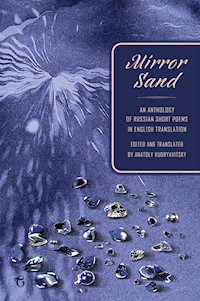
Edited, translated, and introduced by Anatoly Kudryavitsky, this bilingual anthology presents Russian short poems of the last half-century. It showcases thirty poets from Russia, and displays a variety of works by authors who all come from different backgrounds.
Some of them are well-known not only locally but also internationally due to festival appearances and translations into European languages; among them are Gennady Aigi, Gennady Alexeyev, Vladimir Aristov, Sergey Biryukov, Konstantin Kedrov, Igor Kholin, Viktor Krivulin, Vsevolod Nekrasov, Genrikh Sapgir, and Sergey Stratanovsky.
The next Russian poetic generation also features prominently in the collection. Such poets as Tatyana Grauz, Dmitri Grigoriev, Alexander Makarov-Krotkov, Yuri Milorava, Asya Shneiderman and Alina Vitukhnovskaya are the ones Russians like to read today.
This anthology shows Russia looking back at itself, and reveals the post-World-War Russian reality from the perspective of some of the best Russian creative minds. Here we find a poetry of dissent and of quiet observation, of fierce emotions, and of deep inner thoughts.
Das E-Book können Sie in Legimi-Apps oder einer beliebigen App lesen, die das folgende Format unterstützen:
Seitenzahl: 78
Veröffentlichungsjahr: 2018
Ähnliche









MIRROR SAND
An Anthology of Russian Short Poems in English Translation
Translated byAnatoly Kudryavitsky
MIRROR SAND
An Anthology of Russian Short Poems in English Translation
(English only edition)
Edited, translated, and introduced by Anatoly Kudryavitsky, this anthology presents Russian short poems of the last half-century. It showcases thirty poets from Russia, and displays a variety of works by authors who all come from different backgrounds. Some of them are well-known not only locally but also internationally due to festival appearances and translations into European languages; among them are Gennady Aigi, Gennady Alexeyev, Vladimir Aristov, Sergey Biryukov, Konstantin Kedrov, Igor Kholin, Viktor Krivulin, Vsevolod Nekrasov, Genrikh Sapgir, and Sergey Stratanovsky. The next Russian poetic generation also features prominently in the collection. Such poets as Tatyana Grauz, Dmitri Grigoriev, Alexander Makarov-Krotkov, Yuri Milorava, Asya Shneiderman and Alina Vitukhnovskaya are the ones Russians like to read today. This anthology shows Russia looking back at itself, and reveals the post-World-War Russian reality from the perspective of some of the best Russian creative minds. Here we find a poetry of dissent and of quiet observation, of fierce emotions, and of deep inner thoughts.
Introduction copyright © Anatoly Kudryavitsky, 2018
English translations © Anatoly Kudryavitsky, 2006, 2018
Original Russian-language poems © their individual authors, 2018
This collection copyright © Glagoslav Publications, 2018
Front cover image © Jassemine Darouiech, 2018
Cover and layout design by Max Mendor
www.glagoslav.com
ISBN: 978-1-91141-474-2 (Ebook)
A catalogue record for this book is available from the British Library.
This book is in copyright. No part of this publication may be reproduced, stored in a retrieval system or transmitted in any form or by any means without the prior permission in writing of the publisher, nor be otherwise circulated in any form of binding or cover other than that in which it is published without a similar condition, including this condition, being imposed on the subsequent purchaser.
Contents
Acknowledgments
Introduction
Gennady Aigi
The Silence of Snow
Hush
The Rain
Snowstorm in My Window
Our Way
Ivan Akhmetiev
The Challenge
A Pause
Writing
Waiting
Observation
Margarita Al
Desire
Wings
The Poet
The Beast Hasn’t Been Born Yet – but It Already is a Beast
A Porcelain Morning
Maria Alekhina
Pushkin Square
The Room
Prescience
Time
Simple Life
Gennady Alexeyev
Every Morning
My Funeral
Flowers
A Poem About the Disadvantages of Being Human
What I Want
Vladimir Aristov
From “Accidentally Met in Moscow”
The Surface of the Chinese Mirror
The Dragon
For A.U.
Infernal Repetitions
Sergey Biryukov
Everything Changes
Who’s Good?
Beastmen
The Treble Clef
News of Petrarch and Laura
Vladimir Burich
At Night I Looked into my Room Through the Window
Half Past Seventies
What Will Remain
Germany, 1984
On the Boulevard
Vladimir Earle
Autumn
The Barrier of Sleep
Opinions
Eurydice
Under Water
Mikhail Finerman
Touching
Yearning
Name
Winter
To Find Yourself
Ruslan Galimov
Forecast
In General, She Was Right
Agreeability
What Can Man Think About?
Today
Tatyana Grauz
Morning Dream
July’s Light
Butterfly
Soft Sun
April-Dove
Dmitry Grigoriev
Night
Words
Shades of Night
Not Rubbish
Fishermen
Elena Katsuba
Candle
Butterfly and the Rain
An Apocryphal Story
There’s Nothing Replaceable in the Dump!
The Rose Garden
Konstantin Kedrov
Hieroglyph for God
Aero Era
Keel
Reed Pipe
Wings
Igor Kholin
Cramer’s Camera
Poem for Edmund Iodkovsky
From “The War River”
Common Grave
Truths
Viktor Krivulin
Lynx
While We Invented Paradise
Books and Men
Over the Granite Factory
The End
Anatoly Kudryavitsky
Chamber Music
Bunin: Portrait with the Person Missing
Judas
The Invisible Cinema
The Shooting Down of MH17
Alexander Makarov-Krotkov
For K.
On the Quays
The Doggy
Stockholm
A Soviet Reader’s Remark on James Joyce
Arvo Mets
The Poet
Absentee
Resemblance
Penniless Man
Names
Yuri Milorava
Untitled 1
Untitled 2
Untitled 3
Untitled 4
Untitled 5
Vsevolod Nekrasov
Freedom
Untitled 1
Untitled 2
Pride
Love
Rea Nikonova
Simple
The World of Idiots
Anti-Novella
Foretaste
Russia
Genrikh Sapgir
Grove
New in Town
Business Trip
A Proverb
Sounds of Silence
Ian Satunovsky
Changing the Bulb
If They So Desire
Almost by Mistake
Writing
A Bloody Yid
Asya Shneiderman
Poetry
The Tower
The City
Poem for Lena Zhukova
Especially in this Kind of World
Mikhail Sokovnin
Fantasy
Woodsman
Samovar
A Northern Song
Untitled
Sergey Stratanovsky
In the Nabokov Hotel
A Shark as a Cabinet of Curiosities
Leviathan
The Library Tower
An Apocryphal Story
Arkady Tyurin
Inseparability
It Is Careless of You …
Time and the River
She
Garden
Alina Vitukhnovskaya
By Touch
Your Chaos
Zero
Pavlov’s Dog
Eva Browning
About the translator
Thank you for purchasing this book
Glagoslav Publications Catalogue
Acknowledgments
Grateful acknowledgement is made to the editors of the following, in which a number of these translations, or versions of them, originally appeared:
Hayden’s Ferry Review, Cyphers, Das Gedicht, Poetry Ireland Review, The SHOp, Shot Glass Journal, SurVision, Public Pool, Four Centuries, World Poetry Almanac (Ulaanbaatar, Mongolia), A Night in the Nabokov Hotel anthology (Dedalus Press, 2006).
Some of these poems, in English translation, were first broadcast on RTÉ Radio 1.
Every effort has been made to trace the holders of the copyright to the works by Vladimir Burich, Mikhail Finerman and Arkady Tyurin, and to obtain permissions to reproduce their works. Please do get in touch with any enquiries or any information relating to their poems or the rights holders.
Introduction
A saying has it that Russia produces more than it can consume locally. Should this refer to Russian poetry? Western readers are well acquainted with poetry written in that country over the last three centuries, from Alexander Pushkin to Anna Akhmatova, mostly through translations. Some other Russian poets, including Vladimir Nabokov and Joseph Brodsky, felt at home at writing in English. This book offers an opportunity to hear a few newer voices.
As Vladimir Nabokov once put it, “Literature belongs to the department of specific words and images rather than to the department of general ideas.” Unfortunately, the general idea in Communist Russia was to encourage and publish only those writers who supported and even glorified the regime. It was Government policy, especially strict after the last world war. It is inconceivable now that any European poet could write a paean for the President of the European Council, but we have to bear in mind that in Communist Russia, even in the 1980s, this sort of poetry was a commonplace. Other poets ran the risk of being treated with suspicion by each and every literary vigilante. Should we be surprised by Marina Tsvetayeva’s line: “All the poets are Jews”?
“After Pasternak, Russian poetry sustained a pause,” the late Genrikh Sapgir used to say. It was destined to be a long pause. In fact, the generation of Russian writers that emerged in the early 60s grew up reading and studying in college Russian poetry from the 1920s. Some of them were particularly inspired by Boris Pasternak and Osip Mandelstam, others by Velimir Khlebnikov and other Russian Futurist poets. What appeared in Soviet “fat magazines” in those times were, to quote Anna Akhmatova, “rhymed editorials”, or otherwise third-rate imitations of Symbolist poetry from the late nineteenth century.
In these circumstances some Russian poets chose to refrain from publishing anything openly, while others were banned from publishing. Writing “into the table” became customary for them. Many of them explored the possibilities of so-called “open poetry”. By stripping their pieces down to a most basic expression, and outlawing most literary devices or even emotional colouring, they focused their attention on individual words, or even on fragments of those words and sound units from them. This style was later defined as minimalism. One can trace the sources of modern-day minimalist texts to Dadaist, Surrealist, Concrete and even Zen poetry, and it definitely displays parallels to the visual arts. Minimalist poets focused on bare words or phrases, sometimes rearranging them on the page so that their most basic and individual properties disclosed something unexpected about themselves.
The work of these poets wasn’t minimalist in the sense that they had little to say; quite the contrary, it captured the frustration, suppressed ambitions and hidden energy of several generations of Russian people. As Vassily Kandinsky once put it, “Even absolute silence is a loud speech.” Joseph Brodsky in one of his lectures compared Mark Strand and Charles Simic, well-established American “poets of silence”, as he called them, to “unofficial” Russian poets who had to dwell in silence, due to having no other literary space. Rea Nikonova, a poet from the South of Russia, even produced a catalogue of different kinds of silence. She knew very well what she was talking about as she first lived in Yeysk, a small Russian town on coast of the Azov Sea – and then on the other shores of exile, in Germany, until her untimely death.




