


266,99 €
Mehr erfahren.
- Herausgeber: John Wiley & Sons
- Kategorie: Wissenschaft und neue Technologien
- Sprache: Englisch
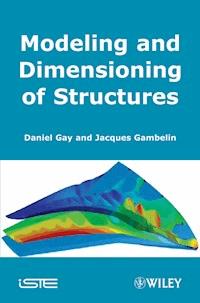
This book provides the main topics currently used for the calculus of structures. The reference establishes a link between the traditional approach on the strength of materials and the present finite element method, details the main aspects of practical modeling, and explores numerous case studies.
Sie lesen das E-Book in den Legimi-Apps auf:
Seitenzahl: 519
Veröffentlichungsjahr: 2013
Ähnliche



















Table of Contents
Preface
Part 1. Level 1
Chapter 1. The Basics of Linear Elastic Behavior
1.1. Cohesion forces
1.2. The notion of stress
1.3. Hooke’s law derived from a uniaxially applied force
1.4. Plane state of stresses
1.5. Particular case of straight beams
Chapter 2. Mechanical Behavior of Structures: An Energy Approach
2.1. Work and energy
2.2. Conversion of work into energy
2.3. Some standard expressions for potential deformation energy
2.4. Work produced by external forces on a structure
2.5. Links of a structure with its surroundings
2.6. Stiffness of a structure
Chapter 3. Discretization of a Structure into Finite Elements
3.1. Preliminary observations
3.2. Stiffness matrix of some simple finite elements
3.3. Getting the global stiffness matrix of a structure
3.5. Different types of finite elements available in industrial software
Chapter 4. Applications: Discretization of Simple Structures
4.1. Stiffness matrix of a spring
4.2. Assembly of elements
4.3. Behavior in the global coordinate system
4.4. Bracket
Part 2. Level 2
Chapter 5. Other Types of Finite Elements
5.1. Return to local and global coordinate systems
5.2. Complete beam element (any loading case)
5.3. Elements for the plane state of stress
5.4. Plate element
5.5. Elements for complete states of stresses
5.6. Shell elements
Chapter 6. Introduction to Finite Elements for Structural Dynamics
6.1. Principles and characteristics of dynamic study
6.2. Mass properties of beams
6.3. Generalization
6.4. Summary
Chapter 7. Criteria for Dimensioning
7.1. Designing and dimensioning
7.2. Dimensioning in statics
7.3. Dimensioning in fatigue
Chapter 8. Practical Aspects of Finite Element Modeling
8.1. Use of finite element software
8.2. Example 1: machine-tool shaft
8.3. Example 2: thin-walled structures
8.4. Example 3: modeling of a massive structure
8.5. Summary of the successive modeling steps
Part 3. Supplements
Chapter 9. Behavior of Straight Beams
9.1. The “straight beam” model
9.2. Mesoscopic equilibrium or equilibrium extended to a whole cross-section
9.3. Behavior relations and stresses
9.4. Application: example of detailed calculation of the resultant forces and moments of cohesive forces
Chapter 10. Additional Elements of Elasticity
10.1. Reverting to the plane state of stresses
10.2. Complete state of stresses
Chapter 11. Structural Joints
11.1. General information on connections by means of cylindrical fasteners
11.2. Bolted joint
11.3. Riveted joint
11.4. Welded joints
Chapter 12. Mathematical Prerequisites
12.1. Matrix calculus
12.2. Change in orthonormal coordinate system
Appendix A. Modeling of Common Mechanical Joints
A.1. Definition
A.2. Common standardized mechanical joints (ISO 3952)
Appendix B. Mechanical Properties of Materials
B.1. Mechanical properties of some materials used for structures
Appendix C. List of Summaries
Bibliography
Part of this book adapted from “Dimensionnement des structures: une introduction” published in France by Hermes Science Publications in 1999
First published in Great Britain and the United States in 2008 by ISTE Ltd and John Wiley & Sons, Inc.
Apart from any fair dealing for the purposes of research or private study, or criticism or review, as permitted under the Copyright, Designs and Patents Act 1988, this publication may only be reproduced, stored or transmitted, in any form or by any means, with the prior permission in writing of the publishers, or in the case of reprographic reproduction in accordance with the terms and licenses issued by the CLA. Enquiries concerning reproduction outside these terms should be sent to the publishers at the undermentioned address:
ISTE Ltd
John Wiley & Sons, Inc.
6 Fitzroy Square
111 River Street
London W1T 5DX
Hoboken, NJ 07030
UK
USA
www.iste.co.uk
www.wiley.com
© ISTE Ltd, 2008
© HERMES Science Publications, 1999
The rights of Daniel Gay and Jacques Gambelin to be identified as the authors of this work have been asserted by them in accordance with the Copyright, Designs and Patents Act 1988.
Library of Congress Cataloging-in-Publication Data
Modeling and dimensioning of structures: a practical approach/Daniel Gay, Jacques Gambelin.
p. cm.
“Part of this book adapted from "Dimensionnement des structures: une introduction” published in France
by Hermes Science Publications in 1999." Includes bibliographical references and index.
ISBN 978-1-84821-040-0
1. Structural engineering--Data processing. 2. Structural engineering--Mathematics. 3. Structural analysis (Engineering) 4. Structural frames--Mathematical models. I. Gay, Daniel, 1942- II. Gambelin, Jacques.
TA640.S77 2007
624.1'7--dc22
2007009432
British Library Cataloguing-in-Publication Data
A CIP record for this book is available from the British Library
ISBN: 978-1-84821-040-0
Preface
This book is aimed at teachers, students, engineers and technicians working in the field of mechanical design.
The modeling and sizing of structures and mechanical assemblies nowadays and universally resort to specific computation software based on finite element analysis. The contents and the scheduling of this work are thus meant to enable the reader to understand and prepare the use of computer code under the best possible conditions.
This work proposes the basics of the dimensioning of structures to readers who will not inevitably continue studies in mechanics of continuous media. This book acts as a support for courses, exercises and experimental work, and as preliminary practical work before calculating (practical modeling). We will find there as straightforward as possible an approach of principles and methods used nowadays to size mechanical structures and assemblies, at the various stages of their design (to learn how to dimension, with the aim of a better design).
With this posted goal, this book differs from a traditional text on the strength of materials. The study plan is not the same. Everything is done to lead rapidly to the concepts of flexibility and stiffness of a structure, in order to approach them in their matrix form.
This work has a “utility” purpose: the main practical results obtained at each stage are synthesized systematically in the form of summarized tables. Formalism and notations are reduced to a minimum. Basic elements for beginners are marked in the margin by a shaded band.
This book is composed of three main parts. The technical level increases from Part 1 to Part 2, and each part can be used independently. Part 1 corresponds to a 2-year undergraduate degree or Licence (L2). Part 2 is meant for an educational
program of higher level in industrial design, i.e. corresponding to a 3-year undergraduate degree or Licence (L3) or bachelor’s degree, if necessary finished by a one-year Master’s (M1) diploma (EU studies).
In Part 3 supplements are given, particularly regarding the modeling and dimensioning of structural joints.
Thus, the book is useful for students, as well as for practical engineers who want to learn, on the job, the guidelines for the use of finite element software.
This work is intended to adapt and replace, correctly, the traditional subject which the strength of materials constitutes. It addresses the modeling of the behavior of structures by avoiding the often too abstract formalism of the mechanics of continuous media. It provides comprehensive coverage of both the analysis and design used in industry today. The content and structure of the book are intended to help the reader understand the use of finite element techniques and software, which are now essential for such a discipline, and supply the material necessary to make models and to interpret results.
PART 1
Level 1
In this first part, the shaded vertical borders mark the essential, basic elements, for beginners. This first level is meant for students having, in the European system (licence, Masters, PhD), a “first year of licence”. In Chapters 3 and 4 we deal with the simplest finite elements, along with some applications showing the fundamental steps of calculation.
Chapter 1
The Basics of Linear Elastic Behavior
Mechanical structures consist of accurately organized groups of parts formed of solid media. These solids are obtained by the processing of proven construction materials: cements and steels for architects, metal alloys (steel, light alloys, titanium, etc.) for mechanical designers, more advanced materials (special alloys, composites) for certain kinds of precise activities (terrestrial transport, aeronautics, shipbuilding, etc.).
We arrange these parts of structures to optimize their performance and the cost returns of the complete structure:
durability for a predefined time frame;
the lowest possible cost returns and maintenance.
These are fundamental considerations, for they form the goals that designers try to achieve. It is therefore important to be well advised right from the beginning. We shall have the opportunity to review this1.
At the beginning of this chapter we shall accept without demonstration, certain standard properties of a loaded elastic structure, that is to say, under mechanical loads. These properties are useful for a better understanding of what follows2.
1.1. Cohesion forces
In a real structure, it is necessary to accept the existence of a system of internal cohesion forces which originate from intermolecular actions and which allow, among other things, the preservation of the initial form of the structure.
In a structure made of a material we shall assume to be elastic3, let us isolate a particle of matter specified by a very small sphere around a point M (Figure 1.1a).
Figure 1.1.A spherical domain's deformation around point M
When this structure is loaded, point M undergoes a displacement (Figures 1.1b and 1.1c) which we shall assume to be very small when compared to the dimensions of the structure, so that the latters shape does not vary perceptibly. It is shown for all materials made up of standard structures, that the small spherical domain around the point M first deforms weakly4 becoming an ellipsoid. The shape and the orientation of that ellipsoid change not only with the position of point M in
the structure but also with the nature of the loads as illustrated in Figure 1.1c. Such an isolated ellipsoid is shown in Figure 1.2.
Figure 1.2.Cohesion forces around the small domain
Thus isolated, we must calculate the forces exerted by the suppressed part of the structure on all the elementary surfaces dSi with the outgoing normal unit constituting the surface of the ellipsoid. These elementary forces, which assure the equilibrium of a particle, are referred to as cohesion forces or internal forces of the structure.
NOTE
These cohesion forces lead the initially spherical domain to become ellipsoidal.
The distribution of these forces on the surface therefore has symmetry properties.
These cohesion forces are made up of:
on the one hand the initial cohesion forces before the structure was loaded. This initial unloaded state is also called neutral state;
on the other hand the complementary cohesion forces created by the loading. We shall be exclusively interested in these complementary cohesion forces from now on.
These complementary cohesion forces shall henceforth be referred to as cohesion forces. Their distribution around any point in the structure is therefore very narrowly linked to the applied forces, as illustrated in Figure 1.3.
Figure 1.3.Cohesion forces for two distinct loadings
1.2. The notion of stress
1.2.1. Definition
For the small domain with center M, and for each direction , we shall define a vector called stress vector noted as:
[1.1]
where:
is the cohesion force exerted by the extracted part, on one surface with the value dSi of the ellipsoid with center M (Figure 1.2);
is the outgoing normal5 on the surface dSi of the ellipsoid on which is exerted.
NOTE
Dimensional homogenity of the stress vector: (Pascal) or, in a manner more adapted for design engineers: (MegaPascal).
1.2.2. Graphical representation
Figure 1.4.A single normal component of the stress
for 2: normal stress;
for 2: tangential or shear stress.
Figure 1.5.Normal and tangential components of a stress
1.2.3. Normal and shear stresses
As we observe in Figure 1.5 we may note the vector as the sum of the normal stress vector and the tangential or shear stress vector , i.e.:
NOTE
We demonstrate7 and we shall admit for the time being that if we isolate a surface dS2 perpendicular to (plane of Figure 1.5 re-examined in Figure 1.6), this surface will automatically undergo a shear stress such that oriented as shown in Figure 1.6.
Figure 1.6
We say there is reciprocity in the shear stresses:
if is directed towards edge , the intersection between surfaces dS2 and dS2 , then is directed towards edge ;
if is directed away from edge , the intersection between surfaces dS2 and dS2 , then is directed away from (this standard property is referred to as the reciprocity of shear stresses or Cauchys property).
We may note in Figure 1.2 that we represented several points on the ellipsoids surface specifically as shown in Figure 1.4 where reaches an entirely normal stress. These points have been reworked and illustrated with their associated surfaces in .
Lesen Sie weiter in der vollständigen Ausgabe!
Lesen Sie weiter in der vollständigen Ausgabe!
Lesen Sie weiter in der vollständigen Ausgabe!
Lesen Sie weiter in der vollständigen Ausgabe!
Lesen Sie weiter in der vollständigen Ausgabe!
Lesen Sie weiter in der vollständigen Ausgabe!
Lesen Sie weiter in der vollständigen Ausgabe!
Lesen Sie weiter in der vollständigen Ausgabe!
Lesen Sie weiter in der vollständigen Ausgabe!
Lesen Sie weiter in der vollständigen Ausgabe!
Lesen Sie weiter in der vollständigen Ausgabe!
Lesen Sie weiter in der vollständigen Ausgabe!
Lesen Sie weiter in der vollständigen Ausgabe!
Lesen Sie weiter in der vollständigen Ausgabe!
Lesen Sie weiter in der vollständigen Ausgabe!
Lesen Sie weiter in der vollständigen Ausgabe!
Lesen Sie weiter in der vollständigen Ausgabe!




