


118,99 €
Mehr erfahren.
- Herausgeber: John Wiley & Sons
- Kategorie: Wissenschaft und neue Technologien
- Sprache: Englisch
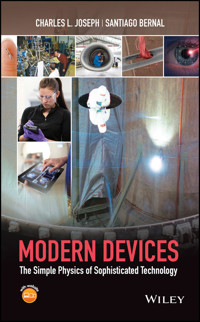
Focuses on the common recurring physical principles behind sophisticated modern devices
This book discusses the principles of physics through applications of state-of-the-art technologies and advanced instruments. The authors use diagrams, sketches, and graphs coupled with equations and mathematical analysis to enhance the reader’s understanding of modern devices. Readers will learn to identify common underlying physical principles that govern several types of devices, while gaining an understanding of the performance trade-off imposed by the physical limitations of various processing methods. The topics discussed in the book assume readers have taken an introductory physics course, college algebra, and have a basic understanding of calculus.
- Describes the basic physics behind a large number of devices encountered in everyday life, from the air conditioner to Blu-ray discs
- Covers state-of-the-art devices such as spectrographs, photoelectric image sensors, spacecraft systems, astronomical and planetary observatories, biomedical imaging instruments, particle accelerators, and jet engines
- Includes access to a book companion site that houses Power Point slides
Sie lesen das E-Book in den Legimi-Apps auf:
Seitenzahl: 932
Veröffentlichungsjahr: 2016
Ähnliche



















Table of Contents
COVER
TITLE PAGE
PREFACE
ABOUT THE COMPANION WEBSITE
1 PRINCIPLES OF PHYSICS AND THE RELEVANCE TO MODERN TECHNOLOGIES
1.1 CM, EM, AND QM: THE BACKBONE OF PHYSICS
1.2 PHOTONICS AND ELECTRONICS
2 EVERYDAY HOME APPLIANCES
2.1 THE AIR CONDITIONER
2.2 MICROWAVE OVENS
2.3 SMOKE DETECTORS
2.4 COMPACT DISCS, DIGITAL VERSATILE DISCS, AND BLU-RAY DISCS
2.5 PHOTOCOPIERS AND FAX MACHINES
3 DEVICES ENCOUNTERED IN MODERN LIFE
3.1 METAL DETECTORS FOR AIRPORTS AND TRAFFIC LIGHTS
3.2 BARCODE SCANNERS, QUICK RESPONSE CODES, AND RADIO-FREQUENCY IDENTIFICATION READERS
3.3 GLOBAL POSITIONING
3.4 TRANSPORTATION TECHNOLOGIES
4 VACUUM SYSTEMS: ENABLING HIGH-TECH INDUSTRIES
4.1 VACUUM CHAMBER TECHNOLOGY
4.2 PHYSICS OF SOME VACUUM GAUGES
4.3 LOW VACUUM VIA VENTURI, MECHANICAL, OR SORPTION PUMPS
4.4 HV VIA DIFFUSION, TURBOMOLECULAR, OR CRYOGENIC PUMPS
4.5 UHV VIA ION PUMPS
5 CLEANROOMS, AN ENABLING TECHNOLOGY
6 SOLID-STATE ELECTRONICS
6.1 CONDUCTING, SEMICONDUCTING, AND INSULATING MATERIALS
6.2 RESISTORS, CAPACITORS, AND INDUCTORS
6.3 DIODES AND TRANSISTORS
6.4 FET, JFET, MOSFET, CMOS, AND TTL
6.5 SUMMARY
7 HIGH-TECH SEMICONDUCTOR FABRICATION
7.1 THIN FILMS
7.2 THIN-FILM DEPOSITION METHODS
7.3 HIGH-PURITY CRYSTALS VIA MBE
7.4 PHOTOLITHOGRAPHY AND ETCH TECHNIQUES
7.5 IN SITU AND INTERMEDIATE-STAGE TESTS
7.6 DEVICE STRUCTURES AND IC PACKAGING
8 MATERIALS SCIENCE—INVALUABLE HIGH-TECH CONTRIBUTIONS
8.1 THE USE OF COMPOSITE MATERIALS
8.2 THIN-FILM MULTILAYERS
8.3 NANOTECHNOLOGY
9 LIGHT SOURCES
9.1 INCANDESCENT LAMPS
9.2 GAS DISCHARGE LAMPS
9.3 FLUORESCENT LAMPS
9.4 LIGHT EMITTING DIODES
9.5 X-RAY SOURCES
9.6 LASERS
9.7 SYNCHROTRON LIGHT SOURCES
9.8 SUMMARY OF LIGHT SOURCES
10 SOME BASIC PHYSICS OF OPTICAL SYSTEMS
10.1 REFRACTIVE AND REFLECTIVE OPTICS AND THEIR USES
10.2 POLARIZATION AND BIREFRINGENCE
10.3 DIFFRACTION
10.4 HOLOGRAPHY
10.5 PRIMARY ABERRATIONS
11 OPTICAL COUPLERS INCLUDING OPTICAL FIBERS
11.1 OPTICAL FIBERS AND HOLLOW WAVEGUIDES
11.2 COUPLERS FOR LONG DISTANCES
11.3 OPTICAL COUPLERS AS A MEANS OF ELECTRONIC ISOLATION
12 SPECTROGRAPHS: READING THE “BAR CODE” OF NATURE
12.1 PRISMS, RULED GRATINGS, AND HOLOGRAPHIC GRATINGS
12.2 LONG-SLIT SPECTROGRAPHS
12.3 INTEGRAL FIELD UNIT AND FABRY–PÉROT
12.4 ECHELLE SPECTROGRAPHS
12.5 RAMAN SPECTROGRAPHS
13 OPTICAL AND ELECTRON MICROSCOPY
13.1 OPTICAL MICROSCOPES
13.2 THE TRANSMISSION ELECTRON MICROSCOPE
13.3 ELECTRON–MATTER INTERACTIONS
13.4 BRAGG’S DIFFRACTION
13.5 SCANNING PROBE MICROSCOPES
14 PHOTOELECTRIC IMAGE SENSORS
14.1 SOLID-STATE VISIBLE WAVELENGTH SENSORS
14.2 PHOTOEMISSIVE DEVICES FOR UV AND X-RAYS
14.3 INFRARED “THERMAL” SENSORS AND NIGHT VISION SENSORS
15 IMAGE DISPLAY SYSTEMS
15.1 THE HUMAN VISUAL SYSTEM
15.2 WHO INVENTED TELEVISION?
15.3 TRADITIONAL AND HIGH-DEFINITION TV DISPLAY FORMATS
15.4 CATHODE RAY TUBES
15.5 LIQUID CRYSTAL DISPLAYS
15.6 PLASMA DISPLAYS
15.7 DIGITAL MICRO-MIRROR DEVICES
15.8 TOUCH SCREENS
15.9 ELECTROPHORETIC DISPLAYS
15.10 NEAR-EYE DISPLAYS, AUGMENTED REALITY, AND VIRTUAL REALITY
15.11 STEREOSCOPIC, AUTOSTEREOSCOPIC, AND HOLOGRAPHIC 3D DISPLAYS
16 SPACECRAFT SYSTEMS
16.1 OPERATING IN SPACE: AN OVERVIEW
16.2 ATTITUDE CONTROL SYSTEM
16.3 SPACECRAFT POWER
16.4 THERMAL AND OTHER ENVIRONMENTAL CONTROL
16.5 COMMAND, CONTROL, AND TELEMETRY
16.6 LAUNCH, PROPULSION, STATION KEEPING, AND DEORBIT
17 ASTRONOMICAL AND PLANETARY OBSERVATORIES
17.1 TELESCOPE DESIGNS
17.2 VERY LARGE, ULTRA-LIGHTWEIGHT OR SEGMENTED MIRRORS
17.3 ADAPTIVE OPTICS AND ACTIVE OPTICS
17.4 SPACE OBSERVATORIES
17.5 PLANETARY PROBES
18 TELECOMMUNICATIONS
18.1 PHYSICAL CONNECTIONS: PHONE LINES, COAXIAL CABLE, AND FIBER OPTICS
18.2 ANALOG FREE-SPACE CHANNELS: TV, RADIO, MICROWAVE CONNECTIONS
18.3 DIGITALLY MODULATED FREE-SPACE CHANNELS
18.4 THE NETWORK, MULTIPLEXING, AND DATA COMPRESSION
19 PHYSICS OF INSTRUMENTS FOR BIOLOGY AND MEDICINE
19.1 IMAGING INSTRUMENTS
19.2 MINIMALLY INVASIVE PROBES AND SURGERY
19.3 LASER TECHNOLOGIES
19.4 MISCELLANEOUS ELECTRONIC DEVICES
20 A-BOMBS, H-BOMBS, AND RADIOACTIVITY
20.1 ALPHA, BETA, AND GAMMA RAY RADIATION
20.2 A-BOMBS, H-BOMBS, AND DIRTY BOMBS
20.3 RADIATION SAFETY, DETECTION, AND PROTECTION
20.4 INDUSTRIAL AND MEDICAL APPLICATIONS
21 POWER GENERATION
21.1 PRINCIPLES OF ELECTRIC GENERATORS
21.2 POWER STORAGE AND POWER CONTENT OF FUELS
21.3 THE POWER GRID
22 PARTICLE ACCELERATORS—ATOM AND PARTICLE SMASHERS
22.1 LORENTZ FORCE, DEFLECTION, AND FOCUSING
22.2 BEAM GENERATION, MANIPULATION, AND CHARACTERIZATION
22.3 DC ACCELERATORS
22.4 RF LINEAR ACCELERATORS
22.5 CYCLOTRONS
22.6 SYNCHROTRON RADIATION AND LIGHT SOURCES
23 JET ENGINES, STRATOSPHERIC BALLOONS, AND AIRSHIPS
23.1 RAMJETS, TURBOJETS, AND TURBOFAN JETS
23.2 STRATOSPHERIC BALLOONS
23.3 FUTURE AIRSHIPS
APPENDIX A: STATISTICS AND ERROR ANALYSIS
BIBLIOGRAPHY
INDEX
END USER LICENSE AGREEMENT
List of Tables
Chapter 05
Table 5.1 ISO 14644-1 Cleanroom Standards
Chapter 07
Table 7.1 Types of Vapor Deposition
Chapter 09
Table 9.1 Laser Classifications
Table 9.2 Blackbody Temperatures and Colors
Chapter 11
Table 11.1 Attenuation Values from the Cisco Webpages
Chapter 13
Table 13.1 Main Parameters of a Typical Optical Microscope
Table 13.2 Main Parameters of Phillips CM200 FEG Transmission Electron Microscope
Chapter 15
Table 15.1 Analog and Digital TV Standards
Table 15.2 Resolution and Aspect Ratio of Some Common Computer Monitor Formats
Chapter 18
Table 18.1 A Few Radio Bands and Telecommunication Uses
Chapter 21
Table 21.1 Life Cycle Greenhouse Gas Emissions
Chapter 23
Table 23.1 Approximate Benchmark Numbers for the Atmosphere
List of Illustrations
Chapter 01
Figure 1.1 In the ever-expanding body of human knowledge, it is difficult for an individual to keep pace by only absorbing factual information. Gray areas represent small fragments of an individual’s knowledge compared to all of the available data. Some of these fragments are connected (shown as lines) via various means (e.g., factual, cognitive, and reasoning).
Figure 1.2 A few of the many uses of modern day pulleys.
Figure 1.3 Benchmark sizes of fingerprint ridges, a cotton thread, and a typical hair from a human head, showing the relative scale of objects that can be seen by the eye.
Figure 1.4 (a) It is often useful to conceive of an atom as a planetary model with a central nucleus, surrounded by orbiting electrons. The size of a free electron (as determined from its de Boglie wavelength) is approximately the size of the atom itself. The size of the nucleus is so small that it cannot be drawn to scale. (b) Pictured is a single photon (
λ
= 500 nm) scaled equivalently to half of an 8.5″ × 11″ sheet of paper. Also drawn to scale is the size of an atom, which is 1/5000 times smaller (the dot).
Chapter 02
Figure 2.1 A schematic representation of a room air conditioner. Temperature and pressure change significantly at two locations in a manner similar to Equation 2.1.
Note
: the four locations. These denote the thermodynamic positions of the refrigerant on the graphs that follow.
Figure 2.2 An air conditioner must add work to extract heat from the cold environment and move it to the warmer one.
Figure 2.3 The thermodynamic path of taken by a refrigerator or air conditioner. Compression of vapor occurs along the path from point 1 to 2. Superheated vapor is removed in the condenser along 2–2a. Vapor to liquid in the condenser is along path 2a–3. From 3 to 4, the liquid flashes into vapor + liquid in expansion valve. The two-phase fluid converts completely to vapor in evaporator along path 4 to 1.
Figure 2.4 Top left: the four stages of an A/C corresponding to those in Figure 2.1. Top right: the thermodynamic curve given in Figure 2.2 for reference. Bottom left: an excerpt from pressure–temperature table used by A/C technicians and engineers. Bottom right: an example graphic used by A/C engineers.
Figure FB2.1 Phase transition diagram for H
2
O, specifically temperature versus energy for a single isobar. In a closed system such as an air conditioner where the pressure is also a variable, there is a family of curves representing various isobars.
Figure 2.5 The basic components of a microwave oven.
Figure 2.6 The water molecule, consisting of one oxygen atom (red) and two hydrogen atoms (green). The molecule is a dipole with an internal electric field pointing up in this example. One molecule tends to attract weakly another with the same orientation (right).
Figure 2.7 The schematic representation of the response of water molecules to an electric field. The HO molecules start flipping and spinning if the
field continually changes its orientation. The resulting higher internal motions correspond to an increased temperature.
Lesen Sie weiter in der vollständigen Ausgabe!
Lesen Sie weiter in der vollständigen Ausgabe!
Lesen Sie weiter in der vollständigen Ausgabe!
Lesen Sie weiter in der vollständigen Ausgabe!
Lesen Sie weiter in der vollständigen Ausgabe!
Lesen Sie weiter in der vollständigen Ausgabe!
Lesen Sie weiter in der vollständigen Ausgabe!
Lesen Sie weiter in der vollständigen Ausgabe!
Lesen Sie weiter in der vollständigen Ausgabe!
Lesen Sie weiter in der vollständigen Ausgabe!
Lesen Sie weiter in der vollständigen Ausgabe!
Lesen Sie weiter in der vollständigen Ausgabe!
Lesen Sie weiter in der vollständigen Ausgabe!
Lesen Sie weiter in der vollständigen Ausgabe!
Lesen Sie weiter in der vollständigen Ausgabe!
Lesen Sie weiter in der vollständigen Ausgabe!
Lesen Sie weiter in der vollständigen Ausgabe!
Lesen Sie weiter in der vollständigen Ausgabe!
Lesen Sie weiter in der vollständigen Ausgabe!
Lesen Sie weiter in der vollständigen Ausgabe!
Lesen Sie weiter in der vollständigen Ausgabe!
Lesen Sie weiter in der vollständigen Ausgabe!
Lesen Sie weiter in der vollständigen Ausgabe!
Lesen Sie weiter in der vollständigen Ausgabe!
Lesen Sie weiter in der vollständigen Ausgabe!
Lesen Sie weiter in der vollständigen Ausgabe!
Lesen Sie weiter in der vollständigen Ausgabe!
Lesen Sie weiter in der vollständigen Ausgabe!
Lesen Sie weiter in der vollständigen Ausgabe!
Lesen Sie weiter in der vollständigen Ausgabe!
Lesen Sie weiter in der vollständigen Ausgabe!




