


62,99 €
Mehr erfahren.
- Herausgeber: John Wiley & Sons
- Kategorie: Wissenschaft und neue Technologien
- Sprache: Englisch
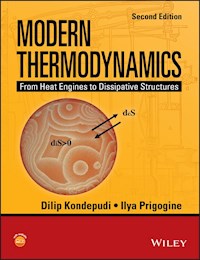
Modern Thermodynamics: From Heat Engines to Dissipative Structures, Second Edition presents a comprehensive introduction to 20th century thermodynamics that can be applied to both equilibrium and non-equilibrium systems, unifying what was traditionally divided into ‘thermodynamics’ and ‘kinetics’ into one theory of irreversible processes.
This comprehensive text, suitable for introductory as well as advanced courses on thermodynamics, has been widely used by chemists, physicists, engineers and geologists. Fully revised and expanded, this new edition includes the following updates and features:
- Includes a completely new chapter on Principles of Statistical Thermodynamics.
- Presents new material on solar and wind energy flows and energy flows of interest to engineering.
- Covers new material on self-organization in non-equilibrium systems and the thermodynamics of small systems.
- Highlights a wide range of applications relevant to students across physical sciences and engineering courses.
- Introduces students to computational methods using updated Mathematica codes.
- Includes problem sets to help the reader understand and apply the principles introduced throughout the text.
- Solutions to exercises and supplementary lecture material provided online at http://sites.google.com/site/modernthermodynamics/.
Modern Thermodynamics: From Heat Engines to Dissipative Structures, Second Edition is an essential resource for undergraduate and graduate students taking a course in thermodynamics.
Sie lesen das E-Book in den Legimi-Apps auf:
Seitenzahl: 1045
Veröffentlichungsjahr: 2014
Ähnliche



















Modern Thermodynamics
From Heat Engines to Dissipative Structures
Second Edition
DILIP KONDEPUDI
Wake Forest University, USA
ILYA PRIGOGINE
Formerly Director, International Solvay Institutes, Belgium
This edition first published 2015 © 2015 John Wiley & Sons, Ltd
Registered officeJohn Wiley & Sons Ltd, The Atrium, Southern Gate, Chichester, West Sussex, PO19 8SQ, United Kingdom
For details of our global editorial offices, for customer services and for information about how to apply for permission to reuse the copyright material in this book please see our website at www.wiley.com.
The right of the author to be identified as the author of this work has been asserted in accordance with the Copyright, Designs and Patents Act 1988.
All rights reserved. No part of this publication may be reproduced, stored in a retrieval system, or transmitted, in any form or by any means, electronic, mechanical, photocopying, recording or otherwise, except as permitted by the UK Copyright, Designs and Patents Act 1988, without the prior permission of the publisher.
Wiley also publishes its books in a variety of electronic formats. Some content that appears in print may not be available in electronic books.
Designations used by companies to distinguish their products are often claimed as trademarks. All brand names and product names used in this book are trade names, service marks, trademarks or registered trademarks of their respective owners. The publisher is not associated with any product or vendor mentioned in this book.
Limit of Liability/Disclaimer of Warranty: While the publisher and author have used their best efforts in preparing this book, they make no representations or warranties with respect to the accuracy or completeness of the contents of this book and specifically disclaim any implied warranties of merchantability or fitness for a particular purpose. It is sold on the understanding that the publisher is not engaged in rendering professional services and neither the publisher nor the author shall be liable for damages arising herefrom. If professional advice or other expert assistance is required, the services of a competent professional should be sought.
The advice and strategies contained herein may not be suitable for every situation. In view of ongoing research, equipment modifications, changes in governmental regulations, and the constant flow of information relating to the use of experimental reagents, equipment, and devices, the reader is urged to review and evaluate the information provided in the package insert or instructions for each chemical, piece of equipment, reagent, or device for, among other things, any changes in the instructions or indication of usage and for added warnings and precautions. The fact that an organization or Website is referred to in this work as a citation and/or a potential source of further information does not mean that the author or the publisher endorses the information the organization or Website may provide or recommendations it may make. Further, readers should be aware that Internet Websites listed in this work may have changed or disappeared between when this work was written and when it is read. No warranty may be created or extended by any promotional statements for this work. Neither the publisher nor the author shall be liable for any damages arising herefrom.
Library of Congress Cataloging-in-Publication Data
Kondepudi, Dilip, 1952– author. Modern thermodynamics : from heat engines to dissipative structures / Dilip Kondepudi, Ilya Prigogine. – Second edition. pages cm Includes index. ISBN 978-1-118-37181-7 (pbk.) 1. Thermodynamics. I. Prigogine, I. (Ilya), author. II. Title. QC311.K66 2015 536′.7–dc23
2014021349
A catalogue record for this book is available from the British Library.
ISBN: 9781118371817
To all who contributed to our knowledge of Dissipative Structures
and
to Shelley and Maryna
CONTENTS
Preface to the Second Edition
Preface to the First Edition: Why Thermodynamics?
Acknowledgments
Notes
Notes for Instructors
Notes
List of Variables
Part I: Historical Roots: From Heat Engines to Cosmology
Chapter 1: Basic Concepts and the Laws of Gases
Introduction
1.1 Thermodynamic Systems
1.2 Equilibrium and Nonequilibrium Systems
1.3 Biological and Other Open Systems
1.4 Temperature, Heat and Quantitative Laws of Gases
1.5 States of Matter and the van der Waals Equation
1.6 An Introduction to the Kinetic Theory of Gases
Appendix 1.1 Partial Derivatives
Appendix 1.2 Elementary Concepts in Probability Theory
Appendix 1.3
Mathematica
Codes
References
Examples
Exercises
Note
Chapter 2: The First Law of Thermodynamics
The Idea of Energy Conservation Amidst New Discoveries
2.1 The Nature of Heat
2.2 The First Law of Thermodynamics: The Conservation of Energy
2.3 Elementary Applications of the First Law
2.4 Thermochemistry: Conservation of Energy in Chemical Reactions
2.5 Extent of Reaction: A State Variable for Chemical Systems
2.6 Conservation of Energy in Nuclear Reactions and Some General Remarks
2.7 Energy Flows and Organized States
Appendix 2.1
Mathematica
Codes
Appendix 2.2 Energy Flow in the USA for the Year 2013
References
Examples
Exercises
Notes
Chapter 3: The Second Law of Thermodynamics and the Arrow of Time
3.1 The Birth of the Second Law
3.2 The Absolute Scale of Temperature
3.3 The Second Law and the Concept of Entropy
3.4 Modern Formulation of the Second Law
3.5 Examples of Entropy Changes due to Irreversible Processes
3.6 Entropy Changes Associated with Phase Transformations
3.7 Entropy of an Ideal Gas
3.8 Remarks about the Second Law and Irreversible Processes
Appendix 3.1 The Hurricane as a Heat Engine
Appendix 3.2 Entropy Production in Continuous Systems
References
Examples
Exercises
Note
Chapter 4: Entropy in the Realm of Chemical Reactions
4.1 Chemical Potential and Affinity: The Thermodynamic Force for Chemical Reactions
4.2 General Properties of Affinity
4.3 Entropy Production Due to Diffusion
4.4 General Properties of Entropy
Appendix 4.1 Thermodynamics Description of Diffusion
References
Example
Exercises
Part II: Equilibrium Thermodynamics
Chapter 5: Extremum Principles and General Thermodynamic Relations
Extremum Principles in Nature
5.1 Extremum Principles Associated with the Second Law
5.2 General Thermodynamic Relations
5.3 Gibbs Energy of Formation and Chemical Potential
5.4 Maxwell Relations
5.5 Extensivity with Respect to
N
and Partial Molar Quantities
5.6 Surface Tension
References
Examples
Exercises
Note
Chapter 6: Basic Thermodynamics of Gases, Liquids and Solids
Introduction
6.1 Thermodynamics of Ideal Gases
6.2 Thermodynamics of Real Gases
6.3 Thermodynamics Quantities for Pure Liquids and Solids
Reference
Examples
Exercises
Note
Chapter 7: Thermodynamics of Phase Change
Introduction
7.1 Phase Equilibrium and Phase Diagrams
7.2 The Gibbs Phase Rule and Duhem's Theorem
7.3 Binary and Ternary Systems
7.4 Maxwell's Construction and the Lever Rule
7.5 Phase Transitions
References
Examples
Exercises
Chapter 8: Thermodynamics of Solutions
8.1 Ideal and Nonideal Solutions
8.2 Colligative Properties
8.3 Solubility Equilibrium
8.4 Thermodynamic Mixing and Excess Functions
8.5 Azeotropy
References
Examples
Exercises
Notes
Chapter 9: Thermodynamics of Chemical Transformations
9.1 Transformations of Matter
9.2 Chemical Reaction Rates
9.3 Chemical Equilibrium and the Law of Mass Action
9.4 The Principle of Detailed Balance
9.5 Entropy Production due to Chemical Reactions
9.6 Elementary Theory of Chemical Reaction Rates
9.7 Coupled Reactions and Flow Reactors
Appendix 9.1
Mathematica
Codes
References
Examples
Exercises
Notes
Chapter 10: Fields and Internal Degrees of Freedom
The Many Faces of Chemical Potential
10.1 Chemical Potential in a Field
10.2 Membranes and Electrochemical Cells
10.3 Isothermal Diffusion
10.4 Chemical Potential for an Internal Degree of Freedom
References
Examples
Exercises
Chapter 11: Thermodynamics of Radiation
Introduction
11.1 Energy Density and Intensity of Thermal Radiation
11.2 The Equation of State
11.3 Entropy and Adiabatic Processes
11.4 Wien's Theorem
11.5 Chemical Potential of Thermal Radiation
11.6 Matter–Antimatter in Equilibrium with Thermal Radiation: The State of Zero Chemical Potential
11.7 Chemical Potential of Radiation not in Thermal Equilibrium with Matter
11.8 Entropy of Nonequilibrium Radiation
References
Example
Exercises
Part III: Fluctuations and Stability
Chapter 12: The Gibbs Stability Theory
12.1 Classical Stability Theory
12.2 Thermal Stability
12.3 Mechanical Stability
12.4 Stability and Fluctuations in
N
k
References
Exercises
Note
Chapter 13: Critical Phenomena and Configurational Heat Capacity
Introduction
13.1 Stability and Critical Phenomena
13.2 Stability and Critical Phenomena in Binary Solutions
13.3 Configurational Heat Capacity
Further Reading
Exercises
Chapter 14: Entropy Production, Fluctuations and Small Systems
14.1 Stability and Entropy Production
14.2 Thermodynamic Theory of Fluctuations
14.3 Small Systems
14.4 Size-Dependent Properties
14.5 Nucleation
References
Example
Exercises
Part IV: Linear Nonequilibrium Thermodynamics
Chapter 15: Nonequilibrium Thermodynamics: The Foundations
15.1 Local Equilibrium
15.2 Local Entropy Production
15.3 Balance Equation for Concentration
15.4 Energy Conservation in Open Systems
15.5 The Entropy Balance Equation
Appendix 15.1 Entropy Production
References
Exercises
Notes
Chapter 16: Nonequilibrium Thermodynamics: The Linear Regime
16.1 Linear Phenomenological Laws
16.2 Onsager Reciprocal Relations and the Symmetry Principle
16.3 Thermoelectric Phenomena
16.4 Diffusion
16.5 Chemical Reactions
16.6 Heat Conduction in Anisotropic Solids
16.7 Electrokinetic Phenomena and the Saxen Relations
16.8 Thermal Diffusion
References
Further Reading
Exercises
Notes
Chapter 17: Nonequilibrium Stationary States and Their Stability: Linear Regime
17.1 Stationary States under Nonequilibrium Conditions
17.2 The Theorem of Minimum Entropy Production
17.3 Time Variation of Entropy Production and the Stability of Stationary States
References
Exercises
Note
Part V: Order Through Fluctuations
Chapter 18: Nonlinear Thermodynamics
18.1 Far-from-Equilibrium Systems
18.2 General Properties of Entropy Production
18.3 Stability of Nonequilibrium Stationary States
18.4 Linear Stability Analysis
Appendix 18.1 A General Property of d
F
P
/d
t
Appendix 18.2 General Expression for the Time Derivative of
δ
2
S
References
Exercises
Note
Chapter 19: Dissipative Structures
19.1 The Constructive Role of Irreversible Processes
19.2 Loss of Stability, Bifurcation and Symmetry Breaking
19.3 Chiral Symmetry Breaking and Life
19.4 Chemical Oscillations
19.5 Turing Structures and Propagating Waves
19.6 Dissipative Structures and Machines
19.7 Structural Instability and Biochemical Evolution
Appendix 19.1
Mathematica
Codes
References
Further Reading
Exercises
Notes
Chapter 20: Elements of Statistical Thermodynamics
Introduction
20.1 Fundamentals and Overview
20.2 Partition Function Factorization
20.3 The Boltzmann Probability Distribution and Average Values
20.4 Microstates, Entropy and the Canonical Ensemble
20.5 Canonical Partition Function and Thermodynamic Quantities
20.6 Calculating Partition Functions
20.7 Equilibrium Constants
20.8 Heat Capacities of Solids
20.9 Planck's Distribution Law for Thermal Radiation
Appendix 20.1 Approximations and Integrals
Reference
Example
Exercises
Notes
Chapter 21: Self-Organization and Dissipative Structures in Nature
21.1 Dissipative Structures in Diverse Disciplines
21.2 Towards a Thermodynamic Theory of Organisms
References
Epilogue
Lesen Sie weiter in der vollständigen Ausgabe!
Lesen Sie weiter in der vollständigen Ausgabe!
Lesen Sie weiter in der vollständigen Ausgabe!
Lesen Sie weiter in der vollständigen Ausgabe!
Lesen Sie weiter in der vollständigen Ausgabe!
Lesen Sie weiter in der vollständigen Ausgabe!
Lesen Sie weiter in der vollständigen Ausgabe!
Lesen Sie weiter in der vollständigen Ausgabe!
Lesen Sie weiter in der vollständigen Ausgabe!
Lesen Sie weiter in der vollständigen Ausgabe!
Lesen Sie weiter in der vollständigen Ausgabe!
Lesen Sie weiter in der vollständigen Ausgabe!
Lesen Sie weiter in der vollständigen Ausgabe!
Lesen Sie weiter in der vollständigen Ausgabe!
Lesen Sie weiter in der vollständigen Ausgabe!
Lesen Sie weiter in der vollständigen Ausgabe!
Lesen Sie weiter in der vollständigen Ausgabe!
Lesen Sie weiter in der vollständigen Ausgabe!
Lesen Sie weiter in der vollständigen Ausgabe!
Lesen Sie weiter in der vollständigen Ausgabe!
Lesen Sie weiter in der vollständigen Ausgabe!
Lesen Sie weiter in der vollständigen Ausgabe!
Lesen Sie weiter in der vollständigen Ausgabe!
Lesen Sie weiter in der vollständigen Ausgabe!
Lesen Sie weiter in der vollständigen Ausgabe!
Lesen Sie weiter in der vollständigen Ausgabe!
Lesen Sie weiter in der vollständigen Ausgabe!
Lesen Sie weiter in der vollständigen Ausgabe!
Lesen Sie weiter in der vollständigen Ausgabe!
Lesen Sie weiter in der vollständigen Ausgabe!
Lesen Sie weiter in der vollständigen Ausgabe!
Lesen Sie weiter in der vollständigen Ausgabe!
Lesen Sie weiter in der vollständigen Ausgabe!
Lesen Sie weiter in der vollständigen Ausgabe!
Lesen Sie weiter in der vollständigen Ausgabe!
Lesen Sie weiter in der vollständigen Ausgabe!
Lesen Sie weiter in der vollständigen Ausgabe!
Lesen Sie weiter in der vollständigen Ausgabe!
Lesen Sie weiter in der vollständigen Ausgabe!




