


16,99 €
Mehr erfahren.
- Herausgeber: John Wiley & Sons
- Kategorie: Wissenschaft und neue Technologien
- Sprache: Englisch
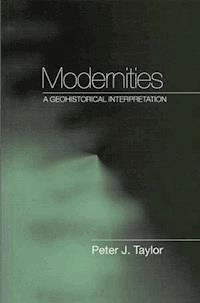
Taylor develops a geohistorical argument which focuses on the periods and places of modernities, offering a grounded analysis of what it is to be modern. He identifies three 'prime modernities' which have defined the development of our modern world: today's consumer modernity preceded by the industrial modernity of the nineteenth century which was itself preceded by mercantile modernity.
Sie lesen das E-Book in den Legimi-Apps auf:
Seitenzahl: 288
Veröffentlichungsjahr: 2013
Ähnliche



















Copyright © Peter J. Taylor 1999
The right of Peter J. Taylor to be identified as author of this work has been asserted in accordance with the Copyright, Designs and Patents Act 1988.
First published in 1999 by Polity Press in association with Blackwell Publishers Ltd.
Editorial office: Polity Press 65 Bridge Street Cambridge CB2 1UR, UK
Marketing and production: Blackwell Publishers Ltd 108 Cowley Road Oxford OX4 1JF, UK
All rights reserved. Except for the quotation of short passages for the purposes of criticism and review, no part of this publication may be reproduced, stored in a retrieval system, or transmitted, in any form or by any means, electronic, mechanical, photocopying, recording or otherwise, without the prior permission of the publisher.
Except in the United States of America, this book is sold subject to the condition that it shall not, by way of trade or otherwise, be lent, re-sold, hired out, or otherwise circulated without the publisher’s prior consent in any form of binding or cover other than that in which it is published and without a similar condition including this condition being imposed on the subsequent purchaser.
ISBN: 978-0-7456-6874-1 (Multi-user ebook)
A catalogue record for this book is available from the British Library.
Typeset in 11 on 13 pt Sabon by Ace Filmsetting Ltd, Frome, Somerset Printed in Great Britain by MPG Books Ltd, Bodmin, Cornwall
This book is printed on acid-free paper.
This book is dedicated to Holly, Colette and Christian
Preface
Prologue: Being Geohistorical
Who’s modern?
Whose modern?
1 Modern, -ity, -ism, -ization
Ambiguous to the core
Social theory with smoke in its eyes
Multiple moderns versus multiple modernities
Modernizations of modernities
2 Prime Modernities
World hegemony as uneven social change
Three prime modernities
Two modernizations of modernities
Consensus and coercion in the projection of hegemonic power
3 Ordinary Modernity
Cultural celebrations of ordinariness
Feeling comfortable: the modern home
Suburbia: the domestic landscape of consumer modernity
Not modernism
4 Modern States
Inter-stateness
Absolutism as a political way of life
Going Dutch
The changing nature of territoriality
5 Political Movements
Parties and movements
Movements and modernities
Socialism against the modernity that Britain created
Environmentalism against the modernity that America created
6 Geographical Tensions
Where and what?
Place–space tensions
Nation-state as enabling place and dis-enabling space
Home-household as enabling place and dis-enabling space
7 Americanization
Incipient, capacious and resonant Americanizations
Inside America: conditions for constructing a modernity
Outside America: seeing the most modern of the modern
Americanization and globalization
Epilogue: Presents and Ends
System logic: the extraordinary effect of ordinary modernity
Political practice: the post-traditional challenge
References
Index
As a British resident, I will always remember 1997 as the year of the modern. In May a General Election landslide produced a New Labour government committed to modernizing Britain. It was led by people who called themselves modernizers. In August Diana, Princess of Wales, died and was immediately converted into a modern icon. Suddenly the words modern, modernity and modernization seemed to be on every news report. The Queen even complained about the world moving too fast, the time-honoured lament about living in a modern world. 1997 was a very modern year.
I had been thinking about modernity for some time before 1997. I began a project about world hegemony in 1990 and somewhere along the way this got interwoven with the concept of modernity. The result, in 1996, was The Way the Modern World Works (1996a), which some reviewers, tired of more about hegemony, had hoped contained rather more on modernity. In fact I only really begin to get to grips with modernity in the last chapter of the aforementioned book. This book builds upon The Way by restating the hegemony–modernity link (to make this book freestanding) but then takes it much further by adding some earlier work on modern politics and recent work and ideas on the ambiguity of modernization. In particular I use the book to promote what I term a geohistorical approach to social science as a reaction against some of the more esoteric treatments of its subject matter. The latter, after all, consists largely of the everyday experience of ordinary men and women.
This is my first book since moving to Loughborough University. I am relishing being in a department with so many fine researchers all interested, in their different ways, in the cultural-political-historical-global mix of ideas that fascinate me. I would defy any human geography researcher not to enjoy the collective intellectual stimulation provided by a group such as Jon Beaverstock, Morag Bell, Ed Brown, Marcus Doel, Mike Heffernan, Sarah Holloway, David Slater and David Walker. In addition, outside the department, there are leading social scientists such as Michael Billig, Linda Hantrais, Ruth Lister, Mike Smith and Robert Walker. Loughborough is a very good environment in which to pursue social science.
At the same time that I moved to Loughborough I became a granddad, a much more important transition in life. This book is dedicated to three bairns for their lovely smiles and impish grins and everything which goes with both.
Peter Taylor
Do you think of yourself as being modern? The chances are you will not have to think too hard about this question; instinctively most readers would say ‘yes, of course I am modern’. To be modern is perceived as being essentially positive, it is about ‘moving with the times’, being up to date, following the latest fashions or using the newest gadgets. For the whole of the twentieth century and for some time before, many, many millions of people have subscribed to the idea of being modern or have aspired to becoming modern. At times modern appears to be an all-pervasive identity, ubiquitous and therefore taken for granted and, if not yet universal, destined to become so. Modern is what we are.
The hold that the idea of being modern has on contemporary life can be appreciated by considering the use of the word modern as an adjective. In my teaching I ask students to fill in the blank in the following: ‘modern…………..’. The range of suggestions is always extraordinary in its breadth. As well as well-known items such as modern jazz and modern art, this word association exercise penetrates all realms of social activity: modern furniture, modern ideas, modern industry, modern science, modern medicine, modern transport, modern families, modern fashion, modern marriages, modern country, modern warfare, modern shopping centres, modern homes, modern farming, modern diseases, modern technology, and the list goes on and on. In nearly all cases the word modern is being used to convey the idea that what is modern is better than what went before – Henri Lefebvre (1995, p. 185) calls it ‘a prestigious word’. Advertisers, and politicians, know this association only too well. Academics are not immune to the attractiveness of this seductively simple adjective either: in one bibliographic search for 1990 to 1997 I was able to find 5,057 items which had modern in their title. I should add immediately that I was not able to read all this work but I presume that in much of these writings modern was being used with its meaning taken for granted. That is to say, it was not interrogated as a concept or idea in the body of the text. So pervasive is this that it may even be the case in situations where such intellectual examination is the of the publication. The (East and Joseph, 1994) is just such a case in point; there is no entry for modern. I guess the implication is that such an entry is unnecessary, everybody knows what modern is. Hence the book before you is redundant … er, well no, do not be too hasty, please read on.
Lesen Sie weiter in der vollständigen Ausgabe!
Lesen Sie weiter in der vollständigen Ausgabe!
Lesen Sie weiter in der vollständigen Ausgabe!
Lesen Sie weiter in der vollständigen Ausgabe!
Lesen Sie weiter in der vollständigen Ausgabe!
Lesen Sie weiter in der vollständigen Ausgabe!
Lesen Sie weiter in der vollständigen Ausgabe!
Lesen Sie weiter in der vollständigen Ausgabe!
Lesen Sie weiter in der vollständigen Ausgabe!
Lesen Sie weiter in der vollständigen Ausgabe!
Lesen Sie weiter in der vollständigen Ausgabe!




