


41,99 €
Mehr erfahren.
- Herausgeber: Packt Publishing
- Kategorie: Wissenschaft und neue Technologien
- Sprache: Englisch
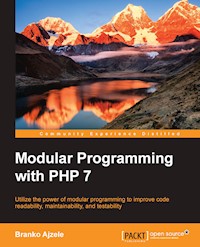
Utilize the power of modular programming to improve code readability, maintainability, and testability
About This Book
- This book demonstrates code reusability and distributed development to get high speed, maintainable, and fast applications
- It illustrates the development of a complete modular application developed using PHP7 in detail
- This book provides a high-level overview of the Symfony framework, a set of tools and a development methodology that are needed to build a modular web shop application
Who This Book Is For
This step-by-step guide is divided into two sections. The first section explores all the fundamentals of modular design technique with respect to PHP 7. The latter section demonstrates the practical development of individual modules of a web shop application.
What You Will Learn
- Discover the new features of PHP 7 that are relevant to modular application development
- Write manageable code based on the GoF design patterns and SOLID principles
- Define the application requirements of a working modular application
- Explore the ins and outs of the Symfony framework
- Build a set of modules based on the Symfony framework that comprise a simple web shop app
- Use core modules to set the structure and dependencies for other modules to use
- Set up entities that are relevant to the module functionality and see how to manage these entities
In Detail
Modular design techniques help you build readable, manageable, reusable, and more efficient codes. PHP 7, which is a popular open source scripting language, is used to build modular functions for your software. With this book, you will gain a deep insight into the modular programming paradigm and how to achieve modularity in your PHP code.
We start with a brief introduction to the new features of PHP 7, some of which open a door to new concepts used in modular development. With design patterns being at the heart of all modular PHP code, you will learn about the GoF design patterns and how to apply them. You will see how to write code that is easy to maintain and extend over time with the help of the SOLID design principles.
Throughout the rest of the book, you will build different working modules of a modern web shop application using the Symfony framework, which will give you a deep understanding of modular application development using PHP 7.
Style and approach
This book is for intermediate-level PHP developers with little to no knowledge of modular programming who want to understand design patterns and principles in order to better utilize the existing frameworks for modular application development.
Sie lesen das E-Book in den Legimi-Apps auf:
Seitenzahl: 275
Veröffentlichungsjahr: 2016
Ähnliche


















Table of Contents
Modular Programming with PHP 7
Modular Programming with PHP 7
Copyright © 2016 Packt Publishing
All rights reserved. No part of this book may be reproduced, stored in a retrieval system, or transmitted in any form or by any means, without the prior written permission of the publisher, except in the case of brief quotations embedded in critical articles or reviews.
Every effort has been made in the preparation of this book to ensure the accuracy of the information presented. However, the information contained in this book is sold without warranty, either express or implied. Neither the author, nor Packt Publishing, and its dealers and distributors will be held liable for any damages caused or alleged to be caused directly or indirectly by this book.
Packt Publishing has endeavored to provide trademark information about all of the companies and products mentioned in this book by the appropriate use of capitals. However, Packt Publishing cannot guarantee the accuracy of this information.
First published: September 2016
Production reference: 1020916
Published by Packt Publishing Ltd.
Livery Place
35 Livery Street
Birmingham B3 2PB, UK.
ISBN 978-1-78646-295-4
www.packtpub.com
Credits
Author
Branko Ajzele
Reviewer
Tomislav Sudmak
Commissioning Editor
Kunal Parikh
Acquisition Editor
Chaitanya Nair
Content Development Editor
Priyanka Mehta
Technical Editor
Ravikiran Pise
Copy Editor
Safis Editing
Project Coordinator
Izzat Contractor
Proofreader
Safis Editing
Indexer
Tejal Daruwale Soni
Graphics
Abhinash Sahu
Production Coordinator
Aparna Bhagat
Cover Work
Aparna Bhagat
About the Author
Branko Ajzele was born in January 1983 and lives in Osijek, Croatia. He is a husband, father of two, book author, and software developer. He holds a faculty degree in electrical engineering. He loves all things digital and makes a living out of software development.
Branko has years of hands-on experience in full-time software development and team management and specializes in e-commerce platforms. He has worked with Magento since 2008, knee-deep since its very first beta version. He is regularly in touch with modern software development technologies.
He has strong technical knowledge and is able to communicate technicalities clearly with strong direction. He feels comfortable proposing alternatives to demands that he feels can be improved, even when this means pulling a late shift to meet deadlines.
Branko holds several IT certifications such as Zend Certified Engineer (ZCE PHP), Magento Certified Developer (MCD), Magento Certified Developer Plus (MCD+), and Magento Certified Solution Specialist (MCSS).
Instant E-Commerce with Magento: Build a Shop by Packt Publishing was his first Magento-related book oriented toward Magento newcomers, after which he decided to write Getting Started with Magento Extension Development for developers. His third book, Magento 2 Developer's Guide, covers Magento 2 e-commerce platform development.
He currently works as a full-time contractor for Lab Lateral Ltd.—an award-winning team of innovative thinkers, artists, and developers, specializing in customer-centric websites, digital consultancy, and marketing—as the lead Magento developer and head of the Lab's Croatia office.
Branko was crowned E-commerce Developer of the Year by Digital Entrepreneur Awards in October 2014 for his excellent knowledge and expertise in e-commerce development. His work is second to none, and is truly dedicated to helping the Lab Lateral Ltd. team and fellow developers across the world.
About the Reviewer
Tomislav Sudmak is a software developer with an interest in all things digital. He developed an interest in programming during his college life while participating at the Start Up Academy, and he has been in love with various software technologies since then.
He has a master's degree in electrical engineering. Through his education, he crafted his skills with PHP and the Laravel framework, after which he became interested in e-commerce and Magento. He has also worked with Symfony, WordPress, Drupal, and other PHP-related frameworks.
During and after college, he worked as a freelancer on various web-related projects.
He has years of hands-on experience with full-time software development related with PHP, which is his main programming language.
Currently, he works as a backend developer in an award-winning digital agency, Lab Lateral Ltd.
During his free time and when he is not doing anything related to IT, Tomislav enjoys going to the gym, riding his bike, and visiting places he has never been to.
www.PacktPub.com
eBooks, discount offers, and more
Did you know that Packt offers eBook versions of every book published, with PDF and ePub files available? You can upgrade to the eBook version at www.PacktPub.com and as a print book customer, you are entitled to a discount on the eBook copy. Get in touch with us at <[email protected]> for more details.
At www.PacktPub.com, you can also read a collection of free technical articles, sign up for a range of free newsletters and receive exclusive discounts and offers on Packt books and eBooks.
https://www2.packtpub.com/books/subscription/packtlib
Do you need instant solutions to your IT questions? PacktLib is Packt's online digital book library. Here, you can search, access, and read Packt's entire library of books.
Why subscribe?
Preface
Building modular applications is a challenging task. It involves a wide spectrum of knowledge, ranging from design patterns and principles to the ins and outs of the chosen technology stack. The PHP ecosystem has quite a selection of tools, libraries, frameworks, and platforms to assist us with our goal of modular application development.
PHP 7 brings a lot of improvements that can further assist achieving that goal. We will start our journey by looking into some of these improvements. By the end of this book, our final delivery will be a modular web shop application built by the Symfony framework.
What this book covers
Chapter 1, Ecosystem Overview, gives a gentle introduction to the current state of the PHP ecosystem. It looks into the latest features of PHP 7, some of which open a door to the new concepts of use in modular development. Furthermore, this chapter glosses over the popular PHP frameworks.
Chapter 2, GoF Design Patterns, describes recurring solutions to common problems in software design. Practical PHP examples are given for each of the following patterns: creation pattern types, structural patterns, and behavioral patterns.
Chapter 3, SOLID Design Principles, dives into the five basic principles of object-oriented programming and design under the acronym SOLID (single responsibility, open-closed, Liskov substitution, Interface Segregation, and dependency inversion).It gives practical examples and explains the importance of these principles in modular development.
Chapter 4, Requirement Specification for a Modular Web Shop App, guides a reader through the process of defining overall application requirements. It starts by defining actual application feature requirements and progresses all the way to the technology stack selection.
Chapter 5, Symfony at a Glance, gives a high-level overview of Symfony as a framework, a set of tools, and a development methodology. It focuses on the building blocks that we will need to build our modular application.
Chapter 6, Building the Core Module, guides you through setting up a core module based on the Symfony bundle. The core module is then used to set the structure and dependencies for other modules to use.
Chapter 7, Building the Catalog Module, guides us through building a self-sufficient module that matches the web shop catalog-only feature set. It shows us how to set up entities relevant to the module functionality and how to manage those entities and their interactions using the existing framework.
Chapter 8, Building the Customer Module, guides us through building a self-sufficient module that matches the web shop customer-related feature set. It shows us how to set up entities relevant to the module's functionality and how to manage those entities and their interactions using the existing framework. It further shows us how to create a register and login systems.
Chapter 9, Building the Payment Module, guides us through building a self-sufficient module that matches the web shop payment-related feature set. It shows us how to integrate with a third-party payment provider. It further shows us how to expose a payment provider as service for other modules to use.
Chapter 10, Building the Shipment Module, guides us through building a self-sufficient module that matches the web shop shipment-related feature set. It shows us how to define several flat methods that yield different shipment pricing based on various cart product attributes. It further shows us how to expose a shipment method as service for other modules to use.
Chapter 11, Building the Sales Module, guides us through building a self-sufficient module that matches the web shop sales-only feature set. It shows us how to set up cart, cart item, order, and order item entities relevant to the module functionality and how to manage those entities and their interactions using the existing framework.
Chapter 12, Integrating and Distributing Modules, integrates all the modules built in the preceding chapters into a single functioning application. Moving on, it guides us through the modern PHP module distribution techniques. These include Git and Composer, which in turn indirectly include GitHub and Packagist.
What you need for this book
In order to successfully run all the examples provided in this book, you will need either your own web server or a third-party web-hosting solution. The high-level technology stack includes PHP 7.0 or greater, Apache/Nginx, and MySQL.
The Symfony framework itself comes with a detailed list of system requirements that can be found at http://symfony.com/doc/current/reference/requirements.html.
This book assumes that the reader is familiar with setting up the complete development environment.
Who this book is for
This book is primarily intended for intermediate-level PHP developers, with little to no knowledge of modular programming who want to understand design patterns and principles in order to better utilize the existing framework for modular application development.
The modular web-shop application developed as a part of this book uses the Symfony framework. However, no previous knowledge of the Symfony framework is assumed or required.
Conventions
In this book, you will find a number of text styles that distinguish between different kinds of information. Here are some examples of these styles and an explanation of their meaning.
Code words in text, database table names, folder names, filenames, file extensions, pathnames, dummy URLs, user input, and Twitter handles are shown as follows: "We can include other contexts through the use of the include directive."
A block of code is set as follows:
Any command-line input or output is written as follows:
New terms and important words are shown in bold. Words that you see on the screen, for example, in menus or dialog boxes, appear in the text like this: "Clicking the Next button moves you to the next screen."
Note
Warnings or important notes appear in a box like this.
Tip
Tips and tricks appear like this.
Reader feedback
Feedback from our readers is always welcome. Let us know what you think about this book—what you liked or disliked. Reader feedback is important for us as it helps us develop titles that you will really get the most out of.
To send us general feedback, simply e-mail <[email protected]>, and mention the book's title in the subject of your message.
If there is a topic that you have expertise in and you are interested in either writing or contributing to a book, see our author guide at www.packtpub.com/authors.
Customer support
Now that you are the proud owner of a Packt book, we have a number of things to help you to get the most from your purchase.
Downloading the example code
You can download the example code files for this book from your account at http://www.packtpub.com. If you purchased this book elsewhere, you can visit http://www.packtpub.com/support and register to have the files e-mailed directly to you.
You can download the code files by following these steps:
You can also download the code files by clicking on the Code Files button on the book's webpage at the Packt Publishing website. This page can be accessed by entering the book's name in the Search box. Please note that you need to be logged in to your Packt account.
Once the file is downloaded, please make sure that you unzip or extract the folder using the latest version of:
The code bundle for the book is also hosted on GitHub at https://github.com/PacktPublishing/Modular-Programming-with-PHP7. We also have other code bundles from our rich catalog of books and videos available at https://github.com/PacktPublishing/. Check them out!
Downloading the color images of this book
We also provide you with a PDF file that has color images of the screenshots/diagrams used in this book. The color images will help you better understand the changes in the output. You can download this file from https://www.packtpub.com/sites/default/files/downloads/ModularProgrammingwithPHP7_ColorImages.pdf.
Errata
Although we have taken every care to ensure the accuracy of our content, mistakes do happen. If you find a mistake in one of our books—maybe a mistake in the text or the code—we would be grateful if you could report this to us. By doing so, you can save other readers from frustration and help us improve subsequent versions of this book. If you find any errata, please report them by visiting http://www.packtpub.com/submit-errata, selecting your book, clicking on the Errata Submission Form link, and entering the details of your errata. Once your errata are verified, your submission will be accepted and the errata will be uploaded to our website or added to any list of existing errata under the Errata section of that title.
To view the previously submitted errata, go to https://www.packtpub.com/books/content/support and enter the name of the book in the search field. The required information will appear under the Errata section.
Piracy
Piracy of copyrighted material on the Internet is an ongoing problem across all media. At Packt, we take the protection of our copyright and licenses very seriously. If you come across any illegal copies of our works in any form on the Internet, please provide us with the location address or website name immediately so that we can pursue a remedy.
Please contact us at <[email protected]> with a link to the suspected pirated material.
We appreciate your help in protecting our authors and our ability to bring you valuable content.
Questions
If you have a problem with any aspect of this book, you can contact us at <[email protected]>, and we will do our best to address the problem.




