


0,99 €
Mehr erfahren.
- Herausgeber: Zenith Whispering Pines Publishers
- Kategorie: Geisteswissenschaft
- Sprache: Englisch
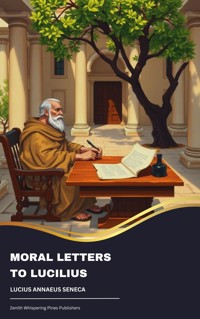
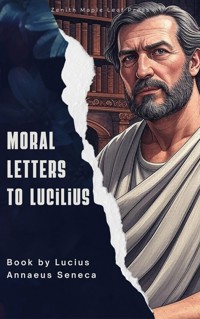
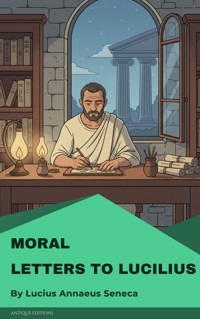
"It is not that we have a short time to live, but that we waste a lot of it." Discover the ancient wisdom that is still radically relevant today. Seneca's Moral Letters to Lucilius is a priceless collection of 124 philosophical essays in the form of letters, written by one of Rome's most influential Stoic philosophers. It stands alongside Meditations as a pillar of Stoic philosophy. In these powerful, personal letters, Seneca explores the core tenets of Stoicism, providing a practical guide to living a better, more resilient life. This work is a masterclass in: Mindfulness and Time Management: Profound reflections, especially in the seminal essay, "On the Shortness of Life." Conquering Fear and Anxiety: Practical advice on overcoming the fear of death and managing daily stresses. The Pursuit of Virtue: A clear path to inner peace and true happiness through reason and self-control. Friendship and Self-Improvement: The timeless counsel of a wise mentor—Lucius Annaeus Seneca—to his friend Lucilius. If you seek the philosophical roots of resilience and desire a structured, deeply engaging approach to personal development, this book is essential. It is perfect for readers interested in stoicism and the art of happiness and the works of Marcus Aurelius. Start your journey to a life of virtue and serenity. Click "Buy Now" and embrace the wisdom of the Stoics.
Das E-Book können Sie in Legimi-Apps oder einer beliebigen App lesen, die das folgende Format unterstützen:
Veröffentlichungsjahr: 2025
Ähnliche







Moral letters to Lucilius/Introduction
Introduction
Among the personalities of the early Roman Empire there are few who offer to the readers of to-day such dramatic interest as does Lucius Annaeus Seneca, the author of the Epistles which are translated in this volume. Born in a province, educated at Rome, prominent at the bar, a distinguished exile, a trusted minister of State, and a doomed victim of a capricious emperor, Seneca is so linked with the age in which he lived that in reading his works we read those of a true representative of the most thrilling period of Roman history.
Seneca was born in the year 4 B.C., a time of great opportunity, at Corduba, in Spain, son of the talented rhetorician, Annaeus Seneca. We gather that the family moved to Rome during the boyhood of Lucius, that he was educated for the bar, and that he was soon attracted by the Stoic philosophy, the stern nurse of heroes during the first century of the Empire. That his social connexions were distinguished we infer from the prominence and refinement of his brother Gallio, – the Gallio of the New Testament, – from the fact that he himself was noticed and almost condemned to death by the Emperor Caligula soon after he began to speak in public, and especially because his aunt, whom he visited in Egypt, was the wife of the governor of that country.
Up to the year 41 he prospered. He makes mention of his children, of his mother who, like the mother of Goethe, seems to have imbued him with idealism and a certain amount of mysticism, and of many valued friends. But during that year, as a result of court intrigue, he was banished to the island of Corsica. The charge against him was a too great intimacy with Iulia Livilla, unfortunate sister of the late emperor, and the arch-foe of Messalina, whose husband, Claudius, had recalled the princess from exile. We may discount any crime on Seneca's part because even the gossip-laden Suetonius says: "The charge was vague and the accused was given no opportunity to defend himself."
The eight years of exile were productive of much literary work. The tragedies, which have had such influence on later drama, are the fruit of this period, besides certain essays on philosophic subjects, and a rather cringing letter to Polybius, a rich freedman at the court of Claudius. In 49, however, Fortune, whom Seneca as a Stoic so often ridicules, came to his rescue. Agrippina had him recalled and appointed tutor to her young son, later to become the Emperor Nero. Holding the usual offices of state, and growing in prominence, Seneca administered the affairs of the prince, in partnership with Burrus, the praetorian. Together they maintained the balance of power between throne and Senate until the death of Burrus in the year 62. After that time, a philosopher without the support of military power was unable to cope with the vices and whims of the monster on the throne.
The last two years of Seneca's life were spent in travelling about southern Italy, composing essays on natural history and relieving his burdened soul by correspondence with his friend Lucilius. In the year 65 came his suicide, anticipating an act of violence on the Emperor's part; in this deed of heroism he was nobly supported by his young wife Paulina. The best account of these dark days is given in Tacitus.
These letters are all addressed to Lucilius. From internal evidence we gather that the native country of this Lucilius was Campania, and his native city Pompeii or Naples. He was a Roman knight, having gained that position, as Seneca tells us, by sheer industry. Prominent in the civil service, he had filled many important positions and was, at the time when the Letters were written, procurator in Sicily. He seems to have had Epicurean tendencies, like so many men from this part of Italy; the author argues and tries to win him over to Stoicism, in the kindliest manner. Lucilius wrote books, was interested in philosophy and geography, knew intimately many persons in high places, and is thought by some to be the author of the extant poem Aetna.
When their friendship began we cannot say. The Naturales Quaestiones and the Letters are the work of Seneca's closing years. Both are addressed to Lucilius. The essay De Providentia, which was also dedicated to him, is of doubtful date, and may be fixed at any time between the beginning of the exile in Corsica and the period when the Letters were written.
In spite of the many problems which confront us, it may be safely said that the years 63-65 constitute the period of the Letters. We find possible allusions to the Campanian earthquake of 63, a reference to the conflagration at Lyons, which took place either in 64 or in 65, and various hints that the philosopher was travelling about Italy in order to forget politics. The form of this work, as Bacon says, is a collection of essays rather than of letters. The recipient is often mentioned by name; but his identity is secondary to the main purpose. The language at the beginning of the seventy-fifth letter, for example, might lead one to suppose that they were dashed off in close succession: "You complain that you receive from me letters which are rather carelessly written;" but the ingenious juxtaposition of effective words, the balance in style and thought, and the continual striving after point, indicate that the language of the diatribe had affected the informality of the epistle.
The structure of each letter is interesting. A concrete fact, such as the mention of an illness, a voyage by sea or land, an incident like the adventure in the Naples tunnel, a picnic party, or an assemblage of friends who discuss questions from Plato, or Aristotle, or Epicurus, – these are the elements which serve to justify the reflections which follow. After such an introduction, the writer takes up his theme; he deals with abstract subjects, such as the contempt of death, the stout-heartedness of the sage, or the quality of the Supreme Good. We shall not mention the sources of all these topics in footnotes, but shall aim only to explain that which is obscure in meaning or unusual in its import. Plato's Theory of Ideas, Aristotle's Categories, Theophrastus on Friendship, Epicurus on Pleasure, and all the countless doctrinal shades of difference which we find in the Stoic leaders, are at least sketched in outline.
But we must give full credit to the philosopher's own originality. In these letters, it is impossible to ignore the advance from a somewhat stiff and Ciceronian point of view into the attractive and debatable land of what one may fairly call modern ideas. The style of the Epistles is bold, and so is the thought.
Considered en masse, the letters form a fruitful and helpful handbook, of the very widest scope and interest. The value of intelligent reading and the studies which make for culture is presented to Lucilius with frequency, notably in Nos. II. and LXXXVIII. Seneca agrees with the definition of higher studies as "those which have no reference to mere utility." The dignity of the orator's profession (XL. and CXIV.) is brought to the attention of a young self-made merchant who seems inclined towards platform display. The modern note is struck when the author protests against the swinish and debasing effects of slavery or gladiatorial combats (XLVII. and LXX.); preaches against the degeneracy of drunkenness (LXXXIII.); portrays the charms of plain living and love of nature (LVII., LXVII., LXXIX., LXXXVI., LXXXVII., XC., XCIV.); recommends retirement (XVIII., LI., LVI., LXXX., CXXII.); or manifests a Baconian interest in scientific inventions (LVII., LXXIX.). Most striking of all is the plea (XCIV.) for the equality of the sexes and for conjugal fidelity in the husband, to be interpreted no less strictly than honour on the part of the wife. The craze for athletics is also analyzed and rebuked (XV.).
The Epistles contain also, of course, the usual literary types which every Roman epistolographer would feel bound to introduce. There is the consolatio; there is the theme of friendship; there are second-hand lectures on philosophy taken from Plato and Aristotle and Theophrastus, as we have indicated above; and several characteristically Roman laudations of certain old men (including the author himself) who wrestle with physical infirmities. But the Stoic doctrine is interpreted better, from the Roman point of view, by no other Latin writer. The facts of Seneca's life prove the sincerity of his utterances, and blunt the edge of many of the sneers which we find in Dio Cassius, regarding the fabulous sums which he had out at interest and the costly tables purchased for the palace of a millionaire.
Finally, in no pagan author, save perhaps Vergil, is the beauty of holiness (XLI.) so sincerely presented from a Roman standpoint. Although his connexion with the early Church has been disproved, Seneca shows the modern, the Christian, spirit. Three of the ideals mentioned above, the hatred of combats in the arena, the humane treatment of slaves, and the sanctity of marriage, draw us towards Seneca as towards a teacher like Jeremy Taylor.
There is no pretence of originality in the Latin text; the translator has adopted, with very few deviations, that of O. Hense's second edition. This text he has found to be excellent, and he has also derived assistance from the notes accompanying the Selected Letters of W. C. Summers.
Richard M. Gummere. Haverford College, May, 1916.
Moral letters to Lucilius/Letter 1
I. On Saving Time
Greetings from Seneca to his friend Lucilius.
1. Continue to act thus, my dear Lucilius – set yourself free for your own sake; gather and save your time, which till lately has been forced from you, or filched away, or has merely slipped from your hands. Make yourself believe the truth of my words, – that certain moments are torn from us, that some are gently removed, and that others glide beyond our reach. The most disgraceful kind of loss, however, is that due to carelessness. Furthermore, if you will pay close heed to the problem, you will find that the largest portion of our life passes while we are doing ill, a goodly share while we are doing nothing, and the whole while we are doing that which is not to the purpose. 2. What man can you show me who places any value on his time, who reckons the worth of each day, who understands that he is dying daily? For we are mistaken when we look forward to death; the major portion of death has already passed. Whatever years be behind us are in death's hands.
Therefore, Lucilius, do as you write me that you are doing: hold every hour in your grasp. Lay hold of to-day's task, and you will not need to depend so much upon to-morrow's. While we are postponing, life speeds by. 3. Nothing, Lucilius, is ours, except time. We were entrusted by nature with the ownership of this single thing, so fleeting and slippery that anyone who will can oust us from possession. What fools these mortals be! They allow the cheapest and most useless things, which can easily be replaced, to be charged in the reckoning, after they have acquired them; but they never regard themselves as in debt when they have received some of that precious commodity, – time! And yet time is the one loan which even a grateful recipient cannot repay.
4. You may desire to know how I, who preach to you so freely, am practising. I confess frankly: my expense account balances, as you would expect from one who is free-handed but careful. I cannot boast that I waste nothing, but I can at least tell you what I am wasting, and the cause and manner of the loss; I can give you the reasons why I am a poor man. My situation, however, is the same as that of many who are reduced to slender means through no fault of their own: every one forgives them, but no one comes to their rescue.
5. What is the state of things, then? It is this: I do not regard a man as poor, if the little which remains is enough for him. I advise you, however, to keep what is really yours; and you cannot begin too early. For, as our ancestors believed, it is too late to spare when you reach the dregs of the cask. Of that which remains at the bottom, the amount is slight, and the quality is vile. Farewell.
Moral letters to Lucilius/Letter 2
II. On Discursiveness in Reading
1. Judging by what you write me, and by what I hear, I am forming a good opinion regarding your future. You do not run hither and thither and distract yourself by changing your abode; for such restlessness is the sign of a disordered spirit. The primary indication, to my thinking, of a well-ordered mind is a man's ability to remain in one place and linger in his own company. 2. Be careful, however, lest this reading of many authors and books of every sort may tend to make you discursive and unsteady. You must linger among a limited number of master thinkers, and digest their works, if you would derive ideas which shall win firm hold in your mind. Everywhere means nowhere. When a person spends all his time in foreign travel, he ends by having many acquaintances, but no friends. And the same thing must hold true of men who seek intimate acquaintance with no single author, but visit them all in a hasty and hurried manner. 3. Food does no good and is not assimilated into the body if it leaves the stomach as soon as it is eaten; nothing hinders a cure so much as frequent change of medicine; no wound will heal when one salve is tried after another; a plant which is often moved can never grow strong. There is nothing so efficacious that it can be helpful while it is being shifted about. And in reading of many books is distraction.
Accordingly, since you cannot read all the books which you may possess, it is enough to possess only as many books as you can read. 4. "But," you reply, "I wish to dip first into one book and then into another." I tell you that it is the sign of an overnice appetite to toy with many dishes; for when they are manifold and varied, they cloy but do not nourish. So you should always read standard authors; and when you crave a change, fall back upon those whom you read before. Each day acquire something that will fortify you against poverty, against death, indeed against other misfortunes as well; and after you have run over many thoughts, select one to be thoroughly digested that day. 5. This is my own custom; from the many things which I have read, I claim some one part for myself.
The thought for today is one which I discovered in Epicurus; for I am wont to cross over even into the enemy's camp, – not as a deserter, but as a scout. 6. He says: "Contented poverty is an honourable estate." Indeed, if it be contented, it is not poverty at all. It is not the man who has too little, but the man who craves more, that is poor. What does it matter how much a man has laid up in his safe, or in his warehouse, how large are his flocks and how fat his dividends, if he covets his neighbour's property, and reckons, not his past gains, but his hopes of gains to come? Do you ask what is the proper limit to wealth? It is, first, to have what is necessary, and, second, to have what is enough. Farewell.
Moral letters to Lucilius/Letter 3
III. On True and False Friendship
1. You have sent a letter to me through the hand of a "friend" of yours, as you call him. And in your very next sentence you warn me not to discuss with him all the matters that concern you, saying that even you yourself are not accustomed to do this; in other words, you have in the same letter affirmed and denied that he is your friend. 2. Now if you used this word of ours in the popular sense, and called him "friend" in the same way in which we speak of all candidates for election as "honourable gentlemen," and as we greet all men whom we meet casually, if their names slip us for the moment, with the salutation "my dear sir," – so be it. But if you consider any man a friend whom you do not trust as you trust yourself, you are mightily mistaken and you do not sufficiently understand what true friendship means. Indeed, I would have you discuss everything with a friend; but first of all discuss the man himself. When friendship is settled, you must trust; before friendship is formed, you must pass judgment. Those persons indeed put last first and confound their duties, who, violating the rules of Theophrastus, judge a man after they have made him their friend, instead of making him their friend after they have judged him. Ponder for a long time whether you shall admit a given person to your friendship; but when you have decided to admit him, welcome him with all your heart and soul. Speak as boldly with him as with yourself. 3. As to yourself, although you should live in such a way that you trust your own self with nothing which you could not entrust even to your enemy, yet, since certain matters occur which convention keeps secret, you should share with a friend at least all your worries and reflections. Regard him as loyal, and you will make him loyal. Some, for example, fearing to be deceived, have taught men to deceive; by their suspicions they have given their friend the right to do wrong. Why need I keep back any words in the presence of my friend? Why should I not regard myself as alone when in his company?
4. There is a class of men who communicate, to anyone whom they meet, matters which should be revealed to friends alone, and unload upon the chance listener whatever irks them. Others, again, fear to confide in their closest intimates; and if it were possible, they would not trust even themselves, burying their secrets deep in their hearts. But we should do neither. It is equally faulty to trust everyone and to trust no one. Yet the former fault is, I should say, the more ingenuous, the latter the more safe. 5. In like manner you should rebuke these two kinds of men, – both those who always lack repose, and those who are always in repose. For love of bustle is not industry, – it is only the restlessness of a hunted mind. And true repose does not consist in condemning all motion as merely vexation; that kind of repose is slackness and inertia. 6. Therefore, you should note the following saying, taken from my reading in Pomponius: "Some men shrink into dark corners, to such a degree that they see darkly by day." No, men should combine these tendencies, and he who reposes should act and he who acts should take repose. Discuss the problem with Nature; she will tell you that she has created both day and night. Farewell.
Moral letters to Lucilius/Letter 4
IV. On the Terrors of Death
1. Keep on as you have begun, and make all possible haste, so that you may have longer enjoyment of an improved mind, one that is at peace with itself. Doubtless you will derive enjoyment during the time when you are improving your mind and setting it at peace with itself; but quite different is the pleasure which comes from contemplation when one's mind is so cleansed from every stain that it shines. 2. You remember, of course, what joy you felt when you laid aside the garments of boyhood and donned the man's toga, and were escorted to the forum; nevertheless, you may look for a still greater joy when you have laid aside the mind of boyhood and when wisdom has enrolled you among men. For it is not boyhood that still stays with us, but something worse, – boyishness. And this condition is all the more serious because we possess the authority of old age, together with the follies of boyhood, yea, even the follies of infancy. Boys fear trifles, children fear shadows, we fear both.
3. All you need to do is to advance; you will thus understand that some things are less to be dreaded, precisely because they inspire us with great fear. No evil is great which is the last evil of all. Death arrives; it would be a thing to dread, if it could remain with you. But death must either not come at all, or else must come and pass away.
4. "It is difficult, however," you say, "to bring the mind to a point where it can scorn life." But do you not see what trifling reasons impel men to scorn life? One hangs himself before the door of his mistress; another hurls himself from the house-top that he may no longer be compelled to bear the taunts of a bad-tempered master; a third, to be saved from arrest after running away, drives a sword into his vitals. Do you not suppose that virtue will be as efficacious as excessive fear? No man can have a peaceful life who thinks too much about lengthening it, or believes that living through many consulships is a great blessing. 5. Rehearse this thought every day, that you may be able to depart from life contentedly; for many men clutch and cling to life, even as those who are carried down a rushing stream clutch and cling to briars and sharp rocks.
Most men ebb and flow in wretchedness between the fear of death and the hardships of life; they are unwilling to live, and yet they do not know how to die. 6. For this reason, make life as a whole agreeable to yourself by banishing all worry about it. No good thing renders its possessor happy, unless his mind is reconciled to the possibility of loss; nothing, however, is lost with less discomfort than that which, when lost, cannot be missed. Therefore, encourage and toughen your spirit against the mishaps that afflict even the most powerful. 7. For example, the fate of Pompey was settled by a boy and a eunuch, that of Crassus by a cruel and insolent Parthian. Gaius Caesar ordered Lepidus to bare his neck for the axe of the tribune Dexter; and he himself offered his own throat to Chaerea. No man has ever been so far advanced by Fortune that she did not threaten him as greatly as she had previously indulged him. Do not trust her seeming calm; in a moment the sea is moved to its depths. The very day the ships have made a brave show in the games, they are engulfed. 8. Reflect that a highwayman or an enemy may cut your throat; and, though he is not your master, every slave wields the power of life and death over you. Therefore I declare to you: he is lord of your life that scorns his own. Think of those who have perished through plots in their own home, slain either openly or by guile; you will that just as many have been killed by angry slaves as by angry kings. What matter, therefore, how powerful he be whom you fear, when every one possesses the power which inspires your fear? 9. "But," you will say, "if you should chance to fall into the hands of the enemy, the conqueror will command that you be led away," – yes, whither you are already being led. Why do you voluntarily deceive yourself and require to be told now for the first time what fate it is that you have long been labouring under? Take my word for it: since the day you were born you are being led thither. We must ponder this thought, and thoughts of the like nature, if we desire to be calm as we await that last hour, the fear of which makes all previous hours uneasy.
10. But I must end my letter. Let me share with you the saying which pleased me to-day. It, too, is culled from another man's Garden: "Poverty brought into conformity with the law of nature, is great wealth." Do you know what limits that law of nature ordains for us? Merely to avert hunger, thirst, and cold. In order to banish hunger and thirst, it is not necessary for you to pay court at the doors of the purse-proud, or to submit to the stern frown, or to the kindness that humiliates; nor is it necessary for you to scour the seas, or go campaigning; nature's needs are easily provided and ready to hand. 11. It is the superfluous things for which men sweat, – the superfluous things that wear our togas threadbare, that force us to grow old in camp, that dash us upon foreign shores. That which is enough is ready to our hands. He who has made a fair compact with poverty is rich. Farewell.
Moral letters to Lucilius/Letter 5
V. On the Philosopher's Mean
1. I commend you and rejoice in the fact that you are persistent in your studies, and that, putting all else aside, you make it each day your endeavour to become a better man. I do not merely exhort you to keep at it; I actually beg you to do so. I warn you, however, not to act after the fashion of those who desire to be conspicuous rather than to improve, by doing things which will rouse comment as regards your dress or general way of living. 2. Repellent attire, unkempt hair, slovenly beard, open scorn of silver dishes, a couch on the bare earth, and any other perverted forms of self-display, are to be avoided. The mere name of philosophy, however quietly pursued, is an object of sufficient scorn; and what would happen if we should begin to separate ourselves from the customs of our fellow-men? Inwardly, we ought to be different in all respects, but our exterior should conform to society. 3. Do not wear too fine, nor yet too frowzy, a toga. One needs no silver plate, encrusted and embossed in solid gold; but we should not believe the lack of silver and gold to be proof of the simple life. Let us try to maintain a higher standard of life than that of the multitude, but not a contrary standard; otherwise, we shall frighten away and repel the very persons whom we are trying to improve. We also bring it about that they are unwilling to imitate us in anything, because they are afraid lest they might be compelled to imitate us in everything.
4. The first thing which philosophy undertakes to give is fellow-feeling with all men; in other words, sympathy and sociability. We part company with our promise if we are unlike other men. We must see to it that the means by which we wish to draw admiration be not absurd and odious. Our motto, as you know, is "Live according to Nature"; but it is quite contrary to nature to torture the body, to hate unlaboured elegance, to be dirty on purpose, to eat food that is not only plain, but disgusting and forbidding. 5. Just as it is a sign of luxury to seek out dainties, so it is madness to avoid that which is customary and can be purchased at no great price. Philosophy calls for plain living, but not for penance; and we may perfectly well be plain and neat at the same time. This is the mean of which I approve; our life should observe a happy medium between the ways of a sage and the ways of the world at large; all men should admire it, but they should understand it also.
6. "Well then, shall we act like other men? Shall there be no distinction between ourselves and the world?" Yes, a very great one; let men find that we are unlike the common herd, if they look closely. If they visit us at home, they should admire us, rather than our household appointments. He is a great man who uses earthenware dishes as if they were silver; but he is equally great who uses silver as if it were earthenware. It is the sign of an unstable mind not to be able to endure riches.
7. But I wish to share with you to-day's profit also. I find in the writings of our Hecato that the limiting of desires helps also to cure fears: "Cease to hope," he says, "and you will cease to fear." "But how," you will reply, "can things so different go side by side?" In this way, my dear Lucilius: though they do seem at variance, yet they are really united. Just as the same chain fastens the prisoner and the soldier who guards him, so hope and fear, dissimilar as they are, keep step together; fear follows hope. 8. I am not surprised that they proceed in this way; each alike belongs to a mind that is in suspense, a mind that is fretted by looking forward to the future. But the chief cause of both these ills is that we do not adapt ourselves to the present, but send our thoughts a long way ahead. And so foresight, the noblest blessing of the human race, becomes perverted. 9. Beasts avoid the dangers which they see, and when they have escaped them are free from care; but we men torment ourselves over that which is to come as well as over that which is past. Many of our blessings bring bane to us; for memory recalls the tortures of fear, while foresight anticipates them. The present alone can make no man wretched. Farewell.




