


Erhalten Sie Zugang zu diesem und mehr als 300000 Büchern ab EUR 5,99 monatlich.
- Herausgeber: epubli
- Kategorie: Fantasy und Science-Fiction
- Sprache: Englisch
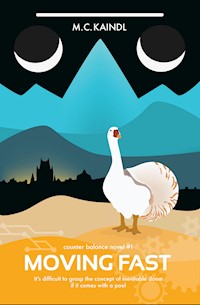
Solitary engineer Ceriel Bleek spends her days in the workshop and her nights in the pub until she invents something so incredible that it will finally make her go down in history – but probably not for very long. With the wizards fearing for their place in the Counter Balance where they run the only long-distance travel bureau, the city's chairman with big plans for Lusona and together with a squad of incredibly unqualified personnel, she needs to save everything.
Sie lesen das E-Book in den Legimi-Apps auf:
Seitenzahl: 409
Veröffentlichungsjahr: 2022
Das E-Book (TTS) können Sie hören im Abo „Legimi Premium” in Legimi-Apps auf:
Ähnliche



















MOVING FAST
M.C.Kaindl
This is a work of fiction. Names, characters, events and places are the product of the author’s imagination. Any resemblance to persons, living or dead, events or locales are coincidental.
Except for Simon.
.
.
.
.
Copyright © 2022 by Manuela Kaindl
Publisher:
Manuela Kaindl
c/o Autorenservice Gorischek
Am Rinnergrund 14/5
8101 Gratkorn, Austria
Print:
epubli – a Service of neopubli GmbH, Berlin
-
To Fabian, the most wonderful person I know, whose instincts are impeccable. Thank you for your invaluable feedback
(even if I just wanted a pat on the back).
-
There was a time when the earth was a few piles of rock in the middle of a prehistoric ocean containing the occasional unicellular organism. From there on, things got out of hand fast. Every action triggered an endless line of reactions, eternally cascading through time and space. Quickly, this led from scaly quadrupeds, trying to walk in early swamplands, to bipeds, trying to walk in new Italian leather shoes. This rapid development knocked the universe out of its long-established balance, causing cracks in the very fabric of existence. To restore equilibrium in the universe and allow further development without breaking everything, the world of the Counter Balance was created. The two worlds are tethered together by an invisible thread – as the original world evolves, so does the Counter Balance, always awaiting the next move.
.∆.
Ceriel Bleek wiped the soot out of her eyes. The phial containing the grey silviter was completely pulverised and spread throughout the workshop.
Concerned, Ceriel touched her face to scan it for missing parts. She relaxed as she noticed that only about half of her left ear was missing – a pre-existing condition. One would think that a person who had already cut her ear off in an experiment would take more precautions, but that’s how it goes: you start out carefully, with goggles and gloves, and with every ten times nothing happens, you get less and less careful until you consider it enough to just know exactly where the protective gear is located in the room.
With the audible pulsing of blood in her eardrums, Ceriel sat down in front of the workbench to recover from the rush of adrenaline that still prickled in her fingertips. She wiped her hands on the apron covering her linen shirt. A few mid-brown strands had escaped from the low ponytail she used to contain her unruly hair. Ceriel always looked a bit like she had just been woken up from a nap and needed to get herself together quickly to answer the door, but the recent explosion had added some derangement.
In the evening, Ceriel always put aside the tools she needed for her day job as a watchmaker to work on her private project. A dim light draped over the filigree gadgets on the shelf behind her and caused the brass to shimmer warmly. Watchmakers preferred brass to any other metal. It was what happened when gold learnt a thing or two about life. On the table in front of Ceriel, the silvery parts of her project reflected the light of the illuminant. Where her new invention was going, the old ways wouldn’t do.
After the dust of the explosion had settled to create a thin layer of scientific error on every surface of the workshop, Ceriel mounted a complex contraption with an optical glass in front of her eye. She leant over a piece of machinery on the workbench, manipulating tiny elements with a pair of tweezers. It required a steady, patient hand, which Ceriel didn’t have. Another lorinx disc crumbled between the pliers. A painful grunt escaped her. She knew very well that rushing would only prolong her work, but there are things you know with your brain and there are things you know with your heart and the two often don’t have a reliable way of communication.
Between the tools and work material, there was only one personal item in the workshop – a dark-haired woman smiled purposefully from a picture behind Ceriel, as if she was looking over her shoulder. Since her early childhood, Ceriel had admired one of the most well-known inventors and scientists of her time, Mareena Gible. Mareena was one of the few people ever to be published as an image in print. She not only had her likeness printed as pictures for her admirers to put on the wall but she was also published in the most important book on the continent: The ‘Manual of Working Things – Handbook for Tools of Daily Use and Technical Progress’ was edited by the Magistrate of Technology and explained how to use and maintain all inventions currently available.
The last major update was Mareena Gible’s invention of a tramway – a large vehicle moving on tracks through the city. While officially called ‘Bolt’, it was often called the ‘Lazy Horse’, or simply ‘Lazy’, because one could still travel more swiftly using a horse-drawn carriage or by walking slightly faster than usual.
The Bolt connected the main points of interest in Lusona, such as the market, the harbour and the city centre, and it was free of charge. Every earlier means of transport had involved the physical labour of animals or people, so it was considered a big deal.
Mareena was said to have died in a tragic accident trying to invent an immensely potent drink based on industrial alcohol, grape juice and nitroglycerine. It had been impossible to identify her body or even locate most bits of it.
Ceriel looked at the picture of Mareena. She did not see the person, Mareena Gible; she saw the image of an inventor who had gotten the world to remember her long after her death. She had left a deep and wide footprint on the face of the earth. That was what Ceriel wanted.
Mareena had already worked on means of transportation, but in Ceriel’s opinion, there was room for improvement. The trams did bring people from one place to another, but only within the city limits and too slowly. For every trip beyond the walls of Lusona, the citizens had to stand in line at the station the wizards had put up for long-distance travel. Since there was nothing besides a stagecoach to travel middle distances, which was inconvenient and expensive, people used the service of the wizards. The traveller had to fill in details about the stay abroad and make binding arrangements for their return. Regulations defined how much luggage could be transported and to which locations, and at what times travel was possible. On top of that, it cost almost as much as the coach.
Only the Lusona Society of Wizardry knew how the transportation worked. The passenger was led into a darkened room and got out the other side at their grandmother’s house, their holiday destination or, sporadically, the crocodile swamps of Zeeneder. The latter fell into the money-back policy – in case the traveller made it back – the money being paid as a proportional refund, depending on how much of the traveller came back to claim it. For the transport, a wizard had to be present, and since there were only 24 wizards in Lusona, there was not enough magic to cover many journeys. Where magic was not an option, technology had to fill the void.
For over a year now, Ceriel had spent most of her spare time working on her transportation project. There must be a better way to get around, one where the traveller decides where to go, and nobody has to account for where they are going. A fast, cheap and simple solution for everyone.
Ceriel felt she had really got somewhere in the last month. There were all the signs of something working soon. One of the signs being that it did not work yet, but there was flickering, there was flashing, there was the promise of a future with her machine in it and it changing the world.
A gentle sound mixed into the ticking in the workshop. It resembled a far-off thunderstorm, announcing itself long before it arrived but with a higher pitch. Under the workbench, Ceriel found a dark storm cloud, the size of a grapefruit, hovering in the air between the table legs. It moved somewhat erratically. Noticing a few drops of water on the floor, Ceriel ushered the cloud out from under the table and over an empty bowl with circular lime deposits on the workbench. A few seconds later, the weather phenomenon violently expelled water into the vessel, throwing tiny bolts of lightning at the closest objects. Uncommon for a cumulus cloud, which was usually white, puffy and produced no precipitation, this one was dark blue, often illuminated by little flashes on the inside and it occasionally flooded the workshop. It was also uncommon for cumulus clouds to reside indoors.
Trying to save a particularly delicate piece of machinery from being fried by an incontinent aerosol, Ceriel lost her train of thought. That was as good a reason to close up for the night as any.
.∆.
The wind was biting, and it was chasing autumn leaves down the road when Ceriel left the house through the shop’s door. During the night, a second plate was added to the ‘We’re open’ sign. It now read ‘We’re open – when we’re open’. Ceriel draped her cape tighter around her, shielding her ears from the cold.
Most of the houses in Tower Street were residential buildings – narrow and half-timbered, with peaked roofs leaning far into the street, almost meeting in the middle. Flower boxes sporadically underlined windows, populated with the same two colours of cranesbill for several hundred years into the past, as well as, Ceriel was sure, several hundred years into the future. Wrought-iron lamps illuminated the street randomly, leaving dark spots on the road, but picturesquely highlighting some shop’s displays.
Ducking her head, Ceriel hurried along the street and around the corner to the Mole, Rat & Badger. The Mole was the kind of pub that left nothing to be desired, if you desired to drink beer from an adventurously dirty glass. It also left you nothing of whatever it was you had brought in with you in case you were a stranger.
Warm light fell through the crown glass windows of the pub and shimmered on the cobbled street. Ceriel pressed her body against the massive wooden door to open it. It was not only the weight of the door that made it difficult to open, but also a semi-conscious coastguard who was leaning against it from the inside.
‘Hello, Cer.’ The barkeeper nodded in Ceriel’s direction.
‘Hello, Adamus,’ Ceriel replied, taking her place on a bar stool in the corner where the counter met the moss-green wall. She had a glass of beer in front of her in an instant. The foam towered over the round-bodied mug the Mole’s crew had gotten her for her 15th birthday. Ceriel had been an old regular of the pub since her childhood. Her father, a petty crook in times when the law was more of a recommendation than a rule and people who did not live by it were considered charming rascals, had taken her. No matter what crime he committed, he just had to wink and have his eyes twinkle, and people would go ‘oh you’ and waive away the deed. From her father, Ceriel had inherited the ability to get away with everything with the wink of an eye, but she hardly made use of that gift – it felt like an unfair advantage.
‘How are you doing?’ Adamus, the pub’s owner with a heart of gold and a liver of less precious but probably more robust metal, disregarded any advances by other customers to get their order placed, and moved over to Ceriel.
‘Did you hear that Lidi was taken yesterday?’ he asked in a low voice.
‘What’s the accusation?’ Ceriel tried to reach her drink through the thick layer of foam.
‘They say she nicked the Lanser’s milk cow, made it into stew and sold it on her cart.’ Adamus leant on the counter in Ceriel’s direction.
‘And, did she?’ Ceriel leant in from the other side.
‘She did not!’ Adamus raised his voice in excitement and stood up straight. ‘It was no stew at all.’ He paused. ‘It was braised beef, I think. Potatoes and everything. Very tender. For a milking cow.’
Ceriel nodded. She had got to know the regulars as aunts and uncles when she’d spent her afternoons and early evenings drawing on the writing pad typically used for taking orders. She had grown out of calling the guests Uncle Serill and Aunt Mini and so on, but they somehow still belonged to her family – or they were her family. Amongst these cardsharps, swindlers and thieves, and in the depth of thick cigar and pipe smoke, she felt most at home. Feeling at home wasn’t necessarily tied to feeling good, but at least she felt like she wasn’t out of place. Still, having a regular job and no intentions of pursuing a criminal career or even starting to smoke, she was an island in this turbulent sea that swept its occupants in and out of prisons and infirmaries.
Ceriel had known Adamus for several years and enjoyed talking to him. He did not ask complicated questions, primarily as he lacked the required vocabulary. Ceriel especially liked the way he’d got the pub. It was not the usual violent way that came with bruises, broken ribs and the inevitable exchange of the pub’s glazing. Adamus had simply won the bar from the former owner in a game of rabble. He had used marked cards and a few extra aces, but so had the former owner. It boiled down to a game of skills, including eight Aces of Acorn in one deck.
Ceriel’s father used to say that you should not start a game of rabble without a stiff drink, an ace up your sleeve and a very fast horse. This was also how he had left the family. Without knowing why, Ceriel always carried an Ace of Acorn in her bag. She never played rabble, but just in case.
Ceriel noticed raised voices in another corner of the bar. Two men stood in front of a table, which was dripping with candle wax. With his hands firmly on the tabletop, one of them leant towards another man, who was sunk in his chair with the facial expression of the holistically horrified. The two drunkards were well known. They were Jon, a daytime woodworker and nighttime thief, and Linnarde, his brother, who dedicated all of his time to profitable wrongdoing. The man in the chair was a stranger to Ceriel.
‘Who’s that?’ she enquired.
‘Don’t know. Came in here all dressed up like a ship’s clown. The guys don’t like strangers in the pub. Or anywhere, really. He’s gettin’ a good talkin’ to.’ Adamus poured gold-coloured beer into a glass while looking over to the table in amused anticipation. The crowd in the Mole, Rat & Badger was suspicious of new people. New people meant trouble. They might be undercover city guards, or they might be dirty rabble players. As dirty as themselves, that was. No one wanted to be around people as bad as themselves.
‘Make them be reasonable, will you? He’s half their size. And half their quantity. Just throw him out before they do.’ Ceriel felt distracted. She had come over to talk to Adamus about the work she had done in the last few days. He could not contribute, look interested or with both eyes in the same direction, but phrasing her thoughts helped her understand them better. Also, beer helped. It helped loosen her tongue and get a stream of consciousness going. Adamus might as well have been a wooden duck she talked to, but a duck would have a hard time refilling her glass.
In the corner of her eye, she noticed Adamus carrying the stranger out by the collar like a kitten.
‘So, I tried linking the taepiphysic axiometer to the gauge. I wanted to wait until the binnacle pitch was ready, but then I thought it might be better this way around,’ Ceriel began.
Adamus had just got back behind the bar and his eyes became glassy in an instant.
‘It blew up in my face. I must have underestimated the tension of the fluke immensely. Only one part is gone, but that was close.’ Ceriel focused on Adamus, who pretended to wipe the counter with an old rag. ‘You see, that puts it in a whole different perspective.’
‘Hm.’ Adamus nodded towards Ceriel’s empty glass. ‘You want another?’
‘Yes. Make it large.’
An hour went by, during which Ceriel told Adamus all about the last few days of her project, what had gone wrong, and how she felt she was still heading in the right direction. She had to wake up early the following day to open up the shop, so she got up, staggering slightly. The pub was crowded now. Ceriel channelled her way through the lot of them to find the coastguard still leaning against the door. She reached up to pinch his cheek.
‘Good morning. Time to go home now, isn’t it?’ Ceriel shouted encouragingly in his ear.
The large man stood up tall and blinked slowly. He seemed to be trying hard to combine the multiple images floating in front of his eyes.
‘Ceriel, when did you get here?’ He smiled without haste and fell over.
The air outside was thin. The sharp wind rearranged Ceriel’s hair and brain and made her focus again, but there was nothing left to focus on.
.∆.
The shop was slightly dusty, and the sun, falling through the stained window, shone its light on particles floating lazily through the air. It was no coincidental dust, nor was the glass frosted with a brownish hue by accident. When people walk into a watchmaker’s shop, they expect things. They expect the person behind the counter to wear a pair of glasses and greet them in a soothing voice. They expect a thin layer of dust on the shelves, not the type you get from neglecting basic hygiene, but the type you see in mysterious places, promising old books with ancient knowledge and secrets long forgotten. They expect the light to be faint and golden. People come in from the stream of life that rushes past the door. They step in and find a place devoid of time, filled to the brim with its instruments. The watchmaker is not subject to time. One can confidently assume that time does not especially appreciate clocks or their makers. It feels watched.
A watchmaker’s shop ought not to change, and when you come in as a grandmother, you will feel once again like the young girl that came in holding her father’s hand when he had his pocket watch repaired. You feel a deep attachment to the universe, where everything changes ceaselessly, by having this one anchor in time. And like holding on to a rock in the middle of an untamed stream, you suddenly feel time washing away over you, and you look at your hands and see that you have grown old, and you wonder how that happened and why you married that guy you just wanted to go for a drink with.
A shop is not all magical just when one shoves a bunch of watches in it. It needs careful crafting of the interior design, with dust being a valuable stylistic device that could be ordered along with gears and balance swings, and it requires a stoic refusal of refurnishing. Florigal Mile was an exemplary shop owner when it came to not moving the furniture. Usually, she minded the shop while Ceriel worked on repairing and maintaining whatever the customers brought in. Ceriel only went upstairs to write orders, get the broken watches, take the mended ones up, and whenever Florigal persuaded her to eat. Today, she did the repairs on the shop’s counter next to the cash register, since Florigal had to do some bookkeeping in the back. Ceriel could not focus on Mr Donell’s watch, which had a severe case of someone sitting on it. She kept thinking about the next steps of her project.
Mr Donell’s watch fell out of the case in Ceriel’s hand and onto the dark wooden counter with a cheap-sounding clang. Simultaneously, the little bell on the door that announced customers jingled. Ceriel winced. Along with a gush of cold air, a young man entered, hiding his face in his coat’s collar and carrying a parcel under his arm.
‘Hello, Ceriel,’ the young man said as if it was the most normal thing in the world. He wore a grey, woollen cape coat, leather boots and tight, tough trousers. The shoes had been shiny once, but shiny was not for people who had to walk six hours every day, jerk open gates with their feet when their hands were busy balancing parcels, or regularly run from guard dogs and, occasionally, geese. His face, much like the boots, was worn beyond his years. He must have been in his twenties, but his skin and facial features made it look like he’d spent most of this time out in the rain. His ridiculously golden hair, which appeared to be the one thing on him that had just recently been restored like an ancient piece of furniture, fell in his eyes.
‘Hello,’ Ceriel answered after too much time. She could not remember his name for the life of her.
‘Danee!’ Florigal came out of the back kitchen. ‘How lovely! What do you have for us?’ she enquired cheerfully with her deep and raspy but warm voice.
Danee, that was it. Ceriel felt the urge to make space in her head to remember otherwise useless things like names of people. She decided to make an effort on the social front for a change.
‘Hello, Danee,’ she said, more quietly than she had planned, and she wasn’t sure if he had heard her. For a moment, her brain raced and weighed the options of saying it again and maybe looking like an idiot or not saying it again and being somewhat rude.
‘It’s from “Tock Pete and Sons”,’ Danee read from the parcel before Ceriel could decide on further steps. ‘I think it’s the parts you ordered last week. They are really fast.’
‘They use a Linquist A83 to produce balance springs now,’ Ceriel said. ‘The “Pigtail Twister’’ at the back of the machine does a flawless overcoil that only needs little manual adjustment.’ Ceriel caught herself lecturing and quickly stopped talking. That probably wasn’t a good start for a polite conversation and she regretted it immediately. She thought about all the other things she could have said instead, like “Yes”.
‘You know a lot about machines,’ Danee said. ‘I wouldn’t even know what a valants spring is. My cart only has two wheels and a thing … stick in between them—’
‘An axle,’ interrupted Ceriel. Damn.
‘Yes, that, and a handle. It’s as old as me, but it never breaks down.’
Ceriel gathered herself. She roughly understood the concept of reliability, which seemed to be worth more than convenience for many.
‘But do you not wish for something a little smarter when you drag your cart up Mill’s Hill?’ Ceriel wanted to know. In anticipation of an answer, she even looked at Danee instead of the watch before her. Ceriel knew that his route included walking up the steep road of Mill’s Hill twice a week to deliver to the houses built up there. He pulled the cart through icy winds from the north, in the drenching rain from the cloudbursts around the festivities of Boar Charming, or the baking heat of the late summer, when the street was flickering and the postman was fried from both sides.
Danee thought for a while and then lit up.
‘I could use some sort of a roof. Made from something light. That would keep me dry and shady, at least in most weather.’ His smile spread across his whole face. ‘The idea just came to me like that, hit me like a hammer.’
Ceriel was slightly disappointed. On some level, she thought he would be able to grasp the need for effortless transportation. She felt as if she had tried to teach a dog to write his name, but he had only managed to sit and stay. It was somehow to be expected, but a setback nonetheless.
‘That’s a good idea,’ she said with a soft voice. She could have thought of ten better ideas and in fact, she had been working on one of them for quite some time.
‘That is a great idea, love!’ Florigal weighed in and placed her hand on Danee’s shoulder. ‘You are a scientist too, aren’t you? The two of you could go about inventing things,’ she said with a hearty laugh. The stout woman had about the same amount of black hair as she had grey, and it was all twisted into a bun in the nape of her neck which saved her from whiplash whenever she threw her head back laughing. It was the type of bun one would see in a person who does not take the time for unnecessary things in life. Florigal was a busy enterprising lady who not only ran the shop, but also rented out every available room of the house to people in need of a place to hang their hat. Thanks to the motherly care, empathetic advice, and butter-heavy cooking Florigal imposed on the residents, most of them averted all other kinds of hangings.
‘Sure,’ Ceriel said, with no plan of following up on Florigal’s idea at any point. She suppressed the many sarcastic replies forming in her head. Ceriel longed for the time when Danee might have been a smart man – right before he had opened his mouth. She felt sorry for herself for not having found a better recipient for her new effort of talking to people.
‘Anyway,’ Danee picked up the conversation, ‘here’s your package.’ He handed the small bundle wrapped in brown paper over to Florigal. ‘That will be 62 shilling, thank you very much.’
Florigal opened the cash register with a high-pitched ring.
‘Thank you so much, dear. And let me give you the new order as well. Ceriel, do you need anything else from Tock Pete’s?’
‘No, thanks,’ Ceriel replied then added, ‘I think you should work on your idea. Make a prototype.’ That was tough to say, but she felt much better now that she could push it over the edge of her lower lip. Danee lit up and blushed under his golden strands. How was his hair so golden? Her urge to touch it and feel from which material it was made had recently weakened but was still detectable.
‘Thanks, Ceriel. Coming from a real inventor, that’s something.’ He showed a smile, wider than seemed possible, considering the anatomic foundation of his face. It was only stopped on each side by a pair of red ears.
.∆.
It is unlikely that any resident of the Counter Balance ever correctly imagined the original world, just as it is unlikely that anyone inhabiting the original world ever imagined the Counter Balance correctly. Philosophers and physicists (and their ungodly combination: metaphysicians) on both sides have been thinking about other worlds, but that was more of a conceptual approach, and no one was able to narrow it down to what really existed. They thought about dimensions where anything was possible, where they could be anything. There might be a universe where they were movie stars instead of philosophers, or they had black hair instead of grey strands around a bald top or where they weren’t named Gottfried, but there was often this one big flaw in their thinking: they thought that if there was another world, they would be in it.
.∆.
The bell on the shop’s door announced the entrance of Danee. The young mailman held a parcel in his arms and had a big smile across his face. Ceriel just happened to be bringing a repaired watch upstairs from the workshop. The open door let in a cold that cut through the cosy warmth of the tiled stove.
‘Ceriel, perfect!’ Danee cheered. ‘I have a delivery for you!’ He quickly handed over the package. ‘Sorry, it took so long. I reckon the parts are difficult to make or something.’
Ceriel lit up with excitement. She had been waiting for the new parts for several weeks already. Every chance she got, she came up to the shop to check whether they had finally arrived.
‘Great, thanks!’ she shouted a little too loudly.
‘Wanna see something?’ Danee blushed slightly. ‘Remember when we talked about making my cart better? I also did some inventing.’
Ceriel did not want to see “something” or anything other than the inside of this box. This box contained the parts she needed to finish her project.
‘It turned out great. We already have orders.’ Danee looked so happy and was so eager to show her what he had done that it would have been cruel not to let him. He was like a little puppy. He had big glossy eyes, and he wanted a pat on the head. Ceriel felt an excited prickling in her fingertips. She could not stand another minute without getting started with her new parts, but she took a deep breath, just so much that Danee would not notice. At least not consciously.
‘Show me then,’ she said without detectable joy and with a docile hint of a smile. She followed him out of the shop and onto the pavement. The wind drove a thin layer of snow over the cobblestones. There was hardly a day without wind so close to the harbour. Ceriel pressed her hands under her arms for warmth. On the side of the road stood the post cart, loaded with parcels of different sizes and two large bags of letters. The big difference, from every time Ceriel had seen that cart before, was an elegant dark blue roof over the spot where the mailman was positioned when dragging the vehicle. It was a bit peculiar to see the old brittle cart, which had probably been used for generations, featuring a brand-new roof of what seemed to be thin but tightly woven fabric mounted on a delicate metal frame.
‘Look! You can even push it back.’ Danee pushed the roof, and it folded into a slim bar. He dragged it towards him and it unfolded like the wings of a giant bat, catapulting a handful of snow into the air. Ceriel went closer to examine the mechanism. It looked uncomplicated. She had been inventing complex mechanics, evaluating chemical reactions and combining novel materials for her project, but sure, weld a few sticks together, slap some fabric on and call it an invention.
‘It looks nice, Danee. Who made this?’ she asked.
‘I took my plan to Herol the blacksmith. He does a lot of fine work and jewellery too, and he liked the idea. He made a few changes so it would fold, but in principle, it is still what I wanted.’ Danee fondly ran his fingers along the edge of the roof. ‘He used a light metal that’s bendy but sturdy, and I chose the fabric. It’s my favourite colour, and it is also light and tough, for when the wind is strong. Herol had a finish that we used to coat the fabric with, so no rain and snow can get through either.’ He smiled and slapped the roof from below, which lifted another handful of snow off the fabric. ‘And it makes it a bit shiny too.’
‘It looks really good,’ Ceriel said. She thought it was a pretty-looking feature for the old cart but hardly more. ‘I like the colour too,’ she added, ‘and very well-done mechanics.’ She walked around the cart, leaving footprints on the white street. ‘But can it make you faster?’ she asked, carefully trying to make Danee realise that his idea may be pretty but wasn’t a paragon of progress.
‘I get my parcels and letters done perfectly on time every day, thank you very much. I don’t need to be faster. I need to be drier.’ He laughed.
‘But imagine you could be done with your work in half the time.’
‘What would I be doing with the leftover hours then?’
‘Well, you could deliver more parcels and letters.’ Ceriel was hoping that he would catch up with her soon.
‘But there aren’t more parcels. This district has two mailmen – Raneo Jonsa and me – and he would be calling me names up and down Mill’s Hill if I was to take away his deliveries too. He gets cake here and there on his route. He has a good route, and he wants to keep it.’ Danee seemed agitated so Ceriel gave up. ‘I’m also paid by the hour, you know?’ he added.
‘Well, it’s a nice roof you built. I’m sure it will help you with the weather,’ Ceriel said to cheer him up again.
‘Thanks, I’m sure it will,’ Danee said, back in his good mood in an instant. ‘I’m glad you like it. I don’t know any other inventors.’
.∆.
Linees Peryll had a plan. He always had a plan. It was not always good or even average, but a man had to have a plan. If you didn’t have a plan, how could you tell when things started to go wrong? His system was boldly pointing out issues since he began the current undertaking. It was known in the underground that two monks of the Order of the Living Cunin walked around the monastery every half hour. Today, they were circling the premises every fifteen minutes, and there were three instead of two. And primarily, instead of strolling monks, they were armed guards.
Linees stood inconspicuously at a shop’s display, pretending to browse the fruit. The followers of Cunin were numerous, compared to other religions, bordering on a thousand supporters, most of whom lived in the centre of Lusona in and around the monastery. Several other, smaller, groups were scattered over the whole continent.
Linees needed to be successful by the end of the day, that much was certain. For now, many things seemed to stand in the way of that. The monastery was a complex of six buildings, arranged in a star shape around the central “Great Hall”, where the monks gathered and prayed every day. The buildings around the centre were housing for the believers, a communal kitchen and wash house, as well as a dining hall furnished with long tables that could seat all active members of the religion in Lusona. The complex was surrounded by a wall about two and a half times Linees’ height. Along its top grew a border of colourful flowers between lush green leaves throughout every season. They had been planted to make the religious headquarters more inviting and friendly but also to conceal large shards of glass that were supposed to keep out those with ill intentions. One could argue that just having the glass without the flowers would have been the more humanitarian choice, but then again, arguing with inveterate religious followers often turned out to be futile and had made many a weary contender want to bite into the upholstery.
Thankfully, Linees knew about the glass and also about the pitfalls on the premises of the Living Cunin. In the underground, where criminals spent most of their recreational time, all traps and every ambush targeted at burglars were known and shared faster than the Cunin’s could dig their holes, tension their wires and tinker buckets of tar on top of doors. The pitfalls, designed to secure the legacy of the Living Cunin, only ever trapped their own designers, who kept forgetting about the locations after a few years, months or even weeks. After several severe injuries, the followers of Cunin decided to remove the spears from the bottom of the pits and replace them with a comfortable layer of straw. They also placed small rations of snacks in the traps to pass the waiting time until any of their fellow believers noticed the absence of the captive or the gaping hole in the ground.
Linees planned to use the first masking shadows of the falling night to sneak onto the premises while the grand door was still open and tiptoe close to the wall of the sleeping quarters, but the heightened security worried him. Postponing the operation was not an option. Seminesk Rochade was waiting for the haul at the harbour to take it to a hideout on a nearby island. They would wait a week or two and then offer it to the Cunins for 100,000 shilling, somewhat sharing the money between themselves, with Seminesk receiving the vast majority of the income. Linees knew that this arrangement was hardly fair, considering he did all of the work and had all of the risk, but Seminesk Rochade was not a partner in this crime – he was the employer, and he expected results or else . . .
He also very much expected the results to materialise tonight, and Linees was unwilling to lose more body parts than necessary.
The night rolled through the streets and filled every corner and pothole with darkness. The guards had just passed the monastery entrance, so Linees would have about fifteen minutes to get within the walls and find a hideout. He stood in the doorway of a residential building and let one eye peek up and down the street for passers-by. His street-mutt blond hair was moving erratically in a gust of cold wind trapped in the niche. The pedestrians were frequent, so he could not find a good time to slip into the complex unseen. He turned a coin in his pocket nervously. It was his lucky coin. The first shilling he had ever stolen.
It was not actually the first shilling he had ever stolen – he had spent that one a thousand times over – but he liked to think about it whenever he felt for some change in his pocket. As a young boy, money had been as scarce as parental guidance. From his mother, he had learnt few things, or at least he only remembered few things. One of them was that everything was more valuable when you owned it. She had explained that you would not buy a new horseshoe from the blacksmith for 10 shilling, but if it was yours, you would expect 10 shilling from somebody else for it. Therefore, the value must increase by possessing something. This one shilling in his pocket was valuable to him because it was his. Linees had started his moderately successful career as a thief, and today, he could easily afford the 10 shilling for a new horseshoe or, well, he could just steal it.
As a young couple went along the street and passed the entrance, they seemed engrossed in their conversation, so Linees leapt out of his dark doorway as silently as possible and over the street towards the monastery. His shoe slipped on the sandy ground and made a loud “chhhrrrrt” sound under his foot. Startled, the couple turned around. Linees dived, head first, through the entrance at that very second.
Behind a marble statue of a leopard almost twice his size, Linees found temporary shelter from being discovered. The fifteen minutes in which the guards were busy circling the premises were almost over, and he only had another fifteen minutes before the gate was closed for the night. Two voices behind him made Linees turn around in alarm, pressing his back against the wall. Two followers of the Living Cunin walked around the corner and came through the entrance. Their long purple robes with orange hoods, draped elegantly around them, moved with every stride as only expensive fabrics, made from the expensive secretion of expensive animals, do. The monks did not notice the black figure hiding behind the leopard and strolled to the sleeping quarters. Linees had not thought of disguising himself to get in, and the idea just now dawned on him. Soon, there would not be enough time to enter the Great Hall and make it off the premises. Linees’ heart was pounding in his chest.
This was more complex than what he usually did. In, take, out, run – that was mostly it. Now that the two monks were securely deposited in the sleeping quarters, he seized the opportunity to sprint to the door of the Great Hall. He had not planned to take the shortcut over the main path, running inelegantly, his long arms and legs awkwardly wiggling around his body, but nothing of what had happened so far had been part of his plan. Quickly, Linees grabbed the large handle of the entrance, opened the door and slipped in.
The Great Hall housed the Cunin Cylinder, a valuable artefact of clay covered in ancient characters. The cylinder was not made of precious material nor could anyone alive read the inscription, but the followers of the Living Cunin worshipped the lump of baked dirt. They believed that Cunin himself once put his feet up on the cylinder after a long walk. Linees had received clear instructions on the whereabouts of the cylinder and a piece of paper depicting its inscriptions in case he had to distinguish it from other artefacts.
At least a hundred candles on each side lit the Great Hall. The golden intarsia shimmered in the unsteady light, and Linees could not help feeling a little touched by the solemnity that the monks had so devotedly manufactured. Tall, colourful windows depicted a sequence of Cunin taking an extensive hike, ending with a lead-framed image of the prophet, resting his feet on an earthen cylinder. The brickwork was whitewashed and supported by dark wooden beams that also carried the roof. Between the vast number of candles, standing on three layers of landings on the sides, the wooden floor was empty. The Cunins did not seem to use chairs. The room could only accommodate approximately 40 people at a time and Linees wondered if the monks drew straws to determine who could go inside to pray.
During the day, the Cunin Cylinder was kept on display on the altar at the front of the hall. During the night, Linees knew, it was stored in a tabernacle, a cabinet with a lock, behind the artefact’s daytime location. He strode rapidly towards the front, causing the candlelight to quiver. The altar was full of objects the believers had brought Cunin as a sacrifice. Nervously, Linees fumbled for the tools in his inside pocket and laid out three metal pins of different shapes. He brushed away a glass, a comb, a cloth and a strangely luminescent toupee to be able to place his elbows on the slab of Helonian marble and inserted a pin in the lock of the tabernacle. What kind of god did they think would answer their prayers in exchange for a glowing wig?
The keyhole was shaped differently. Compared to an ordinary keyhole, it was larger in total size and narrower in the middle. Linees inserted the second pin and started scrubbing. It felt like the pin was utterly lost in the lock. It moved in all directions without a hint of grip. Droplets of sweat began to form on Linees’ forehead, and his hands started to tremble. Pleadingly, he looked around himself to find something he could use to open the cabinet – a key, a larger pin, an axe. He scanned the divine sacrifices. The flimsy comb? The copper tea kettle? The miniature statue of a dog that was missing one leg and good taste? A dark metal rod lying between the wig and a brightly coloured stone caught Linees’ eye. It was significantly larger than his pins, more than a finger in width. He inserted it into the lock. The gears and bolts on the inside started reacting to its movements.
Click, click, clack, and the double-wing door slightly opened. Linees grinned.
He opened the door and stood in front of a complete lack of Cunin Cylinder. The tabernacle was so empty that it echoed the thud when Linees’ heart plunged into his stomach. Some gold coins were scattered at the bottom, which he had no interest in because they would not save his toes from being severed by Seminesk.
Bright light and noise suddenly filled the room. Linees turned around. Through the door, more guards than he could count streamed into the Great Hall carrying illuminants and truncheons, all aggressively directed at Linees.
‘He really came back!’ cheered a monk, squeezing through the crowd.
‘Don’t move!’ shouted the officer, who was first through the door, ‘You are under arrest!’
.∆.
With Mareena’s fierce eyes staring down at her from the picture, Ceriel worked feverishly on a delicate metal element. She had made a lot of progress in the last few weeks. There was spinning and gurgling going on in all the right places. Ceriel had to steady her hands, shaky from anticipation, at every connection of a new element. Her workshop table was covered with glass, metal and modern composite materials, many in shapes that had never been used or even seen before. A titanium pad, resembling a horned elephant on a boat, lay next to a crementhium element with twelve perfectly regular pentagons on each of its twelve sides. When it came to geometry, the Counter Balance had not moved very far outside the concept of cubes. They were used for dice and wine crates, and so far, nobody had seen the need for anything with more than six sides. That would just make it harder to put in the bottles.
Ceriel picked up a tiny valve with a pair of tweezers as she heard a knock at the door. Nobody ever bothered to knock coming down to the basement, especially since nobody ever came down to the basement.
Puzzled, she said, ‘Erm, come in?’
A tall figure wrapped in a light black cape stepped in. Behind her, a younger man in a long black coat entered the room.
‘Ceriel Bleek, I presume?’ said the woman, her dark eyes shaded by a wide-brimmed hat.
‘Yes, and you are?’ Ceriel’s surprise had turned into suspicion. She knew perfectly well who this person was. She had seen her in the newspaper often enough, but Ceriel could feel that this woman had the upper hand in every conversation of her life, so she didn’t want to make it too easy for her. A tiny lightning bolt cracked under the table.
‘I apologise. My name is Margeth. I am the Director of the Society of Wizardry, and this is my assistant.’ Margeth waved her hand elegantly in the man’s direction. She wore a high-necked dress from an incomprehensibly valuable fabric that made the gown look like it shifted back and forth between worlds with every move. Her black hair was glossy, bound tightly at the back and hardly framed the face that seemed carved out of walnut wood with a hint of gold.
‘It would have been easy for us to appear in your workshop out of nowhere, but we chose the more considerate way, and appeared outside the door and knocked. We find that people are a lot easier to talk to when they do not acutely question their sanity.’
‘I thank you for that. I like not having to question my sanity. So, what do you want?’ Ceriel said. She already had a feeling that these two crows in their large hats were not here to talk about the game of rockney that had happened last night.
‘It came to our attention that you are trying to build a machine allowing the common citizen to travel long distances. Is that correct?’ Margeth asked stiffly but with a warm undertone.
‘For all citizens. That is correct,’ Ceriel answered as straightened her posture.
‘You see, we run into a problem,’ Margeth said softly and folded her hands. ‘We would never want to forbid you to invent such a machine, but it puts us in a bad position—’
‘So, you come to threaten me?’ Ceriel interrupted. ‘Because of your travel business?’
Margeth tilted her head slightly and narrowed her eyes, her tall black hat pointing to two o’clock. ‘No, we do not come to threaten you. We would like to make you an offer,’ she said as encouragingly as it was possible, being dressed like and having the general air of the anthropomorphic death.
The assistant handed Margeth a rolled-up paper and added, ‘We offer you a contract that will allow you to focus on your inventions completely.’
Ceriel stared at the assistant. She could not shake the feeling that she knew the thin man from somewhere. He was probably standing in the back of every news picture of the Director. He really looked like someone who stood slightly behind more powerful people.
‘We are bound to certain rules, you see, Ceriel Bleek?’ Margeth explained. ‘We cannot simply make people do what we desire. We can make them want to do what we desire with the right incentives.’
Ceriel was fed up.
‘What exactly is it that you want?’
‘We want you to abandon your project, but hear me out! You will be granted substantial financial support for ten years instead, where you can focus on developing your inventions in a well-equipped laboratory in our headquarters. We are open to prolonging the contract after the first period with possible adjustments,’ Margeth said. Never in the history of conversations was there less gesticulation involved than in this encounter.
‘What do you get out of this?’ Ceriel asked. For now, the arrangement did sound interesting and it wasn’t easy to keep up the appropriate amount of resistance.
‘We will get to be the council that helps you define what you work on.’ Margeth ran two fingers along the workbench, narrowing her lips at the sight of the silvery dust.
‘So, you tell me what to do?’ Ceriel asked with a raised eyebrow. She had the urge to slap Margeth’s hand to make her stop touching things, but the woman was about one head taller than her even without the hat.
‘We tell you what not to do.’ Margeth smiled. ‘Just so you know, Mareena Gible really made a name for herself after she signed up with us. We helped her a lot with her inventions.’




