


Erhalten Sie Zugang zu diesem und mehr als 300000 Büchern ab EUR 5,99 monatlich.
- Herausgeber: Luath Press
- Kategorie: Gesellschafts- und Liebesromane
- Sprache: Englisch
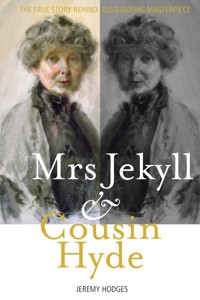
When Robert Louis Stevenson wrote Strange Case of Dr Jekyll and Mr Hyde, he did not dedicate it to his wife Fanny, despite her crucial role in persuading him to burn the first draft and write a new version that became an instant best-seller. Instead he wrote a dedication to his cousin, Mrs Katharine de Mattos. Why did Stevenson link Katharine with this dark tale of duality, and what role did she play in its creation? In Mrs Jekyll and Cousin Hyde, Jeremy Hodges tells the story of the cousins' close relationship, from childhood romance to bitter estrangement in later life.
Sie lesen das E-Book in den Legimi-Apps auf:
Seitenzahl: 349
Veröffentlichungsjahr: 2020
Das E-Book (TTS) können Sie hören im Abo „Legimi Premium” in Legimi-Apps auf:
Ähnliche




















JEREMY HODGES has been a reporter, feature writer, columnist and TV critic in a varied journalistic career stretching from Merseyside to Australia, John O’Groats to Glasgow. After writing his first article on Stevenson to mark the 1994 centenary of the author’s death in Samoa, he developed an RLS obsession which he sought to cure by writing a book. Soon his wife and sons in Falkirk were obliged to accept ‘Louis’ as an extra member of the family, with every detail of his fascinating life discussed over the meal table. After more than two decades, they have given up trying to get rid of him.
To Christine, Tom and Jonathan for living with my obsession, and to my parents for sharing their love of books with me.
First published 2017
ISBN: 978-1-912387-15-1
The author’s right to be identified as author of this book under the Copyright, Designs and Patents Act 1988 has been asserted.
The paper used in this book is recyclable. It is made from low chlorine pulps produced in a low energy, low emission manner from renewable forests.
Printed and bound by Martins the Printers, Berwick-upon-Tweed
Typeset in 11 point Sabon by Lapiz
© Jeremy Hodges 2017
Contents
Childhood Romance
An Unhappy Marriage
Glimpses of Hyde
The Runaway Wife
A Married Man
Birth of a Monster
Through The Red-Litten Windows
An Uneasy Friendship
The Stolen Story
Cousin Hyde
In Her Own Write
Tragedy Transformed
Last Act
Further Reading
1
Childhood Romance
FROM THE MOMENT it appeared, Strange Case of Dr Jekyll and Mr Hyde caused a sensation. The idea that a respectable professional man and a depraved monster might coexist in the same body – and that one might yearn to become the other – sent a frisson of horror through repressed Victorian society. Yet such was the skill of the story’s creator that Mr Hyde’s depravity was left to the imagination of thousands of readers, producing mental pictures more shocking than anything Robert Louis Stevenson might write. Clergymen even preached sermons inspired by such a highly moral cautionary tale.
Yet while the story that appeared in a lurid, cheap edition was devoured eagerly by the masses, those who bothered to read the dedication may have been puzzled to find the inspiration for Jekyll and Hyde was a woman. And nothing seemed further from the dark streets of London where Jekyll became Hyde and committed foul crimes than the accompanying heartfelt verses harking back to a shared childhood in Scotland:
It’s ill to loose the bands that God decreed to bind;
Still will we be the children of the heather and the wind.
Far away from home, O it’s still for you and me
That the broom is blowing bonnie in the north countrie.
Mrs Grundy, the mythological Victorian matron who stood guard over the nation’s morals, would have been shocked to discover the woman to whom the verses were addressed was a mother-of-two who had left her husband and run away to France with another man. He might have been her cousin but Stevenson’s attempts to save her from an unhappy marriage came perilously close to landing him in the divorce courts as a correspondent. Certainly the private letter he sent her along with a copy of Jekyll and Hyde would have seemed highly inappropriate from a man who was married himself: ‘Here, on a very little book and accompanied with lame verses, I have put your name. Our kindness is now getting well on in years; it must be nearly of age; and it gets more valuable to me with every time I see you. It is not possible to express any sentiment, and it is not necessary to try, at least between us. You know very well that I love you dearly, and that I always will. I only wish the verses were better, but at least you like the story; and it is sent to you by the one that loves you – Jekyll, and not Hyde.’
The recipient of the letter, book and verses was Katharine de Mattos, daughter of the famous author’s uncle Alan Stevenson. She and the cousin she knew affectionately as Louis had been close from childhood and would remain so until a bitter quarrel involving Stevenson’s wife destroyed their friendship forever.
Katharine was born a year after her cousin, into the same engineering dynasty that built all the lighthouses around Scotland’s coast. Their grandfather Robert Stevenson was immortalised by Sir Walter Scott as the builder of the Bell Rock lighthouse off Arbroath, and his work would be carried on by his three sons and two grandsons. But other descendants chose not to follow in his footsteps, including two christened after him – Robert Lewis Balfour Stevenson, never known as Robert but always Lewis or Louis, and Katharine’s brother Robert Alan Mowbray Stevenson, known simply as Bob.
The Alan was mandatory in Alan Stevenson’s branch of the family. Not only Bob but his three sisters – Jean Margaret Alan, Dorothea Frances Alan and Katharine Elizabeth Alan – bore both their father’s names. Even their mother Margaret was known throughout the family as Aunt Alan. It was as if the name were in their blood, infusing it with elements of the dark, romantic, erratic and ultimately doomed genius that was Alan Stevenson.
Alan was his father’s eldest son, born in 1807 and marked down early as a builder of lighthouses, although his frail health and inclination to become a romantic poet in the mould of Wordsworth indicated otherwise. At the Royal High School in Edinburgh, Alan was the most intelligent and gifted of the Stevenson boys and developed a love of the classics which continued when at 14 he went on to Edinburgh University. But at 16 he was asked to commit himself to a career and bowed to the inevitable, replying by letter to his father in roundabout, humorous fashion: ‘I found in myself a strong desire of literary glory, and I pitched upon an advocate but there was want of interest. I was the same way with a clergyman; and, as I am by no means fond of shopkeeping, I determined upon an engineer, especially that all with whom I had spoken on the subject recommend it, and as you yourself seem to point it out as the most fit situation in life I could choose…’
After time spent in London, learning to become a gentleman, Alan applied himself to the business of engineering and the itinerant lifestyle it imposed, travelling from one construction project to the next around the coast of Britain. He was 26 when he arrived in Anglesey to work on plans for a new lighthouse at Point Lynas, and was invited to call at Llynnon Hall, the home of Welsh landowner Humphrey Jones. He and his Scottish wife Jean were happy to welcome a young man from her home city of Edinburgh – but there was a considerable social gap between the aristocratic Joneses and the Stevensons, still regarded as little more than gifted artisans. Mr Jones had qualified in medicine but had no need to practise as he owned a Caernarfonshire estate in addition to Llynnon, where he was Master of Foxhounds and a Justice of the Peace. When he and his wife detected signs of a growing affection between their young visitor and their daughter Margaret, it was not something they wished to encourage.
Yet the two had fallen in love and were determined to be together. The problem was overcoming the Joneses’ objections to a marriage. Alan Stevenson, as he stood, was not good enough for their daughter. He would have to prove himself first. And so began an 11 year separation during which the young lovers pledged to ‘save themselves’ for each other until Alan’s undoubted success enabled them to marry, long after the passions of youth were spent. By then he was 37 and she was 32, rather late to be starting a Victorian family, but their long-delayed union was soon blessed by the arrival of Jean, known as Mab, followed by Bob, Dorothea or Dora, and finally in 1852 by Katharine.
Alan Stevenson’s family was now complete, living happily in Edinburgh’s Royal Terrace, where he spent as much time with Margaret and the children as could be spared from his duties as Engineer to the Commissioners of Northern Lighthouses, having succeeded his father in 1842. By the time of his marriage Alan had proved himself by successfully completing Scotland greatest lighthouse, a 156ft giant called Skerryvore, 12 miles off the coast of Tiree. To achieve this feat he worked alongside the skilled labourers as they blasted foundations out of the rock and slowly assembled each precision-cut block of granite to form the tower. For seven days a week they worked long hours before collapsing on their bunks in a fragile barracks, bolted to the rock and hammered by storms until at times the men cried out in terror, convinced their time had come.
Alan, in a small compartment of his own, took his mind off the danger by writing poetry and corresponding with his friend William Wordsworth, who had come to value the intrepid lighthouse builder as a man of sound judgment in literature. Poetry had sustained Alan through his long years of separation from Margaret Jones, to whom he occasionally sent romantic verses. So occupied, he spent the six years it took to build Skerryvore, staying out on the reef each summer before the storms of winter drove him back to the comforts of Edinburgh. In 1844 the great light was lit for the first time and its triumphant creator was at last permitted to wed the woman he loved.
Yet their happiness was short-lived. No sooner was their family complete than Alan was struck down by a mysterious, paralysing illness. Bones ached, vision blurred and nerves no longer transmitted the power of movement. Scarcely had little Katharine learned to stand on her feet than her father lost the ability to walk beside her, and was forced to accept the life of an invalid. Slumped in a bath chair and swathed in rugs, he appeared like a spectre at the feast on what should have been happy family occasions.
In 1853 Alan resigned his post, his duties taken over by his brothers David and Tom. The rest of his life, through which according to family legend he ‘lay on his face for 12 years until he died’, was a forlorn pilgrimage in search of health, taking the family with him. For a while they lived in the Angus coastal village of St Cyrus, occasionally seeking out warmer climes in France, before finally retiring to Portobello on the outskirts of Edinburgh.
It was a sad, depressing life for the children, from which their natural high spirits found release when they were sent to stay with uncles and aunts. There was always a welcome at Uncle Tom and Aunt Maggie’s home in Edinburgh, where Bob once stayed for several months. There he took refuge with his young cousin Lewis in a make-believe world where they were the rulers of two rival kingdoms, Encyclopaedia and Nosingtonia, whose affairs they would imagine in great detail.
In the summer, when the Stevenson families of Tom, David and ‘poor Alan’ would rent large villas in the country or by the sea, the two boys would be joined by Bob’s sisters. Auntie Maggie, who could have no more children after Lewis, had longed for a daughter and always made a big fuss over her nieces. Bright, girlish and chatty, she was quite unlike their own Welsh mother who remained calm and impassive throughout her husband’s long illness. But Katharine was less interested in discussing the latest fashions with her aunt than in sharing the make-believe adventures of her big brother and their cousin, both of whom she idolised.
At Bridge of Allan, near Stirling, there were long walks by the river to Dunblane, passing a small cave in the bank that was ripe for Lewis’s ‘supposings’. Who did they suppose might have lived there? Little did Bob and Katharine know that in their cousin’s imagination the inhabitant of the cave would become a half-crazed, marooned mariner called Ben Gunn, immortalised in Treasure Island. Likewise the beach and rocky outcrops at North Berwick on the Firth of Forth were populated with pirates in the children’s imagination. From dawn till dusk they could play on the sands, summoned occasionally to meals in the smart new villas that lined the seafront. Uncle Tom and Aunt Maggie rented a large one in a row overlooking the East Sands and the Black Rock, on which the cousins would climb on their buccaneering adventures.
This was more convivial than the atmosphere at Anchor Villa on the West Links, where Alan Stevenson clung to life though an ever-darkening cloud of doom. It was not just nerves and muscles on which his paralysing illness fed. ‘Poor Alan’ was losing his mind. The Stevensons were all God-fearing people, brought up in the Kirk on which their beliefs were founded like the lighthouses they built, rooted to the rock to weather all storms. Before illness struck, Alan had worn his religion lightly and was happy to go along with his wife’s Anglican ways, which in Scotland made his branch of the family Episcopalians. But as his affliction grew, he came to see it as a punishment from the Almighty for forsaking the true faith. Waves of guilt engulfed his mind as he cried out in terror, remembering how his men had done the same in the storms that battered Skerryvore. Slumped in his bath chair on the seafront, he was tormented by the thought that he had forced them to work on the Sabbath, the day of rest, in defiance of God’s holy law. Later some of these workmen were puzzled to receive letters whose shaky scrawl implored their forgiveness.
For Katharine, Bob and their sisters, Alan’s torment was deeply disturbing. It was hard for children to understand a father who, on Bob’s 5th birthday, presented him with a bible inscribed in a fit of doom-laden religious mania:
Read in this blessed Book, my gentle boy;
Learn that thy heart is utterly defiled…
This day five years thou numberest; and I
Write on a bed of anguish. O my son,
Seek thy Creator, in thine early youth;
Value thy soul above the world, and shun
The sinner’s way; oh! Seek the way of truth.
Oft have we knelt together, gentle boy,
And prayed the Holy Ghost to give us power
To see God reconciled, through Christ, with joy;
Nought else, but Christ brings peace in sorrow’s hour.
How could children fathom the guilt that had turned the romantic poet who once penned sunny verses about Manuela the Mountain Maid into an angst-ridden penitent seeking to expiate his sins by translating the pious works of a 5th century Greek bishop into English verse as the Ten Hymns of Synesius? What sins could Alan Stevenson have committed that he felt the need to warn his innocent, five-year-old son about a heart ‘utterly defiled’?
With modern hindsight, biographers have suggested that Alan Stevenson suffered from multiple sclerosis. In Victorian times, no such illness had been identified. In the minds of Katharine’s uncles who shook their heads over the fate of ‘poor Alan’ – and perhaps in the tormented consciousness of Alan himself – the unspoken thought was that general paralysis was most commonly the result of syphilis. God’s punishment on the fornicator could lie dormant for decades, long after the moment of lust and the briefly unpleasant symptoms of the initial contagious period. Then in mid-life Triponema pallidum might again rear its ugly head, boring into the bones with deep-seated ulcers, weakening blood vessels, enlarging the heart and destroying the nerves until the sufferer was confined to a bath chair by locomotor ataxia. As a final act, the disease might attack the brain, producing the ultimate Gothic horror – general paralysis of the insane.
For 11 years, Katharine’s father had been expected to live like a monk before being allowed to marry her mother. In the barracks on Skerryvore, he had no option. But during winters in Edinburgh, where there were numerous brothels a stone’s throw from his father’s house in Baxter’s Place, might the passionate poet have felt tempted to take a walk on the Hyde side? For countless respectably married Dr Jekylls and callow youths who adored sweethearts from afar, sex with a prostitute was a practical safety valve and did not really count as infidelity in the male mores of the Victorian age. But years later, paying a terrible price for fleeting pleasure, Alan Stevenson would never have been able to forgive himself for allowing his heart to be defiled by such wickedness, robbing little Katharine, Dora, Mab and Bob of a father’s care when they needed it.
By the summer of 1865, the last act was coming to a close. From the house of gloom in Portobello, Katharine and Bob may have been glad of the chance to escape to the Borders, where Uncle Tom, Auntie Maggie and Lewis were spending July and August at Elibank Villa in Peebles. Katharine was 13 that summer, a strange, fey child on the brink of womanhood and falling shyly in love with her cousin. Louis might be painfully thin and at times in delicate health, but even in his early teens he had the charm that would win hearts throughout life’s journey. Katharine might seem withdrawn and a little mysterious after years spent in the shadow of her father’s illness, but she and Lewis understood each other and shared a passion for dark romance.
There was plenty to be found at Neidpath Castle on the banks of the Tweed. This once grand structure had been allowed to go to rack and ruin by its owner William Douglas, 4th Duke of Queensberry, whose decision to cut down the surrounding forest for the timber had provoked Alan Stevenson’s friend Wordsworth to verses of condemnation: ‘Degenerate Douglas! Oh the unworthy Lord!’
Since then the castle’s west wing had collapsed, although one floor still served to accommodate a gamekeeper. When he was abroad, there was nothing to stop Lewis and the others exploring the mouldering, panelled rooms and narrow, winding stair to the battlements – where in a turret they chanced upon half a dozen back numbers of a long, romantic serial entitled Black Bess or The Knight of the Road. It was the work of one Edward Viles who, unbeknown to his young readers, churned out reams of lurid romance to support his addiction to alcohol and keep the horrors at bay.
The discovery of these ‘penny dreadfuls’ was doubly exciting for Lewis, as his parents would not let him read such stories for fear that they might corrupt young morals. The mildewed sheets were soon borne away to a nearby fir wood where the youngsters lay down comfortably on a bed of wild blueberries to read the adventures of the highwayman Dick Turpin at leisure…
The rim of the rising moon was just peeping above the horizon, and a few faint, sickly beams of light shot up from into the night sky, giving to all objects a dim, spectral-like appearance. Standing in the middle of the high road which skirts Wimbledon Common on the north side was a horse and rider. The moonlight shimmered upon both with a strange effect. At first sight it seemed as though a lambent flickering flame was playing over them, from the horse’s hoofs to the long feather in the rider’s hat... He was tall and muscular and sat in the saddle with an ease and grace as rare as it was admirable... Of the steed which he bestrode, and which was no other than the mare so celebrated in song and story – Black Bess – we feel it is perfectly unnecessary to say a word in the shape of description. Her rider – whom we may as well at once call by name, Dick Turpin – had, at the moment we introduce him to our readers, one hand upon her neck...
Later the story portrayed its highwayman hero escaping from his pursuers across the rooftops of a city and appearing without warning through a trapdoor into a room below:
A horrifying sight met his gaze. Cowering on the floor, and divested of almost every article of attire, was a young girl of about 17 years of age. She was dark, and had long glossy hair hanging disorderedly about her. Her hands were clasped together tightly, and her face, under happier auspices, was doubtless beautiful, but now it was convulsed with agony. Her lips were apart and bloodless, and tears were streaming from her eyes.
Standing over her, and flourishing a broad, heavy belt or strap, was a being in the shape of a woman. She was old and gaunt, presenting indeed more the appearance of an animated skeleton than aught else. Her eyes were bright and reptile looking, and a ghastly expression of delight and fiend-like malice lighted up her countenance as she struck the girl brutally with the strap. ‘Help! Help! Save me! Save me!’ shrieked the girl, as her eyes fell upon the newcomer... Dick passed his arm round the slight frame of the young girl and drew her towards him, endeavouring by this means to reassure her and calm her terrible agitation.
‘Save you, my poor girl!’ he said, in his deep, manly tones, which thrilled through every nerve of the girl’s body with a feeling of exquisite delight which she had never before experienced, ‘Of course I will...’
Victorian parents may have been right to deplore such literature, consumed so avidly by Louis and perhaps his shy cousin, who after years of lacking a strong male figure in her life may have longed for manly arms to hold her. Lewis for his part would always remember the holiday when ‘that part of the earth was made a heaven to me by many things now lost, by boats, and bathing, and the fascination of streams, and the delights of comradeship, and those (surely the prettiest and simplest) of a boy and girl romance’.
For him, any fleeting adolescent passion would soon turn to fond affection. But it seems Katharine would always carry a torch for her cousin, although according to her mother’s relative Ursula Wyllie, who used the pen name Susan Miles, it was Lewis who was first smitten: ‘He was said to have been in love with Katharine. Whether she did not love him enough to marry him or whether the parents were opposed to marriage between first cousins I do not know. The man she did marry failed to make her happy...’
2
An Unhappy Marriage
WHY KATHARINE EVER wanted to marry Sydney de Mattos was a mystery her family and friends could never fathom. The son of a Dutch East India merchant, he was a presentable young man who had studied law at Cambridge and might be thought to have good prospects, but he and Katharine did not appear to have much in common. She was creative, intuitive and artistic, living largely in a dream world, while he prided himself on an incisive, rational intelligence which led him to the obvious conclusion that God did not exist. There was no God other than William Sydney de Mattos and he would live according to his own moral law.
Nobody could have been less like Katharine’s father, who had finally given up his life of torment just before Christmas. Alan’s family had gathered at the house in Portobello and sat praying in the gaslight around the great lighthouse builder’s bed as the obscene paralysis gently squeezed the last breath from his body in the small hours of 23 December 1865. It then fell upon Bob, now the man of the family at 18, to register his father’s death.
Alan’s widow kept the family together, supported by her late husband’s two brothers who did their best to sort out his business affairs and make financial provision for his children, allowing Bob to finish his last year at Windermere College in the Lake District and go on to Cambridge. There he excelled as an athlete, gymnast and oarsman but achieved only a humble pass degree, without honours, in botany. Bob was a brilliant talker with an original mind, but it did not work well on paper.
His sisters were not expected to go to university but to make good marriages, and when they did so Uncle Tom and Uncle David would set up trust funds for them in their husband’s names. As yet Katharine was too young to marry, and like other young ladies growing up in Victorian Edinburgh was kept in ignorance about sex. When her mother’s carriage brought her and her sisters in from Portobello to go shopping in Princes Street, they would have no inkling of what went on in the dark closes they passed.
The grand eastern approach to Edinburgh had been built by Katharine’s grandfather, cutting through a cemetery and requiring the removal of many bodies, including some of Robert Stevenson’s own children who had died in infancy. Louis would describe the resulting thoroughfare as ‘the New Town passing overhead above its own cellars; walking, so to speak, over its own children, as is the way of cities and the human race’. But it may have been more than his little dead uncles and aunts that caused him to use this curious metaphor. Just below the great Waterloo Arch built by his grandfather lay ‘that sunless and disreputable confluent of Leith Street’ where poor, half-starved girls barely into their teens might be trampled in the mire of prostitution.
Had Katharine stopped and looked down from the parapet, she would have seen the dark back-tenements of St Ninian’s Row, lurking between the great arch and Leith Street. In her father’s day this was known as ‘the Sautbacket’ or salt bucket, and may have been where ‘poor Alan’ absorbed the seeds of his paralysis. Here girls moonlighting from poorly paid day jobs as milliners, bookfolders or domestic servants could be had for a few pennies in the dubious privacy of tenement rooms which the part-time whores rented by the hour. No questions were asked and the respectable wives or sweethearts of the city’s many Mr Hydes need never suspect anything amiss.
While Katharine knew nothing of Edinburgh’s dark underbelly, her brother and childhood sweetheart were beginning to explore it. After enrolling at the university, her cousin had taken to spelling his name ‘Louis’ in the French fashion while retaining the Scots pronunciation, growing his hair and sporting a battered velvet smoking jacket. So clad, he would skip lectures and spend his days in an old public house that backed on to the Sautbacket, ‘frequented by the lowest order of prostitutes – threepenny whores – where there was a room in which I used to go and write. I saw a good deal of the girls – they were really singularly decent creatures, not a bit worse than anybody else. But it wasn’t a good beginning for a young man.’
At the same time Louis’s father, as a director of the Edinburgh Magdalene Asylum, was endeavouring to save fallen women by offering them the chance of redemption through work in the laundry or sewing room while respectable married ladies read to them from the Scriptures. He would not have been happy to see his son consorting with the girls in their unredeemed state at ‘Collette’s’, a subterranean shebeen below the old Sautbacket run by one Thomas Arthur Corlett, a Manxman of dubious origins with a murky, multiple marital history.
Admittance to this windowless hellhole below the pavement of Leith Street was by a door with a spyhole, at which Louis and Bob had to show their faces to gain entry. Inside, where the girls sought to pick up soldiers, sailors or medical students in various stages of intoxication, the cousins would rail against the hypocritical respectability of Edinburgh society. This was embodied in the mythological Mrs Grundy – although Bob preferred to blame her husband. In the sort of bizarre comic monologue reproduced later by his friend HG Wells, Bob would exclaim: ‘Did I tell you of a wonderful discovery I’ve made? There’s no Mrs Grundy. She’s merely an instrument, Louis. She’s borne the blame. Grundy’s a man. Grundy unmasked. Rather lean and out of sorts. Early middle age. With bunchy black whiskers and a worried eye. Been good so far, and it’s fretting him! Moods!
‘There’s Grundy in a state of sexual panic, for example – “For God’s sake cover it up! They get together – they get together! It’s too exciting! The most dreadful things are happening!” Rushing about – long arms going like a windmill. “They must be kept apart!” Absolute separations. One side of the road for men, and the other for women, and a hoarding – without posters – between them. Every boy and girl to be sewed up in a sack and sealed, just the head and hands and feet out until 21. Music abolished, calico garments for the lower animals! Sparrows to be suppressed – ab-so-lutely!
‘And that’s why everything’s wrong. Grundy, damn him! stands in the light, and we young people can’t see. His moods affect us. We catch his gusts of panic, his disease of nosing, his greasiness. We don’t know what we may think, what we may say, he does his silly utmost to prevent our reading and seeing the one thing, the one sort of discussion we find – quite naturally and properly – supremely interesting. So we don’t adolescence; we blunder up to sex. Dare – dare to look – and he may dirt you for ever! The girls are terror-stricken to silence by his significant whiskers, by the bleary something in his eyes…’
For Katharine sex remained a closed door without so much as a spyhole and she would never experience the Bohemian squalor of Collette’s, from which Louis would stagger away long after midnight to his parents’ home in Heriot Row while Bob set a course for Portobello where his mother and sisters lay sleeping. Having left Cambridge, Katharine’s brother was now studying at the Edinburgh school of art. There the use of nude models provoked loud protest from Grundyite factions such as the Scottish National Association for the Suppression of Licentiousness, which campaigned to have the life classes banned as an affront to public morals.
Bob’s response was to launch his own campaign of elaborate practical jokes to confuse and confound the city’s upright citizens, in which his cousin took part enthusiastically. The two Stevensons invented a non-existent character called John Libbel, originally a pseudonym used by Bob when pawning a pair of trousers to raise the money for a train fare. To perpetuate the myth, they printed business cards for him which ‘began to be handed about Edinburgh at a great rate, sometimes with manuscript additions which did not tend to improve the moral character of Mr Libbel’.
The crowning-point of the long practical joke was the Libbel Succession: ‘Wherever we went, we had a notebook in our hand; we would put questions, look at each other, purse our lips, and gradually let it escape to our auditor, as if by accident, that we were agents looking for the heir to the great Libbel fortune. We tried to get an advertisement into The Scotsman newspaper, but the clerk plainly smelling a hoax, we were ejected from the office…’
Katharine might not have the freedom enjoyed by her brother and cousin but she would love to hear from Bob about the latest Libbel escapades and everything Louis had said and done. With two such colourful characters in the family, her own life did not feel quite so dull and constrained by Mrs Grundy. Travel, too, offered her an escape from the claustrophobic confines of Edinburgh, with visits to wealthy relatives in Wales and, increasingly, London with its array of theatres, museums and galleries that nurtured Katharine’s love of art.
These were welcome distractions now that Bob was away in Paris, studying painting at the atelier of Carolus Duran. At the same time a tension had developed between Katharine’s family and Louis’s, which meant she did not hear from her cousin so often. Unknown to Katharine, Louis had been unwell with a disease that required him to convalesce in the spa town of Malvern, accompanied by his mother. From the symptoms it seems it was the same affliction that most probably caused Uncle Alan’s sad demise.
Louis’s parents had already accepted his refusal to follow in his father’s footsteps as an engineer, so long as he studied law instead. They might now forgive his ‘youthful indiscretion’, as the quack remedies for syphilis phrased it. What they could never accept was his refusal to seek God’s forgiveness for his unbelief. As part of his rebellion against Edinburgh respectability, he and his young lawyer friend Charles Baxter had invented a secret society called the L.J.R., whose initials stood for Liberty, Justice and, inexplicably, Reverence. Bob was a member, as was Louis’s friend Walter Ferrier – a beautiful young man with an impeccable literary pedigree. A nephew of the novelist Susan Ferrier, Scotland’s Mrs Gaskell, he was also a grandson of John Wilson, who as ‘Christopher North’ had been a leading light of Blackwood’s Magazine. To cap it all, Ferrier was descended from the poet and brilliant military commander James Graham, 1st Marquess of Montrose, known modestly as ‘Scotland’s Glory, Britain’s Pride’ – and Louis was in awe of him.
In such grand company, Louis had resolved to follow the L.J.R. credo, to reject the Established Church and ‘disregard everything our parents taught us’. But on returning from Malvern he was confronted by his father with a copy of the L.J.R. constitution in his hand. On questioning his son, the God-fearing Tom Stevenson found Louis no longer believed in the Christian religion. The ensuing volcanic row lasted a year, with the family in Heriot Row convulsed by hysterics until Louis suffered a breakdown and was packed off to convalesce alone on the Riviera.
There his frustration at the repressive hypocrisy of Mrs Grundy’s Edinburgh was aggravated further by news that the city was in the grip of a religious revival, led by the American evangelists Dwight L Moody and Ira D Sankey. From magazine cuttings sent out to him, Louis learned that James Balfour of Pilrig House, head of his mother’s side of the family and a staunch supporter of the Edinburgh Magdalene Asylum, was one of those in the grip of religious fervour. This triggered an outburst of Hyde-like rage which Louis vented in a letter to Charles Baxter: ‘I saw that bald-headed bummer J. Balfour had been describing a meeting he was at. He said, “They then enjoyed very precious and manifest tokens of the Lord’s Presence.” If I had been there and had sworn upon all the obscene and blasphemous phrases in my large repertory, that God had not been there, they would have told me it was because my heart was hard... O Sapristi! If I had hold of James B. by the testicles I would knock his bald cranium against the wall until I was sick.’
Meanwhile Tom Stevenson had been told that the Mephistopheles who had turned Louis into a ‘horrible atheist’ was Bob. In a highly unpleasant interview he told his nephew he never wished to see him again, and from then on regarded all the Alan Stevensons with mistrust. As if to confirm his suspicions, it then emerged that his niece Katharine had been seeing a young man down in London who was another callow scoffer at religion. Worse still, she had accepted Sydney de Mattos’s proposal of marriage.
Louis arrived home from the Riviera towards the end of April, 1874, well in advance of the wedding. His parents had forgiven him and agreed to an allowance of £84 a year, enough to give him independence and membership of a London club. He agreed to return to his law studies that autumn, and in the meantime spent his days at his parents’ summer home in Swanston, writing or roaming the Pentland Hills above the village. There he received bad news that threatened to wreck Katharine’s wedding plans – Bob had returned from Paris and promptly gone down with diphtheria, which might easily kill him.
The house in Portobello, which should have been filled with excitement as everyone prepared for Katharine’s big day, was filled with foreboding as the feverish patient’s throat swelled alarmingly and Bob faced the prospect of choking to death. Louis was distraught and confided in a friend: ‘This is the 6th case in my immediate family, whereof three have been fatal.’ He went out to Portobello in fear that he would find the blinds down for a bereavement, but returned home euphoric in the knowledge that his cousin had safely passed the crisis point. Such was the sense of relief throughout the family that the rift was forgotten and Katharine was invited out to Swanston with her sister Dora.
Louis would tell a friend how he and the girls in the garden ‘ended the afternoon by lying half an hour together on a shawl. The big clouds had all been carded out into a thin luminous white gauze, miles away; and miles away too seemed the little black birds that passed between this and us, as we lay prostrate with faces upturned. The similarity of what we saw struck in us a curious similarity of mood; and, in consequence of the small size of the shawl, we all lay so close that we half pretended, half felt that we had all lost our individualities and become merged and mixed up in a quadruple existence.
‘We had the shadow of an umbrella over ourselves; and when anyone reached up a brown hand into the golden sunlight overhead we all feigned that we did not know whose hand it was, until at last I really do not think we quite did. Little black insects also passed over us; and in the same half wanton manner, we pretended we could not distinguish them from the birds. There was a splendid sunlit silence about us; and as Katharine said the heaven seemed to be dropping oil upon us, as honeydew – it was all so ‘bland’… K, by the way, is just going to be married to an atheist, to the great horror of the family…’
That afternoon was Katharine’s last intimate moment with her cousin before becoming a married woman. For better or for worse, on Thursday 25 June, 1874, she took Sydney de Mattos to be her lawful wedded husband. The wedding was at Dunblane, the scene of happy childhood holidays with Bob and Louis, and the ceremony took place at St Mary’s. There de Mattos took wedding vows in accordance with the rites of the Scottish Episcopal Church, in which he had not the slightest belief, and his father and Katharine’s mother signed the register as witnesses. Three months later, Katharine’s Victorian sex education was complete when she discovered she was pregnant.
It had not taken long for her to realise she was unhappy with de Mattos, now working for a pittance for a law firm as part of his training. Without the income from his wife’s marriage settlement they would have been struggling. Louis was one of the trustees along with Katharine’s uncle, Humphrey Jones, but they had no say in what happened to the interest and dividends paid into de Mattos’s bank account. It might be money from his wife’s family, but he did not seem inclined to pass much of it on to his wife. This left Katharine so short of funds that she was desperate to have an income of her own, in an age where respectable middle-class married women were not meant to work. She knew Louis was starting to have some success writing for literary magazines that paid well, and begged him to help her learn to write. Ashamed to admit her marriage had been a mistake, she made no mention of her money problems when she sought his advice on something she had written, a disturbing description of a road running through a mysterious village.
Her cousin pulled no punches: ‘Now, for the introduction. I am going to be rude. It’s all bad. It is woolly, hard to follow, and disorderly...’ But Louis could also sense what she was trying to achieve, even if it made him feel uneasy, like the more morbid tales of Edgar Allan Poe which he was reviewing for the Academy magazine. ‘I shall never get the village out of my head,’ he told Katharine. ‘I know the place; it is called (to imitate Bunyan) the village of Hope-deferred, and near it goes the river of the Shadow of Suicide. I have seen the white faces at the upper windows, and heard the singing, and walked with the wayfarers; and I pray God (if there is such a gentleman) that I may come no more into that countryside: it is not wholesome for any long sojourn: it is a place to go through in a coach and four and never bait, or so much as draw bridle, till you are over the border again in better air and among more cheerful people.’
Had Louis known how desperate Katharine was feeling, pregnant and trapped in a loveless marriage, he might have kept the river of the Shadow of Suicide to himself. Instead, he confessed to his cousin how the religious rows with his parents that drove him to a breakdown had once made him think of ending his own life: ‘And I say, you must not despond; however bad things are, you know they do come straight; when I think of the time when I wished to kill myself, for instance, and see the pleasure I should have missed, I am humbled at my own precipitate folly.’




