


0,49 €
Niedrigster Preis in 30 Tagen: 1,99 €
Niedrigster Preis in 30 Tagen: 1,99 €
Mehr erfahren.
- Herausgeber: Booksell-Verlag
- Kategorie: Gesellschafts- und Liebesromane
- Sprache: Englisch
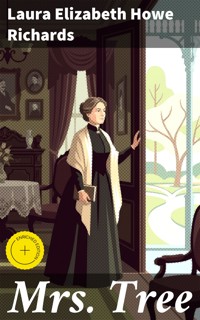
In "Mrs. Tree," Laura Elizabeth Howe Richards presents a captivating tale that weaves together elements of social critique and personal growth through the lens of a woman's life choices in a rapidly changing post-Victorian society. The novel showcases Richards' mastery of narrative style with its vivid characterizations and incisive dialogue, reflecting the constraints and expectations faced by women of her era. Thematically, it examines the dichotomy of duty versus desire, exploring how Mrs. Tree navigates her complex existence amidst the societal norms of her time. Laura Elizabeth Howe Richards, an eminent poet, and writer of the late 19th century, drew inspiration from her experiences as a feminist and a progressive thinker. Being part of the literary elite and having a rich familial background that included notable abolitionists and women's rights advocates, Richards was profoundly influenced by social issues. Her writings often mirrored her commitment to highlighting the female experience, making "Mrs. Tree" a significant exploration of women's roles and aspirations during a transformative period in American history. This book is highly recommended for readers interested in feminist literature and the evolution of women's narratives. Richards'Äô prose is both engaging and thought-provoking, rendering "Mrs. Tree" an essential read for anyone wishing to delve into the complexities of gender and identity in literature. In this enriched edition, we have carefully created added value for your reading experience: - A succinct Introduction situates the work's timeless appeal and themes. - The Synopsis outlines the central plot, highlighting key developments without spoiling critical twists. - A detailed Historical Context immerses you in the era's events and influences that shaped the writing. - A thorough Analysis dissects symbols, motifs, and character arcs to unearth underlying meanings. - Reflection questions prompt you to engage personally with the work's messages, connecting them to modern life. - Hand‐picked Memorable Quotes shine a spotlight on moments of literary brilliance. - Interactive footnotes clarify unusual references, historical allusions, and archaic phrases for an effortless, more informed read.
Das E-Book können Sie in Legimi-Apps oder einer beliebigen App lesen, die das folgende Format unterstützen:
Veröffentlichungsjahr: 2021
Ähnliche














Mrs. Tree
Table of Contents
Introduction
Growing up can feel like learning to stand tall while the world keeps changing its weather around you.
Mrs. Tree by Laura Elizabeth Howe Richards is a short work of children’s literature by a writer closely associated with late nineteenth- and early twentieth-century English-language juvenile fiction. Richards is best known for stories that take everyday childhood feelings seriously while keeping the narrative accessible to younger readers. In Mrs. Tree, the natural world provides the immediate frame of reference, and the tale uses that familiar setting to explore questions of responsibility, patience, and belonging. The book’s compact scale and clear storytelling reflect a period when moral imagination and gentle instruction often traveled together.
The premise centers on a tree presented as a figure with a distinct identity, inviting readers to consider what it means to have a place in a larger living community. Without relying on spectacle, the story draws attention to ordinary rhythms—growth, seasons, and the small events that accumulate into change. Readers can expect a narrative that is attentive to detail and oriented toward observation, using a straightforward progression that suits a read-aloud experience as well as independent reading. The setup encourages curiosity about how natural processes can mirror human concerns without turning the book into a lesson in disguise.
Richards’s approach typically favors clarity and warmth over complexity, and Mrs. Tree offers a similarly measured reading experience. The voice is gentle and steady, designed to keep the reader close to the central figure and to the environment that shapes her days. The style is likely to feel traditional to modern audiences: composed, deliberate, and more interested in moral and emotional resonance than in rapid plotting. That calm pacing helps the book function as a reflective fable-like narrative, one that invites children to notice patterns and invites adults to appreciate how careful attention can be made engaging.
At its heart, the book turns on themes of endurance and care, asking what it means to persist through cycles that are not fully under one’s control. It also encourages empathy across difference by prompting readers to imagine interiority where they might not ordinarily look for it. The tree’s rootedness becomes a way to think about duty and constancy, while the surrounding world supplies reminders of vulnerability and interdependence. Without needing to be explicit, the story suggests that strength can be quiet and that value can be found in steady presence rather than dramatic action.
The natural setting also makes room for an early ecological sensibility, not as modern environmental advocacy, but as attentiveness to how living things affect and rely on one another. Contemporary readers may recognize in this attention a corrective to distraction: the book slows the gaze and restores significance to small, recurring experiences. It can also serve as an entry point for discussing how older children’s books shape ideas about character and conduct through metaphor rather than argument. The story’s simplicity becomes a feature, creating space for conversation and interpretation.
Mrs. Tree still matters because it models an ethical imagination that begins with noticing, then moves toward respect. In an era when children encounter constant novelty, a narrative built around continuity and seasonal change can offer a different kind of emotional education—one centered on patience, resilience, and responsibility. Richards’s work remains relevant for families and classrooms interested in stories that are approachable yet thoughtful, and for readers who value children’s literature as a place where moral questions can be explored with tact. The book’s enduring appeal lies in its quiet insistence that growth is both natural and earned.
Synopsis
Mrs. Tree by Laura Elizabeth Howe Richards is a short work of children’s fiction centered on an elderly woman known as Mrs. Tree, whose identity is closely bound to a particular tree and the place where she lives. The opening establishes a small, familiar community in which Mrs. Tree is a distinctive figure, watched with curiosity and affection by others, especially younger observers. Richards frames the narrative through everyday sights and conversations, letting readers learn who Mrs. Tree is by how she moves through her surroundings and how the neighborhood responds to her presence.
paragraphs(continued) is a property not allowed.
The story proceeds by focusing on Mrs. Tree’s unusual routines and the quiet authority she seems to possess in her chosen setting. Richards emphasizes observation over action, drawing attention to the details of season, weather, and the changing life around the tree. As the community’s interest grows, the book explores how people interpret what they do not fully understand: some are amused, some doubtful, and some sincerely drawn to Mrs. Tree’s steadfastness. The narrative keeps its stakes intimate, grounded in small acts and daily encounters rather than overt conflict.
As attention gathers around Mrs. Tree, the book develops a gentle tension between ordinary social expectations and Mrs. Tree’s singular commitment to her way of life. Children and adults alike test boundaries through questions, assumptions, and attempts to define her story in simple terms. Richards uses these interactions to examine how myths and reputations form in a close-knit environment, and how a person’s chosen identity can be both respected and misunderstood. The tree itself functions as more than a backdrop, shaping the rhythm of scenes and anchoring the book’s emotional focus.
Midway through, shifts in the environment and the community’s routines bring Mrs. Tree’s situation into sharper relief. The narrative follows the natural progression of time, allowing small changes to accumulate into meaningful pressure on Mrs. Tree’s habits and on the patience or sympathy of those around her. Without turning sensational, Richards keeps the reader attentive to what might happen when a cherished local certainty is challenged by forces beyond any single person’s control. The book’s conflict remains primarily social and psychological, expressed through responses and decisions rather than confrontations.
The latter portion of the story narrows in on the question of what the tree and its attendant rituals truly mean to Mrs. Tree and to the people who observe her. Richards continues to balance outside perspectives with Mrs. Tree’s own steadfast intent, inviting readers to consider how care, solitude, and belonging can take unconventional forms. The community’s reactions reveal differing ideas about responsibility, kindness, and what it means to let someone live according to a private conviction. The narrative maintains a calm surface while quietly intensifying its emotional stakes.
As events move toward resolution, Richards foregrounds the consequences of attention and interpretation: how stories about a person can help or harm, and how compassion may require restraint as well as action. The book avoids simple moralizing, instead presenting the characters’ choices as arising from mixed motives—curiosity, concern, and the desire for order. The tree’s continued presence keeps the plot tethered to the natural world and to a sense of time that exceeds human plans. The reader is led to anticipate change while remaining uncertain of its final shape and meaning without being told outright how everything ends.
Historical Context
Laura Elizabeth Howe Richards (1850–1943) wrote for a U.S. readership shaped by the long transition from the Civil War era into the Progressive Era. Born in Boston, Massachusetts, she grew up in a region where public education, reform societies, and publishing were well developed. Her father, Samuel Gridley Howe, was a reformer associated with the Perkins Institution for the Blind, and her mother, Julia Ward Howe, was a prominent writer and activist. This family context placed Richards near debates over moral education, philanthropy, and women’s public roles that influenced late nineteenth-century children’s literature.
paragraphs
In the decades when Richards established her career, American children’s books increasingly served as tools for character formation as well as entertainment. Periodicals and book series expanded through improvements in printing and distribution, while libraries and schools created steady demand for juvenile titles. The period’s mainstream children’s fiction often promoted diligence, honesty, and sympathy, echoing Protestant-inflected moral instruction but also adapting to a more urban, commercially oriented culture. Richards became known for stories that mixed domestic realism with gentle humor, aligning with a broad late nineteenth-century preference for instructive narratives that avoided sensationalism and emphasized everyday ethical choices.
paragraphs
New England settings remained culturally influential in U.S. letters after the Civil War, reflecting both regional identity and national ideals of civic virtue. Rural villages and small-town households were commonly used to explore social expectations, family obligations, and community scrutiny. At the same time, the United States experienced rapid industrialization, growth of cities, and increased immigration, prompting anxieties about social cohesion and proper upbringing. Children’s and family-centered fiction provided a venue for reaffirming community standards amid change. Richards’s work frequently draws on familiar domestic spaces and local social networks, presenting them as arenas where kindness and responsibility are tested.
paragraphs
Women’s expanding participation in public life formed another key context. The women’s club movement grew substantially in the late nineteenth century, organizing around education, temperance, settlement work, and civic reform; the National American Woman Suffrage Association was founded in 1890. While legal and political equality remained limited, women’s writing and philanthropic leadership were prominent in cultural life. Richards’s career demonstrates how women authors built reputations in children’s literature and used it to model social virtues. Her family’s reform connections also reflect a wider tradition of linking literature with moral improvement and community service.
paragraphs,




