


1,99 €
Mehr erfahren.
- Herausgeber: Quickie Classics
- Kategorie: Gesellschafts- und Liebesromane
- Sprache: Englisch
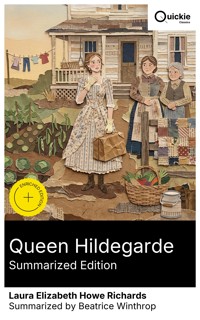
Queen Hildegarde introduces a pampered city girl exiled to a plain New England farm, where she trades borrowed "royalty" for the nobility of work, loyalty, and neighborly duty. Richards's brisk, companionable prose blends comic episodes with keen observation of domestic labor, its gentle didacticism characteristic of late-nineteenth-century girls' fiction. Episodic chapters form a moral apprenticeship, while local-color detail—kitchen garden, quilting, village calls—grounds the conversion narrative. In the Alcottian tradition, 'queenship' becomes character rather than pedigree. Laura Elizabeth Howe Richards, daughter of reformers Julia Ward Howe and Samuel Gridley Howe, wrote from a household steeped in service and letters. Living in Maine, she produced lively juvenile fiction and verse, and later won a Pulitzer for coauthoring her mother's biography. Her conviction that cheerful industry and community obligation refine the self animates Hildegarde's arc; the rural setting distills rhythms she knew and respected. Recommended to readers who relish character-driven tales and historically grounded portraits of girlhood, Queen Hildegarde rewards with warmth, wit, and a clear moral intelligence. It will especially suit admirers of Alcott and Burnett, students of Gilded Age juvenile literature, and anyone curious how ordinary tasks teach extraordinary grace. Quickie Classics summarizes timeless works with precision, preserving the author's voice and keeping the prose clear, fast, and readable—distilled, never diluted. Enriched Edition extras: Introduction · Synopsis · Historical Context · Brief Analysis · 4 Reflection Q&As · Editorial Footnotes.
Das E-Book können Sie in Legimi-Apps oder einer beliebigen App lesen, die das folgende Format unterstützen:
Veröffentlichungsjahr: 2026
Ähnliche
















Queen Hildegarde (Summarized Edition)
Table of Contents
Introduction
At the heart of Queen Hildegarde lies the discovery that true sovereignty has less to do with comfort and ornament than with the courage to serve, the humility to learn, and the steady work of belonging, as a self-assured young heroine, accustomed to the deference of others and the easy rituals of genteel life, is carried into circumstances that test her habits, sharpen her sympathies, and invite her to crown her days not with display but with usefulness, patience, and grace, and help her see the common life as a place fit for honor.
Laura Elizabeth Howe Richards, an American writer best known for her juvenile fiction, composed Queen Hildegarde as a work of domestic realism in the late nineteenth century, a period when stories for young readers often joined entertainment with moral formation. Set largely in the New England countryside, the novel follows the rhythms of farm and village rather than city parlors, inviting attention to ordinary labor and seasonal change. Within this frame, Richards offers a realistic coming-of-age narrative attentive to manners, class, and conscience. The result is a gentle but pointed exploration of character that reflects its era while remaining appealingly direct.
At the novel’s outset, a well-bred city girl finds herself removed from familiar luxuries and placed in a plain, hard-working household for a season, a shift that unsettles her pride even as it broadens her sight. The story proceeds through episodes of daily work, small social tests, and moments of quiet beauty, any crisis scaled to a young person’s world. Richards writes in a warm third-person voice that is gently ironic yet charitable, favoring clear description and light humor over melodrama. The pace is steady and intimate, yielding a reading experience that feels both consoling and bracing.
Themes of pride, humility, and the social uses of wealth animate the book without blunting its charm. Hildegarde’s education hinges not on punishment but on participation: learning to read the needs of a household, to honor skilled labor, and to recognize community as a web of mutual care. The countryside setting provides a moral horizon, with weather, harvests, and neighborly rituals shaping her choices. Richards also traces a distinctly feminine path to agency, grounding competence in attention, courtesy, and perseverance. The novel suggests that refinement becomes meaningful only when turned outward, a lesson developed through observation rather than lecture.
Much of the book’s pleasure comes from Richards’s craft. She draws the protagonist with affectionate clarity, allowing vanity, courage, wit, and awkwardness to coexist in a believable adolescent temperament. Secondary figures—farmers, neighbors, and children—are outlined with economy and warmth, their speech revealing social nuance without caricature. Scenes turn on practical tasks, meals, errands, and small ceremonies, letting action communicate values. The prose is unadorned yet musical, its humor arising from mismatched expectations rather than cruelty. The structure is episodic, so that change accrues gradually, scene by scene, creating the quiet suspense of wondering who the heroine will choose to become.
Contemporary readers will find the novel pertinent to ongoing conversations about privilege, rural-urban divides, and the cultivation of practical wisdom. Its portrait of learning through service anticipates modern ideas about experiential education, while its respect for interdependence speaks to civic life in any era. The book invites reflection on food, clothing, shelter, and the skills that sustain them, countering disposability with attentiveness. It also models how young people can grow without losing brightness or individuality. In a culture of hurried achievement, Queen Hildegarde advocates patience, gratitude, and responsibility, offering an antidote that is gentle, humane, and quietly demanding.
As an entry into Richards’s body of work, the novel remains welcoming to both younger readers and adults, its language accessible and its insights durable. It is well suited to classrooms, family reading, or book clubs interested in character-driven narratives, and it rewards a measured pace that lets the textures of daily life accumulate. Readers need not know more than the opening situation to appreciate the arc; spoilers would only diminish the delicate surprises of growth. Approached in this spirit, Queen Hildegarde offers both delight and guidance, and it continues to matter because it teaches care without scolding and hope without illusion.
Synopsis
Laura Elizabeth Howe Richards’s Queen Hildegarde is a late nineteenth‑century juvenile novel about a privileged city girl whose imperious self-image earns her the nickname that gives the book its title. Circumstances in her family prompt a decisive change: she is sent away from her comfortable routines to spend an extended season in the New England countryside. The move is presented not as punishment, but as a corrective experience meant to test character. With understated humor and an observant eye for domestic detail, Richards sets a contrast between urban polish and rural plainness that frames the book’s central question of pride, usefulness, and genuine worth.
Upon arrival at the farmhouse, the heroine meets a household that is kindly yet resolute, where expectations are clear and work is shared by all. Used to servants and indulgence, she resists being told to rise early, mend, churn, or keep simple order. Her speech, clothing, and assumptions grate against the modest rhythms of the place, and a series of small embarrassments punctures her hauteur. The narrative lingers on the friction of first adjustments, portraying irritation, homesickness, and mortified dignity, while also introducing the steadiness of her hosts, whose quiet fairness denies her special treatment without ever withholding respect.
As days lengthen into weeks, routine begins to reshape outlook. The girl discovers tasks she can do if she attends closely, and the satisfaction of a day well spent stands against the memory of idle display. Nature itself becomes a tutor—fields, weather, and animals setting limits that neither complaint nor charm can alter. She meets neighboring children and older townspeople whose frankness is softened by generosity. Where she once judged by polish, she now observes skill, patience, and mutual aid. The book traces this widening attention through meals prepared, errands run, and visits paid, letting warmth seep into pride’s stiff edges.
A pivotal challenge arises from beyond the farmhouse walls, calling for steadiness rather than show. It is practical, immediate, and not susceptible to purchase or the borrowed importance of family name. The situation demands that she decide what kind of person she will be under strain—whether she can take instructions, keep counsel, and persist without applause. Richards uses this episode to crystallize the novel’s aims: the heroine’s energy, once spent on ornament, can be turned to care; her quickness, once spent on retort, can be turned to resourcefulness. The community’s response, measured and mutual, further anchors her transformation.
Even as competence grows, the past exerts a pull. Letters and reminders from the city present alluring alternatives: parties, fashions, and friendships that once defined her sense of self. The contrast sharpens her inner debate, revealing habits of mind she has not yet relinquished. Moments of backsliding—impatience, disdain, or careless words—threaten hard-won trust. Yet the daily claims of people who now matter to her complicate any easy return to former ways. By weighing promises made and responsibilities accepted, she begins to discern a new standard: not what flatters, but what fits, helps, and can be relied upon.
The later chapters show her taking initiative without prompting, reading situations with sympathy, and finding pleasure in tasks that once seemed beneath her. Relationships deepen into genuine fellowship, with teasing affection replacing brittle superiority. The social world of the village—its gatherings, seasons, and shared work—comes into focus, providing a setting in which the heroine’s altered bearings can be seen and tested. Anticipation of her eventual return raises quiet tension: what will be carried forward, and what will be laid aside? Richards keeps the tone light and companionable while keeping ethical stakes plainly in view.
Without leaning on melodrama or scolding, Queen Hildegarde articulates an enduring ideal of character shaped by service, humility, and attention to others. Its significance lies in dramatizing how class and habit can be reeducated by proximity to ordinary labor and neighborly obligation. The book remains resonant as a coming‑of‑age story that treats moral growth as a matter of daily practice rather than single grand gestures. By closing on possibility rather than proclamation, Richards leaves readers with a spoiler‑safe sense that pride can be refashioned into steadiness, and that the richest inheritance is the capacity to be of use.
Historical Context
Laura Elizabeth Howe Richards published Queen Hildegarde in the late 1880s, when the United States was deep in the Gilded Age. Rapid industrialization, expanding railroads, and growing cities reshaped New England society, while Boston remained a major publishing and cultural center. Middle-class reading habits broadened with cheaper printing and a strong market for juvenile fiction. The period’s institutions—from public schools to lending libraries—encouraged youth literacy and moral instruction through stories. Set against this backdrop, the novel’s emphasis on character, manners, and community reflects the era’s belief that literature could guide young readers amid social change and widening distances between urban affluence and rural life.
Richards (1850–1943) was born in Boston to influential reformers. Her mother, Julia Ward Howe, authored “The Battle Hymn of the Republic” and was active in suffrage and abolition; her father, Samuel Gridley Howe, led the Perkins Institution for the Blind. Richards was named for Laura Bridgman, the renowned deaf-blind pupil educated at Perkins. In 1876 she settled in Gardiner, Maine, where she wrote prolifically for children. Her later Pulitzer Prize (1917, with Maud Howe Elliott) for a biography of her mother underscores the family’s public-sprit lineage. That background informs Queen Hildegarde’s moral focus, offering a literature of character shaped by reformist values and civic-minded domestic life.
Children’s literature in the late nineteenth century combined amusement with instruction. Publishers and magazines such as St. Nicholas (founded 1873) cultivated a national audience for stories promoting diligence, kindness, and self-mastery. Compulsory schooling, established earliest in Massachusetts (1852) and spreading widely by the 1880s, expanded the juvenile readership. Public libraries multiplied after the formation of the American Library Association in 1876, and Sunday-school libraries remained influential. Within this environment, narratives for girls often used everyday trials to teach ethical decision-making. Queen Hildegarde participates in that tradition, aligning entertainment with explicit cultivation of conduct and social responsibility rather than sensational adventure.




