


10,99 €
Mehr erfahren.
- Herausgeber: novum pro Verlag
- Kategorie: Gesellschafts- und Liebesromane
- Sprache: Englisch
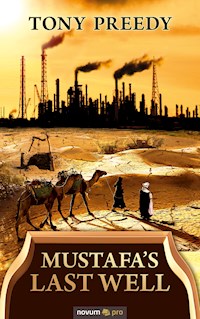
In 1207 Hijri, AD 1776, a young water-diviner named Mustafa experiences a strange, mystical event. 43 years later, he divines water in the desert for what is to be his last well. In 1367 Hijri, AD 1948, in an underdeveloped state on the Persian Gulf, the naïve and oppressed ladies of the Naamlahn Royal Harem see their lives transformed by the discovery of oil within their country's borders. This monumental discovery will lead to unprecedented economic and social upheaval in Naamlah, with the Emir, Salim, determined to lead his country through the shifting sands of development and modernisation. But with political enemies within and without, and religious fanatics whispering in the shadows, Emir Salim and the ladies of his harem face an arduous struggle towards their ambitious goals.
Das E-Book können Sie in Legimi-Apps oder einer beliebigen App lesen, die das folgende Format unterstützen:
Seitenzahl: 389
Veröffentlichungsjahr: 2021
Ähnliche




















Inhalt
Imprint 3
Disclaimer 4
Acknowledgements 5
List of characters 6
Chapter 1 7
Chapter 2 12
Chapter 3 20
Chapter 4 27
Chapter 5 36
Chapter 6 42
Chapter 7 45
Chapter 8 50
Chapter 9 56
Chapter 10 62
Chapter 11 71
Chapter 12 76
Chapter 13 80
Chapter 14 84
Chapter 15 88
Chapter 16 90
Chapter 17 97
Chapter 18 103
Chapter 19 108
Chapter 20 112
Chapter 21 117
Chapter 22 121
Chapter 23 125
Chapter 24 126
Chapter 25 132
Chapter 26 137
Chapter 27 145
Chapter 28 148
Chapter 29 151
Chapter 30 158
Chapter 31 161
Chapter 32 164
Chapter 33 168
Chapter 34 177
Chapter 35 181
Chapter 36 184
Chapter 37 189
Chapter 38 197
Chapter 39 203
Chapter 40 206
Chapter 41 209
Chapter 42 215
Chapter 43 218
Chapter 44 223
Chapter 45 230
Chapter 46 237
Chapter 47 243
Appendix 250
Imprint
All rights of distribution, also through movies, radio and television, photomechanical reproduction, sound carrier, electronic medium and reprinting in excerpts are reserved.
© 2021 novum publishing
ISBN print edition:978-3-99107-637-7
ISBN e-book: 978-3-99107-638-4
Editor:Ashleigh Brassfield, DipEdit
Cover images:Tom Wang, Jan Skwara, Wirestock, Wacomka | Dreamstime.com
Cover design, layout & typesetting:novum publishing
www.novum-publishing.co.uk
Disclaimer
The characters and events in this novel, as with the countries in which it takes place, are entirely fictitious and not intended to represent any real country or person alive or dead. Specifically, the tribal names of the characters are imaginary. The medieval practices described here are not necessarily in chronological context. The name of the country, Naamlah, in which most of the story is set was formed by combining the Arabic Naam, yes with lah, No.
Acknowledgements
I am grateful to my friends; The late Geoff Bagley for revealing his experimental work with torsion waves, Zuaina al-Busaiidi for inspiring the novel and Patricia Lake for encouraging me to finish it.
List of characters
Chapter 1
It is 1207 Hijri: AD 1776
The year in which America declares independence from Britain
Within seconds of the drum beat that proclaimed the start of the race, the small boy had fallen amongst the trampling feet of the pursuing camels. The child now lay whimpering motionless on the ground, surrounded by a cloud of dust. The camels that had been behind him had now passed by.
Mustafa al-Wyly, the 17-year-old son of a widowed date farmer, had accompanied his friend Issa, the crippled son of the local Imam, to the camel race. Mustafa’s father supplemented their meagre income from the date farm by divining for water when a well was required. This was an activity that Mustafa had been encouraged to take over, as the old man was becoming infirm. He had proved to be particularly adept at finding water but was not so enthusiastic when it became necessary to follow this up by digging the wells.
Today, Mustafa and Issa had joined the men who came in from their desert camps, as the camel race was a good excuse to avoid such work. Minutes before, as the owners gave their final encouragement and instructions to the children who were strapped behind their camel’s humps, a man of the al-Jaboo had removed a knife from his robe. Unseen in the excitement, he deftly wielded his knife to weaken the harness of the favourite’s jockey, who now lay on the ground before Mustafa. Mustafa ran towards the child and, as he would with an injured animal, moved his hands over the boy’s limbs. He detected only bruises; the soft broad footpads of the camels, and their natural instinct to avoid stepping on a living creature, had spared the child from broken bones. Unknown to Mustafa, the child had, like Issa, been lame since birth.
Mustafa and Issa had been friends since infancy, when Mustafa had first protected Issa from the taunts of older boys. Issa, had since birth, suffered from a weakness of his left leg which caused a conspicuous limp.
The child’s stunted growth had attracted him to the camel’s owner, who realised he could put the child to good use as a jockey because he was unlikely to put on weight as quickly as other small boys of his age.
Before the drumbeat, Mustafa and Issa had been arguing over which camel would win. Issa supported the light-coated favourite, imported from Somalia, from which the child had fallen, whilst Mustafa was loyal to the locally bred entry of his tribal leader. As his hands passed over the child’s lame left leg, Mustafa experienced a feeling of weakness, as though energy was leaving his body. The child, however, felt himself gently relaxing into unconsciousness. Those men who had supported the favourite had now lost interest in the outcome of the race, and with childlike curiosity gathered around Mustafa and the boy. No women were present, as they were not permitted to attend public gatherings. In this year, just as in medieval times, men assured them that their place was in their tent, even as many women of their faith of later generations would, even two centuries hence, be confined to their homes.
This was the crucial instant when the boy was healed of his disability. Neither healer nor patient had any understanding of how it had transpired. Two centuries later there would be those who claimed that it was an unconscious application of torsion wave energy. They would explain how the child’s DNA spiral became synchronised to the torsion wave field emanating from Mustafa’s DNA. As Mustafa was weakened by the energy imparted to the torsion field, the defective gene responsible for the child’s disability had been altered to replicate the corresponding gene in Mustafa’s DNA.
After several minutes, during which Mustafa silently prayed for assurance from the Almighty that he had done the child no harm, the child regained consciousness and started to clamber first onto all fours, and then to his feet, where he stood as erect as an athlete. After a quick conspiratorial smile directed at his saviour, the boy ran, for the first time in his short life, towards his angry, disappointed master.
The spectators, some now muttering to each other their suspicions of sorcery, backed away in fear for their souls. Others, who did not know him, convinced themselves that Mustafa must be a Jinn in disguise, and in defiance of custom raised their dish-dashes above their knees and ran away from the scene. They left only Issa to support his exhausted friend. Issa, otherwise lost for words after witnessing the healing spectacle, told Mustafa that his choice had won the race by a head, just in front of the al-Jaboo animal.
When the crowd dispersed, Issa, who had with other spectators, been watching Mustafa’s performance, asked, “What did you do to produce that cure?”
“Only Allah knows, for something went from my body that has made me feel weak,” he replied.
Mustafa slowly regained his strength as the friends departed for the farm, where they expected to find Mustafa’s elderly father waiting for news. The old man and his son lived there with no woman, for Mustafa’s mother had died after giving a son to his father in her thirteenth year.
“If only you could do that to me,” Issa lamented.
“I do not know, but there have been other times when I have felt that strange loss of my strength,” replied Mustafa, as he was thinking; “I will try it.”
When they reached the farm, they found no one there. Mustafa said, “Come and lie down here, and I will pretend you are the camel rider.”
Issa obeyed; he had confidence in his friend. He lay on the wicker sleeping frame that sat beneath the palm covered veranda at the front of the house, grinning.
“He is not treating the occasion seriously,” thought Mustafa, as he placed his hand on the lame leg and started to move it over the part that was weak. Immediately he felt the healing sensation start to build. “Do you feel anything yet?” Mustafa asked. Issa was about to say no, but then he felt a strange but pleasant sensation starting to strengthen in his leg. Issa relaxed. Mustafa held his hand steady, even though he continued to feel weakened as the energy transfer intensified. Issa started to become apprehensive, and would have stopped his friend, had he not suddenly lost consciousness. As he felt the healing sensation diminish, Mustafa watched his friend for a reaction, but had to wait several minutes before Issa opened his eyes.
Issa did not know where he was except that the sun was above and shining in his eyes. Then, in the shade of the palms, he saw the familiar beam of palm wood over the doorway to the farmhouse and remembered where he was. “How are you now?” asked Mustafa, concern in his voice.
“Let me get up, and we will see.” Issa swung his legs to place his feet on the floor and started to raise himself from the bed, realising with the utmost pleasure that he had been cured.
Issa departed excitedly to show his father what had happened, and Mustafa entered the house to join his own father. Within the house there was no sign of the old man.
A search amongst the date palms revieled his father’s body. He had died of a heart attack.
***
When Issa arrived home and met his father, the Imam, he showed him what Mustafa had done and told him how the young camel rider had also been healed. The Imam, shocked by these events, muttered a prayer, and told Issa to take him to Mustafa, but before they could set out, Mustafa came into their house to tell the Imam of his father’s death.
After giving condolences to Mustafa and agreeing to arrange for the burial of his father, the Imam became serious. His reaction was ambivalent; gratitude on one hand, whilst on the other hand he was concerned that Mustafa had been blasphemous; had not Allah punished himself or his son for some evil in a past life? The Imam pressured Mustafa to refrain from future attempts to heal. He told of Jesus, the man whose followers claimed him to be the son of Allah, who came six centuries before Allah’s messenger, the prophet Mohamed. Jesus possessed similar powers, for which he was crucified by the Romans who occupied the land. Later, he was worshipped by the Christians in Europe, the same tribes who sent crusaders to recapture the lands conquered by the followers of Mohamed, and burned alive, as witches, all those who emulated Jesus.
The Imam warned, “By continuing to defy the will of Allah, by healing those He had caused to suffer, Mustafa, unless you are the Mahdi, sent by Allah, and that is most unlikely, you risk death for blasphemy at the hands of religious zealots.” Mustafa was visibly frightened by these words. “Promise me you will never attempt such healing again, or I will not be able to protect you from those who would have you killed.” Mustafa agreed.
***
From that time Mustafa confined his use of torsion wave energy (not that he knew anything of this “science”) to his other skill, locating underground sources of water. It was, he knew, only his ability to provide this vital service that had protected him from the Islamic extremists, who needed minimal justification to proclaim a fatwa for his death. To dispel any doubts, as soon as his father had been buried, he crudely engraved the beam above the entrance to his house with a sign declaring “water finding” to be his only business.
Chapter 2
It was the year 1234 Hijri: AD 1819
Queen Victoria is born, along with British democracy, after the massacre of the Peterloo protesters in Manchester
Some who had known Mustafa al-Wyly since childhood called him a healer, after word spread of his performance at the camel race, and others called him a mystic, but the fear of fatwa made him reclusive from all men. The farm lay outside the coastal town that was the capital of the Emirate of Naamlah. Now suffering the ravages of sixty years, his back was bent, and the deterioration of his lungs, due to a fondness for the hookah, caused him difficulty breathing. His reputation came about when, as a boy, he demonstrated that he was blessed with an unnatural power; today this is believed to have been the ability to harness the energy of torsion waves, by which he was able to correct errors in the DNA of his patients – but in his country, at that time, it was considered sorcery.
Naamlah lay on the southern coast of the Persian Gulf, separated from its eastern neighbour, the small country of Haqum, by a natural geological fault knownas al wadi al kabier, the great dry river. This stretched from the mountains, which lay several hundred miles inland, to the south, and out into the sea. Some claimed that occasionally, when storms occurred in the mountains, thewadiwould carry water to the sea, but no one living could recall such an event. The Naamlahn side of the sea was shallow and famous for pearl-bearing oysters, which were relatively easy to harvest. On the eastern side, the waters of their neighbours were deep, and any oysters that lived there were beyond the range of divers. Naamlah prospered on trade whilst the neighbours, who were still mostly nomadic, subsisted only on their flocks of goats and sheep, which they exported to Persia through their small seaport. Later generations on both sides of the border would have hopes of oil being discovered in their land, as it would be in some other Gulf countries.
***
Mustafa never took a wife because he was only attracted to young men. His adult life was, therefore, one of frustration, because the Prophet gave no advice in such circumstances and such relationships were thus declared either as sodomy or non-existent by the religious men. He consulted the Imam, who said it was his duty to father children, but Mustafa found the prospect distasteful. When he had aged and become unfit to dig wells, nor pick dates, he decided to purchase two slaves. He found that the bids for physically fit specimens at the auction were beyond his means but when two young Somali brothers were displayed, a plan came to mind. They were both displaying signs of ill health; other potential slave owners had rejected Hassan because he had a withered arm, and Salim was considered defective because of a persistent cough. Mustafa, therefore, bought them both for a pittance and installed them at his farm. Ever since he had healed the lame jockey, he had yearned to attempt another healing. He saw the brothers as his opportunity to covertly experiment with his mystic power. In defiance of his promise as a boy to the now-dead Imam, he successfully used his healing technique to convert the slaves into healthy, strong workers. The boys therefore felt an uncharacteristic obligation of loyalty towards their owner, both for allowing them to stay together and for healing them.
***
Naamlah’s traders, who travelled through the desert to sell their pearls via the port of Salalah in the Hadramat, had long needed a source of drinking water to sustain them, for they could barely survive the journey with the quantity that their camels could carry. Mustafa had been commissioned by a consortium of traders to provide a well on the Naamlahn side of the mountains, where the trail ran close to thewadi. A price had been agreed and half payment had been accepted, with the balance due on completion. Preparations were made for the task by the boys, Hassan and Salim. They had now been with Mustafa for twelve years, during which they had matured into strong young men as a consequence of their healing, working on the farm and digging wells. Hassan thought that he might be 19 years old, which would make his brother 17, as there were two years between them. Hassan was cultivating a beard, which gave him an imperious appearance, belying his slave status. Salim was clean shaven and was taller than his older brother. Either could have overpowered Mustafa and run from his service, but they had remained dependent on him as they had no funds to sustain them if they did succeed in escaping. Besides, they had come to accept their status because they were devout Muslims, and did not the Holy Book tell of their social status as slaves?
Three camels were burdened by himself, the slaves, their food, bundles of straw, a tent, tools, and a generous ration of water. To the annoyance of the boys, their master insisted on accommodation being found for his hookah. After traveling south for five days, which took its toll on Mustafa’s health, their caravan had arrived at a depression in thewadiwhere gravel and rocks were visible among the sand and where, from his years of experience, Mustafa was confident of finding water. The boys were set to work erecting the tent in which their master would rest as soon as they had hobbled and unloaded the camels. By the time the camp was established, the sun was near the horizon. After ritual washing, as was dictated by their religion, using sand rather than precious water, it was time for all three to prostrate themselves towards Mecca in prayer before the sun disappeared. After their meal, the boys lay with the camels, whilst Mustafa retired to the tent, where he would attend to his journal and then relax smoking his hookah.
As dawn broke, afterfajrprayers, Mustafa was summoned to eat with the boys, who had prepared milk from the camels and dates that they had harvested from Mustafa’s farm. Whilstcawahwas brewing on the fire they had made of camel dung within a ring of stones, Mustafa collected his dousing equipment from the tent. He carried a bundle of short sisal rope ends over an arm and a Y-shaped dowsing stick in one hand. The dowsing stick was made from hazel, a wood imported from Europe and known for its favourable reaction to the “mystical” torsion waves/“dowsing fields.” Before the sun was high, he marched, puffing and panting, back and forth with the stick held before him until a field was detected and transmitted to his arthritic fingers, causing the apex of the stick to dip. At this point, he dropped a piece of rope. He continued until another response was observed, and dropped another piece of rope. Eventually, when satisfied that he had formed a suitable line of rope pieces, he changed direction and repeated the process until he had two lines that crossed. The boys were ordered to dig at the intersection, even though whether they were in Naamlah or the adjacent land of Haqum would be debatable.
The boys shovelled sand all day, with breaks only for refreshment and prayer, whilst Mustafa rested and puffed in his tent. The routine continued on the second day, when the sand gave way to gravel, but no sign of water. Their working conditions improved as they descended into shade. That evening the gravel gave way to rock and progress slowed, as the boys picked and chiselled at the rock and carried the off cuts to the surface. At this point in their digging, Salim made a discovery that brought their work to a halt. He made sure that Mustafa was resting before showing to Hassan thedahabhe had found. In his hand was a nugget, unmistakably of gold, which was the size and shape of a ripe fig, with three nodules on its surface. Spurred on by this discovery, the boys worked harder than ever.
“We must tell the master,” said Salim.
“No; he would not share the gold with us. It must be our secret,” replied Hassan, and that was what they agreed. As smaller pieces of gold continued to be liberated from the rock, they were hidden in the camel blanket in which they kept the dates. They knew Mustafa never looked in there. On the fourth day of excavation, they were past the gold-bearing rock, which had progressively been replaced by clay.
Mustafa was pleased with their progress and ordered them to make a separate pile for clay. As his mind was now deteriorating, he unnecessarily informed them because they had done it many times before: “Inshallah (if Allah wills it), the first water from the well will be added to clay to make bricks, reinforced with the straw we have brought on the camels.” The boys were now working about four meters below the surface and progress was slow, as they had to form steps in the rock to enable them to bring up the clay. Slowly, the clay beneath them became damp, and water started to flow into the hole to cover their feet. Mustafa was summoned and showed his delight by giving thanks to Allah, but not to his slaves. Mustafa made the oldest slave, Hassan, taste the water. After no adverse reaction, he offered water to the camels, who drank it rapidly.
That night the boys plotted to abandon their master and try to return to their homeland. It was, therefore, with feelings of guilt that they made plans to desert the man to whom they owed so much.
Now that they had resources their loyalty to Mustafa was of secondary importance. Neither of them could remember much from before their abduction. They had been taken by armed men from their family’s camp between Hargeisa and Berbera. After two days marching, whilst chained by their ankles, they arrived at the port of Berbera. From here they were taken bydhowto the Persian Gulf. They were not sure which direction to take, but they knew they must travel to the south. From what little he knew of geography, gained from listening to traders, Hassan said that they should aim for Al’Adan on the coast of Yemen and ask how to cross to Somaliland. Hassan added that he knew the dhows sailed from their old country to Al’Adan, and must return. Until now they had not had the means to escape, but now they were confident of buying passage bydhowacross the Arabian Sea from Al’Adan to the port of Berbera in Somaliland. From there, they thought, it could only be a camel ride to Hargeisa, where they would search for their tribe.
The following day the boys were set to making bricks with which to reinforce the well above the rock level, and then to extend above the surface to enclose the well against drifting sand. As the bricks in the wall hardened in the sun, Mustafa prepared a map by which the traders, guided by stars, could find the new well. In his tent, whilst puffing contentedly on the hookah, Mustafa was anticipating breaking camp and starting the journey home that evening – tomorrow in the old Arabic calendar, in which the new day started at sunset – but the boys outside were already preparing to abandon him. Two of the camels were laden with food and well water, but the blanket that concealed their find was heavy and could only be placed on the camel whilst she was sitting. Getting her on to her feet took much effort from both boys, because her burden now was more than she was used to carrying. Whilst loading the camels in haste, Salim had dropped the large nugget in the sand, but before he could recover it one of the camels kicked it away into the distance. It was abandoned, because Hassan would not wait whilst Salim searched for it by moonlight.
***
When Mustafa awoke, he found only one camel and little food. He managed to get water for himself and the camel from his well. He cursed the boys as he set out for home, guided only by the oppressive sun on his back by day and the stars by night. The effort was too much for a man in poor health, and Mustafa did not survive. His camel returned to the farm. Its owner’s body was never discovered, but a record of the activity at the well and a map of its location were found with his hookah in the blanket pocket of the camel. The traders held out for a month, hoping by then that no near relative would come forward to claim the balance of Mustafa’s payment. They were disappointed when the Emir, who was of the same tribe as Mustafa, insisted the money, if not claimed, should be given to the Imam for charitable work. The Emir decreed that henceforth, in recognition of his sacrifice, the watering-place would be known as the Well of Mustafa.
***
Without knowledge of stellar navigation, the boys wandered across the desert in the general direction of Yemen by observing the direction of the sun at its zenith but failed to find a passage through the mountains. Their food and then water ran out, causing a slow death from the mixture of hunger, thirst, and exposure. One of their camels returned weeks later to the date farm, but the one carrying the gold could not keep up, for she was weighed down by her burden, and perished.
***
Two riders searching for grazing had been surprised the previous day to come across a newly built well at the near side of the greatwadi, from which they eagerly drew water for their flock of sheep. They decided that it must have been built by their neighbours. The two, father and son, argued as to in whose territory it was situated.
The son said, “We should claim it to be on our land,” but the older man, the Sheikh who ruled the country, replied:
“Son, it is not important where the border lies. No one has ever disputed this because the relationship with our neighbours has always been amicable, and besides, thewadiland is a worthless desert.”
They found no vegetation and moved the flock back to what was undisputedly their territory, where they agreed that, after prayers, they would tell the rest of their tribal group to camp for the night.
The pair were wakened from their sleep beneath the stars by the sound of the wind rapidly strengthening from the South and burying them in sand. Hastily they loaded their camels, which were hobbled nearby, and started searching for their flock.
***
The traders, being keen to inspect the new well and have it blessed, organized a caravan headed by a brother of the Emir, which included the Imam and a youth, Juma, the eldest son and heir of the Emir. They were accompanied by three slaves from the Emir’s household; two young men from Burundi, who had been sold to the Arabs of Dar-es-Salaam by the chief of their tribe to punish their father, with whom the chief had quarrelled – they had been taken to Zanzibar and held until the arrival of the monsoon that allowed their transport bydhowto the Gulf; the third was Joseph, an older man with thin, grey hair, who had served the Emir since his arrival from Nubia as a child. Joseph stood head and shoulders above the other two men. Their arrival, which coincided with the festival ofEid al Fittah, saw them setting up camp near the Well of Mustafa. The slaves were ordered to erect their tent quickly, as a strong wind had started to rise from the south, where dark clouds and lightning could be seen over the mountains. After the men had retired to the tent a herd of sheep gathered in its lee, joining the camels and slaves, where they sought shelter from sand carried on the wind.
Chapter 3
Her body swayed from side to side, oblivious to the raging storm. Her vision, protected by long lashes which, like the rest of her strange physiology, had evolved over millions of years to survive in these conditions. On her back, the youthful rider was confident of his mount being able to proceed at her usual reliable ambling pace in the teeth of the storm, not much faster than if he walked alone. The boy and his elderly father, the Sheikh, had set out from their camp to search for their flock of sheep that had strayed whilst their companions, all men of the Haqum tribe, had been celebratingEid. Suddenly her hypnotic swaying stopped, as a sound like a breaking stick reached the ear of her young rider. She fell to her knees and he was thrown from her, landing among the stones and sand, without knowing the cause of his fall.
His companion, from whom he had become separated, was at that moment shouting “huna, huna dahab,” but his words were lost, carried away on the howling wind and obliterated by the agonized screams of the suffering camel.
The Sheikh, confused by the sandstorm and having lost sight of his son, had been searching for the footprints of the other camel, in sand and gravel which before his smarting eyes was being swept away by the desert wind. In all his days he had not seen a storm of such violence in their land. It was thus that his attention was taken by the lines of metallic yellow among the rock, exposed by the disappearing sand. He dismounted, took a large piece that was loose, and held it in his hand. There was no mistaking its texture and weight. The nugget had a distinctive shape; a near-spherical lump the size of a ripe fig with three small nodules on one side. The old man re-mounted, and it was then that he shouted the news to the boy, momentarily visible, kneeling by his camel in the distance. “Surely he has also found gold,” thought the old man, until he detected the agonized cries of the boy’s animal. One of her broad hooves had wedged in a fissure of the rock, exposed as the wind whipped away the covering of sand from the middle of the greatwadi. It was plain that this was the cause of her broken leg, the source of her pain. The boy reacted quickly because he wanted to spare her suffering. He knew she was of no value now. From the pocket, within the blanket on her flank, he took an ancient flintlock gun and, as his father hurried his mount towards the source of the animal’s cries, loaded it. He fought both the elements and the tears that were welling in his eyes, causing sand to stick to his cheeks, placed the gun to his shoulder and then, with a single shot to her head, stopped the noise.
***
Not more than a hundred metres from the riders, in the bed of thewadiand invisible in the sandstorm, a tent had been pitched within which traders, members of the al-Wyly, were feasting. Inside their tent, where the sound of the storm was muffled by the thick lining of wool stuffed quilts, the al-Wyly men were relaxing and telling stories of past adventures over freshly brewedcawah. Earlier they had debated if it was right to feast on the sheep that they found sheltering among their camels; it was argued by their Imam that they had been a gift from Allah for this purpose, but the more realistic argument of their leader, that they were only a lost flock, prevailed. The party had to be content with rice, dates, and the fowl that they had carried in coops on their camels.
The bellowing of the camel had been unnoticed against the howling of the wind, but that same wind now carried the louder bark of the gun to the al-Wyly camp. Here the sheep had been found by the al-Wyly and held with their camels until whoever owned them came to claim them. One member of the tribe, Juma, son of their Emir, had left the tent where, as within their neighbour’s camp, the feast ofAl-Fittahwas being celebrated. He had used the pretext of checking the ropes that were straining to hold their cover intact. The young man battled his way to the lee of the tent, where the camels and sheep were huddled together with the slaves sheltering between them, knelt with his back to Mecca, pulled his robe up to his thighs and relieved himself. Before he was done there came on the wind the unmistakable sound of gunfire. He rushed back inside and raised the alarm. The Naamlahn traders ran from the tent whilst binding their heads, leaving only slits for their eyes. Ancient guns in hand, they mounted their near buried kneeling camels and fought the wind, tearing at their clothes, each hastening to what he thought was the source of the sound that young Juma had reported. The impetuous and headstrong youth, who was first to have his gun prepared, raised the weapon intending to fire above the heads of the now visible intruders. Juma realised that his target was directly to windward of his position and therefore required no allowance for the wind to divert his shot to the side, but failed to allow for the headwind causing his shot to fall low and watched in disbelief as one of the intruders fell lifeless across their camel within seconds of him pulling the trigger. The old man died instantly as the shot penetrated his skull. The gold nugget dropped from his grasp before he could show it to his son and sank, lost in the sand. The other rider reached over the body of his father, grabbed the reins, and whipped the animal into a trot.
The Naamlahns started in pursuit, but their leader shouted above the wind to his nephew and the traders: “Leave the intruders, for they only search for their animals.”
“But uncle, they were approaching our new well,” replied young Juma, in a futile attempt to justify what he had done.
***
The young man, now owner of the missing sheep and from then the instant ruler of hisBedouintribe, who for generations had roamed the land of Haqum east of thewadi, washed the body and prayed as he buried the Sheikh, his respected father, on that festive night. The new leader was oblivious to the wealth concealed within their land which might, but for a twist of fate, have liberated his people from poverty. In his anguish, he called on his sons as yet unborn, and their sons after them, to avenge the unprovoked murder of his father by the al-Wyly.
Before sunrise next morning, after the storm was spent, the Naamlahn leader had the sheep returned unseen to where they would be found, near the camp of their neighbours. Later that morning, as the sun was rising, he lay prostrate on his prayer mat desperately beseeching Allah to accept his generous act and thus prevent the inevitable retribution demanded for the death, even of a simple shepherd, by the hand of his nephew, as expected within their culture. Otherwise, it was written that a feud would exist for each of the four generations represented by the fingers on a hand, until only the thumb remained, and the metaphoric hand could no longer hold a dagger.
***
Later that day the Imam held a special ceremony to bless the new well, and the traders gave thanks to Allah in their prayers, whilst on the other side of thewadithe new leader gathered the men of his tribe to plan retribution for his father’s murder. All who loved and respected their old leader were incensed and called for the blood of their new enemy to be spilled.
That night, whilst the traders slept, a party ofBedouinapproached from across thewadi. They first encountered the three sleeping slaves, who they woke and threatened with death if they made a sound, saying they had no argument with them. Next, they set fire to the tent. The remnants of the wind soon fanned the flames such that many inside were suffocated by smoke before they were awake. Those that did wake found their enemies waiting at the only exit with their curvedkhanjar, daggers, drawn. As they staggered out, gasping for air, theBedouingrabbed them and cut their throats in thehalalmanner, in which they were accustomed to killing sheep. Juma was the last out, having suffered from burning clothes which he had discarded, leaving him bare to the waist in only his scorchedizaar. As he took in the carnage outside, he was about to protest and proclaim who he was when twoBedutook hold of his arms and a third brought his knife to Juma’s throat.
Joseph, who had witnessed the slaughter, shouted at the top of his voice to theBedu, “Stop, he is one of us!” The one with the knife looked as though he doubted this, but Joseph continued, “He is the plaything of his master and sleeps beside him.” TheBedugave Juma a look of disgust, turned him towards Joseph and gave Juma a kick that sent him spread-eagled at Joseph’s feet. As Joseph lifted him by the shoulders, he whispered, “Stay quiet, young master, if you want to see your father again.”
Juma was incapable of making a reply; he was in such a state of shock from seeing the carnage that he could not even think properly. The young leader of theBeduthen told his men to leave the slaves and let them tell their Emir of this day. He led his band back to their camp, leaving the slaves with six scorched corpses and six who had died slowly from loss of blood.
Realizing Juma’s condition, Joseph assumed authority and instructed the other two slaves to start digging graves, after choosing a site on the Naamlahn side of thewadi. They found the tools that Mustafa’s slaves had abandoned and set to work as daylight broke. Joseph meanwhile stripped the bodies and washed them with well water. Next, he cut shrouds from the remnants of the tent and bound the bodies. Juma watched as if in a trance, unable to grasp what had occurred. A few words of prayer were mumbled by one of the young slaves as each corpse was placed in its grave, with eyes towards Mecca andkhanjarat its side. By the time each grave was filled the sun was high and the men were feeling hungry, but all of their food had been consumed in the fire. Joseph told them to kill and butcher one of the camels, of which they had fourteen, and gathered the remnants of ropes and tent poles for a fire. Throughout these activities, Juma remained in shock, watching in awe at Joseph’s industry. As the steaks cooked, Joseph used the last of the tent to make a cloak and took a headdress from one of the dead for Juma, for his protection from the sun. Of the steaks, some were for immediate consumption and others stowed on the camels to sustain them on their homeward journey.
They drew water for the camels to drink and filled skins for their own consumption, which they loaded onto the animals, together with the cooked meat. Joseph ordered the camels to be tied together in line and put a man on each of the front four. Juma had by now recovered and expressed gratitude to Joseph for saving him, but hoped that his reputation had not been ruined. The party prayed before setting off to the north with their shadows for guidance.
***
When they arrived back at the Emir’s fort, Joseph had returned to his subservient status, letting Juma lead the party to his father. He relayed the events to the Emir, but not how he had been the cause, and told of how he owed his life to Joseph and begged his father to reward the slaves by giving them freedom. The Emir’s thoughts were elsewhere. He told Juma that he was surprised that their neighbours had taken such offense when they discovered the new well in their territory and asked if there was some other cause for their violent acts. Juma denied knowing the real cause. The Emir decided that the well should not, in future, be used by his subjects. Juma again raised the subject of the slave’s freedom. His father considered this for several minutes, before replying:
“It will be impossible for them to support themselves.” He paused, clearly in thought. “There is a farm that was the property of my distant cousin, Mustafa the water finder. No near relative has been found who can claim it. They shall have it and make a living as date farmers.”
Juma reported this to Joseph, who broke into tears of gratitude, but Juma insisted it was he and the Emir who were in his debt. Juma never mentioned that he was responsible for the death of the other men, until on his deathbed, as Emir, he revealed the truth, for he feared that he would never experience the delights of heaven otherwise. Future descendent Emirs Sidiqu, Hammed and Salim would all suffer for Juma’s misdeed at the Well of Mustafa. After the skirmish, no trader dared to approach the well, for they feared attack by theirBeduneighbours. The well was abandoned and the potential wealth that lay nearby in thekabier wadiwas not to be re-discovered until several generations had passed, during which the intensity of the feud subsided.
Chapter 4
Libya, year 1361 Hijri: AD 1943
The European war meant little to the inhabitants of Naamlah, but in North Africa it was impossible to escape from its impact as Britain fought against Germany and its Italian ally.
Since arriving in Libya, after the sea journey from Italy to the little port of Surt, Bernhardt’s panzer squadron of Rommel’s Africa Corps had made rapid progress in their small part of the conquest of North Africa. Their panzer convoy of Tiger 3 tanks, headed by a type 233, eight-wheeled armoured reconnaissance vehicle, was proceeding towards their destination, the British Egyptian military base in Alexandria. Earlier, the convoy had included half-track trucks carrying fuel, as the panzer tanks needed a gallon for every mile, but this supply had been exhausted, and they now relied on the widely separated fuel dumps of their Italian allies.
Corporal Bernhardt Grover had in six months seen his budding career as an entomologist replaced by that of a tank commander. He was intrigued by the desert, which to his four companions in the Tiger 3 was just a barren wilderness of endless sand, populated by a few inhospitableBedouinnatives. To Bernhardt, the sparse vegetation and unaccustomed life that is supported in the Misratah and more recently the Damah regions held a fascination which he fought to resist, as it replaced the propaganda induced fervour with which he had departed the Fatherland. Given the opportunity, he would have abandoned the tank and its crew of indoctrinated youths and instead collected samples for future study. He had anticipated that at least he would be able to practice his Arabic, hastily taught whilst in Italy, but had underestimated both the sparseness of the population and the reluctance of the few people he encountered to talk to a German invader.
Battle-hardened by increasing British opposition, successful in several skirmishes, they had added captured supplies of Allied forces to those dwindling in the depleted half-tracks that they had previously been following. Now, having entered the range of RAF daytime reconnaissance operating out of an Egyptian base, they had adopted a tactic of maintaining radio silence between the lead panzer and the 233 car, and restricted movements to night-time. Each morning, before the rising sun had time to transform the steel armour of the panzer into an inferno, they camped under camouflage nets and rested. The previous night two panzers had succumbed to the abrading sand, which weakened the joints in their steel tracks as though they were wood. When undertaken as a planned operation it was relatively straightforward – just a matter of releasing a pin, dropping the track onto the sand and driving the machine off her old track and onto the replacement. The crew had all practiced the operation many times in ideal conditions, but when it happened as now, unexpectedly, in the dark, on only one side of the vehicle and uneven ground, it could be a difficult, sometimes dangerous, and time-consuming operation involving other vehicles and extra men. Inevitably it took more time than they would have liked. The convoy, now approaching Al Jaghbub, near the border with Egypt, was not, therefore, capable of moving until dawn, when it would be unsafe. They had therefore been unable to choose their daily hiding place with customary care.
The Germans were otherwise complacent in the knowledge that their efforts at camouflage would avoid detection from the air, because a few extra humps among those left by centuries of erosion in the desert would not be detected unless recent aerial photographs existed for comparison. Given the other failures, Bernhardt inspected the tracks of his panzer and decided he could not afford to miss the opportunity to fit replacements. The new track was unloaded and laid out in the sand ahead of the vehicle. The old one was released and joined to the new to form a straight steel road on which the panzer would move forward without drive sprockets ever disengaging.
In the crucial moment when the camouflage had been thrown clear to allow the panzer to move, they heard the whine of an aeroplane engine, and Bernhardt’s heart sank as he watched the aircraft alter course and swoop towards them before the netting could be reinstated. The convoy leader ordered all of the gunners to open fire with their anti-aircraft machine guns in a desperate attempt to prevent their presence being announced by the pilot. Hampered by the nets, they were not successful, and they watched in disappointment as the plane departed. The order was given for the convoy to move, because it was now anticipated that the British Army would soon know their position. Bernhardt’s panzer was the only one incapable of moving on and was now to complete the operation of track replacement and then try to catch up with the others.
***




