


1,99 €
Mehr erfahren.
- Herausgeber: Quickie Classics
- Kategorie: Gesellschafts- und Liebesromane
- Sprache: Englisch
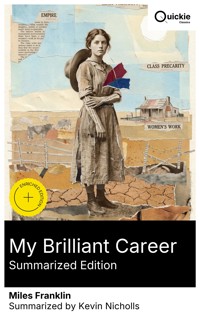
Set in the backblocks of New South Wales, My Brilliant Career follows Sybylla Melvyn, a headstrong teenager who narrates her refusal of the marriage market amid drought, debt, and the drudgery of bush life. In brisk, first‑person prose blending satire with lyrical landscape, the novel adapts the European Bildungsroman to the Bulletin school's realism. Franklin probes class precarity, artistic ambition, and gendered labor, and pointedly overturns the consolations of colonial romance at Federation's cusp. Stella Maria Sarah "Miles" Franklin began the book in her teens and published it in 1901 with Henry Lawson's prefatory endorsement. Raised on struggling properties in rural New South Wales, she drew on pastoral routines and on debates about women's education and work. The sensation—and scandal—of readers treating the novel as memoir hardened her commitment to women's artistic autonomy, later evident in labor and suffrage activism and in the sardonic sequel, My Career Goes Bung. Readers of feminist coming‑of‑age fiction, Australian social history, and environmental humanities will find this a bracing, eloquent study of ambition and constraint. For classrooms and book clubs alike, it is an invigorating cornerstone of the national tradition—and still startlingly modern. Quickie Classics summarizes timeless works with precision, preserving the author's voice and keeping the prose clear, fast, and readable—distilled, never diluted. Enriched Edition extras: Introduction · Synopsis · Historical Context · Brief Analysis · 4 Reflection Q&As · Editorial Footnotes.
Das E-Book können Sie in Legimi-Apps oder einer beliebigen App lesen, die das folgende Format unterstützen:
Veröffentlichungsjahr: 2026
Ähnliche


















My Brilliant Career (Summarized Edition)
Table of Contents
Introduction
A young woman’s fierce hunger for self-determination collides with the confining expectations of family, class, and country life. First published in 1901, My Brilliant Career introduced readers to an unmistakable voice from the Australian bush, a narrator whose candor, wit, and volatility still startle. Miles Franklin’s novel traces the early formation of ambition under conditions of scarcity, drought, and social scrutiny, depicting how dreams grow prickly when they must be protected against the daily grind. The book’s energy lies in a constant tug between yearning and obligation, each chapter staging an argument about possibility. It is an origin story of a sensibility as much as a plot, vigorous, restless, alive.
Often described as a bildungsroman and rural realist novel, My Brilliant Career is set in late nineteenth-century and turn-of-the-century Australia, among homesteads, small townships, and the harsh expanses of the bush. Franklin wrote at a moment when Australian nationhood and literary identity were coming into focus, and her book stands at that threshold with startling assurance. The 1901 publication situates it alongside federation-era debates about class, gender, and land, yet its storytelling remains intimate. Readers encounter the creak of gates, the grit of dust, and the rhythm of chores, not as background, but as the material of character.
At the center is Sybylla Melvyn, a headstrong girl whose family’s fortunes have waned, leaving her chafing against drudgery and lowered prospects. From early on, she announces an intense desire to work, to think, and to create on her own terms, even as relatives and neighbors press other plans upon her. Moves between households, changing responsibilities, and encounters with wealthier acquaintances bring both temptation and resistance. Courtship, that most ordinary social ritual, becomes a testing ground for independence. The novel’s events unfold as episodes in which Sybylla measures herself against the roles available to her and refuses easy comfort.
The narration unfurls in the first person with a youthful immediacy that alternates between exuberance, self-mockery, impatience, and lyrical attention to place. Franklin’s sentences can snap with comic defiance or linger over trees, heat, and music, giving the narrative a dynamic pulse. The style is candid and sometimes stormy, yet it is never careless; beneath the volatility is an alertness to how language can claim space for a young woman otherwise denied it. Readers should expect an intimate monologue, observant of social nuance and quick to satire pretension, while remaining deeply attentive to toil, landscape, and the textures of daily survival.
Key themes emerge with clarity: the friction between individual vocation and domestic duty; the tug of class and money on affection; the bush as both adversary and teacher; the making of an artist under pressure. Franklin examines how reputation and respectability shape choices, how poverty narrows horizons, and how desire, pride, and fear can masquerade as virtue. The book probes the limits of romance as a solution to economic reality, without dismissing tenderness or companionship. It also interrogates national myths by placing a young woman’s perspective at their center, revealing the costs and consolations of ambition in a demanding environment.
For contemporary readers, the novel’s immediacy arises from questions that persist: who gets to invent a life, and at what price. Its portrait of a gifted girl facing unpaid labor, family obligation, and the social policing of women’s aspirations resonates across workplaces, classrooms, and households today. The depiction of rural hardship, drought, and volatility speaks to ongoing environmental and economic precarity. Franklin’s insistence on interiority—on the right to narrate one’s own becoming—anticipates later feminist debates about voice and agency. The result is not doctrine but experience, urgently felt and argued, inviting reflection rather than prescribing answers.
Reading My Brilliant Career now offers more than historical interest; it offers a bracing encounter with the will to live authentically when structures insist otherwise. As an early landmark of Australian fiction, it broadens the canon with a bush narrative driven by a young woman’s authority, while its stylistic verve keeps the pages quick. The novel rewards attention to mood and cadence as much as to action, making it ideal for readers who relish character and voice. Above all, it endures because it tells the difficult, necessary story of how a mind learns to refuse limits.
Synopsis
My Brilliant Career, Miles Franklin’s debut novel set in rural New South Wales, follows Sybylla Melvyn, a sharp, imaginative teenager chafing against poverty and convention on her family’s drought-stricken farm. Her father’s restless schemes and drinking unsettle the household, while her practical mother strives to keep them afloat. Sybylla longs for a life of art and authorship, yet bush drudgery and social expectation press upon her. Narrated in her vivid first-person voice, the opening establishes the central conflict between personal ambition and inherited duty, sketching a society where class position, respectability, and limited opportunities for women weigh on every youthful impulse.
Mounting financial strain prompts a change of scene. Sybylla is sent to Caddagat, the pleasant homestead of her grandmother and Aunt Helen, where comfort, music, and conversation offer respite from Possum Gully’s grind. In this kinder environment she is admired for her wit yet reminded of the codes that govern a small colonial society. Franklin contrasts the nurture of books and gardens with the arid caution of neighbours’ tongues, as Sybylla tests her charm against an expectation of dutiful compliance. The stay refines her tastes and disciplines her imagination, while keeping alive the unresolved question of whether talent can survive circumstance.
Nearby lives Harold Beecham, a young pastoralist whose station signifies stability and wealth in contrast to Sybylla’s precarious home. Their acquaintance grows through rides, visits, and awkward intervals of silence, mixing mutual respect with misread signals. Franklin renders their rapport with ironic clarity, attentive to the ways courtship tests pride as much as affection. For Sybylla, admiration carries a cost: once defined as an eligible girl, she risks being fixed to a role that curtails the unruly energies that nourish her creative dreams. The narrative balances flirtation and self-scrutiny, keeping open the problem of whether love can coexist with freedom.
The story pivots when family misfortune recalls Sybylla from Caddagat. Pressed by debt, her parents arrange for her to work at a remote selection at Barney’s Gap, nominally as a governess to a brood of children but in practice as general drudge. The conditions are coarse, crowded, and unrelenting, exposing the harsh underside of subsistence farming. Franklin depicts the indignities of labor, the blunt economies of survival, and the gendered power that treats a bright girl’s time as collateral. Isolation amplifies Sybylla’s resourcefulness even as her health falters, sharpening her convictions about the price of respectability and the value of self-possession.
From this crucible Sybylla emerges more skeptical of easy solutions and more certain of the limits imposed upon her. Letters and distant friendships keep a thin thread to her earlier life, but the daily arithmetic of money and duty dominates. She persists in teaching, snatches moments to write, and contemplates the narrow avenues by which a colonial girl might pursue a career. The portrayal resists melodrama: progress is incremental, setbacks frequent, and dignity hard-won. When illness and family need alter her immediate circumstances, the question of her future returns with renewed urgency, demanding a choice in which every advantage carries a loss.
Harold Beecham reenters the narrative as a figure of steadiness and promise, and marriage appears as the practical solution admired by relatives and neighbours. Sybylla confronts the prospect with candor, weighing affection and security against the curtailment of her artistic ambitions. Franklin stages these deliberations with poised irony, attentive to the pressures that make acquiescence seem synonymous with maturity. The courtship plot tightens without resorting to sensational turns, instead intensifying the novel’s central dilemma: how a spirited young woman may honor feeling, family, and self-respect at once. The outcome is prepared carefully yet kept unspoken here, in deference to discovery.
Published in 1901, when the author was remarkably young, My Brilliant Career endures for its fresh, insurgent voice and its unsentimental portrait of the Australian bush. Franklin marries bracing social observation with comic verve, producing a narrative that questions who may claim a vocation and at what cost. Without relying on plot surprises, the book’s power lies in the tension it sustains between aspiration and constraint, love and self-determination. Its closing movements consolidate that argument while leaving room for readers to weigh competing goods. The result remains a touchstone of Australian literature and an early landmark in feminist imagination.
Historical Context
My Brilliant Career, first published in 1901, emerged from the late-1890s world of colonial-to-Federation Australia. Its author, Stella Maria Sarah Miles Franklin, grew up in rural New South Wales and drew on bush life among small selectors and large pastoral stations. The setting reflects dispersed homesteads, local schools, churches, and voluntary associations that organized community far from metropolitan Sydney. Railways expanded inland during the 1880s–90s, yet distance and isolation still defined daily existence. Franklin frames a young woman’s ambitions within a frontier society whose economy, customs, and expectations were shaped by land, family, and respectability at the moment a new nation was coalescing.
Australian rural life in the 1890s was marked by economic volatility. After a land and credit boom, the severe depression of the early 1890s culminated in the 1893 banking crisis, when several institutions suspended payments. Falling commodity prices and tight credit burdened pastoralists and small farmers with debt and insolvency. Seasonal employment fluctuated, and families adjusted expectations to survive. The novel’s attention to money worries and precarious prospects reflects this climate. Franklin’s characters inhabit a world where social standing can be undercut by drought, mortgages, and market downturns, capturing the anxiety common across New South Wales and other colonies during the decade.
The 1895–1903 “Federation Drought” compounded hardship across inland Australia. Prolonged rainfall failure damaged pastures, reduced stock numbers, and intensified reliance on bores and waterholes. The rural economy—heavily dependent on wool and livestock—suffered badly, while the rabbit plague, already rampant by the 1890s, stripped vegetation and undermined recovery. Domestic burdens grew as households managed scarcity, dust, and heat with limited services. Franklin’s depictions of arduous work, environmental stress, and frayed tempers echo conditions well documented in New South Wales during these years. The novel’s realism about the bush resists romantic pastoral imagery, grounding personal aspirations in the material limits of climate and land.
Rural work and class politics were also in flux. The great shearers’ strikes of 1891 and 1894 signaled rising union power and sharpened conflicts between pastoralists and laborers. Out of this agitation emerged labor parties in the colonies, with the first brief labor government formed in Queensland in 1899. Although Franklin’s story focuses on domestic and social life rather than union halls, this atmosphere of negotiation and assertion informs background attitudes about status, employment, and obligation. The bush was not only a landscape but a workplace, and expectations of endurance and duty pervaded relationships, shaping how characters measure merit, independence, and respect.
In New South Wales, the Public Instruction Act 1880 established free, compulsory, secular primary schooling, yet advanced study remained scarce in the countryside. Girls commonly moved into domestic service, teaching, or assisting family enterprises. Despite the Married Women’s Property Act 1879, which improved legal rights, social codes still emphasized dutiful marriage, modesty, and supervised courtship. Artistic ambition—music, writing, or performance—was admired in parlors but rarely fostered as a vocation for women outside cities. Franklin situates a gifted young woman amid these constraints, showing how limited schooling, thin cultural infrastructure, and community surveillance could narrow choices while stirring defiance and self-definition.
Women’s political activism was gaining momentum as Franklin wrote. Louisa Lawson’s journal The Dawn (founded 1888) campaigned for suffrage and employment rights, part of networks that won landmark victories: women’s suffrage in South Australia in 1894 and, at the federal level, the Commonwealth Franchise Act 1902, which enfranchised most non‑Indigenous women while excluding many Aboriginal people. Prominent campaigners such as Vida Goldstein brought public attention to female citizenship. Franklin, supported literarily by Louisa Lawson’s son, Henry Lawson, wrote into this ferment. Her heroine’s insistence on self-determination echoes contemporary debates about women’s work, civic voice, and the costs of respectability.
Literary culture in the 1890s was shaped by the Bulletin school, whose nationalist realism celebrated bush life through writers like Henry Lawson and A. B. “Banjo” Paterson. Franklin admired yet diverged from this tradition by centering a young woman’s perspective. With Lawson’s advocacy, My Brilliant Career appeared with William Blackwood & Sons (Edinburgh and London) in 1901, introduced by a prefatory note from Lawson. Its candid depiction of rural hardship and female ambition provoked controversy in Australia, and Franklin later restricted local reprints. The work’s reception reveals tensions between emergent national mythologies and voices challenging gendered expectations within them.
In 1901 the six colonies federated as the Commonwealth of Australia, inaugurating national institutions and policies, including the Immigration Restriction Act 1901 that underwrote the White Australia policy. Cultural nationalism valorized the bush as the cradle of a distinct character—stoic, egalitarian, and male-coded. Franklin’s novel participates in this moment by depicting stations, droughts, and small-town mores, yet it also questions who benefits from such ideals. By foregrounding a bush-bred young woman determined to define her own path, the book records its era’s material realities and exposes the limits imposed by gender, class, and place within the new nation’s self-image.




