


Erhalten Sie Zugang zu diesem und mehr als 300000 Büchern ab EUR 5,99 monatlich.
- Herausgeber: Nick Hern Books
- Kategorie: Poesie und Drama
- Serie: NHB Modern Plays
- Sprache: Englisch
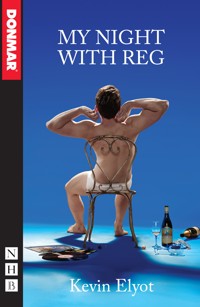
Kevin Elyot's Olivier and Evening Standard Award-winning comedy, My Night with Reg, defined a moment in the lives of gay men and became an instant classic on its premiere at the Royal Court and in the West End. At Guy's London flat, friends old and new gather to party through the night. This is the summer of 1985, and for Guy and his circle the world is about to change forever. Deliciously funny and bittersweet, Kevin Elyot's play captures the fragility of friendship, happiness and life itself. My Night With Reg first premiered at the Royal Court Theatre, London, in 1994, and went on to win the Evening Standard and Olivier Awards for Best Comedy. This new edition was published alongside the first major revival of the play at the Donmar Warehouse, London, in 2014, directed by Robert Hastie. It includes introductions by Hastie, Roger Michell, who directed the premiere, and the Booker Prize-winning novelist Alan Hollinghurst.
Sie lesen das E-Book in den Legimi-Apps auf:
Seitenzahl: 101
Veröffentlichungsjahr: 2014
Das E-Book (TTS) können Sie hören im Abo „Legimi Premium” in Legimi-Apps auf:
Ähnliche














Kevin Elyot
MY NIGHTWITH REG
NICK HERN BOOKS
London
www.nickhernbooks.co.uk
Contents
Title Page
Remembering Kevin
Original Production
Dedication
Epigraph
Characters
My Night with Reg
About the Author
Copyright and Performing Rights Information
Remembering Kevin
Alan Hollinghurst
Kevin Elyot was a great truth-teller, fearlessly and often hilariously candid, who brought the facts and fancies of contemporary gay life on to the London stage in unprecedentedly bold and bawdy ways. He was also a highly sophisticated craftsman, whose plays have beautiful and complex structures – of time, ideas, imagery and feeling. He was a tight plotter who wasted nothing and had a proper respect for coincidence, which he used sparingly but pointedly in everything he wrote. In his comedies of social and sexual manners, with their wonderfully outrageous and authentic dialogue, every detail none the less counts, and takes its place in the pattern, though the pattern itself may not become clear until the very last moments of the play. Their distinctive poetry lies in the glimpsed symmetries and secret harmonies that are revealed within and around the confused and sometimes cruelly shortened lives of his characters.
He is a writer with an evident if mysterious core of feelings, to which he returns, through his six stage plays, in ever more subtle and surprising ways. Since one of his preoccupations is the arrested emotional development of people for whom youthful passions can never be erased or equalled by later experience, there is something richly appropriate in this thematic recurrence. The world of the sexual free-for-all is constantly offset by a sense of almost incommunicable longing, just as joyful disinhibition is challenged by the deeper demands of love, and in the gay world of the 1980s by a lurking new equation of sex and death. Elyot’s first two plays, Coming Clean, which was staged at the Bush in 1982, and My Night with Reg, first produced at the Royal Court in 1994, are emphatically gay plays, with no straight or female characters. They are also vitally of their moment. In the long reflective gaps between his plays, Elyot produced marvellous screen adaptations of writers mainly from earlier eras – Wilkie Collins’s The Moonstone, Isherwood’s Berlin memoirs, Patrick Hamilton’s Twenty Thousand Streets Under the Sky, as well as half-a-dozen Miss Marple mysteries, and three Poirots; but his original work was all strictly contemporary. The action of Coming Clean ends the month before it was first performed; and Reg keeps sorrowful, incredulous pace with the ongoing ravages of AIDS in the decade that was to follow.
In the British theatre, the most prominent plays on the theme of AIDS before Reg had been American: Larry Kramer’s angrily political The Normal Heart, which reached London in 1986, and Tony Kushner’s bombastic Angels in America, a huge success when its two parts were staged at the National Theatre in 1992 and 1993. Elyot’s response to the subject could hardly have been more different from those ranting and sprawling US imports: a finely made three-act comedy, in which the structure ingeniously encodes the progress of the disease. The love-theme of traditional comedy is ghosted by a death-theme and the play ends not in happy resolution and the award of just deserts, but in the indiscriminate erasure of the lovers themselves.
My Night with Reg shows a preoccupation with time that was to grow ever more complex in Elyot’s subsequent work. He was fascinated by consequences, by the lasting effects of an action, or of a failure to act; and, as a keen Proustian, by the ways in which, through remembering and forgetting, we make what sense we can of the changes wrought by time. In Forty Winks, written ten years after Reg, and in his highly original and still unstaged last play, Twilight Song, something almost uncanny is made from the patterns of recurrence from one generation to the next, and from the uncertain spaces opened up, in memory and understanding, by the passing of decades. In Reg there is history, evident if ambiguous from the start – ‘It’s been a year or two, hasn’t it?’ says careless John; ‘Nine-and-a-half, actually,’ says Guy, who’s been counting; but the action, with its unnerving elisions of time, is relatively compact. Guy dwells obsessively on the past, but the play he’s in is inexorably forward-moving.
Its mood darkens through the four years covered by the action, but Elyot, the least preachy of playwrights, trusts his audience to interpret and connect. In the first scene, Guy has taken up knitting as a ‘lust-depressant’, because ‘One does need to be careful’, though the realities of safe sex are touched on only in Daniel’s wild satire on Guy’s habitual caution: ‘You know he masturbates in Marigolds… He won’t look at pornography without a condom over his head.’ But in the suddenly shelving depths of Scene Two, where the comedy of the sexual round turns much darker, we find Benny performing the terrified rituals of the potential plague-victim: ‘any little cough, twinge or itch brings me out in a cold sweat. And then I start panicking about the fucking cold sweat. I tell you, if I haven’t caught anything, it’ll be a fucking miracle.’ The worry is not only his. In the final scene of the play, Elyot’s plotting is as stern as the progress of the disease itself.
The idea for Reg, Elyot later revealed, had come to him at the funeral, in Bristol in the mid-1980s, of an old flatmate who had died of AIDS and who, it became clear, had slept with a large number of the mourners. In the play, the unseen figure of Reg himself has an analogous function. We know, tantalisingly but aptly, almost nothing about this compulsive seducer who in the time of AIDS is a threat as much as a promise of excitement. Reg isn’t even, we gather, his real name: he is called Rinaldo, an American, who insists on being Anglicised – rather as the popular epidemiology of AIDS saw it as an American disease which was to take on a British habitation. When one young stranger sleeps with him, ‘he said names didn’t matter. I could call him anything I wanted’: he becomes for him the avatar of an adolescent crush. As the play progresses, the energies of farce and fate converge in this ubiquitous and irresistible figure of desire.
The importance of My Night with Reg was seen as soon as it opened twenty years ago; it won prestigious awards, and a long West End run, and was filmed by the BBC in 1996. When Elyot came back to the AIDS subject, in his 2001 hit Mouth to Mouth, he showed it in a very different perspective – the protagonist Frank is a decade older than Guy and his friends, a man living with the depredations of HIV, and the dislocations, worries and horrors of treatment. The panicky comedy lies in part in the way the AIDS survivor is neglected by those around him, a quiet voice of suffering in the storm of egos, not least that of a monstrously self-absorbed gay doctor. The disease won’t go away, but nor will the defiant force of Kevin Elyot’s wit. Now Elyot himself has gone, but his plays survive, to haunt, to disconcert and, in a favourite line of his from Love’s Labour’sLost, ‘To move wild laughter in the throat of death’.
Roger Michell
I first met Kevin Elyot twenty years ago on the eleventh floor of the Royal Free Hospital in Hampstead. He was in the ward reserved for patients with AIDS-related issues and, to be honest, he didn’t look great. I remember thinking, ‘Christ, I hope he doesn’t die before we manage to get this show on.’
I’d been sent My Night with Reg by the Royal Court and didn’t really know anything about him. They sent me his earlier play which had been done at the Bush. I didn’t really want to do a play at the time, but this one kept sticking in my mind. And I wanted to do it Downstairs at the Court, not Upstairs, thinking it was going to be very popular and commercial, but Stephen Daldry was immovable. In the end I thought I liked the play just too much to want to watch someone else direct it and said yes. Apart from all the usual things one might respond to in a play (comedy, tragedy, characterisation, subject matter, etc.), I was completely seduced by the craft of it: here was a piece of utterly modern writing constructed with the skill and care of a nineteenth-century watchmaker... and built into the mechanism were two breathtaking theatrical coups which of course I won’t attempt to explain here. Let’s just say they are sort of time-jumps by misdirection.
I last saw Kevin the week before he died on the same floor of the same hospital. He was sitting up delicately eating M&S orange segments from the carton and chatting enthusiastically about the revival of his play at the Donmar. In front of him on the table, apart from the usual paraphernalia of the sick bed, were modern novels, newspapers and a copy of Private Eye. In the corner of the room, amongst the get-well cards, sticking up jauntily out of a toilet roll were the two helium balloons that my little girls had insisted on buying for him in the hospital shop the week before. One, pink, read ‘It’s a Baby Girl!’ and the other, heart-shaped, ‘I Love You’.
We all came to love Kevin. Mind you, you didn’t often get the feeling he was encouraging the process. Immaculately turned out, he would sit quietly at the edge of the rehearsal room, tiny notebook to hand, eyebrow arched. He would be really quite crisp with the actors: perhaps because he was one himself. Text errors, however minute, were fastidiously corrected. Punctuation was a particular issue.
I invited Stephen Daldry to a final run in the rehearsal room. ‘Shall I bring my knife and fork?’ he asked. ‘Why?’ ‘To eat my own shit.’ ‘I’m sure that won’t be necessary.’
At the first preview Kevin and I sat nervously side by side making bets on when the first laugh would arrive. ‘When David Bamber takes off his apron,’ I suggested, optimistically: this happened about halfway down the first page. In fact the apron was not only a key prop but something that David had brilliantly integrated into his performance: folding it, wiping his hands on it, tying and retying it, crying into it. The lights snapped up and after a moment Kevin leant over and whispered into my ear: ‘He’s not wearing it.’ ‘What?’ ‘He’s not wearing it. David’s forgotten to put the apron on.’
So the first laugh was on us. But by the end of that first performance in the tiny Theatre Upstairs we all felt what we’d come together to make was special. I’d decided to stage it (wonderfully designed by Bill Dudley) in traverse. Staring into the bank of seating opposite, as it slowly subsided from astonished laughter at the boulevard comedy of the first act, through the utterly brilliant coups of the two time-jumps, into the pin-drop sadness of the last, felt like a nightly miracle. Night after night amongst the usual Sloane Square crowd I saw the faces of a young gay audience, jaws dropping as they slowly realised that this was their story, and the story of that terrible disease that is unnamed in the play, made clear and accessible and human to the wider world.
The play transferred (the first play to do so directly from the Theatre Upstairs in the history of the Royal Court) and happily sat at the Criterion in the West End before moving with a new cast to the Playhouse. It was lauded, loved and larded with gongs. Later, with a screenplay by Kevin, we made a film of it with the original cast: so we were together as an affectionate




