


8,49 €
Mehr erfahren.
- Herausgeber: Foodwatch Pty Ltd
- Kategorie: Ratgeber
- Sprache: Englisch
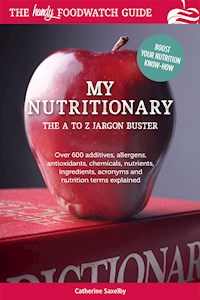
Do you know your MCTs from your LCTs? How about sterols from stanols? Or omega-3 vs omega-6? If you find yourself confused by food labels and ads for healthy eating, Catherine Saxelby’s comprehensive guide My Nutritionary will help you cut through the jargon and put the power of her nutrition know-how in your hands.
We live in a world with constantly changing nutrition advice – eat more of this, avoid that – but increasingly this information uses scientific terminology that few of us are familiar with. When everyone from diet gurus to wellness bloggers to celebrity chefs and even your doctor has suggestions for healthy eating, translating the latest nutrition jargon into useful terms can be overwhelming.
What’s the difference between glucose and dextrose? Or probiotics and prebiotics? Why do we need calcium? What additive is number 330? How safe is acesulfame K? And what the heck are trans fatty acids?
In
My Nutritionary, Catherine answers these questions and more in plain English, helping you navigate through the jargon and hype so you know what you’re eating. If you want to know exactly what you’re putting in your shopping trolley – or on the dinner table, this is the guide for you.
Das E-Book können Sie in Legimi-Apps oder einer beliebigen App lesen, die das folgende Format unterstützen:
Veröffentlichungsjahr: 2018
Ähnliche















About My Nutritionary
Do you know your MCTs from your LCTs? How about sterols from stanols? Or omega-3 vs omega-6? If you find yourself confused by food labels and ads for healthy eating, Catherine Saxelby’s comprehensive guide My Nutritionary will help you cut through the jargon and put the power of her nutrition know-how in your hands.
We live in a world with constantly changing nutrition advice – eat more of this, avoid that – but increasingly this information uses scientific terminology that few of us are familiar with. When everyone from diet gurus to wellness bloggers to celebrity chefs and even your doctor has suggestions for healthy eating, translating the latest nutrition jargon into useful terms can be overwhelming.
What’s the difference between glucose and dextrose? Or probiotics and prebiotics? Why do we need calcium? What additive is number 330? How safe is acesulfame K? And what the heck are trans fatty acids?
In My Nutritionary, Catherine answers these questions and more in plain English, helping you navigate through the jargon and hype so you know what you’re eating. If you want to know exactly what you’re putting in your shopping trolley – or on the dinner table, this is the guide for you.
Contents
This book is for our daughter Georgia so it may answer the many questions she often asks me. This one is for you, darling.
‘The investigation of the meaning of words is the beginning of education.’
Antisthenes (445–365 BCE)
Hello and welcome from Catherine
Thanks for buying this eBook.
As a nutritionist, I am frequently asked all kinds of questions relating to what is in our food and how it affects us. These days, we are bombarded with information about how to eat right, stay slim, live longer, look younger and remain vital. Articles about health and nutrition seem to be everywhere we look – books, magazines, television, radio, the Internet … You can’t escape them on Facebook, Instagram or Twitter either. What’s more, this information is often conflicting. Who knows what to believe!
When I speak to people about nutrition, they want me to cut through this confusion and hype. They’re after clear and simple explanations for all the technical terms that appear on food items, and straight answers to queries such as these:
How is starch ‘modified’?
What's the difference between glucose and dextrose?
How can you tell if a ‘thickener’ is made from wheat?
What additive is code number 621?
Why is a microbiome useful?
How does fasting help you lose weight?
What’s all the fuss about kombucha? Or kale?
If you have ever checked out a food label, or read about losing weight, coping with a food allergy or boosting your immune system, it’s likely you will have asked at least one of these questions.
My aim in writing this book is to explain – clearly and simply – all these nutritional terms. It first began life as a brief glossary in my best-selling book, Nutrition for Life. Later, I expanded it to become a post on my website (where it remains very popular). In fact, I too still use it for double-checking a term when I’m in a hurry! So I started thinking that if I find it so handy, others might too.
This book is the result. I have made it as comprehensive as a guide can be. It is designed in a simple A to Z format to put the facts and figures right at your fingertips, whenever you need them. This book is for everyone, whether you’re a student or you have a professional interest in nutrition as a dietitian, food technologist, home economist, chef or food marketing executive – or you simply want to know more.
Whatever your background, I’m sure you won’t be surprised when I tell you that nutrition changes. It evolves, it twists and turns, it often swings back to an earlier position. This is hardly unusual for a new discipline blended from biochemistry, physiology, medicine, food technology and the culinary arts. And as new terms and discoveries keep popping up, there are shifts in thinking on many issues. So to help you stay up to date, you can find it revised as new information becomes available online at www.foodwatch.com.au.
And, if you come across a term that’s not in this guide or on the website, please send your question to me at [email protected]. I’d love to hear from you.
So, why do we need nutritional terms?
Like all sciences, nutrition has its own 'language': its own way of accurately describing or classifying what's in food and the effect it has on the body.
There are terms to classify important constituents in food, like vitamins, minerals, carbohydrates, proteins, fats and fatty acids. There are also terms describing more recent nutritional discoveries, such as antioxidants, phytochemicals, polyphenols, resistant starch and probiotics.
Then there are ways of eating – diets and regimes for improving health or solving a health problem.
Finally, there are food processes, such as canning, freezing, pasteurisation, homogenisation and irradiation, and the accompanying additives that stabilise, moisturise, thicken, acidify, intensify, enhance, colour and preserve.
Many people today suffer from food allergies or intolerances and find it hard to obtain information on what's in food and what they should – and shouldn't – worry about. Of course, not all additives are a problem. So if you know what's OK and what to avoid, it gives you a much greater choice for your daily diet. That is why I have included food additives (over 300 of them), listed both by code number in the Appendix 2 and by name, along with a helpful summary of which ones are the most likely to cause problems.
All these nutritional terms are listed here. With over 600 entries from arachidonic acid to zinc, this book will help you make sense of what’s in the food you eat. I hope you find it helpful and easy to use.
Without more ado, let’s start at the beginning of the alphabet …
Regards
Catherine
How to get the most from this book
First the good news. You don’t have to read this cover to cover.
This book is a ‘nutritionary’ – use it like a dictionary to look up additives, jargon and acronyms (like SDTs, RDI or BMI), vitamins, minerals, unusual ingredients (like inulin or fructo-oligosaccharides) and other strange-sounding terms, as when you stumble across them.
All the entries are listed in easy alphabetical order in the main A to Z section.
If you want to understand how all the nutrients are grouped (for example, if you want to find out a list of all the vitamins or fatty acids or minerals), then turn to Appendix 1 and you’ll find the classifications used by nutritionists.
If you are looking for a particular food additive but all you have is its code number from a food label, then you'll find it in Appendix 2 where all the code numbers are listed (this is handy to have with you when you're shopping).




