www.amberbooks.co.uk
This digital edition first published in 2012
Published by
Amber Books Ltd
United House
North Road
London N7 9DP
United Kingdom
Website: www.amberbooks.co.uk
Instagram: www.instagram.com/amberbooksltd/
Facebook: www.facebook.com/amberbooks
Twitter: @amberbooks
Copyright © 2012 Amber Books Ltd
eISBN: 978-1-908696-85-4
PICTURE CREDITS
All illustrations © Amber Books Ltd (Illustrator Myke Taylor/The Art Agency) except
p10-11, 18-21, 28-29, 32-33, 38-41, 46-47, 50-53, 58-61, 68-69, 80-95 © IMP AB
All rights reserved. With the exception of quoting brief passages for the purpose
of review no part of this publication may be reproduced without prior written
permission from the publisher. The information in this book is true and complete
to the best of our knowledge. All recommendations are made without any guarantee
on the part of the author or publisher, who also disclaim any liability incurred in
connection with the use of this data or specific details.
Ancient Legends and Folklore
Beowulf ’s Dragon
8
Chupacabra
10
Gorynych
12
Knucker
14
Krak’s Dragon
16
Leviathan
18
Mummy
20
Orochi
22
St. George and the Dragon
24
Wyvern
26
Mythological Monsters
Basilisk
28
Cerberus
30
Cyclops
32
Fafnir
34
Futs-Lung
36
Gorgon
38
Griffin
40
Hatuibwari
42
Jawzahr
44
Kraken
46
Ladon
48
Minotaur
50
Oni
52
Ryujin
54
Shen-Lung
56
Sphinx
58
Thunderbird
60
Movie Monsters
Dracula
62
Frankenstein's Monster
64
Glaurung
66
Godzilla
68
Hungarian Horntail
70
King Kong
72
Luckdragon
74
Norwegian Ridgeback
76
Smaug
78
Werewolf
80
Modern Monsters
Bigfoot
82
Hopkinsville Goblin
84
Jersey Devil
86
Loch Ness Monster
88
Reptoid Alien
90
Yeti
92
Yowie
94
Index
96
Contents
Introduction
6
Introduction
F
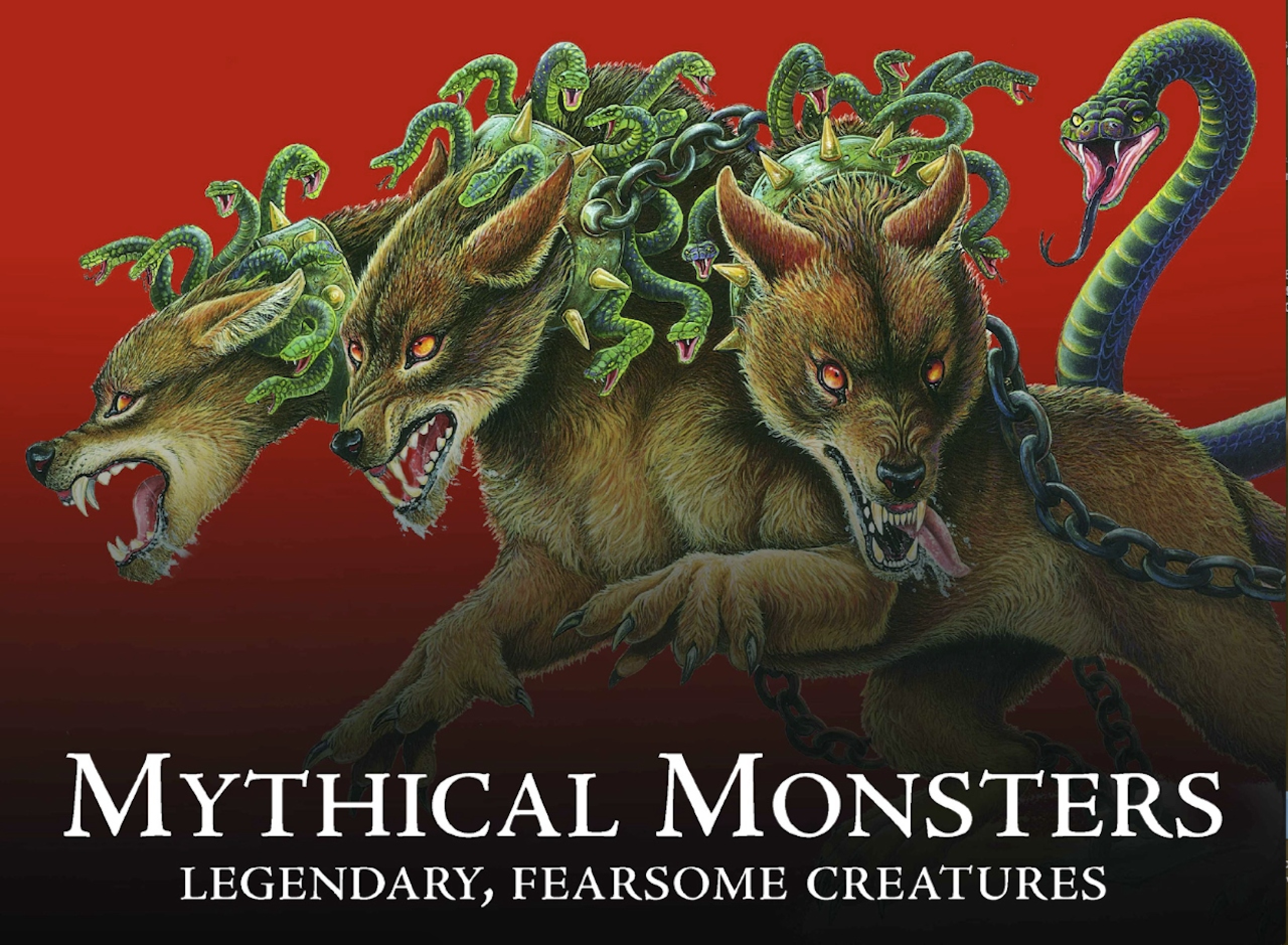
or as long as humans have had fears, there have been stories about monsters.
Some monsters were born of literature and myth—creatures such as Cyclops,
the Sphinx, and the Minotaur. For ancient people, these were not mere
fantasies, but real beliefs that haunted their lives. The citizens of Ancient Greece, for
example, believed they faced an afterlife meeting with the three-headed dog
Cerberus. In North America, Native Americans would tremble in fear
of the Thunderbird every time a storm slashed through the sky.
Legends of many ancient monsters survived to terrorize people born
hundreds of years later. The Basilisk, a lethal hybrid creature
first described 2,000 years ago by the Roman writer
Pliny, was still feared and encountered by the 16th
century
AD.
In 1587, a Basilisk was said to have
killed two young girls who were hiding in
their cellar in Poland.
But haven’t we moved on since then? Don’t
we know now that monsters are just products of
fantasy? Don’t be so sure. Several of the monsters in this
book are certainly figures of pure invention. King Kong was created for
cinema in 1933, and Godzilla has been a star of film and print for
more than 50 years. Yet, countless witnesses throughout
history have claimed that monsters are every bit as real as
you or me—they have seen them with their own eyes!
Thousands of people, for example, say they have seen
the Loch Ness Monster. Scientists still aren’t able to
explain the sightings and huge footprints of Bigfoot.
Reports of Reptoid aliens come from around the world.
And more than 1,000 people claimed to witness the
Jersey Devil in 1909.
All monster stories lurk somewhere between fantasy and reality. Everyone knows that
some creatures are pure myth, but people love to hear a good story! Oftentimes,
skeptics discredit modern monster stories by giving scientific explanations—
like Bigfoot is just a big ape. But what’s so wrong with believing? Thousands of
witnesses can’t all be lying, right? Don’t let the skeptics fool you. It’s human nature to
be interested in the unknown, and many people—even the nonbelievers—secretly want
to believe in these strange beasts.
EYES
Adapted to see in the dim
light of caves, the dragon’s
eyes are well suited for
watching over its hoard of
plundered treasure.
WINGS
Batlike wings attached to
the torso by robust muscles
lift the dragon in flight.
The bones within the wing
structure are hollow to
reduce their weight.
BODY
The dragon’s enormous body is
blackened by the soot of its own
flames. Its blue green scales glow
with inner fire.
JAWS
Its fiery breath lights the skies. Chain mail
provides no defense against its crushing jaws and
poisonous fangs. A reservoir of venom is located
in the upper jaw.
Beowulf’s
Dragon
TAIL
The barbed tail
shaped like an
arrowhead can be
used as a weapon in
battle. In flight, the
tail operates like a rudder,
balancing the dragon and
allowing it to execute skillful
aerial maneuvers.
Did you know?
Where in the world?
Geatland, a region in the south of
Sweden, is where Beowulf met the
mighty dragon in battle. Geatland’s
deep forests provided the ideal
habitat for a fire drake.
Did you know?
BEOWULF STRIKES THE DRAGON WITH HIS SWORD,
but the blow glances off the beast’s
terrible hide. Beowulf is engulfed in dragon flames, a sight so terrifying that his army
flees. Only the faithful Wiglaf remains to help. Beowulf breaks off the blade of his magic
sword in the dragon’s head. Bitten on the neck by the dragon, Beowulf is soaked in his own
blood but continues fighting. Wiglaf stabs the dragon in a vulnerable place and Beowulf
slashes it through the middle, cutting the monster in two and ending its life.
●
Beowulf dies from his battle wounds. The dragon’s treasure is removed from the cave and buried
with Beowulf. All the pieces of the dragon’s corpse are thrown into the sea.
●
The dragon’s flames are so intense that they burn Wiglaf ’s shield down to its handle. Wooden
shields, such as the one Wiglaf used, are a poor choice when doing battle with a fire drake.
●
Beowulf carries an iron shield bearing the image of a dragon.
●
A dragon’s lightweight bones are tougher than reinforced concrete.
●
Smoke rising from the mouth of a cave is usually a telltale sign that a dragon resides within.
●
The dragon is the largest-known flying creature.
C
oiled in a cavern beneath a gray rock there is a terrifying
dragon—a fire drake measuring 50 ft. (15 m) long. The dragon
guards a lair filled with piles of priceless treasure. Its heavy
body blocks daylight from reaching the armor, goblets, jewels, coins, and
golden swords it hoards deep in the cave. When a thief steals a golden
cup from its lair, the dragon rampages through the countryside, burning
everything it sees. The fire drake
breathes flames that light up the
sky, terrifying villagers and burning
every home in Geatland. Beowulf,
King of the Geats, armed with a
magic sword, leads an army into
battle to face the dragon.
SWEDEN
SKIN
Some witnesses say the beast
has bare gray or blue skin,
others that it has scales or fur.
SPINES
These reportedly burst through the skin
of the monster’s head and back. Their
purpose is unknown, but they may offer
protection against enemies.
SIZE
Eyewitness accounts are muddled.
Estimates of the creature’s height
in the standing position vary from
3 ft. 3 in. (1 m) to 6 ft. 6 in. (2 m).
WINGS
The chupacabra is usually
said to have bat like wings
with a span up to 13 ft.
(4 m). A few reports say
it has no wings.
FANGS
Witnesses say the chupacabra’s
mouth bristles with great fangs.
Some say they are bright red.
CLAWS
The monster’s feet and
hands have huge, viciously
curved and wickedly sharp
claws for pinning down
helpless prey.
LEGS
These are long and muscular
for bounding 66 ft. (20 m) at
a stride when advancing on
prey. Strangely, the monster
never leaves footprints.
EYES
The size of hens’ eggs,
the big eyes glow an
alien red. Some
witnesses claim they
fire laser beams to
paralyze victims!
Chupacabra
Where in the world?
Did you know?
A
CHUPACABRA SWOOPS TOWARD A SMALL HERD OF GOATS
and drops silently between
the trees —a ragged silhouette against the night sky. Sensing danger, the goats shuffle
nervously, then start to bleat in panic as the monster strides toward them, moving
unnaturally fast on its long legs. Paralyzed by terror and the foul, sulfurous odor of the
chupacabra, the goats are helpless to flee. The monster seizes the nearest one with its claws,
plunges its huge fangs into the animal, and swiftly sucks out every last drop of blood. Goat
after goat, it drains the whole herd, then slips off in search of other prey—for a chupacabra’s
craving for blood is never satisfied. It leaves no tracks behind.
●
Two Brazilian fishermen claim they shot a chupacabra dead and still have its head—which they
refuse to let anyone examine.
●
The mayor of Canovanas, a town in Puerto Rico, leads chupacabra search parties, armed with
a crucifix and a gun. He also sets traps around the town in the hope of catching one of the
elusive creatures.
●
In 1996, a Mexican policeman opened fire on a chupacabra at close range—but his bullets had
no effect, and the monster escaped.
●
Attacks on humans are rare, but a nurse in Mexico reportedly lost an arm to the fangs
of a chupacabra.
A
modern menace of the Americas, this bloodsucking, bat-like
fiend is blamed by farmers and the authorities alike for the
brutal slaughter of pets and livestock. This multi-fanged,
many-spined, foul-smelling monster was first reported in 1995. It seeks
out its victims in the dark of night and preys on a range of farm and
domestic animals, sucking them
dry of blood – its name means
“goat-sucker,” after its first victim.
Some people say that the
chupacabra comes from outer
space, while others say it is the
result of US military experiments.
The chupacabra is known in
Central and South America. There
are also reports from the southern
states of the USA, including
California, Arizona, Texas and
Florida. Most sightings are from
Puerto Rico, an island 994 miles
(1600km) southeast of Florida.
PUERTO
RICO
TAILS
Seven wildly thrashing tails
render the dragon’s back end
as hazardous as his front.
BODY
The scaly body produces a reek of sulfur that
hangs around Gorynych like a sinister cloud.
WINGS
Although his great bulk prevents him
from flying quickly, Gorynych’s wings
allow him to descend in places where he
is least expected.
CLAWS
Iron claws rip knights’
suits of armor open as if
they were aluminum
cans.
Gorynych
HEADS
Three fanged, fire spitting
heads with terrible horns make
it impossible to approach
Gorynych. Six watchful eyes
and a heightened sense of smell
enable him to detect a maiden
from a mile (1.6 km) away.
Did you know?
Where in the world?
The fearsome seven-tailed
Gorynych is featured in folktales
and myths originating from Russia
and Ukraine.
IVAN,
A PALACE GUARD
who understands the speech of animals, overhears two crows
discussing where the princess is hidden. The czar gives Ivan a magic sword to help him
on his rescue mission. Nemal Chelovek’s fortress is unguarded because he believes no one
would dare approach him. Nemal Chelovek turns himself into a giant when he discovers Ivan
in his castle. The magic sword flies from Ivan’s hands, killing the giant, then flies through the
castle halls until it finds and slays Gorynych. Ivan marries the princess.
●
Gorynych caused eclipses of the Sun and Moon. The fact that they reappeared showed that
even a powerful dragon could not defeat the Sun and Moon. The Russians took this as a sign
that dragons can be defeated by the righteous.
●
Not all Slavic dragons are destructive. The Slovenian city of Ljubljana is protected by a dragon.
This benevolent dragon is pictured on the city’s coat of arms.
●
Dragon blood is so venomous that Earth does not absorb it.
●
There are no cave paintings of dragons because caves are a favorite residence of dragons. The
dragon residing in the cave would have driven all cave painters away.
●
A magic sword that enables the warrior to stand far away from the dragon is the ideal weapon
for battle with dragons.
T
his savage Russian dragon has three fire-spitting heads and
seven tails. Gorynych walks on his two hind legs and has two
small front legs, like a Tyrannosaurus rex. His iron claws can
slash through any shield or suit of armor. The air around Gorynych
reeks of sulfur, a sign of its evil. His uncle, the sorcerer Nemal
Chelovek, kidnaps the czar’s daughter and intends her to wed
Gorynych. The princess is
imprisoned in the sorcerer’s dark
mountain castle. Desperate to have
his daughter back, the czar offers a
huge reward to anyone who can
rescue the princess from the castle.
Many princes try and fail.
UKRAINE
RUSSIA
JAWS
Immense jaws open wide
enough to swallow a horse and













![Tintenherz [Tintenwelt-Reihe, Band 1 (Ungekürzt)] - Cornelia Funke - Hörbuch](https://legimifiles.blob.core.windows.net/images/2830629ec0fd3fd8c1f122134ba4a884/w200_u90.jpg)