


5,99 €
Mehr erfahren.
- Herausgeber: Eagles and Dragons Publishing
- Kategorie: Fantasy und Science-Fiction
- Serie: Mythologia
- Sprache: Englisch
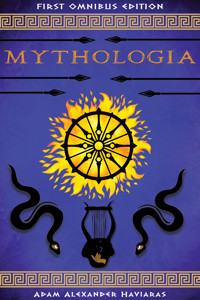
Long ago, when gods and heroes walked the earth in triumph and tragedy, true love and epic deeds were set among the stars…
For thousands of years, the stories of gods, goddesses and heroes in Greek Mythology have entertained, inspired and enlightened mortals. This rich storytelling tradition has continued from one generation to the next, the stories retold over and over again in the hopes that they will drive us to better ourselves, and to remind us that there is still magic and wonder in the world. They teach us that life can be beautiful and terrible, exhilarating and fleeting.
In this First Omnibus Edition of the Mythologia series, readers will escape into unique retellings of the poignant and epic myths of Phaethon, Pelops and Hippodameia, and of Orpheus and Eurydice.
In this collection, best-selling and award-winning author and historian, Adam Alexander Haviaras, combines in-depth research and unparalleled imagination in bringing these ancient Greek myths to vivid life for readers of all ages.
Step back in time for an epic journey you will never forget.
If you enjoy books by Natalie Haynes, Madeline Miller, and Jennifer Saint, then you will love the Mythologia historical fantasy series!
Read this collection of books today and return to a time of true love and epic deeds when gods and heroes roamed the earth.
Das E-Book können Sie in Legimi-Apps oder einer beliebigen App lesen, die das folgende Format unterstützen:
Seitenzahl: 466
Veröffentlichungsjahr: 2024
Ähnliche







Contents
Copyright
Newsletter
Chariot of the Son
The Story of Phaethon
Hymn I
1. The Rising Sun
2. Secrets Revealed
Hymn II
3. The Heliades
4. The Chained Titan
Hymn III
5. The Palace of the Sun
6. With the Sunset
7. A Burning Purpose
Hymn IV
8. The Eyes of Olympus
9. Arcing Fire
10. Elegy
Author’s Note
Wheels of Fate
The Story of Pelops and Hippodameia
Hymn I
1. The Child
2. A Feast for the Gods
3. The Halls of Olympus
Hymn II
4. A House of Sadness and Death
5. Arcadian Idyll
6. The Challenge
7. Gifts of Peril and Grace
Hymn III
8. The Spinning of Wheels
9. Victory
10. Blood Guilt
11. Cursed
Author’s Note
A Song for the Underworld
The Story of Orpheus and Eurydice
Hymn I
1. The God and the Muse
2. The Gift
3. The Birth of Love
4. Oh Hymenaie!
Hymn II
5. The Covetous Herdsman
6. Slithering Death
7. The Silent Strings
Hymn III
8. Paths of the Dead
9. Lord of the Underworld
10. Toward the Light
11. A Life Without Love
Author’s Note
Thank you for Reading
Become a Patron
About the Author
Stay Connected
Mythologia
First Omnibus Edition
Adam Alexander Haviaras
Mythologia: First Omnibus Edition
and the Mythologia series
Copyright © 2024
by Adam Alexander Haviaras
Chariot of the Son - Copyright © 2014
by Adam Alexander Haviaras
Wheels of Fate - Copyright © 2021
by Adam Alexander Haviaras
A Song for the Underworld - Copyright © 2021
by Adam Alexander Haviaras
Eagles and Dragons Publishing, Stratford, Ontario, Canada
All Rights Reserved.
The use of any part of this publication, with the exception of short excerpts for the purposes of book reviews, without the written consent of the author is an infringement of copyright law.
ISBN: 978-1-988309-66-8
E-pub Omnibus Edition
Cover design by Eagles and Dragons Publishing
Sign-up for the Eagles and Dragons Publishing Newsletter and get a FREE BOOK today.
Subscribers get first access to new releases, special offers, and much more.
CLICK HERE to get started!
Chariot of the Son
The Story of Phaethon
And Theia was subject in love to Hyperion and bare great Helios and clear Selene and Eos who shine upon all that are on earth and upon the deathless Gods who live in the wide heaven.
Hesiod, Theogony
Hymn I
OUTCASTS
The Rising Sun
On a high rock overlooking the grassy plain of Ethiopia, a young man waited.
Everyday since he was old enough to do so, Phaethon left the safety of the palace of King Merops while darkness still blanketed the world and some light yet lingered in the constellations.
With spear and bow in hand, he crossed the open spaces of the grassland, and forded the broad rivers, risking lion and crocodile to reach the edge of the forest where the land rose and rocks from the last great making of the world thrust upward to the sky.
The climb to his chosen eyrie was not an easy one, but he had strength in his limbs and a will to reach the top.
Phaethon, golden-skinned and auburn-haired, waited not for beasts to hunt, nor enemies to waylay, nor the young women carrying water upon their heads that he might abuse them.
He waited for the sun.
The whole of Phaethon’s existence revolved around that first, soul-warming glimpse of golden light to pour out of the East every day with divine constancy. Never wavering in his devotion, he watched it, his hands gripping the edge of the rock above the deadly precipice, anticipating that first brilliant crack at the far edge of the world.
It was with a longing, and a lingering sadness, that Phaethon watched the light of the world turn all to colour - the emerald of the plains, the silver of the rivers, the blue of the lakes, and the browns and yellows of earth and mountain. He needed to feel that light as his body needed air to breathe or water to drink. The light was sustenance for his very spirit, and when it rushed upon Phaethon, he felt it rejuvenate him, fill him with power, and pride, and other inexplicable emotions. All about him life exploded, and he revelled in it.
Flowers blossomed, flights of birds shot into the skies, and beasts crawled from their dens to welcome each new day. The rising sun drove them all, created anew with each rosy dawn.
Phaethon stood, his tunic thrown down, his arms outspread to the world until, having reached its zenith, he could feel the sun moving on. The young man breathed slowly in and out, images of rushing rivers and snow-capped mountains flashing suddenly behind his closed lids - wheels turning, as of fire and streaks across a singed sky.
Then, blinding light.
When he awoke, he was on his perch near to the edge.
He sighed and gathered his belongings - his tunic, bow, and the spear around which a serpent had wrapped itself. Gently, Phaethon slid it off and the serpent lay there in the last light of the sun.
On the plain where the antelope leapt, and wild horses cropped at the tall grasses, a rider in a plumed head-dress came toward him. Phaethon recognized his eldest brother Niobis’ haughty manner.
As Merops’ heir, Niobis treated all his brothers and sisters as subjects, but none more so than Phaethon.
“Phaethon!” he called out.
“Yes, brother,” Phaethon answered, stopping and leaning casually upon his spear.
“You’ve been gone most of the day. Mother is worried.”
“She knows where I go. Why worry?”
“Father sent me to collect you. Come now.”
“As you can see, I am already coming.”
“You’re always so impudent!”
“And you’re as puffed up as a peacock, Niobis. Get yourself back! I come when the sun sets.”
Without warning, Niobis kicked his dark stallion hard at Phaethon, his spear out for attack.
Phaethon dropped his things and grabbed hold of the oncoming spear shaft just in time, throwing Niobis into the mud.
“Curse you!” Niobis sputtered full of rage.
Phaethon held the spear toward his brother and then with three long strides sent the shaft into the brown water of the river where it stuck in the mud and then toppled over beneath the surface.
He picked up his things, turned his back on his brother, and walked away in the direction of the palace.
The palace came into view a short while later, its gilded peaks and walls of red and yellow stone appearing as deep shades of earth in the angling light.
Phaethon nodded to the guards as he passed and saw them tense at his approach.
In the inner courtyard stood all of his brothers and sisters in a circle. Their voices were like a muttering of seals on a too-little beach. All tall, and slim, and dark, Phaethon never felt at one with them. He was pale, and thickly muscled, his brown-red hair always having been a source of amusement.
At his approach, the circle broke to reveal Niobis sitting in the centre. His other brothers stood about him, fists clenched, their royal robes angry and wrinkled from bending over the eldest.
“Phaethon!” cried Teros, a younger of the boys. “Why did you try to kill Niobis?”
“Me?” Phaethon returned. “He charged me from horseback with his spear!”
“You lie!” Niobis rose and came forward, brushing off the hands of his concerned sisters. “You tried to kill me.”
“Careful, little king. Else you may eat more mud.”
“You’re a bastard!” The words exploded full force from Niobis’ mouth to echo throughout the palace.
Phaethon held back, his fists wanting to swing up, but he controlled them. Instead, he looked upon his brothers and sisters, all beautiful, all smooth as ebony, with gold about their arms, necks, and ankles. Their eyes were wide with wonder, and he knew they believed it too, that he was not one of them. He never would be.
Niobis smiled broadly, sensing that his shot had hit home. “You know it’s true. You’re a bastard. You…don’t…belong…here.”
“What’s the meaning of this?”
The voice of King Merops crashed down on them, and all the children cowered before their father. All except Phaethon.
Merops’ tall form swept in among them, a full head taller than Niobis. His yellow and purple robes rustling as he swished a horse-hair flail at a few stray flies. He came between Niobis and Phaethon.
“I asked you both a question. What is the meaning of this?”
Phaethon looked up into the king’s big white eyes, held his gaze, but said nothing.
“Niobis?” the king asked. “Why are you covered in mud? It is unseemly for a prince.”
“I fell from my horse.”
“How?”
“I…” Niobis looked at Phaethon, his eyes narrowing. “I went to fetch Phaethon as you asked, but when I approached him he unhorsed me and threw me into the mud.”
“Father,” Phaethon spoke up. “I merely grabbed the spear that he had levelled at me.”
“But Father-”
“Silence!” Merops’ thick hand fastened on Niobis’ shoulder, silencing him.
“Father,” Teros stepped up. “Niobis called Phaethon bastard before all here.”
Merops looked down on the little boy, his countenance grave. He was silent a moment, breathing deeply.
“Phaethon,” the king began. “It is time for you to go to your mother. She would have words with you, and she has been worried.”
“Yes, father.” Phaethon looked at one of the upper windows of Queen Clymene’s apartments. He could see her blond head framed within, her stormy blue eyes taking in the scene below.
Merops looked up at the window, nodded, and spoke loud enough for her to hear him. “It is time she told you what you need to know.”
With that, King Merops swept from the courtyard with Niobis and the rest following.
Phaethon stood alone looking up at his mother.
Secrets Revealed
“Mother?” Phaethon’s voice was soft in the upper corridor of the palace. Red walls led to a blue door at the end. “Mother, may I enter?”
The door swung open and a young girl, one of his mother’s handmaidens, bowed to him.
“Leave us, Anthi,” the queen’s voice commanded, and the girl went out, closing the door behind her as Phaethon watched.
He stood still, taking in the rooms, a place he loved second only to his eyrie on the other side of the plain.
Queen Clymene’s royal rooms were nothing like the earthly elsewheres of Merops’ palace. There were no browns or greys or blacks. Rather, Clymene’s world was one of blues and brilliant greens, pink, white, and the light of the sun. The walls were painted in shades of turquoise with depictions of dolphins and sea horses, and glimpses of Poseidon’s world. Temples wavered in the wine-dark realm, and oceanids roamed freely, including one that looked very much like Clymene.
Above it all, rising over the sea and the earth, shone the sun, brilliant and blinding. The likeness was as though captured sunlight had been embedded in the wall of the queen’s apartments.
Clymene sat on a couch of pure white marble, draped with sea-blue cushions that matched her robes. The blond waves of her hair fell about her shoulders to frame the pink seashell that hung about her neck. She stroked the latter with a finger, and her eyes met her son’s.
“I was worried for you this morning.”
“I’m well,” Phaethon answered. “I wanted to linger in the sun longer today. That’s all.”
“Yes,” she replied, her eyes closing then opening. He thought that she would say more, but she only beckoned for him to sit next to her.
Clymene took her son’s hand in both of hers and bent her forehead to touch it. Phaethon felt cool tears run onto his hand, and sensed an odour of sea spray in the air, though he knew little of the sea, never having experienced that particular joy.
“What’s wrong, Mother?” he asked, letting her weep without making any motion to comfort her.
Clymene regained her composure and sat straight, the salt tears soaking back into her skin like water upon a soft, sandy beach. In truth, something in her majestic eyes now worried Phaethon, and he pulled his hand away.
“I heard all that transpired in the courtyard, my son,” she finally said.
Phaethon jumped up, his anger back as he stared at the sun upon the wall.
“Niobis called me a bastard in front of my brothers and sisters, even in front of the servants! Father said nothing…did nothing!” Phaethon’s arms and shoulders flexed, his jaw tensed.
When did my beautiful boy become a man? Clymene thought as she looked upon him. How the tides do flow without notice… It is time.
“They are not your brothers and sisters,” Clymene said. “And Merops is…not your father.” It is done…
Phaethon whirled around as though he had been struck, and for a moment he was confused as to whether his anger stemmed from the words his mother had spoken, or because he realized Niobis had spoken true.
“And you?” Fear and sadness welled inside of Phaethon’s golden eyes, their brilliance momentarily dim and dark. “Are you not my mother?”
“I am your mother,” Clymene answered without hesitation, her voice strong like a crashing wave. “And I am proud of that fact. I am your mother, Phaethon. It was I who gave birth to you, who brought you to the light.”
The young man was relieved, but the great question hung like a double-headed axe between them.
“Then…who is my father?”
Clymene rose from her couch and walked to the fresco of the sun on her wall. Phaethon noticed that her lips moved, but she uttered no words.
“Mother, please. I must know.”
“Your father,” she began, “is the Shining One. He who lights the world.” She turned to face her son. “You, my lovely Phaethon, are the son of Helios.”
Phaethon stepped back until he felt the couch, then sat. He saw his mother standing before him, the image of the sun illuminating the space behind her.
“Helios? The Great Charioteer is my father?”
Clymene nodded, sad, wistful, and longing. He would have questions, she knew. First, she moved to a box of carved olive wood which rested upon a table. She opened it and removed a gold medallion with an image of the sun upon it. She handed it to her son, dangling it by the braided leather rope.
“This is yours now,” she said.
Phaethon took it in his hands and looked at the image of the charioteer on the back, then at the face on the obverse. A handsome, golden visage stared back at him, hair long and wild as sunlight, smiling.
“My father…”
“Yes, he is.”
“But why…I don’t understand. Why are we here in this land with Merops? Why are we not with my father? Do you not love him?”
His mother’s face told him the truth immediately. There was a great sadness, untold pain at the remark, a wound that had not healed.
“He is my truest love, incomparable to Iapetus, or Merops.”
“Then why are you not with him?”
“Zeus forbade it.”
The mention of the king of the Olympians silenced Phaethon. Now he waited, listened.
“From the realm of my own father, Oceanus, I used to watch Helios drive his team across the sky. I would sing to him from the deep, and from the shore. I would call to him. One day, he stopped and we, for but a few minutes, stared at each other. We knew we loved one another, and every day after that I sang and he stopped, always for an instant. Then, one night while your aunt Selene lashed her blacks across the world, your father came to my shore in a gilded boat. He was dressed all in white.” She smiled. “Even by night he was brilliant and beautiful.”
Clymene roamed about the large room in remembrance, her hand straying to objects now and then as if to ground herself back in reality.
“Beneath the constellations we lay together, and I begot you.”
“What of your then husband?” Phaethon had known that much of the time before Merops, that his mother had been wed to another.
“Iapetus was a Titan, and had other interests than a mere oceanid such as me. I had not seen him for an age, and our sons, your brothers, were all grown.”
“I have brothers?”
“Atlas, Menoetius, Prometheus, and Epimetheus are your half-brothers, yes.”
Phaethon knew their names. “You never told me?”
“Again, Zeus forbade it, and all are bound to obey or bear his wrath.” Clymene touched the fire of a lamp that burned nearby when she said it, remembering her beloved Prometheus. “When you were born, Zeus commanded your father to stay away from us. He knew, by the word of Aphrodite, that your father loved us more than anything, and so he feared for the timely rising and setting of the sun. I was commanded to marry Merops, and banished to this dry place of earth and heat so far from the life-giving sea.”
Phaethon went to his mother’s side at the west-facing window where they both watched the last rays of sun bleed over the edge of the world.
“That’s why I long for the sun, why I’m so different here,” Phaethon said in a low voice.
“Yes. In your heart, you have always known the light, and been drawn to your father’s strength.” She placed her hands on Phaethon’s shoulders. “One thing you can be sure of is that you were never without him in the light of day, for he sees all from his heights, and was surely watching you as he passed.”
“Am I the only child you had by him?”
Clymene hesitated, then turned to the window again.
“No. Your father and I, we disobeyed Zeus and met again. I had to see him. I had to show you to him.” She looked her son in his brilliant, confused eyes. “You have three sisters, Phaethon. They are the Heliades: Phoebe, Merope, and Aetheria. Long have they waited to meet you.”
“Where are they?” Phaethon’s emotions welled fiercely inside. He had felt alone for so long, ignorant of all.
“They linger by the seas, and are charged with the return of your father’s gilded boat when he is not in need of it.”
“They see him?”
“Rarely. They have their purpose as decreed.”
“And I have no purpose!” Phaethon pushed away from her and went to another window where he looked down into the courtyard and saw Niobis and the other boys practicing with sword and spear in the torchlight. “I’ll kill them for their insults,” he muttered.
“No! You shall not. You are no murderer, and Merops has been good to us.”
“A good jailer!”
“No. A good friend and kindly husband. He protected us when no other would have received us beneath their roof for fear of angering Zeus.”
Phaethon turned back to the window, quiet and angry, his mind whirling like the starlit heavens.
Darkness hung heavier on the world that night, it seemed. The stars burned fiercely. The son of Helios suddenly hated the world in which he found himself, in which his mother was imprisoned. The sounds of his step-brothers and sisters out the window annoyed him like the braying of hyenas on the plain. The lake waters beyond the palace smelled stale, and the plains that had once appeared to him green and fresh were now dank, and dark, and soiled.
“Why would Zeus do this to us…to me? He doesn’t even know me.”
Clymene reached out a lithe but shaking hand to her son’s shoulder. He did not pull away this time.
“Zeus rules all the world, and must think of the whole - gods, men, beasts, and those in between. It does not seem fair or just, that is true. Many a night did I cry myself to a sleep with nightmares and loneliness. But…each morning, with the rising of the sun, I would pick you up from your crib, hold you to my breast, and feel the true well of love that existed. You are what has kept me close to my true love. You are a product of that love.”
Phaethon heard the warm words pouring from his mother’s heart, and a measure of guilt crept in upon him. He had not fully listened to her meaning. There was one thought which he then clung to, and would not release.
“I want to go to my father.”
Clymene had been waiting for it, had known he would wish it. She sat down, nodding her head absently. This was the moment she had dreaded in her heart. The time had come to bid her son farewell.
“I cannot stop you. You are a man now, and able to roam this earth as you will.”
“Come with me.” A small remnant of the naive boy asked. “Be with Father.” He said it as if it was a simple matter.
“If I were to go, I would be defying Zeus who forbade me to ever see your father again. Were I caught, and I would be, I would be chained in the darkest depths of Tartarus, never to see you or feel you father’s light upon my face again.”
“And I?”
“There were no such laws placed upon you. All that was commanded was that you would be reared here, away from your father. And now you are a man, and free to go.”
Sad rivulets ran from Clymene’s eyes. Oceanids had ever been full of emotion, storm-tossed.
Phaethon could see her struggling to right herself and he held both her hands in his.
“I would go, Mother, though it crushes me to leave you in this place.”
Silence hung between them for several heartbeats.
“How do I get there? I mean…where will I find him?”
“Your father dwells in the Palace of the Sun, far, far to the East, beyond the world’s edge. Few venture there or find it.”
“Then how will I?”
Clymene’s eyes strayed to the medallion about his neck.
“That is your key, your guide. Your sisters will take you to the other side of the world in the gilded boat, and with the medallion of the sun, his palace shall appear to you.”
“Appear? Is it a magical place?”
“It is god-made, the home of the Sun.”
“And my sisters? Where do I find them?”
“You will need to travel to the sea east of here. Wait upon the shore while holding the medallion and they will come to you.”
Phaethon stood up and paced excitedly, scarcely able to contain the new-found life and hope that burned within his veins.
“There is one thing you must do for me, Phaethon, before you go to your father.” She stood now, determined, emboldened by his own fervour.
“Yes?”
“I wish for you to go to your half-brother, Prometheus, high in the Caucasus.”
“What shall I say to him?”
“After yourself, he is one of my most beloved.” Clymene stared into dark memories then, to a time when Zeus had meted out punishment to her sons by Iapetus - Atlas holding up the heavens, and Prometheus chained at the top of the world while the others went down into darkness. “Tell him I love him, and forever shall. That I am proud of him for what he did to champion men. Tell him that I think of him every day, and hope that my prayers somewhat ease his suffering.”
“But how do I get to the top of the world? Where is the Caucasus?”
She had forgotten that Phaethon’s only world had ever been the one of Merops’ palace, and the plain beyond. To be released from imprisonment would be daunting in itself, a terrifying event.
“You must go north before you seek your father’s palace. Your sisters know the way.” Clymene went to a carved cupboard and removed another box decorated with a relief of Olympus. “Give this to Prometheus for me.”
“What’s in it?” Phaethon opened the lid to see two gold, covered bowls, and a small phial. “It smells wonderful, sweet.”
“The bowls contain ambrosia and nectar. They will give him strength for a long time.”
“And the phial?”
“An alternative to his imprisonment.” Clymene looked down and then directly at Phaethon. “You must not touch the phial, for any reason.”
He looked at it and closed the lid, wary. “Very well.”
There was little else to say. How does one express a whole sea of emotion in a few days, hours, or even minutes. Clymene threw her arms about him, tried to breathe him in, remember how it felt to hold her dearest son.
“I’m afraid,” she whispered.
“I must see him, meet him. If I do not, I shall never rest or be able to gaze upon the sun again for fear of the pain in my heart. I’ll never fit in here, Mother.”
She stood back and looked upon him. He was a man, handsome, strong, a descendant of gods. Such were not meant to be chained.
“You are right. You must go if your heart tells you. Remember, the world is not always kind, even to gods. Listen to your sisters and they will take you where you need to go. When you travel with them, time speeds itself, and so you will be able to cover great distances. Take all that you need from the palace stores - food, weapons. I will speak with Merops.”
“I love you, Mother. I will come to you before I leave tomorrow.”
“Tomorrow?” she began to protest, but stopped herself. “Yes. Tomorrow. Please do come to see me.”
Phaethon hugged her again, kissed her hand, and left her rooms with the carved box beneath his arm.
When he was gone, Clymene lay down upon her bed and cried herself to sleep as she had not done for an age.
“Will you miss me?” the girl, Anthi, asked as she and Phaethon lay naked together in his room.
“Of course I will,” he answered, his fingers tracing the swell of her breasts, and the curve of her hips. “I shall think on you always.” It sounded hollow to him and her resigned sigh confirmed it. However, she was the only girl he had ever known. She possessed a small part of him, but he found it difficult to imagine missing the girl whom he had first kissed and made love to. All he could think of, as he gazed from her naked body to the collection of his things in the corner of the room, was his long journey on the morrow to the top of the world and beyond, to the Palace of the Sun where he would finally meet his father.
“I love you, Phaethon,” Anthi whispered, her tears falling on his chest.
He held her tight, silent in the dying lamplight.
When next Anthi awoke, Phaethon was gone.
As the sun rose the next morning, Phaethon was already making his way across the plain toward the sea. He walked quickly, eager to meet his sisters, eager to get away from Merops’ palace.
He had seen King Merops that morning, and the truth was that the king had been kindly toward him. He always had been. When Phaethon told him he was leaving, Merops placed a thick hand upon his shoulder.
“I wish you well on your journey to see your father, Phaethon. Though you are not my own, it has been a pleasure seeing you grow into a man. Take whatever you need from the palace for your journey, and if your path ever leads you back this way, your mother and I shall bless the day.”
“Thank you, sire. Please…take care of my mother for me.”
“Never fear, Phaethon. For she is dear to me, though I know her heart has never been mine.”
The king looked sad then. He turned, beckoning all his own children. They followed without another word. Only Teros lingered a moment, his glassy eyes taking one last look at Phaethon.
When he was alone with Clymene, Phaethon embraced her and hoisted his satchel and spears.
“You have the medallion and box?” she asked.
“Yes.”
“Go then, with my love, my son. The sun is rising, and you must rush to meet it.”
And that had been it. Phaethon had gathered his things and left by the large wooden gates of the palace. He glanced back only once to see Clymene’s dark outline upon the parapet of the palace gatehouse.
Ahead, the dirt road was flanked by the green grass of the plain, and as the sun rose higher and higher, antelope, buffalo, zebras, and other beasts ranged all about him.
Hymn II
CHILDREN OF THE SUN
The Heliades
It took Phaethon three days to reach the sea, and the anticipation of seeing it deepened with each step.
His mother’s true home… He could smell it, and hear it more and more until the crash of waves matched the beating of his own heart.
All the world seemed fresh to Phaethon, each new experience empowering. At night, he slept beneath the stars, sword close in case of lions, but none came. He dreamed of meeting his father, and woke to his light in the dawn sky.
On the day when he finally reached the seashore, a place of soft golden sand, he waded into the foam and breathed deeply of the salt air that reminded him of his mother’s tears. He tasted it and marvelled at the feeling of comfort it gave him.
After exploring the shore and washing himself in the sea’s embrace, Phaethon lit a fire and lay back against a sand dune to wait as darkness fell. His sisters had not come.
Lulled by the sea, as if its music were a long-forgotten lullaby, Phaethon drifted away on a tide of dreams, not of the deep, or of Merops’ palace, nor even of his mother.
He dreamed of light, so intense, so powerful, that fear shook his sleeping form. The light grew bigger and hotter, even louder in his ears. Behind it all, a crash of waves, a neighing of horses, and weeping. When the white light slammed into him, he awoke with a cry, his eyes wider than a frightened child’s.
“Be at peace, Brother.” The voice was soft as a trickling spring, or shower of misty rain. “You are safe.”
When the fear and confusion bled away from his eyes, Phaethon took in the scene around him. He was no longer on the beach. It was a ship of polished wood and hammered gold, and it cut swiftly through the water, though there was no one at the helm.
The young man’s eyes fell on three girls, and he knew them at once.
“Sisters?”
They smiled and nodded, each beautiful and bright, one with hair of gold, one of black, and one of auburn, each with eyes to match.
“I am Phoebe,” said the first, who had spoken already.
“I am Merope,” added the second.
“And I am Aetheria,” said the last.
“We are the Heliades,” Phoebe said. “Our mother told us to come and get you.”
“How?” Phaethon sat up. “You speak with her?”
“Of course,” Merope handed him a cup of fresh water. “We hear her prayers, and she ours, when we are at sea.”
“And our father?” Phaethon asked, hopeful. “Do you see and speak with him?”
All three girls hung their heads, and Aetheria answered.
“Rarely. Zeus decreed that we should bring the golden boat to where father needs it, but we do not see him take it. We are always made to sleep, and when we awake, the boat is returned, and he is gone.”
“Will you take me to him? Please, sisters!”
The girls looked at each other, and then at once each pulled a golden medallion from her silken robes.
“Yes,” Phoebe answered. “We will journey together to the Palace of the Sun, and there you will meet our father.”
Their voices were as a welcome home, a farewell to solitude. Phaethon looked at the sisters he had never known, and try as he might, he could not stay the tears that had, for so long, been dammed up behind the walls of his soul.
He turned his face away from them, his eyes on the glittering sea. He spied the world below clearly, a world of sea nymphs and oceanids, of coral palaces and temples, and chariots drawn by teams of hippocampi.
I have missed so much.
“Do not weep, Brother.” Phoebe sat beside him and she cradled his head on her shoulder, her tenderness lightening his heart. “Long have we wanted to see you, our only brother. We are your sisters, and now that we are together -”
“Nothing shall separate us,” continued Merope.
“Ever,” added Aetheria.
Brother and sisters sat then, close in the middle of the sacred boat, and looked in wonder to the sun crossing the heavens above them.
Phaethon slept again, and when he awoke, it was dusk. He was on the shore of a long-flowing river among reeds and tall grass. For a moment he panicked, wishing it had not all been a dream.
When his sisters’ laughter splashed into his hearing, relief washed over him. All of their things had been laid out on the beach, and a pavilion of white and blue with golden suns had been erected. In the distance, north, loomed a mass of jagged mountains that seemed to pierce the very clouds and sky.
Phaethon stood up, the sound of insects ringing all about him. The air smelled of fresh water and clean mud as he went down the path through the grasses to the water.
The boat was gone, and the Heliades splashed naked in the shallows.
Phaethon noticed how the angling orange light covered their bodies and turned away.
“Come, Brother!” Aetheria called, laughing. “The river water is so different!”
His sisters were beautiful, but he still did not move. Never did he see his step-sisters in Merops’ palace in their full nakedness.
“We must not embarrass Phaethon, sisters,” Phoebe said as she came out of the water and donned her robe. “Come. We will go to the pavilion while he bathes.”
When all three were gone, Phaethon undressed and plunged into the river. It was fresher than the lake before Merops’ palace, and tasted sweet. He dove, and surfaced, and dove again, washing the dust off and reviving himself. He floated on his back for a time, his hand on a nearby rock, and stared at the sky.
Phaethon wondered where his father was, what it must be like to drive the Chariot of the Sun across the heavens.
As the sun descended and the stars lifted their veils, a sadness came over him. It always did.
He remembered his mother speaking of all the nights she had cried herself to sleep.
In darkness, I feel the same, he realized.
When he reached the pavilion, his sisters were seated about a table with a carved relief of the sun in the middle. It was set with bowls of fruit and nuts, and boards of cheese and bread. Into four cups, Merope had poured crimson wine.
Phaethon sat upon a cushion and accepted a plate and cup. “What are we doing here?” he asked.
“Waiting,” Phoebe answered.
“For what?”
“For the boat to return. When father needs it, it is there for him. Then it is returned to us.”
“But he could be anywhere!”
“It is no matter. It always returns to us.”
“But how?”
The Heliades were silent. Then Merope spoke.
“We forget, brother, that you have been raised in a mortal world among Merops’ children.”
“It is easier if you trust in the boat to return,” Phoebe continued. “It is part of the natural order of things.”
Phaethon sipped his wine, his brow creased.
Phoebe smiled. “We are also to remain here until you complete your task.”
“I am to see our half-brother, Prometheus, in the Caucasus. But we have only travelled a day! How am I to reach the top of the world?”
“Again,” said Aetheria, “You must trust in this. Believe, Phaethon.”
“Look outside,” Merope said.
They all looked out the entrance of the pavilion where the folds were pulled aside.
There, visible from where they sat, all four siblings gazed upon the tallest peak to the North where it shot upward out of a grassy world to touch the heavens.
“The snow-covered peak,” Phoebe whispered. “That is where you will find him.”
Phaethon felt a chill run through his body.
“It’s so high… So far…”
“Yes,” Merope said. “Prometheus is up there, and that is where you must go.”
“Mother should never have asked this of you!” Aetheria said, struggling to control her fear.
“But she did,” Phaethon said. “And I must do as I promised.”
They ate in silence after that. The mountain seemed to have cast a pall over their reunion, and so all each of them wished for was to fall into sleep’s embrace.
Only Phaethon found it difficult to sleep. To him, it seemed, there was an echo of constant, pained moaning on the wind in the world outside.
The Chained Titan
Sunlight filtered through the fabric of the pavilion, soft and diffused.
Phaethon awoke to see Merope and Aetheria sleeping still, the rise and fall of their breaths soothing and melodic.
He rose, strapped on his sandals and cloak, and went outside. There he found Phoebe facing the rising sun, a silhouette of white and gold. He approached quietly from behind.
“Good morning, Phaethon.”
“Sister.”
“Did you sleep?” she continued to stare east.
“Not really. Well…a little. I don’t sleep very well.”
Phoebe turned to him.
“Could you hear him? Up there?” Her eyes went to the snow-capped peak in the sky.
“Yes. I could hear him.”
“I always hear him.” Phoebe’s eyes were pained then, small wisps of golden hair falling about her face, loose in the morning breeze.
“You weep?”
She looked back at him, surprised. “Of course. He is our brother, our mother’s son.” She walked a few paces as if toward the mountain. “For seeking to help mortals and wanting them to be better than themselves, Zeus punished Prometheus with eternal torment and pain. The eagle devours our brother’s liver daily, only for it to grow back and have the torture repeated the next day.”
Phaethon came up beside her, the echo of the previous night’s pained anthem in his mind.
“He suffers for us all,” she said.
“Mother gave me things for him.”
“I know.” Phoebe faced him. “Are you prepared to make this journey?”
Phaethon looked up again. “Yes. But how do I find my way? I could get lost.”
“You will know the way.”
“What about all of you? There may be bandits in these parts.”
“Worry not, Brother,” came Aetheria’s voice, followed by Merope’s.
“The Heliades are needed and respected by all. The sun is our emblem, and our shield. None harm us, for all rely upon us.”
“What of me?” he asked.
“You must take your weapons with you,” Phoebe said.
A short time later, Phaethon was walking north along the river, with his sisters watching his back from the pavilion.
He was wrapped in his cloak, the box from his mother strapped to his back. With his sword, shield, and spears, he was well-armed. Defending himself was not his biggest worry. Getting lost was.
However, his feet felt light as he went. The mountains approached him at an alarming rate until he found himself in the foothills. The wind became stronger, colder. In fact the wind blew so much louder than on the plain that it seemed to Phaethon it was masking something.
The path became steeper, rockier, with tufts of purple, blue, and yellow wildflowers cropping up. A mountain stream trickled down beside his chosen path as Phaethon went up and up, first among beech and oak, and then among tall wavering pines that seemed to whisper as he passed.
The sun was angling west soon, and Phaethon realized that he would need to find shelter for the night. When Selene came into the sky with the darkness, Phaethon was perched beneath a rocky outcrop, his shield before him, his spear in his hand.
Moonlight painted the forest slopes with silver, and soon a howling of wolves could be heard all over the mountainside.
The night was one of terror.
Apart from the incessant wind and howling of wolves, his brother’s moans haunted the slopes of that high place.
Phaethon wondered if Prometheus was not exaggerating his condition, being cowardly.
He soon realized the cruelty of that thought, wondered if the wolves were also feasting on his brother in the dark.
With his shield before him, spear levelled, he went out into the moonlight to look up the path. The stream trickled like a black line through the snow-frosted ground, and the path disappeared into the steeper reaches.
A deep resonant growling came up behind Phaethon.
The darkness seemed to deepen as he turned to see three wolves spreading out around him. Their teeth gleamed like polished bronze as they bared them.
Phaethon crouched.
He had hunted lions in Ethiopia, but always one at a time, and always with Merops’ sons.
Now he was alone in the dark.
Phaethon backed up the path, trying to keep the wolves in front of him. It seemed to him that the forest floor rumbled with their threats.
The wolf on the right stepped into the small stream and yanked its paw out quickly.
As Phaethon watched, the wolf on the left lunged, its teeth grating on the large round shield that he held before him. He drove his spear down on top of the wolf’s neck and felt the bone snap. When the other by the stream came, Phaethon swung the spear that way to slash across its chest.
The beast roared in pain and clamped its jaws on the spear shaft, wrenching it from Phaethon’s grip. When it lunged again, Phaethon’s sword slid free and drove into the opened chest wound. They both tumbled into the stream.
Phaethon turned quickly, the last wolf almost upon him, its jaws gaping for the kill.
It was a sound to chill the soul that stopped the beast and sent it back into the darkness. A cry so full of terror, pain, and lamenting that Phaethon too cowered, covered his ears, and scrambled out of the stream.
He retrieved his shield and sword and made for the rocks where he had been taking shelter. The wind battered down the howling of wolves and the cries of all other beasts until, clutching his shield and medallion about his neck, Phaethon lost consciousness there, in the dark upon the mountain.
It was a bird that woke him, and pecked at the rim of his shield while he slept beneath it.
Phaethon shivered as he awoke, stiff and confused. The wind had died. He stood and looked down the mountain between the trees to the green plains beyond, the rivers running south like molten silver.
Did I come all that way in one day?
The thought unnerved and encouraged him at once. Even without the boat or his sisters, he had moved through the world unlike any mortal.
I am the son of Helios, he told himself and hoisted his belongings.
He paused when his eyes fell on his blood-stained hands and forearms, the legs of his breeches. The two wolf bodies on the ground nearby were frozen, as if sleeping.
Phaethon stepped around the bodies, and went to kneel beside the stream to drink.
Just as he put his lips to his cupped hands, he was spitting the blood from his mouth. He fell back from the stream, crabbing backwards from the red current.
Phaethon looked at his hands and legs and remembered falling into the stream.
It can’t be…
He looked up the mountain. Phoebe’s lonely figure the previous morning came to his mind then. He suffers for us all, she had said.
Phaethon picked up his shield and spear, and with what strength he had, he pressed on up the path.
The light was full upon the mountain as he broke from the tree line onto the rocky, snow-capped heights. As he did so, thunder crashed in the distance, though the sky was purest blue but for the sun.
Phaethon stood still.
All sound had gone out of the world - the wind, the birds, the tumble of frozen rock. All was utterly still. Even his own breath was silent, though he was certain he breathed.
Walk on… came a hushed voice at the back of his consciousness. Keep moving, Phaethon…
“Mother? Phoebe?”
He could not figure out who had spoken, but whomever it was had given him courage so that he was able to climb one step at a time along that silent, crimson stream that steamed in the cold mountain air like fire.
Higher and higher Phaethon went. At one point, he spotted a giant bird circling the highest peak and then land.
“The eagle…” he muttered to himself, his words swallowed by the air. “I promised her…” he reminded himself as he went faster, despite the crushing feeling hammering in his young lungs.
The bloody stream ran faster now, as Phaethon came to the bottom of the last peak. He struggled to keep his footing on the snow, and shielded his eyes against the white glare.
He came to a cliff face near twice his height, next to which a rich red spray fluted into the air to join the stream below. With no other way up, Phaethon lunged for the ledge above him, and with frozen hands, grasped the jagged rocks.
His eyrie in Ethiopia had been a more difficult jump to master, but here it seemed all of his strength was being sapped. He strained, and pulled, and with one leg thrown up and over, attained the top.
Phaethon stood, dizzy from the effort. The air smelled of blood and fire at once, and he fought back the urge to vomit.
A path slick with blood wound away from him, around a corner. He followed it and turned the corner, his hand upon the rock face.
Phaethon wanted to weep at the sight that met him, and his hand went to his mouth to stifle a cry.
Sound had returned, though he wished it had not. For all he could hear was the sound of tearing flesh, a muffled squelching, and the occasional flutter of great feathers that blew slaughter-scented wind in his face.
Phaethon looked upon the massive rock face where his brother, the Titan Prometheus, hung in chains of adamant. Blood ran in a river from the tear in his body where Zeus’ eagle devoured his liver, slowly, endlessly.
He stepped up to where Prometheus was chained, his muscular body hanging limp and uncovered.
Prometheus was perfect, strong and young, despite being ages old. His handsome face, framed by long auburn hair, was frozen in an agonized sleep.
Just when Phaethon began to wonder if he was indeed dead, Prometheus let out a groan which shook that peak at the top of the world.
“Brother?” Phaethon spoke to the tortured Titan.
The muscles of that massive form strained momentarily. Prometheus’ head raised, an ear cocked, and then he opened his tired eyes.
“Phaethon?”
“Yes. It’s me.”
To Phaethon’s surprise, Prometheus closed his eyes again and wept softly.
The eagle continued about its business, plunging its beak into his side, and ripping out tiny bits of flesh.
Phaethon drew his sword and moved to kill the animal.
“NO!” Prometheus’ eyes shot open, and he shook his head urgently. “You mustn’t!”
“But why?” Phaethon asked, tears burning his own eyes. “I can’t just let it do that to you.”
Prometheus smiled. “Dear, brother. It’s not for you to end my punishment, but for Zeus alone.”
“I don’t understand.” Phaethon collapsed upon a rock, utterly spent from his trek. He looked up at the clouds in the sky, cold and grisly now that he was here among the dark rock and despair that was his brother’s everyday. The snows ran away from that spot, through the trees to the rivers far below. And Prometheus’ blood mingled with it all, leaching from the heavens.
Prometheus sensed Phaethon’s tired bewilderment.
“When I gave man the secret of fire, I knew I was defying Zeus. And I knew there would be consequences. But in so doing, I have given man hope, a better future.”
“While you stay up here, chained and tortured for all time?”
Prometheus’ golden eyes met Phaethon’s, and it seemed to the latter then that fear and sorrow dwelt alongside determination and courage beyond measure.
“It is my fate, Brother.”
The eagle then stopped its savage feast to look from the one to the other. Its beautiful all-knowing, all-seeing eyes were in distinct contrast to its gore-besmirched head and talons.
“I’m glad to see you, Phaethon,” Prometheus finally said. “I had begun to wonder if ever I would.”
“I would have come sooner, but-”
“No. Now was the time.”
Phaethon nodded and looked away as steaming blood poured away again from his brother’s side.
“Phoebe, Merope, and Aetheria send you their love, especially Phoebe.”
“Yes,” the Titan smiled. “We talk sometimes when the world permits. She in her dreams, and I when the pain is at its least.”
“Mother wanted me to bring this to you.” Phaethon unhitched the wooden box from his back, unwrapped and opened it.
Prometheus’ eyes gazed into it with curiosity, and he smiled.
“Even now she wishes to feed me. Please, Phaethon. Can you raise the ambrosia to my lips first?”
Phaethon glanced at the eagle a moment where it watched him intently. A distant rumble of thunder peeled across the valleys, but the bird allowed Phaethon to approach. He climbed up the rock, holding the slack of one chain, and held out the fire-coloured ambrosia.
Prometheus ate, and ate, until the bowl was empty, and Phaethon could feel a greater intensity of heat radiating from his brother’s body. The Titan motioned to the other bowl.
“The nectar, please.”
Phaethon did the same with the nectar, feeding it to his brother carefully so as not to loose a single drop.
Prometheus sighed and breathed deeply so that his chest and ribs heaved. He strained his arms and legs against the chains, testing their strength. His muscles doubled in size, and for a moment Phaethon thought he would break his god-made bonds.
But it was not meant to be.
“What is that small phial within the box?” Prometheus asked.
“Mother told me not to touch it, but that it was an alternative to imprisonment.”
“Hydra’s blood.” Sadness crept across Prometheus’ features. “I wish she had not tempted me so.”
“Will it kill you?”
“Yes. And you or anyone else who touches it. You must close the box and cast it down the mountainside when you leave.”
“You don’t want to…you don’t want to be free of this?” Phaethon looked at the eagle, the chains, that desolate place at the top of the world.
“Brother, the very actions that put me here are what made me free. If I escape these chains, I will not be free. As I said, it is my destiny to be here.”
Phaethon was quiet, and watched as the sun tipped westward to the edge of the world. “What of my destiny? I’ve been living in ignorance, never knowing who I was, by the order of Zeus.”
“Our mother kept you safe, in accordance with her own destiny.”
“But what am I to do with my life now?” Phaethon’s voice was pleading, but Prometheus shook his head.
“I cannot tell you that, for in so doing, you would not be free.” Prometheus strained at his chains, ignoring the feasting eagle to lean closer to Phaethon. “Listen to me. You must decide what to do, Brother. We are our choices, both gods and men.” He looked at the sun then, arcing across the sky. “Just remember that we are all held to account for our choices, for all time.” He rattled the heavy adamant links that had imprisoned him. “Think on what you want, what you feel you must do, and then do that.”
Phaethon’s eyes strayed again to the setting sun.
Dread entered Prometheus’ heart, but he remained silent.
“You must go now. Night approaches and you should not remain here with me too long. Zeus knows all, and sees all.”
Just then the eagle pulled back from Prometheus’ body, flapped its great wings, and soared into the western sky.
“Go now,” the Titan urged. “I have enjoyed meeting you. You have given me strength, Phaethon. In my heart. But I must rest for the morrow.”
Phaethon nodded. “Will I ever see you again?”
Prometheus merely shook his head. “Go now, and tell our sisters I love and cherish them.”
“I will.” Phaethon took up the box, and made his way down the path, pausing at the turn for one last glimpse, a wave. He could not see the tears in the Titan’s eyes then, nor hear the prayers Prometheus muttered to the sky in his favour.
When Phaethon retrieved his sword, spear, and shield, and once more made his way onto the snows before the tree line, he crept toward a cliff overlooking a canyon of crags far below, and cast the wooden box over the precipice as his brother had requested.
He then followed the bloody stream down the mountain, through the snow and trees. He pressed on through the night, wanting only to get as far as he could from the Caucasus. The pain he felt in his throat, his heart, was too much to bear.
Sound returned, and he could hear the nocturne of the wood as he went, including the wolves. He was grateful that they stayed away from him. He had come far to see Prometheus.
And yet only to leave him there.
The thoughts pressed upon him as his footsteps came onto the soft grasses of the foothills. He could hear singing in his mind, and stopped to look about. It was beautiful, sad.
The red stream had bled into the earth some way back, and now Phaethon could see the smooth line of the river pouring south.
He listened again to the song as the sun broke over the horizon in myriad shades of yellow, pink, and fire, its rays covering the sky in magnificent strokes.
The voices intensified in their sonorous rhythm and beauty, and Phaethon knew it was his sisters, the Heliades, singing to their father as he raced across the world.
Phaethon closed his eyes and let the blessed light wash over his weary body. He dropped his shield and spear and held his arms wide as he looked over the broad green plains laced with fresh rivers as far as the eye could see, flowing to the deserts of the South.
The light gave him strength as the nectar and ambrosia had done for Prometheus. With a great bound from the boulder upon which he stood, Phaethon leapt down the path and ran the rest of the way back to his sisters and the camp.
I’m coming, Father! I am coming…
Aetheria and Merope each ran to him as he appeared on the path flanked by tall grasses. The light and warmth of the river valley set all about them in gold, and in the angling light, birds, butterflies, and other insects flit about them.
Aetheria launched herself at Phaethon, divine laughter bursting forth.
Merope’s dark hair fell over his shoulder as she held him, tight and intense. “We were worried,” she said in his ear.
“Where is Phoebe?”




