


4,99 €
Mehr erfahren.
- Herausgeber: Eagles and Dragons Publishing
- Kategorie: Fantasy und Science-Fiction
- Serie: Mythologia
- Sprache: Englisch
Long ago, when gods and heroes walked the earth in triumph and tragedy, true love and epic deeds were set among the stars…
In the city of ancient Corinth, Bellerophon grew up in the corridors of the palace, haunted by his father’s gruesome death, and distrusted and ignored by the rest of his own family.
He now spends his life in the shadows of society, and that is how he prefers it. However, the Gods of Olympus have something more in mind for him.
After a violent incident in the mountains, Bellerophon is banished from his home for all time. His path leads him to the court of an aged king in Tiryns where he is welcomed at first, but due to the spiteful queen, he is wrongly accused of another crime in a world that seems endlessly cruel.
Dejected and uncaring of what happens to him and his hateful life, Bellerophon is sent across the sea to the court of King Iobates of Lykia. At the urging of his seer, the king welcomes Bellerophon as an honoured guest in his home, until he discovers the reason for his arrival.
Seeking a way to be rid of Bellerophon, without violating the sacred laws of Zeus, King Iobates commands that he complete three impossible tasks to prove his innocence or bring about his death.
With the world set against him, Bellerophon welcomes his imminent end. That is, until he meets the king’s daughter, Philonoe, the only person who has ever believed in him, and whose father has kept a dark secret from for many years.
With the Gods and Lykia’s princess on his side, can Bellerophon prove his innocence and help save Lykia and its people? Will he finally accept the fate that the Gods have pressed upon him? Or will he succumb to the despair and hopelessness that have dogged him all of his life?
Only by facing his deepest fears and a creature more terrible than any other of the Gods’ creation can Bellerophon truly succeed and become the hero he is meant to be…
The Reluctant Hero is an epic retelling of the story of Bellerophon and the Chimera from Greek mythology. It is the fourth book in the Mythologia fantasy series by best-selling and award-winning author and historian, Adam Alexander Haviaras.
If you enjoy books by Madeline Miller, Stephen Fry, Natalie Haynes or Jennifer Saint then you will love the Mythologia series.
Read The Reluctant Hero today and witness the rise of one of the greatest heroes of the ancient world!
Das E-Book können Sie in Legimi-Apps oder einer beliebigen App lesen, die das folgende Format unterstützen:
Seitenzahl: 411
Veröffentlichungsjahr: 2021
Ähnliche










Mythologia IV
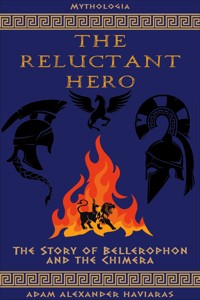
THE RELUCTANT HERO
The Story of Bellerophon and the Chimera
CONTENTS
Copyright
Newsletter
Hymn I
1. The Seer
2. Shadow of the Past
3. A Monster Emerges
4. Queen of Spite
Hymn II
5. Sea of Dreams
6. A Dark Missive
7. The Unleashing
8. The Daughters of Ares
Hymn III
9. The Third Task
10. Divine Counsel
11. Pegasus
12. The Chimera
13. A Hero’s Triumph
14. A Tale of Glories Past
Thank you for Reading
Author’s Note
Become a Patron
About the Author
Stay Connected
The Reluctant Hero
and the Mythologia series
Copyright © 2021 by Adam Alexander Haviaras
Eagles and Dragons Publishing, Stratford, Ontario, Canada
All Rights Reserved.
The use of any part of this publication, with the exception of short excerpts for the purposes of book reviews, without the written consent of the author is an infringement of copyright law.
ISBN: 978-1-988309-46-0
E-pub Edition
Cover design by Eagles and Dragons Publishing
Sign-up for the Eagles and Dragons Publishing Newsletter and get a FREE BOOK today.
Subscribers get first access to new releases, special offers, and much more.
CLICK HERE to get started!
Men come and go as leaves year by year upon the trees. Those of autumn the wind sheds upon the ground, but when the season of spring returns the forest buds forth with fresh vines.
Even so is it with the generations of humankind, the new spring up as the old are passing away. If, then, you would learn my descent, it is one that is well known to many. There is a city in the heart of Argos, pasture land of horses, called Ephyra [Corinthos], where Sisyphus lived, who was the craftiest of all humankind. He was the son of Aeolus, and had a son named Glaukos, who was father to Bellerophon, whom heaven endowed with the most surpassing comeliness and beauty.
HOMER, THE ILIAD
THE RELUCTANT HERO
The Story of Bellerophon and the Chimera
ADAM ALEXANDER HAVIARAS
HYMN I
THE DARKNESS INSIDE
THE SEER
It had been a long, hot summer’s day on the island. The inhabitants of that green jewel set in Aegeus’ sea waited out the daylight until evening rescued them. It was quiet as the fishermen slept indoors, and the goatherds rested in the shade of mountain pines whilst their flocks cropped at dried grass around them. The mountain pathways that led like arteries from their green and rocky heights to the brilliant sea below were quiet but for the constant whirr of cicadas.
Suddenly, a cacophony broke the silence. From up one of the mountain paths, a troupe of sweating, victorious youths of the village marched in procession toward the gathering place by the seaside. Men and boys, women and girls, emerged from their dwellings to see what the racket was about.
The boys marched past in triumph, each of them carrying a portion of a beast they had slain upon the mountain.
“We’ve killed it!” one of the boys announced to the villagers as he marched in the lead, carrying a great serpent’s head on the tip of a spear. “Our flocks will be safe now!”
Behind him, his fellows lugged the body of the beast as if carrying a newly-hacked cedar tree. They all grunted and sweat, smiled as they strained to carry the body of the titanic serpent over their shoulders, all except one last youth beyond the tail. He walked slowly, and last, tears in his eyes which he would not have shown the world as he carried the others’ spears.
“Well done, boys!” some of the men called out to them, though the local priests wondered if the Gods might take offence at the slaying of so ancient a creature.
But the boys did not care. When they arrived at the teaching stone, beside the white-pebbled beach, they cheered as they dropped their grisly trophy and ran into the sea where the turquoise water turned crimson about them. They splashed, and cheered, and washed. They already retold and embellished the story of their hunt for the serpent, certain they would go down as heroes in the annals of the island.
The last youth arrived while the others bathed, and stood alone before the enormous, crooked piece of death upon the sun-baked rocks. The beast’s head, which swayed slightly upon the tall spear that had been plunged between the rocks, stood oddly apart from its blood-caked body. The black eyes stared accusingly at him, a thing to haunt his dreams for years to come.
He had not intended to be a part of the hunting party, for he had never had trouble with the serpent. His father was a fisherman, not a goatherd. While it was true that the beast had terrorized the village for a long while, eaten countless goats, and even a few wandering children, it had been a creature of the Gods’ design, with a purpose, a part to play in the drama of their island home.
No one else saw it that way, however, except perhaps the priests, and the old man who usually sat in that place and occasionally told them a story.
“Don’t worry, Daxeos!” the oldest of their group yelled at him from the water. “It won’t hurt you anymore! Go on! Dig your spear into its side, just once! It’s safe now!”
The other boys all laughed and splashed, and began to cook fish they had just caught over a fire on the beach.
The boy did not join them. Though it horrified him to look at the slain beast, he found that he could not leave its side. Its glistening scales of shifting brown, black and green still mesmerized him. He wanted to look upon it while he could, for soon the colours would fade as much as the descending sun in the distance.
Eventually the boys returned to review their work with some of the village men in tow, praising each other’s feats of strength and skill, bragging and patting their fellows on the back.
And all through it, Daxeos stood back, not hungry, not thirsty, not interested in the tall tales that already circulated.
The cicada song slowed eventually as the day neared its end, and a fire was built up around the teaching stone. The attendant villagers faded back into their homes, and the boys were alone again, unwilling to let the day of their victory end.
It was then that Daxeos heard the familiar trundle of the old man coming up the path to the stone. He stood and rushed to meet him where the path opened up onto the sprawling rock surrounded by seaside pines.
“Good evening, Daskale!” Daxeos said as he met him upon the path.
“Good evening, Daxeos,” the old man answered, stopping in the path. His old, heavily creased face smiled, and his sightless eyes searched for the location of the young voice that had come to greet him. He adjusted the skull cap that protected his bald pate from he sun, and his hands opened and closed upon the staff he carried with him always, tapping slightly on the rocky ground at his feet. “The news in the village is that you have slain a great beast.”
The boys about he fire grew silent, the eldest standing up. “We did! The great serpent is finally slain, Daskale! Are you not proud of us?” he puffed out his chest, and nodded to his friends.
“Daxeos,” the blind man said. “Give me your arm, please.”
“Of course,” the boy answered, and the old man laced his arm through Daxeos’ who led him across the ground to the rocky seat that jutted up amongst the boys. “Here you are.”
“Thank you,” the old man said, leaning upon his staff. “Where is the beast?”
“The body is near your feet,” one of the boys answered.
The old man was silent as he bent over, leaning upon his staff, to lay his searching hand upon the slain serpent’s thick body. “He is dead then.”
“Truly,” said the eldest youth. “And we shall be remembered for this great deed!”
“Is that what you believe?” the old man said, his voice suddenly curt.
The boys grew silent, and looked from one to another.
“You may have saved a few goats and sheep, even the lives of a few children.”
“But that is a good thing!” one of the youths protested. “My father lost many goats to this beast!”
“And mine lost six lambs last month alone!” said another.
“I understand that,” the old man said. “I also understand that now that he is slain, there will be countless rats and mice in the village. What then will happen to our grain supplies that he will no longer be there to roam the pathways of our villages at night to devour rodents?”
The boys were quiet, some angry.
“Daskale?” said the eldest. “Do you deny that this beast terrorized our village? Are you telling us that it was not bravely done?” His voice was challenging, tainted with aggression.
“I do not,” the old man replied calmly, rallying his patience for the youths about him where he sat upon the rock. “The serpent did both protect and terrorize our village. It was here for a reason, and so you must make offerings for the life you have taken.”
“We will all make belts from its skin,” said one of the younger boys. “And we will be known as the brave monster-hunters of Chios!”
The boys cheered at that idea.
“Well, all of us except Daxeos,” the eldest added, his eyes turning on the boy at the old man’s side. “He was afraid to even come with us, let alone throw a spear.”
“And were you afraid?” the old man asked the eldest.
“No. I was not,” the older boy said proudly.
“Were the rest of you?” he asked the others.
“No.”
“Was that because you were in a group? Did you feel stronger together?”
They did not answer.
“What is fear?” the old man asked, and in that moment, the cicadas slowed completely in their song and the sea’s breeze whistled through the pines about them.
“Fear is weakness,” the eldest finally said.
“Is it?” The old man straightened as he leaned on his staff. “I rather think that fear is the Gods’ way of warning us of a great trial to come…or an impending sacrilege.”
This last silenced them, but he smiled kindly, though he could not see them.
“You say that Daxeos here,” he placed his hand upon the boy’s shoulder, “was afraid to come. But he did, despite his fear. One might say that he was the most brave because he felt fear. Because he went with you nevertheless.”
“Pssht!” the eldest scoffed.
“I knew a man once who felt great fear. Would you like to hear a story about fear, portents, and courage?”
“Yes, Daskale!” they all replied, for they never missed an opportunity for one of the old man’s tales when he offered.
“Very well then,” he said as they gathered around him in the fading sunlight as the sea lapped at the shore of the beach nearby. He closed his eyes as he searched his mind for the memories, felt the wind upon his face, gently rustling the boughs of pine about them.
“Let me tell you of one hero who lived with fear, but who found the courage to overcome it…”
SHADOW OF THE PAST
There was blood everywhere, as though one stood in the middle of a great battle. Except, there were no armies to speak of. A man stood alone, turning in the dark as he screamed, surrounded by blood-soaked stallions and their gnashing jaws. All was chaos in that moment, and fear filled the man’s veins from head to foot as the stallions closed in, kicking with iron hooves, biting with bared teeth that tore into his flesh and cracked his bones as he wailed.
But that was not all. For in the midst of such violence, another beast reared its head. Its roar tore through the air, and a great hissing froze what blood was left in his limbs. And then, all-consuming fire burst forth to close in on the man’s terror-stricken eyes before death claimed him…
“FATHER!”
The room was quiet. Bellerophon was struck dumb for a few moments by the dream he had just endured, the dream the Gods had sent him again. Breathless and sweaty, he swung his legs over the edge of his bed to look out of the palace window at the sun. The great chariot was only just cresting the rocky edges of the Acrocorinthos, the high citadel overlooking the city of Corinthos and the surrounding plains.
Breathe…just breathe… he told himself, wiping the sweat from his brow and burying his face in his hands. He hated that dream, hated how weak it made him feel.
A cock crowed somewhere outside, followed by the braying of a donkey. For once, he was happy for their morning racket to invade and break up his thoughts as the remnants of his dream leached away.
Bellerophon, son of Glaucus, grandson of Sisyphus, stood and looked at the plain wall of his palace room where his great round shield hung above his throwing spears and sword. He stared at them for a moment, and then shut his eyes tightly against the still-flashing images of his nightmare.
It had been some years since his father’s horrible death when his own horses tore him to pieces after Pelias’ funeral games, and yet the images kept coming back to him in the darkness of night. He had not been there when it happened, but he was made to revisit his father’s end over, and over.
Bellerophon felt his jaw tighten and went over to the stone wall where two handprints darkened the whitewash. He squared off before the wall, placed his trembling hands upon it, and pushed with all of his might. He focussed on the strain in every part of his muscular body - arms, shoulders, legs and torso - and forced the tension to still his mind, and provide some focus. When he felt calm, he stepped back from the wall. The surface had cracked where he had been pushing for so long, and yet the wall still stood.
Taking a leather thong from the small wooden table beside his bed, he tied his long, dark hair back and went through an open door that led out onto a small terrace overlooking the clay rooftops of the palace and battlements beyond. He breathed deeply of the fresh Spring air and watched the servants moving about the palace like ants about a mound of dirt. Some carried water into the palace from the spring outside the walls, and others headed out into the fields of olive and orange to begin their toils.
In the courtyard below, he could see a slave preparing a chariot for his brother, Deliades, to go out hunting, while another saddled horses for his other two brothers.
Bellerophon did not care for his siblings. He never had, and the feeling was mutual. He had never felt that he was a part of that family, and with the death of his father, the link that had kept them all civil toward each other had been broken. Some people whispered in the dark corridors of the palace that Bellerophon had not been the son of Glaucus, but rather was the result of an indiscretion between his mother, Eurymede, and Horse-Taming Poseidon. Whether or not that was the reason for his siblings’ dislike or fear of him, he had never cared. He was an outcast in his family, and preferred his own company anyhow.
He chose to spend his days alone, training with sword, spear and shield for a life he did not have. His mother chided him sometimes for his lack of ambition, even for not being possessed of the cunning and ingenuity of his grandfather, Sisyphus, never mind that those ‘qualities’ had landed the latter in the darkest depths of Tartarus.
Corinthos was a prison to be sure, but where else could Bellerophon go? His father had had few friends, and it was rumoured that the goddess Aphrodite had hated Glaucus for preventing his mares from breeding. Even if there was a king or lord who would have wanted to take Bellerophon into their household, they would not have wanted to risk the goddess’ wrath.
The sun was rising quickly now, the heat burning away the morning chill over the plain.
Bellerophon put on his crimson tunic, strapped on his sandals, and then took down his bronze sword, shield, and a clutch of short throwing spears in their quiver off of the wall. He closed his chamber door and went down the fire-lit halls of the palace, still haunted by absence, to the kitchens where he took a skin of wine and a loaf of fresh bread from the servants before going out into the lower courtyard to leave.
“Bellerophon?” his mother, Queen Eurymede called to him. “Where are you going?”
“To train,” he answered.
“You have a wild look in your eyes, my son.” She approached him, her long, pale hair falling over her silk-covered shoulders. Her green eyes looked upon him with pity and, for once, a little kindness. “The servants heard you cry out this morning again. Are you unwell?”
“I’m fine, Mother. I’m a grown man now. You need not worry.”
“A mother always worries.”
Just not for me, he wanted to say, but held his tongue. “The Gods sent me another dream.”
She was quiet, and he saw that she took a small step backward from him. “Sit. Tell me of this dream,” she said, going over to the bench beneath a large olive tree in the middle of the courtyard.
Bellerophon watched her sit, but did not move. Instead, he stood there in the gathering light, his shield on his arm, and the spears slung over his shoulder. She had never spoken up for him when it came to the others, nor tried with the council elders to gain him a seat since the crown was out of his reach. Now, years later, she pretended to care.
I don’t want any of it anyway, he thought as he took a few steps forward, but did not sit.
Eurymede of Megara sat there looking up at her son expectantly. “Tell me,” she said, placing her hands in her lap when she saw he would not sit.
“It is nothing,” Bellerophon lied. “I dreamed of father’s end. That is all.”
She stared at her clasped hands in her lap and, for a moment, there was sadness there, more than he thought her capable of feeling.
It surprised him.
“Your father was ruled by fear of many things. He lived in your grandfather’s shadow, and the end he too met still endures. Sisyphus built this great polis, and was married to the daughter of a Titan. Glaucus always compared his life to those before him, those around him. He was King of Corinthos, and he wanted to appear as such to his peers. And yet, he feared greatness and the punishments the Gods might mete out to him as they did to his father.”
“I don’t see what this has to do with my dream, Mother.”
She pursed her lips, the long, golden earrings she wore dangling from her lobes. “That fear of appearing weak to others led him to treat his mares badly in the hopes that it would make them aggressive enough to win at Pelias’ funeral games. He sowed his own doubt all his life, and in the end, it brought about his downfall. Now…while his father is tortured for all time in Tartarus, Glaucus’ shade haunts the hippodrome of Isthmia.”
Bellerophon lowered his shield arm as the weight of it began to strain.
“The problem was,” Eurymede continued, “Sisyphus was not someone to aspire to. He was a trickster, and though he did found Corinthos, and fortify the mountain above us, his end is not to be envied.”
She stood, walked over to her son, and looked up into his dark eyes. “I see the fear in your eyes, the anger… And I know that I have not done enough for you since Glaucus died. I am sorry for that.” She placed her hands upon his broad shoulders. “Men need to aspire to their own deeds, Bellerophon. You need to overcome your own, individual fears and trials without looking to the past, or the deeds of other men. Envy and comparison only leads one to lose oneself.” She searched his eyes for a moment, a glimmer of hope there, but even that was as fleeting as the feigned tenderness she now displayed in the palace courtyard. Eurymede stepped back.
“I must go now,” he said to her as he hoisted his shield.
“Yes. Go. Train. Think on what I have said.”
Without another word, Bellerophon turned and made his way out of the gate, the fear that had awoken him that morning now replaced with anger.
Standing in the swirling dust of the courtyard, Eurymede watched her son leave through the stone archway and make his way along the road that led to the Acrocorinthos. She turned and went back inside the palace.
Bellerophon walked briskly up the gently-sloping road that cut through the olive and orange groves that surrounded the base of the mountain. He was in no rush, for outside of the palace, away from his mother and siblings, he felt at last like he could breathe.
He did not see the point of his mother’s words. It angered him how she thought she knew him. She was always a bit sad, speaking only dark words to him. She has had her own trials, I suppose. But that darkness had seeped into him since he was a child.
The dream of the previous night flashed once again in his mind, and he gripped his shield more tightly and removed one of the spears from the quiver. He paused in the middle of the road, his eyes searching the surrounding trees where the sound of cicadas was settling in.
A few stray workers moved about the trees, pruning, but none else that he could see. But his dream stretched through the veil it seemed, for the sound of that roaring, and the sight of gnashing horses, seemed to be all around him.
Bellerophon shook his head, as if shaking away a flurry of flies, and looked up at the Acrocorinthos built by his grandfather.
Clutching his shield and weapons, he continued up the road that led to the sun-baked crown of the mountain.
A MONSTER EMERGES
It was a long climb to the end of the road and the path that led onto the top of the mountain, and Bellerophon was sweating by the time he got there.
During times of war, the guard tower would normally be manned, and the fortifications dotted with sentries, but it was a time of peace, and so the high fortress was devoid of men. Only a few stray goats jumped from rock to rock across the surface of the mountain as Bellerophon made his way past the great spring to the high plateau. There, he set down his weapons and turned his head to the sky with his eyes closed, taking slow, deep breaths. Then, he walked to the nearest cliff edge and looked out over the world.
Despite the dizzying height of his vantage point, and the stabbing panic that rose in his chest every time he stood there, Bellerophon forced himself to look, to gaze down the jagged walls of the mountain to his grandfather’s city set among olive and orange. He took in the turquoise mass of the sea and allowed his eyes to wander along the shore to Isthmia and the gulf of poor King Saron beyond where it stretched away into the distance to lands he had never seen.
The world seemed to be throbbing with colour and light, more than ever before, and he wondered at this, whether he was falling into a dream again, just as he always felt from those heights that he would tumble out of the sky. He hated the heights, but he had never admitted as much to anyone. Strangely, Bellerophon had found it necessary to go up there every day, to challenge himself, to train in the sky where only the Gods could see him.
After a few moments, he stepped back from the edge and went back to where he had left his weapons. The large, dead tree trunk he usually practiced on was set about fifty paces away. Bellerophon unwrapped the throwing spears he favoured, and began to throw.
One, two, three… His spears plunged into the dead wood, sending splinters into the air each time as they gathered together in a group. Four, five, six, seven… In rapid succession he threw, never missing, always accounting for the gusting wind in that high place.
When he finished throwing, he ran about the surface of the plateau, as agile as any goat there present, running and leaping from one boulder to the next, avoiding the basking serpents that usually stretched out up there, again, tempting his fears, his dreams of beasts and striking teeth and fangs.
Toward midday, when the sun was hot upon the mountain, Helios lighting his temple there, Bellerophon sat to drink some of the wine from the skin, and to tear into the bread he had brought with him.
He leaned back to look up at the sky, and felt the calm settle over him at last. Martial pursuits always calmed him, helped to clear his mind after the long nights.
“Goddess Athena…” he said, reaching out to the daughter of Zeus in his mind. “Grant me wisdom of action and thought. Guide me, oh Goddess, for I feel lost in this world.” He looked at the gorgon head upon his shield, reminiscent of the Aegis carried by the goddess into battle. “Take me away from this place, away from the long shadows of the past…”
There was a flash of light then, blinding and hot, but when Bellerophon stood and looked around, he saw nothing but the wind in the grass, and the nodding heads of thistle and poppies upon the mountaintop.
Then, voices broke into his hearing, harsh and angry.
Bellerophon recognized the voices of some of the men from the city, and realized they must have followed him.
They were as jackals searching for the one lion cast out of the pride. The leader of the group was Belleros, the eldest son of his cousin, Thoas, whose father Ornytion was Glaucus’ brother. Ever since the death of Glaucus, Thoas’ family had been making attempts to take full control of Corinthos, and Belleros had been the most active in those efforts.
The group walked up the rocky slope toward Bellerophon, pointing in his direction. They began to spread out as they approached, until they formed a wide circle about him. Belleros stood facing Bellerophon.
Belleros was about ten years younger than Bellerophon, but the latter knew he should not underestimate him. Belleros was fast, and quick with a bronze dagger. He was not so strong as Bellerophon, but still, there were four of them.
Bellerophon checked that his dagger was tucked into his belt, and then bent to pick up and sling his quiver of throwing spears across his back, making no pretence about it. He glanced to see that the grips of his shield were facing up beside him.
“Run away from the palace again, Cousin?” Belleros said, chuckling as he pushed back his blond hair. “What are you training for? You pretending to kill the horses that ate your father? We all know how vicious horses can be!” he laughed, and his fellows joined him, their voices echoing around Bellerophon who could tell they were inching closer.
“What do you want, Belleros?” Bellerophon asked, but in that moment he could not help but see the vibrancy of the colour around him, feel an energy in the air that made his fingers and muscles tingle. His awareness was unusually acute, even as he saw Belleros draw his blade and point it at him. “I would put that away.”
“Or what? What are you going to do? We’ve tolerated your family for long enough. Why should your brother rule, or your whore mother have a say in the ruling of the city? My father is the rightful king of Corinthos!”
“You speak of things I care little for,” Bellerophon said, holding his cousin’s gaze as he adjusted his grip on the spear shaft, holding it near the butt end. “Go home.”
“I will. But not before your body lies here for the carrion crows,” Belleros growled.
There was a tense pause, as if the four attackers were holding their breath collectively before they struck.
Then, Belleros rushed forward as quickly as he could, his blade out to kill.
Bellerophon parried his cousin’s arm with his spear shaft and kicked hard, sending Belleros backward down the slope. Without wasting a moment, he spun, slashing the spear tip across the neck of the man who had been rushing him from behind.
Blood sprayed from the wound, and slowed the attack of the other two who were rushing over the rocks on either side.
Bellerophon bent quickly to pick up his shield with his left arm and turned again to loose the spear at one of the men, but the attacker was already crashing into him.
The man cried out as the spear tip found his gut and blood poured over Bellerophon as the wounded man wiggled like a harpooned fish out of water.
Bellerophon tried to gain his feet, but another attack came from his other side and he raised his shield just in time to deflect a dagger thrust. He pushed out and hit the man in the nose, sending him backward screaming.
Belleros rushed again, and Bellerophon turned and made for the high plateau where it was flatter.
“Get him!” Belleros yelled to his one, surviving fellow, and together they rushed after him.
When Bellerophon reached the top, he turned to see them rushing up the rocky path, spreading out. In that moment, he felt nothing but disgust and disappointment, with his entire family, with Corinthos, with his world in general. He could see the hate in Belleros’ eyes, even though he had never done anything to the younger man or his friends.
And yet, all they wanted to do in that moment, was to kill him.
Bellerophon reached for a spear and, more quickly that they could have anticipated, he loosed it so that it shot down the slope to slam into the other man’s throat, sending his body rolling back down the rocky path.
Belleros stopped, breathless, his dagger shaking in his hand as he pointed it at Bellerophon.
“Don’t do this, Belleros.”
“Put down your spears, coward!”
Bellerophon could tell with absolute certainty that his cousin would not stop. “Your father wouldn’t want this.”
Belleros laughed. “You idiot! He’s the one who sent me!”
Bellerophon’s anger rose at that, but he forced himself to stay focussed. He slid the quiver of spears off of his back and laid it on the ground beside his shield. Then, he drew his own, gleaming bronze blade. “Just remember,” he said. “I gave you a choice to stop, and you wouldn’t.”
“You’ll dine in Hades tonight!” Belleros yelled as he leapt at Bellerophon, his blade diving in and out like a viper’s darting head.
Bellerophon parried wildly, dodged left and right, and stabbed out trying to lame his cousin, but Belleros was too fast, pressing him backward more and more with his attack.
Then, a moment came when Belleros thought he could deal his death blow and drew his arm over his head for a final death-dealing thrust.
Bellerophon lunged and kicked him square in the gut, winding him and sending his blade clanging on the rocks nearby.
Belleros screamed with fury and rushed with flailing fists, seeing that Bellerophon was near the precipice. He landed a blow, and then a second on Bellerophon’s jaw, but then Bellerophon spun to get behind him, and Belleros teetered on the edge of the cliff, his arms waving as he tried to regain his balance.
Bellerophon’s fist struck out and he grabbed hold of his cousin’s tunic to keep him from falling to his death.
“Why did you have to do this?” Bellerophon yelled at him, his angry voice breaking out in the rising wind. “I’ve done nothing to any of you!”
Belleros spat in his face. “You breathe.” Then, a second dagger whipped out from behind him.
Bellerophon swept his arm across to parry Belleros’ arm, making him spin, and then he kicked out as hard as he could.
Belleros’ body tumbled over into the air from that high Acrocorinthos, and he fell like a young vulture, too soon pushed out of the nest.
Bellerophon fell to his knees on the rocks to watch as his cousin fell to his death, his body cracking on the cliff face a couple of times before landing on the sloping earth of the olive groves outside the city.
Screams echoed up the mountain as the slaves gathered around the body, their voices rising up to Bellerophon’s ears.
“Damn you, Belleros!” Bellerophon cursed, but as his eyes strayed from the groves to the rooftops of the city beyond, he knew that it was he who was damned.
Bellerophon slept uneasily that night.
Outside, the night sky was lashed by lightning strikes that echoed over the city, as if Zeus’s fist pounded the rocky mountain above. Horses cried wildly from within the palace stables, and in the groves, sheep and goats bleated incessantly, running about the walls as if Corinthos were in the midst of a great maelstrom.
Bellerophon found himself on the top of the mountain again, surrounded by slavering jaws and red eyes. In the darkness beyond, there was roaring…hissing…and fire. The sound of shod hooves was all around him, and an angry neighing accented the night.
He spun, launching spears into the darkness around him, but the eyes, those horrid sounds, still closed in, pushing him more and more until he found himself on the cliff’s edge.
From out of the darkness came Belleros, his body broken and bloody. He reached out, and before Bellerophon could block him, he kicked.
Bellerophon felt himself falling wildly through the air, the dark earth rushing up to meet him, his final thought… This is the end…
QUEEN OF SPITE
“AHHH!”
Bellerophon sat bolt upright in his bed. Sweat dripped from his brow and his body shook.
The pounding upon his chamber door echoed in his head and, disoriented, he looked about the room which was already filling with morning sunlight. On the floor, he could see his spears and shield, the blood still caked upon them where they lay beside his bloody and torn tunic.
“Open up, Bellerophon!” his brother Deliades said from beyond the olive wood door.
“What is it?” Bellerophon answered, though he knew in his heart what it was.
“You know what!”
Bellerophon stood and went slowly to the basin of water that stood upon a tripod near the window. His brother continued to pound upon the door, but he did not rush, did not care. He splashed his face with water and looked up at the risen sun through the refracted light of his wet eyes. “Gods…do with me what you will. I no longer care.”
He dried his face and turned to dress, his ribs sore from the fight the day before. He pulled a clean, crimson tunic over his head, belted it, and strapped on his sandals. For a moment, he thought to take his dagger, but then he knew it was pointless, that Deliades would not have come alone.
He walked to the door and unbolted it.
Deliades, his older brother, stood there scowling at him with two armed palace guards beyond his shoulder. “What have you done?”
“They attacked me, Brother,” Bellerophon answered.
“Four men are dead, and one of them our royal cousin! They city is in an uproar!”
“What are you doing here?”
“You’re summoned to the bouleuterion. The council has assembled. I’m to bring you before them.”
Bellerophon looked at the two guards behind. They gripped their long spears tightly, and stared at him from beneath the brims of their boar’s tusk helmets.
“Don’t make this difficult,” Deliades said. “Please. Let’s get this over with.”
“Of course,” Bellerophon answered. “We wouldn’t want you to be late for your hunting.” And with that, he pushed past his brother and the guards, and marched down the fire-lit corridor to go to the council house outside the palace walls.
Deliades and the guards followed closely behind him, their weapons pointed at his back.
The morning was clear, clean, and bright after the storms the previous night. The air smelled of damp earth and juniper.
As Bellerophon marched out of the palace toward the bouleuterion, stray dogs ran across his path, barking at him in passing. Silent citizens stared at him with dismay, some with hate, from the dark doorways of their dwellings.
He ignored them all as he went, numb to the outside world, and yet, he marvelled at the brilliance of colour and light around him. It was as though he walked through a dream.
But his dream ceased the moment he passed beneath the soaring columns of the council house and into the crowded chamber. The seats were packed with faces, including his other brothers and sister, his cousins, the scowling, aged men of the council, and even his mother, the only one who would not meet his eyes.
Bellerophon stood in their midst, the guards at his back as Deliades took his seat beside their mother.
Then, his cousin Thoas, Belleros’ father, stood.
If there had been hatred in Belleros’ eyes when they had fought, there was now purest malice in the eyes of his father as he gazed upon his son’s killer.
“Bellerophon…” Thoas began, “you are accused of…of the murder of my son, your own cousin…Belleros.”
Bellerophon did not speak immediately. He stared into his Thoas’ eyes. “I did kill him.”
There were gasps and accusations from the seats.
“So you admit it?” Thoas said, his feigned tears quickly drying up.
“I admit that I defended myself against attack. Belleros and his three friends attacked me.”
“Lies,” Thoas said.
“At your order, Cousin.” Bellerophon pointed at Thoas.
But Thoas was unfazed. “More lies!”
Bellerophon looked from his cousin to his own family, his brothers, sister, and his mother, and none of them met his gaze. None of them wanted to be there. None of them cared. He shrugged. “It seems that there is no justice in this chamber.”
“There is always justice,” Thoas said.
“What is the council’s decision?” Bellerophon asked plainly.
“Death!” someone barked from behind Thoas.
“Death!” cried another.
In that moment, Eurymede jumped to her feet. “No!” Her eyes at last met her son’s. Then, she turned to face the council. “Please, wise elders. You cannot execute Bellerophon, the grandson of Sisyphus.”
“He is a murderer!” Thoas’ voice echoed over the chamber, the lengths of his long grey hair shuddering like his jowls.
“Please,” Eurymede said. “Not death. Let it be banishment for all time from Corinthos. The Gods will smile on you for it, for your just decision. It was well-known that Belleros hated my son.”
“But he killed them all!” Thoas said.
“Yes,” Eurymede conceded. “So let him be banished, never to return here.”
Thoas continued to stare at Eurymede before turning his eyes on Bellerophon. He could see his cousin had no ambition, that he did not care for Corinthos, nor care for the throne like his older brother Deliades did. I can deal with Deliades later, he told himself.
“The council must vote!” Thoas proclaimed. “All those in favour of execution?”
Several hands went up behind him.
“And those in favour of banishment?” Thoas asked.
Even more hands were raised, including those of Bellerophon’s own brothers.
“Banishment it is!” Thoas declared, stepping forward to face Bellerophon. “Bellerophon… You are hereby banished from Corinthos and all its lands for the remainder of your lifetime. Return here only on pain of death. Do you understand?”
“Yes,” Bellerophon answered. “You’ve got your wish, Cousin.”
“My wish was to see you dead,” Thoas whispered. “But this is a fine alternative.” Thoas cleared his throat and spoke once again so all could hear. “You must be gone from Corinthos by nightfall!”
Bellerophon looked at his family then, and only his mother met his eyes. He nodded resignedly, turned, and left the chamber.
“Follow him!” Thoas said to the guards. “Make sure he leaves.”
The guards nodded, and went after Bellerophon.
That afternoon, Bellerophon stood in the courtyard with his newly-cleaned spears and shield slung over his shoulders, and his sword and dagger hanging from his belt. He carried a satchel filled with his few possessions - a cloak, some food, and a tinder box - and stood waiting to see if his family would come to bid him farewell under the watchful eyes of the guards.
None but his mother came.
Eurymede emerged from the shadows of one of the corridors off of the courtyard. She was cowled, but her eyes were dry and unfeeling.
Bellerophon looked upon her, the woman who had born him, and he felt little besides a long-simmering resentment, and a void between them that had stretched wider and wider over the years since his father’s death. He forced himself to be calm, however, for he knew that he would not see her again in that lifetime. And he could accept that.
“Thank you for staying the execution, Mother,” Bellerophon said.
She stopped a few feet from him and pushed back her cowl. “Whatever distance there may be between us, you are still my son. You are still the child whom I bore for many moons.”
“What have I ever done to you?”
She looked confused by his question, but she knew she had never been affectionate with him. In truth, she did not know why exactly, only that, unlike her other children, she had a constant feeling that he was not entirely hers to mother.
“You never did anything.”
The answer confounded him, but he simply shrugged. He had stopped trying to win her favour long ago.
“Be careful of Thoas, Mother,” Bellerophon warned. “He will stop at nothing to eliminate my brothers, as he tried to eliminate me.”
“I know,” she said, looking at the weapons he held in his hands and on his person. Then, she looked up. “My son. I know not what the Gods have in store for you, but know that you are a man of great strength and skill, and the battle upon the mountain yesterday only proves it. Wherever you go, I pray that the Gods protect you better than I have.”
“They will do with me what they will,” he answered, and he found that he cared less and less. He shrugged. “I only have to pick a road.”
“There, I can help you,” she said, stepping closer to him. She reached inside her cloak and pulled out a small bee’s wax tablet which she handed to him discreetly. “Put this in your satchel now.”
Bellerophon wanted to look at it, but he saw the guards eyeing them. “What is it?”
“A letter of introduction to King Proetus of Tiryns. I had the scribe write it out for me. Proetus knew your father, and though they were not great friends, they were not enemies either. Go there. Take the road southwest, past high-walled Mycenae, and then go south into the kingdom of Argos.”
“You are sure that is the way?” he asked, never having travelled beyond the confines of Corinthos’ borders.
“Yes. Your father and I travelled that way long ago. But do not stop at Mycenae. There are rumours of the harshness of the new Atreidai kings who rule there.”
That was it. She had nothing more to say.
Bellerophon nodded and stared at her for a few, uncomfortable moments, waiting to see if she would step closer to kiss his brow, or even lay a hand upon him in farewell, but she did nothing.
“Thank you for the letter,” he said, hoisting his shield and spears. “May the Gods give you what you want, Mother, you and my brothers and sister.”
“And may the Gods protect and guide you better than I have, my son.”
For a moment, he thought she might embrace him tightly, for once in his lifetime, but she only backed away a step as she pulled up her hood, and turned to go quietly back into the darkness of the palace.
Bellerophon glanced at the guards who had stepped closer. “I’m going,” he said as he turned. He then walked beneath the great stone lintel of the palace to join the track that led around the Acrocorinthos to the main road.
The days grew increasingly hot as time and the road wore on. It seemed to Bellerophon that the road constantly sloped downward as he went, though he knew that was not the case. The arid mountains sloped up to either side of him and the sky, a radiant and pulsing blue accented by occasional clouds, seemed to stretch into infinity all around.
In some ways, Bellerophon felt that he could breathe at last, and he wondered how it was that he had never left Corinthos, never thought of wanting more, of wanting a family of his own, of seeing the wonders he had only heard of. Truthfully, he was not sure he cared anyway, for he felt still that he was a spinning leaf on the wind. But the brief glimpse that had already been captured by his eyes had sparked a minor curiosity.
After some days upon the road in which he spotted only a few scattered shepherds upon the stark mountainsides, Bellerophon passed into the rich lands of Mycenae.
Groves of olive and orange stretched out before him, and soon patrolling groups of warriors in bronze began to appear. They were pulled by teams of stomping stallions harnessed to sharp-wheeled chariots which hovered around the fortress’ high walls like bees about a hive.
The men of Mycenae had always been lions and, if Bellerophon was honest, he was curious to meet them. But he did not need to add further accusations of murder to his deeds, and so when the patrols appeared, he hid himself deep in the olive groves until they passed.
From a distance, he could see the high, thick and warlike walls of Mycenae’s citadel, but that was enough. And so, he carried on his course, turning south toward the kingdom of Argos.
At night, he lay beneath a canopy of brilliant stars and wondered at the glittering forms those heavenly lights created. It was a script of the Gods’ making, and if anything made him feel small in his life, it was the vastness of those heavens.
If only I could soar up to those heights and touch them! He thought as he lay beside his fire, his sword, shield and spears close by him.
The next morning, as the mist rolled around his sleeping form, Bellerophon’s eyes opened slowly. He was surprised not to have dreamed that night, but rather to have slept soundly, unusually so. The sounds about him were different from the palace at Corinthos, the smells too, and all of that newness brought a hint of wonder.
He sat up suddenly when he saw a pair of eyes staring at him from behind the broad trunk of an aged olive tree. He reached for his sword and held it out at his observer.
“What are you doing?” Bellerophon asked. “Come out from there!” He stood, his limbs suddenly alert, ready to pounce.
“There is no need for your weapon,” said a vaguely timid voice. “I belong to these groves. I play my flute, and the trees grow.”
The satyr stepped out from behind the tree, his hooves clicking on the hard ground, his arms out, showing the expanse of his lean, hairy chest. He smiled, and the horns upon his head seemed to stretch with the action. In his hand he held a reed flute.
“Why are you watching me?” Bellerophon demanded.
“You are not from around here, are you?” the satyr asked, moving to a boulder to sit slowly.
“I am Bellerophon of Corinthos. I’m on my way to Tiryns to see King Proetus.”
“For killing a man?”
Bellerophon’s sword came up again quickly, and he stepped toward the satyr. “How do you know that?”
“We have our ways…whispers on the wind, music in the air…the trees flutter and tell.”
Bellerophon was not sure what to make of the creature, whether he was lying or not.
“Why would you go to Tiryns?” the satyr asked. “There are kinder places to go.”
“My mother knows the king.”
The satyr shook his horned head. “A king in name only, holed up behind his high walls. He does not go out to roam the land.”




