


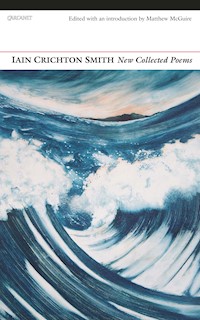
18,19 €
Mehr erfahren.
- Herausgeber: Carcanet Poetry
- Kategorie: Poesie und Drama
- Sprache: Englisch
Iain Crichton Smith's Collected Poems was awarded the Saltire Prize when it was published in 1992. This completely revised and enlarged edition includes seventy additional poems, mostly from the four books the poet published in the 1990s: Ends and Beginnings (1994), The Human Face (1996), The Leaf and The Marble (1998) and A Country for Old Men and My Canadian Uncle (2000), together with extracts from his 1971 translation of Sorley Maclean's epic D?in do Eimhir agus D?in Eile (Poems to Eimhir, 1943), a founding moment of modern Gaelic poetry. The new introduction by Matthew McGuire of the Department of Scottish Literature, University of Glasgow, illuminates the range of Crichton Smith's achievement as a poet of Scotland and Europe: rooted in local tradition yet, in Edwin Morgan's words, 'open to the whole intellectual world'.
Das E-Book können Sie in Legimi-Apps oder einer beliebigen App lesen, die das folgende Format unterstützen:
Veröffentlichungsjahr: 2011
Ähnliche











Iain Crichton Smith
New Collected Poems
Edited by Matthew McGuire
To Donalda
ACKNOWLEDGEMENTS
The poems in this volume are taken from the following publications: The Long River (Edinburgh: Macdonalds); The White Noon (from New Poems, edited by Edwin Muir, London: Eyre and Spottiswoode); Thistles and Roses (London: London: Eyre and Spottiswoode); Deer on the High Hills (Edinburgh: Giles Gordon); The Law and the Grace (London: Eyre and Spottiswoode); Three Regional Voices (London: Poet and Printer); From Bourgeois Land (London: Victor Gollancz); Ben Dorain (Preston: Akros Publications, reprinted Newcastle upon Tyne: Northern House); Lines Review (special edition of the author’s work, Edinburgh: Macdonalds); Poems to Eimhir (London: Victor Gollancz); Love Poems and Elegies (London: Victor Gollancz); Penguin Modern Poets 21 (Harmondsworth: Penguin); Orpheus and Other Poems (Preston: Akros Publications); Poems for Donalda (Belfast: Ulsterman Publications); The Permanent Island (Edinburgh: Macdonalds); The Notebooks of Robinson Crusoe and Other Poems (London: Victor Gollancz); In the Middle (London: Victor Gollancz); The Emigrants (Glasgow: University of Glasgow); The Exiles (Manchester: Carcanet); A Life (Manchester: Carcanet); The Village and Other Poems (Manchester: Carcanet); Ends and Beginnings (Manchester: Carcanet); The Human Face (Manchester: Carcanet); The Leaf and the Marble (Manchester: Carcanet); A Country for Old Men and My Canadian Uncle (Manchester: Carcanet).
CONTENTS
Title Page
Dedication
Acknowledgements
Introduction
Further Reading
from THE LONG RIVER (1955)
The Dedicated Spirits
‘Some days were running legs’
Poem of Lewis
Anchored Yachts on a Stormy Day
from THE WHITE NOON (1959)
False Summer Leans
In Luss Churchyard
Highland Sunday
End of the Season on a Stormy Day – Oban
School Teacher
The Widow
Statement by a Responsible Spinster
Night Walk 1
Night Walk 2
Seagulls
Room for Living
Beautiful Shadow
For the Unknown Seamen of the 1939–45 War Buried in Iona Churchyard
The Window
from THISTLES AND ROSES (1961)
Old Woman (‘And she, being old fed from a mashed plate’)
Luss Village
A Note on Puritans
Schoolgirl on Speech-day in the Open Air
Dying is not Setting Out
John Knox
About that Mile
Sunday Morning Walk
Love Songs of a Puritan
Kierkegaard
By Ferry to the Island
Culloden and After
A Young Highland Girl Studying Poetry
For Angus MacLeod
Studies in Power
Home
For My Mother
DEER ON THE HIGH HILLS (1962)
from THE LAW AND THE GRACE (1965)
Old Woman (‘Your thorned back’)
The Witches
Two Girls Singing
Old Highland Lady Reading Newspaper
Lenin
The Argument
Johnson in the Highlands
Face of an Old Highland Woman
The Clearances
‘It is the old’
At the Firth of Lorne
The Law and the Grace
Hume
Rythm
Preparation for a Death
Encounter in a School Corridor
To Forget the Dead
The Chess Player
Envoi (Remember me when you come into your kingdom)
from THREE REGIONAL VOICES (1968)
The Departing Island
Old Woman (‘Overwhelmed with kindnesses…’)
Money-man Only
Returning Exile (Home he came after Canada)
She Teaches Lear
from FROM BOURGEOIS LAND (1969)
Entering Your House
Hamlet
Epitaph
‘It was the heavy jokes’
In Youth
The Wind Roars
Young Girl Singing Psalm
At the Sale
‘More than twenty years ago’
‘I take it from you’
‘To hell with this poetry reading’
‘What’s your Success?’
‘Children, follow the dwarfs’
BEN DORAIN (1969). Translated from the Gaelic of Duncan Ban Macintyre
from LINES REVIEW (1969)
Old Woman with Flowers
Glasgow
The House We Lived In
Return to the Council House
School Sports, at the Turnstiles
Mr M.
In the Classics Room
Hear us, O Lord
Homage to George Orwell
from Transparencies: A Sequence
Shall Gaelic Die?
from POEMS TO EIMHIR (1971). Translated from the Gaelic of Sorley MacLean
from HAMLET IN AUTUMN (1972)
On a Summer’s Day
Dead for a Rat
Dear Hamlet
How often I feel like you
Russian Poem
Party
Dipping Your Spoon
Shane
Chaplin
End of Schooldays
For Keats
For John Maclean, Headmaster, and Classical and Gaelic Scholar
Gaelic Songs
Not to Islands
For Ann in America in the Autumn
In the Chinese Restaurant
The Small Snags
Children in Winter
Lear and Carroll
Give Me Your Hand
Christmas, 1971
The Letter
In the Time of the Useless Pity
Finis not Tragedy
Everything Is Silent
from LOVE POEMS AND ELEGIES (1972)
‘You lived in Glasgow’
‘You told me once’
‘My sailor father’
‘That island formed you’
The Space-ship
On Looking at the Dead
‘Of the uncomplicated dairy girl’
‘Tinily a star goes down’
Contrasts
Moonlight over the island
‘The chair in which you’ve sat’
Argument
‘The world’s a minefield’
The place without music
At the Scott Exhibition, Edinburgh Festival
from PENGUIN MODERN POETS 21 (1972)
By the Sea
Jean Brodie’s Children
If You Are About to Die Now
The White Air of March
from ORPHEUS AND OTHER POEMS (1974)
The Island (‘And as for that island…’)
In the Dark
Orpheus
Breughel
Poem for Auden
The Glass of Water
from POEMS FOR DONALDA (1974)
Helplessly
The Present
The Shadows
Tonight
from THE PERMANENT ISLAND (1975). Translated from the author’s own Gaelic
Young Girl
You are at the bottom of my mind
Going Home
To an Old Woman
The Old Woman (‘Tonight she is sitting by a window…’)
At the Cemetery
At the Stones of Callanish
What Is Wrong?
Eight Songs for a New Ceilidh
Oban
Sighting the Mountains of Harris
The Sea and the Rocks
Song of Remembrance
1941–1942
The Minister
The Rain
Song
Love Song
The Highlands
Luss
Bareness
On the Street
Innocence
The Island (‘There is an island…’)
When We Were Young
Poem (‘Liberal, Labour or Conservative…’)
My Poetry
One Girl
Freud
The White Swan
The Little Old Lady
Conversation
The Melodeon of the Spirit
Predestination (‘If I had done that…’)
For Derick Thomson
The Prodigal Son (‘Under the stars of grief…’)
The Poppy
Saturday 2
Deirdre
The Heroes
Autumn Song
The Fool
To My Mother
The Old Woman (‘The postman will come tonight…’)
On a Beautiful Day
The Stone
Raven
On a Misty Evening
The TV
from THE NOTEBOOKS OF ROBINSON CRUSOE AND OTHER POEMS (1975)
My Uncle
The Prodigal Son (‘All day,’ he said, ‘I’ve been trying to write a play’)
Ceilidh
The Sound of Music
Incident (‘She watched him…’)
Chinese Poem
The Notebooks of Robinson Crusoe
fromIN THE MIDDLE (1977)
In Yellow
When Day is Done
The Torches
My Child
The Chair
The Scream
Women
Tears Are Salt
The Old School Books
Clouds
None Is the Same as Another
from THE EMIGRANTS (1983). Translated from the author’s own Gaelic
Lewis
The Herring Girls
Climbing and Climbing
We Will Walk
Berries
When I am Reading
On an Autumn Day
Vancouver
You
Let us Raise
from THE EXILES (1984)
Returning Exile (You who come home do not tell me)
There is no Sorrow
Next Time
The Exiles. Translated from the author’s own Gaelic
Always
In the Spring
Youth
Australia
Prince Charles
No Return
Reading Shakespeare
Speech for Prospero
‘You’ll take a bath’
Autumn (‘Autumn again. A wide-eyed absence in’)
Owl and Mouse
‘Iolaire’
For Poets Writing in English over in Ireland
Lost
Hallowe’en (‘Someone was playing the piano…’)
Poem (‘It is always evening in a German poem’)
The Survivors
The ‘Ordinary’ People
At the Funeral of Robert Garioch
Who Daily
Envoi (There are)
A LIFE (1986)
Lewis 1928–1945
Aberdeen University 1945–1949
National Service 1950–1952
Clydebank and Dumbarton 1952–1955
Oban 1955–1982
Taynuilt 1982–
THE VILLAGE AND OTHER POEMS (1989)
The Village
Nothing Will Happen
Not in Heaven
Helensburgh
The Drowned
Villagers
Photograph of Emigrants
Incubator
The Story
At the Party
After the Edinburgh Festival
Stupidly
In this Pitiless Age
Slowly
Meeting
Marx
The Women
In Belfast
Girl and Child
Speeding-up
TV
Christmas
The Country of Pain
Poor Artist
Against Apartheid 1
Against Apartheid 2
Snow
Cat and Mouse
The Leaves and Us
In the Garden
Rose
Autumn Stubble
The Cat
Early Spring
The Black Chest
The Traveller
Farewell my Brother
Listen
from THE BIRLINN (uncollected, 1977). Translated from the Gaelic of Alexander Macdonald (eighteenth century)
The Storm
ROMAN POEMS (uncollected, 1979)
The Invasion
Marcus Aurelius Speaks
The Atoms
from ENDS AND BEGINNINGS (1994)
Poetry
The Bible
Old Lady (‘All your sap is thickened towards survival’)
As Time Draws Near
Funeral
An Old Man Praying
Dying Man
In Hospital
Dogmas
Come, Fool
From the Mad Ward
London
Aberdeen
Putting out the Ashes
Hallowe’en (‘This small child has an old man’s face’)
The Fence
Welcome
The Gaelic Proverb
The Poet (‘Chained at his desk’)
Milton
The Scholar
Dream
The Young Girls
Books
Others
Insomnia
from THE HUMAN FACE (1996)
‘That ethnic differences should’
from THE LEAF AND THE MARBLE (1998)
from A COUNTRY FOR OLD MEN (2000)
The Old Man
Those Who Talk to the Wind
Autumn (‘Autumn reminds one’)
Names
Ashes
Old Lady (‘I salute this gallant old lady’)
On a Photograph by Dan Morrison
Shorts
Old Folks’ Party
In Winter
Neighbour
MacDiarmid
All Day
The Old Men
Interviewer
Time to Stop
The Old Woman (‘It took me a while to push her down’)
Parkhead
For A.J. Macleod
For Edwin Morgan
Old Woman (‘I see the old woman…’)
Leaves
Not a Day for Dante
Page after Page
He Spoke
from MY CANADIAN UNCLE (2000)
UNCOLLECTED POEMS
Crofter’s Wife
From the Train
Art
The Lesson
Shylock
Lear
The Forest of Arden
On an Icy Day
On Seeing a Russian Version of Richard III at the Edinburgh Festival
Van Gogh and the Visitors
In Paisley Library
Return to Aberdeen
The Old Lady
Predestination (‘The tram ran on rails’)
The Red Horse
I Remember I Remember
My Brother
Old Characters
Martha
The Unemployed
Autumn (‘Let me read again the autumn newspapers’)
Reminder
For Peter, Leaving for the RAF
The Tape Runs
Sometimes When I Am Alone
On National Service
Hallowe’en (‘Hunting for apples’)
Top of the Pops
By the Sea in Autumn
The Autumn of Experience
‘She goes off to be a missionary’
Fairy Story
Morality Play in Cambridge in the Open Air
At Ely Cathedral
Incident (‘As we sit in the theatre…’)
Those
‘The Tiger’ by Franz Marc
‘Don Quixote’ by Daumier
Detail from ‘The Triumph of Death’ by Breughel
Goya
Botticelli’s ‘Primavera’
The Cry of the Woman
The Poet (‘I have outdistanced the music’)
‘If in this summer’
Index of Titles
Index of First Lines
About the Author
Also by lain Crichton Smith from Carcanet Press
Copyright
INTRODUCTION
Iain Crichton Smith was a prolific writer. During his career he produced twenty-seven volumes of poetry, fourteen novels, twelve short story collections and a number of plays for both radio and stage. Friend and fellow poet Norman MacCaig once joked that he was worried about Iain: ‘He hasn’t published a new book for… days.’ Such creative abundance presents obvious challenges to the editor of Crichton Smith’s work. The present volume is a fully revised and updated version of Carcanet’s original Collected Poems (1992) which was both a Poetry Book Society Special Recommendation and a winner of the Saltire Prize. Unsurprisingly perhaps, Crichton Smith continued to write and publish throughout the 1990s, producing four additional volumes of poetry: Ends and Beginnings (1994), The Human Face (1996), The Leaf and The Marble (1998) and A Country for Old Men and My Canadian Uncle (2000). This new edition contains seventy additional poems, the majority of which are taken from these four volumes and, for the first time, extracts from Crichton Smith’s 1971 translation of Sorley MacLean’s epic Dàin do Eimhir agus Dàin Eile (1943), or Poems to Eimhir, often regarded as the founding moment of modern Gaelic poetry. The importance of this sequence, along with the sheer quality of Crichton Smith’s translation, more than merits its inclusion. The New Collected Poems also reinstates the date and title of individual collections within the body of the text, enabling the reader to contextualise particular poems whilst listening out for the inflection of particular volumes. Of course, the preoccupations of Crichton Smith’s work transcend both the volumes and periods in which they initially appeared. The current collection allows Crichton Smith’s themes to emerge, including his preoccupation with island life, Calvinist religion, the role of art and the nature of exile. To this end I have included a number of poems omitted from the original 1992 Collected Poems: ‘Moonlight over the island’, ‘The place without music’, ‘The Island’, ‘Poem for Auden’, ‘My Uncle’, ‘Clouds’, ‘The Survivors’ and ‘To hell with this poetry reading’. This New Collected Poemsrepresents the most complete and comprehensive collection of Iain Crichton Smith’s poetry to date.
* * *
Born in Glasgow in 1928, Iain Crichton Smith moved with his family to the Hebridean island of Lewis when he was two years old. His father, a sailor, died of tuberculosis when Iain was one and his family was raised by their mother in Bayble, a small village on the island’s east coast. Like the rest of this generation, Crichton Smith experienced a bilingual upbringing on Lewis. Whereas Gaelic was the language of home, it was English that was the language of school: as a result, Crichton Smith’s formal education was in the medium of a foreign tongue. These circumstances, the experience of living and moving between two cultures, had a profound effect on the kind of poetry he would subsequently write. If English opened up vast new worlds of experience, such gains were not without their cost. The Gaelic poet Derick Thomson, who grew up in the same village as Crichton Smith, wrote:
The heart tied to a tethering post…
And the mind free.
I bought its freedom dearly.
In 1945, at the age of seventeen, Crichton Smith left Lewis for the first time and travelled to Aberdeen for university and an honours degree in English Literature. This was followed by two years’ National Service, before he began work as an English teacher, first in Clydebank (1952–5) and then in Oban (1955–77). In 1977 Crichton Smith retired from teaching and devoted his energies to writing full time. In the same year he married Donalda Logan. Having received an OBE in 1980, the poet moved with Donalda to the village of Taynuilt in Argyll. He lived here from 1982 until his death in 1998.
The people, places and events of childhood left indelible marks on Iain Crichton Smith and his vision of the world. The poet admitted that as a boy he had little feeling for Scotland as a country, except perhaps through football, and felt intuitively that he belonged to Lewis. Such assertions interrupt the nationalist assumptions that often underpin the appreciation of modern Scottish poetry and can be seen in recent anthologies such as Dream State: The New Scottish Poets (1994) and Scotlands: Poets and the Nation (2004). The nature of island life, its separation from the mainland, creates a distance, both physical and emotional, between Crichton Smith and the preoccupations of Scottish nationalism. Islands, of course, figure prominently in the work of other twentieth-century Scottish poets, most notably Edwin Muir and George Mackay Brown. However, unlike Muir and Orkney, Crichton Smith’s Lewis did not represent some form of cherished territory, a mythic space that must be sought out and recovered. In an essay entitled ‘Real People in a Real Place’ (Towards the Human, 1986), the poet writes:
To grow up on an island is to grow up in a special world. Many of the books that I have read on the Hebrides, however, make this world appear Edenic and unreal: others suggest that the islander is a child who appears lost in the ‘real world’, and even invent for him a language that was never spoken by anyone. It is easy to assign the islander to this misty, rather beautiful world, and leave him there.
It is this mystical otherworldliness that Crichton Smith’s poetry continually attempts to unravel. At the same time he is highly alert to the sacred, otherworldly quality of everyday experience. For the literary critic George Watson the urge ‘to connect the parish to the universe’ is one of the most enduring notes within Crichton Smith’s poetry.
Lewis, then, as both inspiration and obstacle, sanctuary and prison. One aspect of island life that was particularly important in this regard was the influence of the Free Presbyterian Church. Edwin Muir had argued that the Protestant Reformation of the sixteenth century signalled a moment of acute despair for Scottish culture. If this was the case, then the Free Presbyterian Church was arguably the most distilled form of such constrictive energies. Indelibly stained by original sin, mankind lived in a world of ubiquitous temptation. Music and dancing were sinful indulgences; storytelling a kind of vanity. A dour practicality eclipsed the pleasures of a rich imaginative life. In early poems such as ‘The Dedicated Spirits’, ‘Highland Sunday’ and ‘Love Songs of a Puritan’ Crichton Smith confronts the repressive nature of this culture. And in ‘Poem of Lewis’ he depicts an island where:
They have no place for the fine graces
of poetry. The great forgiving spirit of the word
fanning its rainbow wing, like a shot bird
falls from the windy sky. The sea heaves
in visionless anger over the cramped graves
and the early daffodil, purer than a soul,
is gathered into the terrible mouth of the gale.
On a place like Lewis, nature itself seems to conspire against such delicate flights of fancy. There is the sense of an agenda being laid out in these early poems and much of Crichton Smith’s subsequent writing attempts to escape such imaginative poverty, to articulate ‘the fine graces of poetry’, to locate ‘the great forgiving spirit of the word’ amid the carefully crafted line. Despite the rejection of Calvinism, a deeply religious rhetoric (‘grace’, ‘forgiveness’) informs Crichton Smith’s vocabulary. Such self-contradiction echoes the Yeatsian notion that poetry emerges out of the argument we have with ourselves. In ‘Real People in a Real Place’, Crichton Smith comments: ‘Religion has been internalised in my personality whether I like it or not and its dilemmas will always be with me.’ Embracing such contradictions also serves to rebuke the dogmatic certainties of the Free Presbyterian Church. Throughout his poetry Crichton Smith cultivates a Keatsian sensibility, a willingness to exist amidst uncertainty and doubt, without striving after fact or reason. Such impulses are revealed in the titles of various collections: Thistles and Roses (1961), The Law and the Grace (1965) and Ends and Beginnings (1994). Crichton Smith’s is a poetry of contestation, of contingency and conditionality: ‘Dogma teaches people to give superficial answers to very profound questions,’ he said in a 1993 interview. ‘I feel a lot of my poetry is questioning, rather than providing answers.’ As a result, Lewis cannot be embraced, yet nor can it be completely abandoned. Despite its cold conservatism it remains a community, and for Crichton Smith this is not something to be forsaken lightly:
To work harmoniously within an accepting community must be as high a pleasure as is known to man […] One of the problems of modern man is that he does not have a real home, and for the modern writer that he does not have a real audience, only individuals scattered here and there, pin-points of light answering each other from space.
Throughout Crichton Smith’s work the tensions outlined above are inextricably bound up with questions of language. The infallibility of ‘The Word’ is contrasted with the fallibility of words, their straining to capture the quiddity of human experience. The poem is not a sacrosanct object and its truth, if it contains any at all, is elliptical and elusive. Such propositions find their fullest working out in Deer on the High Hills (1962), which the poet himself regarded as his greatest work. The poem deals with the essential strangeness of the world, the chasm between objective reality and our attempts to render it through language. An extended meditation on a single scene, Deer on the High Hills is symptomatic of the Imagist tendency within Crichton Smith’s work. To this end, the cultural and spiritual nuances of Lewis are made manifest in one of the most recurring images in his poetry, the old woman. Eight poems in the New Collected Poems refer to the old woman in their title. She is also the main character in Crichton Smith’s most successful novel, Consider the Lilies (1968), a story set during the Clearances about an elderly woman confronted by eviction. The image of the old woman is rooted in the poet’s childhood, spent among the many widows and spinsters of the two world wars that scarred the first half of the twentieth century. It is also informed by his relationship with his own mother, who was herself a strict Free Presbyterian and someone the poet remembered as being generally unaffectionate. Many of the poems are attempts to achieve a level of intimacy that was absent from the poet’s Lewis childhood. In contrast to a writer like Norman MacCaig, Crichton Smith has little interest in writing about landscape, generally preferring people as subjects for his poetry. Many poems, such as ‘Encounter in a School Corridor’, ‘She Teaches Lear’ and ‘School Sports, at the Turnstiles’, draw directly on his professional life as a teacher. His working life exerts a grounding effect within his writing, rooting abstract experiences in everyday reality. A fine example of such transfiguration of the commonplace is the elegy for a fellow school teacher, ‘For Angus MacLeod’:
A useful life with pupils and with poems:
sufficient honours (his humour asked no more)
he takes his place in many minds and rooms.
Without their knowing it, his patient care
instructs far hands to turn a new lever,
a voice to speak in a mild-mannered tone.
The deeds we do reverberate forever.
Inveterate justice weighs the flesh and bone.
His best editions are some men and women
who scrutinise each action like a word.
The truest work is learning to be human
definitive texts the poorest can afford.
And whilst Crichton Smith does write out of his own local experience, he is not a parochial poet, a Highlander merely writing about Highland life. His poetry evinces a voracious literary appetite; it forms an imaginative constellation whose stars include Marcus Aurelius, Shakespeare, Daniel Defoe, Samuel Johnson, and George Orwell. For Edwin Morgan this is the triumphant note of Crichton Smith’s creative life, illustrating ‘how someone brought up in a narrow, constricted environment can be open to the whole intellectual world if he wants to be’. It reveals an author committed to the universe in its entirety, to what the Irish poet Louis MacNeice called ‘the drunkenness of things being various’.
* * *
Although most of his work is in English, Gaelic was of crucial importance to Iain Crichton Smith. Several of the volumes that make up the New Collected Poems are translations of work by other Gaelic poets, including Ben Dorain from the eighteenth-century poet Duncan Ban Macintyre and The Birlinn from the Gaelic of Alexander Macdonald. Also featured are poems from The Permanent Island and The Emigrants, translations by the poet of his own Gaelic originals. As mentioned earlier, the New Collected Poems also contains part of the translation of Sorley MacLean’s 1943 epic Dàin do Eimhir agus Dàin Eile, or Poems to Eimhir. There is a nice synchronicity here, as the young Crichton Smith was given a copy of this book as a school prize when he was a fifth year pupil at the Nicholson Institute in Stornoway. Influenced by the Spanish Civil War, the rise of Communism and the work of W.B. Yeats, MacLean’s sequence marked a radical turning point in the evolution of modern Gaelic verse, signalling a decisive shift away from the oral tradition of Gaelic poetry and its familiar styles, metrics and themes.
The twentieth century was, of course, a period of considerable turbulence within Gaelic-speaking areas. It witnessed a relatively isolated, monoglot culture increasingly penetrated by the forces of modernity. In 1901 a census recorded over 200,000 Gaelic speakers living in Scotland; by 2001 that number had fallen to less than 60,000. In ‘Real People in a Real Place’, Crichton Smith writes: ‘We are born inside a language and see everything from within its parameters: it is not we who make language, it is language that makes us […] For Gaelic to die would be for the islands to die a more profound death than economics could bring.’ Poems such as ‘Shall Gaelic Die?’ explore the implications of linguistic death:
He who loses his language loses his world. The Highlander
who loses his language loses his world.
The space ship that goes astray among planets loses the world.
The conflation of Gaelic and galactic imagery emphasises the scale of such a loss. It also alludes to the technological roots of such narratives. Radio, television and the computer have all had dramatic implications for the feasibility of Gaelic as a living language and in poems such as ‘Speeding Up’ and ‘By the Sea’ the poet casts a cold eye over the advances of the electronic age. This being said, Crichton Smith was never a naive dreamer, patiently waiting the heroic rehabilitation of some mythical Gaelic order. His writing is highly alert to the clichés of Gaeldom; in poems like ‘The Gaelic Proverb’ he takes to task the pithy phrasemaking of inherited wisdom. Elsewhere, in poems like ‘Eight Songs for a New Ceilidh’, it is a fully integrated, modern Gaelic culture that Crichton Smith attempts to imaginatively invoke. Most of his poetry was written in English, and the poet admitted that such a choice often felt like an act of betrayal. However, we might read such preference in light of Crichton Smith’s extended introduction to the craft, both at school and university, through English-language verse. This bitter-sweet pill is one that almost all Gaelic writers had to swallow during the course of the twentieth century. If bilingualism entailed partial estrangement from one culture, though, it also opened the doors to a whole new literary universe. Like Sorley MacLean before him, Crichton Smith reaches far beyond the oral traditions of the Gaelic-speaking regions of Scotland. His early school reading was in Shelley, Kipling and D.H. Lawrence. Later, the two poets he would come to regard as the most exciting and significant influences on his work were an Englishman, W.H. Auden, and an American, the confessional poet Robert Lowell. In fact, Crichton Smith would write his own version of Lowell’s groundbreaking collection Life Studies (1959) in 1986, under the title A Life. His work echoes that of his contemporary, the Glasgow poet Edwin Morgan, in terms of its willingness to transcend any discernibly local or national tradition.
If other poetry in English was crucial to Crichton Smith’s vision, there are two other important influences, which might be termed the classical and the intellectual. In A Life the poet describes leaving Lewis for Aberdeen for the first time, clutching ‘my Homer steady in my hand’. Throughout the New Collected Poems both The Odyssey and Virgil’s Aeneid offer lenses through which Crichton Smith views life in the Highlands, not least its acute experience of exile. In ‘Real People in a Real Place’ he writes: ‘The fact of the islands stronger than any other is that of exile: it is that which casts its guilt continually backwards like the rays of a setting sun. The islander has never had the chance of staying where he is: history has condemned him to departure, and afterwards to the choice of whether or not to return.’ Homer and Virgil allow the poet to recontextualise such formative experiences within the Gaelic-speaking world. In A Life he quotes the Headmaster of Oban High School, who was also a classical scholar:
‘Transposing Greek to Gaelic is no toil.
They had their clans, their sea terms. And the style
of the great Odyssey is what Gaelic knows.’
Ancient poetry enables Crichton Smith to retain a quiet poise, to locate the modern Gaelic experience as part of a deeper, more universal set of historical narratives. The use of Homer simultaneously evokes a writer like James Joyce, for whom the ambivalent nature of home also offered a well of creativity from which great art might be drawn. In poems like ‘No Return’ however, Crichton Smith realises that not all stories of estrangement are fulfilled by a mythic homecoming: ‘you can’t go back to / that island any more. The people / are growing more and more unlike you’. At the same time, poems such as ‘The Departing Island’ suggest the persistence of a spiritual umbilical cord, a connection that remains and can never be completely severed:
It’s the island that goes away, not we who leave it.
Like an unbearable thought it sinks beyond
assiduous reasoning light and wringing hands,
or, as a flower roots deep into the ground,
it works its darkness into the gay winds
that blow about us in a later spirit.
In terms of an intellectual or philosophical context, Crichton Smith is equally cosmopolitan, drawing upon European traditions of existential thought. A scepticism of religious dogma becomes a suspicion of all abstract systems. Like the existentialist philosopher, Crichton Smith prefers subjective experience as the foundation stone for determining human behaviour. In ‘The White Air of March’ he writes:
I speak now of those who told the truth.
Let them be praised.
Dostoevsky, Nietzsche, Kierkegaard,
Kafka – let them be honoured.
Out of all these thinkers it was the Danish philosopher Sören Kierkegaard who most influenced Crichton Smith’s poetry, particularly through his belief in individual authenticity and the importance of self-reflection and introspection as a means of its attainment. The working out and exploration of such tensions pervade this New Collected Poems and their enduring relevance of such questions in the twenty-first century is merely one of many reasons why Iain Crichton Smith’s poetry will continue to fascinate.
Finally, mention must be made of Crichton Smith’s wife Donalda. The poet’s friend Alasdair MacRae describes his marriage to Donalda as the making of Iain Crichton Smith. She domesticated and humanised him, ‘encouraged him and opened up areas of life new to him, [and] taught him much about trust and love’. Some of the most exquisite touches within Crichton Smith’s work occur when the poet turns his gaze on the most rewarding aspect of his life. In 1974 he published the collection Poems for Donalda. The New Collected Poems also contains The Leaf and the Marble (1998), a sequence inspired by a trip to Rome, where the monuments of the faded empire, for all their grandiosity, are eclipsed by the perennial rejuvenations of love.
When everything trembles, only love holds it together.
Rome is an act of the will, but the leaf protects us.
Day after day, year after year, Rome with its stony walls and
statues is
built above a cage of wolves.
But love is not an act of the will.
No legions can defend or destroy love.
When the walls fly apart, when the horizons shimmer, only
love can save us.
It is only fitting that this New Collected Poems, like so many of Crichton Smith’s previous publications, is dedicated to Donalda.
SELECTED FURTHER READING
Novels
Consider the Lilies (London: Gollancz, 1968)
The Last Summer (London: Gollancz, 1969)
My Last Duchess (London: Gollancz, 1971)
Goodbye, Mr. Dixon (London: Gollancz, 1974)
The Village (Inverness: Club Leabhar 1976)
An End to Autumn (London: Gollancz, 1978)
On the Island (London: Gollancz, 1979)
A Field Full of Folk (London: Gollancz, 1982)
The Search (London: Gollancz, 1983)
The Tenement (London: Gollancz, 1985)
In the Middle of the Wood (London: Gollancz, 1987)
The Dream (London: MacMillan, 1990)
An Honourable Death (London: MacMillan, 1992)
Listen to the Voice (Edinburgh: Canongate, 1993)
Short Fiction
The Red Door: The Complete English Stories 1949–76, ed. Kevin MacNeil (Edinburgh: Birlinn, 2001)
The Black Halo: The Complete English Stories 1977–98, ed. Kevin MacNeil (Edinburgh: Birlinn, 2001)
Murdo: The Life and Works, ed. Stewart Conn (Edinburgh: Birlinn, 2001)
Play
Visitor, in Ricardo Galgani, Linda McLean and Iain Crichton Smith, Family: Three Plays (London: NHB, 1999)
Literary Criticism
Towards the Human: Selected Essays (Edinburgh: Macdonald Publishers, 1986)
Introduction to Sangschaw and Penny Wheep: Lyric Poems by HughMacDiarmid. Spoken word CD compiled to commemorate the centenary of the birth of Hugh MacDiarmid (Glasgow: Scotsoun, 1992, 2002)
Critical Works on Iain Crichton Smith
John Blackburn, The Poetry of Iain Crichton Smith (Aberdeen: Association for Scottish Literary Studies, 1992)
Gerry Cambridge, ‘Interview: Iain Crichton Smith at Seventy’, The Dark Horse 6, Spring 1998, pp. 46–55
Douglas Gifford, ‘Deer on the High Hills: The Poetry of Iain Crichton Smith’, in Gaelic and Scots in Harmony (Proceedings of the Second International Conference on the Languages of Scotland, University of Glasgow, 1988), ed. Derick S. Thomson (Glasgow: University of Glasgow, 1990)
Carol Gow, The Mirror and the Marble: The Poetry of Iain Crichton Smith (Edinburgh: Saltire Society, 1992)
Colin Nicholson (ed.), Iain Crichton Smith: Critical Essays (Edinburgh: Edinburgh University Press, 1992) Poem, Purpose and Place (Edinburgh: Polygon, 1992)
Alasdair D.F. MacRae, ‘Remembering Iain Crichton Smith’, The Dark Horse 8, Autumn 1999, pp. 52–8
Edwin Morgan, ‘The Contribution of Iain Crichton Smith’, Scotlit 23, 2001, www.arts.gla.ac.uk/scotlit/asls/ICSmith.xhtml
Isobel Murray (ed.), Scottish Writers Talking, 2: Iain Banks, Bernard MacLaverty, Naomi Mitchison, Iain Crichton Smith, Alan Spence (East Linton: Tuckwell Press, 2002)
Stan Smith, Poetry and Displacement (Liverpool: Liverpool University Press, 2007)
Moray J. Watson, ‘Iain Crichton Smith’s Perception’ (Ph.D. thesis, University of Aberdeen, 2001)
Christopher Whyte, Modern Scottish Poetry (Edinburgh: Edinburgh University Press, 2004)
Grant F. Wilson, A Bibliography of Iain Crichton Smith
NEW COLLECTED POEMS
fromTHE LONG RIVER (1955)
(1955)
The Dedicated Spirits
The dedicated spirits grow
in winters of pervasive snow
their crocus armour.
Their perpendiculars of light
flash sheerly through the polar night
with missionary fire.
The red and sombre sun surveys
the footsteps of the ancestors
in the white ghostly snow:
from pasts without a season they
inhabit the imperfect day
our grieving spirits know.
About us the horizon bends
its orphan images, and winds
howl from the vacant north.
The mapless navigator goes
in search of the unscented rose
he grows in his heart’s south.
Turning on the icy wheel
of image without substance, heal
us whatever spirit lies
in polar lightning. Let the ice
break, lest our paralysis
destroy our seeing eyes.
The faceless night holds dialogue
with us by the ancient rock.
The demons we abhor
dwell in the waste of mirrors we
choose to protect us from the fury
of the destructive fire.
O chosen spirits turning now
to your large skies the sun from snow
has swept at last,
let music from your rising wings
be heard in islands where we sing
to placate a lost ghost.
‘Some days were running legs’
Some days were running legs and joy
and old men telling tomorrow would be
a fine day surely: for sky was red
at setting of sun between the hills.
Some nights were parting at the gates
with day’s companions: and dew falling
on heads clear of ambition except light
returning and throwing stones at sticks.
Some days were rain flooding forever the green
pasture: and horses turning to the wind
bare smooth backs. The toothed rocks rising
sharp and grey out of the ancient sea.
Some nights were shawling mirrors lest the lightning
strike with the eel’s speed out of the storm.
Black the roman rocks came from the left squawking
and the evening flowed back around their wings.
Poem of Lewis
Here they have no time for the fine graces
of poetry, unless it freely grows
in deep compulsion, like water in the well,
woven into the texture of the soil
in a strong pattern. They have no rhymes
to tailor the material of thought
and snap the thread quickly on the tooth.
One would have thought that this black north
was used to lightning, crossing the sky like fish
swift in their element. One would have thought
the barren rock would give a value to
the bursting flower. The two extremes,
mourning and gaiety, meet like north and south
in the one breast, milked by knuckled time,
till dryness spreads across each ageing bone.
They have no place for the fine graces
of poetry. The great forgiving spirit of the word
fanning its rainbow wing, like a shot bird
falls from the windy sky. The sea heaves
in visionless anger over the cramped graves
and the early daffodil, purer than a soul,
is gathered into the terrible mouth of the gale.
Anchored Yachts on a Stormy Day
Nine yachts are rocking in the sullen water,
one mast to each, one mast narrow and straight,
almost (so one would think) about to break
but never breaking quite. Indeed a kind of laughter
a demon gaiety, lightens their dull weight
so that the wave and wood, moving together,
blend into one as if they yearned to make
a unity in spite of love or hate
and the dense rancour of the heaving weather.
Though a tenth lies there capsized, the others dance
their stormy demon dance as if awake
they know the chances they must always take
when seas are riding high: and that their tether
is what will save them when the waters shake.
fromTHE WHITE NOON(1959)
(1959)
False Summer Leans
False summer leans across the dwindling veins:
the crags are wild with flowers and dear indeed
the sails, green-leaved, that dizzy the blue waves:
and pleasant that boat’s engine, gravely humming
like Sunday pots on boil. The winter’s pains
hang out like ragged washing, whitely streaming.
These are fine mornings when the boats at anchor
ride, freshly-painted, on the winking waves
and seagulls, yellow beaked, sidle down piers.
The herring surge into the wide Atlantic
and those, who come with flowers to growing graves,
are caught, like bees, within them, lost to tears.
Such music stirs within the naked rocks.
Such waves remember where the dear heads range
studying water in a purer tide
that ageing mouths gulp up the air like hawks:
for now, indeed, time is no longer strange
but walks beside us calmly, groom and bride.
And this is much that, from the dizzied cliffs,
descending late, we reach the level land
where growth as free as this can take our place.
This is a season we have never planned
but meets us gravely, face to equal face,
content to die, nor seek to understand.
In Luss Churchyard
Light strikes the stone bible like a gong:
blank leaves gape open. Greenness of grass is most
what, raging round the slabs, astonishes
the casual visitor drifting like a ghost
among the inscriptions and the wishes
chiselled on stone, prayed for a dead tongue.
A bird flickers from bough to windless bough
unsettled, frenzied perhaps with heat
or violence of the breast, a pagan joy.
The stranger remarks anew his moving feet
so constantly labouring in his employ
and walking without thought as they do now:
and the very inscriptions mirror modes of death –
the early stately and the later terse
(the very early almost invisible).
Consider how this eighteenth-century verse
glides with a quiet charm through pastoral
landscapes of the wandering breath.
Here however a skull, there crossed bones
leap out with tigerish instancy, like fire
burning through paper: with a savage force
punch through electric noon where the hands perspire
and prickle with the sun. This is indeed a coarse
imagery to be carved on harmless stones.
The adjacent river rambles quietly on
with wayward music, hardly disturbing even
the image of a leaf or stone or stick
but holding all the amplitude of heaven –
the fiery blueness of a composed Atlantic –
arching an earth poised in the breathless noon
where living and dead turn on the one hinge
of a noon intensely white, intensely clear.
The eyes read dates: the hands steady and rest
on leaning stone without a twitch of fear
merely an aimless curiosity. The breast,
empty with indifference, broods in change.
Yet, should a charge populous, terrible,
burst through the feeding greenness, capsizing this
mound like a knotted table, knees would sink
into the imponderable abyss
where the one star burns with a convulsive wink
in a white sky, blown outwards like a bubble.
The silence holds. A saw nags at a tree.
The settled bird chirps briefly while a breeze
ruffles its breast. The eye confused by dates
is pleasurably excited by the trees
arching a coolness over the heavy gates.
Therefore out of the noon’s implacable sea
of hammered light the feet, still steady, go.
The hands touch wood and push the gate away
from the dreaming body which casts a little shade.
Out of the hectic greenness into a day
of dusty roadways the feet, suddenly gripping, wade
gathering power, changing to swift from slow.
Highland Sunday
Striped-trousered, hard-black-hatted, sunday-sunned,
swayed to clasped hands they stand at the church door
the graced, unwasted flock: and small, half-stunned
by the bells’ summering welcome, I implore
a sudden lightning out of thunderous sound.
The Sunday palms with gentleness the roar
of ghostly waves that swell this cold-railed ground.
A band of bounded black defines the shore.
The threshold glitters to the whinnying souls
hand-clasped from anguish.
Has this circle’s core
its purple darkness?
In assembling heat
the pouring roses drown their glowing shoes
and riotous gods, flexing warm muscles, fuse
their summer ardours with a loved defeat.
End of the Season on a Stormy Day – Oban
In the dead park a bench sprawls drunkenly.
Buoys bob in the bay.
The ghostly waters rise in laddered spray.
Blank-faced hotels stand stiffly by the shore
in the dead silence after crockery falls.
Their sighing landscapes sink into the walls,
the visitors being gone, the season ended.
Boats lag on the waves untenanted.
There’s thinner patter of walking on the winded
grey extended front. The soldier draws
into his Great War stone from loose applause.
A motor boat, stern-flagged, drives steadily through
the seething waters. Braced to a splayed poise
a yellow sailor digs his cockerel claws.
And so! And so! His harvest in his hold
he weathers another season, drives through cold
towards his roped stone quay, his dead fish fold.
School Teacher
She was always earlier than the bell at nine.
She trod the same stone street for forty years.
(The stone might show a broken-backed design
of prints that slowly slant from toe to heel
as the years told.) Boys saluted well
as, morning-mounted, light struck spinning wheels
of cycles heading schoolward. Poets’ lines
shimmered within boys’ cheering. Globes and faces
spun, blurred. Open atlases
shouted their naked countries, bright as paint
created for her pupils. (‘Stand. Recite.’)
And who stood up? John’s father? John? The faint
graph of her will climbed the wavering wall.
It climbed for forty years. It made a white
snake on distemper. (‘Who was the famous saint
who crossed from Ireland in a flimsy boat,
Columba or Columbus? Surely you remember?’
‘Remember, answering questions you must quote.
Never forget what the poet really wrote.’)
The iambic’s broken by the clanging bell.
The room’s destroyed by noise, by leaving feet.
What was the message she had tried to tell
for forty years? She knew she had a debt
to pay for living. It had started well.
Yes, there was something she had tried to tell.
She’d never told it, for the moment passed
into the seething waters as a cast
wavers in underwater, taking shape
from shaken river movement, from the swell.
Yes, there was something. But she could not tell.
The walls wavered into moving lines.
John? John’s father? stood in a bright class
hurrying the dead metres of his race
well-brushed, well-mannered. Irony perhaps?
Was that the message – that we’ll never learn?
That all our atlases have shining maps?
The classroom wavered. The four walls poured in.
Her barren gown hung in the sea’s spin.
‘I want that apple. Bring it here at once.’
And smilingly he came to lay it flat
on the clear desk. It hissed like a red cat:
and standing quietly by her unlearnèd breast
the boy’s eyes shone with an oblique unrest.
Sighing, she locked the lid. The apple lay
in her loved desk, soon to decay.
The Widow
That’s his harem on the shelves.
I don’t know
whether to keep them or to ask some men
to take and marry them. Would that be wrong,
a posthumous divorce? No, I think no,
they shall bed here: at least they’ll have a roof
even though he’s gone without a single proof
of late repentance. But ‘he had a stroke’ –
how could he show repentance? Being aloof
was always his best nature. I had proof.
Surely if anyone knows I ought to know.
Let me be clear – his chair is rocking now
as if he’s sitting in it writing scripts
for his societies – (Lamb it was he liked
of all the writers – he had wounded wings).
He should have told me forty years ago.
The church echoed my wifehood. There is no
happiness like that, the golden rings
growing to children’s curls. And then the snarl,
barren and savage, on our wedding night.
The light burned late, the bare electric light
mocked my new body. You’re an ageing girl.
The two rooms shook loudly in the night.
It wasn’t right. No, though you’re sitting there
it wasn’t right, I tell you. You were tired
or so you told me when you came from where
you taught your pupils. They at least were fired
by passions that your bookishness could share
only by proxy. You would make them write
their growing into grammar (‘would’ to ‘might’).
And then you were a child again. The stroke
twitched your left eye. I towered you lying white
each gaping morning. What it was that broke
was mended out of pity by the night.
I did not love you. I did what I would do
for any sufferer. You had gone beyond
the limits of the landscape that I knew.
I’ll not be jealous of books. I can’t afford
to let this anger shake me. The white sword
rusts in the bookcase. It’s a thousand years
since I first met you. ‘Clever lad’ they said
‘and diligent as well, but, more than these
a faithful son, his mother’s tireless nurse.’
O, it’s what I knew. Your bedroom’s polished board
shakes with your pacing. It was you, not me,
whose anguish throbbed the house when like a tree
you felt your birds all leave you, without a word
hunched at your glittering window. What went free
that should have stayed? Your heart clicked like a glove.
Perhaps you loved me as you loved those boys
and girls you taught, leading to stricter joys
their halting minds? Perhaps it was a love
the spirit not the flesh might understand.
Why did you marry me? (I long to know.)
I hear you saying: ‘They must learn to love
the purest light shed from the purest mind’
as, raincoated and thin, you’d strike through wind
into the endless struggle to be true
to what is most untrue, the being-bound
to loveless loving. Should I read your books
not leave them in the glass case where I found
them, neatly ordered? You can write each night
here on this table. I will rub it white.
How could you forgive me if you could
never forgive yourself? That’s why you’re dead.
‘There’s nothing to forgive,’ I might have said
but that’s untrue. You know it is untrue.
Could you expect from me a gratitude
I could not feel? Often in the night
I heard you tossing like a guilty child
calling his mother through the shaken wood.
You wouldn’t marry till she died. I knew
or thought I knew that that was true and right.
Can I forgive you or be reconciled
when you would scourge yourself? It’s past my knowing.
Are there such people whose true life is dying?
O, if there are, you certainly were one
Whose best success was failure.
To cease growing –
that is the worst of all. Therefore must I
hug your cold shoulders all the wintry night
and summer too? Old woman like a sky
open to rain and lightning. Am I God
so to forgive you or to leave the Why
nailed to my cross? Your chair is rocking, rocking,
as if with grief. I see you with a rod
whipping your bony body. Stop, I say.
Stop, child, you mustn’t. You were all I had.
Statement by a Responsible Spinster
It was my own kindness brought me here
to an eventless room, bare of ornament.
This is the threshold charity carried me over.
I live here slowly in a permanent
but clement weather. It will do for ever.
A barren bulb creates my firmament.
A sister cries: ‘I might have learned to wear
sardonic jewellery and the lineament
of a fine beauty, fateful and austere.
I might have trained my perilous armament
on the learnèd and ferocious. A lover
would have emerged uniquely from that element.’
I know that for a lie, product of fever.
This is my beginning. Justice meant
that a man or woman who succumbs to fear
should not be married to good merriment.
I inspect justice through a queer air.
Indeed he lacks significant ornament.
Nevertheless he does not laugh or suffer
though, like pity’s cruelty, he too is permanent.
And since I was trapped by pity and the clever
duplicities of age, my last emolument
returns, thus late, its flat incurious stare
on my ambiguous love, my only monument.
Night Walk 1
Someone had painted a moon on the sky.
He had added chimney smoke and painted houses.
It was really the sort of night you could get for Christmas
if nights were given for gifts or if you could buy
the earth as its own painting. The roads were painted
a hollow repetitive yellow as if all the way
from station to cottage a great yellow dog had panted
its yellowness up the long road by the side of the bay.
The dog would be part of the painting, not a live dog
and its breath would also be painted. Similes flog
the huge real brutes out of their slavering day.
Whoever had painted that night had knocked corners off.
You could hardly imagine you could bear to live in a world
thus painted and flattened. You’d have to be painted yourself
that is to say
you’d have to be less than human or inhuman enough
not to get up in the night to drive that nightmare away.
Night Walk 2
The tall lamps burn their sockets late
like ambitious men who cannot sleep at night
for thinking of a crown or of a slight
endured in inward fury.
I walk this street
also in fury (though I don’t know what
or whom to train it on). Only the light,
a sickly yellow, gathers round my feet
till they are yellow too, an incomplete
tinkle of hollow bells, neutral, not sweet.
This is the sound I make – of echoing wells
tapped by my yellow feet, as tired and late
they ring on the street’s door their yellow bells.
It is this yellowness that wakes my fury
though to be furious with a colour is
matter for laughter, and one should be chary
of such an almost-madness, like the lilies
furiously spinning in a flat air.
Therefore, though I seem to swim in bare
and sickly yellowness, I must curb this rage
for rage is yellow too and makes a cage
of slovenly light around a parrot’s stare.
Seagulls
These have the true cold avarice beyond
anything we can say of them or write down.
Their hunger
as they plunge
in a squabble of devils on to a ringed pond
of paper, orange peel, and all the trash
we throw down water to them (their small cash)
attracts nobility through their obscene
beggary by singleness of will
that, screeching here, like selfish children, they
demand from us to be responsible
for the gifts of food they ask, screaming their way
through panes of meaning that, invisible,
make rocks in twisting air: and their beaks are
like children’s fingers scrabbling on a pane
caging the gift they think their right. It’s there –
therefore it’s theirs, invented for their own.
These have the true cold avarice beyond
anything of spirit you could suppose.
They are like
the ragged quick
nervous fears that make dim islands round
the circle of our gayest happiest thoughts
or like our sins that follow us in hordes
of running angular screams back to the house
we poorly guiltily inhabit. These
are screeched despairs that on our tallest mast,
beside our yellow ropes, perch high and curse
all that was best in climbing, all the most
impeccable and sated intercourse
that our illuminated beings had:
and strike with swearing voices through the bold
webs of analysis that good or bad
hang out their azure meanings on our field.
There is nothing anyone can do with these
sheer naked wills that dominate this sea.
Nearer to stone
than to a thinking man
they have no cruel look or kind. Amuse
yourself with fantasies, these will not come
out of the different air which is their home.
Your circles cannot touch. No tangent may
even lightly curve through blue to join you to
a seagull’s world which at the centre is
the single-headed seagull in the blue
image you make for it, its avarice
its only passion that is really true.
You cannot admire it even. It is simply
a force that, like a bomb slim as a death,
plunges, itself, no other, through the ample
imperial images that disguise your truth.
Room for Living
You should stop here and not step
into that land of strange waters and strange
persuasive drum beats which have power to change
skin and skeleton to an earlier shape
till, like a mumbling cannibal, you set up
your own headstone on a dazzled slope.
These sights trouble your dreams. Like a toothed moon
rearing from rank forest lands you go
in silver aseptic light over the slow
entangled swamps and, as in a bright spoon,
see huge queer shapes dancing: a slant grin
splitting a face as dangerous as a lion.
Nevertheless, if you wish to keep
yourself to yourself and not become
a sort of music beaten on a drum
in a kind of shapelessness and dying sleep
you should stay quietly by this river, not rig ship
to take you down far water, bright and sharp.
If you listen calmly, you can hear music here
of rusted broken strings, an orchestra
that gathers volume like an autumn star
filling your sky with light, stranger more dear
than any light through any atmosphere
of foreign land, nourished by native fear.
A kind of courage glitters in that huge
corrupted music and heroic men
win crippled victories on a staring plain.
If you listen tranquilly you will enlarge
yourself to more than you till the white surge
will bear you also down its stream of courage.
Beautiful Shadow
Beautiful shadow, cool, fastidious,
that follows substance like a wife or child,
you push the world a stage away from us
and you are all that from the huge and wild
riotous abandon of the exodus
of colour and of shape remain for us.
I do not think you the ridiculous
follower or yesman of the old
lying phenomena that the eyes unfold:
but rather shy and quiet and moving here
in your cool tracks like a soft-stepping deer
and in your inner darkness burning all
false decoration from the actual.
Therefore remain with me, fine shadow, for
you are the ending of a metaphor
and all aesthetics gather round you till,
thus loving you, I find you at the end,
beyond the anguish of the ethical,
my best follower and my truest friend.
For the Unknown Seamen of the 1939–45War Buried in Iona Churchyard
One would like to be able to write something for them
not for the sake of the writing but because
a man should be named in dying as well as living,
in drowning as well as on death-bed, and because
the brain being brain must try to establish laws.
Yet these events are not amenable
to any discipline that we can impose
and are not in the end even imaginable.
What happened was simply this, bad luck for those
who have lain here twelve years in a changing pose.
These things happen and there’s no explaining,
and to call them ‘chosen’ might abuse a word.
It is better also not to assume a mourning,
moaning stance. These may have well concurred
in whatever suddenly struck them through the absurd
or maybe meaningful. One simply doesn’t
know enough, or understand what came
out of the altering weather in a fashioned
descriptive phrase that was common to each name
or may have surrounded each like a dear frame.
Best not to make much of it and leave these seamen
in the equally altering acre they now have
inherited from strangers though yet human.
They fell from sea to earth from grave to grave
and, griefless now, taught others how to grieve.
The Window
We walked that night between the piled houses.
It was late and cold. Frost gleamed on the road
like the sheen of over-learning. Beaked and bowed,
the lamp-posts lectured light, dispensed discourses.
All windows were dark. As on the edge of a cliff
we warily walked, stepping on steeps of silence
except for the click-click-click of our heels, the parlance
of stones that down a well make a crooked graph.
A bus like a late planet turned a corner.
There was nothing else, we and darkness merely.
These ancient houses had never stood in an early
atmosphere or radiance of summer.
At day’s end they sank heavily into slumber
as a man sleeps open-mouthed at his fire when
too much light and heat exhaust his brain.
He floats on darkness like a tired swimmer.
None but we two, walking almost as over
a world’s end. Yellow light sang and sang
into our coats, our faces, skin and tongue.
We thought each other shook with a yellow fever.
Then she said: ‘Look, there’s a light up there’
and, slowly climbing the cliff-face, my eyes came
to a square light that shone with a blunt flame.
It was solid and dull and red in the yellow air.
And I wondered whose it was – a sleepless man
turning and turning between a window and bed
cursing his sleeplessness and the huge dread
shrill light that pecked at his bemused brain?
Or was it perhaps one studious and grave
who, grasping his pale book, would listen to
the sound it made, the authentic echo
of words returning what he thought and gave?
Or was it a mother, waking for her child,
who could not sleep because of the cold air,
and stumbled between dull bed and dull chair
in the red light imperious and wild?
At least the light was human: and we looked
into each other’s eyes shyly as if
a house had suddenly sprung from a dead cliff
and it was all our searching spirits lacked.




