


Erhalten Sie Zugang zu diesem und mehr als 300000 Büchern ab EUR 5,99 monatlich.
- Herausgeber: Cheapest Books
- Kategorie: Wissenschaft und neue Technologien
- Sprache: Englisch
Isaac Newton was a shy, quiet boy growing up on a farm in England 300 years ago. He was not a very good student and nobody paid much attention to him. Nobody that is, except the school bully. One day the bully punched Isaac in the stomach. That hurt, and that got Isaac very mad! He pulled himself up straight and fought back. Isaac pushed the bully onto the ground and rubbed his face in the mud. All the other kids hated the bully and came and cheered for Isaac.So Isaac taught the bully a lesson, but he wasn't satisfied with that. Now that he knew he could fight better than the bully, he wanted to prove that he could do anything better than the bully. So he started paying attention to school and studying hard. He was soon the top of his class, proving he was smarter than the bully too.Isaac Newton kept on studying and when he grew up he became a math professor at Cambridge University. He discovered lots of important things and is one of the most famous scientists who ever lived.But One day Isaac was reading a book under an apple tree on the farm. An apple fell out of the tree - bonk! Ow!Now, for most people that would be the end of the story, but not for Isaac. Not for somebody who just couldn't stop asking why all the time.Why did the apple fall out of the tree? Does everything fall? What makes things fall? Can anything stop things from falling? Are the sun, moon, and stars falling? Why don't they ever hit the ground?So many questions. Newton spent many years answering these questions by thinking and doing experiments. He made up the law of gravity. According to this law everything pulled everything else to itself by a force called gravity. How strong that force is depends on how heavy the things are and how close together..This book telling this excellent biographic story very simple, teaching and amazingly..
Sie lesen das E-Book in den Legimi-Apps auf:
Seitenzahl: 360
Veröffentlichungsjahr: 2024
Das E-Book (TTS) können Sie hören im Abo „Legimi Premium” in Legimi-Apps auf:
Ähnliche















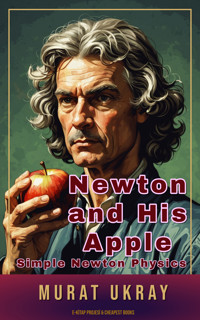
Newton and His Apple
&
Simple Newton Physics
Murat Ukray
Newton and His Apple
&
Simple Newton Physics
PUBLISHED BY
E-KİTAP PROJESİ & CHEAPEST BOOKS
Contact: www.ekitapyayincilik.com
Copyright, 2011 by M. Ukray
ISBN:978-1-4581-9324-7
İstanbul, 2011 ALL RIGHTS RESERVED
NOTE TO THE READER:
"Why did the apple fall out of the tree? Does everything fall? What makes things fall? Can anything stop things from falling? Are the sun, moon, and stars falling? Why don't they ever hit the ground?
So many questions. Newton spent many years answering these questions by thinking and doing experiments. He made up thelaw of gravity. According to this law everything pulled everything else to itself by a force called gravity. How strong that force is depends on how heavy the things are and how close together..
This book telling this excellent biographic story very simple, teaching and amazingly.."
http://www.smashwords.com/profile/view/KIYAMETGERCEKLIGI
E-Posta (e-mail):[email protected]
Internet Adresi (web site):http://www.kiyametgercekligi.com
* * * * *
About the Book
"Isaac Newton was a shy, quiet boy growing up on a farm in England 300 years ago. He was not a very good student and nobody paid much attention to him. Nobody that is, except the school bully. One day the bully punched Isaac in the stomach. That hurt, and that got Isaac very mad! He pulled himself up straight and fought back. Isaac pushed the bully onto the ground and rubbed his face in the mud. All the other kids hated the bully and came and cheered for Isaac.
So Isaac taught the bully a lesson, but he wasn't satisfied with that. Now that he knew he could fight better than the bully, he wanted to prove that he could do anything better than the bully. So he started paying attention to school and studying hard. He was soon the top of his class, proving he was smarter than the bully too.
Isaac Newton kept on studying and when he grew up he became a math professor at Cambridge University. He discovered lots of important things and is one of the most famous scientists who ever lived.
But One day Isaac was reading a book under an apple tree on the farm. An apple fell out of the tree - bonk! Ow!
Now, for most people that would be the end of the story, but not for Isaac. Not for somebody who just couldn't stop askingwhyall the time.
Why did the apple fall out of the tree? Does everything fall? What makes things fall? Can anything stop things from falling? Are the sun, moon, and stars falling? Why don't they ever hit the ground?
So many questions. Newton spent many years answering these questions by thinking and doing experiments. He made up thelaw of gravity. According to this law everything pulled everything else to itself by a force called gravity. How strong that force is depends on how heavy the things are and how close together..
This book telling this excellent biographic story very simple, teaching and amazingly.."
* * * * *
• If you've seen the future, I always had to stand on the shoulders of giants.
• People are like numbers, that human value is measured by the number found in that issue.
• Plato is my friend, Aristotle is my friend, but the truth is my greatest friend.
• I calculate the movements of the stars, but not the madness of people.
• God created everything in measure: weight, number and length.
• Aside from all the other evidence is sufficient to believe in the existence of God, even my thumb.
• Love is like bridge. People everywhere will establish a bridge, building a wall to remain alone.
• Without a robust estimate, has not been any major breakthrough.
• look to the world I do not know how, but I played myself yet undiscovered shores of an ocean full of facts, a smooth pebble or a beautiful sea shell finds joy, I see as a small child.
• We are not our thoughts, our thoughts shapes us.
• If the other people who wanted to do something for me, could not do anything.
Sir Isaac NEWTON (1643-1727)
Chapter I
Newton’s Early Life
In 1642, the year Galileo died,Isaac Newtonwas born in Woolsthorpe, Lincolnshire, England on Christmas Day. His father had died three months earlier, and baby Isaac, very premature, was also not expected to survive. It was said he could be fitted into a quart pot. When Isaac was three, his mother married a wealthy elderly clergyman from the next village, and went to live there, leaving Isaac behind with his grandmother. The clergyman died, and Isaac’s mother came back, after eight years, bringing with her three small children. Two years later, Newton went away to the Grammar School in Grantham, where he lodged with the local apothecary, and was fascinated by the chemicals. The plan was that at age seventeen he would come home and look after the farm. He turned out to be a total failure as a farmer.
The School in the 1850s
The School in 1858
His mother’s brother, a clergyman who had been an undergraduate at Cambridge, persuaded his mother that it would be better for Isaac to go to university, so in 1661 he went up to Trinity College, Cambridge. Isaac paid his way through college for the first three years by waiting tables and cleaning rooms for the fellows (faculty) and the wealthier students. In 1664, he was elected a scholar, guaranteeing four years of financial support. Unfortunately, at that time the plague was spreading across Europe, and reached Cambridge in the summer of 1665. The university closed, and Newton returned home, where he spent two years concentrating on problems in mathematics and physics. He wrote later that during this time he first understood the theory of gravitation, which we shall discuss below, and the theory of optics (he was the first to realize that white light is made up of the colors of the rainbow), and much mathematics, both integral and differential calculus and infinite series. However, he was always reluctant to publish anything, at least until it appeared someone else might get credit for what he had found earlier.
On returning to Cambridge in 1667, he began to work on alchemy, but then in 1668 Nicolas Mercator published a book containing some methods for dealing with infinite series. Newton immediately wrote a treatise,De Analysi, expounding his own wider ranging results. His friend and mentor Isaac Barrow communicated these discoveries to a London mathematician, but only after some weeks would Newton allow his name to be given. This brought his work to the attention of the mathematics community for the first time. Shortly afterwards, Barrow resigned his Lucasian Professorship (which had been established only in 1663, with Barrow the first incumbent) at Cambridge so that Newton could have the Chair.
Newton’s first majorpublicscientific achievement was the invention, design and construction of a reflecting telescope. He ground the mirror, built the tube, and even made his own tools for the job. This was a real advance in telescope technology, and ensured his election to membership in the Royal Society. The mirror gave a sharper image than was possible with a large lens because a lens focusses different colors at slightly different distances, an effect calledchromatic aberration. This problem is minimized nowadays by using compound lenses, two lenses of different kinds of glass stuck together, that err in opposite directions, and thus tend to cancel each other’s shortcomings, but mirrors are still used in large telescopes.
Later in the 1670’s, Newton became very interested in theology. He studied Hebrew scholarship and ancient and modern theologians at great length, and became convinced that Christianity had departed from the original teachings of Christ. He felt unable to accept the current beliefs of the Church of England, which was unfortunate because he was required as a Fellow of Trinity College to take holy orders. Happily, the Church of England was more flexible than Galileo had found the Catholic Church in these matters, and King Charles II issued a royal decree excusing Newton from the necessity of taking holy orders! Actually, to prevent this being a wide precedent, the decree specified that, in perpetuity, the Lucasian professor need not take holy orders. (The current Lucasian professor is Stephen Hawking.)
In 1684, three members of the Royal Society, Sir Christopher Wren, Robert Hooke and Edmond Halley, argued as to whether the elliptical orbits of the planets could result from a gravitational force towards the sun proportional to the inverse square of the distance. Halley writes:
Mr. Hook said he had had it, but that he would conceal it for some time so that others, triing and failing might know how to value it, when he should make it publick.
Halley went up to Cambridge, and put the problem to Newton, who said he had solved it four years earlier, but couldn’t find the proof among his papers. Three months later, he sent an improved version of the proof to Halley, and devoted himself full time to developing these ideas, culminating in the publication of thePrincipiain 1686. This was the book that really did change man’s view of the universe, as we shall shortly discuss, and its importance was fully appreciated very quickly. Newton became a public figure. He left Cambridge for London, where he was appointed Master of the Mint, a role he pursued energetically, as always, including prosecuting counterfeiters. He was knighted by Queen Anne. He argued with Hooke about who deserved credit for discovering the connection between elliptical orbits and the inverse square law until Hooke died in 1703, and he argued with a German mathematician and philosopher, Leibniz, about which of them invented calculus. Newton died in 1727, and was buried with much pomp and circumstance in Westminster Abbey— despite his well-known reservations about the Anglican faith.
An excellent, readable book isThe Life of Isaac Newton, by Richard Westfall, Cambridge 1993, which I used in writing the above summary of Newton’s life.
A fascinating collection of articles, profusely illustrated, on Newton’s life, work and impact on the general culture isLet Newton Be!, edited by John Fauvel and others, Oxford 1988, which I also consulted.
§
Isaac Newton, Underachiever?
Born two to three months prematurely on January 4, 1643, in a hamlet in Lincolnshire, England, Isaac Newton was a tiny baby who, according to his mother, could have fit inside a quart mug. A practical child, he enjoyed constructing models, including a tiny mill that actually ground flour—powered by a mouse running in a wheel. Admitted to the University of Cambridge on 1661, Newton at first failed to shine as a student.
In 1665 the school temporarily closed because of a bubonic plague epidemic and Newton returned home to Lincolnshire for two years. It was then that the apple-falling brainstorm occurred, and he described his years on hiatus as "the prime of my age for invention."
Despite his apparent affinity for private study, Newton returned to Cambridge in 1667 and served as a mathematics professor and in other capacities until 1696.
§
Isaac Newton:
More Than Master of Gravity
Decoding gravity was only part of Newton's contribution to mathematics and science. His other major mathematical pre-occupation was calculus, and along with German mathematician Gottfried Leibniz, Newton developed differentiation and integration—techniques that remain fundamental to mathematicians and scientists.
Meanwhile, his interest in optics led him to propose, correctly, that white light is actually the combination of light of all the colors of the rainbow. This, in turn, made plain the cause of chromatic aberration—inaccurate color reproduction—in the telescopes of the day. (Related: "Galileo's Telescope: From Spyglasses to Hubble.")
To solve the problem, Newton designed a telescope that used mirrors rather than just glass lenses, which allowed the new apparatus to focus all the colors on a single point—resulting in a crisper, more accurate image. To this day, reflecting telescopes, including the Hubble Space Telescope, are mainstays of astronomy.
Following his apple insight, Newton developed the three laws of motion, which are, in his own words:
• Newton's Law of Inertia:Every object persists in its state of rest or uniform motion in a straight line unless it is compelled to change that state by forces impressed upon it.
• Newton's Law of Action and Reaction:For every action, there is an equal and opposite reaction.
Newton published his findings in 1687 in a book calledPhilosophiae Naturalis Principia Mathematica (Mathematical Principles of Natural Philosophy)commonly known as thePrincipia.
"Newton'sPrincipiamade him famous—few people read it, and even fewer understood it, but everyone knew that it was a great work, rather like Einstein's Theory of Relativity over two hundred years later," writes mathematician Robert Wilson of the Open University in an article on a university Web site.
§
Isaac Newton's "Unattractive Personality"
Despite his wealth of discoveries Isaac Newton wasn't well liked, particularly in old age, when he served as the head of Britain's Royal Mint, served in Parliament, and write on religion, among other things.
"As a personality, Newton was unattractive—solitary and reclusive when young, vain and vindictive in his later years, when he tyrannized the Royal Society and vigorously sabotaged his rivals," the Royal Society's Rees said.
Sir Isaac Newton surrounded by symbols of some of his greatest findings.
§
Isaac and the Bully
Isaac Newton was a shy, quiet boy growing up on a farm in England 300 years ago. He was not a very good student and nobody paid much attention to him. Nobody that is, except the school bully. One day the bully punched Isaac in the stomach. That hurt, and that got Isaac very mad! He pulled himself up straight and fought back. Isaac pushed the bully onto the ground and rubbed his face in the mud. All the other kids hated the bully and came and cheered for Isaac.
So Isaac taught the bully a lesson, but he wasn't satisfied with that. Now that he knew he could fight better than the bully, he wanted to prove that he could do anything better than the bully. So he started paying attention to school and studying hard. He was soon the top of his class, proving he was smarter than the bully too.
Isaac Newton kept on studying and when he grew up he became a math professor at Cambridge University. He discovered lots of important things and is one of the most famous scientists who ever lived.
§
Isaac and the Wind
If Isaac was so smart, then why didn't he always do well at school? Well, how well somebody does at school isn't the whole story about them. Its good to remember that just because somebody has trouble with something at school, it doesn't mean they are stupid. Isaac Newton proved that!
I expect that one reason he didn't do well for a long time was that he was always thinking about things. Its just that usually the things he was thinking about weren't the things other people wanted him to think about.
For example, one time there was a terrible wind storm on the farm. His mother was worried that the wind might break gates, doors and shutters. She sent Isaac out to check all over the farm buildings and fences to make sure there wasn't anything flapping in the wind.
"Isaac went out, but he didn't come back. He looked at the strong wind blowing things all around and thought "I wonder ..."
His mother waited and waited, then went out looking for him. When she found him, he was jumping up off a fence over and over to see how far the wind would carry him. He had gotten thinking about how strong the wind was, and forgot completely about everything else.
Isaac loved the wind, so of course he loved kites. He even used to fly kites in the dark. He would tie a small lamp to the tail of the kite so he could see it up in the night sky. However, people were very superstitious when he lived. When the neighbours saw a light floating in the sky at night they were worried about ghosts, or witches, or other things. When Isaac heard about this he laughed, but he decided he better stop flying the kite at night.
§
Comets and Apple Trees
One day Isaac was reading a book under an apple tree on the farm. An apple fell out of the tree - bonk! Ow!
Now, for most people that would be the end of the story, but not for Isaac. Not for somebody who just couldn't stop askingwhyall the time.
Why did the apple fall out of the tree? Does everything fall? What makes things fall? Can anything stop things from falling? Are the sun, moon, and stars falling? Why don't they ever hit the ground?
So many questions. Newton spent many years answering these questions by thinking and doing experiments. He made up thelaw of gravity. According to this law everything pulled everything else to itself by a force called gravity. How strong that force is depends on how heavy the things are and how close together.
So even two apples pull toward each other. But, the force is so small that you need a very careful experiment to measure it. The reason that things fall toward the ground is that the earth we live on is so very heavy, and we are so close to it.
Newton's law of gravity not only explained how things fall on earth, but how planets move around the sun and how moons move around planets. A friend of his, Edmund Halley, decided to try Newton's theory on comets. People had been studying comets for hundreds of years without figuring them out, so he decided to study their reports and compare them to Newton's theories.
Up til then people had thought that comets just came and went, and that nobody could know when or why. But Newton's law of gravity gave rules that Halley could use to study the records of comets. He found some reports of a big bright comet that he was sure was the same one, coming back every 75 years. He predicted when it would come back next.
If anybody still didn't believe Newton, then the appearance ofHalley's Cometjust when Halley had predicted it using Newtons ideas was enough to convince them. Halley's comet has come a few times since then, always right on schedule. You'll be able to see it on its next trip near the sun and earth when you're old enough to be a grandparent.
§
Newton and Hooke
Do you know anybody who always has to be first? Maybe its your brother or sister, or a friend. When you say you learned something, they say "I already knew that". When you're going to do something, they say "He already didn’t that".
There was another famous scientist named Robert Hooke who was very jealous of Netwon. Whenever Newton announced he had discovered something, Hooke would say "he already discovered that first, I just didn't tell anybody yet." This made Newton very mad.
Everybody makes mistakes sometimes, even very smart people like Newton. One time when Newton made a mistake, Hooke was the first to discover the mistake and tell everybody about it. Newton was mad and embarrassed. He didn't like to make mistakes, but he really hated that it was Hooke who figured out the mistake. Newton said that he would never tell anybody about his discoveries again. He didn't want to ever have Hooke catch him making a mistake again. In a while though, Newton realized how silly this was and started telling about his discoveries again.
Newton wrote a big book calledPrincipia. This book told all about how things push and pull, and gave lots of examples of how machines work and how things like planets and comets move. It was a very important book, and scientists still like to read it, even though it is more than 300 years old. But guess what happened when he was writing it. Hooke found out about what he was writing and said "I already discovered that!" Newton was so angry that he decided not to write the book. It was a good thing that he again realized how silly it is to let somebody else bother you that much. He did finish writing it, and even mentioned some things that Hooke had done.
§
All the Colors of Light
Newton’s reflective telescobe
Another important thing that Newton did was to figure out a lot about how light works. One day he bought a prism at the Stourbridge Fair. (This is a piece of glass shaped like a triangle.) He had it sitting on his desk, and noticed how when the sun shone on it, he got different colors out. This made him very curious. Does this change the light, or does the sunlight have lots of colors that the prism puts into different places? How does the prism do it?
To find the answers, Newton had to do some experiments. He first used his blinds to get a very thin sunbeam to hit the prism. This was important - to control the light that was coming in so that he knew exactly what he was starting with. He discovered that the separation of light was even clearer. There was red, then orange, then yellow, then green, and then blue.
Newton was pretty sure that what was happening was that the light from the sun had all these colors in it, and that what the prism was doing was bending them all to go into slightly different directions. To test this he got two prisms and a card with a hole in it. He used the first prism to get the sunlight to make different colors. Then he would choose a color and put the hole so than only that color went through into the next prism. He then had a very thin line of red, yellow or some other color of light going to the second prism.
He discovered that when the light came out of the other side of the next prism, it was still the same color as when it went in. So the prism doesn't change the light's color. What the prism did do was to bend the path the light went on, so that it hit a different place than when the prism wasn't there. When he tried different colors of light he found that the prism bent them all a little bit differently. That was why light that looked white, which had all the colors in it, made different colors when it went through the prism - the different colors all came out of it in slightly different directions.
§
Chapter II
MATHEMATICAL THREATMENT OF THE NATURE AND NATURAL PHYLOSOPHY BEFORE NEWTON
Classical Epistemology From the Copernican Revolution (1600) to the 1848 Revolution in Germany.
Copernicus and Galileo
Copernicus was commissioned by the Pope to investigate possible improvements in methods of constructing the calendar, but his report had revolutionary implications. Galileo fought for his life defending Copernicus’ system and in presenting his view of a material world existing independently of human consciousness which can be understood through theories which reflect the actual movement of bodies verified by observations accumulated over generations. He does not reject the knowledge of his predecessors, but on the contrary calls upon them in his defence, including Thomas Aquinas in arguing against the literal interpretation of the Bible. Galileo relies upon the unstoppable progress of industry and enquiry to prove the validity of building theoretical knowledge on the basis of logical analysis and observation, as against the right of the Church to determine theoretical knowledge as a matter of dogma.
Galileo’s epistemology is impressively sophisticated and balanced in relation to the developments of the subsequent 200 years. What is the essence of what he has to say? It is the separation of ethics from knowledge (of nature, history, etc), of the separation of science from the legitimate domain of the Church; he claimed the right of the people to investigate profane matters, questions which were capable of falsification in experience or reason, while the Holy Fathers could confine themselves to determining what was necessary to gain access to eternal life and avoid damnation. Bacon also achieved this same separation in England, claiming that the way to perceive God’s Will was to observe his Works.
As I said, Galileo was a very sophisticated thinker, and in many ways centuries ahead of his time. In the course of defending philosophical materialism against the Church, he even goes so far as refuting the “economy of thought” argument which would appear in natural scientific philosophy three hundred years later. He made important statements on all sorts of matters both natural-scientific and philosophical — but the Essence of what he said was the liberation of the knowledge from Scripture, from Ethics. He held that making of this or that proposition about nature could not be sinful, but only objectively true or false.
It should be noted that Galileo did not call into question the right of the Church to rule within its own domain, but that matters which can be demonstrated as true or false in Nature cannot be the subject of Scripture. He was forced to recant, but the Inquisition could not prevent Galileo’s triumph. They could not prevent Galileo’s triumph, simply because people were out there with lenses and mechanical devices, investigating nature and demonstrating the falsity of conventional wisdom, and no Ecclesiastical decree was going to stop them. Capitalist industry and commerce was on the march. Galileo’s declaration of the right of free enquiry was the parallel of the rising bourgeoisie’s right to organise labour in whatever way made sense at the time, irrespective of the rights and obligations of feudal social organisation. [See Feuerbach on materialism.]
§
Descartes and Bacon
Descartes and Bacon both propose the wholesale rejection of the legacy of supposed knowledge from the past and to start from the beginning in order to build an adequate knowledge of the world. However, they place emphasis on opposite sides. This is the period of struggle between Rationalism and Empiricism. This polarity is the first of a series of polarities manifested in the classical history of epistemology. Each dichotomy remains unresolved till the mid-19th century, but within a single generation is overtaken by a new dichotomy which, so to speak, takes centre stage.
The difference in emphasis on experience or reason remains a contrast between the British and Continental lines of development ever after. The British bourgeoisie made the political revolution as early as 1640, whereas it is not until 1789 in France that the bourgeoisie gained political control of their country, and the German bourgeoisie did not gain political power till after World War I.
The rise of Empiricism is often linked to the successful Industrial Revolution first accomplished in Britain. However, empiricism was already thoroughly imbued in the population by the time of the beginning of the Industrial Revolution in the second half of the 18th century.
The capital accumulated mainly on the basis of slavery and plunder during the period prior to the 17th century, the century which gave birth to the rise of bourgeois philosophy as opposed to theology, was either merchant or usurer capital. This primitive accumulation depended overwhelmingly on robbery of the Americas and the East Indies, in particular the slave trade, and the nations engaged in this plunder were, in more or less chronological order Spain, Portugal, Holland, France and England (Marx,CapitalI, XXXI). By the time England is at it, a combination of colonisation, national debt, taxation and protectionism — all depending on the brute force of the State — is arrived at to hasten to birth of the economic power of capitalism within feudal society. With the commercial capital accumulated by the most bestial rape of the colonies, there would be no capitalism in Europe.
Even before the English Revolution, the British bourgeoisie was busy ripping off Crown and communal land and bleeding State coffers. The concentration of land in the hands of large landowners allowed both the improvement of agricultural productivity and the creation of a mass of landless proletarians. The transformation of the peasantry into agricultural labourers also created a home market for manufactured products such as linen and yarn which would have formerly been produced by subsistence methods by the peasants themselves.
During the period from 1640 to 1760, the British bourgeoisie succeeded in removing all internal barriers to trade and found within their own territory an abundant home market for agricultural produce and small-scale industrial products. The French however found it impossible to create a home market or to break down the network of restrictions on internal trade maintained by the French nobility.
Although the Industrial Revolution is still 100 years away in the time of Bacon, what distinguishes England from the Continent is the presence of both an industrial and agricultural bourgeoisie.
What Bacon and Descartes have in common is the radical separation of subject and object in knowledge. In Bacon this not brought out, but is implicit in the conception of Nature as the object of experiment and investigation by the human subject, quite uncritical in the sense of later generations of both English and Continental philosophy. For Descartes, the dualism is quite explicit: the problem is how on Earth to explain that Mind is capable of corresponding to the material world though it be of totally different substance with no apparent point of contact.
The first act of epistemology is thus the rupture of subject and object. But this begs the question of the priority to be given to the subject (Reason) or the Object (sensuous perception) is the act of knowledge. I feel compelled to surmise that it is the conditions of accumulation of value in the home market that give rise to the birth of empiricist philosophy. Artisans were active in all the towns of the time, and in Holland and Italy for example, the trades were highly developed long before the time of Bacon. So it is not at all feasible to suppose that this early “technological” activity formed the basis of empiricist philosophy, which was after all the product not of artisans, but of bourgeois or even aristocratic gentlemen.
§
There is no doubt at all that the development of science furthered the economic and social interests of the bourgeoisie. The question is: why did this take two different, opposite forms in England and France? George Novack, in his “Empiricism and its Evolution”, seems to believe that empiricism is the natural and only ideology for the development of industry and science and therefore capitalism, and for that matter, goes so far as to impute a Pragmatist position to Bacon, and deems Pragmatism to be the very doorway to dialectical materialism. This just won’t do. Descartes is quite explicit, and moreover correct, in his criticism of Empiricism, and hostility to Empiricism (and Pragmatism) continues among French philosophers right up to the present day. France has given the world its greatest mathematicians, not just Descartes but Lagrange, Poisson, Galois, Lefevbre, ... the list goes on and on, and apart from Sir Isaac Newton one must wait till the 20th century to find an English mathematician (Russell, Whitehead, Keynes) and then mediocre ones. The French are not lacking in experimental scientists (Lavoisier for example) but without a doubt Britain is the home of experimental science (Bacon himself, Boyle, Harvey, Gilbert, Hooke, ...)
Britain emerged as the pre-eminent capitalist power long before its competitors had even gained control of their own home market and achieved State power, and by means of the home market, the increase in agricultural and manufacturing productivity mainly by concentration of trades in a single workshop and enclosure of peasant lands, and thereby the creation of an industrial and agricultural proletariat.
How was science to advance in France? chiefly in the heads of the aristocracy. Capital was being accumulated solely by the subjugation of other human beings. InDiscourse on Method, Descartes clearly foresees the mastery of Nature by the use of machinery, but mastery of Nature is the extension of a mastery achieved by superior military logistics and organisation, superior leadership and military science.
For Bacon, the mastery of Nature follows from the mobilisation of masses of investigators, observers and collectors, funded and working to a plan it is true, but it is a direct sensuous action upon Nature that he envisages — the employment of people upon nature. Thus, the opposite theories of Nature reflect opposite means of the accumulation of value.
§
Spinoza and Hobbes-Locke
The first act of epistemology is the separation of subject and object. The next generation — Descartes’ admirer Spinoza in Europe, and Bacon’s pupil Hobbes and his successor Locke in England — had to wrestle with this separation of a subject and object which did not “know each other”. This is the period concerned with the dichotomy ofdualismandmonism.
In the Dutch Republic, the finance capital of the world enjoying its “Golden Age” based on plundering of the East Indies, the son of Portuguese Jewish refugees, Benedict Spinoza proposes a monist solution of Descartes’ rationalism.
Meanwhile, in Revolutionary England, the Royalist Thomas Hobbes continues the evolution of empiricism by a consideration of how the action of matter on the sense organs generates thought in the mind; this line of development is continued by John Locke, who provides the newly ruling English bourgeoisie with the most fully worked out philosophy of the time, based on the epistemology of empiricism.
At this time, Spinoza’s profound materialism leads to a kind of dead-end however. His main work which is clearly an attempt to correct Descartes’ dualism and formulate a materialist and monist epistemology, is entitledEthics. And indeed, though answering a question of knowledge, the answer is more ethical than an epistemological. God did not create Nature, NatureisGod. [Spinoza’s rational materialism finds further development in Leibnitz’s objective idealism and is to some extent revived by Goethe in the Enlightenment. Monism does not become a dominant feature of epistemology until Hegel. The bourgeoisie of the dominant capitalist powers remain dualists.]
In Bacon, dualism is not explicit, but it is made explicit in Hobbes and Locke. Locke holds: “All ideas come from sensation or reflection. — Let us then suppose the mind to be, as we say, white paper [tabula rasa], void of all characters without any ideas; how comes it to be furnished?” In fact it appears that ideas do not justcome fromsensations, but the distinction between sensations and ideas has disappeared altogether; ideas are but reflexes.
Nature is given in the form of sensation and ideas are these sensations plus further sensations derived from the contemplation of other ideas. Sensation is at this time identified as the connecting medium between Nature and consciousness. The objective existence of the material world is not questioned, nor is the validity of the impressions made by Nature upon the senses deemed in any way problematic. The material world is held to be given in sensation and knowable. However, the Mind has become a passiveorganof Nature. Thus the dualism inherent in Bacon is only overcome by the denial of an active Reason altogether.
The principle mode of accumulation in Britain at this time was the removal of peasants from their means of subsistence, so that the entire product of their labour could be appropriated for the market, alongside the concentration of unorganised proletarians — peasants driven from their land altogether — to carry out their traditional handicrafts as employees, for the market rather than for immediate consumption.
§
Hobbes: “The value or worth of a man, is as of all other things, his price — that is to say, so much as would be given for the use of his power” [Leviathan].
Locke: “The universal consent of mankind gave to silver, on account of its qualities which made it suitable for money, an imaginary value”
The bourgeoisie of this time were not involved in revolutionising technology. They simply separated the workpeople from the means of subsistence so that their labour could be prolonged and the product placed on the market to render a profit. Nature and the workers who laboured upon Nature simply produced a profit by the very act of conversion of their labour into value. “Nature”, i.e. the labouring people, gives up its value like water into a sponge. This view of value corresponded to the view of knowledge accumulated by simple receipt of sensations from Nature.
This mode of accumulation was not possible on the Continent: the French bourgeoisie continued to rely on forcible appropriation of the products of labour from the colonial people.
§
Newton-Leibnitz and Berkeley
The next generation in this line of development is the incomparable Sir Isaac Newton in Britain, the peculiarly British mathematician who unlocked the key to “Nature’s laws”, his nemesis in Switzerland, the brilliant Gottfried Leibniz, a continental mathematician and statesman of the first order, and the champion of clerical reaction, the Irish Bishop George Berkeley.
Leibniz continues the Rationalist and monistic line of development which only later bears fruit in Germany, but I do not see that his contribution is the essential one in this period. He restores God-the-Creator as opposed to Spinoza’s God-as-Nature, transforming man from the agent of God’s Will to being a creation of God who is in turn “capable of knowing the system of the universe, and of imitating some features of it by means of artificial models, each spirit being like a small divinity in its own sphere”.
Newton’s epistemology is rich, complex and very problematic, and has been the subject of endless analysis. Newton the man was an alchemist and exegist (interpreter of the Bible) as well as physicist. But the realisation that Newton was not the idealisation nineteenth century British historians made of him, must not lead away from understanding what was the essence of Newton’s contribution, which may indeed bear a stronger relationship to that idealisation than it does to the actual man.
The essence of this period is the opposite ways in which Berkeley and Newton deal with the subject-object relationship developed by empiricism.
Newton died a generation before the application of his discoveries finds direct economic application in the Industrial Revolution, but already the need to increase the power and productivity of labour and the need for a science which can be applied to the levers of production has become clear — and Newton’s contemporary Bishop Berkeley knew the social implications of this method! It is well-known and oft-repeated that Newton’s physics was meeting a need of capitalist exploitation, but this is not the point of interest, because Newton did not set out to produce plans for engines, he aimed to discover and give voice to the Laws of Nature, and the point of interest is the mentality with which he set about that task, how that mentality allowed him to succeed, and what was the social basis of this mentality.
The problem that the British bourgeoisie faced at this time was that further expansion of value could not be achieved by simple extension of the working day and the concentration of labour. The working day had already been extended as much as it could and workers responded to increased wages only by working shorter hours. The countryside had already been denuded of workers and agricultural productivity had reached the limit which could be reached without industrialisation. From 1688, the British bourgeoisie had removed all significant barriers to trade, and the rapid expansion of markets resulting from the increased of Europe and the expansion of trade with the Americas and Asia, there was an unmeetable demand for the products of manufacture.
It was therefore necessary to increase the rate of surplus value by reducing the necessary labour time. Marx refers to this as the movement from the accumulation ofAbsolutesurplus value toRelativesurplus value. The bourgeoisie could no longer stand outside the labour process and Nature and “soak up” the surplus value created, it was necessary to mentally grasp and control the production process itself.
§
In Newton’s physics, the thinker steps outside of the process, but leaves a proxy of the subject in the object itself, places the body of the subject into Nature while removing the Mind of the subject outside of Nature.
Newton pushes God to the “boundary conditions” of the world which acts according to laws which are entirely open to rational-empirical elaboration, and beyond that — the internal causes of phenomena — “it doesn’t matter”.
I think there are two elements in particular which gave Newton’s method such all-conquering power, the differential calculus and the method of measurement relative to a frame of reference, a hypothetical “observer” which did away with concepts of absolute time and space, replaced with a world which is “relative to the observer”. Linked to this “theory of relativity”, was the equation of properties of all observed matter with absolute properties ofall matter, and the rendering of forces and properties (the properties of the various chemical elements, the origin of forces of attraction and repulsion observed, etc.) as outside the scope of science.
The differential calculus comes from regarding magnitudes as essentially “elastic”. It is one thing to say that the space traversed,s, is proportional to the time elapsed,t, and the velocityv, i.e.svt, but quite another when you say thatvs/dt. Newton discovered that Nature works by differentials (or relatives), not absolutes. The Subject has disappeared into the Object.
Newton is simply continuing Bacon’s project, but whereas Bacon was obliged to put the value of the entire intellectual product of the past at zero, and place priority on the accumulation of the primary material for reasoning, Newton bases his method on systematic and exclusive induction upon accumulated data. The emphasis is on unification of the mass of data in simple differential formulae.
For Newton value lies in Nature, and Man is able to appropriate Nature. What he has no use for, has no value.
Berkeley, on the other hand, proves that if all that is given to consciousness is sensation, then “logically” there is no sense in the concept of knowing of anythingbeyond




