


0,99 €
Mehr erfahren.
- Herausgeber: DigiCat
- Kategorie: Geisteswissenschaft
- Sprache: Englisch
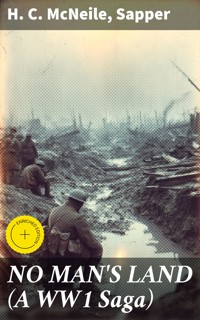
Dive into the turbulent world of "NO MAN'S LAND (A WW1 Saga)", an anthology that masterfully captures the multifaceted experiences of World War I. This collection presents an array of literary styles, from gripping narratives to evocative reflections, each painting a vivid picture of life amid the trenches. As a well-orchestrated whole, the anthology unfolds the harrowing realities and profound camaraderie that defined the Great War, offering both historical insight and emotional depth. Particularly notable are the vignettes that highlight the nuances of war's impact on identity and humanity without confining themselves to a single perspective. Helmed by renowned military author H. C. McNeile, famously known as Sapper, the collection draws upon his own experiences as well as the diverse voices of his contemporaries. Known for his intricate depictions of wartime life, McNeile's editorial influence ensures a cohesive yet diverse narrative flow. The anthology resonates with the essence of the early 20th-century literary movement that sought to navigate and articulate the chaos and complexity of war, bringing together an eclectic mix of styles and insights from authors of varied backgrounds and experiences. This anthology is a profound invitation to explore the multiplicity of perspectives on the war, as it offers a treasure trove of narratives that enrich readers' historical and cultural understanding. Scholars, history enthusiasts, and literary aficionados alike will find "NO MAN'S LAND" to be an invaluable resource, offering an exceptional blend of educational merit and emotional exploration. It stands as a testament to storytelling's ability to bridge past and present, fostering a dialogue among the varied voices immortalized within its pages. In this enriched edition, we have carefully created added value for your reading experience: - A succinct Introduction situates the work's timeless appeal and themes. - The Synopsis outlines the central plot, highlighting key developments without spoiling critical twists. - A detailed Historical Context immerses you in the era's events and influences that shaped the writing. - A thorough Analysis dissects symbols, motifs, and character arcs to unearth underlying meanings. - Reflection questions prompt you to engage personally with the work's messages, connecting them to modern life. - Hand‐picked Memorable Quotes shine a spotlight on moments of literary brilliance. - Interactive footnotes clarify unusual references, historical allusions, and archaic phrases for an effortless, more informed read.
Das E-Book können Sie in Legimi-Apps oder einer beliebigen App lesen, die das folgende Format unterstützen:
Veröffentlichungsjahr: 2023
Ähnliche











NO MAN'S LAND (A WW1 Saga)
Table of Contents
Introduction
Between survival and duty lies the shattered strip where men learn what they are willing to risk, and No Man’s Land never leaves that perilous ground. H. C. McNeile, writing as Sapper, draws on his experience as a British Royal Engineers officer to produce a work of war fiction set largely along the Western Front in World War I. First appearing during the war years, the collection bears the urgency of immediate witness. Its genre is martial short fiction: compact episodes built from patrols, trenches, and the uncertain spaces between lines, presented with the terseness and practical focus of a soldier’s eye.
Rather than a single continuous plot, the book assembles a mosaic of frontline scenes: night crawls into the neutral ground, anxious hours under bombardment, fragile respites in dugouts, and the routine tasks that make survival possible. Characters often emerge at the moment of decision and recede just as quickly, emphasizing the randomness of risk and reprieve. The voice is crisp and unsentimental, enlivened by dry wit and a craftsman’s attention to practical detail. The style favors swift turns and tight vignettes, while the tone balances fatalism with flashes of courage and fellowship, creating a reading experience at once tense and humane.
At its core, the collection probes the liminal zone where rules blur: the boundary between courage and caution, impulse and discipline, individual instinct and collective duty. The terrain itself becomes a presence, with mud, wire, craters, and sudden flares shaping what characters can attempt or imagine. McNeile’s perspective, informed by engineering service, keeps attention fixed on the unglamorous necessities of war—laying wire, cutting gaps, locating posts, bringing men back alive—so that heroism appears as craft as much as spectacle. The result is an anatomy of tested judgment, in which skill, luck, and leadership continually intersect under conditions no one fully controls.
Stylistically, No Man’s Land favors economy over ornament: sentences move briskly, scenes tighten around action, and description serves function as much as atmosphere. McNeile uses the soldier’s register—plain, sardonic, and attentive to kit, orders, and timing—to preserve credibility without dulling intensity. Violence arrives abruptly and rarely lingers; what remains are the inches gained or lost, the decisions made in the dark, and the dry humor that keeps fear at bay. The narration’s restraint gives the episodes a documentary edge, while swift cuts between calm and alarm generate suspense that feels earned, not forced, grounding drama in the practical realities of survival.
Published while the conflict still raged, the book occupied a distinctive place between reportage and invention, offering shaped stories that nonetheless carry the immediacy of a participant’s outlook. McNeile’s signature, Sapper, signaled technical familiarity as well as comradeship, and contemporary readers sought that authenticity. The collection contributed to a broader wartime literature that translated trench experience for the home front, neither purely propagandistic nor detachedly experimental. Its emphasis on procedure, morale, and small-unit initiative reflects concerns that governed daily survival, and its focus on the narrow zone between opposing lines helped define how a generation imagined the strange, contested space that gave the volume its title.
For contemporary readers, No Man’s Land endures because it restores scale and texture to a conflict often reduced to dates and casualty figures. Its close focus on small teams, improvised tactics, and moral strain speaks to ongoing questions about leadership under pressure, the ethics of risk, and the bonds that sustain people in extreme conditions. The book also models how narrative can frame violence without sensationalizing it, an issue that remains urgent in today’s reporting and storytelling about war. Read alongside later accounts, it offers a complementary perspective shaped by immediacy, craft, and a determination to look steadily at what duty demands.
Approached as a sequence of sharpened encounters rather than a single arc, the collection rewards deliberate reading: one episode at a time, with space to absorb its pressures and afterimages. In that cadence, its central idea gathers force, for no man’s land is not merely a strip of earth but a condition of uncertainty that tests resolve, empathy, and judgment. McNeile’s disciplined prose makes that test legible without collapsing complexity into slogans. The result is a book that still matters, not as relic, but as a clear-sighted guide to the fraught ground where survival, responsibility, and human connection meet.
Synopsis
NO MAN'S LAND (A WW1 Saga) by H. C. McNeile, writing as Sapper, is a contemporaneous collection of frontline stories shaped by his Royal Engineers service. Published during the First World War, it presents episodic scenes along the Western Front rather than a single continuous plot. The pieces follow soldiers confronting the churn of trench warfare—mud, wire, shellfire, and the uncharted strip between lines that gives the book its title. McNeile’s perspective emphasises professional competence and matter‑of‑fact courage, setting a tone of brisk realism. Without grand overture, the opening sketches plunge straight into patrols and dugouts, framing danger as routine work performed under watchful enemy guns.
Subsequent episodes track small-unit actions that hinge on nerve, observation, and timing. Night patrols creep through shell holes; listening posts parse faint noises for clues; sentries test the dark for movement that might be fatal or banal. McNeile distills these encounters to brief decisions—a hand signal, a misstep, a flare—that carry disproportionate consequences. Individual soldiers emerge through habits and slang rather than extended backstory, a choice that keeps attention on duty rather than biography. The mood balances tension with dry, occasionally sardonic humour, suggesting how veterans mask fear while carrying on. Success is measured less by heroics than by bringing men back intact.
The engineer’s craft supplies a distinct throughline. Forward works are pushed beneath observation; wire is laid, cut, and disguised; tunnels are driven and opposed with a patience that borders on ritual. The prose dwells on method—tools, timings, passwords, the discipline of silence—while acknowledging the omnipresence of chance. Small technical choices determine whether a task remains invisible or attracts fire. When operations go wrong, the narrative refuses melodrama, noting consequences in the same clipped register used for preparation. That steadiness, shaped by McNeile’s own branch, frames the front as a workplace whose rules are learned at cost.
Rank and class appear as pressures that the line both enforces and erodes. Officers are judged by their steadiness under shelling and their willingness to share risk; men watch, and verdicts form quickly. Courtesies of prewar life survive in gestures and catchphrases, but the modernity of industrial killing narrows the gap between backgrounds. Orders must be concise, and trust accumulates in small acts—accurate maps, timely rations, a word at the right moment. McNeile’s portraits avoid sentimentality, showing leadership as a craft like any other, meaningful when it spares lives and brittle when it confuses appearance for competence.
Away from the parapet, billets and rest areas furnish a different cadence. Cafés, makeshift concerts, and letters home offer intervals that are neither pure respite nor mere illusion; each interlude is shadowed by the return to the line. The men cultivate rituals—tea brewed at impossible hours, lucky tokens, jokes repeated until they become passwords—that preserve identity. This alternating rhythm underscores a central question: how to remain recognisably oneself while adapting to a world that punishes hesitation. The stories rarely moralise; instead they assemble evidence from fragments, letting readers infer what endurance costs and why the smallest comforts matter.
Tactical set pieces punctuate the quieter observation. Barrages roll and lift; raids test the wire; reconnaissance stalks through fog and rain that flatten perspective. Technology intrudes as both threat and scaffold—automatic fire, gas warnings, optical devices, telephones—each enabling some safety while introducing new kinds of failure. McNeile’s descriptive economy turns terrain into character: mud as adhesive force, chalk as betrayer of footprints, darkness as both shield and trap. Occasionally, glimpses of the enemy surface not as demons but as counterparts bound to the same ground, underlining how the battlefront’s logic can compress hatred into wary professionalism.
Without culminating in a single decisive engagement, the collection accrues a composite verdict on trench warfare: it is sustained by competence, habits of mutual care, and a resilience that prefers understatement to display. The closing notes keep faith with the book’s restraint, avoiding grand solutions while acknowledging the strain of protracted conflict. As a record by a serving officer published during the war, No Man’s Land holds continuing value for its immediacy and its clear, unsentimental prose. It endures as a disciplined witness to experience, inviting reflection on courage that is procedural rather than theatrical and on the costs of such steadiness.
Historical Context
'No Man's Land' (1917) by H. C. McNeile, known by his wartime pen name Sapper, emerges directly from the Western Front of the First World War. McNeile served as an officer in the British Royal Engineers, and army regulations led him to use a pseudonym. The stories draw on operations in France and Flanders between 1914 and 1917, when the British Expeditionary Force held sectors of a continuous trench line against the German Army. Written during the conflict and soon after, the collection reflects a participant’s eye for detail, focusing on front-line routines, raids, engineering tasks, and the specific hazards of trench warfare.
The setting centers on the entrenched stalemate that developed after the mobile battles of 1914. From the North Sea to the Swiss border, opposing forces constructed systems of front, support, and reserve trenches connected by communication trenches. Between them lay no man’s land, a shell-blasted zone of wire, craters, and dead ground patrolled at night and deadly by day. Routine dominated: stand-to at dawn and dusk, ration and wiring parties, sentry duty, and fatigue work under intermittent shelling and sniper fire. Rotations through the line, rest billets, and brief leaves shaped soldiers’ rhythms and inform the backdrop of McNeile’s narratives.
As a Royal Engineers officer, McNeile observed the technical backbone of trench warfare. The Engineers sited and built trenches, saps, dugouts, strongpoints, and bridges; repaired roads and railways; laid and cut barbed wire; maintained water and sanitation; and ran field communications. From early 1915, specialist Tunnelling Companies conducted underground warfare, driving galleries to place explosive charges beneath enemy positions and counter-mining to foil German efforts. British mining reached a dramatic peak at Messines Ridge in June 1917, when huge charges detonated under German lines. That expertise, along with day-to-day engineering labor, shapes the practical texture and problem-solving focus of the stories.
The collection’s milieu reflects a front altered by major offensives and tactical adaptation. The Second Battle of Ypres (April–May 1915) introduced large-scale chlorine gas on the Western Front, forcing rapid development of respirators and alarms. The Somme offensive (July–November 1916) saw creeping barrages, massed artillery, and costly infantry assaults, while teaching lessons about combined arms and small-unit tactics. In 1917, fighting around Arras and the ridges near Ypres demanded continued trench holding, patrols, and raids despite terrible terrain. These campaigns conditioned everyday expectations: heavy barrages, counter-battery duels, cratered landscapes, and the constant possibility of sudden local attacks.
Weaponry and tools central to McNeile’s vignettes were standard across the British sectors. Machine guns dominated open ground; artillery inflicted most casualties; trench mortars and rifle grenades harassed front lines and support trenches. The Mills bomb (adopted 1915) and the light, rapid-firing Stokes mortar enhanced raiding and close defense. Gas—delivered by cloud or shell—made masks and sentry systems routine. Sniping duels exploited loopholes and camouflage; scouting relied on listening posts and patrols. Communications depended on field telephones vulnerable to shellfire, supplemented by runners, lamps, flags, and carrier pigeons. Increasingly, aircraft provided reconnaissance and artillery spotting over the contested front.
Personnel structures and wartime policy frame the social world of the book. Britain’s small prewar Regular Army was reinforced by Territorials and mass volunteer formations—Kitchener’s Army—from 1914, followed by conscription in 1916. The regimental system, public-school traditions among officers, and experienced noncommissioned leadership shaped units’ culture and language. The Defense of the Realm Act empowered censorship and information control, influencing how soldiers wrote and how newspapers published. Officers commonly used pseudonyms when publishing wartime accounts, explaining McNeile’s signature Sapper. The result is a voice that blends professional understatement, barrack-room humor, and patriotic resolve with attention to technical and tactical realities.
Intelligence and security concerns inform episodes of deception, patrol work, and countermeasures. British formations employed intelligence staffs to plot trench maps, identify enemy units, and assess artillery and gas threats, while raids sought prisoners and documents for identification. At higher levels, Britain expanded prewar security services—MI5 for counter-espionage and the Secret Intelligence Service (often called MI1(c) or MI6)—and ran signals intelligence such as Room 40’s codebreaking. On the front, measures like censorship, pass systems, codewords, and camouflage protected operations. These institutions explain the emphasis on secrecy, reconnaissance, and sudden, limited-objective actions that underpin many of the collection’s tense encounters.
No Man’s Land reflects its moment by combining close-grained realism with wartime attitudes of duty, cohesion, and technical competence. It neither offers a grand strategic critique nor romanticizes combat; rather, it records how soldiers managed danger through training, improvisation, and mutual reliance. The emphasis on engineers’ work foregrounds the infrastructure and logistics often invisible in battle narratives. Its tone—patriotic, sometimes sardonic—matches contemporaneous British press and official messaging while acknowledging loss and exhaustion. In this way, McNeile’s stories preserve a record of the Western Front’s routines and risks and exemplify how wartime publishing framed endurance as a collective national virtue.
NO MAN'S LAND (A WW1 Saga)
PREFACE
During the first few days of November 1914 Messines was lost—in silence; during the first few days of June 1917 Messines was regained—and the noise of its capture was heard in London. And during the two and a half years between these two events the game over the water has been going on.
It hasn't changed very much in the time—that game—to the player. To those who look on, doubtless, the difference is enormous. Now they speak easily of millions where before they thought diffidently of thousands. But to the individual—well, Messines is lost or Messines is won; and he is the performer. It is of those performers that I write: of the hole-and-corner work, of the little thumb-nail sketches which go to make up the big battle panels so ably depicted over the matutinal bacon and eggs.
And as one privileged to assist at times in that hole-and-corner work, I offer these pages as a small tribute to those who have done so far more than I: to the men who have borne the burden of the days, the months, the years—to the men who have saved the world—to the Infantrymen.
PART I THE WAY TO THE LAND
I
It came suddenly when it did come, it may be remembered. Every one knew it was coming, and yet—it was all so impossible, so incredible. I remember Clive Draycott looking foolishly at his recall telegram in the club—he had just come home on leave from Egypt—and then brandishing it in front of my nose.
"My dear old boy," he remarked peevishly, "it's out of the question. I'm shooting on the 12th."
But he crossed the next day to Boulogne.
It was a Sunday morning, and Folkestone looked just the same as it always did look. Down by the Pavilion Hotel the usual crowd of Knuts in very tight trousers and very yellow shoes, with suits most obviously bought off the peg, wandered about with ladies of striking aspect. Occasional snatches of conversation, stray gems of wit, scintillated through the tranquil August air, and came familiarly to the ears of a party of some half-dozen men who stood by a pile of baggage at the entrance to the hotel.
"Go hon, Bill; you hare a caution, not 'arf." A shrill girlish giggle, a playful jerk of the "caution's" arm, a deprecating noise from his manly lips, which may have been caused by bashfulness at the compliment, or more probably by the unconsumed portion of the morning Woodbine, and the couple moved out of hearing.
"I wonder," said a voice from the group, "if we are looking on the passing of the breed."
He was a tall, thin, spare fellow, the man who spoke; and amongst other labels on his baggage was one marked Khartoum. His hands were sinewy and his face was bronzed, while his eyes, brown and deep-set, held in them the glint of the desert places of the earth: the mark of the jungle where birds flit through the shadows like bars of glorious colour; the mark of the swamp where the ague mists lie dank and stagnant in the rays of the morning sun.
No one answered his remark; it seemed unnecessary, and each was busy with his own thoughts. What did the next few days hold in store for the world, for England, for him? The ghastly, haunting fear that possibly they held nothing for England gnawed at men's hearts. It would be incredible, inconceivable; but impossible things had happened before. Many must have felt that fear, but to none can it have been quite so personal, so hideously personal, as to the officers of the old Army and the Navy. To them it was as if their own honour were at stake, and I can see now a man opposite me almost sobbing with the fury and the shame of it when for a while we thought—the worst. But that was later.
"Time to go on board, gentlemen."
Almost as beings from another world, they passed through the noisy throng, so utterly inconsequent, so absolutely ignorant and careless. One cannot help wondering now just how that throng has answered the great call; how many lie in nameless graves, with the remnants of Ypres standing sentinel to their last sleep; how many have fought and cursed and killed in the mud-holes of the Somme; how many have chosen the other path, and even though they had no skill and aptitude to recommend them, are earning now their three and four pounds a week making munitions. But they have answered the call, that throng and others like them; they have learned out of the book of life and death; and perhaps the tall man with the bronzed face might find the answer to his question could he see England to-day. Only he lies somewhere between Fletre and Meteren, and beside him are twenty men of his battalion. He took it in the fighting before the first battle of Ypres . . .
"I call it a bit steep." A man in the Indian Cavalry broke the silence of the group who were leaning over the side watching the coast fade away. "In England two days after three years of it, and now here we are again. But the sun being over the yard-arm—what say you?"
With one last final look at the blue line astern, with one last involuntary thought—"Is it au revoir, or is it good-bye?"—they went below. The sun was indeed over the yard-arm, and the steward was a hospitable lad of cosmopolitan instincts. . . .
II
"It is impossible to guarantee a ticket to Marseilles." So the ticket vendor at Folkestone had informed them, and his pessimism was justified by future events.
The fun began at the Gare du Nord. From what I have since learned, I have often wished since that my mission in life had been to drive a fiacre in Paris during the early days of August '14. A taxi conjures up visions too wonderful to contemplate; but even with the humble horse-bus I feel that I should now be able to afford a piano, or whatever it is the multi-millionaire munition-man buys without a quiver. I might even get the missus a fur coat.
Every living soul in Paris seemed obsessed with the idea of going somewhere else; and the chances of the stranger within their gates approached those of an icicle in Hades, as our friends across the water would say. Finally, in despair, Draycott rushed into the road and seized a venerable flea-bitten grey that was ambling along with Monsieur, Madame, and all the little olive-branches sitting solemnly inside the cab. He embraced Madame, he embraced the olive-branches; finally—in despair—I believe he embraced Monsieur. He wept, he entreated, he implored them to take him to the Gare de Lyon. It was imperative. He would continue to kiss them without cessation and in turn, if only they would take him and his belongings to the Gare de Lyon. He murmured: "Anglais—officier anglais"; he wailed the mystic word, "Mobilisation." Several people who were watching thought he was acting for the cinematograph, and applauded loudly; others were convinced he was mad, and called for the police.
But Monsieur—God bless him!—and Madame—God bless her!—and all the little olive-branches—God bless them!—decided in his favour; and having piled two suit-cases and a portmanteau upon that creaking cab, he plunged into the family circle.
It was very hot; he was very hot; they were very hot; and though Draycott confesses that he has done that familiar journey between the two stations in greater comfort, he affirms that never has he done it with a greater sense of elation and triumph. The boat train to Marseilles, he reflected complacently; if possible a bath first; anyway, a sleeper, a comfortable dinner, and——
"Parbleu, M'sieur; la Gare de Lyon c'est fermée." Madame's voice cut into his reflections.
As in a dream he extricated himself from to-night's supper and three sticky children, and gazed at the station. They were standing six deep around the steps—a gesticulating, excited mob; while at the top, by the iron railings, a cordon of soldiers kept them back. Inside, between the railings and the station, there was no one save an odd officer or two who strolled about, smoking and talking.
Mechanically he removed his baggage and dumped it in the road; mechanically he re-kissed the entire party; he says he even kissed the flea-bitten grey. Then he sat down on a suit-case and thought.
It was perfectly true: the Gare de Lyon was shut to all civilians; the first shadow of war had come. As if drawn by a magnet the old men were there, the men who remembered the last time when the Prussian swine had stamped their way across the fields of France. Their eyes were bright, their shoulders thrown back as they glanced appraisingly at the next generation—their sons who would wipe out Sedan for ever from the pages of history. There was something grimly pathetic and grimly inspiring in the presence of those old soldiers: the men who had failed through no fault of their own.
"Not again," they seemed to say; "for God's sake, not a second time. This time—Victory. Wipe it out—that stain."
They had failed, true; but there were others who would succeed; and it was their presence that made one feel the unconquerable spirit of France.
III
The French officer in charge was polite, but firmly non-committal.
"There is a train which will leave here about midnight, we hope. If you can get a seat on it—well and good. If not——" he shrugged his shoulders superbly, and the conversation closed.
It was a troop train apparently, and in the course of time it would arrive at Marseilles—perhaps. It would not be comfortable. "Mais, que voulez-vous, M'sieur? c'est la guerre."
At first he had not been genial; but when he had grasped the fact that mufti invariably cloaked the British officer, en permission, he had become more friendly.
He advised dinner; in these days, as he truly remarked, one never knows. Also, what was England going to do?
"Fight," Draycott answered promptly, with an assurance he did not feel. "Fight, mon Colonel; ça va sans dire."
"C'est bien," he murmured, and stood up. "Vive l'Angleterre." Gravely he saluted, and Draycott took off his hat.
"Mon Colonel, vive la France." They shook hands; and having once again solemnly saluted one another, he took the Frenchman's advice and went in search of dinner.
In the restaurant itself everything seemed normal. To the close observer there was possibly an undue proportion of women who did not eat, but who watched with hungry, loving eyes the men who were with them. Now and again one would look round, and in her face was the pitiful look of the hunted animal; then he would speak, and with a smile on her lips and a jest on her tongue she would cover a heart that seemed like to burst with the agony of it. Inexorably the clock moved on: the finger of fate that was to take him from her. They had quarrelled, sans doute—who has not? there had been days when they had not spoken. He had not been to her all that he might have been, but . . . But—he was her man.
And now he was going; in half an hour her Pierre was going to leave her. For him the bustle and glamour of the unknown; for her—the empty chair, the lonely house, and her thoughts. Dear God! but war is a bad thing for the women who stop behind. . . .
And on Draycott's brain a tableau is stamped indelibly, just a little tableau he saw that night in the restaurant of the Gare de Lyon. They came, the three of them, up the flight of steps from the seething station below, into the peace and quiet of the room, and a roar of sound swept in with them as the doors swung open. Threading their way between the tables, they stopped just opposite to where he sat, and instinctively he turned his head away. For her the half-hour was over, her Pierre had gone; and it is not given to a man to look on a woman's grief save with a catching in the throat and a pricking in the eyes. It is so utterly terrible in its overwhelming agony at the moment, so absolutely final; one feels so helpless.
The little boy clambered on to a chair and sat watching his mother gravely; a grey-haired woman with anxious eyes held one of her hands clasped tight. And the girl—she was just a girl, that's all—sat dry-eyed and rigid, staring, staring, while every now and then she seemed to whisper something through lips that hardly moved.
"Maman," a childish voice piped out. "Maman." He solemnly extended a small and grubby hand towards her.
Slowly her head came round, her eyes took him in—almost uncomprehendingly; she saw the childish face, the little dirty hand, and suddenly there came to her the great gift of the Healer.
"Oh! mon bébé, mon pauv' p'tit bébé!" She picked him up off the chair and, clutching him in her arms, put her face on his head and sobbed out her heart.
"Come on." Draycott got up suddenly and turned to the man he was dining with. "Let's go." They passed close to the table, and the fat waiter, wiping his eyes on a dinner napkin, and the grey-haired woman leaning gently over her, were talking in low tones. They seemed satisfied as they watched the sobbing girl; and they were people of understanding. "Pauvre petite," muttered the waiter as they passed. "Mon Dieu! quelle vâche de guerre."
"My God!" said Draycott, as they went down the steps. "I didn't realise before what war meant to a woman. And we shall never realise what it means to our own women. We only see them before we go. Never after."




