


1,99 €
Mehr erfahren.
- Herausgeber: DigiCat
- Kategorie: Gesellschafts- und Liebesromane
- Sprache: Englisch
In Fyodor Dostoevsky's seminal work, "Notes from Underground," the narrative unfolds through the fragmented consciousness of the Underground Man, an enigmatic antihero who grapples with alienation and societal disillusionment. Written in a confessional style, the novella serves as an exploration of existential themes, reflecting the moral and psychological dilemmas of mid-19th century Russia. Dostoevsky employs a first-person perspective, immersing readers in the irrationality and depth of human emotion, challenging the notion of rational self-interest prevalent in contemporary philosophical debates. The unabridged Garnett translation captures the nuances of Dostoevsky's prose, depicting the Underground Man's profound struggle against modernity and the constraints of society. Fyodor Dostoevsky, a central figure in Russian literature, experienced tumultuous periods of imprisonment and hardship, experiences that profoundly shaped his worldview. His encounters with poverty, exile, and existential despair inform the psychological depth of his characters. Dostoevsky's engagement with radical ideologies of his time, coupled with his deep Christian faith, presents a complex landscape of morality and human nature in his work. "Notes from Underground" is highly recommended for readers interested in existential literature and the human psyche. Its rich exploration of themes such as free will, morality, and the quest for identity continues to resonate, making this novella not only a cornerstone of literary history but also a profound reflection on the human condition. In this enriched edition, we have carefully created added value for your reading experience: - A succinct Introduction situates the work's timeless appeal and themes. - The Synopsis outlines the central plot, highlighting key developments without spoiling critical twists. - A detailed Historical Context immerses you in the era's events and influences that shaped the writing. - An Author Biography reveals milestones in the author's life, illuminating the personal insights behind the text. - A thorough Analysis dissects symbols, motifs, and character arcs to unearth underlying meanings. - Reflection questions prompt you to engage personally with the work's messages, connecting them to modern life. - Hand‐picked Memorable Quotes shine a spotlight on moments of literary brilliance. - Interactive footnotes clarify unusual references, historical allusions, and archaic phrases for an effortless, more informed read.
Das E-Book können Sie in Legimi-Apps oder einer beliebigen App lesen, die das folgende Format unterstützen:
Veröffentlichungsjahr: 2023
Ähnliche











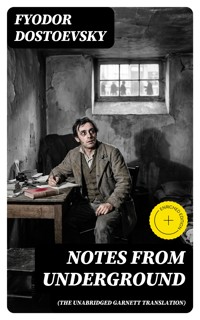
Notes from Underground (The Unabridged Garnett Translation)
Table of Contents
Introduction
Out of a cramped Petersburg cellar emerges a voice that declares, with corrosive clarity, that a human being will endure humiliation, loneliness, and even self-destruction sooner than let the tidy mathematics of progress deprive him of the wild, stubborn freedom to choose his own misery, and in that defiant refusal—half confession, half challenge—the book discovers a battlefield where reason, pride, and pain wrestle not toward resolution but toward the unsettling recognition that we often sabotage ourselves precisely to prove that we are more than predictable mechanisms, that we can say no even when yes would be easier, safer, and rewarded.
Notes from Underground (The Unabridged Garnett Translation) by Fyodor Dostoevsky is a short novel first published in 1864 in the journal Epoch. It presents an unnamed, retired civil servant in St. Petersburg who withdraws from society and sets down a jagged meditation on reason, freedom, and human perversity, followed by recollections that test his ideas in lived situations. As an early work of Dostoevsky’s mature period, it ushers in the psychological intensity that would define his later masterpieces. Garnett’s complete English rendering helped establish the book’s international reputation, and its compact form offers an uncompromising point of entry into Dostoevsky’s larger concerns.
Dostoevsky composed the work amid the turbulent intellectual climate of the 1860s, when arguments over utilitarian ethics, rational self-interest, and social engineering animated Russian journals and salons. Having returned to the literary scene after years of exile and hardship, he brought to the novella a sharpened interest in the limits of rational systems and the moral weight of suffering. The Petersburg setting, with its damp rooms and bureaucratic corridors, crystallizes a modern city where isolation intensifies rather than dissolves. The original publication in Epoch, a periodical associated with the author and his brother, positioned the book squarely within contemporary debates without tying it to any single manifesto.
Notes from Underground is strikingly structured in two movements that mirror thought and experience. The first is a relentless monologue, a kind of intellectual self-portrait in which the narrator dismantles prevailing doctrines and exposes his own contradictions with remorseless candor. The second turns outward, recounting episodes that place his assertions under pressure, showing how ideas behave when they collide with other people and the stubborn facts of circumstance. The effect is not to confirm a thesis but to dramatize the uneasy traffic between theory and life. This formal design was innovative in its time and remains unsettlingly effective today.
Its classic status rests on a union of philosophical audacity and psychological penetration. The narrator is one of literature’s earliest modern antiheroes, a consciousness refusing to be cured by progress, pleading for the irrational as a mark of humanity. Dostoevsky probes motives that run beneath polite intention: envy, resentment, shame, pride, and the craving to be seen. He refuses easy consolations, insisting that freedom includes the capacity to harm oneself. Such candor about the murk of inner life helped expand the novel’s range, showing that the genre could stage not only social plots but also the conflicts of a divided mind.
Generations of writers and thinkers have recognized the book as a precursor to existential inquiry and modernist technique. Its abrasive intimacy and logical paradoxes echo in the work of Kafka and Beckett; its defiance of rational utopias resonates with the reflections of Camus and later philosophers concerned with freedom and responsibility. The jagged monologue anticipates stream-of-consciousness strategies and the unreliable narrators that populate twentieth-century fiction. Beyond labels, the figure of an isolated self wrestling with the promise and threat of reason has entered the broader cultural imagination, influencing how we talk about alienation, authenticity, and the temptations of self-sabotage.
Constance Garnett’s unabridged translation played a decisive role in introducing English-language readers to Dostoevsky’s voice. Her renderings, produced with care and consistency across many volumes, shaped the reception of Russian classics for more than a century. In this version, the cadences of the underground man’s address come through with a brisk clarity that highlights both sarcasm and despair. While later translators may phrase certain turns differently, Garnett’s uncut text preserves the full architecture of the original, including the tense pivot between meditation and narrative. For many readers, this remains a lucid, historically important pathway into Dostoevsky’s harrowing little book.
At its core, the book confronts the seduction and the insufficiency of purely rational schemes. It entertains the hope that enlightened calculation could organize society and improve lives, then counters with the obstinate fact that people often want what is bad for them. The underground man insists on the right to err, to desire unpredictably, to resist being totaled up by formulas of interest. That insistence raises a moral puzzle: is the defense of freedom merely a mask for cruelty and pride, or a necessary check against dehumanizing systems? Dostoevsky lets the question burn without extinguishing it.
The narrative voice is direct, often accusatory, and sometimes painfully funny, addressing a hypothetical audience and anticipating objections. This conversational battering endows the text with theatrical energy while implicating the reader in the speaker’s zigzag logic. We are invited to judge him, then forced to notice how his grievances resemble our own impulses toward pettiness or self-justification. The result is a rare combination of intimacy and estrangement: we see his flaws clearly yet cannot dismiss him without examining our premises. The voice’s volatility is a deliberate instrument, exposing ideas at their most unguarded and revealing the emotional cost of holding them.
Dostoevsky’s technique relies on sharp contrasts and paradoxes, which the Petersburg landscape silently reinforces. The city is damp, drafty, and bureaucratic, a place where human contact is possible but difficult, and where small slights bloom into obsessions. Scenes tilt from philosophical abstraction to petty detail, from grand principle to awkward encounter, underscoring how fragile theories become in ordinary life. The underground, then, is not simply a locale; it is a metaphor for inner retreat, defensive pride, and a stubborn negative freedom. Within that chamber, language itself performs: confessing, dodging, taunting, pleading, and turning back on its own pretensions.
Approached as a tract, the book would be intolerable; approached as a drama of consciousness, it is inexhaustible. The narrator invites argument, but he also dramatizes the wish to be paradoxical for its own sake, an impulse that many intellectual cultures share. Attentive readers will find that the text’s ambiguities are intentional provocations, not loose ends. Its meaning resides in the friction among ideas, feelings, and actions rather than in any tidy resolution. This introduction asks you to linger with that friction, to hear the subterranean music of protest and self-doubt, and to recognize the mind at war with itself.
In an age enthralled by metrics, optimization, and predictive models, Notes from Underground retains its sting. It reminds us that algorithms misunderstand us if they forget our appetite for exception, and that dignity cannot be reduced to utility. The book’s vision of isolation within a crowded city prefigures modern forms of loneliness, while its portrait of wounded pride and corrosive irony remains uncannily familiar. As literature, it endures for its daring form and distinctive voice; as thought, it endures for its refusal to flatter. Garnett’s unabridged translation keeps that refusal intact, inviting new readers to enter the underground and listen carefully.
Synopsis
Fyodor Dostoevsky’s Notes from Underground, in the unabridged Garnett translation, is a compact work in two parts that combines philosophical critique with psychological portraiture. Its unnamed narrator writes from a metaphorical “underground” in St. Petersburg, addressing an imagined audience as he argues with them and with himself. The first part is an extended monologue that attacks fashionable rationalism and exposes the speaker’s contradictions. The second part shifts to narrative, recounting episodes from his earlier life that demonstrate his theories in practice. The book’s structure invites readers to weigh ideas about freedom, reason, and dignity against the messy reality of wounded pride and social humiliation.
The narrator introduces himself as a retired minor civil servant who is embittered, hyperaware, and chronically indecisive. He insists that excessive consciousness paralyzes action: while a “man of action” charges ahead, the overthinking person dissects every motive until nothing can be done. He returns to images of inertia—sitting in a corner, nursing resentments, refusing medical help—not as heroic renunciations but as proofs of a self-defeating will. His voice is combative, defensive, and self-mocking. He confesses pettiness and spite while insisting on his right to be unreasonable, establishing a conflict between the craving for autonomy and the humiliating evidence of his own weakness.
Challenging utilitarian optimism, he targets the belief that humans will inevitably choose what is calculated to maximize their happiness. Against such “rational egoism,” he argues that people sometimes act against interest simply to assert freedom. He denies that individuals are mere keys on a piano obedient to deterministic laws. The dream of a perfect social order—symbolized by glittering constructions of glass and iron—leaves him cold; to him, such schemes flatten the unruly human will. He clings to caprice, even to suffering, as proof of personhood. Yet his logic loops back on itself, showing how rebellion without purpose can harden into sterile contrariness.
The narrator probes revenge as a test case. A calculating avenger, he claims, will always talk himself out of action by foreseeing every outcome. He contrasts the impulsive blow of the “simple” man with his own convoluted hesitations, bumping up against “stone walls” of natural law and social fact that no amount of theory can move. The wall becomes a figure for necessity, before which he sulks rather than acts. He admits to luxuriating in humiliations, feeding on slights to nourish a sense of specialness. Writing to an unseen reader, he both invites and rejects sympathy, exposing a consciousness trapped between corrosive insight and paralysis.
Part II, titled “Apropos of the Wet Snow,” replays episodes from his younger years to show these ideas in life. A minor official at the time, he is isolated and resentful, fantasizing about decisive gestures that would repair his dignity. He recalls a perceived insult from an officer who wordlessly moved him aside on a sidewalk. Obsessed, he spends years plotting an equalizing shoulder-to-shoulder pass. When he finally engineers the contact, the victory is hollow, an emblem of how long resentment can ferment into a moment that changes nothing. The episode captures his fixation on recognition and the thin line between resolve and self-absorption.
He describes his uneasy ties with former school acquaintances. Learning of a farewell dinner for Zverkov, he insists on attending though clearly unwelcome. At the table he veers between hostile provocations and appeals for fellowship, exposing class anxieties and the cruelty of casual slights. His speech swells with imagined moral triumphs, then collapses into embarrassment. He longs to be admired yet courts rejection, pushing others away to prove a point about their superficiality. The scene dramatizes how pride, envy, and the desire for equality warp into social self-sabotage, while the narrator’s interior commentary highlights the gulf between his grand inner theater and the awkward facts.
After the dinner, he trails the group to a brothel and, arriving later, encounters Liza, a young woman working there. Their extended conversation is the emotional center of Part II. He sketches a bleak future meant to awaken her self-respect, invoking images of domestic tenderness alongside the machinery of degradation. His words mix genuine compassion with manipulative rhetoric, as he seeks both to save and to dominate. Liza listens with a seriousness that unsettles him, and a fragile bond forms around the possibility of change. He gives her his address, inviting a later meeting that will test his sincerity and the limits of his resolve.
Back in his cramped apartment, he wrestles with the implications of that encounter. He cycles through vanity, fear, and remorse, imagining how he will appear when Liza arrives and searching for a posture that affirms his ideals without exposing his vulnerability. The visit that follows forces him to confront the gap between moral insight and lived behavior. He vacillates between tenderness and cruelty, ashamed of his poverty yet defensive of his superiority. The aftermath leaves him scrutinizing every gesture he made, as the possibility of mutual understanding collides with the old habits of self-wounding pride and retreat.
Notes from Underground endures as a foundational exploration of modern self-consciousness. Its first part challenges deterministic and utopian certainties; its second part shows how grand ideas falter within ordinary encounters. Dostoevsky’s portrait neither excuses nor condemns simply; it reveals freedom as a burden that can curdle into spite, and pity as a feeling easily tainted by vanity. Without disclosing final turns, one can say the work resists closure, presenting a mind that circles endlessly around its wounds. Its lasting force lies in the questions it poses about autonomy, dignity, and authenticity in a world of competing rationalities and fragile human ties.
Historical Context
Notes from Underground is anchored in St. Petersburg in the early 1860s, under the autocracy of Tsar Alexander II. The empire’s dominant institutions—the imperial bureaucracy, the Orthodox Church, and the policing and censorship apparatus of the Third Section—structured public and private life. St. Petersburg, the capital until 1918, symbolized state rationality and European aspiration, yet it was also a place of sharp social contrasts: glittering ministries alongside overcrowded apartments and damp basements. The novella’s claustrophobic rooms, petty offices, and fogged streets echo the hierarchical order and surveillance culture that shaped daily experience and circumscribed the voices of dissenting intellectuals and minor officials alike.
The immediate historical backdrop includes the Crimean War (1853–1856), which ended in Russia’s defeat against an alliance of Britain, France, and the Ottoman Empire. The loss exposed the empire’s military and administrative backwardness, shaking elite confidence and prompting widespread calls for reform. Public discussion in the 1850s and early 1860s turned to Russia’s infrastructure, education, and the control of serf labor. For writers and thinkers, the war’s aftermath intensified a sense of national self-examination—an atmosphere in which penetrating critiques of institutions, ideologies, and the psychology of power and humiliation, like those depicted in Notes from Underground, found their urgency.
Alexander II’s “Great Reforms” defined the 1860s. The emancipation of the serfs in 1861 legally freed tens of millions, but tied many to land through redemption payments and communal obligations, generating new tensions and migration to cities. Subsequent measures introduced local self-government (zemstvos, 1864) and a major judicial reform (1864) establishing more independent courts and trial by jury. Press regulation eased somewhat compared with Nicholas I’s era, though censorship remained potent. The novella’s skepticism about “improving” schemes resonates with the ambivalent outcomes of reform: rational projects promised liberation and order, yet they often produced new inequalities, paperwork, and dislocation.
The imperial bureaucracy was organized by Peter the Great’s Table of Ranks (1722), still decisive in the 1860s. Civil service rank conferred social status, privileges, and identity, and it stratified officials into a finely graded hierarchy. Petty clerks (chinovniki) endured low pay, cramped offices, and constant status anxiety. Bribery and bureaucratic inertia were chronic complaints, satirized by earlier writers like Gogol and critically examined by realists of the 1860s. Notes from Underground’s narrator, a retired minor official, personifies the frustrations of rank-conscious Petersburg life, where a person’s dignity was measured by titles and epaulettes as much as by character or talent.
St. Petersburg’s urban modernity was emerging unevenly. The Nikolaev Railway between St. Petersburg and Moscow opened in 1851, linking the capitals and accelerating movement of people and ideas. Gas lighting, expanding street improvements, and new commercial districts transformed central avenues, while crowded lodging houses and damp basements persisted in working-class quarters. Horse-drawn street railways began operating in the early 1860s, yet sanitation and water systems lagged, and periodic epidemics reminded residents of the city’s frailty. The novella’s cramped interiors, taverns, and night streets evoke this transitional metropolis—one simultaneously aspiring to European order and marked by poverty, noise, and moral ambiguity.
Censorship and publishing shaped the life of ideas. Under Nicholas I, prepublication censorship was stringent; Alexander II’s reign brought a partial thaw, but oversight remained. The influential “thick journals” mediated public debate, serializing fiction and criticism side by side. Dostoevsky and his brother Mikhail edited Vremya (Time, 1861–1863), which was suspended by censors in 1863 after controversy over the Polish question. They founded Epokha (Epoch) in 1864, where Notes from Underground first appeared. The need to navigate censorship encouraged indirect argument, allegory, and psychological portraiture—strategies evident in the novella’s polemical monologue and subterranean tone.
Intellectual life polarized around Westernizers and Slavophiles, a debate stretching from the 1830s into the 1860s. Westernizers advocated constitutionalism and European models of development; Slavophiles emphasized Russia’s distinct communal traditions and Orthodoxy. By the 1860s, a younger radical intelligentsia pressed for rapid rational reorganization of society, often in sharp polemic with conservative critics. Notes from Underground engages this ideological battlefield obliquely. Its narrator addresses an imagined audience of rational progressives, turning their premises back on them to probe the limits of reason, the roots of resentment, and the unpredictability of human desire amid competing visions of Russia’s future.
Utilitarianism, entering Russian discourse via Bentham and Mill, inspired theorists who argued that rational self-interest and the calculus of utility could guide social reform. Nikolai Chernyshevsky’s novel What Is to Be Done? (1863), written under confinement and published in Sovremennik (The Contemporary), formulated “rational egoism” and depicted communal, scientifically organized living. Its emblem of transparent, harmonious modernity was the “Crystal Palace,” a metaphor drawn from industrial exhibition architecture. Notes from Underground (1864) directly challenges this outlook, most memorably in the narrator’s denunciations of arithmetical certainty—his rebellion against “two times two make four” as a tyrannical ideal of human behavior.
Positivism and materialist determinism further stirred debate. Through critics like Dmitry Pisarev, the 1860s intelligentsia celebrated natural science as the model for knowledge and social policy. Psychology, morals, and history were recast in causal, physiological, or economic terms. Radical journals urged the demolition of inherited authorities in the name of empirical clarity. Dostoevsky’s novella confronts this program by dramatizing acts of will that defy rational calculation. The Underground Man insists that people may choose against their interests simply to assert freedom—an argument aimed at the reduction of human motives to scientific laws or utilitarian equations then fashionable in elite circles.
Dostoevsky’s 1862 trip to Western Europe shaped his critique. He visited France and England and saw London’s Crystal Palace, the iron-and-glass structure first erected for the Great Exhibition of 1851. In Winter Notes on Summer Impressions (1863), he reflected on European industrial power, social inequality, and socialist ideas, expressing unease at mass conformity beneath gleaming order. Notes from Underground crystallizes this encounter: the Crystal Palace becomes a symbol not only of technical triumph but of the aspiration to eliminate unpredictability. Dostoevsky’s response is psychological and ethical rather than economic, highlighting dignity, suffering, and individuality against systems of perfected rationality.
The author’s biography lends weight to his suspicion of rational utopias. In 1849, Dostoevsky was arrested for participation in the Petrashevsky Circle, a group that discussed banned texts and reformist ideas. After months in prison, he endured a staged execution before being sent to penal labor (katorga) in Omsk (1850–1854), followed by military service in Semipalatinsk (1854–1859). These experiences led to his memoir Notes from a Dead House (1861–1862), a stark portrait of convicts and moral complexity. The ordeal intensified his interest in freedom, guilt, and redemption—concerns that structure the Underground Man’s agonized insistence on human unpredictability.
Orthodox Christianity’s influence on Dostoevsky deepened after Siberia. Though Notes from Underground contains little explicit theology, its meditation on conscience, shame, and self-laceration reflects an ethical framework shaped by Orthodox ideas of sin and spiritual struggle. The author increasingly distrusted secular projects that promised happiness by reorganizing material conditions alone. He opposed solutions that, in his view, ignored the inner drama of the human person. In the novella, this surfaces as a defense of moral freedom—even when misused—over any system that would harmonize society by restricting or predetermining the soul’s desires.
Social mobility in the 1860s was changing. The “raznochintsy”—educated people from non-noble estates—were rising within administration, professions, and letters. Often lacking noble pedigree yet newly trained in universities reformed in this era, they formed a restless intelligentsia debating science, ethics, and politics. Many lived precariously on modest salaries in boarding houses, navigating the etiquette of rank without the protections of birth. The Underground Man’s status anxiety, resentment of superiors, and sensitivity to slights fit the dilemmas of this intermediate class, suspended between the old order and the promised rational society of the radicals.
Gender relations and economic pressure framed urban encounters. In mid-19th-century Russian cities, state regulation of prostitution required registration and medical inspections; women in poverty faced limited employment and education options. Philanthropic circles and journals argued over morality, public health, and social causes. Notes from Underground portrays a meeting with a young prostitute not to sensationalize, but to address dignity, pity, and power within regulated vice and economic desperation. The scene reflects a city where modern policing and medical bureaucracies intersected with intimate life, and where reformist rhetoric often collided with the lived realities of vulnerable populations.
The January Uprising in Poland (1863) reverberated through the empire, prompting intensified surveillance and fierce polemics about nationalism and imperial policy. Russian presses and journals fought over the meaning of the rebellion, and censors tightened controls. Dostoevsky’s journal Vremya was suspended amid the fraught “Polish question,” forcing him to publish in a new venue, Epokha, in 1864. This climate of ideological siege heightened the risks of public argument. The Underground Man’s embattled address to an imagined audience registers the period’s confrontational tone, as ideas about freedom, order, and justice were contested under the shadow of state scrutiny.
The novella also belongs to a specific literary moment. Russian realism, nourished by the “physiological sketches” of the 1840s and by Gogol’s Petersburg tales, had turned toward psychological depth by the 1860s. Turgenev’s Fathers and Sons (1862) popularized the term “nihilist,” while thick journals published fiction as a vehicle for social analysis. Dostoevsky’s innovation was to compress debate into a confessional monologue that interrogates theory through the crises of a single consciousness. Without offering a program, Notes from Underground opened a path to psychological and existential prose that destabilized both utopian and purely satirical treatments of modern life.
Publication and reception were constrained by the market and censorship. Serialized texts needed to provoke discussion without courting bans. Epokha struggled financially, and Dostoevsky wrote under pressure following the closure of Vremya. Even with some liberalization compared with the 1850s, editors navigated prepublication review and post-publication reprisals. The novella’s strategy—eschewing direct ideological treatise for a bitter, self-contradictory voice—reflects a writer speaking within limits, yet against prevailing intellectual fashions. It models how 1860s authors used fictional form to advance critique, trusting readers to hear in psychological conflict the arguments they could not state as manifestos. The result is both historically situated and enduring in scope.




