


Erhalten Sie Zugang zu diesem und mehr als 300000 Büchern ab EUR 5,99 monatlich.
- Herausgeber: Books on Demand
- Kategorie: Gesellschafts- und Liebesromane
- Sprache: Englisch
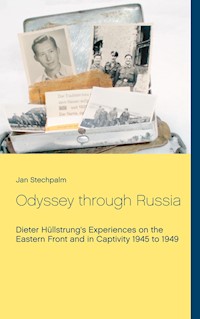
It is the year 1944 as the 19-year old German high school graduate, Dieter, is drafted by the Nazi army and sent into World War II, which by this time has already been long lost to the Allied Forces. Within months of being sent straight into the confusion and turmoil at the Eastern Front in Belarus he is taken prisoner by Russian forces. And so begins his long and harrowing odyssey through various Russian prisoner of war (POW) camps and an imprisonment that would extend far beyond the declared end of WWII. This true-story is a concise narrative of a good-hearted young man and his struggle to survive through a time of distorted ideologies, horrid violence, starvation, disease and the devastatingly long, freezing Russian winters.
Sie lesen das E-Book in den Legimi-Apps auf:
Seitenzahl: 126
Veröffentlichungsjahr: 2019
Das E-Book (TTS) können Sie hören im Abo „Legimi Premium” in Legimi-Apps auf:
Ähnliche




















Table of Contents
Introduction
Odyssey to the Eastern Front
The Reich Labour Service and Basic Military Training
First Deployment to Walcheren
The Madman Adolf's War World
The Russian Campaign
Between Fronts
A Sign of Life for Mother
End of the Search
The Last Battle Position
A Night at the Foremost Front
Capture
Prisoners of War during World War II
The Interrogation
The National Committee for a Free Germany (NKFD)
Offer to Defect
Prisoner Relocation
Forest Camp 168 Minsk
Insomnia, Frostbite and Hunger Swelling
A Life-Saving Idea
In the Hospital
Peat-Digging Detail near Minsk
POW Camp 13 Minsk
Classical Theatre in Captivity
Transfer to the Donets Basin
Return of German POWs from Russia
The Decision to Starve
Release from Captivity
Return Home
Introduction
As a young boy I always loved it when my father recited classical theatre dialogues, dramatic ballads or when he read adventure stories to us. He managed to make the scenes come alive so well by changing his voice, facial expressions, the pace of his reading and had us completely captivated by the fiery sparkle in his eyes. This filled the long, late and cosy evenings of our skiing holidays in the Swiss Alps or at home, when guests from distant countries filled the vaulted living room of our turn-of-the-century townhouse and curious neighbours came by to listen to my father's stories, ask his advice or learn something about Latin, theology, philosophy or history – all obsessions of his.
At first, when I was younger, I romanticised his World War II stories as one might a wild west novel or a pirate tale. In fact, my father was sent to serve at the Russian front where, at the age of 19, he was captured and spent five long years of his youth in Russian captivity. As I grew older, new facets of his experiences began to interest me: How could anyone even survive such an ordeal? What survival skills and tricks had my father developed? How had he experienced Germany's defeat? How had he overcome the brutalities of war? Had he been able to find any joys during this time? Had he ever killed anyone?
Unfortunately, before his death in the year 2000, my father had not heeded my request to write down these experiences for his children and grandchildren, as his own father had done with his memoirs of World War I. However, in the spring of 2000, as if with a sense of foreboding, we sat together in the evenings of our last skiing holiday in the Swiss Alps and scribbled down dates and places of his captivity on a few sheets of paper.
I was left with these sketchy notes, his photo album, my memories of his telling, audio tapes of his evening stories and his correspondence with his parents during his captivity. Armed with these, as well as my own painstaking research in books and on the Internet, I began the attempt of weaving these threads into his story.
If one examines the history around the collapse of the Eastern Front, the ’Heeresgruppe Mitte’, and around German prisoners of war (POWs) in Russia during and after World War II, one will find a great deal of literature on the subject. My research began with the 15-volume work The History of German Prisoners of War in the Second World War (Zur Geschichte der deutschen Kriegsgefangenen des Zweiten Weltkrieges) by E. Maschke. In 1957, Maschke had founded the ‘Scientific Commission for the History of the German Prisoners of War’ to investigate the atrocities against German POWs. The committee compiled a wealth of data, researching field posts, reports by returnees and the documents of non-profit organizations, such as the Red Cross, among others.
After the end of the Cold War in the early 1990s, the Soviet archives were gradually opened for research, among them the Central Archive of the Russian Federation, as well as many local archives in the respective regions of the prison camps. This also included the headquarters for storing historical and documentary collections with over two million detainee records, pay-books, letters and photographs of German POWs. An in-depth historical overview can be found in more recent books, such as In the GUPVI Archipelago, Prisoners of War in the Soviet Union, 1941–1956 (Im Archipel GUPVI, Kriegsgefangenschaft in der Sowjetunion 1941–1956) by S. Karner (1995) or German POWs in the Soviet Union, 1941–1956; POW Policy, Camp Life and Memories (Deutsche Kriegsgefangene in der Sowjetunion, 1941–1956; Kriegsgefangenenpolitik, Lageralltag und Erinnerungen) by A. Hilger (2000). Interesting published reports of individual stories can also be found in the German authors’ book series Storytelling is Remembering (Erzählen ist Erinnern) of the German war graves commission (‘Volksbund Deutsche Kriegsgräberfürsorge e.V.’), for example, in Volume 27, ‘Resisting or adapting? A question of Survival’ (Anpassen oder Widerstehen? Eine Überlebensfrage) by J. Wildenhain or in Volume 30, ‘Forty-nine Months. Russian War Imprisonment from May 1945 to June 1949’ (Neunundvierzig Monate. In russischer Kriegsgefangenschaft Mai 1945 bis Juni 1949) by E. Eicher.
While researching the background information, contradictory statements by various authors were uncovered, especially when it came to estimates of troop sizes, the number of prisoners and the number of dead. Furthermore, I discovered contradictions and haziness concerning my father’s personal fate within my own sources.
The content of this book can, therefore, best be seen as an approximation of the actual course of events. The language in places may seem somewhat colloquial. This tone was used deliberately to lend authenticity to the experiences of the young soldier that Dieter was. Ultimately, it was not my ambition to reproduce this complex part of history in a scientifically exact historical-critical manner on paper. This has already been accomplished by much better-skilled authors. The driving force behind this exciting venture was simply that this extraordinary chapter in my father’s life should not be forgotten by our own family and for generations to come. If it succeeds in enticing you, the reader, to reflect on your own heritage, your values, on the necessary and the superfluous as well as on the enduring and the transient aspects of life, then the effort was more than worthwhile.
Jan D. Stechpalm
Dieter Hüllstrung (*1925 - †2000)
Odyssey to the Eastern Front
He sat in the train from Warsaw to Moscow somewhere between Brest and Minsk. A landscape of wooded hills and cultivated fields slid by before his eyes and let his mind drift back home to Karlsruhe and to the northern Black Forest, where he had spent his childhood and youth in similar hills. In summer times he had loved exploring woods and hills like those by long cycling tours and hikes. He had set with friends around campfires for endless evenings. Their songs resonated in his ears.
Suddenly there was a violent jolt and the sounds of the screeching brakes. The train stopped abruptly in the middle of the forest. Someone shouted: ‘Air raid! Everyone out of the train!’ Panic ensued, as the soldiers grabbed their weapons, rushed out of the railcars and ran at lightning speed down the railway embankment to find cover in the woods. Overhead, several Russian combat planes dived like buzzards towards the train. The howling engines and salvos of machinegun fire filled the air, before they disappeared in the grey of the sky again.
For the first time in his life, Dieter felt a real fear for his life. This was not how he had imagined things would be. He was only 19 years old and on his way to join the Second World War, on his way to the Eastern Front. Everyone training to become an officer had to serve at least three months at the front. Just one year before, in March 1943, he had received his high school diploma. He was still half a boy, a late bloomer. So far, he had not even needed to shave. His graduating class had only consisted of seven boys. The older ones, born in 1924 – there had been twenty-four – had graduated from high school a quarter of a year earlier and had been ‘allowed’ to enrol for military service. The boys were taught to believe that the path of a soldier to war was a favourable opportunity to achieve fame and honour for the ‘Führer’, the ‘Volk’ and the ‘Vaterland’. Two or three had died in their first few days at the front. By the end of the war only 20 of the 30 boys would survive. So much for the ‘privilege’ of going to war for ‘leader, folk and country’!
The Reich Labour Service and Basic Military Training
On 17 April 1943, Dieter had to leave home to serve in the obligatory labour service of the Third Reich, something every youth had to complete before his military service. Dieter was called in to Landau, Pfalz. There, for a short time, he found pleasant companions. He was also promoted several times: on 16 June to Foreman and on 8 July to Chief Foreman. Unfortunately, this promising start to a heroic military career was thwarted by scarlet fever. For three weeks, sick with fever and a scalding throat, he felt the fallibility of his limbs. The only thing he was guarding was his bed, while others pursued the highest, unspoiled dreams of youth to become daring soldiers. Could this have been a warning of the suffering that awaited him at war?
Photo: Dieter at the Reich Labour Service in Landau (second from right)
In mid-July 1943, Dieter was finally able to enroll for basic military training with the 5th Artillery Regiment in Ulm. There, his training as a gunner on the light field howitzer (LFH 16) began. This artillery gun (pictured below) had a caliber of 10.5 cm (4.13 inches) and ran with two spare carriages. It weighed 1,525 kg (3,362 lbs), was 5 m (16.5 ft) long, 1.65 meters (5.5 ft) high and carried the shot at an exit velocity of about 470 m/s (1,542 ft/s) with a maximum firing range of 10,675 m (11,675 yds). As a gunner, Dieter was the soldier who had to calculate the launch angle and launch direction and then make adjustments according to the reported hit. The other shooters on the howitzer had to launch the shot, if necessary change the position of the gun and load new ammunition into the howitzer.1
Light Field Howitzer 16 on carriage
The basic training consisted first of the drill in the combat formation, of long marches with heavy baggage in rank and file, the use of rifle and handgun, setting up and dismantling field camps, digging safety trenches, creating camouflage and last but not least, learning the indispensable and, later at the front, what would prove life-saving, measure of military discipline. This had been drummed into them by sharp, seemingly pitiless officers and sergeants, who like vicious shepherd dogs wandered constantly around the flock, barking faulty recruits back into line or penalising them with extra laps.
In addition, Dieter also learned the technical skills required to operate and maintain an artillery gun. This he found very enjoyable, because the mathematics used to calculate the ballistic trajectories of projectiles came easily to him. In the middle of this rather mindless military life, where unreflective, gear-like operation was more important than independent thinking, it gave him the feeling that he still belonged to an intelligent species.
After a mere two weeks, he was sent to the Reserve Officer Applicant (Reserveoffiziersbewerber), or in short, ‘ROB’-course, to Dijon, where he spent six months and where, in addition to mathematical and technical skills, he learned lessons in military leadership and tactics. The army was now in a hurry to train new soldiers for the front. Up to this point, everything had had a rather sporting-fellowship character; in Dijon, he had even won a shooting competition as the gunner of his howitzer. The camaraderie reminded him of his time in the German Youth and Hitler Youth2, the obligatory youth organisations of the Nazi Party.
Then things became more serious.
At morning roll call on 3 January 1944, his division was given the transfer order. However, because he had severely chafed his instep during his last practice march, the barracks doctor found him ‘unfit to march’, and he had to stay behind at the general hospital in Dijon, while his comrades were sent towards the ‘enemy’. For Dieter, this meant three weeks of strict bed rest with a plaster cast. He was placed in the ward for skin and venereal diseases, where – in his youthful innocence – his greatest fear was of catching a ‘nasty’ disease. Luckily, he had found an original version of Goethe’s Faust in a bookshop during one of the outings in the French old-town of Dijon. This cheered him up.
Finally, he was released from hospital, still limping. From the command post, he found out where his ‘pack’ had landed: on the island of Walcheren at Westkapelle, just off the Dutch North Sea coast. They had been selected to confront the anticipated sea invasion of the ‘Tommies’, their name for the Englishmen. To Dieter that certainly sounded heroic. Now he would surely be able to complete his ROB-course.
1 Panzermuseum Münster, http://www.panzermuseum.com/
2 From 1933 until 1945, there was only one official youth organisation in Germany, as organised by the Nazi Party (NSDAP). Every 10–13-year-old boy was required to join the ‘German Youth’ (Deutsches Jungvolk) and 14–18-year-olds joined the ‘Hitler Youth’ proper (Hitlerjugend). Dieter served as violinist in the ‘Bann’-Orchestra of the Hitler Youth, travelling to concerts throughout Baden.
First Deployment to Walcheren
The voyage to Walcheren was an adventure. Dieter travelled in trains crowded with soldiers with all of his gear via Paris, Brussels and Amsterdam. Every train station was teeming with dense crowds of German soldiers, through which Dieter, with his injured foot and heavy baggage, had to struggle. At every station he panicked that he might miss his connecting train. In Paris, however, he took advantage of a longer stopover for a trip on the subway, the famous ‘Metro’ – one last encounter with civilian life. The time had flown by.
Walcheren Island in 1944http://upload.wikimedia.org/wikipedia/commons/d/d4/Walcheren2.gif
On the island of Walcheren, Dieter was first positioned in Westkapelle on the howitzer as a gunner. This did not appeal to him because of the four comrades on the gun, three were incompetent. They did not cooperate properly with the team and, instead, looked after themselves. He was very happy, therefore, when, on his 19th birthday, on 19 February 1944,




