


177,99 €
Mehr erfahren.
- Herausgeber: John Wiley & Sons
- Kategorie: Wissenschaft und neue Technologien
- Sprache: Englisch
This book is designed to help scientifically astute non-specialists understand basic geophysical and computational fluid dynamics concepts relating to oil spill simulations, and related modeling issues and challenges. A valuable asset to the engineer or manager working off-shore in the oil and gas industry, the authors, a team of renowned geologists and engineers, offer practical applications to mitigate any offshore spill risks, using research never before published.
Sie lesen das E-Book in den Legimi-Apps auf:
Seitenzahl: 283
Veröffentlichungsjahr: 2014
Ähnliche



















Contents
Cover
Half Title page
Title page
Copyright page
Dedication
Preface
Organization of the Book
Reference
Part I: Applied Oil Spill Modeling (with applications to the Deepwater Horizon oil spill)
Chapter 1: The 2010 Deep Water Horizon and 2002 Supertanker Prestige Accidents
1.1 Introduction
1.2 The Oil Spills Described
1.3 How Much Material Remains in the Gulf?
1.4 The Role of Ocean Models to Explain what Happened
References
Chapter 2: Gulf of Mexico Circulation
2.1 General Characteristics
2.2 Exchanges at Lateral and Surface Boundaries
2.3 Loop Current Eddies
2.4 Blocking by the Pycnocline
2.5 Fate of the Deepwater Horizon Well Blowout Material
2.6 Summary
References
Chapter 3: Geophysical Fluid Dynamics and Modeling Challenges
3.1 Modeling the Circulation and Mixing of the Gulf Waters
3.2 External Boundaries
3.3 Addressing the Water Column Contamination and Fluxes
3.4 Effects of Bottom Dynamics on Accumulated Hydrocarbons
3.5 Churning by Extreme Weather Events
3.6 Summary
References
Chapter 4: Flow and Oil Transport Model Choices, Setup and Testing
4.1 The DieCAST Ocean Circulation Model
4.2 Korotenko Oil Transport Module KOTM
4.3 Gulf Modeling Approach
4.4 Model Vertical Eddy Viscosity and Diffusivity
4.5 Surface Wind Driving and Open Boundary Conditions
4.6 Comments on Modeling Equatorial Dynamics and the Gulf of Mexico
4.7 Modeling Multi-Century Gulf Currents
References
Chapter 5: Modeling the 2010 DWH Oil Spill
5.1 Introduction: the BP/Deepwater Horizon Accident
5.2 Deepwater Blowouts: Processes Affecting the Transport and Fate of Oil throughout the Water Column
5.3 Oil Spill Model for Gulf of Mexico (GOSM)
5.4 Results and Discussion
5.5 Summary
References
Part 2: Special Topics in Oil Spill Modeling
Chapter 6: DieCAST Model Origin and Development
6.1 Introduction
6.2 Recent Model Attributes
6.3 Challenges in Modeling the Gulf of Mexico Circulation
6.4 Complications of Modeling near-Equatorial Circulation
6.5 Non Hydrostatic Effects
6.6 Sponge Layers in the Global Model
6.7 Inflow Considerations
References
Chapter 7: Brief History of the Community Ocean Modeling System (COMS)
7.1 COMS history
7.2 Background and motivations
7.3 COMS elliptic solver history
7.4 Evolution of DieCAST
7.5 Outlook
References
Chapter 8: DieCAST Model Equations1
8.1 Model Equations
8.2 Model Layer Depths
References
Chapter 9: Some Basic Physical, Mathematical and Modeling Concepts
9.1 Buoyancy, Density and the Hydrostatic Approximation
9.2 Pycnocline Slope: Geopotential Surface as a Natural Vertical Coordinate
9.3 Rotation and Coriolis Terms
9.4 Pycnocline and the Florida Strait Sill Depth
9.5 Surface and Bottom Mixed Layers
References
Chapter 10: Modeling Challenges, Validations and Animations
10.1 Incompressibility, Geostrophy, Data Assimilation and Initialization Issues
10.2 Thermocline Maintenance, Ventilation and Extreme Events
10.3. Nesting, Grid Coupling and Open Boundary Conditions
10.4. Validation of Simulated Major Current Patterns in the Gulf
10.5 Note on Data Assimilation
10.6 Gulf Circulation Animations
10.7 Animation 116
10.8 Animation 218
10.9 Animation 319
References
Chapter 11: A Five-Century Gulf Simulation using DieCAST
11.1 Motivation
11.2 Basic Flow Patterns
11.3 Some Results Observed during the 5th Century
11.4 Internal Waves
11.5 Island/Headland Wake Effects in the Yucatan Channel
11.6 Deeply Suspended and Bottom Deposited Material
References
Chapter 12: Extreme Events and Oil Rig Stability
12.1 Introduction
12.2 An Unusual Northern Gulf Eddy Event
12.3 Detailed Discussion of Run A
12.4 Some Comments
12.5 Other Extreme Events Found during the 500-year simulation
References
Chapter 13: Initialization and Data Assimilation; MAM Procedure
13.1 Introduction
13.2 Preliminary Comment
13.3 MAM Procedure
13.4 Refinements, Variations, Generalizations and Specializations of the MAM Approach
References
Chapter 14: On the Simulation of Density Currents by z-level Models
14.1 Motivation
14.2 Introduction
14.3 Analysis
14.4 Summary and Conclusion
14.5 Acknowledgements
References
Appendix I: Notes on Modeling Hurricanes with DieCAST
A1.1 Introduction
A1.2 Model Setup
A1.3 Results and Discussion
A1.4 Final Remarks
A1.5 Summary
A1.6 Acknowledgements
References
Appendix II: A Model Study of Ventilation of the Mississippi Bight by Baroclinic Eddies: Local Instability and Remote Loop Current Effects
A2.1 Abstract
A2.2 Introduction
A2.3 Model Setup
A2.4 Results
A2.5 Concluding Remarks
References
Index
Oil Spill Risk Management
Gulf of Mexico satellite sea surface temperature (SST) images (upper left: May 28, 20101,2; lower left: April 20, 1984) and sample DieCAST ocean circulation model SST plots (upper right: day 180; lower right: day 1220 (from Dietrich et al., 1997, see Ch 10).
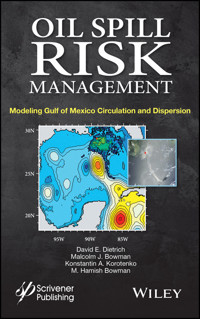
The similarity between observations and model results published many years before is remarkable. The same DieCAST model was coupled to the authors’ oil spill dispersal model to hind-cast the oil spread from the 2010 Deepwater Horizon blowout (see cover picture and described in detail in Ch. 5).
1http://eddy.colorado.edu/ccar/data_viewer/index
2http://podaac.jpl.nasa.gov/dataset/JPL-L4UHfnd-GLOB-MUR
Copyright © 2014 by Scrivener Publishing LLC. All rights reserved.
Co-published by John Wiley & Sons, Inc. Hoboken, New Jersey, and Scrivener Publishing LLC, Salem, Massachusetts. Published simultaneously in Canada.
No part of this publication may be reproduced, stored in a retrieval system, or transmitted in any form or by any means, electronic, mechanical, photocopying, recording, scanning, or otherwise, except as permitted under Section 107 or 108 of the 1976 United States Copyright Act, without either the prior written permission of the Publisher, or authorization through payment of the appropriate per-copy fee to the Copyright Clearance Center, Inc., 222 Rosewood Drive, Danvers, MA 01923, (978) 750-8400, fax (978) 750-4470, or on the web at www.copyright.com. Requests to the Publisher for permission should be addressed to the Permissions Department, John Wiley & Sons, Inc., 111 River Street, Hoboken, NJ 07030, (201) 748-6011, fax (201) 748-6008, or online at http://www.wiley.com/go/permission.
Limit of Liability/Disclaimer of Warranty: While the publisher and author have used their best efforts in preparing this book, they make no representations or warranties with respect to the accuracy or completeness of the contents of this book and specifically disclaim any implied warranties of merchantability or fitness for a particular purpose. No warranty may be created or extended by sales representatives or written sales materials. The advice and strategies contained herein may not be suitable for your situation. You should consult with a professional where appropriate. Neither the publisher nor author shall be liable for any loss of profit or any other commercial damages, including but not limited to special, incidental, consequential, or other damages.
For general information on our other products and services or for technical support, please contact our Customer Care Department within the United States at (800) 762-2974, outside the United States at (317) 572-3993 or fax (317) 572-4002.
Wiley also publishes its books in a variety of electronic formats. Some content that appears in print may not be available in electronic formats. For more information about Wiley products, visit our web site at www.wiley.com.
For more information about Scrivener products please visit www.scrivenerpublishing.com.
Library of Congress Cataloging-in-Publication Data:
ISBN 978-1-118-29038-5
This book is dedicated to Dr. Verne E. Dietrich, the father of the first author. Dr. Dietrich Sr. was a mathematician who understood the nature of science, and who emphasized that it is as important to understand the reasoning behind science as it is to know science. His favorite hymn, “In the Garden” relates closely to the inspirational poem “Footprints”, which explains any successes that I [David E. Dietrich] have had in science.
Preface
The Deepwater Horizon oil spill accident (variously referred to as the BP oil spill/disaster or the Macondo blowout) commenced on April 20th, 2010 on the BP-operated Macondo Prospect drilling platform. The ensuing fire aboard the drilling platform claimed eleven lives. Following the explosion and sinking of the floating oil rig, a sea-floor oil gusher flowed for 87 days, until it was capped on July 15th, 2010. The total discharge has been estimated at 4.9 million barrels (780,000 m3), and the event was considered by some authorities to be the largest accidental marine oil spill in the history of the petroleum industry.1
Gulf fisheries, tourism, nearshore and wetlands environments were also severely damaged by the blowout [1]. Much of the released material was less dense than the Gulf surface waters, so its buoyancy caused it to rise to the surface and accumulate in a spreading surface patch. Some of the surface material was quickly blown ashore by winds. Some floating residues were entrained into Gulf of Mexico mesoscale eddies and into the Loop Current that are dominant features of the central and eastern Gulf. The combined action of winds and underlying Gulf currents apparently kept the surface material from escaping from the Gulf through the Florida Strait.2 A small amount of subsurface suspended denser material may have escaped undetected, either eastward through the Florida Strait or southward through the Yucatan Strait between Cuba and Mexico.
In this book, we attempt to address several important questions:
Organization of the Book
In Chapter 1 we compare the 2010 DWH event to the 2002 Prestige supertanker event; the ship broke up near the northwest corner of Spain and sank to about 3,500 m depth. This is of interest as both events leaked huge amounts of oil material near an open coast. In Spain and Portugal it gravely damaged fisheries and deposited tar-balls on beaches, damaging sensitive ecosystems and negatively impacting tourism. We also raise the question of how much of the DWH spilled oil remains in deep waters of the Gulf and the role of ocean models in explaining what happened.
In Chapter 2 we describe the dominant physical properties of the Gulf and its circulation patterns with a focus on those that affected the transport and fate of the DWH well blowout material. We describe exchanges of water and material at the lateral and surface boundaries, the spectacular Loop Current eddies, properties of the water column pycnocline and close with a brief discussion of the possible fate of the well blowout material.
In Chapter 3 we introduce basic concepts of geophysical fluid dynamics and how the motion and mixing of the Gulf’s waters influenced the transport and fate of spilled materials near surface, in the water column and near the bottom.
In Chapter 4 we discuss the coupling of the DieCAST ocean model to the Korotenko Oil Transport Module to create the Gulf of Mexico Oil Spill Model (GOSM) and the modeling approach to investigate the spreading, diffusion, transformation and evaporation of the spilled materials. The numerical approach is described along with the complexities of modeling near-equatorial circulation dynamics. We discuss major Gulf flow features that affect the fate of material leaked during the DWH event, plus the challenges inherent in running very long (multi-century) simulations.
In Chapter 5 we present the results obtained using the coupled GOSM to predict the transport pathways and fate of the various oil fractions released during the DWH accident.
Advanced Topics: Finally, in a series of appendices, we present a variety of advanced modeling topics for the expert modeler, with a focus on applications to the Gulf of Mexico.
It is hoped that our studies will provide useful information about how natural oceanographic and atmospheric processes can be successfully modeled using modern numerical methods in order to shed light on how these processes effect the transport and dispersion of hydrocarbons accidently released into the sea.
David Dietrich, Lakeland, Florida Malcolm Bowman, Stony Brook, New York Konstantin Korotenko, Moscow, Russian Federation M. Hamish Bowman, Dunedin, New Zealand
Reference
1. Safina, C. A Sea in Flames: The Deepwater Horizon Oil Blowout. 2011. Crown Publishing Group, 352 pp.
1http://en.wikipedia.org/wiki/Deepwater_Horizon_oil_spill
2http://en.wikipedia.org/wiki/Deepwater_Horizon_oil_spill
Part I
Applied Oil Spill Modeling (with applications to the Deepwater Horizon oil spill)
Chapter 1
The 2010 Deep Water Horizon and 2002 Supertanker Prestige Accidents
1.1 Introduction
The Gulf of Mexico is a marginal sea forming the southern coast of the United States, bounded on the northeast, north and northwest by the Gulf Coast of the United States, on the southwest and south by Mexico, and on the southeast by Cuba. The Gulf has a surface area of ~ 1.6 million km2 with almost half of the basin being shallow continental shelf waters. However, in the Sigsbee Deep, an irregular trough more than 550 km long, the maximum depth is almost 4,400 m deep. The dominant circulation feature is the Loop Current, which flows into the Gulf from the Caribbean Sea through the Yucatan Channel between Mexico’s Yucatan Peninsula and Cuba. The Loop Current subsequently feeds the Gulf Stream as it flows through the Florida Strait that lies between Florida, Cuba and the Bahamas.
Lesen Sie weiter in der vollständigen Ausgabe!
Lesen Sie weiter in der vollständigen Ausgabe!
Lesen Sie weiter in der vollständigen Ausgabe!
Lesen Sie weiter in der vollständigen Ausgabe!
Lesen Sie weiter in der vollständigen Ausgabe!
Lesen Sie weiter in der vollständigen Ausgabe!
Lesen Sie weiter in der vollständigen Ausgabe!
Lesen Sie weiter in der vollständigen Ausgabe!
Lesen Sie weiter in der vollständigen Ausgabe!
Lesen Sie weiter in der vollständigen Ausgabe!
Lesen Sie weiter in der vollständigen Ausgabe!
Lesen Sie weiter in der vollständigen Ausgabe!
Lesen Sie weiter in der vollständigen Ausgabe!
Lesen Sie weiter in der vollständigen Ausgabe!
Lesen Sie weiter in der vollständigen Ausgabe!
Lesen Sie weiter in der vollständigen Ausgabe!
Lesen Sie weiter in der vollständigen Ausgabe!
Lesen Sie weiter in der vollständigen Ausgabe!




