


149,99 €
Mehr erfahren.
- Herausgeber: John Wiley & Sons
- Kategorie: Wissenschaft und neue Technologien
- Sprache: Englisch
This is a complete examination of the theory and methods of modern olefin metathesis, one of the most widely used chemical reactions in research and industry. * Provides basic information for non-specialists, while also explaining the latest trends and advancements in the field to experts * Discusses the various types of metathesis reactions, including CM, RCM, enyne metathesis, ROMP, and tandem processes, as well as their common applications * Outlines the tools of the trade--from the important classes of active metal complexes to optimal reaction conditions--and suggests practical solutions for common reaction problems * Includes tables with structures of commercial catalysts, and recommendations for commercial catalyst suppliers
Sie lesen das E-Book in den Legimi-Apps auf:
Seitenzahl: 1281
Veröffentlichungsjahr: 2014
Ähnliche



















Table of Contents
Cover
Title Page
Copyright
Preface
Reference
Contributors
Part I: Applications of Olefin Metathesis Reactions
Section 1: Introduction
Chapter 1: Olefin Metathesis Reactions: From A Historical Account to Recent Trends
1.1 Introduction
1.2 The Metathesis Reactions: Exchanges of Carbenes and Carbynes
1.3 The Early Days of Olefin Metathesis in American Industry
1.4 Unsuccessful Attempts to Solve the Mechanistic Puzzle
1.5 The Chauvin Mechanism: A Metathesis Dance
1.6 The Importance of the Chauvin Mechanism for Overall Organometallic Catalysis
1.7 Schrock's High Oxidation State Alkylidene and Alkylidyne Complexes
1.8 Grubbs' Approach and the Ru Olefin Metathesis Catalysts
1.9 Olefin Metathesis in Aqueous Solvents and Water
1.10 Olefin Metathesis in Other “Green Solvents”: Ionic Liquids and CO
2
1.11 Solid Catalyst Supports
1.12 Metal Contamination of the Metathesis Reaction Products
1.13 Industrial Applications
1.14 Applications to Organic Synthesis
1.15 Alkyne Metathesis
1.16 Alkane Metathesis
1.17 Polymerization Metathesis and Polymer Materials
1.18 Concluding Remarks
Acknowledgments
References
Section 2: Types of Olefin Metathesis Reactions
Chapter 2: Cross Metathesis
2.1 Introduction
2.2 Functional Group Influence on the Metathesis Outcome
2.3
E/Z
Selectivity Control
2.4 Outlook and Perspectives
Acknowledgments
References
Chapter 3: Ring-Closing Metathesis
3.1 Introduction
3.2 General Factors in Cyclization Efficiency
3.3 Scope, Challenges, and Opportunities
3.4 Practical Aspects
3.5 Practical Examples
3.6 Industrial Applications of RCM
3.7 Conclusions
Acknowledgments
References
Chapter 4: Ene-Yne Metathesis
4.1 Introduction
4.2 Ene-Yne Metathesis not Involving Cascades
4.3 Tandem Processes Involving En(e)Yne Metathesis
4.4 Conclusion and Outlook
References
Chapter 5: Domino and other Olefin Metathesis Reaction Sequences
5.1 Introduction
5.2 Domino Reactions
5.3 Metathesis/Non-Metathesis Reaction Sequences
References
Chapter 6: Enantioselective Olefin Metathesis
6.1 General Introduction
6.2 Asymmetric Ring-Closing Metathesis (ARCM)
6.3 Tandem Asymmetric Ring-Opening/Cross Metathesis (AROM/CM) or Tandem Asymmetric Ring-Opening/Cross-Closing Metathesis (AROM/RCM)
6.4 Conclusion
References
Chapter 7: Olefin Metathesis Polymerization
7.1 Introduction
7.2 ROMP—The Mechanism
7.3 The Initiators/Catalysts
7.4 ROMP—The Monomers
7.5 ROMP—Applications
7.6 Acyclic Diene Metathesis
7.7 Cyclopolymerizations
7.8 Conclusions
References
Section 3: Applications of Olefin Metathesis Reactions
Chapter 8: Applications in the Synthesis of Natural and Biologically Active Molecules
8.1 Introduction
8.2 Ring-Closing Metathesis (RCM)
8.3 Relay Ring-Closing Metathesis (RRCM)
8.4 Temporary Tether and RCM (TT-RCM)
8.5 Cross-Metathesis (CM)
8.6 Ring-Opening Metathesis (ROM)
8.7 Asymmetric RCM and ROM
8.8 Conclusion
References
Chapter 9: Multifold Ring-Closing Olefin Metatheses in Syntheses of Organometallic Molecules with Unusual Connectivities
9.1 Introduction
9.2 Strategic Considerations
9.3 Early Systematic Studies with Phosphine Ligands
9.4 Applications of Twofold Ring-Closing Olefin Metatheses using Phosphine Ligands
9.5 Studies with
trans
Bis(Pyridine) Complexes
9.6 Studies with Arene and Cyclopentadienyl Ligands
9.7 Studies with Polypyridine and Poly(Terpyridine) Complexes
9.8 Gyroscope-Like Complexes Derived from
trans
-Bis(Phosphine) Complexes
9.9 Other Relevant Multifold Ring-Closing Metatheses
9.10 Kinetic and Thermodynamic Control
9.11 Prospective
Acknowledgments
References
Chapter 10: Industrial Applications of Olefin Metathesis Polymerization
10.1 Introduction
10.2 Poly(Dicyclopentadiene)
10.3 Poly(Norbornene)
10.4 Cyclic Olefin Copolymers
10.5 Polyalkenamers
10.6 Rubber Modification
10.7 Renewable Feedstock Commercialization
10.8 Conclusions
References
Chapter 11: Commercial Potential of Olefin Metathesis of Renewable Feedstocks
11.1 Introduction and Background
11.2 Seed Oil Substrates
11.3 Alkenolysis: Ethylene Surrogates
11.4 Terpenes
11.5 Natural Rubber
11.6 Other Renewable Feedstock Olefins
11.7 Conclusion
References
Chapter 12: Challenges and Opportunities For Scaling The Ring-Closing Metathesis Reaction in the Pharmaceutical Industry
12.1 Introduction
12.2 Catalyst
12.3 Large-Scale Challenges
12.4 Large-Scale RCM Pharmaceutical Synthesis
12.5 Conclusion and Outlook
References
Part II: Development of the Tools
Section 4: Different Classes of Olefin Metathesis Catalysts
Chapter 13: Well-Defined Olefin Metathesis Catalysts Based on Metals of Group 4–7
13.1 Introduction
13.2 Survey of Olefin Metathesis Catalysts Based on Titanium, Tantalum, Vanadium and Rhenium
13.3 Early Tungsten Based Metathesis Catalysts
13.4 Tungsten and Molybdenum Imidoalkylidene Complexes
13.5 Supported Imidoalkylidene Complexes as Catalysts of Olefin Metathesis
13.6 Molybdenum-Versus Ruthenium-Based Catalysts in Olefin Metathesis
13.7 Toward Wider use of Molybdenum-Based Imidoalkylidene Catalysts
13.8 Concluding Comments
Acknowledgments
References
Chapter 14: Ruthenium-Benzylidene Olefin Metathesis Catalysts
14.1 Introduction to Well-Defined Ruthenium Catalysts
14.2 Ruthenium Benzylidenes
14.3 14-Electron Phosphonium Alkylidenes
14.4 Anionic Ligand Variation
14.5 Mechanism
14.6
E
/
Z
Selectivity
14.7 Conclusions and Perspectives
Acknowledgments
References
Chapter 15: Ruthenium-Indenylidene and other Alkylidene Containing Olefin Metathesis Catalysts
15.1 Ru-Indenylidene Complexes
15.2 Ru-Alkenylcarbene Complexes
15.3 Ru-Vinylidene Complexes
15.4 Ru-Allenylidene Complexes
15.5 Other Ru-Alkylidene Complexes
15.6 Protocol for the Synthesis of Selected Ru-Indenylidene Complexes
References
Chapter 16: Hoveyda-Type Olefin Metathesis Complexes
16.1 Benzylidene Modified Catalysts
16.2 Modifications of the NHC
16.3 Anionic Ligand Exchange
16.4 Heteroatoms in Benzylidene Ligand
References
Chapter 17: Schiff Base Catalysts and other Related Latent Systems for Polymerization Reactions
17.1 Introduction
17.2 Phenoxy-Imine [O,N]
−
Ligands
17.3 Other Examples of Chelating LX Systems
17.4 Concluding Remarks
References
Section 5: Development of Concepts in Olefin Metathesis Catalysts
Chapter 18: Novel Concepts in Catalyst Design—A Case Study of Development of Hoveyda-Type Complexes
18.1 Conclusions
References
Chapter 19: Theoretical Attempts: “In Silico Olefin Metathesis”—How Can Computers Help in the Understanding of Metathesis Mechanisms and in Catalysts Development?
19.1 Introduction
19.2 The Fundamental Steps of Metal-Catalyzed Olefins Metathesis
References
Chapter 20: Immobilization of Olefin Metathesis Catalysts
20.1 Introduction
20.2 Immobilization of Metathesis Catalysts on Organic Supports
20.3 Immobilization of Metathesis Catalysts on Inorganic Supports
20.4 Novel, Alternative Approaches
20.5 Summary/Outlook
References
Chapter 21: Olefin Metathesis in Water and Aqueous Media
References
Chapter 22: Olefin Metathesis in Green Organic Solvents and without Solvent
22.1 Introduction
22.2 Olefin Metathesis in Supercritical CO
2
22.3 Olefin Metathesis in Organic Carbonates
22.4 Olefin Metathesis in Non Conventional Green Solvents (Glycerol, Poly(Ethylene Glycol), Methyl Decanoate)
22.5 Olefin Metathesis without Solvent
22.6 Conclusion
References
Chapter 23: Olefin Metathesis in Fluorous Phases and in Fluorinated Aromatic Solvents
23.1 Olefin Metathesis in Fluorinated Aliphatic Hydrocarbons
23.2 Olefin Metathesis in Fluorinated Aromatic Hydrocarbons
23.3 Conclusions and Perspective
Acknowledgments
References
Chapter 24: Olefin Metathesis in Ionic Liquids
24.1 Ionic Liquids (ILs)
24.2 Use of Non Tagged-IL Catalysts
24.3 Use of Tagged-Ionic Liquid Catalysts
24.4 Supported Ionic Liquid Catalysts
24.5 Conclusion And Perspectives
References
Chapter 25: Purification Strategies in Olefin Metathesis
25.1 The Core of the Problem
25.2 Solution to the Problem
25.3 Removal of Ruthenium from Products Obtained with Classical Catalysts
25.4 Removal of Ruthenium from Products Obtained with Modified Catalysts
References
Part III: Tables and Charts
Section 6: Olefin Metathesis Catalysts—A Tabular Review
References
Outlook and Perspectives
References
Index
End User License Agreement
Pages
ix
xi
xii
xiii
5
6
7
8
9
10
11
12
13
14
15
16
17
18
19
20
21
22
23
24
25
26
27
28
29
30
31
32
33
34
35
36
39
40
41
42
43
44
45
46
47
48
49
50
51
52
53
54
55
56
57
58
59
60
61
62
63
64
65
66
67
68
69
70
71
72
73
74
75
76
77
78
79
80
81
82
83
85
86
87
88
89
90
91
92
93
94
95
96
97
98
99
100
101
102
103
104
105
106
107
108
109
110
111
112
113
114
115
116
117
118
119
120
121
122
123
124
125
126
127
128
129
130
131
132
133
134
135
136
137
138
139
140
141
142
143
144
145
146
147
148
149
150
151
152
153
154
155
156
157
158
159
160
161
162
163
164
165
166
167
168
169
170
171
172
173
174
175
176
177
178
179
180
181
182
183
184
185
187
188
189
190
191
192
193
194
195
196
197
198
199
200
201
202
203
204
205
206
207
208
209
210
211
212
213
214
215
216
217
218
219
220
221
222
223
224
225
226
227
228
229
230
231
232
233
234
235
236
237
238
239
240
241
242
243
244
245
246
247
248
249
250
251
252
253
254
255
256
257
258
259
260
261
262
263
264
265
266
267
269
270
271
272
273
274
275
276
277
278
279
280
281
282
283
284
287
288
289
290
291
292
293
294
295
296
297
298
299
300
301
302
303
304
305
306
307
308
309
311
312
313
314
315
316
317
318
319
320
321
322
323
324
325
326
327
328
329
330
331
332
333
335
336
337
338
339
340
341
342
343
344
345
346
347
348
349
350
351
352
353
354
355
356
357
358
359
360
361
362
363
364
365
371
372
373
374
375
376
377
378
379
380
381
382
383
384
385
386
387
388
389
390
391
392
393
394
395
396
397
398
399
400
401
402
403
404
405
406
407
408
409
410
411
412
413
414
415
416
417
418
419
420
421
422
423
424
425
426
427
428
429
430
431
432
433
434
435
436
437
438
439
440
441
442
443
444
445
446
447
448
449
450
451
453
454
455
456
457
458
459
460
461
462
463
464
465
466
467
468
469
470
471
475
476
477
478
479
480
481
483
484
485
486
487
488
489
490
491
492
493
494
495
496
497
498
499
500
501
502
503
504
505
506
507
508
509
510
511
512
513
514
515
516
517
518
519
520
521
523
524
525
526
527
528
529
530
531
532
533
534
535
537
538
539
540
541
542
543
544
545
547
548
549
550
551
552
553
554
555
556
557
558
559
560
561
562
563
564
565
567
566
568
569
570
571
1
367
573
587
589
590
591
592
Guide
Cover
Table of Contents
Preface
Part I: Applications of Olefin Metathesis Reactions
Chapter 1: Olefin Metathesis Reactions: From A Historical Account to Recent Trends
List of Illustrations
Figure 1.1
Figure 1.2
Scheme 1.1
Figure 1.2
Figure 1.3
Scheme 1.3
Scheme 1.4
Scheme 1.5
Figure 1.4
Figure 1.5
Scheme 1.6
Scheme 1.7
Figure 1.6
Figure 1.7
Figure 1.8
Figure 1.9
Figure 1.10
Scheme 1.8
Figure 1.11
Scheme 1.9
Scheme 1.10
Scheme 1.11
Scheme 1.12
Figure 1.12
Scheme 1.13
Scheme 1.14
Scheme 1.15
Scheme 1.16
Scheme 1.17
Scheme 2.1
Scheme 2.2
Scheme 2.3
Scheme 2.4
Figure 2.1
Figure 2.2
Scheme 2.13
Figure 2.50
Scheme 2.5
Scheme 2.6
Scheme 2.7
Scheme 2.8
Scheme 2.9
Scheme 2.10
Scheme 2.11
Scheme 2.12
Scheme 2.14
Scheme 2.96
Scheme 2.15
Scheme 2.16
Scheme 2.17
Scheme 2.18
Scheme 2.19
Scheme 2.20
Scheme 2.21
Scheme 2.22
Scheme 2.27
Scheme 2.42
Scheme 2.23
Scheme 2.24
Scheme 2.25
Scheme 2.26
Scheme 2.28
Scheme 2.29
Scheme 2.30
Scheme 2.31
Scheme 2.32
Scheme 2.33
Scheme 2.34
Scheme 2.35
Scheme 2.36
Scheme 2.37
Scheme 2.38
Scheme 2.39
Scheme 2.40
Scheme 2.41
Scheme 2.43
Scheme 2.44
Scheme 2.45
Scheme 2.46
Scheme 2.47
Scheme 2.48
Scheme 2.49
Scheme 2.51
Scheme 2.52
Scheme 2.53
Scheme 2.54
Scheme 2.55
Scheme 2.56
Scheme 2.57
Scheme 2.58
Scheme 2.59
Scheme 2.60
Scheme 2.61
Scheme 2.62
Scheme 2.63
Scheme 2.64
Scheme 2.65
Scheme 2.66
Scheme 2.67
Scheme 2.84
Scheme 2.68
Scheme 2.69
Scheme 2.70
Scheme 2.71
Scheme 2.72
Scheme 2.73
Scheme 2.74
Scheme 2.75
Scheme 2.76
Scheme 2.77
Scheme 2.78
Scheme 2.79
Scheme 2.80
Scheme 2.81
Scheme 2.82
Scheme 2.83
Scheme 2.85
Scheme 2.86
Scheme 2.87
Scheme 2.88
Scheme 2.92
Scheme 2.89
Scheme 2.90
Scheme 2.91
Scheme 2.93
Figure 2.3
Scheme 2.94
Scheme 2.95
Scheme 2.97
Figure 3.1
Figure 3.2
Figure 3.3
Figure 3.4
Figure 3.5
Figure 3.6
Figure 3.7
Figure 3.8
Figure 3.9
Figure 3.10
Figure 3.11
Figure 3.12
Figure 3.13
Figure 3.14
Figure 3.15
Figure 3.16
Figure 3.17
Figure 3.18
Figure 3.19
Figure 3.20
Figure 3.21
Figure 3.22
Figure 3.23
Figure 3.24
Figure 3.25
Figure 3.26
Figure 3.27
Figure 3.28
Figure 3.29
Figure 3.30
Figure 3.31
Figure 3.32
Figure 3.33
Figure 3.34
Figure 3.35
Figure 3.36
Figure 3.37
Figure 3.38
Figure 3.39
Figure 3.40
Figure 3.41
Figure 3.42
Figure 3.43
Figure 3.44
Figure 3.45
Figure 3.46
Figure 3.47
Figure 3.48
Figure 3.49
Figure 3.50
Figure 3.51
Figure 3.52
Figure 3.53
Figure 3.54
Figure 3.55
Figure 3.56
Figure 3.57
Figure 3.58
Figure 3.59
Figure 3.60
Figure 3.61
Figure 3.62
Figure 3.63
Figure 3.64
Figure 3.65
Figure 3.66
Figure 3.67
Figure 3.68
Figure 3.69
Figure 3.70
Figure 3.71
Figure 3.72
Figure 3.73
Figure 3.74
Figure 3.75
Figure 3.76
Figure 3.77
Figure 3.78
Figure 3.79
Figure 3.80
Figure 3.81
Figure 3.82
Figure 3.83
Figure 3.84
Figure 3.85
Figure 3.86
Figure 3.87
Figure 3.88
Figure 3.89
Figure 3.90
Figure 3.91
Figure 3.92
Figure 3.93
Figure 3.94
Figure 3.95
Figure 3.96
Figure 3.97
Figure 3.98
Scheme 4.1
Scheme 4.2
Scheme 4.3
Scheme 4.4
Scheme 4.5
Scheme 4.6
Scheme 4.7
Scheme 4.8
Scheme 4.9
Scheme 4.10
Scheme 4.11
Scheme 4.12
Scheme 4.13
Scheme 4.14
Scheme 4.15
Scheme 4.16
Scheme 4.17
Scheme 4.18
Scheme 4.19
Scheme 4.20
Scheme 4.21
Scheme 5.1
Scheme 5.2
Scheme 5.3
Scheme 5.4
Scheme 5.5
Scheme 5.6
Scheme 5.7
Scheme 5.8
Scheme 5.9
Scheme 5.10
Scheme 5.11
Scheme 5.12
Scheme 5.13
Scheme 5.14
Scheme 5.15
Scheme 5.16
Scheme 5.17
Scheme 5.18
Scheme 5.19
Scheme 5.20
Scheme 5.21
Scheme 5.22
Scheme 5.23
Scheme 5.24
Scheme 5.25
Scheme 5.26
Scheme 5.27
Scheme 5.28
Scheme 5.29
Scheme 5.30
Scheme 5.31
Scheme 5.32
Scheme 5.33
Scheme 5.34
Scheme 5.35
Scheme 5.36
Scheme 5.37
Scheme 5.38
Scheme 5.39
Scheme 5.40
Scheme 5.41
Scheme 5.42
Scheme 5.43
Scheme 5.44
Scheme 5.45
Scheme 5.46
Scheme 5.47
Scheme 5.48
Scheme 5.49
Scheme 5.50
Scheme 5.51
Scheme 5.52
Scheme 5.53
Scheme 5.54
Scheme 5.55
Scheme 5.56
Scheme 5.57
Scheme 5.58
Scheme 5.59
Scheme 5.60
Figure 5.61
Scheme 5.62
Scheme 5.63
Scheme 5.64
Scheme 5.65
Scheme 5.66
Scheme 5.67
Scheme 5.68
Scheme 5.69
Scheme 5.70
Scheme 5.71
Scheme 5.72
Scheme 5.73
Scheme 5.74
Scheme 5.75
Scheme 5.76
Scheme 5.77
Scheme 5.78
Scheme 5.79
Scheme 5.80
Scheme 5.81
Scheme 5.82
Scheme 5.83
Scheme 5.84
Scheme 5.85
Scheme 5.86
Scheme 5.87
Scheme 5.88
Scheme 6.1
Scheme 6.2
Scheme 6.3
Scheme 6.4
Scheme 6.5
Scheme 6.6
Scheme 6.7
Scheme 6.8
Scheme 6.9
Scheme 6.10
Scheme 6.11
Scheme 6.12
Scheme 6.13
Scheme 6.14
Scheme 6.15
Scheme 6.16
Scheme 6.17
Scheme 6.18
Scheme 6.19
Scheme 6.20
Scheme 6.21
Scheme 6.22
Scheme 6.23
Scheme 6.24
Scheme 6.25
Scheme 6.26
Scheme 6.27
Scheme 6.28
Scheme 6.29
Scheme 6.30
Scheme 6.31
Scheme 6.32
Scheme 6.33
Scheme 6.34
Scheme 6.35
Scheme 6.36
Scheme 6.37
Scheme 6.38
Scheme 6.39
Scheme 6.40
Scheme 6.41
Scheme 6.42
Scheme 6.43
Scheme 6.44
Scheme 6.45
Scheme 6.46
Scheme 6.47
Scheme 6.48
Scheme 6.49
Scheme 6.50
Scheme 6.51
Scheme 6.52
Scheme 6.53
Scheme 6.54
Figure 7.1
Figure 7.2
Figure 7.3
Figure 7.4
Figure 7.5
Figure 7.6
Figure 7.7
Figure 7.8
Figure 7.9
Figure 7.10
Figure 7.11
Figure 7.12
Figure 7.13
Figure 7.14
Figure 8.1
Figure 8.2
Figure 8.3
Figure 8.4
Figure 8.5
Figure 8.6
Figure 8.7
Figure 8.8
Figure 8.9
Figure 8.10
Figure 8.11
Figure 8.12
Figure 8.17
Figure 8.18
Figure 8.19
Figure 8.20
Figure 8.22
Figure 8.24
Figure 8.25
Figure 8.26
Figure 8.27
Figure 8.28
Figure 8.29
Figure 8.30
Figure 8.31
Figure 8.32
Figure 8.33
Figure 8.34
Figure 8.35
Figure 8.36
Figure 8.37
Figure 8.38
Scheme 9.1
Scheme 9.2
Scheme 9.3
Scheme 9.4
Scheme 9.5
Scheme 9.6
Scheme 9.7
Scheme 9.8
Scheme 9.9
Scheme 9.10
Scheme 9.11
Scheme 9.12
Scheme 9.13
Scheme 9.14
Scheme 9.15
Scheme 9.16
Scheme 9.17
Scheme 9.18
Scheme 9.19
Scheme 9.20
Scheme 9.21
Scheme 9.22
Scheme 9.23
Scheme 9.24
Figure 10.1
Figure 10.2
Figure 10.3
Figure 11.1
Figure 11.2
Figure 11.3
Scheme 11.1
Scheme 11.2
Scheme 11.3
Scheme 11.4
Figure 11.4
Scheme 11.5
Figure 11.5
Scheme 11.6
Figure 11.6
Scheme 11.7
Scheme 11.8
Scheme 11.9
Scheme 11.10
Figure 12.1
Figure 12.2
Figure 12.3
Scheme 12.1
Scheme 12.2
Scheme 12.3
Scheme 12.4
Figure 12.4
Scheme 12.5
Figure 12.5
Scheme 12.6
Scheme 12.7
Figure 12.6
Figure 12.7
Scheme 12.8
Figure 12.8
Scheme 12.9
Scheme 12.10
Scheme 12.11
Scheme 12.12
Scheme 12.13
Figure 12.9
Scheme 12.14
Figure 13.1
Scheme 13.1
Scheme 13.2
Scheme 13.3
Scheme 13.4
Figure 13.2
Figure 13.3
Figure 13.4
Figure 13.5
Figure 13.6
Scheme 13.5
Scheme 13.6
Figure 13.7
Scheme 13.7
Scheme 13.8
Scheme 13.9
Figure 13.8
Scheme 13.10
Figure 13.9
Scheme 13.11
Figure 13.10
Scheme 13.12
Scheme 13.13
Figure 13.11
Figure 14.1
Figure 14.2
Figure 14.3
Figure 14.4
Figure 14.5
Figure 14.6
Figure 14.7
Figure 14.8
Figure 14.9
Figure 14.10
Figure 14.11
Figure 14.12
Figure 14.13
Figure 14.14
Figure 14.15
Figure 14.16
Figure 14.17
Figure 14.18
Figure 14.19
Figure 14.20
Figure 14.21
Figure 14.22
Figure 14.23
Scheme 14.1
Scheme 14.2
Figure 14.24
Scheme 14.3
Scheme 14.4
Figure 14.25
Figure 15.1
Figure 15.2
Figure 15.3
Figure 15.4
Figure 15.5
Figure 15.6
Figure 15.7
Figure 15.8
Figure 15.9
Figure 15.10
Figure 15.11
Figure 15.12
Figure 15.13
Figure 15.14
Figure 15.15
Figure 15.16
Figure 15.17
Figure 15.18
Figure 15.19
Figure 15.20
Figure 15.21
Figure 15.22
Figure 15.23
Figure 15.24
Figure 15.25
Figure 15.26
Figure 15.27
Figure 15.28
Figure 15.29
Figure 15.30
Figure 15.31
Figure 15.32
Figure 15.33
Figure 15.34
Figure 15.35
Figure 15.36
Figure 15.37
Figure 15.38
Figure 15.39
Figure 15.40
Figure 15.41
Figure 15.42
Figure 15.43
Figure 15.44
Figure 15.45
Figure 15.46
Figure 15.47
Figure 15.48
Figure 15.49
Figure 16.1
Figure 16.2
Figure 16.3
Figure 16.4
Figure 16.5
Figure 16.6
Figure 16.7
Figure 16.8
Figure 16.9
Scheme 16.1
Scheme 16.2
Figure 16.10
Figure 16.11
Figure 16.12
Figure 16.13
Figure 16.14
Figure 16.15
Figure 16.16
Scheme 16.3
Figure 16.17
Figure 16.18
Scheme 16.4
Figure 16.19
Scheme 16.5
Figure 16.20
Figure 16.21
Figure 16.22
Figure 16.23
Figure 16.24
Scheme 16.6
Figure 16.25
Figure 16.26
Figure 16.27
Figure 16.28
Figure 16.29
Figure 16.30
Figure 16.31
Scheme 17.1
Scheme 17.2
Figure 17.1
Scheme 17.3
Scheme 17.4
Scheme 17.5
Scheme 17.6
Scheme 17.7
Scheme 17.8
Scheme 17.9
Scheme 17.10
Figure 17.2
Figure 17.3
Scheme 17.11
Scheme 17.12
Scheme 17.13
Scheme 17.14
Scheme 17.15
Scheme 17.16
Scheme 17.17
Scheme 17.18
Scheme 17.19
Scheme 17.20
Scheme 17.21
Scheme 17.22
Scheme 17.23
Scheme 17.24
Scheme 17.25
Scheme 17.26
Scheme 17.27
Scheme 17.28
Scheme 17.29
Figure 18.1
Figure 18.2
Figure 18.3
Figure 18.4
Figure 18.5
Figure 18.6
Figure 18.7
Figure 18.8
Figure 18.9
Figure 18.10
Figure 19.1
Figure 19.2
Figure 19.3
Figure 19.4
Figure 19.5
Figure 19.6
Figure 19.7
Figure 19.8
Figure 19.9
Figure 19.10
Figure 19.11
Figure 19.12
Figure 19.13
Figure 19.14
Figure 19.15
Figure 19.16
Figure 19.17
Figure 19.18
Figure 19.19
Figure 19.20
Figure 19.21
Figure 19.22
Figure 19.23
Figure 19.24
Figure 19.25
Figure 20.1
Scheme 20.1
Scheme 20.2
Scheme 20.3
Figure 20.2
Scheme 20.4
Scheme 20.5
Figure 20.3
Scheme 20.6
Figure 20.4
Figure 20.5
Scheme 20.7
Figure 20.6
Scheme 20.8
Figure 20.7
Figure 20.8
Figure 20.9
Scheme 20.9
Figure 20.10
Figure 20.11
Figure 20.12
Figure 20.13
Figure 20.14
Figure 20.15
Figure 20.16
Figure 20.17
Figure 20.18
Figure 20.19
Scheme 20.10
Scheme 20.11
Figure 20.20
Figure 20.21
Scheme 20.12
Figure 20.22
Scheme 20.13
Figure 20.23
Figure 21.1
Figure 21.2
Figure 21.3
Figure 21.4
Figure 21.5
Figure 21.6
Figure 21.7
Figure 21.8
Figure 21.9
Figure 21.10
Figure 21.11
Figure 21.12
Figure 21.13
Figure 21.14
Figure 21.15
Figure 21.16
Figure 21.17
Scheme 22.1
Scheme 22.2
Scheme 22.3
Scheme 22.4
Scheme 22.5
Scheme 22.6
Scheme 22.7
Scheme 22.8
Scheme 22.9
Figure 22.1
Scheme 22.10
Scheme 22.11
Scheme 22.12
Scheme 22.13
Scheme 22.14
Scheme 22.15
Scheme 22.16
Scheme 22.17
Scheme 22.18
Scheme 22.19
Scheme 22.20
Scheme 22.21
Figure 23.1
Figure 23.2
Figure 23.3
Figure 23.4
Figure 23.5
Figure 23.6
Figure 23.7
Figure 23.8
Figure 23.9
Figure 23.10
Figure 23.11
Scheme 24.1
Scheme 24.2
Scheme 24.3
Scheme 24.4
Scheme 24.5
Scheme 24.6
Scheme 24.7
Scheme 24.8
Figure 24.1
Figure 24.2
Figure 24.4
Figure 24.5
Figure 24.6
Figure 24.7
Figure 24.8
Figure 24.9
Figure 24.10
Figure 24.11
Figure 24.12
Scheme 25.1
Figure 25.1
Figure 25.2
Figure 25.3
Figure 25.4
Figure 25.5
Figure 25.6
Figure 25.7
Figure 25.8
Scheme 25.2
Scheme 25.3
Figure 25.9
Figure 25.10
List of Tables
Table 3.1
Table 3.2
Table 3.3
Table 3.4
Table 4.1
Table 4.2
Table 4.3
Table 4.4
Table 4.5
Table 4.6
Table 4.7
Table 4.8
Table 4.9
Table 4.10
Table 4.11
Table 4.12
Table 4.13
Table 4.14
Table 4.15
Table 4.16
Table 4.17
Table 4.18
Table 4.19
Table 5.1
Table 11.1
Table 11.2
Table 11.3
Table 11.4
Table 12.1
Table 12.2
Table 12.3
Table 12.4
Table 22.1
Table 22.2
Table 24.1
Table 24.2
Table 24.3
Table 24.4
Olefin Metathesis
Theory and Practice
Karol Grela
Copyright © 2014 by John Wiley & Sons, Inc. All rights reserved.
Published by John Wiley & Sons, Inc., Hoboken, New Jersey.
Published simultaneously in Canada.
No part of this publication may be reproduced, stored in a retrieval system, or transmitted in any form or by any means, electronic, mechanical, photocopying, recording, scanning, or otherwise, except as permitted under Section 107 or 108 of the 1976 United States Copyright Act, without either the prior written permission of the Publisher, or authorization through payment of the appropriate per-copy fee to the Copyright Clearance Center, Inc., 222 Rosewood Drive, Danvers, MA 01923, (978) 750-8400, fax (978) 750-4470, or on the web at www.copyright.com. Requests to the Publisher for permission should be addressed to the Permissions Department, John Wiley & Sons, Inc., 111 River Street, Hoboken, NJ 07030, (201) 748-6011, fax (201) 748-6008, or online at http://www.wiley.com/go/permission.
Limit of Liability/Disclaimer of Warranty: While the publisher and author have used their best efforts in preparing this book, they make no representations or warranties with respect to the accuracy or completeness of the contents of this book and specifically disclaim any implied warranties of merchantability or fitness for a particular purpose. No warranty may be created or extended by sales representatives or written sales materials. The advice and strategies contained herein may not be suitable for your situation. You should consult with a professional where appropriate. Neither the publisher nor author shall be liable for any loss of profit or any other commercial damages, including but not limited to special, incidental, consequential, or other damages.
For general information on our other products and services or for technical support, please contact our Customer Care Department within the United States at (800) 762-2974, outside the United States at (317) 572-3993 or fax (317) 572-4002.
Wiley also publishes its books in a variety of electronic formats. Some content that appears in print may not be available in electronic formats. For more information about Wiley products, visit our web site at www.wiley.com.
Library of Congress Cataloging-in-Publication Data:
Olefin metathesis : theory and practice / edited by Dr. Karol Grela, Warsaw University, Warsaw, Poland.
pages cm
“Zespol III.”
Includes bibliographical references and index.
ISBN 978-1-118-20794-9 (cloth)
1. Metathesis (Chemistry) 2. Catalysis. 3. Alkenes. I. Grela, Karol, 1970- editor of compilation.
QD505.O44 2014
547′.215--dc23
2013041990
Preface
Our goal is to create a comprehensive book that can be an everyday reference for synthetic chemists, with no prerequisite deep knowledge in inorganic and coordination chemistry, but at the same time providing the experts with a contemporary view on the theory and methods in the flourishing field of modern olefin metathesis.
The book comprises two major parts: the first one is devoted to the applications of metathesis (Targets), while the second one describes the metathesis Tools.
The most important types of the olefin metathesis reaction (cross metathesis (CM), ring-closing metathesis (RCM), enyne metathesis, ring-opening metathesis polymerization (ROMP), tandem processes, etc.) have been described in the first part of the book. This part also presents a short selection of the key applications of this methodology, for example, in the total synthesis of natural compounds, in the preparation of macromolecules and polymers, in medicinal chemistry, and in the conversion of renewable materials. The goal behind this part of the book is to present a detailed, yet clear description of all important flavors of the metathesis reaction.
The second part of the book describes the tools. A series of chapters introduce the most important classes of metal complexes that are active in metathesis, creating the user's guide to the galaxy of known olefin metathesis catalysts. The same attention is paid to optimization of the reaction conditions, including discussion on effects of the solvent and additives, methods of catalysts immobilization and recovery, purification of the products, computational methods, and so on. This part of the book is used exactly similarly to the famous “The Hitch-Hiker's Guide to the Galaxy,” a fictional travel guide, invented by the writer Douglas Adams. With “the words Don't Panic inscribed in large friendly letters on its cover”(1), the second part of the book allows even the inexperienced end-user to select the most optimal catalyst and conditions for his or her important metathesis project easily and effectively.
I am delighted with the list of authors who have agreed to contribute, and I am honored to act as the editor. All chapters collected in this book come from the leading experts and practitioners in the area and nicely highlight the aspects mentioned above. I would like to thank all the authors for their excellent contributions. My personal wish is that the reader will savor the reading of this book as much as I personally enjoyed reading all chapters and editing the volume.
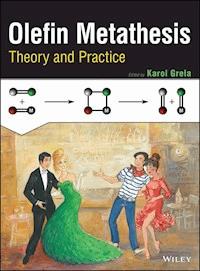
I want to give a special thanks to Polish artist, Ms. Katarzyna Felchnerowska (Effe.Fineart) who prepared the beautiful cover picture, presenting her personal idea of olefin metathesis—a change-your-partners dance (2). Last, but certainly not least, I want to thank the members of my research group who have reviewed the text at every stage of the editing process.
Altogether, I hope that this handy, one-volume book will take its common place on the desks and benches of researchers working in academic laboratories as well as in the industry.
Enjoy reading!
Karol Grela
Reference
1. Adams D.
The Hitchhiker's Guide to the Galaxy
, 25th Anniversary Edition. Crown Publishing Group; New York, 2004. ISBN: 978-1400052929.
2. http://www.nobelprize.org/nobel_prizes/chemistry/laureates/2005/press.html.
Contributors
Didier
Astruc
, ISM, UMR CNRS N°5255, Univ. Bordeaux, Talence Cedex, France
Michał Barbasiewicz
, Faculty of Chemistry, Warsaw University, Warsaw, Poland
Olivier
Baslé
, Ecole Nationale Supérieure de Chimie de Rennes, Rennes Cedex, France
Christian
Bruneau
, UMR 6226 Institut des Sciences Chimiques de Rennes, Organométalliques: Matériaux et Catalyse, Université de Rennes 1, Rennes Cedex, France
Michael
R. Buchmeiser
, Lehrstuhl für Makromolekulare Stoffe und Faserchemie, Institut für Polymerchemie, Universität Stuttgart, Stuttgart, Germany; Institut für Textilchemie und Chemiefasern (ITCF) Denkendorf, Denkendorf, Germany
Luigi
Cavallo
, Dipartimento di Chimica, Università di Salerno, Fisciano, SA, Italy; KAUST Catalyst Research Center, Physical Sciences and Engineering Division, King Abdullah University of Science and Technology, Thuwal, Kingdom of Saudi Arabia
Catherine
S. J. Cazin
, School of Chemistry, University of St. Andrews, St Andrews, UK
Shawn
K. Collins
, Department of Chemistry, Université de Montréal, Montréal, PQ, Canada
Janine
Cossy
, Laboratorie de Chimie Organique ESPCI ParisTech, Paris Cedex, France
Isabelle
Dez
, Ecole Nationale Supérieure de Chimie de Rennes, Rennes Cedex, France
Steven
T. Diver
, Department of Chemistry, University at Buffalo-SUNY Buffalo, NY
Laura
Falivene
, Dipartimento di Chimica, Università di Salerno, Fisciano, SA, Italy
Keith
R. Fandrick
, Chemical Development, Boehringer Ingelheim Pharmaceuticals Inc., Ridgefield, CT
Tobias
Fiedler
, Department of Chemistry, Texas A&M University, College Station, TX
Cédric Fischmeister
, UMR 6226 Institut des Sciences Chimiques de Rennes, Organométalliques: Matériaux et Catalyse, Université de Rennes 1, Rennes Cedex, France
Deryn
E. Fogg
, Centre for Catalysis Research & Innovation, Department of Chemistry, University of Ottawa, Ottawa, Ontario, Canada
Annie-Claude Gaumont
, Ecole Nationale Supérieure de Chimie de Rennes, Rennes Cedex, France
Régis M. Gauvin
, Unité de Catalyse et de Chimie du Solide (UMR CNRS 8181), Axe “Catalyse et Chimie Moléculaire”, Villeneuve d'Ascq Cedex, France
Subir
Ghorai
, Catalysis R&D, Sigma-Aldrich Chemical Co., Sheboygan Falls, WI
Yakov
Ginzburg
, Ben-Gurion University, Israel
John
A. Gladysz
, Department of Chemistry, Texas A&M University, College Station, TX
Karol
Grela
, Biological and Chemical Research Center, Department of Chemistry, Warsaw University, Warsaw, Poland; Institute of Organic Chemistry, Polish Academy of Sciences, Warsaw, Poland
Justin
R. Griffiths
, Department of Chemistry, University at Buffalo-SUNY Buffalo, NY
Stefano
Guidone
, School of Chemistry, University of St. Andrews, St Andrews, UK
Łukasz Gułajski
, Apeiron Synthesis S.A., Wrocław, Poland
Anna
Kajetanowicz
, Institute of Organic Chemistry, Polish Academy of Sciences, Warsaw, Poland
Astrid-Caroline Knall
, Institute for Chemistry and Technology of Materials, Graz University of Technology, Graz, Austria
Stefan
Krehl
, Institut für Chemie, Organische Synthesechemie, Universität Potsdam, Golm, Germany
Gabriel Lemcoff
, Ben-Gurion University, Israel
Bianca
J. van Lierop
, Centre for Catalysis Research & Innovation, Department of Chemistry, University of Ottawa, Ottawa, Ontario, Canada
Bruce
H. Lipshutz
, Department of Chemistry, University of California, Santa Barbara, CA
Justin
A. M. Lummiss
, Centre for Catalysis Research & Innovation, Department of Chemistry, University of Ottawa, Ottawa, Ontario, Canada
Marc
Mauduit
, Ecole Nationale Supérieure de Chimie de Rennes, Rennes Cedex, France
Yohann
Morin
, Unité de Catalyse et de Chimie du Solide (UMR CNRS 8181), Axe “Catalyse et Chimie Moléculaire”, Villeneuve d'Ascq Cedex, France
Andrew
Nickel
, Materia Inc., Pasadena, CA
Steven
P. Nolan
, School of Chemistry, University of St. Andrews, St Andrews, UK
Richard
L. Pederson
, Materia Inc., Pasadena, CA
Cezary
Pietraszuk
, Faculty of Chemistry, Adam Mickiewicz University in Pozna, Pozna, Poland
Albert
Poater
, Departament de Química, Institut de Química Computacional, University of Girona, Girona, Catalonia, Spain; Dipartimento di Chimica, Università di Salerno, Fisciano, SA, Italy
Pierre
Queval
, Ecole Nationale Supérieure de Chimie de Rennes, Rennes Cedex, France
Mathieu
Rouen
, Ecole Nationale Supérieure de Chimie de Rennes, Rennes Cedex, France
Cezary
Samojłowicz
, Institute of Organic Chemistry, Polish Academy of Sciences, Warsaw, Poland
Jolaine
Savoie
, Chemical Development, Boehringer Ingelheim Pharmaceuticals Inc., Ridgefield, CT
Bernd
Schmidt
, Institut für Chemie, Organische Synthesechemie Universität Potsdam, Golm, Germany
Chris
H. Senanayake
, Chemical Development, Boehringer Ingelheim Pharmaceuticals Inc., Ridgefield, CT
Krzysztof
Skowerski
, Apeiron Synthesis S.A., Wrocław, Poland
Christian
Slugovc
, Institute for Chemistry and Technology of Materials, Graz University of Technology, Graz, Austria
Jinhua
J. Song
, Chemical Development, Boehringer Ingelheim Pharmaceuticals Inc., Ridgefield, CT
Brice
Stenne
, Department of Chemistry, Université de Montréal, Montréal, PQ, Canada
César A
. Urbina-Blanco, School of Chemistry, University of St. Andrews, St Andrews, UK
Georgios
C. Vougioukalakis
, Laboratory of Organic Chemistry, Department of Chemistry, University of Athens, Athens, Greece; Division of Physical Chemistry, IAMPPNM, NCSR Demokritos, Athens, Greece
Łukasz Woniak
, Institute of Organic Chemistry, Polish Academy of Sciences, Warsaw, Poland
Nathan
Yee
, Chemical Development, Boehringer Ingelheim Pharmaceuticals Inc., Ridgefield, CT
Grzegorz
Zieliski
, Institute of Organic Chemistry, Polish Academy of Sciences, Warsaw, Poland
Karolina
ukowska
, Institute of Organic Chemistry, Polish Academy of Sciences; Biological and Chemical Research Center, Department of Chemistry, Warsaw University, Warsaw, Poland
Part I
Applications of Olefin Metathesis Reactions
Section 1
Introduction
Chapter 1Olefin Metathesis Reactions: From A Historical Account to Recent Trends
Didier Astruc
ISM, UMR CNRS N°5255, Univ. Bordeaux, Talence Cedex, France
1.1 Introduction
Metathesis (1–5) occupies a central place in the synthesis of complex organic molecules and polymers, and the major problems concerning the catalysts have been solved, including the presence of various functional groups in the organic substrates. Unlike palladium catalysis of cross carbon–carbon bond formation that is the other breakthrough in the formation of organic skeleton architectures, the metathesis reactions do not consume stoichiometric amounts of base, producing stoichiometric amounts of salts as wastes. In this sense, the metathesis reactions belong to the field of green chemistry, saving a number of steps in total syntheses and avoiding the handling and production of inorganic wastes. The discovery of homogeneous catalysis by Osborn and Wilkinson (6), allowing the hydrogenation of olefins, and its efficient asymmetric version by Kagan (7) considerably enhanced the possibilities of bringing about high selectivity and approaching a perfect knowledge of the molecular mechanisms leading to improvements and optimization. Thus, after the pioneering research of American industrial chemists in the 1960s, a significant advance in metathesis chemistry has been the mechanistic insight of Yves Chauvin in the early 1970s in disentangling the “black box” and the intense academic research by organometallic chemists at the end of the twentieth century (8), in particular by the groups of Robert Grubbs at Caltech and Richard Schrock at MIT in their quest for transition-metal-alkylidene (or benzylidene) and alkylidyne metathesis catalysts. Therefore, in this historical chapter, we wish to underline the role of the development of ideas and research efforts that have led to a success story in the advancement of metathesis chemistry and its applications. This chapter also includes examples of the most recent and major developments and applications of the various metathesis reactions, with emphasis on catalyst design and sustainable chemistry.
1.2 The Metathesis Reactions: Exchanges of Carbenes and Carbynes
The word metathesis comes from the Greek μεταθεσιζ that means transposition. Metathesis of ions between two ion pairs is a long-known example of metathesis in which two ion pairs exchange their partners (Eq. 1.1) (8).
Likewise, the exchange of the two carbenes of an olefin with those of another olefin molecule (Eq. 1.2) was first called olefin metathesis by Calderon (9) in 1967, but this reaction requires a catalyst.
The principle is extended to the exchange of the two carbynes of alkyne molecules
The metathesis reactions are under thermodynamic control, which means that the reactions of Eqs 1.2 and 1.3 present the inconvenient of being equilibrated. The problem is usually solved by using terminal olefins that produce gaseous ethylene as one of the metathesis products, which displaces the reaction toward the metathesis products. For alkyne metathesis, terminal alkyne metathesis is possible (see Section 1.15) but of little use due to competitive alkyne polymerization, so methyl-terminated alkynes are used for metathesis, which produces 2-butyne that is also removed according to the same principle.
1.3 The Early Days of Olefin Metathesis in American Industry
The uncatalyzed reaction of propene upon heating at 852 °C had been reported in 1931 by Schneider and Fröhlich (10) to give very low amounts of ethene and 2-butenes among other products, but the publication remained ignored for a long time. Ziegler and Natta's discoveries of ethylene and propylene polymerization in 1953 induced considerable research interest in olefin polymerization reactions and their mechanisms. The first catalyzed metathesis reactions were reported in the late 1950s when industrial chemists at Du Pont, Standard Oil and Phillips Petroleum (H. S. Eleuterio, E. F. Peters, B. L. Evering, R. L. Banks, and G. C. Bailey) reported that propene led to ethylene and 2-butenes when it was heated with molybdenum [in the form of the metal, oxide, or [Mo(CO)6] on alumina (Fig. 1.1)] (11–16).
Figure 1.1 Dates of the history of olefin metathesis.
The first polymerization of norbornene by the system WCl6/AlEt2Cl was independently reported in 1960 by Eleuterio (11) (15) and by Truett et al. (13), but it was recognized only in 1967 by Calderon (9) (17) at Goodyear that the polymerization of cyclic alkenes to polyalkenemers and the disproportionation of acyclic alkenes were the same type of reaction, the metathesis. The following year, labeling experiments by Calderon (9) (17) at Goodyear and Mol (18) in Amsterdam confirmed this key finding.
1.4 Unsuccessful Attempts to Solve the Mechanistic Puzzle
The first mechanistic suggestion to solve the mechanistic puzzle came in 1967 from Bradshaw et al. (19) who proposed a four-centered cyclobutane–metal intermediate. This hypothesis was supported the following year by Calderon (20). No other hypothesis appeared in the United States for three years, and this mechanism seemed to be adopted as being “conventional” by the metathesis community in the United States. Yet, cyclobutanes are not produced by metathesis, and they are not metathesis substrates either. Other mechanistic hypotheses by American chemists appeared only in the early 1970s. In 1971, the brilliant organometallic chemist Pettit (21) (22), who had generated the first transition-metal methylene species [Fe(η5-C5H5)(CO)2(=CH2)][BF4], suggested the possibility of a tetra(methylene)metal intermediate in which the four methylene units were bonded to the transition metal (23–25). Double oxidative addition to a transition-metal center is not possible, however (24) (25). Grubbs (26) proposed rearranging metallocyclopentane intermediates and cyclobutane complexed to a carbene (27). Neither of the mechanisms mentioned above (Fig. 1.2) fit the data, and the olefin metathesis mechanism remained rather mysterious in the United States until the mid 1970s.
Figure 1.2 Erroneous intermediates proposed around 1970 for the olefin metathesis mechanism.
1.5 The Chauvin Mechanism: A Metathesis Dance
Chauvin from the Institut Français du Pétrole, had three key findings in mind when he envisaged the mechanism of olefin metathesis: the report of Fischer (28) on the synthesis of a tungsten–carbene complex, [W(CO)5{C(CH3)(OCH3)}], that of Natta (29) on the polymerization of cyclopentene by ring-opening catalyzed by a mixture of WCl6 and AlEt3, and that of Banks and Bailey (14) on the formation of ethylene and 2-butene from propene catalyzed by [W(CO)6] on alumina. Consequently, Chauvin and his student Hérisson published their proposition of metathesis mechanism in 1971 (Scheme 1.1) (30).
Scheme 1.1 Linear representation of the Chauvin mechanism (including the degenerate metathesis steps).
The Chauvin mechanism involves a metal–carbene species (or more precisely metal–alkylidene), the coordination of the olefin onto the metal atom of this species, followed by the shift of the coordinated olefin to form the metallocyclobutane intermediate, and finally the topologically identical shift of the new coordinated olefin in the metallocyclobutane in a direction perpendicular to the initial olefin shift. This forms a metal–alkylidene to which the new olefin is coordinated, then liberated. This new olefin contains a carbene from the catalyst and the other carbene from the starting olefin. The new metal–alkylidene contains one of the two carbenes of the starting olefin and it can re-enter a catalytic cycle of the same type as the first one (Schemes 1.1 and 1.2).
Scheme 1.2 Cyclic representation of the Chauvin metathesis mechanism.
In fact, depending on the orientation of the coordinated olefin, the new catalytic cycle can give two different metallacyclobutenes, one leading to the symmetrical olefin and the other leading to the starting olefin. This latter cycle is said to be degenerate olefin metathesis. Thus, the catalytic cycles alternatively involve both metal–alkylidene species resulting from the combination of the metal with each of the two carbenes of the starting olefin (Scheme 1.1).
When the Chemistry Nobel prize was announced on October 5, 2005, Chauvin's metathesis mechanism was compared in a video to a dance in which couples exchange partners, which represents the two carbene fragments of the olefin. The dancers cannot exchange their partner directly, but they have to do the exchange by coupling with a master of ceremony that is the metal center. The master of ceremony also has a partner and, with the entering couple they form a circle so that the master of ceremony can exchange partners within the circle by taking a new partner from the couple. Then with his new partner, he can go to another couple for another exchange, and so on (31).
Chauvin and Hérisson not only suggested the metallacyclobutane mechanism, but also published several experiments to confirm it. For instance, they reported that reaction of a mixture of cyclopentene and 2-pentene led to C-9, C-10, and C-11 dienes in the ratio 1 : 2 : 1. Also, the reaction of a mixture of cyclooctene and 2-pentene led almost exclusively to the C-13 product. The latter reaction, but not the first one, was compatible with Calderon's mechanism. In 1973 and 1976, Chauvin (32) (33) published other results showing that the mixture of WCl6 + MeLi catalyzes the formation of propene by reaction of 2-butene, which was proposed to proceed via methylation of tungsten, followed by the α-elimination in the tungsten–carbon bond of W–CH3 to form a W(=CH2)(H) species, then metathesis. Here again, Chauvin's intuition was remarkable, because at that time, σ-bond metathesis in d0 meta-alkyl complexes, that is the only available mechanism to activate such α-C–H bonds, was unknown and was disclosed only more than a decade later by the groups of Watson (Lu) (34), Bercaw (Sc) (35), and Marks (Th) (25) (36, 37).
The first recognition of Chauvin's valuable mechanism together with an elegant confirmation came from Casey and Burkhardt (38) when they reported that the carbene complex [W(CO)5(=CPh2)] reacted with isobutene to form a new olefin, 1,1-diphenylethene (Eq. 1.4), as the major product and that the same complex reacted with H2C=C(OCH3)Ph to form 1,1-diphenylethene and the metal–carbene complex [W(CO)5{=C(OCH3)Ph}] (Eq. 1.5), just as predicted in the Chauvin mechanism.
Later, labeling experiments by the groups of Grubbs and Katz (39–41) demonstrated that alkenes underwent non-pairwise exchange as required by the Chauvin mechanism. In particular, Grubbs (39) showed that a mixture of 1,7-octadiene and its analog that was deuterated on both methylene termini underwent metathesis to yield a statistical mixture of d0-, d2-, and d4-ethylene, and that d0- and d4-ethylene were not scrambled after their formation. At that point, however, the actual catalytically active species was unknown, because the precatalysts used were 18-electron metal–carbene complexes such as [W(CO)5(=CPh2)] or [W(CO)5{C(OMe)Ph] or eventually metal precursors that did not contain a carbene ligand (38–41). Such complexes cannot bind olefins because the metal valence electron shell does not rise to 20 electrons; hence some decomposition of these pre-catalysts had to occur. Casey had nicely shown that the decomposition was partly limited to a single carbonyl ligand with the former complex, but also half of the starting material decomposed. The second complex that was sometimes used by Katz is more problematic, because carbenes bearing a heteroatom are, like CO itself, singlet carbenes. Thus, contrary to common usage, a double bond between this carbene and the metal should not be used in Fischer-type carbene complexes (28) such as this one (in the same way as the representation of the metal–carbonyl bond that is not written as M=C=O). Accordingly, we now know that the Fisher-type metal–carbene complexes are poor metathesis pre-catalysts, and that good tungsten olefin metathesis catalysts systematically have a high oxidation state (4).
1.6 The Importance of the Chauvin Mechanism for Overall Organometallic Catalysis
Chauvin's mechanism introduced several new ideas. First, he proposed a metal–carbene complex to initiate the catalysis of the metathesis reaction. This idea first suggested that one could just synthesize unsaturated metal–alkylidene complexes (i.e., with 16 valence electrons on the metal or less) and let them react as catalysts or pre-catalysts with olefins to carry out the metathesis reaction. Of course, many authors later engaged in such research directions, first delineated by Chauvin. The induction time was long, however. Relatively few chemists became interested in such a route in the first half of the decade following Chauvin's proposal.
The second key point mentioned above was the explanation of the “black box” of the American industrial chemists: a d0 metal–alkyl complex formed using such a mixture undergoes the formation of a metal–methylene or metal–alkylidene species that serves as a catalyst for alkene metathesis. For that purpose, Chauvin included in his metathesis mechanism the crucial proposition of an α-H elimination, a pioneering idea that was reactivated and rationalized by its σ-bond mechanism only much later.
Another very important aspect of the Chauvin mechanism concerns the intermediacy of the metallacyclobutane. Such metallocyclobutane complexes are sometimes stable, and some stable metallacyclobutenes have indeed been shown to be involved in metathesis. Elegant studies by Grubbs' group in 1980 showed that Tebbe's complex [Cp2Ti(CH2)(ClAlMe2)], reported in 1978 (42), reacted with olefins in the presence of dimethylaminopyridine to give titanacyclobutanes that slowly catalyze metathesis and could be used to identify all the intermediates in olefin metathesis (43–45).
Chauvin's mechanism applies to the whole range of olefin metathesis reactions, including cross metathesis (CM), ring-closing metathesis (RCM), acyclic diene metathesis polymerization (ADMEP), ring-opening metathesis polymerization (ROMP), enyne metathesis (EYM), and ring-opening cross metathesis (ROCM) (Fig. 1.3) (1–4).
Figure 1.3 Various types of olefin metathesis reactions (all proceeding according to the Chauvin mechanism).
Finally, it is possible to represent a generalization of the metallosquare formed by the shift of the olefin coordinated to the metal in the metal–alkylidene species (25). The metallosquare is not only involved as an intermediate or transition state in alkene metathesis, but also in many other catalytic organometallic mechanisms. Indeed, the metathesis of alkynes and the metathesis polymerization of cycloalkenes and alkynes formulated by Katz (41) are completely analogous. Moreover, it is possible to represent by a metallo-square scheme the mechanisms of σ-bond metathesis and β-elimination. Scheme 1.3 gathers together the different organometallic reactions involving a metallo-square (that can eventually have puckered shapes).
Scheme 1.3 Square schemes involved in the mechanisms of catalytic organometallic reactions (the metallosquares can eventually have puckered shapes).
1.7 Schrock's High Oxidation State Alkylidene and Alkylidyne Complexes
From the middle of the nineteenth century to the middle of the twentieth century, chemists believed that metal–alkyl compounds were intrinsically unstable, because of the supposedly too low energy of the metal–carbon bond. Wilkinson (46–48) then synthesized stable binary metal–alkyl complexes that did not contain β-hydrogen, showing that this instability was in fact kinetic, due to β-H elimination, because chemists had been trying to make binary metal–ethyl complexes. Organometallic chemists could then synthesize a whole series of thermally stable binary (and other) metal–alkyl complexes with alkyl groups lacking β-hydrogens, such as methyl, benzyl, neopentyl, trimethylsilylmethyl, and mesityl, even if the metal had less than 18 valence electrons in the valence shell (47) (48). Such binary metal–poly(alkyl) complexes have indeed a low number of valence electrons in conflict with the 18-electron rule (49).
Richard Schrock was a PhD student at Harvard of John Osborn, who had been a PhD student of Geoffrey Wilkinson, who was at Imperial College, London, after Harvard had turned down his promotion for tenure. The influence of Wilkinson on his scientific grandson Schrock is seen clearly. Also inspired by Schmidbauer' synthesis of pentaalkyl phosphorous and arsenic derivatives, Schrock, then at Du Pont, synthesized [TaMe5], [Ta(CH2Ph)5] (47) and tried to synthesize [Ta(CH2CMe3)5], which, analogously, would not contain β-hydrogens and thus, according to this principle, should have been stable. An α-elimination reaction occurred, however, upon attempting to coordinate the fifth neopentyl group, which produced one mole of neopentane and led to the isolation of the first stable metal–alkylidene complex, [Ta(CH2CMe3)3(=CHCMe3)] that was reported in 1974 (Scheme 1.4) (50).
Scheme 1.4 σ-bond metathesis mechanism in the formation of Schrock's first neopentylidene complex.
Schrock's group subsequently showed that the α-elimination reaction was quite general when the coordination sphere became crowded in these Ta and Nb complexes. This yielded a rich family of high oxidation state Ta and Nb alkylidene complexes in which the carbenic carbon is nucleophilic, somewhat resembling phosphorus ylids (51) (52). At the time of this finding, the detailed mechanism of this reaction was unknown, but as stated above, the σ-bond metathesis that takes the α-elimination reaction into account was recognized 8 years later (34–37). Neither the 18-electron Fischer-type metal–carbene complexes (see above) nor the 10-electron Schrock-type Ta- or Nb-alkylidene complexes gave olefin metathesis upon reaction with olefins, however, because the metallocyclobutane intermediates gave other products. Fischer-type metal–carbene complexes react with some olefins to give cyclopropanes eventually (but not always) by reductive elimination of intermediate metallacyclobutanes (53), whereas metallacyclobutanes resulting from the reaction of olefins with Schrock-type complexes gave β-H elimination, because they had less than 18 electrons in the Ta valence shell (Scheme 1.5).
Scheme 1.5 The three modes of evolution of metallacyclobutanes formed by reaction between a metal–carbene complex and an olefin.
The metal–alkenyl hydride species formed in the latter case gave reductive elimination. Then, the free coordination sites allowed reaction with 2 mol of olefins giving tantalacyclopentane intermediate that also underwent β-H elimination followed by reductive elimination to yield for instance 1-butene, when the olefin was ethylene. The metal species thus catalyzed olefin dimerization. Interestingly, Chauvin (54) (55) also discovered extremely efficient and selective titanium-based olefin dimerization catalysts that are used industrially. In 1975, Schrock (56) also synthesized at Du Pont the first stable transition-metal–methylene complex, [TaCp2(CH3)(=CH2)] by deprotonation of the cationic Ta-methyl precursor [TaCp2(CH3)2][BF4], and this methylene complex was characterized inter alia by its X-ray crystal structure.
It was only in 1980 that Schrock's group at MIT reported a tantalum–alkylidene complex, [Ta(=CH-t-Bu)(Cl)(PMe3)(O-t-Bu)2], 1 (Fig. 1.4, also Nb and W complexes), that catalyzed the metathesis of cis-2-pentene (57).
Figure 1.4 Early and optimized “unimolecular” Nb, Ta, Mo, and W metal–alkylidene catalysts of olefin metathesis.
After Casey's finding in 1974 and stereochemical arguments from the Grubbs and Katz groups, this provided another evidence for Chauvin's mechanism of olefin metathesis with well-defined high oxidation state alkylidene complexes, almost a decade after Chauvin's proposal. The reason that these complexes catalyzed the metathesis reaction, whereas the other members of the family of niobium– and tantalum–alkylidene complexes failed to do so, was the presence of ancillary alkoxide ligands in the catalysts. Molybdenum and tungsten, however, were obviously the most active metals in alkene metathesis and, around 1980, Schrock and his group considerably increased their efforts in the search for stable molecular alkylidene and alkylidyne complexes of these metals including alkoxide ligands that would catalyze the metathesis of unsaturated hydrocarbons. This search was successful (58) and eventually produced a whole family of molybdenum– and tungsten–alkylidene complexes of the general formula [M(=CHCMe2Ph)(N–Ar)(OR2], R and Ar being bulky groups. In these complexes, the imido ligand is supposed to be a four-electron ligand, because the lone pair of the nitrogen atom is engaged in a vacant tungsten orbital, so that these four-coordinate pseudo-tetrahedral complexes are best considered as 14-electron complexes. These compounds presently are the most active alkene metathesis catalysts (Fig. 1.4). Their metathesis mechanism involves direct (weak) coordination of the olefin to provide 16-electron M(=CH-t-Bu)(olefin) intermediates, presumably of trigonal bipyramidal structure that form 14-electron metallacyclobutanes according to the Chauvin (59–61) mechanism and further continue to give olefin metathesis.
Other chemists such as John Osborn in Strasbourg (26) and Jean-Marie Basset (27) in Lyon played an important role in the history of olefin metathesis by reporting tungsten complexes that were active as olefin metathesis catalysts in the 1980s. Osborn reported a well-defined W(VI) alkylidene metathesis catalysts, 2 (Fig. 1.4) and showed the living character of the polymerization system and the intermediacy of a tungstacyclobutane by 1




