


1,99 €
Mehr erfahren.
- Herausgeber: Cervantes Digital
- Kategorie: Religion und Spiritualität
- Sprache: Englisch
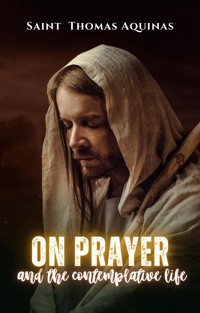
"On Prayer and the Contemplative Life" is a profound theological work attributed to Saint Thomas Aquinas, one of the most influential theologians and philosophers in Christian history. In this enlightening treatise, Saint Thomas delves into the spiritual practice of prayer and the contemplative life, offering profound insights and guidance for seekers of divine connection and enlightenment.
Drawing upon his extensive knowledge of Scripture, philosophy, and Christian tradition, Saint Thomas explores the nature of prayer, its significance in the life of faith, and its role in fostering a deeper relationship with God. He elucidates various forms of prayer, ranging from vocal prayers and meditation to contemplative prayer, guiding readers on a journey toward inner stillness and communion with the divine.
Through Saint Thomas's eloquent prose and rigorous theological reasoning, readers are invited to explore the transformative power of prayer and the contemplative life in nurturing the soul, cultivating virtues, and attaining spiritual fulfillment. The work addresses timeless questions about the nature of God, the purpose of prayer, and the pursuit of spiritual perfection, offering profound insights that continue to resonate with believers and seekers alike across the centuries.
"On Prayer and the Contemplative Life" stands as a timeless testament to Saint Thomas Aquinas's intellectual brilliance, spiritual depth, and unwavering devotion to God. It remains an indispensable resource for those seeking to deepen their understanding of prayer, cultivate a richer spiritual life, and draw closer to the divine presence.
Das E-Book können Sie in Legimi-Apps oder einer beliebigen App lesen, die das folgende Format unterstützen:
Veröffentlichungsjahr: 2024
Ähnliche






Copyright 2024
Cervantes Digital
All rights reserved
TABLE OF CONTENTS
PREFACE
INTRODUCTION
QUESTION LXXXI. OF THE VIRTUE OF RELIGION
I. Does the Virtue of Religion direct a Man to God Alone?
II. Is Religion a Virtue?
III. Is Religion One Virtue?
IV. Is Religion a Special Virtue Distinct From Others?
V. Is Religion One of the Theological Virtues?
VI. Is Religion to be preferred to the Other Moral Virtues?
VII. Has Religion, That is Latria,[65] any External Acts?
VIII. Is Religion the Same as Sanctity?
QUESTION LXXXII. OF DEVOTION
I. Is Devotion a Special Kind of Act?
II. Is Devotion an Act of the Virtue of Religion?
III. Is Contemplation, that is Meditation, the Cause of Devotion?
IV. Is Joy an Effect of Devotion?
QUESTION LXXXIII. OF PRAYER
I. Is Prayer an Act of the Appetitive Powers?
II. Is It Fitting To Pray?
III. Is Prayer an Act of the Virtue of Religion?
IV. Ought We To Pray To God Alone?
V. Should We in our Prayers ask for Anything Definite from God?
VI. Ought We in our Prayers to ask for Temporal Things from God?
VII. Ought We To Pray for Others?
VIII. Ought We To Pray for Our Enemies?
IX. On the Seven Petitions of the lord's Prayer.
X. Is Prayer Peculiar to Rational Creatures?
XI. Do the Saints in Heaven Pray for Us?
XII. Should Prayer be Vocal?
XIII. Must Prayer necessarily be Attentive?
XIV. Should our Prayers be Long?
XV. Is Prayer Meritorious?
XVI. Do Sinners gain Anything From God by their Prayers?
XVII. Can We rightly term Supplications," "Prayers," "Intercessions," and "Thanksgivings," parts of Prayer?
QUESTION LXXII. OF THE PRAYERS OF THE SAINTS WHO ARE IN HEAVEN
I. Are the Saints cognizant of our Prayers?
II. Ought we to appeal to the Saints to intercede for us?
III. Are the Saints' Prayers to God for us always heard?
QUESTION CLXXIX. OF THE DIVISION OF LIFE INTO THE ACTIVE AND THE CONTEMPLATIVE
I. May Life be fittingly divided into the Active and the Contemplative?
II. Is this division of Life into the Active and the Contemplative a sufficient one?
QUESTION CLXXX. OF THE CONTEMPLATIVE LIFE
I. Is the Contemplative Life wholly confined to the Intellect, or does the Will enter into it?
II. Do the Moral Virtues pertain to the Contemplative Life?
III. Does the Contemplative Life comprise many Acts?
IV. Does the Contemplative Life consist solely in the Contemplation of God, or in the Consideration of other Truths as well?
V. Can the Contemplative Life attain, according to the State of this Present Life, to the Contemplation of the Divine Essence?
VI. Is the Act of Contemplation Rightly Distinguished According to the Three Kinds of Motion—Circular, Direct, and Oblique?
VII. Has Contemplation its Joys?
VIII. Is the Contemplative Life lasting?
QUESTION CLXXXI. OF THE ACTIVE LIFE
I. Do all Acts of the Moral Virtues come under the Active Life?
II. Does Prudence pertain to the Active Life?
III. Does Teaching Belong to the Active or to the Contemplative Life?
IV. Does the Active Life continue after this Life?
QUESTION CLXXXII. OF THE COMPARISON BETWEEN THE ACTIVE AND THE CONTEMPLATIVE LIFE
I. Is the Active Life preferable to the Contemplative?
II. Is the Active Life more Meritorious than the Contemplative?
III. Is the Active Life a Hindrance to the Contemplative Life?
IV. Does the Active Life precede the Contemplative?
QUESTION CLXXXVI. ON THE RELIGIOUS STATE
PREFACE
The present generation in the fervour of its repentance is like to cast off too much. So many false principles and hasty deductions have been offered to its parents and grandparents in the name of science that it is becoming unduly suspicious of the scientific method.
A century ago men's minds were sick unto death from too much science and too little mysticism. To-day the danger is that even the drawing-rooms are scented with a mysticism that anathematizes science.
At no time since the days of S. Thomas was the saint's scientific method more lacking. Everywhere there is need for a mystic doctrine, which in itself is neither hypnotism nor hysteria, and in its expression is neither superlative nor apostrophic, lest the hungered minds of men die of surfeit following on starvation.
The message and method of S. Thomas are part of that strange rigidity of the thirteenth century which is one of the startling paradoxes of the ages of faith. It is surely a consolation that these ages of a faith which moved mountains, or at least essayed to remove the Turk, were minded to express their beliefs in the coat of mail of human reason! The giants of those days, who in the sphere of literature were rediscovering verse and inventing rhyme, and who in every sphere of knowledge were bringing forth the sixteenth and nineteenth centuries, were not so blinded by the white light of vision as to disown the Greeks. They made the Ethics of Aristotle the four-square walls of the city of God; they expressed the mysteries of the Undivided Three in terms of the Syllogism. Thus they refused to cut themselves off from the aristocracy of human genius. They laid hands—but not violent hands—on the heritage of the ages. No philosophers have ever equalled their bold and lowly-minded profession of faith in the solidarity of human reason. For this cause S. Thomas, who is their spokesman, has now become an absolute necessity of thought. Unless the great Dumb Ox is given a hearing, our mysticism will fill, not the churches, but the asylums and the little self-authorized Bethels where every man is his own precursor and messiah.
That S. Thomas is to be accepted as a master of mysticism may be judged from the following facts in the life of a mystic of the mystics, S. John of the Cross:
"It has been recorded that during his studies he particularly relished psychology; this is amply borne out by his writings. S. John was not what one could term a scholar. He was, however, intimately acquainted with the Summa of S. Thomas Aquinas, as almost every page of his works proves.... He does not seem to have ever applied himself to the study of the Fathers.... As has already been stated, the whole work (The Ascent of Mount Carmel) is based upon the view S. Thomas Aquinas takes of the essence and operations of the senses and of the faculties of the soul, and upon his treatise on the virtues."[1]
S. Thomas hardly needs an imprimatur after six centuries of full trust. But in the hard matters of mysticism, which he has treated as a scholar should, it is reassuring to know that he has the approval, not only of the scholars, but of the mystics.
VINCENT McNABB, O.P.
INTRODUCTION
The pages which follow call for little introduction. S. Thomas has left us no formal treatise on Mystical Theology, though his teachings on this subject have been collected from his various works and combined to form such a treatise. Especially noteworthy is the work of the Spanish Dominican Valgornera.[2] No such synthesis has been attempted here. We have simply taken from the Summa Theologica the treatises on Religion, on Devotion, Prayer, and the Contemplative Life, and presented them in an English dress. When occasion offered we have added to each portion appropriate passages from S. Augustine, S. Thomas's master, and more rarely from the Commentary on the Summa by the illustrious Cardinal Cajetan.
And we have been led to do this for several reasons. The Mystical life is the life of union with God, and it is based essentially on Prayer and Contemplation. But prayer and contemplation, though simple in themselves, are yet fraught with difficulties and dangers unless we be wisely guided. And as Father Faber shrewdly says: when we ask for instruction in these things, let us by all means make appeal to those whose names begin with S—let us, in other words, go to God's Saints. And the reason is simple: these Saints are no mere idle sign-posts who point the way but stand still themselves; they themselves have been where they would have us go; they speak from no mere theoretical knowledge; they themselves have tasted and seen that the Lord is sweet!
Further, it would have been easy to cull from S. Thomas's writings the salient points of his teaching on these points, and to have presented them in an attractive form. But had we done so the teachings of the Saint would have lost much of their force, and readers might well have doubted at times whether they really had before them the mind of S. Thomas or that of the translator. It is preferable to read the Bible than what men have said about the Bible. Unfortunately, it is the fashion nowadays to consider S. Thomas's writings "out of date"! If the perusal of these pages shall have induced some few at least to go to the original and study it for themselves they will have more than fulfilled the translator's desires.
Another reason which has weighed much with the translator and encouraged him to undertake this task has been the suddenly awakened interest in Mysticism and Mystical studies during the last decade. It has become the fashion to talk about Mysticism, even to pose as Mystics, and—need it be said?—those who talk the most on such subjects are those who know the least. For those who have entered into the secret of the King are ever the most reticent on such matters. At the same time we may welcome this recent development, if only as a set-off against the Spiritualism and occultism which have played such havoc with souls during a space of over fifty years. The human soul, "naturally Christian," as Tertullian would say, is also naturally Divine in the sense that, as S. Augustine so often insists, no rest is possible for it save in God. Now those who are familiar with the Summa Theologica are aware that Union with God is its keynote, or rather is the dominant note which rings out clear again and again with its ever-repeated Sursum Corda! It is this that gives such special value to the treatises here presented on Prayer and the Contemplative Life. They flow from the pen of one who was literally steeped in God and Divine things, and who is speaking to us of things which he had himself tasted and seen. It is this that gives such simplicity and charm to the whole of his teaching. He is not experimenting; he is not speaking of theories; he is portraying to us what was his everyday life.
Perhaps one of the commonest errors regarding the Spiritual life is the confusion between the ordinary and the extraordinary ways of God. For how many does not the Contemplative Life mean the life of ecstasy and vision with which we are familiar in the lives of the Saints? For S. Thomas, on the contrary, the Contemplative Life is but the natural life of a man who is serving God and who devotes a certain portion of his time to the study and contemplation of Divine things. Ecstasy and vision he treats of in another place. They occupy a sphere apart. They belong to God's extraordinary dealings with favoured souls, and while they presuppose prayer and contemplation on the part of those so visited they themselves form no integral part of the Contemplative Life; indeed, they are the exception. Hence in these pages we shall find nought touching Supernatural manifestations, such as visions, ecstasies, and revelations; but we shall find what is of far greater use to us—a Catechism on Devotion, Prayer, and Contemplation.
The main features of the Life of S. Thomas of Aquin are known to most of those who are likely to read this book. His life at first sight seems of such an even tenor that there is but little to record. Yet when we penetrate beneath the surface we realize that he lived in stirring days, and that his short span of fifty years was passed in the full light of the world of the thirteenth century. Thomas was born in the beginning of the year 1225 in the castle of Rocca-Secca, the ancestral home of the Counts of Aquino, in the kingdom of Sicily. His future glory was foretold to his mother, the Countess Theodora, by a hermit of that neighbourhood who also foretold that his parents would endeavour to make him a monk in the Benedictine Abbey of Monte Cassino, but that God had other designs for him, since he was to be a Friar Preacher, a member of the Order of the great S. Dominic who had just gone to his reward. The prophecy was fulfilled to the letter. At the early age of five years he was sent to the Abbey to be educated among the young nobles of the day, as was then the custom. Even thus early he showed a remarkable maturity of character, and his biographer, William of Tocco, dwells with delight on the calm reserve of his childish days and on that eager seeking after God which was to be his future glory.[3]
From Monte Cassino Thomas passed to Naples to complete his studies. Here he became conscious of his vocation, and offered himself to the Dominicans. The Prior of the convent at Naples at that time was Father John of S. Julian, who later became Patriarch of Jerusalem[4]; he gave the habit of the Order to Thomas, who was then but fourteen years of age. His parents were indignant at this step, and did all in their power to shake his determination. Fearing their recourse to the violent methods then so common, the Dominicans sent Thomas to the convent of Santa Sabina at Rome. But S. Thomas's brothers, at their mother's bidding, seized upon the young man and carried him off in his religious habit to his mother who kept him imprisoned for nearly two years.[5] During this time of anxiety nothing disturbed the Saint's equanimity, and he made good use of his time by studying the Bible, the Book of the Sentences—the Theological Manual of those days—and also Aristotle's philosophical treatises. It was at this time that the diabolical attempt upon his virtue was made—an attempt which the Saint resisted effectually; in reward for his constancy he was miraculously girded with a cincture by two Angels from Heaven.[6] Failing in their attempt to shake his determination, his brothers permitted him to escape, and he returned to the convent at Naples in 1245. Thence he was sent by his superiors to Rome, and shortly afterwards to Paris and Cologne to study under Blessed Albert the Great. At Cologne he led the life of a simple student, a life of recollection, prayer, and study. But his extraordinary talents could not long remain hid. The post of Bachelor in the famous House of Studies at Paris was vacant, and at the suggestion of Cardinal Hugo à S. Caro, himself a Dominican, S. Thomas was appointed by the Master-General of the Order to the vacant post. This was a blow to the Saint's humility, but he accepted it under obedience. The impression made by his teaching was extraordinary, and the words of William of Tocco on this point are worth transcribing: "Erat enim novos in sua lectione movens articulos, novum modum et clarum determinandi inveniens, et novas reducens in determinationibus rationes: ut nemo qui ipsum audisset nova docere, et novis rationibus dubia definire dubitaret, quod eum Deus novi luminis radiis illustrasset, qui statim tam certi c[oe]pisset esse judicii, ut non dubitaret novas opiniones docere et scribere, quas Deus dignatus esset noviter inspirare." This novelty in method was evidently remarkable, but, while provoking the attacks of some, it attracted an immense crowd to his lectures, and this not simply by reason of the novelty which characterized them, but by reason of the supereminent sanctity of the teacher. "Dilectus Deo!" cries out his biographer. "Qui scientiam tribuit; et acceptus hominibus, quibus quasi novis radiis veritatis illuxit."[7]




