


12,99 €
Mehr erfahren.
- Herausgeber: novum pro Verlag
- Kategorie: Gesellschafts- und Liebesromane
- Sprache: Englisch
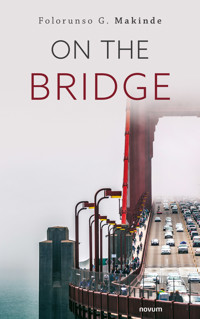
A fast-paced account of what happens on a bridge in Lagos Nigeria in traffic, where a ruthless gang of robbers ambush a stream of cars and then demand at gunpoint from commuters their jewellery, cell phones and other valuables. A shootout between police and gangsters follows with bodies all over the place. The author Folorunso G. Makinde gives us a fascinating look into life in Nigeria today with all its violence, gangster activity and a vast amount of corruption thrown in; where taking bribes has become a way of life; which many citizens accept as the inevitable consequence of living in this bustling country, albeit with widespread violence and criminal activities. Does this all sound disturbingly familiar? Read 'On the Bridge' for yourself and draw your own conclusions!
Das E-Book können Sie in Legimi-Apps oder einer beliebigen App lesen, die das folgende Format unterstützen:
Seitenzahl: 114
Veröffentlichungsjahr: 2023
Ähnliche



















Imprint
All rights of distribution, also through movies, radio and television, photomechanical reproduction, sound carrier, electronic medium and reprinting in excerpts are reserved.
© 2023 novum publishing
ISBN print edition: 978-3-99064-111-8
ISBN e-book: 978-3-99064-112-5
Editor: Hugo Chandler, BA
Cover image: Martinmark | Dreamstime.com
Cover design, layout & typesetting: novum publishing
www.novum-publishing.co.uk
Chapter 1
It was a day like any other in Lagos, southwestern Nigeria. People were going about their normal everyday business. The traffic was heavy as was always the case at this time of the morning. The buses, like massive cranes painted yellow and showing signs of ageing, were full of workers trying to get to their places of work on time. The roads were full of vehicles – some fairly used and others quite old. In fact, many of them looked like the work of a struggling local motor mechanic trying to make a living by putting hard-worn metal parts together to look like a home-made vehicle.
Appearances can be very deceptive though. These vehicles always look as if they could barely travel a mile before they broke down. However, motor car engines never died here. If it couldn’t be made to work as the single unit it once was, the parts could be made to work as separate units put together after undergoing some form of local metamorphosis. Many of the vehicles that were nicknamed Tokunbos (from abroad) were imported second hand vehicles that had failed road-worthiness tests in their respective countries of origin. The luxury and fairly new cars usually had two passengers – the driver sitting in the front and the owner sitting in one corner at the back.
There were no quiet moments on the bridge. The vehicle engines were always kept running even though the long traffic queue moved very slowly. That was the best way. You couldn’t afford to be slow in moving your vehicle because if you were slow, another vehicle would overtake you, making your journey even longer. Then there were vehicles whose owners couldn’t afford to turn off the engine because it might take longer and a lot of effort to get the engine restarted.
The newspapers vendors blew their ‘Vuvuzela’ hooters’ just to get attention and the hawkers were always on the move, approaching vehicle drivers and passengers to offer them their wares. Some drivers ignored them but many did business with them. Business dealings on the bridge are governed by an unspoken rule: you must have the goods in your hands before parting with your money. If you didn’t have the correct amount to pay, you had to first get the change and the goods before parting with your money. That was how business was done on the bridge. It was the smarter way to do business on the bridge if you didn’t want to take the risk of parting with your money, getting nothing in return.
The noise of the stomping of uncountable feet of people walking on the bridge was drowned-out by all the other noise.
Every now and again, a motorist tries to jump the traffic queue. ‘Bastard!’ shouts another driver who is abiding by the rules of the queue. ‘Olosi!’ (wretched person), shouts a bus conductor at another car trying to jump the queue. However, the bus driver soon took a chance, also attempting to jump the queue. The bus passengers were very uneasy about this as the driver’s action put their lives at risk. Their bus might collide with another vehicle or they might be stopped by the police who are half-heartedly trying to enforce the law, but who would ignore the law if a driver bribes them with enough money. Many commuters know the game. They know that the police are not well paid and will do anything to supplement their meagre income. The commuters always have some money (lower denominations of the currency) for this purpose.
Upon the offering and receiving of bribes, the police might even help the vehicles by clearing the way. Therefore, while the main concern of the passengers was about not being involved in an accident, the greater fear was that of having the bus driver and the conductor being stopped by the police and having to part with their hard-earned cash. The going rate was determined by what you were stopped for and where you are stopped. The amount you would pay was higher when you were caught doing something bad or something which appeared to be bad when you were stopped at a routine police checkpoint, probably set up for the purpose of collecting money from passing vehicles. If you were unlucky enough to be stopped in a very quiet area, you might need to pay more. Therefore, the usual response from the passengers when their bus driver decided to jump the traffic queue was always some grumbles, a sigh and a silent prayer. It usually worked. Accidents were not often caused by such behaviour by bus drivers. There is a popular saying: “If you can drive in Lagos, you can drive anywhere in the world.”
The queue was moving unusually slow that day. One driver was contemplating whether or not to jump the queue.
‘Don’t do it dear. Let’s wait,’ said his wife.
‘But you know dear, we’re going to be very late,’ the husband replied.
‘I know dear. But let’s wait.’
The husband listened to the advice of his wife. He decided not to jump the queue that day.
Another time, he might not have listened but the meeting they were to attend that day was not that important. They could afford to be late. Heeding the advice of his wife today turned out to be one of the best decisions the husband ever made in his life as a few moments later, the sound of gunshots was heard coming not too far ahead on the bridge. This caused a commotion among the commuters. Everyone ducked. Some of those walking along took to their heels. To avoid witnessing a terrible incident, one needs to run (‘Koju ma ribi, ese loogun e’). More sounds of gunshots were heard and then followed by shouts and screams. There was commotion everywhere. Pedestrians started to run away from where the gunshots were. Some joined them simply because they saw others running even though they didn’t even know what they were running from or where they were running to. Some vehicles tried to make a U-turn in an effort to get away from the bridge as fast as possible. This resulted in more traffic jams. The sound of gunshots was not unfamiliar in Lagos. It is usually due to one of two things; armed robbers are operating in the area or police are operating there. However, there had been no signs of police vehicles or police operating on the bridge that morning, as no vehicle trying to jump the queue had been stopped.
The commuters’ biggest fear was realising that armed robbers were operating on the bridge. Young men performing armed robbery were usually well-armed and didn’t take nonsense from anyone. It appeared to be a well-planned operation as they usually are – the group’s two vehicles were close behind each other in the queue. The one behind had moved forward as if it were about to overtake the other, but then it stopped suddenly, blocking the way of any other vehicle from moving while the operation went on.
One of the armed robbers, Bobby got out of the car, shot into the air and shouted, “Stay in your cars and don’t move!” He was carrying an AK 47 in his right hand. The two drivers of the vehicles belonging to the armed robbers stayed put. The other members of the group got out of the two cars; each carrying an automatic rifle. Two members of the group Ade and Ben stood beside the two vehicles, each facing different directions keeping close watch on the movement of people around them. The remaining six members of the group, each with an automatic rifle split themselves into two groups of three to form the raiding party. The two groups moved in opposite directions, with each group moving from one vehicle to another, demanding that the passengers hand over their valuables. Bobby led the group heading north while Imam led the group heading south. The people occupying the vehicles knew that the armed robbers must not be toyed with. They meant business and would shoot to kill if you do not comply with their demands.
Something like this could only happen in this country. How could anyone in their right mind choose to carry out an armed robbery on a bridge, knowing that they could easily be cut off and arrested? However, this is not like any other country. This is Nigeria and this is Lagos. The robbers knew that they were seldom disturbed by the police. Therefore, they more or less had free rein to do as they wanted. They could afford to take their time. This was not the first time they had performed such an operation and in fact it was not the first time they had held up a bridge. Meanwhile, the operation continued unhindered.
Chapter 2
At the Lagos Central Police Station, calls were coming in. “There is an armed robbery taking place on the bridge.”
“Oga (master), dem (they) say a gang is holding up a bridge in the North West of Lagos.” The police constable repeated the information to the boss, Peter Jang.
“And what do they want us to do? Tell them to ring the mainland police station. They are closer. It is their responsibility not ours,” replied the boss.
Mr Peter Jang was a decorated superintendent in the police. He had been in the Nigerian Police Force for over twenty years. He was also a married father of four. He took his job very seriously and always tried his best within the scope allowed, despite the scant resources provided by the government. His efforts had been recognised which was the reason why he was promoted to the rank of superintendent. He was a very honest police officer and though he realized that many officers were involved in corrupt practices, he tried not to get involved. He did nothing to stop them either as this might jeopardize his police career. A policeman did not have to join in if he or she didn’t want to, but they didn’t try to stop others’ corrupt practices as every officer always knew a senior officer who knew a more senior officer who benefited from corrupt practices.
Corruption is endemic not only within the Nigerian Police Force but within the whole Nigerian society. Many governments had come and gone having made promises to tackle corruption before coming to power but many if not all of them still ended up being corrupt themselves. None of the so-called big shot had ever been prosecuted. One politician would accuse others of stealing public money but that was as far as it went.
There was an unspoken practice among politicians not to prosecute any big shots. ‘Steal as much as you can while you are in power but don’t prosecute the previous government.’ This was the rule. How could any new government prosecute his or her colleagues. Anyway they had been waiting in the queue for a long time just to take their turn at stealing public money. This is their chance. They not only didn’t want to waste their time pursuing the previous government but they also knew that once they left the seat of power, they didn’t want to worry about being prosecuted themselves either. So, corruption becomes a vicious circle. The justice system is not completely out of what was going on either. Everyone understood the game.
“Sir, apparently the robbers are close to this side of the bridge,” said the officer manning the calls.
“Do I need to repeat myself? Tell them they should ring the mainland police station. It is their responsibility. No one wants to die. I have a wife and four children,” Mr Jang muttered. The other officers agreed. They knew that the armed robbers were usually well armed and in fact usually better armed than the police. The police authority had been asking for better equipment from the government for a long time but their demands had fallen on deaf ears.
“Oga say make you ring the mainland police station, dem for responsible for the bridge,” the junior officer told the person on the other end of the phone; but the calls never stopped coming in.
“Oga, there have been many calls now and they are still coming in.”
“Tell them we no get weapon.”
“Sorry, we no get weapon. Ring the mainland police station, maybe they get weapon.” The officer responded to the caller.
Meanwhile on the bridge, the armed robbery operation continued. The occupants of each vehicle waited patiently and quietly wait for their turn.
“Wetin (what) you get inside the car?” asked one of the armed robbers, looking sternly at the driver of the vehicle.
“Nothing sir.” The lady sitting in the back seat replied. She was the owner of the vehicle. The driver stayed silent, allowing the questions to be directed towards the lady owner. He was not the owner of the vehicle; just the hired driver.
“What!” one of the robbers barked.
“This is my bag. There is my purse, my GSM … nothing else …” The lady responded as she handed over her personal belongings.
“Put your necklace inside and your wrist watch.” The robber held out a bag.




